Drug Information
General Information of This Drug
| Drug ID | DRG00017 | |||||
|---|---|---|---|---|---|---|
| Drug Name | Paradol | |||||
| Synonyms |
Paradol; 27113-22-0; 6-Paradol; [6]-Paradol; 1-(4-hydroxy-3-methoxyphenyl)decan-3-one; 5-Paradol; 3-Decanone, 1-(4-hydroxy-3-methoxyphenyl)-; 1-(4-Hydroxy-3-methoxyphenyl)decan-5-one; [6]-Gingerone; 1-(4-Hydroxy-3-methoxyphenyl)-3-decanone; CHEBI:10137; BO24ID7E9U; Heptyl 4-hydroxy-3-methoxyphenethyl ketone; 1-(4-hydroxy-3-methoxyphenyl)-decan-3-one; CHEMBL2071440; 1-(4-hydroxy-3-methoxy-phenyl)decan-3-one; (6)-GINGERONE; (6)-PARADOL; EINECS 248-228-1; UNII-BO24ID7E9U; 6-Gingerone; 1-(4-Hydroxy-3-methylphenol)-3-decanone; BRN 1984119; CCRIS 8519; 6-GINGERONE; 2-08-00-00318 (Beilstein Handbook Reference); SCHEMBL971599; [6]-Gingerone;[6]-Paradol; MEGxp0_001218; FEMA NO. 4665; ACon1_001067; DTXSID90181574; HYDROXYMETHOXYPHENYL DECANONE; BCP24208; EX-A6738; BDBM50237535; MFCD01736103; s5551; AKOS028111088; CCG-267231; CS-0873; NCGC00169709-01; AC-36782; AS-64448; HY-14617; 1ST158272; DS-020237; FT-0775579; NS00021973; 1-(4'-hydroxy-3'-methoxyphenyl)-3-decanone; 1-(4-Hydroxy-3-methoxyphenyl)-3-decanone #; 1-(4'-hydroxy-3'-methoxyphenyl)-decan-3-one; A911271; Q3363309; BRD-K84571636-001-01-4; Paradol[6]-Paradol; 1-(4-hydroxy-3-methoxyphenyl)decan-3-one; 5-Paradol
Click to Show/Hide
|
|||||
| Target(s) | Prostaglandin G/H synthase 2 (PTGS2) | Target Info | ||||
| Structure |
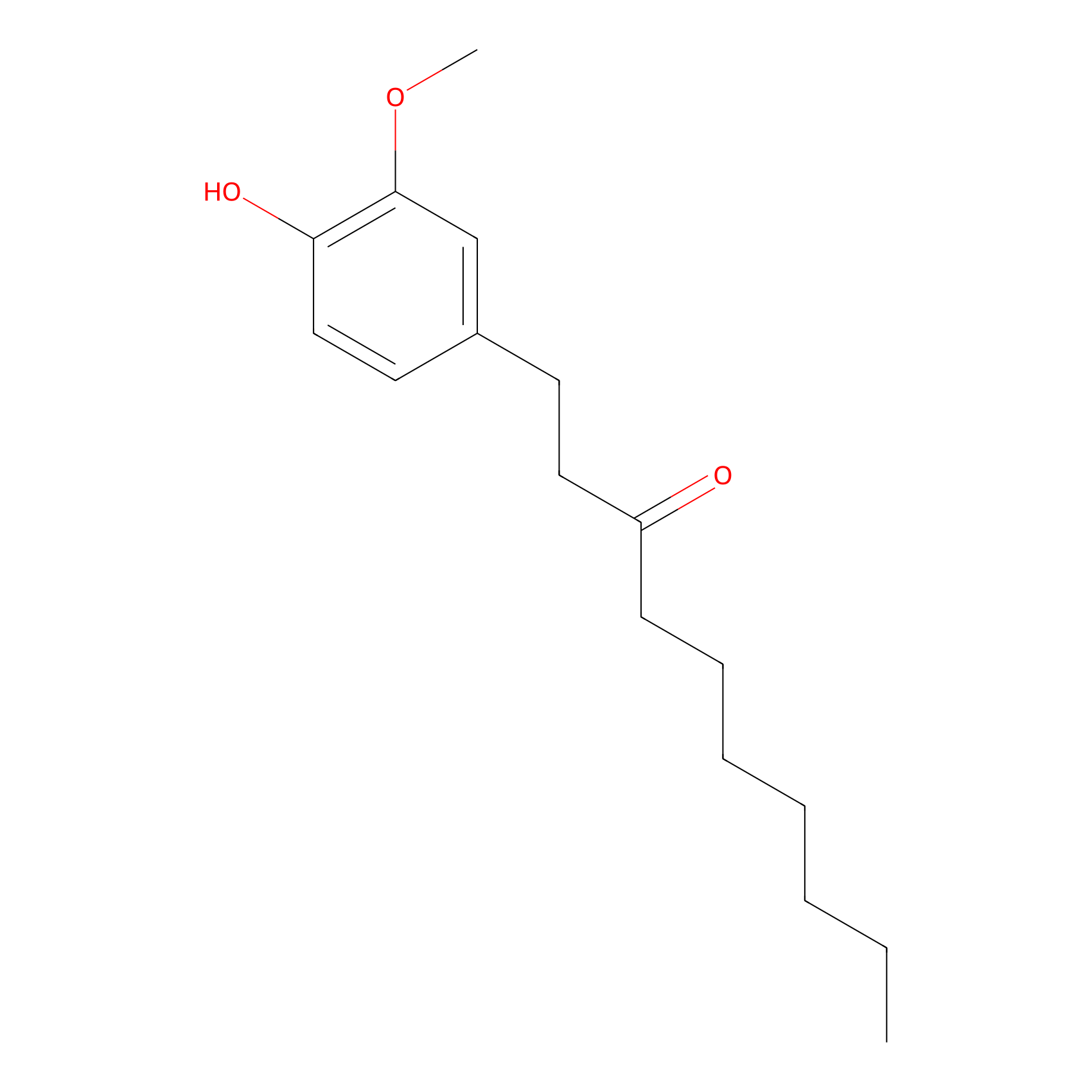
|
|||||
| Formula |
C17H26O3
|
|||||
| #Ro5 Violations (Lipinski): 0 | Molecular Weight (mw) | 278.4 | ||||
| Lipid-water partition coefficient (xlogp) | 3.8 | |||||
| Hydrogen Bond Donor Count (hbonddonor) | 1 | |||||
| Hydrogen Bond Acceptor Count (hbondacc) | 3 | |||||
| Rotatable Bond Count (rotbonds) | 10 | |||||
| PubChem CID | ||||||
| Canonical smiles |
CCCCCCCC(=O)CCC1=CC(=C(C=C1)O)OC
|
|||||
| InChI |
InChI=1S/C17H26O3/c1-3-4-5-6-7-8-15(18)11-9-14-10-12-16(19)17(13-14)20-2/h10,12-13,19H,3-9,11H2,1-2H3
|
|||||
| InChIKey |
CZNLTCTYLMYLHL-UHFFFAOYSA-N
|
|||||
| IUPAC Name |
1-(4-hydroxy-3-methoxyphenyl)decan-3-one
|
|||||
Each Peptide-drug Conjugate Related to This Drug
Full Information of The Activity Data of The PDC(s) Related to This Drug
TM5 [Investigative]
Revealed Based on the Cell Line Data
| Experiment 1 Reporting the Activity Data of This PDC | [1] | ||||
| Indication | Psoriasis-like inflammation | ||||
| Efficacy Data | Half Maximal Inhibitory Concentration (IC50) | 23.31 µM | |||
| Evaluation Method | PDE Activity Colorimetric Assay | ||||
| MOA of PDC |
In this study, physicochemical criteria based on cell-penetrating peptides are employed to design transcellular peptides derived from an antimicrobial peptides library. Among the statistically designed transcellular peptides (SDTs), SDT7 exhibits higher skin permeability, faster kinetics, and improved cell permeability in human keratinocyte cells compared to the control peptide. Subsequently, it is found that 6-Paradol (PAR) exhibits inhibitory activity against phosphodiesterase 4, which can be utilized for an anti-inflammatory PDC.
Click to Show/Hide
|
||||
| Description |
To confirm that TM5, chemically combined with SDT7, conserves the PDE4 inhibition properties of PAR, we evaluated its dose-dependent effect using a PDE Activity Colorimetric Assay Kit. This assay relies on the principle that PDEs catalyze the hydrolysis of cyclic nucleotides, resulting in the production of nucleosides and phosphates. The concentration of 5-AMP, a product of this reaction, was measured to assess PDE activity. TM5 exhibited an IC50 of 23.31 μm, indicating its ability to inhibit PDE enzymatic activity at micromolar concentrations.
Click to Show/Hide
|
||||
| In Vitro Model | Normal | HaCaT cell | CVCL_0038 | ||
References