Drug Information
General Information of This Drug
| Drug ID | DRG00409 | |||||
|---|---|---|---|---|---|---|
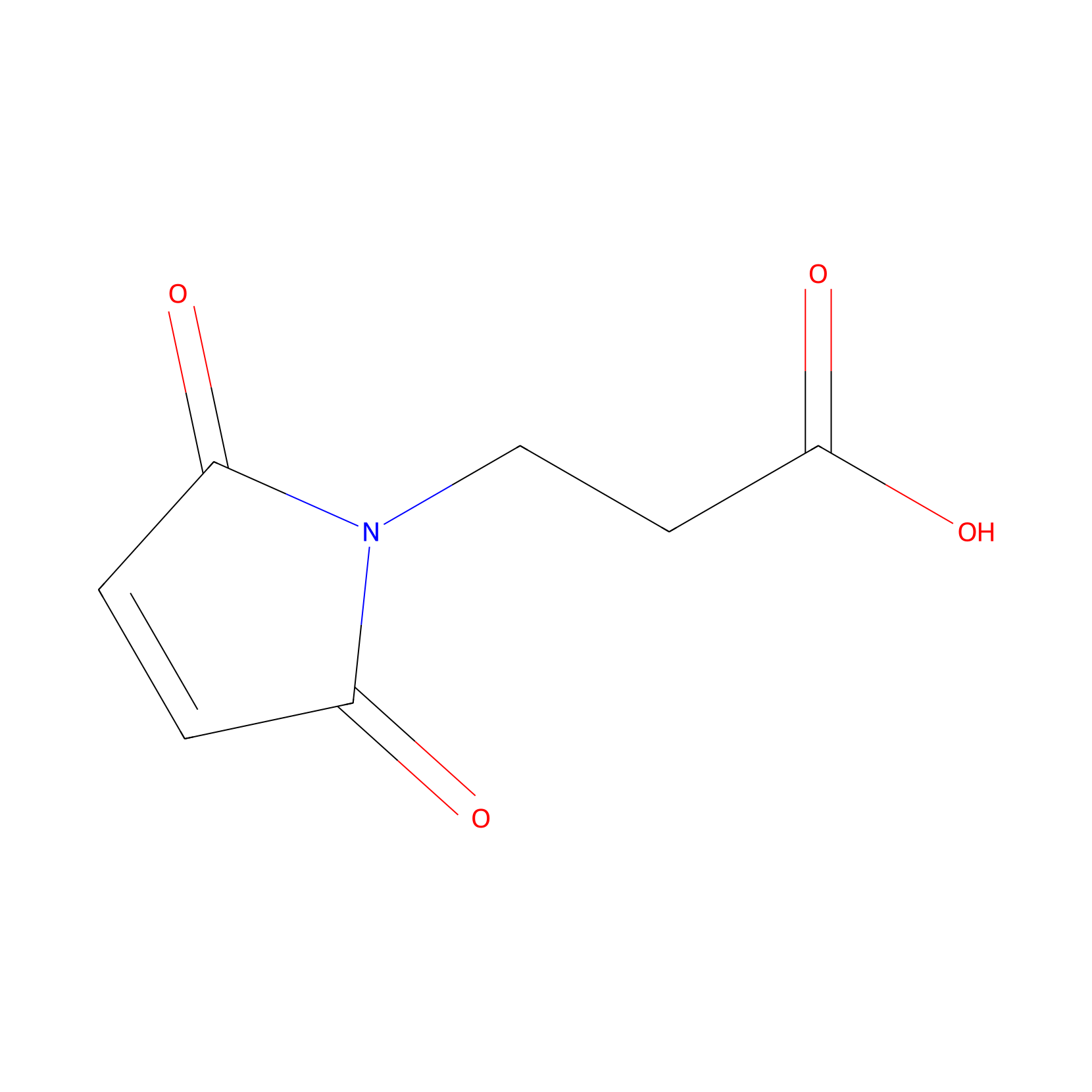
| Drug Name | 3-(2,5-Dioxo-2,5-dihydro-1H-pyrrol-1-yl)propanoic acid | |||||
| Target(s) | Human serum albumin | Target Info | ||||
| Structure |
|
|||||
| Formula |
C7H7NO4
|
|||||
| #Ro5 Violations (Lipinski): 0 | Molecular Weight (mw) | 169.136 | ||||
| Lipid-water partition coefficient (xlogp) | -0.6139 | |||||
| Hydrogen Bond Donor Count (hbonddonor) | 1 | |||||
| Hydrogen Bond Acceptor Count (hbondacc) | 3 | |||||
| Rotatable Bond Count (rotbonds) | 3 | |||||
| Canonical smiles |
O=C(O)CCN1C(=O)C=CC1=O
|
|||||
| InChI |
InChI=1S/C7H7NO4/c9-5-1-2-6(10)8(5)4-3-7(11)12/h1-2H,3-4H2,(H,11,12)
|
|||||
| InChIKey |
IUTPJBLLJJNPAJ-UHFFFAOYSA-N
|
|||||
Each Peptide-drug Conjugate Related to This Drug
Full Information of The Activity Data of The PDC(s) Related to This Drug
FB006M-HSA [Investigative]
Revealed Based on the Cell Line Data
| Experiment 1 Reporting the Activity Data of This PDC | [1] | ||||
| Indication | Human immunodeficiency virus infection | ||||
| Efficacy Data | Selectivity index | > 202 | |||
| Evaluation Method | PBMC assay | ||||
| Administration Time | 6 days | ||||
| MOA of PDC |
Based on these considerations, we set out the program with the peptide HIV-1 fusion inhibitor C34, a 34-amino-acid peptide from the C-terminal heptad repeat region of HIV-1 gp41 envelope protein. At its C terminus, C34 shares an identical 24-amino-acid sequence with the N terminus of enfuvirtide. Nevertheless, these two peptides are believed to utilize nonoverlapping molecular targets in the HIV-1 membrane glycoprotein gp41. Assisted by the crystal structure of C34 in complex with HIV-1 gp41 N peptides, three residues of C34 not involved in target binding were replaced by lysine and glutamic acid to improve the solubility and antiviral activity. This peptide, FB006, is to be chemically modified further and conjugated to albumin. Albumins of rodents, rabbits, dogs, monkeys, and humans all possess a conserved cysteine residue (Cys34 in humans) that has the only free thiol group in the protein. To enable binding to this thiol group, FB006 was modified by 3-maleimidopropionic acid (MPA), which allows an irreversible reaction between the maleimide and the free thiol to form a specific 1:1 peptide-albumin conjugate. Guided by the crystal structure of the HIV-1 gp41 ectodomain, we chemically modified FB006 with a single MPA at different residual positions. These peptides were conjugated to human serum albumin (HSA) in vitro and subjected to a human peripheral blood mononuclear cell (PBMC) assay to determine their anti-HIV activities. Based on the results, a lead molecule named FB006M was selected for further studies.
Click to Show/Hide
|
||||
| Description |
After demonstrating the in vivo albumin conjugation of FB006M and its long half-life, we further examined the anti-HIV activity of albumin-FB006M conjugate. We first examined the in vitro anti-HIV activities of FB006 and FB006M-HSA conjugate in a PBMC assay. The assay used subtype B, A, C, G, and EA HIV-1 viruses, utilizing either CXCR4 or CCR5 coreceptor. The activity against HIV-1MDR 769, a clinical isolate resistant to most of the HIV reverse transcriptase and protease inhibitors, also was determined. Both FB006 and FB006M-HSA conjugate exhibited potent activity, with average 50% effective concentrations (EC50s) of 1.4 and 2.7 nM, respectively. Interestingly, the FB006M-HSA conjugate, in which FB006 was linked to albumin at the 13th lysine residue by a linker molecule, showed anti-HIV activities similar to those of free peptide FB006.
Click to Show/Hide
|
||||
| In Vitro Model | |||||
| Experiment 2 Reporting the Activity Data of This PDC | [1] | ||||
| Indication | Human immunodeficiency virus infection | ||||
| Efficacy Data | Selectivity index | > 208 | |||
| Evaluation Method | PBMC assay | ||||
| Administration Time | 6 days | ||||
| MOA of PDC |
Based on these considerations, we set out the program with the peptide HIV-1 fusion inhibitor C34, a 34-amino-acid peptide from the C-terminal heptad repeat region of HIV-1 gp41 envelope protein. At its C terminus, C34 shares an identical 24-amino-acid sequence with the N terminus of enfuvirtide. Nevertheless, these two peptides are believed to utilize nonoverlapping molecular targets in the HIV-1 membrane glycoprotein gp41. Assisted by the crystal structure of C34 in complex with HIV-1 gp41 N peptides, three residues of C34 not involved in target binding were replaced by lysine and glutamic acid to improve the solubility and antiviral activity. This peptide, FB006, is to be chemically modified further and conjugated to albumin. Albumins of rodents, rabbits, dogs, monkeys, and humans all possess a conserved cysteine residue (Cys34 in humans) that has the only free thiol group in the protein. To enable binding to this thiol group, FB006 was modified by 3-maleimidopropionic acid (MPA), which allows an irreversible reaction between the maleimide and the free thiol to form a specific 1:1 peptide-albumin conjugate. Guided by the crystal structure of the HIV-1 gp41 ectodomain, we chemically modified FB006 with a single MPA at different residual positions. These peptides were conjugated to human serum albumin (HSA) in vitro and subjected to a human peripheral blood mononuclear cell (PBMC) assay to determine their anti-HIV activities. Based on the results, a lead molecule named FB006M was selected for further studies.
Click to Show/Hide
|
||||
| Description |
After demonstrating the in vivo albumin conjugation of FB006M and its long half-life, we further examined the anti-HIV activity of albumin-FB006M conjugate. We first examined the in vitro anti-HIV activities of FB006 and FB006M-HSA conjugate in a PBMC assay. The assay used subtype B, A, C, G, and EA HIV-1 viruses, utilizing either CXCR4 or CCR5 coreceptor. The activity against HIV-1MDR 769, a clinical isolate resistant to most of the HIV reverse transcriptase and protease inhibitors, also was determined. Both FB006 and FB006M-HSA conjugate exhibited potent activity, with average 50% effective concentrations (EC50s) of 1.4 and 2.7 nM, respectively. Interestingly, the FB006M-HSA conjugate, in which FB006 was linked to albumin at the 13th lysine residue by a linker molecule, showed anti-HIV activities similar to those of free peptide FB006.
Click to Show/Hide
|
||||
| In Vitro Model | |||||
| Experiment 3 Reporting the Activity Data of This PDC | [1] | ||||
| Indication | Human immunodeficiency virus infection | ||||
| Efficacy Data | Selectivity index | > 240 | |||
| Evaluation Method | PBMC assay | ||||
| Administration Time | 6 days | ||||
| MOA of PDC |
Based on these considerations, we set out the program with the peptide HIV-1 fusion inhibitor C34, a 34-amino-acid peptide from the C-terminal heptad repeat region of HIV-1 gp41 envelope protein. At its C terminus, C34 shares an identical 24-amino-acid sequence with the N terminus of enfuvirtide. Nevertheless, these two peptides are believed to utilize nonoverlapping molecular targets in the HIV-1 membrane glycoprotein gp41. Assisted by the crystal structure of C34 in complex with HIV-1 gp41 N peptides, three residues of C34 not involved in target binding were replaced by lysine and glutamic acid to improve the solubility and antiviral activity. This peptide, FB006, is to be chemically modified further and conjugated to albumin. Albumins of rodents, rabbits, dogs, monkeys, and humans all possess a conserved cysteine residue (Cys34 in humans) that has the only free thiol group in the protein. To enable binding to this thiol group, FB006 was modified by 3-maleimidopropionic acid (MPA), which allows an irreversible reaction between the maleimide and the free thiol to form a specific 1:1 peptide-albumin conjugate. Guided by the crystal structure of the HIV-1 gp41 ectodomain, we chemically modified FB006 with a single MPA at different residual positions. These peptides were conjugated to human serum albumin (HSA) in vitro and subjected to a human peripheral blood mononuclear cell (PBMC) assay to determine their anti-HIV activities. Based on the results, a lead molecule named FB006M was selected for further studies.
Click to Show/Hide
|
||||
| Description |
After demonstrating the in vivo albumin conjugation of FB006M and its long half-life, we further examined the anti-HIV activity of albumin-FB006M conjugate. We first examined the in vitro anti-HIV activities of FB006 and FB006M-HSA conjugate in a PBMC assay. The assay used subtype B, A, C, G, and EA HIV-1 viruses, utilizing either CXCR4 or CCR5 coreceptor. The activity against HIV-1MDR 769, a clinical isolate resistant to most of the HIV reverse transcriptase and protease inhibitors, also was determined. Both FB006 and FB006M-HSA conjugate exhibited potent activity, with average 50% effective concentrations (EC50s) of 1.4 and 2.7 nM, respectively. Interestingly, the FB006M-HSA conjugate, in which FB006 was linked to albumin at the 13th lysine residue by a linker molecule, showed anti-HIV activities similar to those of free peptide FB006.
Click to Show/Hide
|
||||
| In Vitro Model | |||||
| Experiment 4 Reporting the Activity Data of This PDC | [1] | ||||
| Indication | Human immunodeficiency virus infection | ||||
| Efficacy Data | Selectivity index | > 621 | |||
| Evaluation Method | PBMC assay | ||||
| Administration Time | 6 days | ||||
| MOA of PDC |
Based on these considerations, we set out the program with the peptide HIV-1 fusion inhibitor C34, a 34-amino-acid peptide from the C-terminal heptad repeat region of HIV-1 gp41 envelope protein. At its C terminus, C34 shares an identical 24-amino-acid sequence with the N terminus of enfuvirtide. Nevertheless, these two peptides are believed to utilize nonoverlapping molecular targets in the HIV-1 membrane glycoprotein gp41. Assisted by the crystal structure of C34 in complex with HIV-1 gp41 N peptides, three residues of C34 not involved in target binding were replaced by lysine and glutamic acid to improve the solubility and antiviral activity. This peptide, FB006, is to be chemically modified further and conjugated to albumin. Albumins of rodents, rabbits, dogs, monkeys, and humans all possess a conserved cysteine residue (Cys34 in humans) that has the only free thiol group in the protein. To enable binding to this thiol group, FB006 was modified by 3-maleimidopropionic acid (MPA), which allows an irreversible reaction between the maleimide and the free thiol to form a specific 1:1 peptide-albumin conjugate. Guided by the crystal structure of the HIV-1 gp41 ectodomain, we chemically modified FB006 with a single MPA at different residual positions. These peptides were conjugated to human serum albumin (HSA) in vitro and subjected to a human peripheral blood mononuclear cell (PBMC) assay to determine their anti-HIV activities. Based on the results, a lead molecule named FB006M was selected for further studies.
Click to Show/Hide
|
||||
| Description |
After demonstrating the in vivo albumin conjugation of FB006M and its long half-life, we further examined the anti-HIV activity of albumin-FB006M conjugate. We first examined the in vitro anti-HIV activities of FB006 and FB006M-HSA conjugate in a PBMC assay. The assay used subtype B, A, C, G, and EA HIV-1 viruses, utilizing either CXCR4 or CCR5 coreceptor. The activity against HIV-1MDR 769, a clinical isolate resistant to most of the HIV reverse transcriptase and protease inhibitors, also was determined. Both FB006 and FB006M-HSA conjugate exhibited potent activity, with average 50% effective concentrations (EC50s) of 1.4 and 2.7 nM, respectively. Interestingly, the FB006M-HSA conjugate, in which FB006 was linked to albumin at the 13th lysine residue by a linker molecule, showed anti-HIV activities similar to those of free peptide FB006.
Click to Show/Hide
|
||||
| In Vitro Model | |||||
| Experiment 5 Reporting the Activity Data of This PDC | [1] | ||||
| Indication | Human immunodeficiency virus infection | ||||
| Efficacy Data | Selectivity index | > 1149 | |||
| Evaluation Method | PBMC assay | ||||
| Administration Time | 6 days | ||||
| MOA of PDC |
Based on these considerations, we set out the program with the peptide HIV-1 fusion inhibitor C34, a 34-amino-acid peptide from the C-terminal heptad repeat region of HIV-1 gp41 envelope protein. At its C terminus, C34 shares an identical 24-amino-acid sequence with the N terminus of enfuvirtide. Nevertheless, these two peptides are believed to utilize nonoverlapping molecular targets in the HIV-1 membrane glycoprotein gp41. Assisted by the crystal structure of C34 in complex with HIV-1 gp41 N peptides, three residues of C34 not involved in target binding were replaced by lysine and glutamic acid to improve the solubility and antiviral activity. This peptide, FB006, is to be chemically modified further and conjugated to albumin. Albumins of rodents, rabbits, dogs, monkeys, and humans all possess a conserved cysteine residue (Cys34 in humans) that has the only free thiol group in the protein. To enable binding to this thiol group, FB006 was modified by 3-maleimidopropionic acid (MPA), which allows an irreversible reaction between the maleimide and the free thiol to form a specific 1:1 peptide-albumin conjugate. Guided by the crystal structure of the HIV-1 gp41 ectodomain, we chemically modified FB006 with a single MPA at different residual positions. These peptides were conjugated to human serum albumin (HSA) in vitro and subjected to a human peripheral blood mononuclear cell (PBMC) assay to determine their anti-HIV activities. Based on the results, a lead molecule named FB006M was selected for further studies.
Click to Show/Hide
|
||||
| Description |
After demonstrating the in vivo albumin conjugation of FB006M and its long half-life, we further examined the anti-HIV activity of albumin-FB006M conjugate. We first examined the in vitro anti-HIV activities of FB006 and FB006M-HSA conjugate in a PBMC assay. The assay used subtype B, A, C, G, and EA HIV-1 viruses, utilizing either CXCR4 or CCR5 coreceptor. The activity against HIV-1MDR 769, a clinical isolate resistant to most of the HIV reverse transcriptase and protease inhibitors, also was determined. Both FB006 and FB006M-HSA conjugate exhibited potent activity, with average 50% effective concentrations (EC50s) of 1.4 and 2.7 nM, respectively. Interestingly, the FB006M-HSA conjugate, in which FB006 was linked to albumin at the 13th lysine residue by a linker molecule, showed anti-HIV activities similar to those of free peptide FB006.
Click to Show/Hide
|
||||
| In Vitro Model | |||||
| Experiment 6 Reporting the Activity Data of This PDC | [1] | ||||
| Indication | Human immunodeficiency virus infection | ||||
| Efficacy Data | Selectivity index | > 1235 | |||
| Evaluation Method | PBMC assay | ||||
| Administration Time | 6 days | ||||
| MOA of PDC |
Based on these considerations, we set out the program with the peptide HIV-1 fusion inhibitor C34, a 34-amino-acid peptide from the C-terminal heptad repeat region of HIV-1 gp41 envelope protein. At its C terminus, C34 shares an identical 24-amino-acid sequence with the N terminus of enfuvirtide. Nevertheless, these two peptides are believed to utilize nonoverlapping molecular targets in the HIV-1 membrane glycoprotein gp41. Assisted by the crystal structure of C34 in complex with HIV-1 gp41 N peptides, three residues of C34 not involved in target binding were replaced by lysine and glutamic acid to improve the solubility and antiviral activity. This peptide, FB006, is to be chemically modified further and conjugated to albumin. Albumins of rodents, rabbits, dogs, monkeys, and humans all possess a conserved cysteine residue (Cys34 in humans) that has the only free thiol group in the protein. To enable binding to this thiol group, FB006 was modified by 3-maleimidopropionic acid (MPA), which allows an irreversible reaction between the maleimide and the free thiol to form a specific 1:1 peptide-albumin conjugate. Guided by the crystal structure of the HIV-1 gp41 ectodomain, we chemically modified FB006 with a single MPA at different residual positions. These peptides were conjugated to human serum albumin (HSA) in vitro and subjected to a human peripheral blood mononuclear cell (PBMC) assay to determine their anti-HIV activities. Based on the results, a lead molecule named FB006M was selected for further studies.
Click to Show/Hide
|
||||
| Description |
After demonstrating the in vivo albumin conjugation of FB006M and its long half-life, we further examined the anti-HIV activity of albumin-FB006M conjugate. We first examined the in vitro anti-HIV activities of FB006 and FB006M-HSA conjugate in a PBMC assay. The assay used subtype B, A, C, G, and EA HIV-1 viruses, utilizing either CXCR4 or CCR5 coreceptor. The activity against HIV-1MDR 769, a clinical isolate resistant to most of the HIV reverse transcriptase and protease inhibitors, also was determined. Both FB006 and FB006M-HSA conjugate exhibited potent activity, with average 50% effective concentrations (EC50s) of 1.4 and 2.7 nM, respectively. Interestingly, the FB006M-HSA conjugate, in which FB006 was linked to albumin at the 13th lysine residue by a linker molecule, showed anti-HIV activities similar to those of free peptide FB006.
Click to Show/Hide
|
||||
| In Vitro Model | |||||
| Experiment 7 Reporting the Activity Data of This PDC | [1] | ||||
| Indication | Human immunodeficiency virus infection | ||||
| Efficacy Data | Selectivity index | > 1961 | |||
| Evaluation Method | PBMC assay | ||||
| Administration Time | 6 days | ||||
| MOA of PDC |
Based on these considerations, we set out the program with the peptide HIV-1 fusion inhibitor C34, a 34-amino-acid peptide from the C-terminal heptad repeat region of HIV-1 gp41 envelope protein. At its C terminus, C34 shares an identical 24-amino-acid sequence with the N terminus of enfuvirtide. Nevertheless, these two peptides are believed to utilize nonoverlapping molecular targets in the HIV-1 membrane glycoprotein gp41. Assisted by the crystal structure of C34 in complex with HIV-1 gp41 N peptides, three residues of C34 not involved in target binding were replaced by lysine and glutamic acid to improve the solubility and antiviral activity. This peptide, FB006, is to be chemically modified further and conjugated to albumin. Albumins of rodents, rabbits, dogs, monkeys, and humans all possess a conserved cysteine residue (Cys34 in humans) that has the only free thiol group in the protein. To enable binding to this thiol group, FB006 was modified by 3-maleimidopropionic acid (MPA), which allows an irreversible reaction between the maleimide and the free thiol to form a specific 1:1 peptide-albumin conjugate. Guided by the crystal structure of the HIV-1 gp41 ectodomain, we chemically modified FB006 with a single MPA at different residual positions. These peptides were conjugated to human serum albumin (HSA) in vitro and subjected to a human peripheral blood mononuclear cell (PBMC) assay to determine their anti-HIV activities. Based on the results, a lead molecule named FB006M was selected for further studies.
Click to Show/Hide
|
||||
| Description |
After demonstrating the in vivo albumin conjugation of FB006M and its long half-life, we further examined the anti-HIV activity of albumin-FB006M conjugate. We first examined the in vitro anti-HIV activities of FB006 and FB006M-HSA conjugate in a PBMC assay. The assay used subtype B, A, C, G, and EA HIV-1 viruses, utilizing either CXCR4 or CCR5 coreceptor. The activity against HIV-1MDR 769, a clinical isolate resistant to most of the HIV reverse transcriptase and protease inhibitors, also was determined. Both FB006 and FB006M-HSA conjugate exhibited potent activity, with average 50% effective concentrations (EC50s) of 1.4 and 2.7 nM, respectively. Interestingly, the FB006M-HSA conjugate, in which FB006 was linked to albumin at the 13th lysine residue by a linker molecule, showed anti-HIV activities similar to those of free peptide FB006.
Click to Show/Hide
|
||||
| In Vitro Model | |||||
| Experiment 8 Reporting the Activity Data of This PDC | [1] | ||||
| Indication | Human immunodeficiency virus infection | ||||
| Efficacy Data | Selectivity index | > 6,345 | |||
| Evaluation Method | PBMC assay | ||||
| Administration Time | 6 days | ||||
| MOA of PDC |
Based on these considerations, we set out the program with the peptide HIV-1 fusion inhibitor C34, a 34-amino-acid peptide from the C-terminal heptad repeat region of HIV-1 gp41 envelope protein. At its C terminus, C34 shares an identical 24-amino-acid sequence with the N terminus of enfuvirtide. Nevertheless, these two peptides are believed to utilize nonoverlapping molecular targets in the HIV-1 membrane glycoprotein gp41. Assisted by the crystal structure of C34 in complex with HIV-1 gp41 N peptides, three residues of C34 not involved in target binding were replaced by lysine and glutamic acid to improve the solubility and antiviral activity. This peptide, FB006, is to be chemically modified further and conjugated to albumin. Albumins of rodents, rabbits, dogs, monkeys, and humans all possess a conserved cysteine residue (Cys34 in humans) that has the only free thiol group in the protein. To enable binding to this thiol group, FB006 was modified by 3-maleimidopropionic acid (MPA), which allows an irreversible reaction between the maleimide and the free thiol to form a specific 1:1 peptide-albumin conjugate. Guided by the crystal structure of the HIV-1 gp41 ectodomain, we chemically modified FB006 with a single MPA at different residual positions. These peptides were conjugated to human serum albumin (HSA) in vitro and subjected to a human peripheral blood mononuclear cell (PBMC) assay to determine their anti-HIV activities. Based on the results, a lead molecule named FB006M was selected for further studies.
Click to Show/Hide
|
||||
| Description |
After demonstrating the in vivo albumin conjugation of FB006M and its long half-life, we further examined the anti-HIV activity of albumin-FB006M conjugate. We first examined the in vitro anti-HIV activities of FB006 and FB006M-HSA conjugate in a PBMC assay. The assay used subtype B, A, C, G, and EA HIV-1 viruses, utilizing either CXCR4 or CCR5 coreceptor. The activity against HIV-1MDR 769, a clinical isolate resistant to most of the HIV reverse transcriptase and protease inhibitors, also was determined. Both FB006 and FB006M-HSA conjugate exhibited potent activity, with average 50% effective concentrations (EC50s) of 1.4 and 2.7 nM, respectively. Interestingly, the FB006M-HSA conjugate, in which FB006 was linked to albumin at the 13th lysine residue by a linker molecule, showed anti-HIV activities similar to those of free peptide FB006.
Click to Show/Hide
|
||||
| In Vitro Model | |||||
| Experiment 9 Reporting the Activity Data of This PDC | [1] | ||||
| Indication | Human immunodeficiency virus infection | ||||
| Efficacy Data | Half Maximal Effect Concentration (EC50) | 0.5 nM | |||
| Evaluation Method | PBMC assay | ||||
| Administration Time | 6 days | ||||
| MOA of PDC |
Based on these considerations, we set out the program with the peptide HIV-1 fusion inhibitor C34, a 34-amino-acid peptide from the C-terminal heptad repeat region of HIV-1 gp41 envelope protein. At its C terminus, C34 shares an identical 24-amino-acid sequence with the N terminus of enfuvirtide. Nevertheless, these two peptides are believed to utilize nonoverlapping molecular targets in the HIV-1 membrane glycoprotein gp41. Assisted by the crystal structure of C34 in complex with HIV-1 gp41 N peptides, three residues of C34 not involved in target binding were replaced by lysine and glutamic acid to improve the solubility and antiviral activity. This peptide, FB006, is to be chemically modified further and conjugated to albumin. Albumins of rodents, rabbits, dogs, monkeys, and humans all possess a conserved cysteine residue (Cys34 in humans) that has the only free thiol group in the protein. To enable binding to this thiol group, FB006 was modified by 3-maleimidopropionic acid (MPA), which allows an irreversible reaction between the maleimide and the free thiol to form a specific 1:1 peptide-albumin conjugate. Guided by the crystal structure of the HIV-1 gp41 ectodomain, we chemically modified FB006 with a single MPA at different residual positions. These peptides were conjugated to human serum albumin (HSA) in vitro and subjected to a human peripheral blood mononuclear cell (PBMC) assay to determine their anti-HIV activities. Based on the results, a lead molecule named FB006M was selected for further studies.
Click to Show/Hide
|
||||
| Description |
After demonstrating the in vivo albumin conjugation of FB006M and its long half-life, we further examined the anti-HIV activity of albumin-FB006M conjugate. We first examined the in vitro anti-HIV activities of FB006 and FB006M-HSA conjugate in a PBMC assay. The assay used subtype B, A, C, G, and EA HIV-1 viruses, utilizing either CXCR4 or CCR5 coreceptor. The activity against HIV-1MDR 769, a clinical isolate resistant to most of the HIV reverse transcriptase and protease inhibitors, also was determined. Both FB006 and FB006M-HSA conjugate exhibited potent activity, with average 50% effective concentrations (EC50s) of 1.4 and 2.7 nM, respectively. Interestingly, the FB006M-HSA conjugate, in which FB006 was linked to albumin at the 13th lysine residue by a linker molecule, showed anti-HIV activities similar to those of free peptide FB006.
Click to Show/Hide
|
||||
| In Vitro Model | |||||
| Experiment 10 Reporting the Activity Data of This PDC | [1] | ||||
| Indication | Human immunodeficiency virus infection | ||||
| Efficacy Data | Half Maximal Effect Concentration (EC50) | 0.8 nM | |||
| Evaluation Method | PBMC assay | ||||
| Administration Time | 6 days | ||||
| MOA of PDC |
Based on these considerations, we set out the program with the peptide HIV-1 fusion inhibitor C34, a 34-amino-acid peptide from the C-terminal heptad repeat region of HIV-1 gp41 envelope protein. At its C terminus, C34 shares an identical 24-amino-acid sequence with the N terminus of enfuvirtide. Nevertheless, these two peptides are believed to utilize nonoverlapping molecular targets in the HIV-1 membrane glycoprotein gp41. Assisted by the crystal structure of C34 in complex with HIV-1 gp41 N peptides, three residues of C34 not involved in target binding were replaced by lysine and glutamic acid to improve the solubility and antiviral activity. This peptide, FB006, is to be chemically modified further and conjugated to albumin. Albumins of rodents, rabbits, dogs, monkeys, and humans all possess a conserved cysteine residue (Cys34 in humans) that has the only free thiol group in the protein. To enable binding to this thiol group, FB006 was modified by 3-maleimidopropionic acid (MPA), which allows an irreversible reaction between the maleimide and the free thiol to form a specific 1:1 peptide-albumin conjugate. Guided by the crystal structure of the HIV-1 gp41 ectodomain, we chemically modified FB006 with a single MPA at different residual positions. These peptides were conjugated to human serum albumin (HSA) in vitro and subjected to a human peripheral blood mononuclear cell (PBMC) assay to determine their anti-HIV activities. Based on the results, a lead molecule named FB006M was selected for further studies.
Click to Show/Hide
|
||||
| Description |
After demonstrating the in vivo albumin conjugation of FB006M and its long half-life, we further examined the anti-HIV activity of albumin-FB006M conjugate. We first examined the in vitro anti-HIV activities of FB006 and FB006M-HSA conjugate in a PBMC assay. The assay used subtype B, A, C, G, and EA HIV-1 viruses, utilizing either CXCR4 or CCR5 coreceptor. The activity against HIV-1MDR 769, a clinical isolate resistant to most of the HIV reverse transcriptase and protease inhibitors, also was determined. Both FB006 and FB006M-HSA conjugate exhibited potent activity, with average 50% effective concentrations (EC50s) of 1.4 and 2.7 nM, respectively. Interestingly, the FB006M-HSA conjugate, in which FB006 was linked to albumin at the 13th lysine residue by a linker molecule, showed anti-HIV activities similar to those of free peptide FB006.
Click to Show/Hide
|
||||
| In Vitro Model | |||||
| Experiment 11 Reporting the Activity Data of This PDC | [1] | ||||
| Indication | Human immunodeficiency virus infection | ||||
| Efficacy Data | Half Maximal Effect Concentration (EC50) | 0.9 nM | |||
| Evaluation Method | PBMC assay | ||||
| Administration Time | 6 days | ||||
| MOA of PDC |
Based on these considerations, we set out the program with the peptide HIV-1 fusion inhibitor C34, a 34-amino-acid peptide from the C-terminal heptad repeat region of HIV-1 gp41 envelope protein. At its C terminus, C34 shares an identical 24-amino-acid sequence with the N terminus of enfuvirtide. Nevertheless, these two peptides are believed to utilize nonoverlapping molecular targets in the HIV-1 membrane glycoprotein gp41. Assisted by the crystal structure of C34 in complex with HIV-1 gp41 N peptides, three residues of C34 not involved in target binding were replaced by lysine and glutamic acid to improve the solubility and antiviral activity. This peptide, FB006, is to be chemically modified further and conjugated to albumin. Albumins of rodents, rabbits, dogs, monkeys, and humans all possess a conserved cysteine residue (Cys34 in humans) that has the only free thiol group in the protein. To enable binding to this thiol group, FB006 was modified by 3-maleimidopropionic acid (MPA), which allows an irreversible reaction between the maleimide and the free thiol to form a specific 1:1 peptide-albumin conjugate. Guided by the crystal structure of the HIV-1 gp41 ectodomain, we chemically modified FB006 with a single MPA at different residual positions. These peptides were conjugated to human serum albumin (HSA) in vitro and subjected to a human peripheral blood mononuclear cell (PBMC) assay to determine their anti-HIV activities. Based on the results, a lead molecule named FB006M was selected for further studies.
Click to Show/Hide
|
||||
| Description |
After demonstrating the in vivo albumin conjugation of FB006M and its long half-life, we further examined the anti-HIV activity of albumin-FB006M conjugate. We first examined the in vitro anti-HIV activities of FB006 and FB006M-HSA conjugate in a PBMC assay. The assay used subtype B, A, C, G, and EA HIV-1 viruses, utilizing either CXCR4 or CCR5 coreceptor. The activity against HIV-1MDR 769, a clinical isolate resistant to most of the HIV reverse transcriptase and protease inhibitors, also was determined. Both FB006 and FB006M-HSA conjugate exhibited potent activity, with average 50% effective concentrations (EC50s) of 1.4 and 2.7 nM, respectively. Interestingly, the FB006M-HSA conjugate, in which FB006 was linked to albumin at the 13th lysine residue by a linker molecule, showed anti-HIV activities similar to those of free peptide FB006.
Click to Show/Hide
|
||||
| In Vitro Model | |||||
| Experiment 12 Reporting the Activity Data of This PDC | [1] | ||||
| Indication | Human immunodeficiency virus infection | ||||
| Efficacy Data | Half Maximal Effect Concentration (EC50) | 1.6 nM | |||
| Evaluation Method | PBMC assay | ||||
| Administration Time | 6 days | ||||
| MOA of PDC |
Based on these considerations, we set out the program with the peptide HIV-1 fusion inhibitor C34, a 34-amino-acid peptide from the C-terminal heptad repeat region of HIV-1 gp41 envelope protein. At its C terminus, C34 shares an identical 24-amino-acid sequence with the N terminus of enfuvirtide. Nevertheless, these two peptides are believed to utilize nonoverlapping molecular targets in the HIV-1 membrane glycoprotein gp41. Assisted by the crystal structure of C34 in complex with HIV-1 gp41 N peptides, three residues of C34 not involved in target binding were replaced by lysine and glutamic acid to improve the solubility and antiviral activity. This peptide, FB006, is to be chemically modified further and conjugated to albumin. Albumins of rodents, rabbits, dogs, monkeys, and humans all possess a conserved cysteine residue (Cys34 in humans) that has the only free thiol group in the protein. To enable binding to this thiol group, FB006 was modified by 3-maleimidopropionic acid (MPA), which allows an irreversible reaction between the maleimide and the free thiol to form a specific 1:1 peptide-albumin conjugate. Guided by the crystal structure of the HIV-1 gp41 ectodomain, we chemically modified FB006 with a single MPA at different residual positions. These peptides were conjugated to human serum albumin (HSA) in vitro and subjected to a human peripheral blood mononuclear cell (PBMC) assay to determine their anti-HIV activities. Based on the results, a lead molecule named FB006M was selected for further studies.
Click to Show/Hide
|
||||
| Description |
After demonstrating the in vivo albumin conjugation of FB006M and its long half-life, we further examined the anti-HIV activity of albumin-FB006M conjugate. We first examined the in vitro anti-HIV activities of FB006 and FB006M-HSA conjugate in a PBMC assay. The assay used subtype B, A, C, G, and EA HIV-1 viruses, utilizing either CXCR4 or CCR5 coreceptor. The activity against HIV-1MDR 769, a clinical isolate resistant to most of the HIV reverse transcriptase and protease inhibitors, also was determined. Both FB006 and FB006M-HSA conjugate exhibited potent activity, with average 50% effective concentrations (EC50s) of 1.4 and 2.7 nM, respectively. Interestingly, the FB006M-HSA conjugate, in which FB006 was linked to albumin at the 13th lysine residue by a linker molecule, showed anti-HIV activities similar to those of free peptide FB006.
Click to Show/Hide
|
||||
| In Vitro Model | |||||
| Experiment 13 Reporting the Activity Data of This PDC | [1] | ||||
| Indication | Human immunodeficiency virus infection | ||||
| Efficacy Data | Half Maximal Effect Concentration (EC50) | 2.7 nM | |||
| Evaluation Method | PBMC assay | ||||
| Administration Time | 6 days | ||||
| MOA of PDC |
Based on these considerations, we set out the program with the peptide HIV-1 fusion inhibitor C34, a 34-amino-acid peptide from the C-terminal heptad repeat region of HIV-1 gp41 envelope protein. At its C terminus, C34 shares an identical 24-amino-acid sequence with the N terminus of enfuvirtide. Nevertheless, these two peptides are believed to utilize nonoverlapping molecular targets in the HIV-1 membrane glycoprotein gp41. Assisted by the crystal structure of C34 in complex with HIV-1 gp41 N peptides, three residues of C34 not involved in target binding were replaced by lysine and glutamic acid to improve the solubility and antiviral activity. This peptide, FB006, is to be chemically modified further and conjugated to albumin. Albumins of rodents, rabbits, dogs, monkeys, and humans all possess a conserved cysteine residue (Cys34 in humans) that has the only free thiol group in the protein. To enable binding to this thiol group, FB006 was modified by 3-maleimidopropionic acid (MPA), which allows an irreversible reaction between the maleimide and the free thiol to form a specific 1:1 peptide-albumin conjugate. Guided by the crystal structure of the HIV-1 gp41 ectodomain, we chemically modified FB006 with a single MPA at different residual positions. These peptides were conjugated to human serum albumin (HSA) in vitro and subjected to a human peripheral blood mononuclear cell (PBMC) assay to determine their anti-HIV activities. Based on the results, a lead molecule named FB006M was selected for further studies.
Click to Show/Hide
|
||||
| Description |
After demonstrating the in vivo albumin conjugation of FB006M and its long half-life, we further examined the anti-HIV activity of albumin-FB006M conjugate. We first examined the in vitro anti-HIV activities of FB006 and FB006M-HSA conjugate in a PBMC assay. The assay used subtype B, A, C, G, and EA HIV-1 viruses, utilizing either CXCR4 or CCR5 coreceptor. The activity against HIV-1MDR 769, a clinical isolate resistant to most of the HIV reverse transcriptase and protease inhibitors, also was determined. Both FB006 and FB006M-HSA conjugate exhibited potent activity, with average 50% effective concentrations (EC50s) of 1.4 and 2.7 nM, respectively. Interestingly, the FB006M-HSA conjugate, in which FB006 was linked to albumin at the 13th lysine residue by a linker molecule, showed anti-HIV activities similar to those of free peptide FB006.
Click to Show/Hide
|
||||
| In Vitro Model | |||||
| Experiment 14 Reporting the Activity Data of This PDC | [1] | ||||
| Indication | Human immunodeficiency virus infection | ||||
| Efficacy Data | Half Maximal Effect Concentration (EC50) | 3.9 nM | |||
| Evaluation Method | PBMC assay | ||||
| Administration Time | 6 days | ||||
| MOA of PDC |
Based on these considerations, we set out the program with the peptide HIV-1 fusion inhibitor C34, a 34-amino-acid peptide from the C-terminal heptad repeat region of HIV-1 gp41 envelope protein. At its C terminus, C34 shares an identical 24-amino-acid sequence with the N terminus of enfuvirtide. Nevertheless, these two peptides are believed to utilize nonoverlapping molecular targets in the HIV-1 membrane glycoprotein gp41. Assisted by the crystal structure of C34 in complex with HIV-1 gp41 N peptides, three residues of C34 not involved in target binding were replaced by lysine and glutamic acid to improve the solubility and antiviral activity. This peptide, FB006, is to be chemically modified further and conjugated to albumin. Albumins of rodents, rabbits, dogs, monkeys, and humans all possess a conserved cysteine residue (Cys34 in humans) that has the only free thiol group in the protein. To enable binding to this thiol group, FB006 was modified by 3-maleimidopropionic acid (MPA), which allows an irreversible reaction between the maleimide and the free thiol to form a specific 1:1 peptide-albumin conjugate. Guided by the crystal structure of the HIV-1 gp41 ectodomain, we chemically modified FB006 with a single MPA at different residual positions. These peptides were conjugated to human serum albumin (HSA) in vitro and subjected to a human peripheral blood mononuclear cell (PBMC) assay to determine their anti-HIV activities. Based on the results, a lead molecule named FB006M was selected for further studies.
Click to Show/Hide
|
||||
| Description |
After demonstrating the in vivo albumin conjugation of FB006M and its long half-life, we further examined the anti-HIV activity of albumin-FB006M conjugate. We first examined the in vitro anti-HIV activities of FB006 and FB006M-HSA conjugate in a PBMC assay. The assay used subtype B, A, C, G, and EA HIV-1 viruses, utilizing either CXCR4 or CCR5 coreceptor. The activity against HIV-1MDR 769, a clinical isolate resistant to most of the HIV reverse transcriptase and protease inhibitors, also was determined. Both FB006 and FB006M-HSA conjugate exhibited potent activity, with average 50% effective concentrations (EC50s) of 1.4 and 2.7 nM, respectively. Interestingly, the FB006M-HSA conjugate, in which FB006 was linked to albumin at the 13th lysine residue by a linker molecule, showed anti-HIV activities similar to those of free peptide FB006.
Click to Show/Hide
|
||||
| In Vitro Model | |||||
| Experiment 15 Reporting the Activity Data of This PDC | [1] | ||||
| Indication | Human immunodeficiency virus infection | ||||
| Efficacy Data | Half Maximal Effect Concentration (EC50) | 4.2 nM | |||
| Evaluation Method | PBMC assay | ||||
| Administration Time | 6 days | ||||
| MOA of PDC |
Based on these considerations, we set out the program with the peptide HIV-1 fusion inhibitor C34, a 34-amino-acid peptide from the C-terminal heptad repeat region of HIV-1 gp41 envelope protein. At its C terminus, C34 shares an identical 24-amino-acid sequence with the N terminus of enfuvirtide. Nevertheless, these two peptides are believed to utilize nonoverlapping molecular targets in the HIV-1 membrane glycoprotein gp41. Assisted by the crystal structure of C34 in complex with HIV-1 gp41 N peptides, three residues of C34 not involved in target binding were replaced by lysine and glutamic acid to improve the solubility and antiviral activity. This peptide, FB006, is to be chemically modified further and conjugated to albumin. Albumins of rodents, rabbits, dogs, monkeys, and humans all possess a conserved cysteine residue (Cys34 in humans) that has the only free thiol group in the protein. To enable binding to this thiol group, FB006 was modified by 3-maleimidopropionic acid (MPA), which allows an irreversible reaction between the maleimide and the free thiol to form a specific 1:1 peptide-albumin conjugate. Guided by the crystal structure of the HIV-1 gp41 ectodomain, we chemically modified FB006 with a single MPA at different residual positions. These peptides were conjugated to human serum albumin (HSA) in vitro and subjected to a human peripheral blood mononuclear cell (PBMC) assay to determine their anti-HIV activities. Based on the results, a lead molecule named FB006M was selected for further studies.
Click to Show/Hide
|
||||
| Description |
After demonstrating the in vivo albumin conjugation of FB006M and its long half-life, we further examined the anti-HIV activity of albumin-FB006M conjugate. We first examined the in vitro anti-HIV activities of FB006 and FB006M-HSA conjugate in a PBMC assay. The assay used subtype B, A, C, G, and EA HIV-1 viruses, utilizing either CXCR4 or CCR5 coreceptor. The activity against HIV-1MDR 769, a clinical isolate resistant to most of the HIV reverse transcriptase and protease inhibitors, also was determined. Both FB006 and FB006M-HSA conjugate exhibited potent activity, with average 50% effective concentrations (EC50s) of 1.4 and 2.7 nM, respectively. Interestingly, the FB006M-HSA conjugate, in which FB006 was linked to albumin at the 13th lysine residue by a linker molecule, showed anti-HIV activities similar to those of free peptide FB006.
Click to Show/Hide
|
||||
| In Vitro Model | |||||
| Experiment 16 Reporting the Activity Data of This PDC | [1] | ||||
| Indication | Human immunodeficiency virus infection | ||||
| Efficacy Data | Half Maximal Effect Concentration (EC50) | 4.8 nM | |||
| Evaluation Method | PBMC assay | ||||
| Administration Time | 6 days | ||||
| MOA of PDC |
Based on these considerations, we set out the program with the peptide HIV-1 fusion inhibitor C34, a 34-amino-acid peptide from the C-terminal heptad repeat region of HIV-1 gp41 envelope protein. At its C terminus, C34 shares an identical 24-amino-acid sequence with the N terminus of enfuvirtide. Nevertheless, these two peptides are believed to utilize nonoverlapping molecular targets in the HIV-1 membrane glycoprotein gp41. Assisted by the crystal structure of C34 in complex with HIV-1 gp41 N peptides, three residues of C34 not involved in target binding were replaced by lysine and glutamic acid to improve the solubility and antiviral activity. This peptide, FB006, is to be chemically modified further and conjugated to albumin. Albumins of rodents, rabbits, dogs, monkeys, and humans all possess a conserved cysteine residue (Cys34 in humans) that has the only free thiol group in the protein. To enable binding to this thiol group, FB006 was modified by 3-maleimidopropionic acid (MPA), which allows an irreversible reaction between the maleimide and the free thiol to form a specific 1:1 peptide-albumin conjugate. Guided by the crystal structure of the HIV-1 gp41 ectodomain, we chemically modified FB006 with a single MPA at different residual positions. These peptides were conjugated to human serum albumin (HSA) in vitro and subjected to a human peripheral blood mononuclear cell (PBMC) assay to determine their anti-HIV activities. Based on the results, a lead molecule named FB006M was selected for further studies.
Click to Show/Hide
|
||||
| Description |
After demonstrating the in vivo albumin conjugation of FB006M and its long half-life, we further examined the anti-HIV activity of albumin-FB006M conjugate. We first examined the in vitro anti-HIV activities of FB006 and FB006M-HSA conjugate in a PBMC assay. The assay used subtype B, A, C, G, and EA HIV-1 viruses, utilizing either CXCR4 or CCR5 coreceptor. The activity against HIV-1MDR 769, a clinical isolate resistant to most of the HIV reverse transcriptase and protease inhibitors, also was determined. Both FB006 and FB006M-HSA conjugate exhibited potent activity, with average 50% effective concentrations (EC50s) of 1.4 and 2.7 nM, respectively. Interestingly, the FB006M-HSA conjugate, in which FB006 was linked to albumin at the 13th lysine residue by a linker molecule, showed anti-HIV activities similar to those of free peptide FB006.
Click to Show/Hide
|
||||
| In Vitro Model | |||||
| Experiment 17 Reporting the Activity Data of This PDC | [1] | ||||
| Indication | Human immunodeficiency virus infection | ||||
| Efficacy Data | Half Maximal Effect Concentration (EC50) | 5 nM | |||
| Evaluation Method | PBMC assay | ||||
| Administration Time | 6 days | ||||
| MOA of PDC |
Based on these considerations, we set out the program with the peptide HIV-1 fusion inhibitor C34, a 34-amino-acid peptide from the C-terminal heptad repeat region of HIV-1 gp41 envelope protein. At its C terminus, C34 shares an identical 24-amino-acid sequence with the N terminus of enfuvirtide. Nevertheless, these two peptides are believed to utilize nonoverlapping molecular targets in the HIV-1 membrane glycoprotein gp41. Assisted by the crystal structure of C34 in complex with HIV-1 gp41 N peptides, three residues of C34 not involved in target binding were replaced by lysine and glutamic acid to improve the solubility and antiviral activity. This peptide, FB006, is to be chemically modified further and conjugated to albumin. Albumins of rodents, rabbits, dogs, monkeys, and humans all possess a conserved cysteine residue (Cys34 in humans) that has the only free thiol group in the protein. To enable binding to this thiol group, FB006 was modified by 3-maleimidopropionic acid (MPA), which allows an irreversible reaction between the maleimide and the free thiol to form a specific 1:1 peptide-albumin conjugate. Guided by the crystal structure of the HIV-1 gp41 ectodomain, we chemically modified FB006 with a single MPA at different residual positions. These peptides were conjugated to human serum albumin (HSA) in vitro and subjected to a human peripheral blood mononuclear cell (PBMC) assay to determine their anti-HIV activities. Based on the results, a lead molecule named FB006M was selected for further studies.
Click to Show/Hide
|
||||
| Description |
After demonstrating the in vivo albumin conjugation of FB006M and its long half-life, we further examined the anti-HIV activity of albumin-FB006M conjugate. We first examined the in vitro anti-HIV activities of FB006 and FB006M-HSA conjugate in a PBMC assay. The assay used subtype B, A, C, G, and EA HIV-1 viruses, utilizing either CXCR4 or CCR5 coreceptor. The activity against HIV-1MDR 769, a clinical isolate resistant to most of the HIV reverse transcriptase and protease inhibitors, also was determined. Both FB006 and FB006M-HSA conjugate exhibited potent activity, with average 50% effective concentrations (EC50s) of 1.4 and 2.7 nM, respectively. Interestingly, the FB006M-HSA conjugate, in which FB006 was linked to albumin at the 13th lysine residue by a linker molecule, showed anti-HIV activities similar to those of free peptide FB006.
Click to Show/Hide
|
||||
| In Vitro Model | |||||
| Experiment 18 Reporting the Activity Data of This PDC | [1] | ||||
| Indication | Human immunodeficiency virus infection | ||||
| Efficacy Data | Control rate | 5.5 ± 4.9% | |||
| Administration Time | 21 days | ||||
| Administration Dosage | 10 mg/kg/day | ||||
| MOA of PDC |
Based on these considerations, we set out the program with the peptide HIV-1 fusion inhibitor C34, a 34-amino-acid peptide from the C-terminal heptad repeat region of HIV-1 gp41 envelope protein. At its C terminus, C34 shares an identical 24-amino-acid sequence with the N terminus of enfuvirtide. Nevertheless, these two peptides are believed to utilize nonoverlapping molecular targets in the HIV-1 membrane glycoprotein gp41. Assisted by the crystal structure of C34 in complex with HIV-1 gp41 N peptides, three residues of C34 not involved in target binding were replaced by lysine and glutamic acid to improve the solubility and antiviral activity. This peptide, FB006, is to be chemically modified further and conjugated to albumin. Albumins of rodents, rabbits, dogs, monkeys, and humans all possess a conserved cysteine residue (Cys34 in humans) that has the only free thiol group in the protein. To enable binding to this thiol group, FB006 was modified by 3-maleimidopropionic acid (MPA), which allows an irreversible reaction between the maleimide and the free thiol to form a specific 1:1 peptide-albumin conjugate. Guided by the crystal structure of the HIV-1 gp41 ectodomain, we chemically modified FB006 with a single MPA at different residual positions. These peptides were conjugated to human serum albumin (HSA) in vitro and subjected to a human peripheral blood mononuclear cell (PBMC) assay to determine their anti-HIV activities. Based on the results, a lead molecule named FB006M was selected for further studies.
Click to Show/Hide
|
||||
| Description |
The in vivo efficacy of FB006M was studied in a SCID/hu Thy/Liv mouse model of HIV-1 infection. Homozygous immunodeficient C.B-17-SCID mice were implanted under the left kidney capsule with human fetal thymus and liver tissues from a single donor 20 weeks before inoculation with HIV-1. FB006M was administered by subcutaneous injection at 10 mg/kg per day, beginning 1 day before the direct inoculation of each implant with 1,000 TCID50 of HIV-1NL4-3. FB006 and lamivudine (3TC) were used as controls. The dose selected for the study was based on the observed effective dose of approved AIDS drugs in this model. Because mouse albumin has a half-life of approximately 12 h and the albumin-FB006M conjugate was expected to show a half-life similar to that of albumin, the dosing frequency was set to once daily and once every 2 days. When given by once-daily injection, both FB006 and FB006M showed potent antiviral activity. No p24 antigen was detected in the implants of seven mice treated with 10 mg/kg/day FB006M, and viral RNA was reduced by 3.0 log10 compared to results for untreated mice. When the treatment was once every other day, FB006M reduced p24 by 95% and HIV-1 RNA by 1.5 log10, while FB006 showed no statistically significant activity.
Click to Show/Hide
|
||||
| In Vitro Model | |||||
References