Linker Information
General Information of This Linker
| Linker ID |
LIN00034
|
|||||
|---|---|---|---|---|---|---|
| Linker Name |
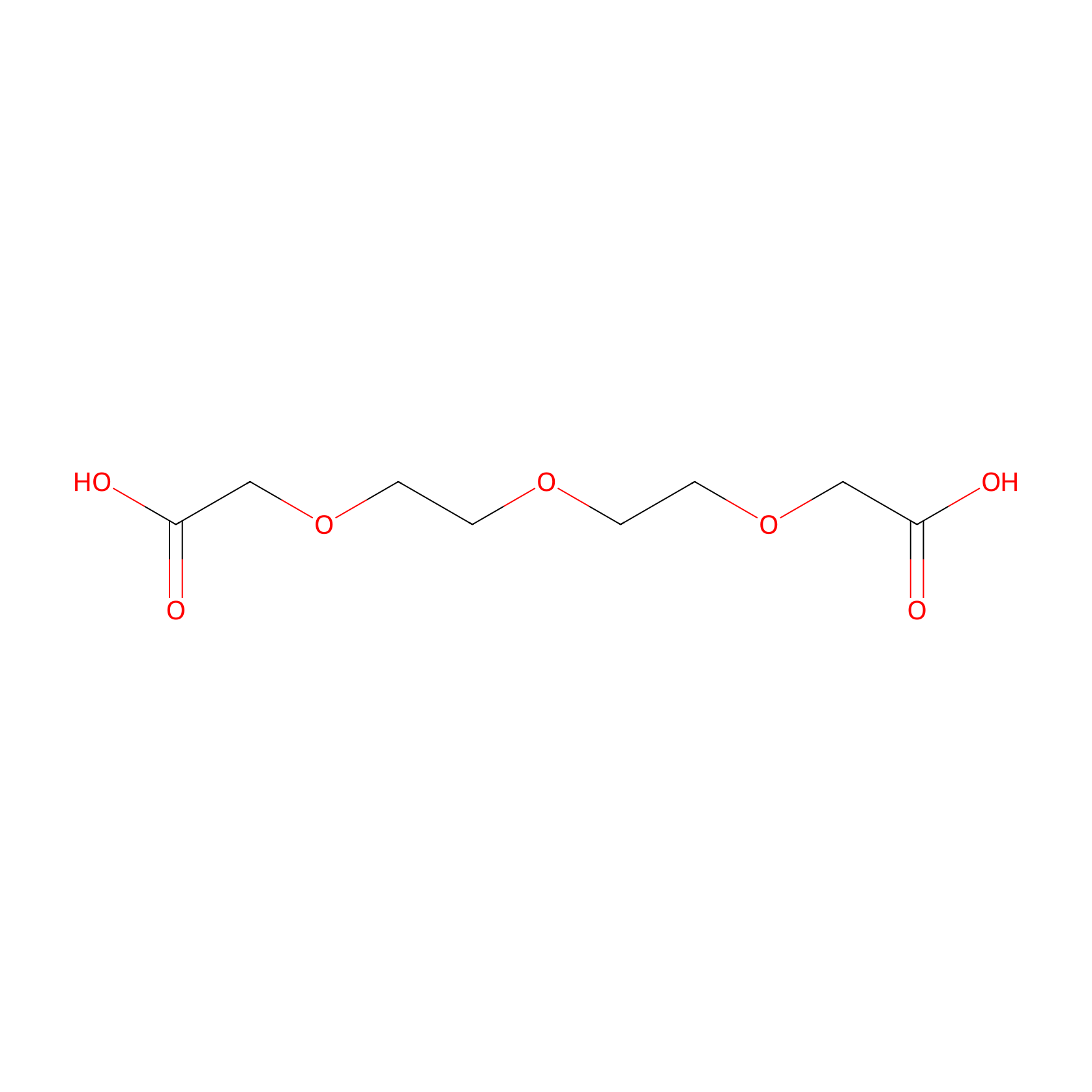
3,6,9-Trioxaundecanedioic acid
|
|||||
| Structure |
|
|||||
| Formula |
C8H14O7
|
|||||
| #Ro5 Violations (Lipinski): 0 | Molecular Weight (mw) | 222.19 | ||||
| Lipid-water partition coefficient (xlogp) | -1 | |||||
| Hydrogen Bond Donor Count (hbonddonor) | 2 | |||||
| Hydrogen Bond Acceptor Count (hbondacc) | 7 | |||||
| Rotatable Bond Count (rotbonds) | 10 | |||||
| PubChem CID | ||||||
| Canonical smiles |
C(COCC(=O)O)OCCOCC(=O)O
|
|||||
| InChI |
InChI=1S/C8H14O7/c9-7(10)5-14-3-1-13-2-4-15-6-8(11)12/h1-6H2,(H,9,10)(H,11,12)
|
|||||
| InChIKey |
HJZZQNLKBWJYPD-UHFFFAOYSA-N
|
|||||
| IUPAC Name |
2-[2-[2-(carboxymethoxy)ethoxy]ethoxy]acetic acid
|
|||||
Each Peptide-drug Conjugate Related to This Linker
Full Information of The Activity Data of The PDC(s) Related to This Linker
An2-morphine [Investigative]
Obtained from the Model Organism Data
| Experiment 1 Reporting the Activity Data of This PDC | [1] | ||||
| Indication | Severe pain | ||||
| Efficacy Data | Maximal antinociceptive effect |
46%
|
|||
| Administration Time | Intravenous administration 60 min | ||||
| Administration Dosage | 3 mg/kg | ||||
| Evaluation Method | Rat tail-flick test assay | ||||
| MOA of PDC |
Given the high analgesic potency of M6G, without induction of the M3G metabolite that antagonizes the analgesic effect of morphine, M6G could be a promising drug to treat moderate to severe pain. The major issue of systemic use of M6G is its poor BBB permeability. In this study, we proposed to increase the BBB penetration of M6G and morphine by conjugation to the shuttle angiopep-2 peptide (An2). Morphine and M6G were first conjugated to An2, a 19-mer peptide that crosses the BBB by low-density lipoprotein receptor-related protein 1 (LRP1) receptor-mediated transcytosis.
Click to Show/Hide
|
||||
| Description |
When equimolar doses of morphine conjugated to An2 (An2-morphine; 3 mg/kg) were compared with unconjugated morphine (1 mg/kg) at the peak effect, similar levels of antinociception were observed, reaching 46% and 49.7% of MPE, respectively.
|
||||
| In Vivo Model | Rat model. | ||||
| Experiment 2 Reporting the Activity Data of This PDC | [1] | ||||
| Indication | Severe pain | ||||
| Efficacy Data | Maximal antinociceptive effect |
79%
|
|||
| Administration Time | Intravenous administration 30 min | ||||
| Administration Dosage | 30 mg/kg | ||||
| Evaluation Method | Hot-plate test assay | ||||
| MOA of PDC |
Given the high analgesic potency of M6G, without induction of the M3G metabolite that antagonizes the analgesic effect of morphine, M6G could be a promising drug to treat moderate to severe pain. The major issue of systemic use of M6G is its poor BBB permeability. In this study, we proposed to increase the BBB penetration of M6G and morphine by conjugation to the shuttle angiopep-2 peptide (An2). Morphine and M6G were first conjugated to An2, a 19-mer peptide that crosses the BBB by low-density lipoprotein receptor-related protein 1 (LRP1) receptor-mediated transcytosis.
Click to Show/Hide
|
||||
| Description |
Similar results were also obtained in the hot-plate test using male CD1 mice. Over a 2-hour period, both morphine and An2-morphine caused similar increases in hot-plate latencies. Likewise, mice receiving An2-M6G (6 mg/kg i.v.) also exhibited a sustained and superior analgesic effect compared with equimolar doses of either morphine or M6G.
|
||||
| In Vivo Model | Male CD1 mice. | ||||
| Experiment 3 Reporting the Activity Data of This PDC | [1] | ||||
| Indication | Severe pain | ||||
| Efficacy Data | Maximal antinociceptive effect |
79%
|
|||
| Administration Time | Subcutaneous administration 95 min | ||||
| Administration Dosage | 20 mg/kg | ||||
| Evaluation Method | Rat tail-flick test assay | ||||
| MOA of PDC |
Given the high analgesic potency of M6G, without induction of the M3G metabolite that antagonizes the analgesic effect of morphine, M6G could be a promising drug to treat moderate to severe pain. The major issue of systemic use of M6G is its poor BBB permeability. In this study, we proposed to increase the BBB penetration of M6G and morphine by conjugation to the shuttle angiopep-2 peptide (An2). Morphine and M6G were first conjugated to An2, a 19-mer peptide that crosses the BBB by low-density lipoprotein receptor-related protein 1 (LRP1) receptor-mediated transcytosis.
Click to Show/Hide
|
||||
| Description |
We also measured the analgesic effect of An2-morphine and An2-M6G after subcutaneous injections. Despite similar MPE at the peak effect, subcutaneous injection of 20 mg/kg An2-morphine (equivalent to 5.5 mg/kg of morphine) produced an analgesic effect that was more prolonged over the time than what was observed with an equimolar dose of morphine.
|
||||
| In Vivo Model | Rat model. | ||||
References