Linker Information
General Information of This Linker
| Linker ID |
LIN00045
|
|||||
|---|---|---|---|---|---|---|
| Linker Name |
2-Aminothiolane
|
|||||
| Linker Type |
GSH concentration-sensitive linkers
|
|||||
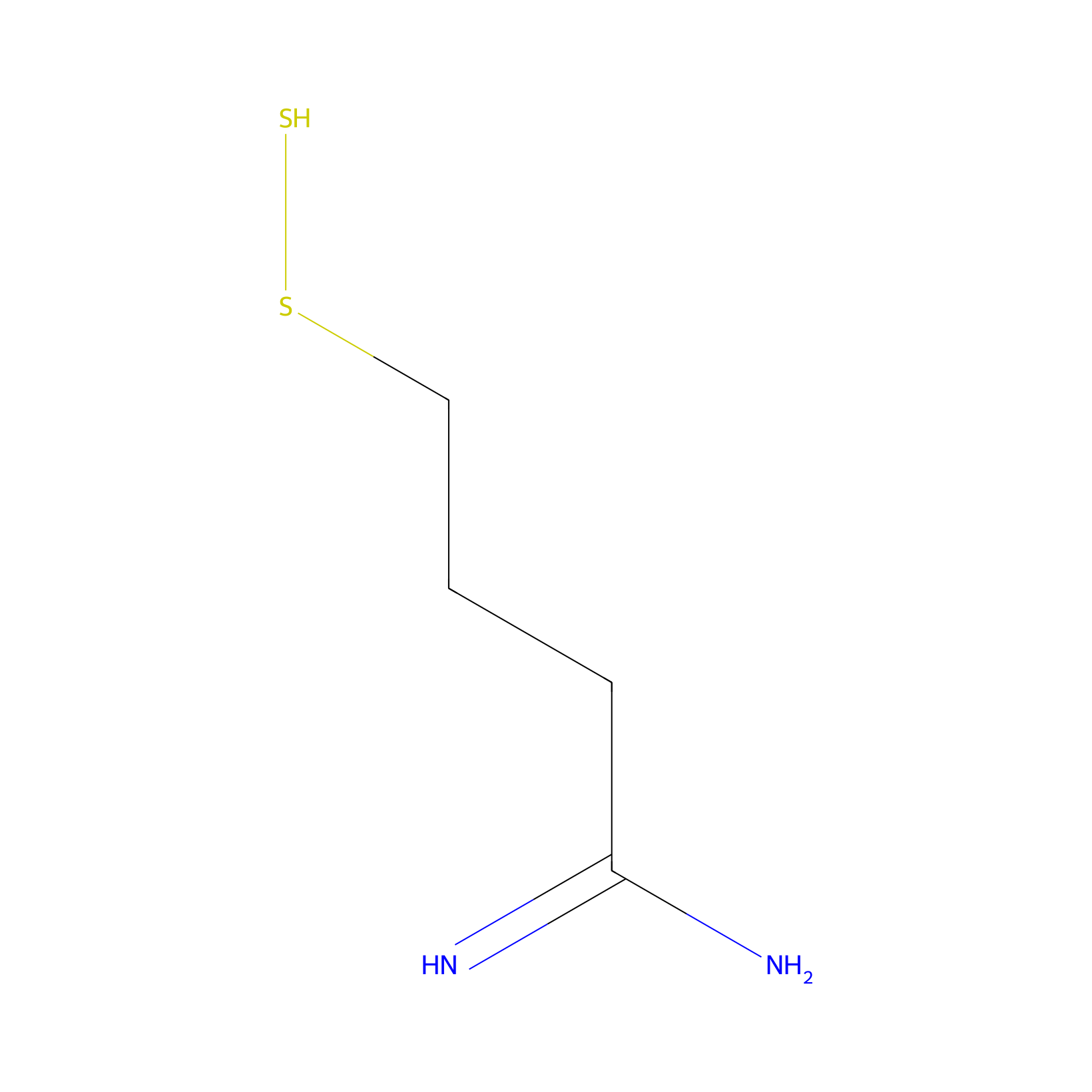
| Structure |
|
|||||
| Formula |
C4H10N2S2
|
|||||
| #Ro5 Violations (Lipinski): 0 | Molecular Weight (mw) | 150.272 | ||||
| Lipid-water partition coefficient (xlogp) | 1.28057 | |||||
| Hydrogen Bond Donor Count (hbonddonor) | 3 | |||||
| Hydrogen Bond Acceptor Count (hbondacc) | 3 | |||||
| Rotatable Bond Count (rotbonds) | 4 | |||||
| Canonical smiles |
N=C(N)CCCSS
|
|||||
| InChI |
InChI=1S/C4H10N2S2/c5-4(6)2-1-3-8-7/h7H,1-3H2,(H3,5,6)
|
|||||
| InChIKey |
WMMFKSXHIFHYKC-UHFFFAOYSA-N
|
|||||
Each Peptide-drug Conjugate Related to This Linker
Full Information of The Activity Data of The PDC(s) Related to This Linker
PNS-SS-DOX [Investigative]
Revealed Based on the Cell Line Data
| Experiment 1 Reporting the Activity Data of This PDC | [1] | ||||
| Indication | Breast cancer | ||||
| Efficacy Data | Cell survival rate |
12%
|
|||
| Administration Time | 24 h | ||||
| Administration Dosage | 20 µg/mL | ||||
| Evaluation Method | CCK-8 assay | ||||
| MOA of PDC |
Therefore, in this study, we present an intelligent drug delivery system based on 2D PNSs, utilizing a thermosensitive chitosan (CS) hydrogel as a sustained release platform to achieve the goal of long-term and effective drug treatment in the body. Under specific conditions, the peptide denoted by the sequence of Fmoc-FKKGSHC undergoes self-assembly, forming 2D PNSs with uniform nanostructure. PNSs are then successfully covalently linked to the thiol-modified DOX via the disulfide bonds, resulting in the synthesis of a 2D PDCs (PNS-SS-DOX). Subsequently, the PNS-SS-DOX PDCs are encapsulated within the injectable CS-based thermosensitive hydrogels. To validate the feasibility of this novel intelligent responsive drug delivery system, we conduct invitro release testing using the CS hydrogels and tested the GSH-responsive release of the PNS-SS-DOX, simulating the tumor cell environment. The results of the study indicate that the hydrogels exhibited pH-responsive release and swelling, providing favorable conditions for the controlled release of the PNS-SS-DOX. Furthermore, the outstanding sustained release effect also facilitated the effective accumulation of the PNS-SS-DOX at the tumor site, reducing inflammation reactions caused by multiple dosages.
Click to Show/Hide
|
||||
| Description |
Subsequently, the cell toxicity of the DOX, DOX-SH, and PNS-SS-DOX was also investigated using the CCK-8 method. As shown in Figure8b, all three materials display significant concentration-dependent cytotoxicity. Additionally, it can be observed that at the same concentration, the cytotoxicity of DOX-SH to MCF-7 cells was nearly identical to that of DOX, indicating that thiolation did not affect the efficacy of DOX. Furthermore, the PNS-SS-DOX group exhibited stronger cytotoxicity to MCF-7 cells. Particularly, at a material concentration of 20ug mL-1, the cell survival rate for the PNS-SS-DOX group was only 12 %, while that of the DOX-SH group was 20 %. We suggest that this effect is possibly due to the modification of PNSs with DOX-SH. On one hand, the hydrophilic peptides effectively improved the solubility of the hydrophobic drug DOX-SH, and on the other hand, the positively charged PNSs enhanced the drug uptake by cancer cells, thus increasing the cancer cell killing efficacy.
Click to Show/Hide
|
||||
| In Vitro Model | Invasive breast carcinoma | MCF-7 cell | CVCL_0031 | ||
| Experiment 2 Reporting the Activity Data of This PDC | [1] | ||||
| Indication | Breast cancer | ||||
| Efficacy Data | Cell survival rate |
32%
|
|||
| Administration Time | 24 h | ||||
| Administration Dosage | 15 µg/mL | ||||
| Evaluation Method | CCK-8 assay | ||||
| MOA of PDC |
Therefore, in this study, we present an intelligent drug delivery system based on 2D PNSs, utilizing a thermosensitive chitosan (CS) hydrogel as a sustained release platform to achieve the goal of long-term and effective drug treatment in the body. Under specific conditions, the peptide denoted by the sequence of Fmoc-FKKGSHC undergoes self-assembly, forming 2D PNSs with uniform nanostructure. PNSs are then successfully covalently linked to the thiol-modified DOX via the disulfide bonds, resulting in the synthesis of a 2D PDCs (PNS-SS-DOX). Subsequently, the PNS-SS-DOX PDCs are encapsulated within the injectable CS-based thermosensitive hydrogels. To validate the feasibility of this novel intelligent responsive drug delivery system, we conduct invitro release testing using the CS hydrogels and tested the GSH-responsive release of the PNS-SS-DOX, simulating the tumor cell environment. The results of the study indicate that the hydrogels exhibited pH-responsive release and swelling, providing favorable conditions for the controlled release of the PNS-SS-DOX. Furthermore, the outstanding sustained release effect also facilitated the effective accumulation of the PNS-SS-DOX at the tumor site, reducing inflammation reactions caused by multiple dosages.
Click to Show/Hide
|
||||
| Description |
Subsequently, the cell toxicity of the DOX, DOX-SH, and PNS-SS-DOX was also investigated using the CCK-8 method. As shown in Figure8b, all three materials display significant concentration-dependent cytotoxicity. Additionally, it can be observed that at the same concentration, the cytotoxicity of DOX-SH to MCF-7 cells was nearly identical to that of DOX, indicating that thiolation did not affect the efficacy of DOX. Furthermore, the PNS-SS-DOX group exhibited stronger cytotoxicity to MCF-7 cells. Particularly, at a material concentration of 20ug mL-1, the cell survival rate for the PNS-SS-DOX group was only 12 %, while that of the DOX-SH group was 20 %. We suggest that this effect is possibly due to the modification of PNSs with DOX-SH. On one hand, the hydrophilic peptides effectively improved the solubility of the hydrophobic drug DOX-SH, and on the other hand, the positively charged PNSs enhanced the drug uptake by cancer cells, thus increasing the cancer cell killing efficacy.
Click to Show/Hide
|
||||
| In Vitro Model | Invasive breast carcinoma | MCF-7 cell | CVCL_0031 | ||
| Experiment 3 Reporting the Activity Data of This PDC | [1] | ||||
| Indication | Breast cancer | ||||
| Efficacy Data | Cell survival rate |
55%
|
|||
| Administration Time | 24 h | ||||
| Administration Dosage | 10 µg/mL | ||||
| Evaluation Method | CCK-8 assay | ||||
| MOA of PDC |
Therefore, in this study, we present an intelligent drug delivery system based on 2D PNSs, utilizing a thermosensitive chitosan (CS) hydrogel as a sustained release platform to achieve the goal of long-term and effective drug treatment in the body. Under specific conditions, the peptide denoted by the sequence of Fmoc-FKKGSHC undergoes self-assembly, forming 2D PNSs with uniform nanostructure. PNSs are then successfully covalently linked to the thiol-modified DOX via the disulfide bonds, resulting in the synthesis of a 2D PDCs (PNS-SS-DOX). Subsequently, the PNS-SS-DOX PDCs are encapsulated within the injectable CS-based thermosensitive hydrogels. To validate the feasibility of this novel intelligent responsive drug delivery system, we conduct invitro release testing using the CS hydrogels and tested the GSH-responsive release of the PNS-SS-DOX, simulating the tumor cell environment. The results of the study indicate that the hydrogels exhibited pH-responsive release and swelling, providing favorable conditions for the controlled release of the PNS-SS-DOX. Furthermore, the outstanding sustained release effect also facilitated the effective accumulation of the PNS-SS-DOX at the tumor site, reducing inflammation reactions caused by multiple dosages.
Click to Show/Hide
|
||||
| Description |
Subsequently, the cell toxicity of the DOX, DOX-SH, and PNS-SS-DOX was also investigated using the CCK-8 method. As shown in Figure8b, all three materials display significant concentration-dependent cytotoxicity. Additionally, it can be observed that at the same concentration, the cytotoxicity of DOX-SH to MCF-7 cells was nearly identical to that of DOX, indicating that thiolation did not affect the efficacy of DOX. Furthermore, the PNS-SS-DOX group exhibited stronger cytotoxicity to MCF-7 cells. Particularly, at a material concentration of 20ug mL-1, the cell survival rate for the PNS-SS-DOX group was only 12 %, while that of the DOX-SH group was 20 %. We suggest that this effect is possibly due to the modification of PNSs with DOX-SH. On one hand, the hydrophilic peptides effectively improved the solubility of the hydrophobic drug DOX-SH, and on the other hand, the positively charged PNSs enhanced the drug uptake by cancer cells, thus increasing the cancer cell killing efficacy.
Click to Show/Hide
|
||||
| In Vitro Model | Invasive breast carcinoma | MCF-7 cell | CVCL_0031 | ||
| Experiment 4 Reporting the Activity Data of This PDC | [1] | ||||
| Indication | Breast cancer | ||||
| Efficacy Data | Cell survival rate |
75%
|
|||
| Administration Time | 24 h | ||||
| Administration Dosage | 5 µg/mL | ||||
| Evaluation Method | CCK-8 assay | ||||
| MOA of PDC |
Therefore, in this study, we present an intelligent drug delivery system based on 2D PNSs, utilizing a thermosensitive chitosan (CS) hydrogel as a sustained release platform to achieve the goal of long-term and effective drug treatment in the body. Under specific conditions, the peptide denoted by the sequence of Fmoc-FKKGSHC undergoes self-assembly, forming 2D PNSs with uniform nanostructure. PNSs are then successfully covalently linked to the thiol-modified DOX via the disulfide bonds, resulting in the synthesis of a 2D PDCs (PNS-SS-DOX). Subsequently, the PNS-SS-DOX PDCs are encapsulated within the injectable CS-based thermosensitive hydrogels. To validate the feasibility of this novel intelligent responsive drug delivery system, we conduct invitro release testing using the CS hydrogels and tested the GSH-responsive release of the PNS-SS-DOX, simulating the tumor cell environment. The results of the study indicate that the hydrogels exhibited pH-responsive release and swelling, providing favorable conditions for the controlled release of the PNS-SS-DOX. Furthermore, the outstanding sustained release effect also facilitated the effective accumulation of the PNS-SS-DOX at the tumor site, reducing inflammation reactions caused by multiple dosages.
Click to Show/Hide
|
||||
| Description |
Subsequently, the cell toxicity of the DOX, DOX-SH, and PNS-SS-DOX was also investigated using the CCK-8 method. As shown in Figure8b, all three materials display significant concentration-dependent cytotoxicity. Additionally, it can be observed that at the same concentration, the cytotoxicity of DOX-SH to MCF-7 cells was nearly identical to that of DOX, indicating that thiolation did not affect the efficacy of DOX. Furthermore, the PNS-SS-DOX group exhibited stronger cytotoxicity to MCF-7 cells. Particularly, at a material concentration of 20ug mL-1, the cell survival rate for the PNS-SS-DOX group was only 12 %, while that of the DOX-SH group was 20 %. We suggest that this effect is possibly due to the modification of PNSs with DOX-SH. On one hand, the hydrophilic peptides effectively improved the solubility of the hydrophobic drug DOX-SH, and on the other hand, the positively charged PNSs enhanced the drug uptake by cancer cells, thus increasing the cancer cell killing efficacy.
Click to Show/Hide
|
||||
| In Vitro Model | Invasive breast carcinoma | MCF-7 cell | CVCL_0031 | ||
References