Linker Information
General Information of This Linker
| Linker ID |
LIN00081
|
|||||
|---|---|---|---|---|---|---|
| Linker Name |
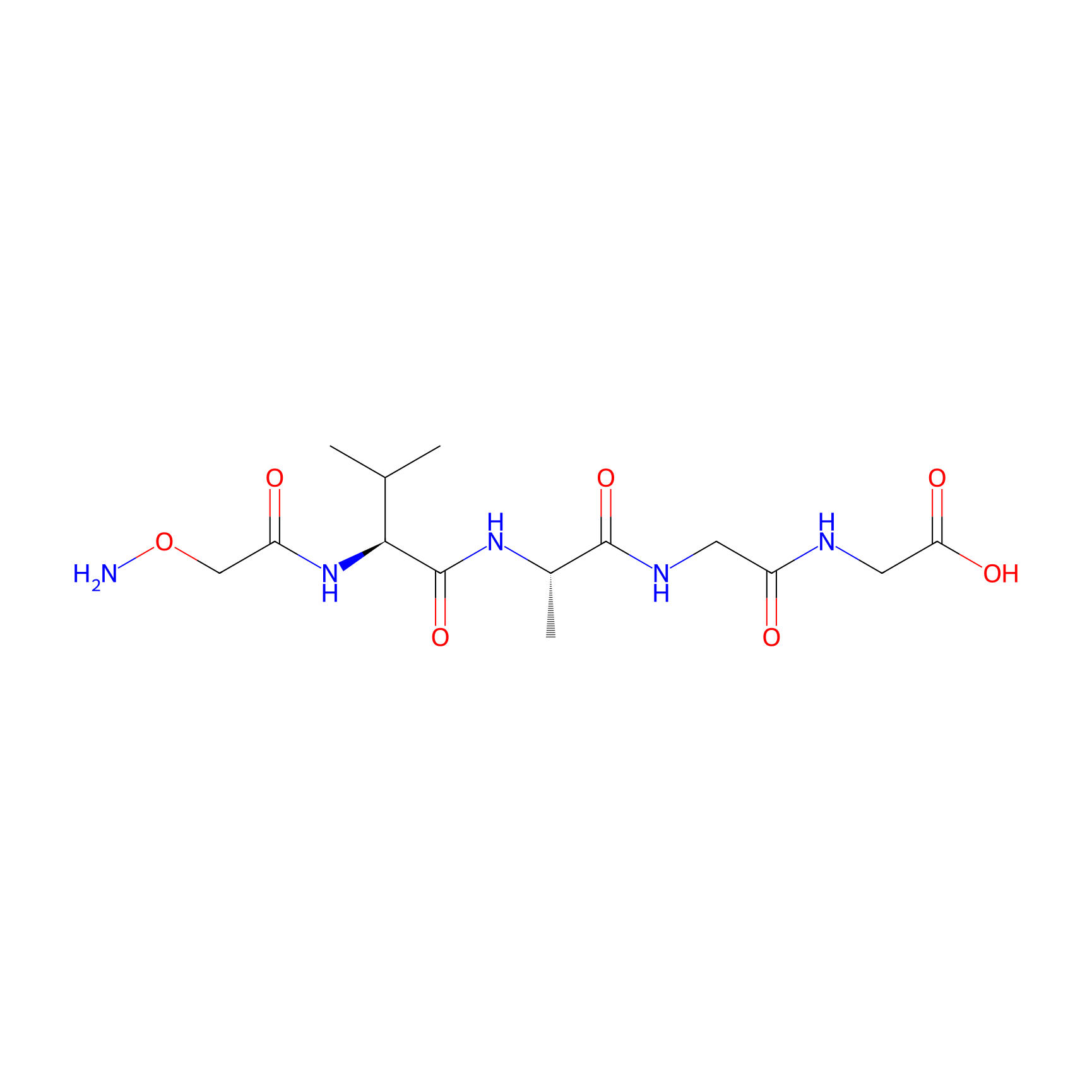
2-(aminooxy)acetic acid-VAGG
|
|||||
| Linker Type |
Enzyme-sensitive linkers
|
|||||
| Structure |
|
|||||
| Formula |
C14H25N5O7
|
|||||
| #Ro5 Violations (Lipinski): 3 | Molecular Weight (mw) | 375.382 | ||||
| Lipid-water partition coefficient (xlogp) | -3.1608 | |||||
| Hydrogen Bond Donor Count (hbonddonor) | 6 | |||||
| Hydrogen Bond Acceptor Count (hbondacc) | 7 | |||||
| Rotatable Bond Count (rotbonds) | 11 | |||||
| Canonical smiles |
CC(NC(=O)C(NC(=O)CON)C(C)C)C(=O)NCC(=O)NCC(=O)O
|
|||||
| InChI |
InChI=1S/C14H25N5O7/c1-7(2)12(19-10(21)6-26-15)14(25)18-8(3)13(24)17-4-9(20)16-5-11(22)23/h7-8,12H,4-6,15H2,1-3H3,(H,16,20)(H,17,24)(H,18,25)(H,19,21)(H,22,23)/t8-,12-/m0/s1
|
|||||
| InChIKey |
WHURRSYONJEKOK-UFBFGSQYSA-N
|
|||||
Each Peptide-drug Conjugate Related to This Linker
Full Information of The Activity Data of The PDC(s) Related to This Linker
H-TFFYGGSRGK(Dau=Aoa-VAGG)RNNFKTEEY-OH [Investigative]
Revealed Based on the Cell Line Data
| Experiment 1 Reporting the Activity Data of This PDC | [1] | ||||
| Indication | Glioblastoma | ||||
| Efficacy Data | Half Maximal Inhibitory Concentration (IC50) |
20.2 ± 3.0 µM
|
|||
| Administration Time | 72 h | ||||
| Evaluation Method | MTT assay | ||||
| MOA of PDC |
The blood-brain barrier (BBB) is a semipermeable system, and, therefore, most of the active substances are poorly transported through this barrier, resulting in decreased therapeutic effects. Angiopep-2 (TFFYGGSRGKRNNFKTEEY) is a peptide ligand of low-density lipoprotein receptor-related protein-1 (LRP1), which can cross the BBB via receptor-mediated transcytosis and simultaneously target glioblastomas. Angiopep-2 contains three amino groups that have previously been used to produce drug-peptide conjugates, although the role and importance of each position have not yet been investigated. Thus, we studied the number and position of drug molecules in Angiopep-2 based conjugates. Conjugates containing one, two, and three daunomycin molecules conjugated via oxime linkage in all possible variations were prepared. The in vitro cytostatic effect and cellular uptake of the conjugates were investigated on U87 human glioblastoma cells. Degradation studies in the presence of rat liver lysosomal homogenates were also performed in order for us to better understand the structure-activity relationship and to determine the smallest metabolites. Conjugates with the best cytostatic effects had a drug molecule at the N-terminus. We demonstrated that the increasing number of drug molecules does not necessarily increase the efficacy of the conjugates, and proved that modification of the different conjugation sites results in differing biological effectiveness.
Click to Show/Hide
|
||||
| Description |
The in vitro cytostatic effect and the in vitro cellular uptake of the spacer-containing daunomycin-peptide conjugates (9-11) were studied on U87 human glioblastoma cells as previously described. The measured IC50 values are shown in Table 2, while the measured cellular uptake at 10 μM and 50 μM concentration are given in Figure 4. The fluorescence intensity values showed good correlation with the percentage of daunomycin-positive cells in the case of these conjugates as well. Conjugate 9 showed slight toxicity during the measurements at a concentration of 50 μM.
Click to Show/Hide
|
||||
| In Vitro Model | Glioblastoma | U87 cell | CVCL_3429 | ||
References