Peptide Information
General Information of This Peptide
| Peptide ID |
PEP00002
|
|||||
|---|---|---|---|---|---|---|
| Peptide Name |
TP10
|
|||||
| Structure |
|
|||||
| Sequence |
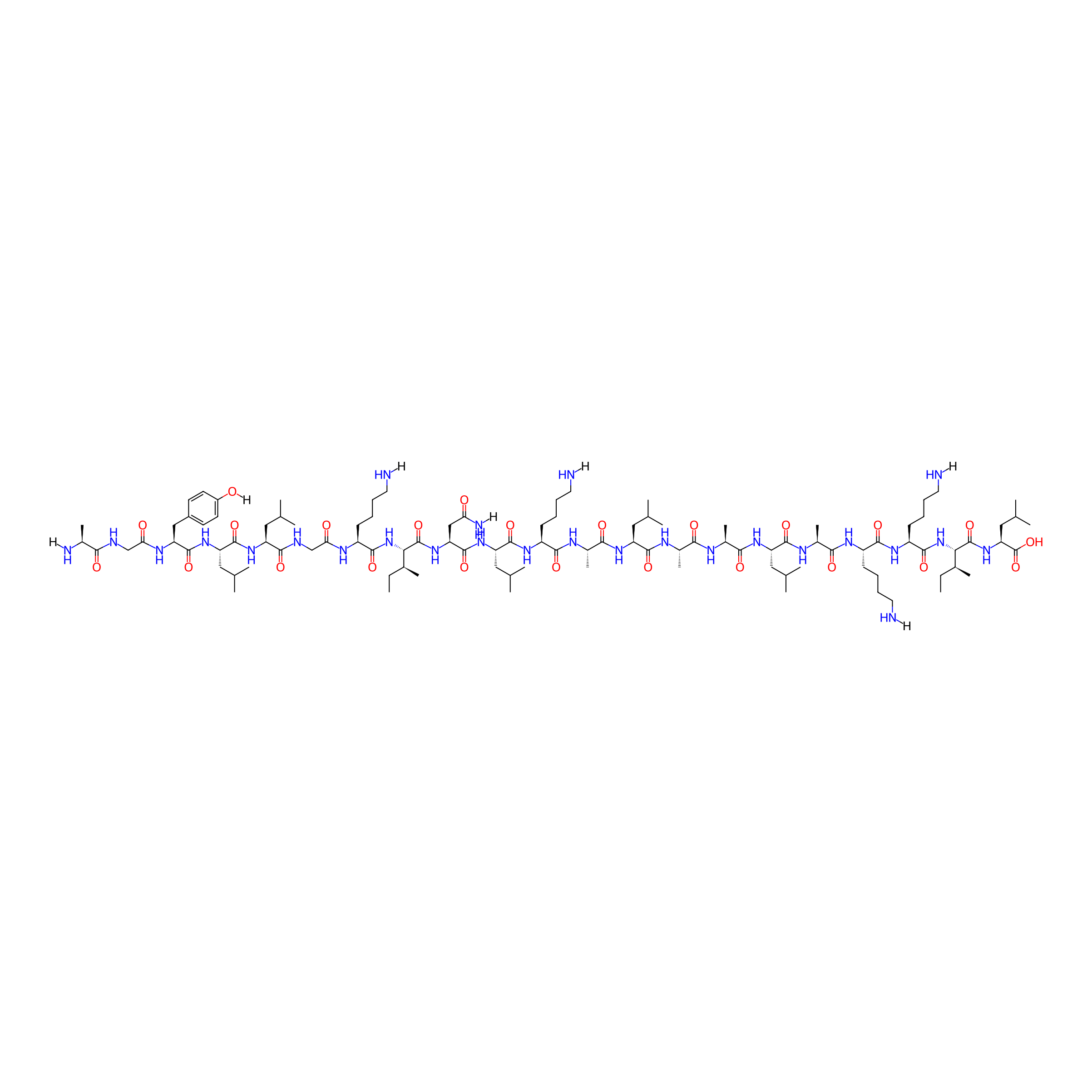
AGYLLGKINLKALAALAKKIL
|
|||||
| Peptide Type |
Linear
|
|||||
| Peptide Half Life Period |
>72 h
|
|||||
| PDC Transmembrane Types | Cell-penetrating peptides (CPPs) | |||||
| Distribution |
The distribution of the 111In-labeled CPPs after i.v. injection in PC-3 tumor-bearing mice is shown in Tables 3 5 as the percentage of the injected dose per gram tissue (%ID/g). All of the radiolabeled CPPs showed a relatively fast blood clearance with %ID/g values decreasing to less than 1 %ID/g after 4 h. In general, the tumor showed the lowest uptake rates among all organs (except for the brain and muscles) for all of the peptides studied. Noticeable values were observed for R9 with 51.4 %ID/g in the liver 10 min after injection, and a rapid accumulation of 81.4 %ID/g in the kidneys was observed for NLS just after 10 min. Penetratin was found to cross the blood brain barrier within 10 min at a level of 0.9 %ID/g in the brain indicating a distinct blood brain barrier permeability of CPPs. After 4 h, all of the peptides (except for PreS2-TLM) were retained in the liver and the kidneys. A high spleen uptake was observed after 4 h for both penetratin and R9 (7.1 %ID/g and 9.1 %ID/g, respectively).
|
|||||
| Formula |
C104H184N26O24
|
|||||
| Isosmiles |
[H]NCCCC[C@H](NC(=O)CNC(=O)[C@H](CC(C)C)NC(=O)[C@H](CC(C)C)NC(=O)[C@H](Cc1ccc(O[H])cc1)NC(=O)CNC(=O)[C@H](C)N[H])C(=O)N[C@]([H])(C(=O)N[C@@H](CC(=O)N[H])C(=O)N[C@@H](CC(C)C)C(=O)N[C@@H](CCCCN[H])C(=O)N[C@@H](C)C(=O)N[C@@H](CC(C)C)C(=O)N[C@@H](C)C(=O)N[C@@H](C)C(=O)N[C@@H](CC(C)C)C(=O)N[C@@H](C)C(=O)N[C@@H](CCCCN[H])C(=O)N[C@@H](CCCCN[H])C(=O)N[C@]([H])(C(=O)N[C@@H](CC(C)C)C(=O)O)[C@@H](C)CC)[C@@H](C)CC
|
|||||
| InChI |
InChI=1S/C104H184N26O24/c1-22-60(15)84(129-94(143)69(32-24-28-40-105)117-82(133)53-112-91(140)73(44-54(3)4)124-99(148)77(48-58(11)12)125-100(149)78(50-67-36-38-68(131)39-37-67)118-83(134)52-111-86(135)62(17)109)102(151)127-79(51-81(110)132)101(150)126-76(47-57(9)10)98(147)121-70(33-25-29-41-106)92(141)114-66(21)90(139)123-74(45-55(5)6)96(145)115-63(18)87(136)113-64(19)89(138)122-75(46-56(7)8)97(146)116-65(20)88(137)119-71(34-26-30-42-107)93(142)120-72(35-27-31-43-108)95(144)130-85(61(16)23-2)103(152)128-80(104(153)154)49-59(13)14/h36-39,54-66,69-80,84-85,131H,22-35,40-53,105-109H2,1-21H3,(H2,110,132)(H,111,135)(H,112,140)(H,113,136)(H,114,141)(H,115,145)(H,116,146)(H,117,133)(H,118,134)(H,119,137)(H,120,142)(H,121,147)(H,122,138)(H,123,139)(H,124,148)(H,125,149)(H,126,150)(H,127,151)(H,128,152)(H,129,143)(H,130,144)(H,153,154)/t60-,61-,62-,63-,64-,65-,66-,69-,70-,71-,72-,73-,74-,75-,76-,77-,78-,79-,80-,84-,85-/m0/s1
|
|||||
| InChIKey |
OUDGQPMZLUVPDJ-FGWYKXIFSA-N
|
|||||
| Pharmaceutical Properties |
Molecule Weight
|
2182.774
|
Polar area
|
812.72
|
||
|
Complexity
|
2181.397681
|
xlogp Value
|
-2.8349
|
|||
|
Heavy Count
|
154
|
Rot Bonds
|
83
|
|||
|
Hbond acc
|
28
|
Hbond Donor
|
28
|
|||
Each Peptide-drug Conjugate Related to This Peptide
Full Information of The Activity Data of The PDC(s) Related to This Peptide
Cq-C4-TP10 [Investigative]
Obtained from the Model Organism Data
| Experiment 1 Reporting the Activity Data of This PDC | [1] | ||||
| Indication | Malaria | ||||
| Efficacy Data | Half Maximal Inhibitory Concentration (IC50) |
0.8 ± 0.1 µM
|
|||
| MOA of PDC |
The significant increase in the hemolytic activity of TP10 upon conjugation to the 4-aminoquinoline suggests that drug cargo prevents an otherwise active CPP carrier from exerting the desired cell penetrating/antiplasmodial action safely, as it produces conjugates that exert membranolytic activity.
|
||||
| In Vivo Model | Plasmodium falciparum 3D7. | ||||
| Experiment 2 Reporting the Activity Data of This PDC | [1] | ||||
| Indication | Malaria | ||||
| Efficacy Data | Half Maximal Inhibitory Concentration (IC50) |
1.5 µM
|
|||
| MOA of PDC |
The significant increase in the hemolytic activity of TP10 upon conjugation to the 4-aminoquinoline suggests that drug cargo prevents an otherwise active CPP carrier from exerting the desired cell penetrating/antiplasmodial action safely, as it produces conjugates that exert membranolytic activity.
|
||||
| Description |
Only three of the Cq-C4-CPP conjugates, namely, 5a, 5b, and 5g, displayed IC50 values below 10 μM, with TP10- and Transportan-derived conjugates 5a (IC50 = 1.52 μM) and 5b (IC50 = 5.20 μM) being the most active.
|
||||
| In Vivo Model | Plasmodium falciparum W2. | ||||
Cq-C10-TP10 [Investigative]
Obtained from the Model Organism Data
| Experiment 1 Reporting the Activity Data of This PDC | [1] | ||||
| Indication | Malaria | ||||
| Efficacy Data | Half Maximal Inhibitory Concentration (IC50) |
0.8 ± 0.3 µM
|
|||
| MOA of PDC |
The significant increase in the hemolytic activity of TP10 upon conjugation to the 4-aminoquinoline suggests that drug cargo prevents an otherwise active CPP carrier from exerting the desired cell penetrating/antiplasmodial action safely, as it produces conjugates that exert membranolytic activity.
|
||||
| In Vivo Model | Plasmodium falciparum 3D7. | ||||
Cq-S-S-TP10 [Investigative]
Obtained from the Model Organism Data
| Experiment 1 Reporting the Activity Data of This PDC | [1] | ||||
| Indication | Malaria | ||||
| Efficacy Data | Half Maximal Inhibitory Concentration (IC50) |
1.0 ± 0.3 µM
|
|||
| MOA of PDC |
The significant increase in the hemolytic activity of TP10 upon conjugation to the 4-aminoquinoline suggests that drug cargo prevents an otherwise active CPP carrier from exerting the desired cell penetrating/antiplasmodial action safely, as it produces conjugates that exert membranolytic activity.
|
||||
| In Vivo Model | Plasmodium falciparum 3D7. | ||||
Cq-TR-TP10 [Investigative]
Obtained from the Model Organism Data
| Experiment 1 Reporting the Activity Data of This PDC | [1] | ||||
| Indication | Malaria | ||||
| Efficacy Data | Half Maximal Inhibitory Concentration (IC50) |
1.2 ± 0.2 µM
|
|||
| MOA of PDC |
The significant increase in the hemolytic activity of TP10 upon conjugation to the 4-aminoquinoline suggests that drug cargo prevents an otherwise active CPP carrier from exerting the desired cell penetrating/antiplasmodial action safely, as it produces conjugates that exert membranolytic activity.
|
||||
| In Vivo Model | Plasmodium falciparum 3D7. | ||||
References