Peptide Information
General Information of This Peptide
| Peptide ID |
PEP00021
|
|||||
|---|---|---|---|---|---|---|
| Peptide Name |
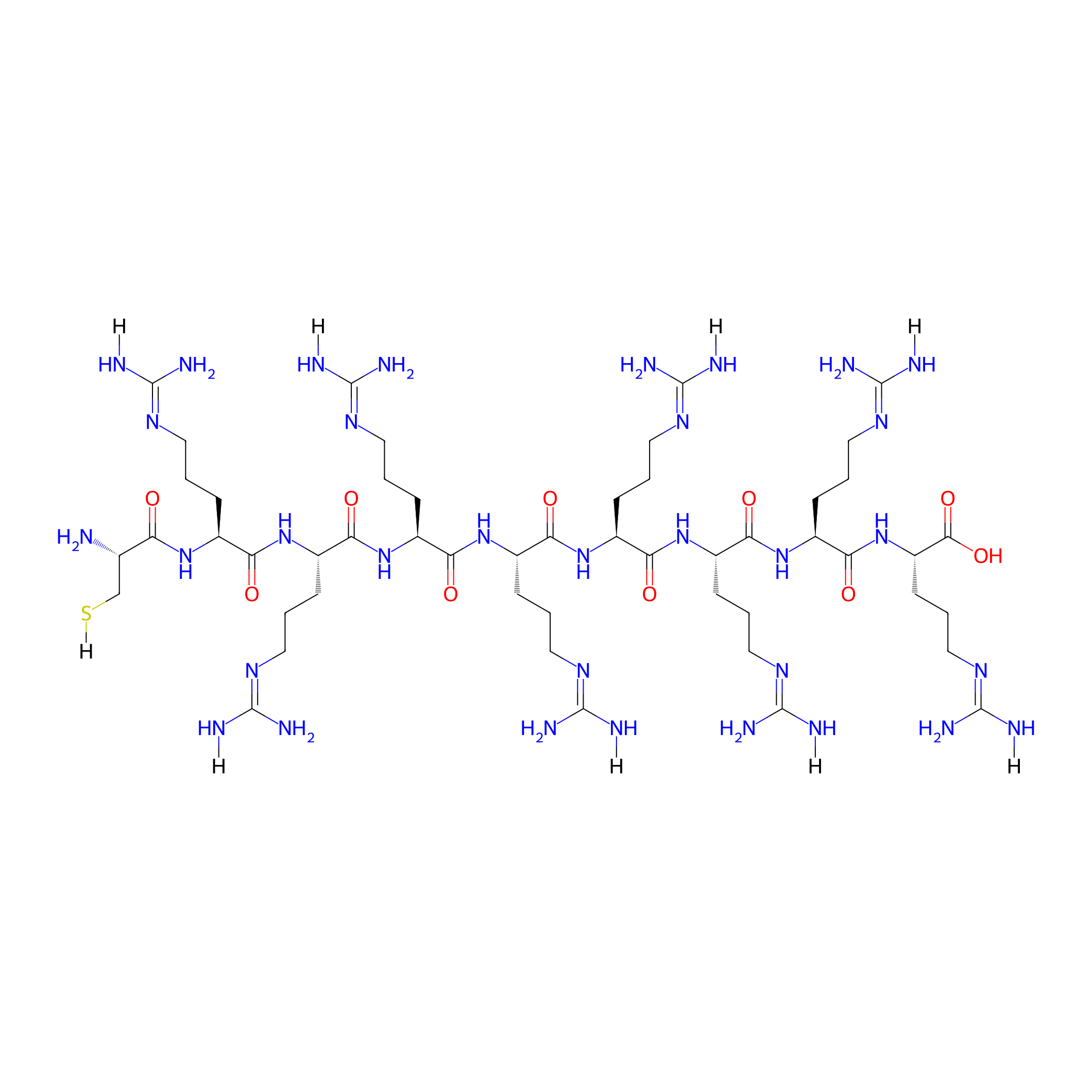
oxmCPP
|
|||||
| Structure |
|
|||||
| Sequence |
CRRRRRRRR
|
|||||
| Peptide Type |
Linear
|
|||||
| PDC Transmembrane Types | Cell-penetrating peptides (CPPs) | |||||
| Formula |
C51H103N33O10S
|
|||||
| Isosmiles |
[H]N/C(N)=N/CCC[C@H](NC(=O)[C@H](CCC/N=C(\N)N[H])NC(=O)[C@H](CCC/N=C(\N)N[H])NC(=O)[C@H](CCC/N=C(\N)N[H])NC(=O)[C@H](CCC/N=C(\N)N[H])NC(=O)[C@H](CCC/N=C(\N)N[H])NC(=O)[C@H](CCC/N=C(\N)N[H])NC(=O)[C@H](CCC/N=C(\N)N[H])NC(=O)[C@@H](N)CS[H])C(=O)O
|
|||||
| InChI |
InChI=1S/C51H103N33O10S/c52-26(25-95)35(85)77-27(9-1-17-69-44(53)54)36(86)78-28(10-2-18-70-45(55)56)37(87)79-29(11-3-19-71-46(57)58)38(88)80-30(12-4-20-72-47(59)60)39(89)81-31(13-5-21-73-48(61)62)40(90)82-32(14-6-22-74-49(63)64)41(91)83-33(15-7-23-75-50(65)66)42(92)84-34(43(93)94)16-8-24-76-51(67)68/h26-34,95H,1-25,52H2,(H,77,85)(H,78,86)(H,79,87)(H,80,88)(H,81,89)(H,82,90)(H,83,91)(H,84,92)(H,93,94)(H4,53,54,69)(H4,55,56,70)(H4,57,58,71)(H4,59,60,72)(H4,61,62,73)(H4,63,64,74)(H4,65,66,75)(H4,67,68,76)/t26-,27-,28-,29-,30-,31-,32-,33-,34-/m0/s1
|
|||||
| InChIKey |
AQPPDBZOMKUMIM-WJKAUMHWSA-N
|
|||||
| Pharmaceutical Properties |
Molecule Weight
|
1370.673
|
Polar area
|
811.32
|
||
|
Complexity
|
1369.828637
|
xlogp Value
|
-12.3647
|
|||
|
Heavy Count
|
95
|
Rot Bonds
|
51
|
|||
|
Hbond acc
|
19
|
Hbond Donor
|
27
|
|||
Each Peptide-drug Conjugate Related to This Peptide
Full Information of The Activity Data of The PDC(s) Related to This Peptide
Peptide-drug conjugate 10 [Investigative]
Revealed Based on the Cell Line Data
| Experiment 1 Reporting the Activity Data of This PDC | [1] | ||||
| Indication | Neuroblastoma | ||||
| Efficacy Data | Half Maximal Inhibitory Concentration (IC50) |
2.47 ± 0.91 µM
|
|||
| Administration Time | 72 h | ||||
| Evaluation Method | CellTiter-Glo luminescent cell viability assay | ||||
| Description |
The cytotoxic effect of the peptide-drug conjugate on Kelly-WT cells was comparable to that of 9, but not as strong as the one of the native drug. Contrary to the other utilized substances, the antiproliferative action of the bioconjugate in wild-type and drug-resistant cells was nearly the same. In comparison with doxorubicin the cytotoxicity of 10 against Kelly-ADR cells was increased by a factor of 3 according to the obtained IC50 values. Even the unmodified dimer had roughly the same cytotoxic effect on Kelly-ADR cells as doxorubicin.
Click to Show/Hide
|
||||
| In Vitro Model | Neuroblastoma | Kelly-WT cell | CVCL_2092 | ||
| Experiment 2 Reporting the Activity Data of This PDC | [1] | ||||
| Indication | Neuroblastoma | ||||
| Efficacy Data | Half Maximal Inhibitory Concentration (IC50) |
2.76 ± 0.33 µM
|
|||
| Administration Time | 72 h | ||||
| Evaluation Method | CellTiter-Glo luminescent cell viability assay | ||||
| Description |
The cytotoxic effect of the peptide-drug conjugate on Kelly-WT cells was comparable to that of 9, but not as strong as the one of the native drug. Contrary to the other utilized substances, the antiproliferative action of the bioconjugate in wild-type and drug-resistant cells was nearly the same. In comparison with doxorubicin the cytotoxicity of 10 against Kelly-ADR cells was increased by a factor of 3 according to the obtained IC50 values. Even the unmodified dimer had roughly the same cytotoxic effect on Kelly-ADR cells as doxorubicin.
Click to Show/Hide
|
||||
| In Vitro Model | Neuroblastoma | Kelly-ADR cell | CVCL_2092 | ||
| Experiment 3 Reporting the Activity Data of This PDC | [1] | ||||
| Indication | Neuroblastoma | ||||
| Efficacy Data | Half Maximal Inhibitory Concentration (IC50) |
3.66 ± 0.77 µM
|
|||
| Administration Time | 72 h | ||||
| Evaluation Method | CellTiter-Glo luminescent cell viability assay | ||||
| Description |
The obtained IC50 values for 9 (6.73 ± 2.44 uM) and 10 (3.66 ± 0.77 uM) were higher than for doxorubicin (0.90 ± 0.12 uM).
|
||||
| In Vitro Model | Invasive breast carcinoma | MCF-7 cell | CVCL_0031 | ||
DOXoxmCPP [Investigative]
Revealed Based on the Cell Line Data
| Experiment 1 Reporting the Activity Data of This PDC | [2] | ||||
| Indication | Breast cancer | ||||
| Efficacy Data | Half Maximal Inhibitory Concentration (IC50) |
11.4 μM
|
|||
| Description |
Doxorubicin binds with high affinity to DNA by intercalation, which leads to DNA damage and subsequent growth inhibition44,45. We performed MTT assays in order to determine the viability of the tumor cells and additionally to assess the proliferative potential of the cells after drug treatment. MCF-7 and HT-29 cells were incubated with doxorubicin and the peptide conjugates at various concentrations in the range of 0.1 and 50 μmfor 72 h (in a serum-containing medium), and the results were expressed as IC50-values (Table 1).
Click to Show/Hide
|
||||
| In Vitro Model | Invasive breast carcinoma | MCF-7 cell | CVCL_0031 | ||
| Experiment 2 Reporting the Activity Data of This PDC | [2] | ||||
| Indication | Breast cancer | ||||
| Efficacy Data | Half Maximal Inhibitory Concentration (IC50) |
27 μM
|
|||
| Description |
Doxorubicin binds with high affinity to DNA by intercalation, which leads to DNA damage and subsequent growth inhibition44,45. We performed MTT assays in order to determine the viability of the tumor cells and additionally to assess the proliferative potential of the cells after drug treatment. MCF-7 and HT-29 cells were incubated with doxorubicin and the peptide conjugates at various concentrations in the range of 0.1 and 50 μmfor 72 h (in a serum-containing medium), and the results were expressed as IC50-values (Table 1).
Click to Show/Hide
|
||||
| In Vitro Model | Invasive breast carcinoma | MCF-7 cell | CVCL_0031 | ||
References