Peptide Information
General Information of This Peptide
| Peptide ID |
PEP00082
|
|||||
|---|---|---|---|---|---|---|
| Peptide Name |
HK2 substrate
|
|||||
| Structure |
|
|||||
| Sequence |
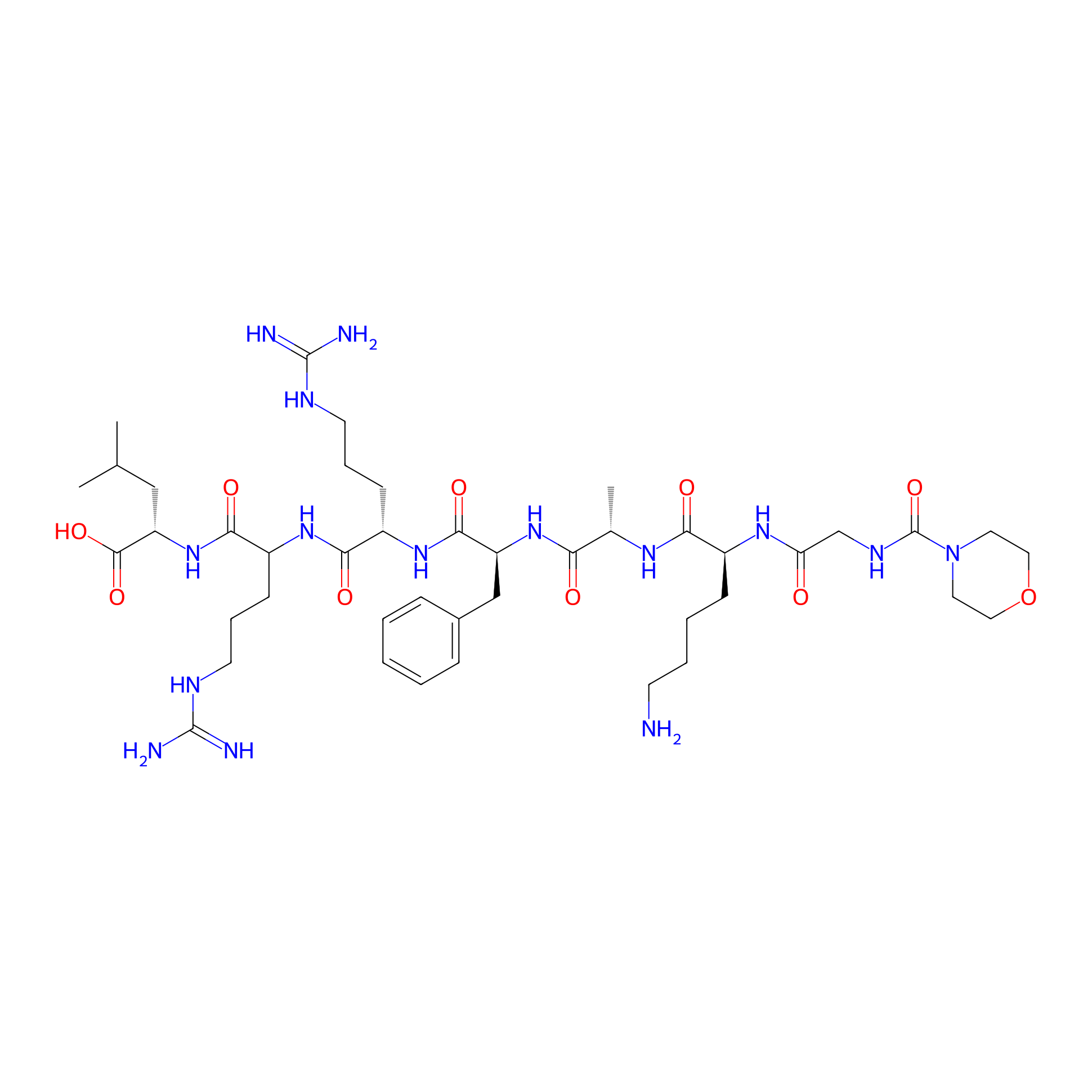
LRRFAKG
|
|||||
| Peptide Type |
Linear
|
|||||
| PDC Transmembrane Types | Cell targeting peptides (CTPs) | |||||
| Formula |
C43H73N15O10
|
|||||
| Isosmiles |
CC(C)C[C@H](NC(=O)C(CCCNC(=N)N)NC(=O)[C@H](CCCNC(=N)N)NC(=O)[C@H](Cc1ccccc1)NC(=O)[C@H](C)NC(=O)[C@H](CCCCN)NC(=O)CNC(=O)N1CCOCC1)C(=O)O
|
|||||
| InChI |
InChI=1S/C43H73N15O10/c1-26(2)23-33(40(65)66)57-38(63)31(15-10-18-50-42(47)48)54-37(62)30(14-9-17-49-41(45)46)55-39(64)32(24-28-11-5-4-6-12-28)56-35(60)27(3)52-36(61)29(13-7-8-16-44)53-34(59)25-51-43(67)58-19-21-68-22-20-58/h4-6,11-12,26-27,29-33H,7-10,13-25,44H2,1-3H3,(H,51,67)(H,52,61)(H,53,59)(H,54,62)(H,55,64)(H,56,60)(H,57,63)(H,65,66)(H4,45,46,49)(H4,47,48,50)/t27-,29-,30-,31?,32-,33-/m0/s1
|
|||||
| InChIKey |
ORCWGJVHLUXOAZ-PASMNNOISA-N
|
|||||
| Pharmaceutical Properties |
Molecule Weight
|
960.152
|
Polar area
|
403.29
|
||
|
Complexity
|
959.5664835
|
xlogp Value
|
-3.01416
|
|||
|
Heavy Count
|
68
|
Rot Bonds
|
30
|
|||
|
Hbond acc
|
12
|
Hbond Donor
|
15
|
|||
Each Peptide-drug Conjugate Related to This Peptide
Full Information of The Activity Data of The PDC(s) Related to This Peptide
HK2-TG prodrug [Investigative]
Discovered Using Cell Line-derived Xenograft Model
| Experiment 1 Reporting the Activity Data of This PDC | [1] | ||||
| Indication | Prostate cancer | ||||
| Efficacy Data | Peak serum prodrug concentration |
˜36 µM
|
|||
| Administration Dosage | 3.67 µmoles/kg/dose | ||||
| MOA of PDC |
There are at least three additional cancer-associated extracellular proteases as potential candidates for the activation of 12-ADT-based prodrugs. These are Human Glandular Kallikrein 2 (HK2 also known as KLK2), Fibroblast Activation Protein (FAP), and Prostate Specific Membrane Antigen (PSMA also known as FOLH1). HK2 is a trypsin-like protease, uniquely secreted into the extracellular fluid at high enzymatically active levels only by normal and malignant prostate epithelial cells. Like PSA, once in the blood, its enzymatic activity is inhibited by serum protease inhibitors, making it an alternative candidate for prostate-targeted prodrug activation. Another alternative candidate is the serine protease, FAP. This is based upon the studies of W. Nathaniel Brennen, initiated while a graduate student with Sam Denmeade, and then, as a post-doctoral fellow with John Isaacs. Subsequently, Dr. Brennen continued this collaboration when he became an independent faculty investigator at Hopkins. His studies focused on the tumor-promoting activity of the influx within sites of metastatic prostate cancer of tumor-infiltrating host-derived fibroblasts that have a highly increased plasma membrane expression of FAP. FAP is a type II integral membrane serine prolyl protease of the dipeptidyl peptidase IV family, which is characterized by a unique post-prolyl cleavage specificity. Based on its restricted expression and unique substrate requirements, FAP is an ideal potential candidate for prodrug activation. PSMA is highly expressed on the extracellular plasma membranes of prostate cancer cells and, as originally discovered by Warren D. W. Heston, has folate hydrolase enzymatic activity. PSMA expression is also upregulated after ADT in resistant metastatic prostate cancer.
Click to Show/Hide
|
||||
| Description |
For the HK2-TG prodrug, the maximally tolerated multiday intravenous dose of prodrug is 6 mg/kg (3.67 umoles/kg/dose), which produced a peak serum concentration of ~36 uM and has a half-life of ~40 min. In addition, over a 24 h period, <0.5% of free L12ADT analog is observed in plasma, while, within the cancer, the level of 12ADT-released toxin at this MTD is ~1 uM. The prodrug demonstrated a significant antitumor effect in vivo while being administered, but prolonged intravenous administration is not possible due to local toxicity to tail veins.
Click to Show/Hide
|
||||
| In Vivo Model | LNCaP human prostate cancer cells xenografts in intact male immune-deficient mice. | ||||
| In Vitro Model | Prostate carcinoma | LNCaP cell | CVCL_0395 | ||
| Half life period | ˜ 40 min | ||||
| Experiment 2 Reporting the Activity Data of This PDC | [1] | ||||
| Indication | Prostate cancer | ||||
| Efficacy Data | Maximum tolerated dose (MTD) |
6 mg/kg
|
|||
| Administration Dosage | 3.67 µmoles/kg/dose | ||||
| MOA of PDC |
There are at least three additional cancer-associated extracellular proteases as potential candidates for the activation of 12-ADT-based prodrugs. These are Human Glandular Kallikrein 2 (HK2 also known as KLK2), Fibroblast Activation Protein (FAP), and Prostate Specific Membrane Antigen (PSMA also known as FOLH1). HK2 is a trypsin-like protease, uniquely secreted into the extracellular fluid at high enzymatically active levels only by normal and malignant prostate epithelial cells. Like PSA, once in the blood, its enzymatic activity is inhibited by serum protease inhibitors, making it an alternative candidate for prostate-targeted prodrug activation. Another alternative candidate is the serine protease, FAP. This is based upon the studies of W. Nathaniel Brennen, initiated while a graduate student with Sam Denmeade, and then, as a post-doctoral fellow with John Isaacs. Subsequently, Dr. Brennen continued this collaboration when he became an independent faculty investigator at Hopkins. His studies focused on the tumor-promoting activity of the influx within sites of metastatic prostate cancer of tumor-infiltrating host-derived fibroblasts that have a highly increased plasma membrane expression of FAP. FAP is a type II integral membrane serine prolyl protease of the dipeptidyl peptidase IV family, which is characterized by a unique post-prolyl cleavage specificity. Based on its restricted expression and unique substrate requirements, FAP is an ideal potential candidate for prodrug activation. PSMA is highly expressed on the extracellular plasma membranes of prostate cancer cells and, as originally discovered by Warren D. W. Heston, has folate hydrolase enzymatic activity. PSMA expression is also upregulated after ADT in resistant metastatic prostate cancer.
Click to Show/Hide
|
||||
| Description |
For the HK2-TG prodrug, the maximally tolerated multiday intravenous dose of prodrug is 6 mg/kg (3.67 umoles/kg/dose), which produced a peak serum concentration of ~36 uM and has a half-life of ~40 min. In addition, over a 24 h period, <0.5% of free L12ADT analog is observed in plasma, while, within the cancer, the level of 12ADT-released toxin at this MTD is ~1 uM. The prodrug demonstrated a significant antitumor effect in vivo while being administered, but prolonged intravenous administration is not possible due to local toxicity to tail veins.
Click to Show/Hide
|
||||
| In Vivo Model | LNCaP human prostate cancer cells xenografts in intact male immune-deficient mice. | ||||
| In Vitro Model | Prostate carcinoma | LNCaP cell | CVCL_0395 | ||
| Half life period | ˜ 40 min | ||||
References