Peptide Information
General Information of This Peptide
| Peptide ID |
PEP00092
|
|||||
|---|---|---|---|---|---|---|
| Peptide Name |
Scrambled -CTCE
|
|||||
| Structure |
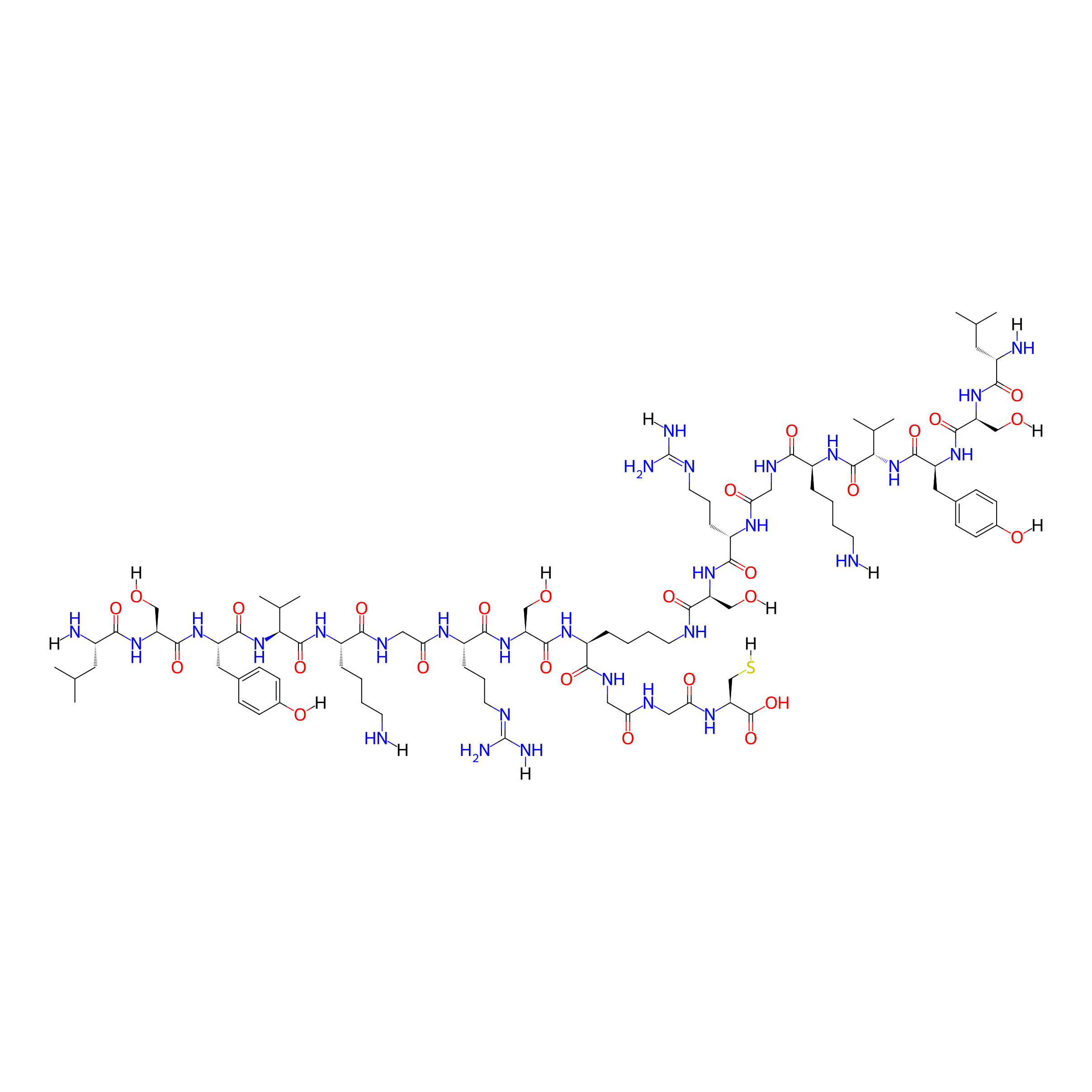
|
|||||
| Sequence |
LSYVKGRSK(GGC)SRGKVYSL
|
|||||
| Peptide Type |
Linear
|
|||||
| PDC Transmembrane Types | Cell targeting peptides (CTPs) | |||||
| Formula |
C93H157N29O27S
|
|||||
| Isosmiles |
[H]NCCCC[C@H](NC(=O)[C@@H](NC(=O)[C@H](Cc1ccc(O[H])cc1)NC(=O)[C@H](CO[H])NC(=O)[C@H](CC(C)C)N[H])C(C)C)C(=O)NCC(=O)N[C@@H](CCC/N=C(\N)N[H])C(=O)N[C@@H](CO[H])C(=O)NCCCC[C@H](NC(=O)[C@H](CO[H])NC(=O)[C@H](CCC/N=C(\N)N[H])NC(=O)CNC(=O)[C@H](CCCCN[H])NC(=O)[C@@H](NC(=O)[C@H](Cc1ccc(O[H])cc1)NC(=O)[C@H](CO[H])NC(=O)[C@H](CC(C)C)N[H])C(C)C)C(=O)NCC(=O)NCC(=O)N[C@@H](CS[H])C(=O)O
|
|||||
| InChI |
InChI=1S/C93H157N29O27S/c1-48(2)35-56(96)76(133)117-66(44-124)87(144)115-63(37-52-22-26-54(127)27-23-52)84(141)121-74(50(5)6)89(146)113-59(17-9-12-30-94)79(136)107-41-72(131)109-61(20-15-33-103-92(98)99)82(139)119-65(43-123)81(138)102-32-14-11-19-58(78(135)106-39-70(129)105-40-71(130)111-69(47-150)91(148)149)112-86(143)68(46-126)120-83(140)62(21-16-34-104-93(100)101)110-73(132)42-108-80(137)60(18-10-13-31-95)114-90(147)75(51(7)8)122-85(142)64(38-53-24-28-55(128)29-25-53)116-88(145)67(45-125)118-77(134)57(97)36-49(3)4/h22-29,48-51,56-69,74-75,123-128,150H,9-21,30-47,94-97H2,1-8H3,(H,102,138)(H,105,129)(H,106,135)(H,107,136)(H,108,137)(H,109,131)(H,110,132)(H,111,130)(H,112,143)(H,113,146)(H,114,147)(H,115,144)(H,116,145)(H,117,133)(H,118,134)(H,119,139)(H,120,140)(H,121,141)(H,122,142)(H,148,149)(H4,98,99,103)(H4,100,101,104)/t56-,57-,58-,59-,60-,61-,62-,63-,64-,65-,66-,67-,68-,69-,74-,75-/m0/s1
|
|||||
| InChIKey |
VSYCNCHAJLSMJR-IIMGRFODSA-N
|
|||||
| Pharmaceutical Properties |
Molecule Weight
|
2145.522
|
Polar area
|
944.46
|
||
|
Complexity
|
2144.152442
|
xlogp Value
|
-12.1709
|
|||
|
Heavy Count
|
150
|
Rot Bonds
|
85
|
|||
|
Hbond acc
|
33
|
Hbond Donor
|
35
|
|||
Each Peptide-drug Conjugate Related to This Peptide
Full Information of The Activity Data of The PDC(s) Related to This Peptide
SC-CTCE-DTX [Investigative]
Revealed Based on the Cell Line Data
| Experiment 1 Reporting the Activity Data of This PDC | [1] | ||||
| Indication | Liver cancer | ||||
| Efficacy Data | Half Maximal Inhibitory Concentration (IC50) |
206.0 nM
|
|||
| Administration Time | 72 h | ||||
| Evaluation Method | CCK-8 assay | ||||
| MOA of PDC |
To increase the DTX solubility and avoid the DTX therapy induced metastasis, we designed a peptide-drug conjugate (CTCE-DTX) by coupling two functional molecules (CXCR4 antagonist peptide and chemotherapeutic agent DTX) through a flexible linker. The amphiphilic monomer of CTCE-DTX could self-assemble into nanoparticles (CTCE-DTX NPs) in the water environment (without the participation of toxic ethanol and Tween 80 as excipients). The CXCR4 antagonist component could target CXCR4 upregulated tumor cells, which not only enhanced the efficacy of DTX but also inhibited the bone and lung metastasis of TNBC.
Click to Show/Hide
|
||||
| Description |
Besides, the combination of DTX and CTCE showed a substantially greater cytotoxicity, with an approximate 2 folds reduction (67.9 nmol/L) in half-maximal inhibitory concentration (IC50) compared to DTX alone. What's more, CTCE-DTX NPs retained a greater cytotoxicity (IC50 = 88.5 nmol/L) than Sc-DTX NPs (IC50 = 169.5 nmol/L), which meant CXCR4 antagonist peptide could work as a sensitizer to DTX. The slightly higher IC50 value of CTCE-DTX NPs than that of DTX + CTCE group may attribute to the incomplete disassembly of nanostructures. Meanwhile, consistent with previous reports14, the CXCR4 antagonist peptide and scramble peptide didn't not show any cytotoxicity to 4T1 cell at low concentration. We also tested the cytotoxicity of the formulations to another CXCR4 high expression (MDA-MB-231) and CXCR4 low expression (HepG2) cell lines and calculated the IC50. In MDA-MB-231 cell line, the IC50 of CTCE-DTX NPs (99.2 nmol/L) was significantly lower than that of DTX (135.8 nmol/L) and Sc-DTX NPs (250.1 nmol/L), which was consist with the tendency of formulations to 4T1 cell line. In comparison, in HepG2 cell line, the IC50 of CTCE-DTX NPs (166.8 nmol/L) was higher than that of DTX (109.5 nmol/L). The results further proved that the recognition of CTCE-DTX NPs with CXCR4 could enhance the cytotoxicity to tumor cells. These results demonstrated that CTCE peptide enhanced the chemosensitivity of cancer cell toward DTX but possessed with no direct toxicity.
Click to Show/Hide
|
||||
| In Vitro Model | Hepatoblastoma | L-O2 cell line | CVCL_0027 | ||
| Half life period | 29.3 h | ||||
| Experiment 2 Reporting the Activity Data of This PDC | [1] | ||||
| Indication | Breast cancer | ||||
| Efficacy Data | Half Maximal Inhibitory Concentration (IC50) |
250.1 nM
|
|||
| Administration Time | 72 h | ||||
| Evaluation Method | CCK-8 assay | ||||
| MOA of PDC |
To increase the DTX solubility and avoid the DTX therapy induced metastasis, we designed a peptide-drug conjugate (CTCE-DTX) by coupling two functional molecules (CXCR4 antagonist peptide and chemotherapeutic agent DTX) through a flexible linker. The amphiphilic monomer of CTCE-DTX could self-assemble into nanoparticles (CTCE-DTX NPs) in the water environment (without the participation of toxic ethanol and Tween 80 as excipients). The CXCR4 antagonist component could target CXCR4 upregulated tumor cells, which not only enhanced the efficacy of DTX but also inhibited the bone and lung metastasis of TNBC.
Click to Show/Hide
|
||||
| Description |
Besides, the combination of DTX and CTCE showed a substantially greater cytotoxicity, with an approximate 2 folds reduction (67.9 nmol/L) in half-maximal inhibitory concentration (IC50) compared to DTX alone. What's more, CTCE-DTX NPs retained a greater cytotoxicity (IC50 = 88.5 nmol/L) than Sc-DTX NPs (IC50 = 169.5 nmol/L), which meant CXCR4 antagonist peptide could work as a sensitizer to DTX. The slightly higher IC50 value of CTCE-DTX NPs than that of DTX + CTCE group may attribute to the incomplete disassembly of nanostructures. Meanwhile, consistent with previous reports14, the CXCR4 antagonist peptide and scramble peptide didn't not show any cytotoxicity to 4T1 cell at low concentration. We also tested the cytotoxicity of the formulations to another CXCR4 high expression (MDA-MB-231) and CXCR4 low expression (HepG2) cell lines and calculated the IC50. In MDA-MB-231 cell line, the IC50 of CTCE-DTX NPs (99.2 nmol/L) was significantly lower than that of DTX (135.8 nmol/L) and Sc-DTX NPs (250.1 nmol/L), which was consist with the tendency of formulations to 4T1 cell line. In comparison, in HepG2 cell line, the IC50 of CTCE-DTX NPs (166.8 nmol/L) was higher than that of DTX (109.5 nmol/L). The results further proved that the recognition of CTCE-DTX NPs with CXCR4 could enhance the cytotoxicity to tumor cells. These results demonstrated that CTCE peptide enhanced the chemosensitivity of cancer cell toward DTX but possessed with no direct toxicity.
Click to Show/Hide
|
||||
| In Vitro Model | Breast adenocarcinoma | MDA-MB-231 cell | CVCL_0062 | ||
| Half life period | 29.3 h | ||||
References