Peptide Information
General Information of This Peptide
| Peptide ID |
PEP00121
|
|||||
|---|---|---|---|---|---|---|
| Peptide Name |
QR
|
|||||
| Structure |
|
|||||
| Sequence |
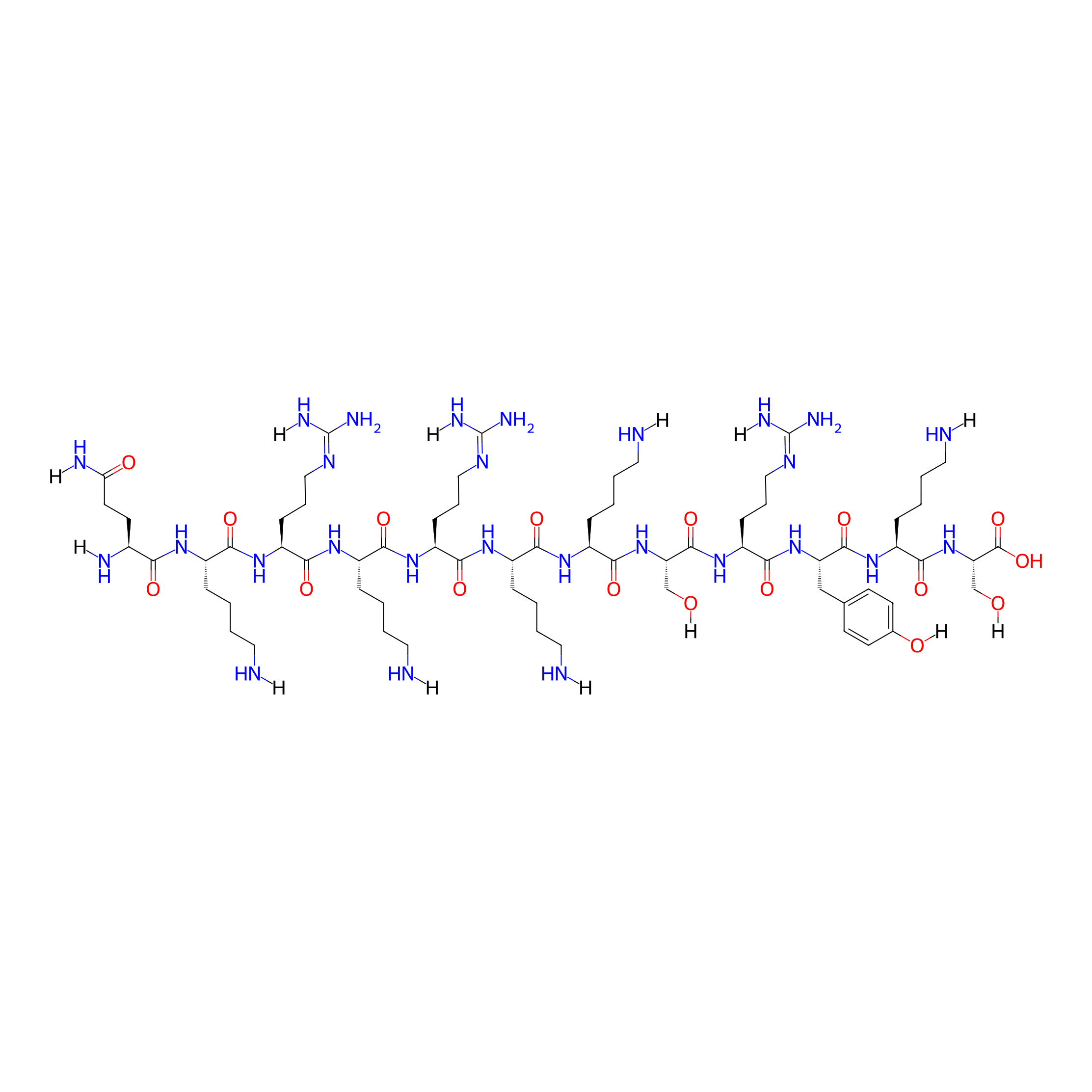
QKRKRKKSRYKS
|
|||||
| Peptide Type |
Linear
|
|||||
| Receptor Name |
Vascular endothelial growth factor receptor 1 (FLT1)
|
Receptor Info | ||||
| PDC Transmembrane Types | Cell targeting peptides (CTPs) | |||||
| Formula |
C68H125N27O17
|
|||||
| Isosmiles |
[H]NCCCC[C@H](NC(=O)[C@H](Cc1ccc(O[H])cc1)NC(=O)[C@H](CCC/N=C(/N)N[H])NC(=O)[C@H](CO[H])NC(=O)[C@H](CCCCN[H])NC(=O)[C@H](CCCCN[H])NC(=O)[C@H](CCC/N=C(/N)N[H])NC(=O)[C@H](CCCCN[H])NC(=O)[C@H](CCC/N=C(/N)N[H])NC(=O)[C@H](CCCCN[H])NC(=O)[C@H](CCC(=O)N[H])N[H])C(=O)N[C@@H](CO[H])C(=O)O
|
|||||
| InChI |
InChI=1S/C68H125N27O17/c69-28-6-1-14-42(85-54(100)41(74)26-27-53(75)99)55(101)89-47(19-11-33-82-66(76)77)58(104)87-44(16-3-8-30-71)57(103)90-48(20-12-34-83-67(78)79)59(105)86-43(15-2-7-29-70)56(102)88-45(17-4-9-31-72)61(107)94-51(37-96)64(110)92-49(21-13-35-84-68(80)81)60(106)93-50(36-39-22-24-40(98)25-23-39)63(109)91-46(18-5-10-32-73)62(108)95-52(38-97)65(111)112/h22-25,41-52,96-98H,1-21,26-38,69-74H2,(H2,75,99)(H,85,100)(H,86,105)(H,87,104)(H,88,102)(H,89,101)(H,90,103)(H,91,109)(H,92,110)(H,93,106)(H,94,107)(H,95,108)(H,111,112)(H4,76,77,82)(H4,78,79,83)(H4,80,81,84)/t41-,42-,43-,44-,45-,46-,47-,48-,49-,50-,51-,52-/m0/s1
|
|||||
| InChIKey |
ZKDMVFKKUCQMJO-SVENNQHVSA-N
|
|||||
| Pharmaceutical Properties |
Molecule Weight
|
1592.92
|
Polar area
|
810.5
|
||
|
Complexity
|
1591.974676
|
xlogp Value
|
-10.2647
|
|||
|
Heavy Count
|
112
|
Rot Bonds
|
71
|
|||
|
Hbond acc
|
25
|
Hbond Donor
|
28
|
|||
Each Peptide-drug Conjugate Related to This Peptide
Full Information of The Activity Data of The PDC(s) Related to This Peptide
QR-KLU [Investigative]
Revealed Based on the Cell Line Data
| Experiment 1 Reporting the Activity Data of This PDC | [1] | ||||
| Indication | Hepatocellular carcinoma | ||||
| Efficacy Data | Half Maximal Inhibitory Concentration (IC50) |
7.3 ± 0.74 µM
|
|||
| Administration Time | 48 h | ||||
| Evaluation Method | CCK8 assay | ||||
| MOA of PDC |
In this paper, we designed a novel PDC which was a conjugation of VEGFR targeting peptide VEGF125-136 and a lytic peptide. This novel peptide conjugate may not only target VEGFR expressed on endothelial cells and inhibit angiogenesis, but also potently inhibit cancer cell proliferation through destroying cell membrane. As its different mechanism from chemotherapeutics, this PDC has a good potential for chemo-resistance cancer therapy. We recognized this peptide could be a potential drug candidate delivered through TAE for HCC therapy. As we know, there has not been a peptide inhibitor used in combination with TACE for HCC therapy. So we developed a VX2 rabbit tumor model and applied this peptide conjugate to TAE for liver cancer therapy, in which this peptide demonstrated better in vivo anti-tumor and anti-angiogenesis effect than conventional TACE. This work may provide an alternative option in combination with TACE for HCC therapy in the future.
Click to Show/Hide
|
||||
| Description |
The effect of the peptide conjugate QR-KLU on the proliferation of Huh7 and HUVEC cells was assessed by CCK8 assays. First, we investigated anti-proliferation ability of three peptides QR, KLU and QR-KLU on Huh7 and HUVEC cells with different concentrations. As shown in Fig. Fig.3A,3A, B, cells were treated with QR peptide, KLU peptide, QR-KLU peptide, DOX with different concentration respectively. The inhibition rate increased in a dose-dependent manner in KLU and QR-KLU groups in both cell lines. In HUVEC cells, peptide QR-KLU (IC50 10.7 ± 0.292 uM) showed more potent inhibition effect than KLU (IC50 33.8 ± 0.98 uM), and in Huh7 cells, QR-KLU (IC50 7.3 ± 0.74 uM) also showed more potent anti-tumor effect than KLU (IC50 36.27 ± 2.7 uM). Meanwhile, peptide QR showed negligible toxicity even under 80 uM.
Click to Show/Hide
|
||||
| In Vitro Model | Hepatocellular carcinoma | Huh-7 cell | CVCL_0336 | ||
| Experiment 2 Reporting the Activity Data of This PDC | [1] | ||||
| Indication | Hepatocellular carcinoma | ||||
| Efficacy Data | Half Maximal Inhibitory Concentration (IC50) |
10.7 ± 0.292 µM
|
|||
| Administration Time | 48 h | ||||
| Evaluation Method | CCK8 assay | ||||
| MOA of PDC |
In this paper, we designed a novel PDC which was a conjugation of VEGFR targeting peptide VEGF125-136 and a lytic peptide. This novel peptide conjugate may not only target VEGFR expressed on endothelial cells and inhibit angiogenesis, but also potently inhibit cancer cell proliferation through destroying cell membrane. As its different mechanism from chemotherapeutics, this PDC has a good potential for chemo-resistance cancer therapy. We recognized this peptide could be a potential drug candidate delivered through TAE for HCC therapy. As we know, there has not been a peptide inhibitor used in combination with TACE for HCC therapy. So we developed a VX2 rabbit tumor model and applied this peptide conjugate to TAE for liver cancer therapy, in which this peptide demonstrated better in vivo anti-tumor and anti-angiogenesis effect than conventional TACE. This work may provide an alternative option in combination with TACE for HCC therapy in the future.
Click to Show/Hide
|
||||
| Description |
The effect of the peptide conjugate QR-KLU on the proliferation of Huh7 and HUVEC cells was assessed by CCK8 assays. First, we investigated anti-proliferation ability of three peptides QR, KLU and QR-KLU on Huh7 and HUVEC cells with different concentrations. As shown in Fig. Fig.3A,3A, B, cells were treated with QR peptide, KLU peptide, QR-KLU peptide, DOX with different concentration respectively. The inhibition rate increased in a dose-dependent manner in KLU and QR-KLU groups in both cell lines. In HUVEC cells, peptide QR-KLU (IC50 10.7 ± 0.292 uM) showed more potent inhibition effect than KLU (IC50 33.8 ± 0.98 uM), and in Huh7 cells, QR-KLU (IC50 7.3 ± 0.74 uM) also showed more potent anti-tumor effect than KLU (IC50 36.27 ± 2.7 uM). Meanwhile, peptide QR showed negligible toxicity even under 80 uM.
Click to Show/Hide
|
||||
| In Vitro Model | Normal | Human umbilical vein endothelial cell | Homo sapiens | ||
| Experiment 3 Reporting the Activity Data of This PDC | [1] | ||||
| Indication | Hepatocellular carcinoma | ||||
| Efficacy Data | Apoptosis rate |
40%
|
|||
| Administration Dosage | 10 µM | ||||
| MOA of PDC |
In this paper, we designed a novel PDC which was a conjugation of VEGFR targeting peptide VEGF125-136 and a lytic peptide. This novel peptide conjugate may not only target VEGFR expressed on endothelial cells and inhibit angiogenesis, but also potently inhibit cancer cell proliferation through destroying cell membrane. As its different mechanism from chemotherapeutics, this PDC has a good potential for chemo-resistance cancer therapy. We recognized this peptide could be a potential drug candidate delivered through TAE for HCC therapy. As we know, there has not been a peptide inhibitor used in combination with TACE for HCC therapy. So we developed a VX2 rabbit tumor model and applied this peptide conjugate to TAE for liver cancer therapy, in which this peptide demonstrated better in vivo anti-tumor and anti-angiogenesis effect than conventional TACE. This work may provide an alternative option in combination with TACE for HCC therapy in the future.
Click to Show/Hide
|
||||
| Description |
The improved proapoptotic activity of QR-KLU was further confirmed by Annexin V-PI staining through FACS. Viable cells, early apoptotic cells, necrotic cells, late apoptotic cells were represented by Q4, Q3, Q2 and Q1 respectively. Peptide QR-KLU displayed a significant proapoptotic effect under 10 uM with apoptosis rate over 60% in Huh 7 cells and over 40% in HUVEC cells.
Click to Show/Hide
|
||||
| In Vitro Model | Normal | Human umbilical vein endothelial cell | Homo sapiens | ||
| Experiment 4 Reporting the Activity Data of This PDC | [1] | ||||
| Indication | Hepatocellular carcinoma | ||||
| Efficacy Data | Apoptosis rate |
60%
|
|||
| Administration Dosage | 10 µM | ||||
| MOA of PDC |
In this paper, we designed a novel PDC which was a conjugation of VEGFR targeting peptide VEGF125-136 and a lytic peptide. This novel peptide conjugate may not only target VEGFR expressed on endothelial cells and inhibit angiogenesis, but also potently inhibit cancer cell proliferation through destroying cell membrane. As its different mechanism from chemotherapeutics, this PDC has a good potential for chemo-resistance cancer therapy. We recognized this peptide could be a potential drug candidate delivered through TAE for HCC therapy. As we know, there has not been a peptide inhibitor used in combination with TACE for HCC therapy. So we developed a VX2 rabbit tumor model and applied this peptide conjugate to TAE for liver cancer therapy, in which this peptide demonstrated better in vivo anti-tumor and anti-angiogenesis effect than conventional TACE. This work may provide an alternative option in combination with TACE for HCC therapy in the future.
Click to Show/Hide
|
||||
| Description |
The improved proapoptotic activity of QR-KLU was further confirmed by Annexin V-PI staining through FACS. Viable cells, early apoptotic cells, necrotic cells, late apoptotic cells were represented by Q4, Q3, Q2 and Q1 respectively. Peptide QR-KLU displayed a significant proapoptotic effect under 10 uM with apoptosis rate over 60% in Huh 7 cells and over 40% in HUVEC cells.
Click to Show/Hide
|
||||
| In Vitro Model | Hepatocellular carcinoma | Huh-7 cell | CVCL_0336 | ||
References