Peptide Information
General Information of This Peptide
| Peptide ID |
PEP01093
|
|||||
|---|---|---|---|---|---|---|
| Peptide Name |
Peptide A6
|
|||||
| Structure |
|
|||||
| Sequence |
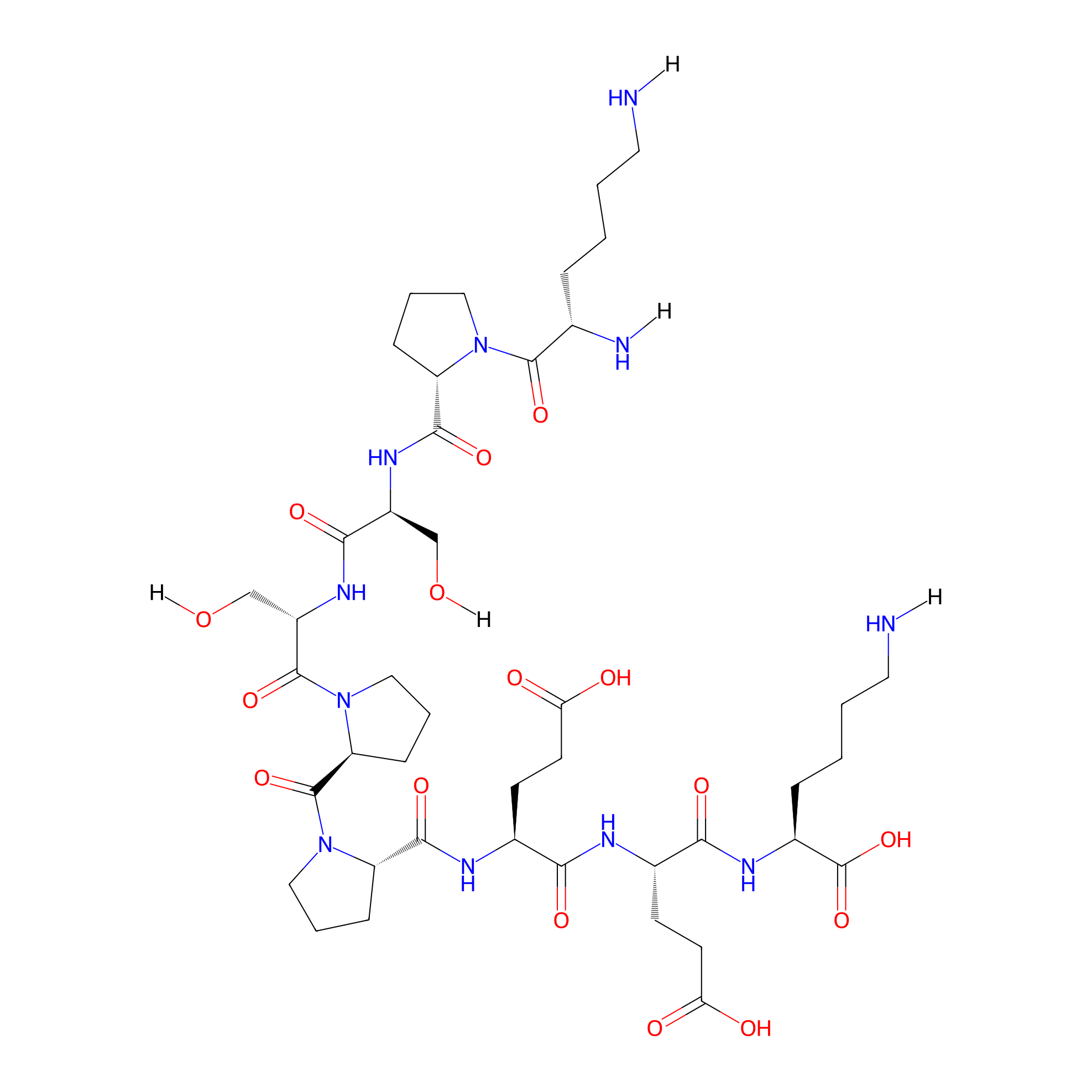
KPSSPPEEK
|
|||||
| Peptide Type |
Linear
|
|||||
| Receptor Name |
CD44 antigen (CD44)
|
Receptor Info | ||||
| PDC Transmembrane Types | Cell targeting peptides (CTPs) | |||||
| Formula |
C43H71N11O16
|
|||||
| Isosmiles |
[H]NCCCC[C@H](NC(=O)[C@H](CCC(=O)O)NC(=O)[C@H](CCC(=O)O)NC(=O)[C@@H]1CCCN1C(=O)[C@@H]1CCCN1C(=O)[C@H](CO[H])NC(=O)[C@H](CO[H])NC(=O)[C@@H]1CCCN1C(=O)[C@H](CCCCN[H])N[H])C(=O)O
|
|||||
| InChI |
InChI=1S/C43H71N11O16/c44-17-3-1-8-24(46)40(66)52-19-5-10-30(52)39(65)50-28(22-55)37(63)51-29(23-56)41(67)54-21-7-12-32(54)42(68)53-20-6-11-31(53)38(64)48-26(14-16-34(59)60)35(61)47-25(13-15-33(57)58)36(62)49-27(43(69)70)9-2-4-18-45/h24-32,55-56H,1-23,44-46H2,(H,47,61)(H,48,64)(H,49,62)(H,50,65)(H,51,63)(H,57,58)(H,59,60)(H,69,70)/t24-,25-,26-,27-,28-,29-,30-,31-,32-/m0/s1
|
|||||
| InChIKey |
GLAHFUYGILDUJS-MQAKNACASA-N
|
|||||
| Pharmaceutical Properties |
Molecule Weight
|
998.102
|
Polar area
|
436.85
|
||
|
Complexity
|
997.5080252
|
xlogp Value
|
-5.2325
|
|||
|
Heavy Count
|
70
|
Rot Bonds
|
35
|
|||
|
Hbond acc
|
16
|
Hbond Donor
|
13
|
|||
Each Peptide-drug Conjugate Related to This Peptide
Full Information of The Activity Data of The PDC(s) Related to This Peptide
Sal-A6 [Investigative]
Revealed Based on the Cell Line Data
| Experiment 1 Reporting the Activity Data of This PDC | [1] | ||||
| Indication | Ovarian serous cystadenocarcinoma | ||||
| Efficacy Data | Half maximal inhibitory concentration (IC50) |
5.45 ± 0.41 μM
|
|||
| Administration Time | 72 h | ||||
| Evaluation Method | CCK8 assay | ||||
| MOA of PDC |
In this study, a disulfide bond was employed as a linker to couple peptide A6 with Sal, yielding the novel conjugate Sal-A6. Compared to Sal, Sal-A6 not only displayed increased activity and solubility but also demonstrated a notable improvement in targeting specificity. Additionally, Sal-A6 can overcome drug-resistance in cells, leading to a sensitization effect. Surprisingly, Sal-A6 also exhibited a bystander killing effect, capable of eliminating tumor cells with low CD44 expression. Furthermore, at lower doses, it exerts antitumor effects in vivo. The glutathione (GSH) content in tumor cells resistant to cisplatin (CDDP) is significantly higher than that in non-resistant tumor cells. GSH possesses a strong binding affinity with CDDP, resulting in the inactivation of CDDP. Nevertheless, Sal can effectively decrease the intracellular GSH content in tumor cells and elevate the level of intracellular reactive oxygen species (ROS). Moreover, the disulfide bond utilized in Sal-A6 can efficiently diminish the intra-cellular GSH content, thereby overcoming cellular resistance to CDDP and improving drug sensitivity.
Click to Show/Hide
|
||||
| Description |
Cell Counting Kit-8 (CCK8) was used to evaluate the in vitro anti-tumor activity and selectivity of Sal-A6 cell viability inhibitory effect of Sal, A6, compound E, and Sal-A6 was assessed in both CD44+ SKOV3 and CD44? A2780 cells. The results showed that peptide A6 exhibited no significant inhibitory effect on any tumor cells, in line with literature reports. Conversely, Sal and compound E significantly inhibited tumor cells proliferation while Sal-A6 conjugate exhibited the ability to suppress the cell viability of CD44+ SKOV3, demonstrating superior activity compared to Sal. However, it showed no significant inhibitory effect on CD44? A2780 cells, exerting only a moderate effect under high concentration conditions, possibly due to the target-mediated cellular entry of Sal-A6. To further validate whether the cytotoxicity of Sal-A6 is related to targeting via CD44, CD44+ SKOV3 cells co-incubated with A6 peptide and Sal-A6 at concentrations of 100 μM and 10 μM, respectively. Peptide A6 partially alleviated the cytotoxicity of Sal-A6, especially at saturated concentration (100 μM), leading to a significant reduction in the in vitro activity of Sal-A6 at both low (10 μM) and high (100 μM) concentrations. These results suggest that cells with low CD44 expression or treated with peptide A6 can mitigate the cellular inhibitory effects of Sal-A6. The onset of action of Sal-A6 was slower than that of Sal, which may be due to the fact that Sal-A6 exerts its efficacy through receptor-mediated entry into the cell and has a slower onset of action than the highly fat-soluble Sal. Overall, the competitive binding of cells with low CD44 expression and peptide A6 confirms that the in vitro activity of Sal-A6 is related to CD44 expression.
Click to Show/Hide
|
||||
| In Vitro Model | Ovarian serous cystadenocarcinoma | SK-OV-3 cell | CVCL_0532 | ||
| Experiment 2 Reporting the Activity Data of This PDC | [1] | ||||
| Indication | Ovarian endometrioid adenocarcinoma | ||||
| Efficacy Data | Half maximal inhibitory concentration (IC50) |
47.09 ± 2.69 μM
|
|||
| Administration Time | 72 h | ||||
| Evaluation Method | CCK8 assay | ||||
| MOA of PDC |
In this study, a disulfide bond was employed as a linker to couple peptide A6 with Sal, yielding the novel conjugate Sal-A6. Compared to Sal, Sal-A6 not only displayed increased activity and solubility but also demonstrated a notable improvement in targeting specificity. Additionally, Sal-A6 can overcome drug-resistance in cells, leading to a sensitization effect. Surprisingly, Sal-A6 also exhibited a bystander killing effect, capable of eliminating tumor cells with low CD44 expression. Furthermore, at lower doses, it exerts antitumor effects in vivo. The glutathione (GSH) content in tumor cells resistant to cisplatin (CDDP) is significantly higher than that in non-resistant tumor cells. GSH possesses a strong binding affinity with CDDP, resulting in the inactivation of CDDP. Nevertheless, Sal can effectively decrease the intracellular GSH content in tumor cells and elevate the level of intracellular reactive oxygen species (ROS). Moreover, the disulfide bond utilized in Sal-A6 can efficiently diminish the intra-cellular GSH content, thereby overcoming cellular resistance to CDDP and improving drug sensitivity.
Click to Show/Hide
|
||||
| Description |
Cell Counting Kit-8 (CCK8) was used to evaluate the in vitro anti-tumor activity and selectivity of Sal-A6 cell viability inhibitory effect of Sal, A6, compound E, and Sal-A6 was assessed in both CD44+ SKOV3 and CD44? A2780 cells. The results showed that peptide A6 exhibited no significant inhibitory effect on any tumor cells, in line with literature reports. Conversely, Sal and compound E significantly inhibited tumor cells proliferation while Sal-A6 conjugate exhibited the ability to suppress the cell viability of CD44+ SKOV3, demonstrating superior activity compared to Sal. However, it showed no significant inhibitory effect on CD44? A2780 cells, exerting only a moderate effect under high concentration conditions, possibly due to the target-mediated cellular entry of Sal-A6. To further validate whether the cytotoxicity of Sal-A6 is related to targeting via CD44, CD44+ SKOV3 cells co-incubated with A6 peptide and Sal-A6 at concentrations of 100 μM and 10 μM, respectively. Peptide A6 partially alleviated the cytotoxicity of Sal-A6, especially at saturated concentration (100 μM), leading to a significant reduction in the in vitro activity of Sal-A6 at both low (10 μM) and high (100 μM) concentrations. These results suggest that cells with low CD44 expression or treated with peptide A6 can mitigate the cellular inhibitory effects of Sal-A6. The onset of action of Sal-A6 was slower than that of Sal, which may be due to the fact that Sal-A6 exerts its efficacy through receptor-mediated entry into the cell and has a slower onset of action than the highly fat-soluble Sal. Overall, the competitive binding of cells with low CD44 expression and peptide A6 confirms that the in vitro activity of Sal-A6 is related to CD44 expression.
Click to Show/Hide
|
||||
| In Vitro Model | Ovarian endometrioid adenocarcinoma | A2780 cell | CVCL_0134 | ||
References