Drug Information
General Information of This Drug
| Drug ID | DRG00002 | |||||
|---|---|---|---|---|---|---|
| Drug Name | Chlorambucil | |||||
| Synonyms |
chlorambucil; 305-03-3; Ambochlorin; Leukeran; Chloroambucil; Chloraminophen; Chlorbutin; Chloraminophene; Chlorobutine; Amboclorin; Ecloril; Chlorbutine; Chlorobutin; Lympholysin; Chlocambucil; Linfolizin; Linfolysin; Elcoril; Phenylbutyric acid nitrogen mustard; Leukersan; Leukoran; Chlorambucilum; NSC-3088; 4-{4-[bis(2-chloroethyl)amino]phenyl}butanoic acid; Benzenebutanoic acid, 4-[bis(2-chloroethyl)amino]-; Cb l348; CB 1348; Phenylbuttersaeure-lost; 4-(4-(Bis(2-chloroethyl)amino)phenyl)butanoic acid; NSC 3088; Rcra waste number U035; NCI-C03485; 4-[p-[Bis(2-chloroethyl)amino]phenyl]butyric acid; N,N-Di-2-chloroethyl-gamma-p-aminophenylbutyric acid; CB-1348; 4-[4-[bis(2-chloroethyl)amino]phenyl]butanoic acid; 4-(Bis(2-chloroethyl)amino)benzenebutanoic acid; p-(N,N-Di-2-chloroethyl)aminophenyl butyric acid; 4-(p-Bis(beta-chloroethyl)aminophenyl)butyric acid; Benzenebutanoic acid, 4-(bis(2-chloroethyl)amino)-; CHEBI:28830; NSC3088; 4-[Bis(2-chloroethyl)aminophenyl]butyric acid; 4-[Bis(2-chloroethyl)amino]benzenebutyric acid; MFCD00021783; 4-[Bis(2-chloroethyl)amino]benzenebutanoic acid; CHEMBL515; 4-(p-(Bis(2-chloroethyl)amino)phenyl)butyric acid; gamma-[p-Di(2-chloroethyl)aminophenyl]butyric acid; MLS000028443; Chloorambucol; Chlorbutinum; DTXSID7020263; Elcorin; 4-(Bis(2-chloroethyl)amino)phenylbutyric acid; NCI-3088; gamma-(p-Di(2-chloroethyl)aminophenyl)butyric acid; Butyric acid, 4-(p-bis(2-chloroethyl)aminophenyl)-; 18D0SL7309; Kyselina 4-(N,N-bis-(2-chlorethyl)-p-aminofenyl)maselna; NCGC00015199-08; Clorambucile; Clorambucilo; CAS-305-03-3; SMR000058372; Clorambucile [DCIT]; Leukeran tablets; 4-[Bis(2-chloroethyl)amino]phenylbutyric acid; DTXCID30263; 4-(4-[Bis(2-chloroethyl)amino]phenyl)butyric acid; .gamma.-[p-Di(2-chloroethyl)aminophenyl]butyric acid; Butyric acid, 4-[p-[bis(2-chloroethyl)amino]phenyl]-; Chlorambucilum [INN-Latin]; Clorambucilo [INN-Spanish]; p-N,N-Di-(.beta.-chloroethyl)aminophenyl butyric acid; N,N-Di-2-chloroethyl-.gamma.-p-aminophenylbutyric acid; C14H19Cl2NO2; CCRIS 126; Phenylbuttersaeure-lost [German]; HSDB 3026; SR-01000000062; LEUKERAN (TN); 4-[4-[Bis(2-chloroethyl)amino]phenyl]butyric Acid; EINECS 206-162-0; .gamma.-(p-bis(2-chloroethyl)aminophenyl)butyric acid; .gamma.-[p-bis(2-chloroethyl)aminophenyl]butyric acid; 4-(p-Bis(.beta.-chloroethyl)aminophenyl)butyric acid; 4-[p-Bis(.beta.-chloroethyl)aminophenyl]butyric acid; RCRA waste no. U035; Butyric acid, 4-(p-[bis(2-chloroethyl)amino]phenyl)-; BRN 0999011; chlorambucilddv; gamma-(p-Bis(2-chloroethyl)aminophenyl)butyric acid; Chlorambucil [USP:INN:BAN]; AI3-26083; UNII-18D0SL7309; p-(N,N-Di-2-chlorethylaminophenyl)butyric acid; para-(Di(2-chloroethyl)aminophenyl)butyric acid; Chlorambucil,(S); gamma-(p-bis(2-chloroethyl)aminophenyl)butyricacid; Butanoic acid, 4-(bis(2-chloroethyl)amino) benzene; phenyl)butanoic acid; p-N,N-Di-(beta-chloroethyl)aminophenyl butyric acid; Butyric acid, 4-(p-(bis(2-chloroethyl)amino)phenyl); para-N,N-Di(beta-chloroethyl)aminophenyl butyric acid; N,N-Di-2-chloroethyl-gamma-para-aminophenyl butyric acid; Opera_ID_51; Spectrum_000118; Kyselina 4-(N,N-bis-(2-chlorethyl)-p-aminofenyl)maselna [Czech]; Prestwick0_001079; Prestwick1_001079; Prestwick2_001079; Prestwick3_001079; Spectrum2_000065; Spectrum3_000336; Spectrum4_000273; Spectrum5_000677; CHLORAMBUCIL [MI]; Lopac-C-0253; CHLORAMBUCIL [INN]; CHLORAMBUCIL [JAN]; Epitope ID:139977; CHLORAMBUCIL [HSDB]; CHLORAMBUCIL [IARC]; SCHEMBL4308; CHLORAMBUCIL [VANDF]; Chlorambucil with impurity G; Lopac0_000227; WLN: QV3R DN2G2G; BSPBio_001098; BSPBio_001971; CHLORAMBUCIL [MART.]; KBioGR_000766; KBioSS_000558; 4-14-00-01715 (Beilstein Handbook Reference); MLS001076130; CHLORAMBUCIL [USP-RS]; CHLORAMBUCIL [WHO-DD]; CHLORAMBUCIL [WHO-IP]; DivK1c_000688; SPECTRUM1500171; Chlorambucil (JAN/USP/INN); SPBio_000249; SPBio_002999; BPBio1_001208; GTPL7143; HMS502C10; KBio1_000688; KBio2_000558; KBio2_003126; KBio2_005694; KBio3_001191; NINDS_000688; CHLORAMBUCIL [ORANGE BOOK]; Chlorambucil for system suitability; HMS1571G20; HMS1920M15; HMS2090M19; HMS2091A22; HMS2098G20; HMS2235A04; HMS3259I10; HMS3372O04; HMS3652P08; Pharmakon1600-01500171; 4-(4-(bis(2-chloroethyl)amino); CHLORAMBUCIL [EP MONOGRAPH]; AMY33445; BCP28394; CHLORAMBUCIL [USP MONOGRAPH]; Tox21_110096; Tox21_201390; Tox21_302996; BDBM50003677; CCG-39872; NSC756674; s4288; CHLORAMBUCILUM [WHO-IP LATIN]; AKOS024319346; Tox21_110096_1; Chlorambucil, purum, >=98.0% (T); CS-3118; DB00291; GS-6200; LP00227; NC00555; NSC-756674; SDCCGSBI-0050215.P005; IDI1_000688; NCGC00015199-01; NCGC00015199-02; NCGC00015199-03; NCGC00015199-04; NCGC00015199-05; NCGC00015199-06; NCGC00015199-07; NCGC00015199-09; NCGC00015199-10; NCGC00015199-11; NCGC00015199-12; NCGC00015199-13; NCGC00015199-14; NCGC00015199-15; NCGC00015199-16; NCGC00015199-17; NCGC00015199-19; NCGC00015199-20; NCGC00023250-00; NCGC00023250-03; NCGC00023250-04; NCGC00023250-05; NCGC00023250-06; NCGC00023250-07; NCGC00023250-08; NCGC00023250-09; NCGC00023250-10; NCGC00256464-01; NCGC00258941-01; BP-24028; HY-13593; NCI60_002639; SY031075; SBI-0050215.P004; DB-047794; AB00051938; C2939; EU-0100227; FT-0617365; NS00009960; SW197258-4; A18607; C 0253; C06900; D00266; EN300-123640; H10484; AB00051938-14; AB00051938-15; AB00051938_16; Q415939; 4-(4-(Bis(2-chloroethyl)amino)phenyl)butanoicacid; 4[p-Bis(.beta.-chloroethyl)aminophenyl]butyric acid; Butanoic acid, 4-(bis(2-chloroethyl)amino)benzene-; SR-01000000062-2; SR-01000000062-4; SR-01000000062-7; W-106940; .gamma.-(p-bis(2-chloroethyl)aminophenyl)butyricacid; BRD-K29458283-001-04-2; BRD-K29458283-001-05-9; BRD-K29458283-001-17-4; 4-(4-[Bis(2-chloroethyl)amino]phenyl)butanoic acid #; Z1552153009; 4-[4-(N,N-bis(2-chloroethyl)-amino]phenyl)butanoic acid; Chlorambucil, European Pharmacopoeia (EP) Reference Standard; Chlorambucil, United States Pharmacopeia (USP) Reference Standard; Chlorambucil for system suitability, European Pharmacopoeia (EP) Reference Standard
Click to Show/Hide
|
|||||
| Target(s) | DNA topoisomerase 2-alpha (TOP2A) | Target Info | ||||
| Structure |
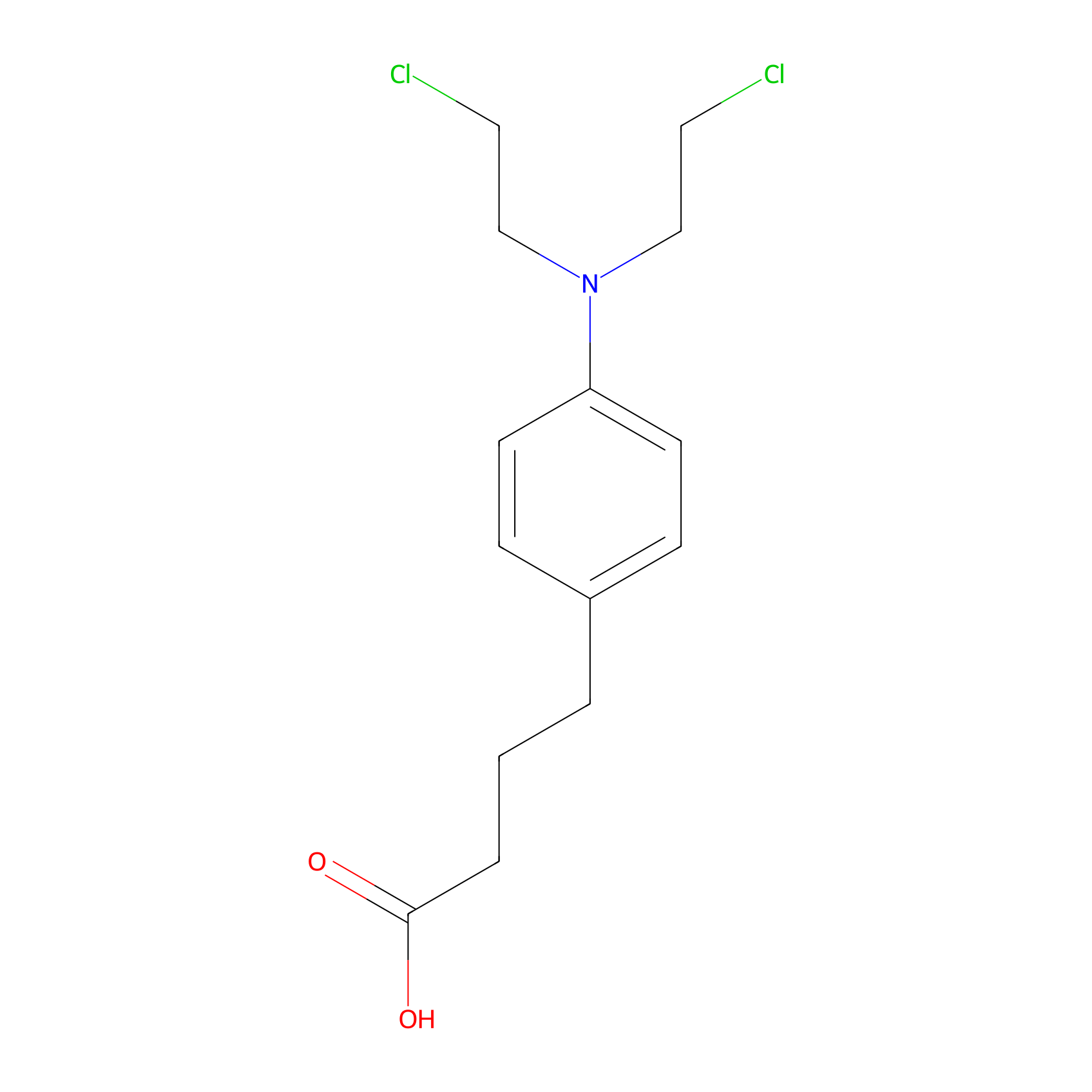
|
|||||
| Formula |
C14H19Cl2NO2
|
|||||
| #Ro5 Violations (Lipinski): 0 | Molecular Weight (mw) | 304.2 | ||||
| Lipid-water partition coefficient (xlogp) | 1.7 | |||||
| Hydrogen Bond Donor Count (hbonddonor) | 1 | |||||
| Hydrogen Bond Acceptor Count (hbondacc) | 3 | |||||
| Rotatable Bond Count (rotbonds) | 9 | |||||
| PubChem CID | ||||||
| Canonical smiles |
C1=CC(=CC=C1CCCC(=O)O)N(CCCl)CCCl
|
|||||
| InChI |
InChI=1S/C14H19Cl2NO2/c15-8-10-17(11-9-16)13-6-4-12(5-7-13)2-1-3-14(18)19/h4-7H,1-3,8-11H2,(H,18,19)
|
|||||
| InChIKey |
JCKYGMPEJWAADB-UHFFFAOYSA-N
|
|||||
| IUPAC Name |
4-[4-[bis(2-chloroethyl)amino]phenyl]butanoic acid
|
|||||
The activity data of This Drug
| Standard Type | Value | Administration times | Cell line | Cell line ID | Ref. | |
|---|---|---|---|---|---|---|
| Half Maximal Inhibitory Concentration (IC50) | 154.4 µM | 48 h | Hep-G2 cell | CVCL_0027 | [1] | |
| Half Maximal Inhibitory Concentration (IC50) | 192.5 µM | 48 h | Bel-7402 cell | CVCL_5492 | [1] | |
| Half Maximal Inhibitory Concentration (IC50) | 214.6 µM | 48 h | MCF-7 cell | CVCL_0031 | [1] | |
Each Peptide-drug Conjugate Related to This Drug
Full Information of The Activity Data of The PDC(s) Related to This Drug
CRB-FFE-YSV [Investigative]
Discovered Using Cell Line-derived Xenograft Model
| Experiment 1 Reporting the Activity Data of This PDC | [2] | ||||
| Indication | Tumor | ||||
| Efficacy Data | Relative tumor volume of mice | 356% | |||
| Administration Time | Day 1, day 4, day 7, and day 10 | ||||
| Administration Dosage | 10 µmol/kg | ||||
| Description |
After treatment for 28 days, the final relative tumor volume of mice treated with PBS, YSV, CRB, YSV + CRB, or CRB-FFE-YSV hydrogel was 927, 728, 491, 514, and 356%, respectively.
|
||||
| In Vivo Model | HepG2-tumor-bearing BALB/c nude mice. | ||||
| In Vitro Model | Hepatoblastoma | L-O2 cell line | CVCL_0027 | ||
Revealed Based on the Cell Line Data
| Experiment 1 Reporting the Activity Data of This PDC | [2] | ||||
| Indication | Tumor | ||||
| Efficacy Data | Half Maximal Inhibitory Concentration (IC50) | 25.7 µM | |||
| Evaluation Method | MTT assay | ||||
| Administration Time | 48 h | ||||
| Description |
The corresponding IC50 values of CRB-FFE-YSV nanofibers against HepG2, MCF-7, and BEL-7402 cells were 28.9, 47.5, and 25.7 um, respectively, which were much lower than that of free YSV (842.9, 999.5, and 719.2 um), free CRB (154.4, 214.6, and 192.5 um), and the mixed drugs (150.0, 190.3, and 180.6 um).
|
||||
| In Vitro Model | Hepatoma | Bel-7402 cell | CVCL_5492 | ||
| Experiment 2 Reporting the Activity Data of This PDC | [2] | ||||
| Indication | Tumor | ||||
| Efficacy Data | Half Maximal Inhibitory Concentration (IC50) | 28.9 µM | |||
| Evaluation Method | MTT assay | ||||
| Administration Time | 48 h | ||||
| Description |
The corresponding IC50 values of CRB-FFE-YSV nanofibers against HepG2, MCF-7, and BEL-7402 cells were 28.9, 47.5, and 25.7 um, respectively, which were much lower than that of free YSV (842.9, 999.5, and 719.2 um), free CRB (154.4, 214.6, and 192.5 um), and the mixed drugs (150.0, 190.3, and 180.6 um).
|
||||
| In Vitro Model | Hepatoblastoma | Hep-G2 cell | CVCL_0027 | ||
| Experiment 3 Reporting the Activity Data of This PDC | [2] | ||||
| Indication | Tumor | ||||
| Efficacy Data | Half Maximal Inhibitory Concentration (IC50) | 47.5 µM | |||
| Evaluation Method | MTT assay | ||||
| Administration Time | 48 h | ||||
| Description |
The corresponding IC50 values of CRB-FFE-YSV nanofibers against HepG2, MCF-7, and BEL-7402 cells were 28.9, 47.5, and 25.7 um, respectively, which were much lower than that of free YSV (842.9, 999.5, and 719.2 um), free CRB (154.4, 214.6, and 192.5 um), and the mixed drugs (150.0, 190.3, and 180.6 um).
|
||||
| In Vitro Model | Invasive breast carcinoma | MCF-7 cell | CVCL_0031 | ||
CRB-FFFK-cyclen [Investigative]
Revealed Based on the Cell Line Data
| Experiment 1 Reporting the Activity Data of This PDC | [3] | ||||
| Indication | Solid tumor | ||||
| Efficacy Data | Half maximal inhibitory concentration (IC50) | 23.8 μM | |||
| Evaluation Method | MTT assay | ||||
| MOA of PDC |
The DNA-alkylating agent chlorambucil (CRB) belongs to aryl nitrogen mustard antitumor drugs, and has been widely used for treating different types of cancerous diseases. However, the clinical application of CRB is severely restricted by its poor aqueous solubility, lack of targeting, short degradation half-life and severe side effects. Macrocyclic polyamines have many applications in medicine, industry and other fields, owing to their chemical and biological properties. Some of them, such as cyclen and cyclam, could be protonated below physiological pH (7.4), and the lower the pH, the higher the degree of protonation. It is reported that the pH of the tumor environment is lower than the physiological pH, which is beneficial to the protonation of macrocyclic polyamines. Modification of macrocyclic polyamine to self-assembling peptide-drug amphiphiles can increase the cell accumulation of the hydrogel, because the cationic hydrogel has a high affinity to a negatively charged cell membrane and nucleus. Therefore, a macrocyclic polyamine containing peptide hydrogel could serve as a suitable delivery system to improve the pharmacokinetic properties of CRB, achieving improved delivery efficacy and enhanced antitumor activity without severe side effects. Herein, we report a self-assembling peptide-based cationic supramolecular nanomedicine bearing the small molecule agent CRB and macrocyclic polyamine cyclen. We found that the CRB-FFFK-cyclen conjugate could readily transform into a hydrogel through a heating-cooling process, and the resulting hydrogel could significantly improve drug stability, cellular uptake and, antitumor activity.
Click to Show/Hide
|
||||
| Description |
The IC50 values of CRB-FFFK-cyclen nanofiber against A549 cells, HeLa cells and MCF-7 cells were 23.8, 50.2, and 127.4 μM, respectively.
|
||||
| In Vitro Model | Lung adenocarcinoma | A-549 cell | CVCL_0023 | ||
| Experiment 2 Reporting the Activity Data of This PDC | [3] | ||||
| Indication | Solid tumor | ||||
| Efficacy Data | Half maximal inhibitory concentration (IC50) | 50.2 μM | |||
| Evaluation Method | MTT assay | ||||
| MOA of PDC |
The DNA-alkylating agent chlorambucil (CRB) belongs to aryl nitrogen mustard antitumor drugs, and has been widely used for treating different types of cancerous diseases. However, the clinical application of CRB is severely restricted by its poor aqueous solubility, lack of targeting, short degradation half-life and severe side effects. Macrocyclic polyamines have many applications in medicine, industry and other fields, owing to their chemical and biological properties. Some of them, such as cyclen and cyclam, could be protonated below physiological pH (7.4), and the lower the pH, the higher the degree of protonation. It is reported that the pH of the tumor environment is lower than the physiological pH, which is beneficial to the protonation of macrocyclic polyamines. Modification of macrocyclic polyamine to self-assembling peptide-drug amphiphiles can increase the cell accumulation of the hydrogel, because the cationic hydrogel has a high affinity to a negatively charged cell membrane and nucleus. Therefore, a macrocyclic polyamine containing peptide hydrogel could serve as a suitable delivery system to improve the pharmacokinetic properties of CRB, achieving improved delivery efficacy and enhanced antitumor activity without severe side effects. Herein, we report a self-assembling peptide-based cationic supramolecular nanomedicine bearing the small molecule agent CRB and macrocyclic polyamine cyclen. We found that the CRB-FFFK-cyclen conjugate could readily transform into a hydrogel through a heating-cooling process, and the resulting hydrogel could significantly improve drug stability, cellular uptake and, antitumor activity.
Click to Show/Hide
|
||||
| Description |
The IC50 values of CRB-FFFK-cyclen nanofiber against A549 cells, HeLa cells and MCF-7 cells were 23.8, 50.2, and 127.4 μM, respectively.
|
||||
| In Vitro Model | Human papillomavirus-related cervical adenocarcinoma | HeLa cell | CVCL_0030 | ||
| Experiment 3 Reporting the Activity Data of This PDC | [3] | ||||
| Indication | Solid tumor | ||||
| Efficacy Data | Half maximal inhibitory concentration (IC50) | 127.4 μM | |||
| Evaluation Method | MTT assay | ||||
| MOA of PDC |
The DNA-alkylating agent chlorambucil (CRB) belongs to aryl nitrogen mustard antitumor drugs, and has been widely used for treating different types of cancerous diseases. However, the clinical application of CRB is severely restricted by its poor aqueous solubility, lack of targeting, short degradation half-life and severe side effects. Macrocyclic polyamines have many applications in medicine, industry and other fields, owing to their chemical and biological properties. Some of them, such as cyclen and cyclam, could be protonated below physiological pH (7.4), and the lower the pH, the higher the degree of protonation. It is reported that the pH of the tumor environment is lower than the physiological pH, which is beneficial to the protonation of macrocyclic polyamines. Modification of macrocyclic polyamine to self-assembling peptide-drug amphiphiles can increase the cell accumulation of the hydrogel, because the cationic hydrogel has a high affinity to a negatively charged cell membrane and nucleus. Therefore, a macrocyclic polyamine containing peptide hydrogel could serve as a suitable delivery system to improve the pharmacokinetic properties of CRB, achieving improved delivery efficacy and enhanced antitumor activity without severe side effects. Herein, we report a self-assembling peptide-based cationic supramolecular nanomedicine bearing the small molecule agent CRB and macrocyclic polyamine cyclen. We found that the CRB-FFFK-cyclen conjugate could readily transform into a hydrogel through a heating-cooling process, and the resulting hydrogel could significantly improve drug stability, cellular uptake and, antitumor activity.
Click to Show/Hide
|
||||
| Description |
The IC50 values of CRB-FFFK-cyclen nanofiber against A549 cells, HeLa cells and MCF-7 cells were 23.8, 50.2, and 127.4 μM, respectively.
|
||||
| In Vitro Model | Invasive breast carcinoma | MCF-7 cell | CVCL_0031 | ||
| Experiment 4 Reporting the Activity Data of This PDC | [3] | ||||
| Indication | Solid tumor | ||||
| Efficacy Data | Cell viability | 15.00% | |||
| Evaluation Method | MTT assay | ||||
| Administration Time | 48 h | ||||
| Administration Dosage | 500 μM | ||||
| MOA of PDC |
The DNA-alkylating agent chlorambucil (CRB) belongs to aryl nitrogen mustard antitumor drugs, and has been widely used for treating different types of cancerous diseases. However, the clinical application of CRB is severely restricted by its poor aqueous solubility, lack of targeting, short degradation half-life and severe side effects. Macrocyclic polyamines have many applications in medicine, industry and other fields, owing to their chemical and biological properties. Some of them, such as cyclen and cyclam, could be protonated below physiological pH (7.4), and the lower the pH, the higher the degree of protonation. It is reported that the pH of the tumor environment is lower than the physiological pH, which is beneficial to the protonation of macrocyclic polyamines. Modification of macrocyclic polyamine to self-assembling peptide-drug amphiphiles can increase the cell accumulation of the hydrogel, because the cationic hydrogel has a high affinity to a negatively charged cell membrane and nucleus. Therefore, a macrocyclic polyamine containing peptide hydrogel could serve as a suitable delivery system to improve the pharmacokinetic properties of CRB, achieving improved delivery efficacy and enhanced antitumor activity without severe side effects. Herein, we report a self-assembling peptide-based cationic supramolecular nanomedicine bearing the small molecule agent CRB and macrocyclic polyamine cyclen. We found that the CRB-FFFK-cyclen conjugate could readily transform into a hydrogel through a heating-cooling process, and the resulting hydrogel could significantly improve drug stability, cellular uptake and, antitumor activity.
Click to Show/Hide
|
||||
| Description |
CRB and CRB-FFFK-cyclen hydrogel both exhibited broad-spectrum anticancer activities against different types of cancer cells in a dose-dependent manner.
|
||||
| In Vitro Model | Lung adenocarcinoma | A-549 cell | CVCL_0023 | ||
| Experiment 5 Reporting the Activity Data of This PDC | [3] | ||||
| Indication | Solid tumor | ||||
| Efficacy Data | Cell viability | 15.00% | |||
| Evaluation Method | MTT assay | ||||
| Administration Time | 48 h | ||||
| Administration Dosage | 500 μM | ||||
| MOA of PDC |
The DNA-alkylating agent chlorambucil (CRB) belongs to aryl nitrogen mustard antitumor drugs, and has been widely used for treating different types of cancerous diseases. However, the clinical application of CRB is severely restricted by its poor aqueous solubility, lack of targeting, short degradation half-life and severe side effects. Macrocyclic polyamines have many applications in medicine, industry and other fields, owing to their chemical and biological properties. Some of them, such as cyclen and cyclam, could be protonated below physiological pH (7.4), and the lower the pH, the higher the degree of protonation. It is reported that the pH of the tumor environment is lower than the physiological pH, which is beneficial to the protonation of macrocyclic polyamines. Modification of macrocyclic polyamine to self-assembling peptide-drug amphiphiles can increase the cell accumulation of the hydrogel, because the cationic hydrogel has a high affinity to a negatively charged cell membrane and nucleus. Therefore, a macrocyclic polyamine containing peptide hydrogel could serve as a suitable delivery system to improve the pharmacokinetic properties of CRB, achieving improved delivery efficacy and enhanced antitumor activity without severe side effects. Herein, we report a self-assembling peptide-based cationic supramolecular nanomedicine bearing the small molecule agent CRB and macrocyclic polyamine cyclen. We found that the CRB-FFFK-cyclen conjugate could readily transform into a hydrogel through a heating-cooling process, and the resulting hydrogel could significantly improve drug stability, cellular uptake and, antitumor activity.
Click to Show/Hide
|
||||
| Description |
CRB and CRB-FFFK-cyclen hydrogel both exhibited broad-spectrum anticancer activities against different types of cancer cells in a dose-dependent manner.
|
||||
| In Vitro Model | Human papillomavirus-related cervical adenocarcinoma | HeLa cell | CVCL_0030 | ||
| Experiment 6 Reporting the Activity Data of This PDC | [3] | ||||
| Indication | Solid tumor | ||||
| Efficacy Data | Cell viability | 20.00% | |||
| Evaluation Method | MTT assay | ||||
| Administration Time | 48 h | ||||
| Administration Dosage | 250 μM | ||||
| MOA of PDC |
The DNA-alkylating agent chlorambucil (CRB) belongs to aryl nitrogen mustard antitumor drugs, and has been widely used for treating different types of cancerous diseases. However, the clinical application of CRB is severely restricted by its poor aqueous solubility, lack of targeting, short degradation half-life and severe side effects. Macrocyclic polyamines have many applications in medicine, industry and other fields, owing to their chemical and biological properties. Some of them, such as cyclen and cyclam, could be protonated below physiological pH (7.4), and the lower the pH, the higher the degree of protonation. It is reported that the pH of the tumor environment is lower than the physiological pH, which is beneficial to the protonation of macrocyclic polyamines. Modification of macrocyclic polyamine to self-assembling peptide-drug amphiphiles can increase the cell accumulation of the hydrogel, because the cationic hydrogel has a high affinity to a negatively charged cell membrane and nucleus. Therefore, a macrocyclic polyamine containing peptide hydrogel could serve as a suitable delivery system to improve the pharmacokinetic properties of CRB, achieving improved delivery efficacy and enhanced antitumor activity without severe side effects. Herein, we report a self-assembling peptide-based cationic supramolecular nanomedicine bearing the small molecule agent CRB and macrocyclic polyamine cyclen. We found that the CRB-FFFK-cyclen conjugate could readily transform into a hydrogel through a heating-cooling process, and the resulting hydrogel could significantly improve drug stability, cellular uptake and, antitumor activity.
Click to Show/Hide
|
||||
| Description |
CRB and CRB-FFFK-cyclen hydrogel both exhibited broad-spectrum anticancer activities against different types of cancer cells in a dose-dependent manner.
|
||||
| In Vitro Model | Lung adenocarcinoma | A-549 cell | CVCL_0023 | ||
| Experiment 7 Reporting the Activity Data of This PDC | [3] | ||||
| Indication | Solid tumor | ||||
| Efficacy Data | Cell viability | 20.00% | |||
| Evaluation Method | MTT assay | ||||
| Administration Time | 48 h | ||||
| Administration Dosage | 250 μM | ||||
| MOA of PDC |
The DNA-alkylating agent chlorambucil (CRB) belongs to aryl nitrogen mustard antitumor drugs, and has been widely used for treating different types of cancerous diseases. However, the clinical application of CRB is severely restricted by its poor aqueous solubility, lack of targeting, short degradation half-life and severe side effects. Macrocyclic polyamines have many applications in medicine, industry and other fields, owing to their chemical and biological properties. Some of them, such as cyclen and cyclam, could be protonated below physiological pH (7.4), and the lower the pH, the higher the degree of protonation. It is reported that the pH of the tumor environment is lower than the physiological pH, which is beneficial to the protonation of macrocyclic polyamines. Modification of macrocyclic polyamine to self-assembling peptide-drug amphiphiles can increase the cell accumulation of the hydrogel, because the cationic hydrogel has a high affinity to a negatively charged cell membrane and nucleus. Therefore, a macrocyclic polyamine containing peptide hydrogel could serve as a suitable delivery system to improve the pharmacokinetic properties of CRB, achieving improved delivery efficacy and enhanced antitumor activity without severe side effects. Herein, we report a self-assembling peptide-based cationic supramolecular nanomedicine bearing the small molecule agent CRB and macrocyclic polyamine cyclen. We found that the CRB-FFFK-cyclen conjugate could readily transform into a hydrogel through a heating-cooling process, and the resulting hydrogel could significantly improve drug stability, cellular uptake and, antitumor activity.
Click to Show/Hide
|
||||
| Description |
CRB and CRB-FFFK-cyclen hydrogel both exhibited broad-spectrum anticancer activities against different types of cancer cells in a dose-dependent manner.
|
||||
| In Vitro Model | Human papillomavirus-related cervical adenocarcinoma | HeLa cell | CVCL_0030 | ||
| Experiment 8 Reporting the Activity Data of This PDC | [3] | ||||
| Indication | Solid tumor | ||||
| Efficacy Data | Cell viability | 20.00% | |||
| Evaluation Method | MTT assay | ||||
| Administration Time | 48 h | ||||
| Administration Dosage | 500 μM | ||||
| MOA of PDC |
The DNA-alkylating agent chlorambucil (CRB) belongs to aryl nitrogen mustard antitumor drugs, and has been widely used for treating different types of cancerous diseases. However, the clinical application of CRB is severely restricted by its poor aqueous solubility, lack of targeting, short degradation half-life and severe side effects. Macrocyclic polyamines have many applications in medicine, industry and other fields, owing to their chemical and biological properties. Some of them, such as cyclen and cyclam, could be protonated below physiological pH (7.4), and the lower the pH, the higher the degree of protonation. It is reported that the pH of the tumor environment is lower than the physiological pH, which is beneficial to the protonation of macrocyclic polyamines. Modification of macrocyclic polyamine to self-assembling peptide-drug amphiphiles can increase the cell accumulation of the hydrogel, because the cationic hydrogel has a high affinity to a negatively charged cell membrane and nucleus. Therefore, a macrocyclic polyamine containing peptide hydrogel could serve as a suitable delivery system to improve the pharmacokinetic properties of CRB, achieving improved delivery efficacy and enhanced antitumor activity without severe side effects. Herein, we report a self-assembling peptide-based cationic supramolecular nanomedicine bearing the small molecule agent CRB and macrocyclic polyamine cyclen. We found that the CRB-FFFK-cyclen conjugate could readily transform into a hydrogel through a heating-cooling process, and the resulting hydrogel could significantly improve drug stability, cellular uptake and, antitumor activity.
Click to Show/Hide
|
||||
| Description |
CRB and CRB-FFFK-cyclen hydrogel both exhibited broad-spectrum anticancer activities against different types of cancer cells in a dose-dependent manner.
|
||||
| In Vitro Model | Invasive breast carcinoma | MCF-7 cell | CVCL_0031 | ||
| Experiment 9 Reporting the Activity Data of This PDC | [3] | ||||
| Indication | Solid tumor | ||||
| Efficacy Data | Cell viability | 28.00% | |||
| Evaluation Method | MTT assay | ||||
| Administration Time | 48 h | ||||
| Administration Dosage | 125 μM | ||||
| MOA of PDC |
The DNA-alkylating agent chlorambucil (CRB) belongs to aryl nitrogen mustard antitumor drugs, and has been widely used for treating different types of cancerous diseases. However, the clinical application of CRB is severely restricted by its poor aqueous solubility, lack of targeting, short degradation half-life and severe side effects. Macrocyclic polyamines have many applications in medicine, industry and other fields, owing to their chemical and biological properties. Some of them, such as cyclen and cyclam, could be protonated below physiological pH (7.4), and the lower the pH, the higher the degree of protonation. It is reported that the pH of the tumor environment is lower than the physiological pH, which is beneficial to the protonation of macrocyclic polyamines. Modification of macrocyclic polyamine to self-assembling peptide-drug amphiphiles can increase the cell accumulation of the hydrogel, because the cationic hydrogel has a high affinity to a negatively charged cell membrane and nucleus. Therefore, a macrocyclic polyamine containing peptide hydrogel could serve as a suitable delivery system to improve the pharmacokinetic properties of CRB, achieving improved delivery efficacy and enhanced antitumor activity without severe side effects. Herein, we report a self-assembling peptide-based cationic supramolecular nanomedicine bearing the small molecule agent CRB and macrocyclic polyamine cyclen. We found that the CRB-FFFK-cyclen conjugate could readily transform into a hydrogel through a heating-cooling process, and the resulting hydrogel could significantly improve drug stability, cellular uptake and, antitumor activity.
Click to Show/Hide
|
||||
| Description |
CRB and CRB-FFFK-cyclen hydrogel both exhibited broad-spectrum anticancer activities against different types of cancer cells in a dose-dependent manner.
|
||||
| In Vitro Model | Lung adenocarcinoma | A-549 cell | CVCL_0023 | ||
| Experiment 10 Reporting the Activity Data of This PDC | [3] | ||||
| Indication | Solid tumor | ||||
| Efficacy Data | Cell viability | 30.00% | |||
| Evaluation Method | MTT assay | ||||
| Administration Time | 48 h | ||||
| Administration Dosage | 62.5 μM | ||||
| MOA of PDC |
The DNA-alkylating agent chlorambucil (CRB) belongs to aryl nitrogen mustard antitumor drugs, and has been widely used for treating different types of cancerous diseases. However, the clinical application of CRB is severely restricted by its poor aqueous solubility, lack of targeting, short degradation half-life and severe side effects. Macrocyclic polyamines have many applications in medicine, industry and other fields, owing to their chemical and biological properties. Some of them, such as cyclen and cyclam, could be protonated below physiological pH (7.4), and the lower the pH, the higher the degree of protonation. It is reported that the pH of the tumor environment is lower than the physiological pH, which is beneficial to the protonation of macrocyclic polyamines. Modification of macrocyclic polyamine to self-assembling peptide-drug amphiphiles can increase the cell accumulation of the hydrogel, because the cationic hydrogel has a high affinity to a negatively charged cell membrane and nucleus. Therefore, a macrocyclic polyamine containing peptide hydrogel could serve as a suitable delivery system to improve the pharmacokinetic properties of CRB, achieving improved delivery efficacy and enhanced antitumor activity without severe side effects. Herein, we report a self-assembling peptide-based cationic supramolecular nanomedicine bearing the small molecule agent CRB and macrocyclic polyamine cyclen. We found that the CRB-FFFK-cyclen conjugate could readily transform into a hydrogel through a heating-cooling process, and the resulting hydrogel could significantly improve drug stability, cellular uptake and, antitumor activity.
Click to Show/Hide
|
||||
| Description |
CRB and CRB-FFFK-cyclen hydrogel both exhibited broad-spectrum anticancer activities against different types of cancer cells in a dose-dependent manner.
|
||||
| In Vitro Model | Lung adenocarcinoma | A-549 cell | CVCL_0023 | ||
| Experiment 11 Reporting the Activity Data of This PDC | [3] | ||||
| Indication | Solid tumor | ||||
| Efficacy Data | Cell viability | 30.00% | |||
| Evaluation Method | MTT assay | ||||
| Administration Time | 48 h | ||||
| Administration Dosage | 125 μM | ||||
| MOA of PDC |
The DNA-alkylating agent chlorambucil (CRB) belongs to aryl nitrogen mustard antitumor drugs, and has been widely used for treating different types of cancerous diseases. However, the clinical application of CRB is severely restricted by its poor aqueous solubility, lack of targeting, short degradation half-life and severe side effects. Macrocyclic polyamines have many applications in medicine, industry and other fields, owing to their chemical and biological properties. Some of them, such as cyclen and cyclam, could be protonated below physiological pH (7.4), and the lower the pH, the higher the degree of protonation. It is reported that the pH of the tumor environment is lower than the physiological pH, which is beneficial to the protonation of macrocyclic polyamines. Modification of macrocyclic polyamine to self-assembling peptide-drug amphiphiles can increase the cell accumulation of the hydrogel, because the cationic hydrogel has a high affinity to a negatively charged cell membrane and nucleus. Therefore, a macrocyclic polyamine containing peptide hydrogel could serve as a suitable delivery system to improve the pharmacokinetic properties of CRB, achieving improved delivery efficacy and enhanced antitumor activity without severe side effects. Herein, we report a self-assembling peptide-based cationic supramolecular nanomedicine bearing the small molecule agent CRB and macrocyclic polyamine cyclen. We found that the CRB-FFFK-cyclen conjugate could readily transform into a hydrogel through a heating-cooling process, and the resulting hydrogel could significantly improve drug stability, cellular uptake and, antitumor activity.
Click to Show/Hide
|
||||
| Description |
CRB and CRB-FFFK-cyclen hydrogel both exhibited broad-spectrum anticancer activities against different types of cancer cells in a dose-dependent manner.
|
||||
| In Vitro Model | Human papillomavirus-related cervical adenocarcinoma | HeLa cell | CVCL_0030 | ||
| Experiment 12 Reporting the Activity Data of This PDC | [3] | ||||
| Indication | Solid tumor | ||||
| Efficacy Data | Cell viability | 35.00% | |||
| Evaluation Method | MTT assay | ||||
| Administration Time | 48 h | ||||
| Administration Dosage | 31.3 μM | ||||
| MOA of PDC |
The DNA-alkylating agent chlorambucil (CRB) belongs to aryl nitrogen mustard antitumor drugs, and has been widely used for treating different types of cancerous diseases. However, the clinical application of CRB is severely restricted by its poor aqueous solubility, lack of targeting, short degradation half-life and severe side effects. Macrocyclic polyamines have many applications in medicine, industry and other fields, owing to their chemical and biological properties. Some of them, such as cyclen and cyclam, could be protonated below physiological pH (7.4), and the lower the pH, the higher the degree of protonation. It is reported that the pH of the tumor environment is lower than the physiological pH, which is beneficial to the protonation of macrocyclic polyamines. Modification of macrocyclic polyamine to self-assembling peptide-drug amphiphiles can increase the cell accumulation of the hydrogel, because the cationic hydrogel has a high affinity to a negatively charged cell membrane and nucleus. Therefore, a macrocyclic polyamine containing peptide hydrogel could serve as a suitable delivery system to improve the pharmacokinetic properties of CRB, achieving improved delivery efficacy and enhanced antitumor activity without severe side effects. Herein, we report a self-assembling peptide-based cationic supramolecular nanomedicine bearing the small molecule agent CRB and macrocyclic polyamine cyclen. We found that the CRB-FFFK-cyclen conjugate could readily transform into a hydrogel through a heating-cooling process, and the resulting hydrogel could significantly improve drug stability, cellular uptake and, antitumor activity.
Click to Show/Hide
|
||||
| Description |
CRB and CRB-FFFK-cyclen hydrogel both exhibited broad-spectrum anticancer activities against different types of cancer cells in a dose-dependent manner.
|
||||
| In Vitro Model | Lung adenocarcinoma | A-549 cell | CVCL_0023 | ||
| Experiment 13 Reporting the Activity Data of This PDC | [3] | ||||
| Indication | Solid tumor | ||||
| Efficacy Data | Cell viability | 40.00% | |||
| Evaluation Method | MTT assay | ||||
| Administration Time | 48 h | ||||
| Administration Dosage | 250 μM | ||||
| MOA of PDC |
The DNA-alkylating agent chlorambucil (CRB) belongs to aryl nitrogen mustard antitumor drugs, and has been widely used for treating different types of cancerous diseases. However, the clinical application of CRB is severely restricted by its poor aqueous solubility, lack of targeting, short degradation half-life and severe side effects. Macrocyclic polyamines have many applications in medicine, industry and other fields, owing to their chemical and biological properties. Some of them, such as cyclen and cyclam, could be protonated below physiological pH (7.4), and the lower the pH, the higher the degree of protonation. It is reported that the pH of the tumor environment is lower than the physiological pH, which is beneficial to the protonation of macrocyclic polyamines. Modification of macrocyclic polyamine to self-assembling peptide-drug amphiphiles can increase the cell accumulation of the hydrogel, because the cationic hydrogel has a high affinity to a negatively charged cell membrane and nucleus. Therefore, a macrocyclic polyamine containing peptide hydrogel could serve as a suitable delivery system to improve the pharmacokinetic properties of CRB, achieving improved delivery efficacy and enhanced antitumor activity without severe side effects. Herein, we report a self-assembling peptide-based cationic supramolecular nanomedicine bearing the small molecule agent CRB and macrocyclic polyamine cyclen. We found that the CRB-FFFK-cyclen conjugate could readily transform into a hydrogel through a heating-cooling process, and the resulting hydrogel could significantly improve drug stability, cellular uptake and, antitumor activity.
Click to Show/Hide
|
||||
| Description |
CRB and CRB-FFFK-cyclen hydrogel both exhibited broad-spectrum anticancer activities against different types of cancer cells in a dose-dependent manner.
|
||||
| In Vitro Model | Invasive breast carcinoma | MCF-7 cell | CVCL_0031 | ||
| Experiment 14 Reporting the Activity Data of This PDC | [3] | ||||
| Indication | Solid tumor | ||||
| Efficacy Data | Cell viability | 50.00% | |||
| Evaluation Method | MTT assay | ||||
| Administration Time | 48 h | ||||
| Administration Dosage | 125 μM | ||||
| MOA of PDC |
The DNA-alkylating agent chlorambucil (CRB) belongs to aryl nitrogen mustard antitumor drugs, and has been widely used for treating different types of cancerous diseases. However, the clinical application of CRB is severely restricted by its poor aqueous solubility, lack of targeting, short degradation half-life and severe side effects. Macrocyclic polyamines have many applications in medicine, industry and other fields, owing to their chemical and biological properties. Some of them, such as cyclen and cyclam, could be protonated below physiological pH (7.4), and the lower the pH, the higher the degree of protonation. It is reported that the pH of the tumor environment is lower than the physiological pH, which is beneficial to the protonation of macrocyclic polyamines. Modification of macrocyclic polyamine to self-assembling peptide-drug amphiphiles can increase the cell accumulation of the hydrogel, because the cationic hydrogel has a high affinity to a negatively charged cell membrane and nucleus. Therefore, a macrocyclic polyamine containing peptide hydrogel could serve as a suitable delivery system to improve the pharmacokinetic properties of CRB, achieving improved delivery efficacy and enhanced antitumor activity without severe side effects. Herein, we report a self-assembling peptide-based cationic supramolecular nanomedicine bearing the small molecule agent CRB and macrocyclic polyamine cyclen. We found that the CRB-FFFK-cyclen conjugate could readily transform into a hydrogel through a heating-cooling process, and the resulting hydrogel could significantly improve drug stability, cellular uptake and, antitumor activity.
Click to Show/Hide
|
||||
| Description |
CRB and CRB-FFFK-cyclen hydrogel both exhibited broad-spectrum anticancer activities against different types of cancer cells in a dose-dependent manner.
|
||||
| In Vitro Model | Invasive breast carcinoma | MCF-7 cell | CVCL_0031 | ||
| Experiment 15 Reporting the Activity Data of This PDC | [3] | ||||
| Indication | Solid tumor | ||||
| Efficacy Data | Cell viability | 55.00% | |||
| Evaluation Method | MTT assay | ||||
| Administration Time | 48 h | ||||
| Administration Dosage | 62.5 μM | ||||
| MOA of PDC |
The DNA-alkylating agent chlorambucil (CRB) belongs to aryl nitrogen mustard antitumor drugs, and has been widely used for treating different types of cancerous diseases. However, the clinical application of CRB is severely restricted by its poor aqueous solubility, lack of targeting, short degradation half-life and severe side effects. Macrocyclic polyamines have many applications in medicine, industry and other fields, owing to their chemical and biological properties. Some of them, such as cyclen and cyclam, could be protonated below physiological pH (7.4), and the lower the pH, the higher the degree of protonation. It is reported that the pH of the tumor environment is lower than the physiological pH, which is beneficial to the protonation of macrocyclic polyamines. Modification of macrocyclic polyamine to self-assembling peptide-drug amphiphiles can increase the cell accumulation of the hydrogel, because the cationic hydrogel has a high affinity to a negatively charged cell membrane and nucleus. Therefore, a macrocyclic polyamine containing peptide hydrogel could serve as a suitable delivery system to improve the pharmacokinetic properties of CRB, achieving improved delivery efficacy and enhanced antitumor activity without severe side effects. Herein, we report a self-assembling peptide-based cationic supramolecular nanomedicine bearing the small molecule agent CRB and macrocyclic polyamine cyclen. We found that the CRB-FFFK-cyclen conjugate could readily transform into a hydrogel through a heating-cooling process, and the resulting hydrogel could significantly improve drug stability, cellular uptake and, antitumor activity.
Click to Show/Hide
|
||||
| Description |
CRB and CRB-FFFK-cyclen hydrogel both exhibited broad-spectrum anticancer activities against different types of cancer cells in a dose-dependent manner.
|
||||
| In Vitro Model | Human papillomavirus-related cervical adenocarcinoma | HeLa cell | CVCL_0030 | ||
| Experiment 16 Reporting the Activity Data of This PDC | [3] | ||||
| Indication | Solid tumor | ||||
| Efficacy Data | Cell viability | 60.00% | |||
| Evaluation Method | MTT assay | ||||
| Administration Time | 48 h | ||||
| Administration Dosage | 15.6 μM | ||||
| MOA of PDC |
The DNA-alkylating agent chlorambucil (CRB) belongs to aryl nitrogen mustard antitumor drugs, and has been widely used for treating different types of cancerous diseases. However, the clinical application of CRB is severely restricted by its poor aqueous solubility, lack of targeting, short degradation half-life and severe side effects. Macrocyclic polyamines have many applications in medicine, industry and other fields, owing to their chemical and biological properties. Some of them, such as cyclen and cyclam, could be protonated below physiological pH (7.4), and the lower the pH, the higher the degree of protonation. It is reported that the pH of the tumor environment is lower than the physiological pH, which is beneficial to the protonation of macrocyclic polyamines. Modification of macrocyclic polyamine to self-assembling peptide-drug amphiphiles can increase the cell accumulation of the hydrogel, because the cationic hydrogel has a high affinity to a negatively charged cell membrane and nucleus. Therefore, a macrocyclic polyamine containing peptide hydrogel could serve as a suitable delivery system to improve the pharmacokinetic properties of CRB, achieving improved delivery efficacy and enhanced antitumor activity without severe side effects. Herein, we report a self-assembling peptide-based cationic supramolecular nanomedicine bearing the small molecule agent CRB and macrocyclic polyamine cyclen. We found that the CRB-FFFK-cyclen conjugate could readily transform into a hydrogel through a heating-cooling process, and the resulting hydrogel could significantly improve drug stability, cellular uptake and, antitumor activity.
Click to Show/Hide
|
||||
| Description |
CRB and CRB-FFFK-cyclen hydrogel both exhibited broad-spectrum anticancer activities against different types of cancer cells in a dose-dependent manner.
|
||||
| In Vitro Model | Lung adenocarcinoma | A-549 cell | CVCL_0023 | ||
| Experiment 17 Reporting the Activity Data of This PDC | [3] | ||||
| Indication | Solid tumor | ||||
| Efficacy Data | Cell viability | 60.00% | |||
| Evaluation Method | MTT assay | ||||
| Administration Time | 48 h | ||||
| Administration Dosage | 31.3 μM | ||||
| MOA of PDC |
The DNA-alkylating agent chlorambucil (CRB) belongs to aryl nitrogen mustard antitumor drugs, and has been widely used for treating different types of cancerous diseases. However, the clinical application of CRB is severely restricted by its poor aqueous solubility, lack of targeting, short degradation half-life and severe side effects. Macrocyclic polyamines have many applications in medicine, industry and other fields, owing to their chemical and biological properties. Some of them, such as cyclen and cyclam, could be protonated below physiological pH (7.4), and the lower the pH, the higher the degree of protonation. It is reported that the pH of the tumor environment is lower than the physiological pH, which is beneficial to the protonation of macrocyclic polyamines. Modification of macrocyclic polyamine to self-assembling peptide-drug amphiphiles can increase the cell accumulation of the hydrogel, because the cationic hydrogel has a high affinity to a negatively charged cell membrane and nucleus. Therefore, a macrocyclic polyamine containing peptide hydrogel could serve as a suitable delivery system to improve the pharmacokinetic properties of CRB, achieving improved delivery efficacy and enhanced antitumor activity without severe side effects. Herein, we report a self-assembling peptide-based cationic supramolecular nanomedicine bearing the small molecule agent CRB and macrocyclic polyamine cyclen. We found that the CRB-FFFK-cyclen conjugate could readily transform into a hydrogel through a heating-cooling process, and the resulting hydrogel could significantly improve drug stability, cellular uptake and, antitumor activity.
Click to Show/Hide
|
||||
| Description |
CRB and CRB-FFFK-cyclen hydrogel both exhibited broad-spectrum anticancer activities against different types of cancer cells in a dose-dependent manner.
|
||||
| In Vitro Model | Human papillomavirus-related cervical adenocarcinoma | HeLa cell | CVCL_0030 | ||
| Experiment 18 Reporting the Activity Data of This PDC | [3] | ||||
| Indication | Solid tumor | ||||
| Efficacy Data | Cell viability | 62.00% | |||
| Evaluation Method | MTT assay | ||||
| Administration Time | 48 h | ||||
| Administration Dosage | 15.6 μM | ||||
| MOA of PDC |
The DNA-alkylating agent chlorambucil (CRB) belongs to aryl nitrogen mustard antitumor drugs, and has been widely used for treating different types of cancerous diseases. However, the clinical application of CRB is severely restricted by its poor aqueous solubility, lack of targeting, short degradation half-life and severe side effects. Macrocyclic polyamines have many applications in medicine, industry and other fields, owing to their chemical and biological properties. Some of them, such as cyclen and cyclam, could be protonated below physiological pH (7.4), and the lower the pH, the higher the degree of protonation. It is reported that the pH of the tumor environment is lower than the physiological pH, which is beneficial to the protonation of macrocyclic polyamines. Modification of macrocyclic polyamine to self-assembling peptide-drug amphiphiles can increase the cell accumulation of the hydrogel, because the cationic hydrogel has a high affinity to a negatively charged cell membrane and nucleus. Therefore, a macrocyclic polyamine containing peptide hydrogel could serve as a suitable delivery system to improve the pharmacokinetic properties of CRB, achieving improved delivery efficacy and enhanced antitumor activity without severe side effects. Herein, we report a self-assembling peptide-based cationic supramolecular nanomedicine bearing the small molecule agent CRB and macrocyclic polyamine cyclen. We found that the CRB-FFFK-cyclen conjugate could readily transform into a hydrogel through a heating-cooling process, and the resulting hydrogel could significantly improve drug stability, cellular uptake and, antitumor activity.
Click to Show/Hide
|
||||
| Description |
CRB and CRB-FFFK-cyclen hydrogel both exhibited broad-spectrum anticancer activities against different types of cancer cells in a dose-dependent manner.
|
||||
| In Vitro Model | Human papillomavirus-related cervical adenocarcinoma | HeLa cell | CVCL_0030 | ||
| Experiment 19 Reporting the Activity Data of This PDC | [3] | ||||
| Indication | Solid tumor | ||||
| Efficacy Data | Cell viability | 64.00% | |||
| Evaluation Method | MTT assay | ||||
| Administration Time | 48 h | ||||
| Administration Dosage | 7.8 μM | ||||
| MOA of PDC |
The DNA-alkylating agent chlorambucil (CRB) belongs to aryl nitrogen mustard antitumor drugs, and has been widely used for treating different types of cancerous diseases. However, the clinical application of CRB is severely restricted by its poor aqueous solubility, lack of targeting, short degradation half-life and severe side effects. Macrocyclic polyamines have many applications in medicine, industry and other fields, owing to their chemical and biological properties. Some of them, such as cyclen and cyclam, could be protonated below physiological pH (7.4), and the lower the pH, the higher the degree of protonation. It is reported that the pH of the tumor environment is lower than the physiological pH, which is beneficial to the protonation of macrocyclic polyamines. Modification of macrocyclic polyamine to self-assembling peptide-drug amphiphiles can increase the cell accumulation of the hydrogel, because the cationic hydrogel has a high affinity to a negatively charged cell membrane and nucleus. Therefore, a macrocyclic polyamine containing peptide hydrogel could serve as a suitable delivery system to improve the pharmacokinetic properties of CRB, achieving improved delivery efficacy and enhanced antitumor activity without severe side effects. Herein, we report a self-assembling peptide-based cationic supramolecular nanomedicine bearing the small molecule agent CRB and macrocyclic polyamine cyclen. We found that the CRB-FFFK-cyclen conjugate could readily transform into a hydrogel through a heating-cooling process, and the resulting hydrogel could significantly improve drug stability, cellular uptake and, antitumor activity.
Click to Show/Hide
|
||||
| Description |
CRB and CRB-FFFK-cyclen hydrogel both exhibited broad-spectrum anticancer activities against different types of cancer cells in a dose-dependent manner.
|
||||
| In Vitro Model | Human papillomavirus-related cervical adenocarcinoma | HeLa cell | CVCL_0030 | ||
| Experiment 20 Reporting the Activity Data of This PDC | [3] | ||||
| Indication | Solid tumor | ||||
| Efficacy Data | Cell viability | 70.00% | |||
| Evaluation Method | MTT assay | ||||
| Administration Time | 48 h | ||||
| Administration Dosage | 62.5 μM | ||||
| MOA of PDC |
The DNA-alkylating agent chlorambucil (CRB) belongs to aryl nitrogen mustard antitumor drugs, and has been widely used for treating different types of cancerous diseases. However, the clinical application of CRB is severely restricted by its poor aqueous solubility, lack of targeting, short degradation half-life and severe side effects. Macrocyclic polyamines have many applications in medicine, industry and other fields, owing to their chemical and biological properties. Some of them, such as cyclen and cyclam, could be protonated below physiological pH (7.4), and the lower the pH, the higher the degree of protonation. It is reported that the pH of the tumor environment is lower than the physiological pH, which is beneficial to the protonation of macrocyclic polyamines. Modification of macrocyclic polyamine to self-assembling peptide-drug amphiphiles can increase the cell accumulation of the hydrogel, because the cationic hydrogel has a high affinity to a negatively charged cell membrane and nucleus. Therefore, a macrocyclic polyamine containing peptide hydrogel could serve as a suitable delivery system to improve the pharmacokinetic properties of CRB, achieving improved delivery efficacy and enhanced antitumor activity without severe side effects. Herein, we report a self-assembling peptide-based cationic supramolecular nanomedicine bearing the small molecule agent CRB and macrocyclic polyamine cyclen. We found that the CRB-FFFK-cyclen conjugate could readily transform into a hydrogel through a heating-cooling process, and the resulting hydrogel could significantly improve drug stability, cellular uptake and, antitumor activity.
Click to Show/Hide
|
||||
| Description |
CRB and CRB-FFFK-cyclen hydrogel both exhibited broad-spectrum anticancer activities against different types of cancer cells in a dose-dependent manner.
|
||||
| In Vitro Model | Invasive breast carcinoma | MCF-7 cell | CVCL_0031 | ||
| Experiment 21 Reporting the Activity Data of This PDC | [3] | ||||
| Indication | Solid tumor | ||||
| Efficacy Data | Cell viability | 78.00% | |||
| Evaluation Method | MTT assay | ||||
| Administration Time | 48 h | ||||
| Administration Dosage | 7.8 μM | ||||
| MOA of PDC |
The DNA-alkylating agent chlorambucil (CRB) belongs to aryl nitrogen mustard antitumor drugs, and has been widely used for treating different types of cancerous diseases. However, the clinical application of CRB is severely restricted by its poor aqueous solubility, lack of targeting, short degradation half-life and severe side effects. Macrocyclic polyamines have many applications in medicine, industry and other fields, owing to their chemical and biological properties. Some of them, such as cyclen and cyclam, could be protonated below physiological pH (7.4), and the lower the pH, the higher the degree of protonation. It is reported that the pH of the tumor environment is lower than the physiological pH, which is beneficial to the protonation of macrocyclic polyamines. Modification of macrocyclic polyamine to self-assembling peptide-drug amphiphiles can increase the cell accumulation of the hydrogel, because the cationic hydrogel has a high affinity to a negatively charged cell membrane and nucleus. Therefore, a macrocyclic polyamine containing peptide hydrogel could serve as a suitable delivery system to improve the pharmacokinetic properties of CRB, achieving improved delivery efficacy and enhanced antitumor activity without severe side effects. Herein, we report a self-assembling peptide-based cationic supramolecular nanomedicine bearing the small molecule agent CRB and macrocyclic polyamine cyclen. We found that the CRB-FFFK-cyclen conjugate could readily transform into a hydrogel through a heating-cooling process, and the resulting hydrogel could significantly improve drug stability, cellular uptake and, antitumor activity.
Click to Show/Hide
|
||||
| Description |
CRB and CRB-FFFK-cyclen hydrogel both exhibited broad-spectrum anticancer activities against different types of cancer cells in a dose-dependent manner.
|
||||
| In Vitro Model | Lung adenocarcinoma | A-549 cell | CVCL_0023 | ||
| Experiment 22 Reporting the Activity Data of This PDC | [3] | ||||
| Indication | Solid tumor | ||||
| Efficacy Data | Cell viability | 78.00% | |||
| Evaluation Method | MTT assay | ||||
| Administration Time | 48 h | ||||
| Administration Dosage | 31.3 μM | ||||
| MOA of PDC |
The DNA-alkylating agent chlorambucil (CRB) belongs to aryl nitrogen mustard antitumor drugs, and has been widely used for treating different types of cancerous diseases. However, the clinical application of CRB is severely restricted by its poor aqueous solubility, lack of targeting, short degradation half-life and severe side effects. Macrocyclic polyamines have many applications in medicine, industry and other fields, owing to their chemical and biological properties. Some of them, such as cyclen and cyclam, could be protonated below physiological pH (7.4), and the lower the pH, the higher the degree of protonation. It is reported that the pH of the tumor environment is lower than the physiological pH, which is beneficial to the protonation of macrocyclic polyamines. Modification of macrocyclic polyamine to self-assembling peptide-drug amphiphiles can increase the cell accumulation of the hydrogel, because the cationic hydrogel has a high affinity to a negatively charged cell membrane and nucleus. Therefore, a macrocyclic polyamine containing peptide hydrogel could serve as a suitable delivery system to improve the pharmacokinetic properties of CRB, achieving improved delivery efficacy and enhanced antitumor activity without severe side effects. Herein, we report a self-assembling peptide-based cationic supramolecular nanomedicine bearing the small molecule agent CRB and macrocyclic polyamine cyclen. We found that the CRB-FFFK-cyclen conjugate could readily transform into a hydrogel through a heating-cooling process, and the resulting hydrogel could significantly improve drug stability, cellular uptake and, antitumor activity.
Click to Show/Hide
|
||||
| Description |
CRB and CRB-FFFK-cyclen hydrogel both exhibited broad-spectrum anticancer activities against different types of cancer cells in a dose-dependent manner.
|
||||
| In Vitro Model | Invasive breast carcinoma | MCF-7 cell | CVCL_0031 | ||
| Experiment 23 Reporting the Activity Data of This PDC | [3] | ||||
| Indication | Solid tumor | ||||
| Efficacy Data | Cell viability | 80.00% | |||
| Evaluation Method | MTT assay | ||||
| Administration Time | 48 h | ||||
| Administration Dosage | 15.6 μM | ||||
| MOA of PDC |
The DNA-alkylating agent chlorambucil (CRB) belongs to aryl nitrogen mustard antitumor drugs, and has been widely used for treating different types of cancerous diseases. However, the clinical application of CRB is severely restricted by its poor aqueous solubility, lack of targeting, short degradation half-life and severe side effects. Macrocyclic polyamines have many applications in medicine, industry and other fields, owing to their chemical and biological properties. Some of them, such as cyclen and cyclam, could be protonated below physiological pH (7.4), and the lower the pH, the higher the degree of protonation. It is reported that the pH of the tumor environment is lower than the physiological pH, which is beneficial to the protonation of macrocyclic polyamines. Modification of macrocyclic polyamine to self-assembling peptide-drug amphiphiles can increase the cell accumulation of the hydrogel, because the cationic hydrogel has a high affinity to a negatively charged cell membrane and nucleus. Therefore, a macrocyclic polyamine containing peptide hydrogel could serve as a suitable delivery system to improve the pharmacokinetic properties of CRB, achieving improved delivery efficacy and enhanced antitumor activity without severe side effects. Herein, we report a self-assembling peptide-based cationic supramolecular nanomedicine bearing the small molecule agent CRB and macrocyclic polyamine cyclen. We found that the CRB-FFFK-cyclen conjugate could readily transform into a hydrogel through a heating-cooling process, and the resulting hydrogel could significantly improve drug stability, cellular uptake and, antitumor activity.
Click to Show/Hide
|
||||
| Description |
CRB and CRB-FFFK-cyclen hydrogel both exhibited broad-spectrum anticancer activities against different types of cancer cells in a dose-dependent manner.
|
||||
| In Vitro Model | Invasive breast carcinoma | MCF-7 cell | CVCL_0031 | ||
| Experiment 24 Reporting the Activity Data of This PDC | [3] | ||||
| Indication | Solid tumor | ||||
| Efficacy Data | Cell viability | 83.00% | |||
| Evaluation Method | MTT assay | ||||
| Administration Time | 48 h | ||||
| Administration Dosage | 7.8 μM | ||||
| MOA of PDC |
The DNA-alkylating agent chlorambucil (CRB) belongs to aryl nitrogen mustard antitumor drugs, and has been widely used for treating different types of cancerous diseases. However, the clinical application of CRB is severely restricted by its poor aqueous solubility, lack of targeting, short degradation half-life and severe side effects. Macrocyclic polyamines have many applications in medicine, industry and other fields, owing to their chemical and biological properties. Some of them, such as cyclen and cyclam, could be protonated below physiological pH (7.4), and the lower the pH, the higher the degree of protonation. It is reported that the pH of the tumor environment is lower than the physiological pH, which is beneficial to the protonation of macrocyclic polyamines. Modification of macrocyclic polyamine to self-assembling peptide-drug amphiphiles can increase the cell accumulation of the hydrogel, because the cationic hydrogel has a high affinity to a negatively charged cell membrane and nucleus. Therefore, a macrocyclic polyamine containing peptide hydrogel could serve as a suitable delivery system to improve the pharmacokinetic properties of CRB, achieving improved delivery efficacy and enhanced antitumor activity without severe side effects. Herein, we report a self-assembling peptide-based cationic supramolecular nanomedicine bearing the small molecule agent CRB and macrocyclic polyamine cyclen. We found that the CRB-FFFK-cyclen conjugate could readily transform into a hydrogel through a heating-cooling process, and the resulting hydrogel could significantly improve drug stability, cellular uptake and, antitumor activity.
Click to Show/Hide
|
||||
| Description |
CRB and CRB-FFFK-cyclen hydrogel both exhibited broad-spectrum anticancer activities against different types of cancer cells in a dose-dependent manner.
|
||||
| In Vitro Model | Invasive breast carcinoma | MCF-7 cell | CVCL_0031 | ||
99mTc-HYNIC-CLB-c(NGR) [Investigative]
Revealed Based on the Cell Line Data
| Experiment 1 Reporting the Activity Data of This PDC | [4] | ||||
| Indication | Melanoma | ||||
| Efficacy Data | Growth inhibition rate | 30% | |||
| Evaluation Method | MTT assay | ||||
| Administration Time | 48 h | ||||
| Administration Dosage | 1 µM | ||||
| Description |
The exposure of cells to PDC resulted in significant growth inhibition at all the concentrations as compared to the drug or the peptide alone. It was observed that nearly 25-fold excess concentration of the drug is required to achieve similar cytotoxicity as obtained on exposure to PDC. The RGD peptide-CLB conjugate has also been reported to show higher growth inhibition in B16F10 cells as compared to the drug or peptide alone.24 The enhanced cytotoxic effect of PDC even at lower levels indicates clear advantage in reducing the systemic exposure and side effects of the drug.
Click to Show/Hide
|
||||
| In Vitro Model | Mouse melanoma | B16-F10 cell | CVCL_0159 | ||
| Experiment 2 Reporting the Activity Data of This PDC | [4] | ||||
| Indication | Melanoma | ||||
| Efficacy Data | Growth inhibition rate | 33% | |||
| Evaluation Method | MTT assay | ||||
| Administration Time | 48 h | ||||
| Administration Dosage | 5 µM | ||||
| MOA of PDC |
Although RNT with 177Lu-DOTATATE/PSMA is known as a novel and effective therapy option for cancer that significantly improves the quality of life and survival of patients, it may have acute or chronic side effects. Therefore, any method that can ameliorate these side effects is useful in the RNT process. For this purpose, a few clinical studies have reported that antioxidants as free radical scavengers such as amifostine and vitamins C and E can reduce radioiodine-related side effects, particularly in salivary glands in thyroid cancer patients.
Click to Show/Hide
|
||||
| Description |
The exposure of cells to PDC resulted in significant growth inhibition at all the concentrations as compared to the drug or the peptide alone. It was observed that nearly 25-fold excess concentration of the drug is required to achieve similar cytotoxicity as obtained on exposure to PDC. The RGD peptide-CLB conjugate has also been reported to show higher growth inhibition in B16F10 cells as compared to the drug or peptide alone.24 The enhanced cytotoxic effect of PDC even at lower levels indicates clear advantage in reducing the systemic exposure and side effects of the drug.
Click to Show/Hide
|
||||
| In Vitro Model | Mouse melanoma | B16-F10 cell | CVCL_0159 | ||
| Experiment 3 Reporting the Activity Data of This PDC | [4] | ||||
| Indication | Melanoma | ||||
| Efficacy Data | Growth inhibition rate | 40% | |||
| Evaluation Method | MTT assay | ||||
| Administration Time | 48 h | ||||
| Administration Dosage | 10 µM | ||||
| Description |
The exposure of cells to PDC resulted in significant growth inhibition at all the concentrations as compared to the drug or the peptide alone. It was observed that nearly 25-fold excess concentration of the drug is required to achieve similar cytotoxicity as obtained on exposure to PDC. The RGD peptide-CLB conjugate has also been reported to show higher growth inhibition in B16F10 cells as compared to the drug or peptide alone.24 The enhanced cytotoxic effect of PDC even at lower levels indicates clear advantage in reducing the systemic exposure and side effects of the drug.
Click to Show/Hide
|
||||
| In Vitro Model | Mouse melanoma | B16-F10 cell | CVCL_0159 | ||
| Experiment 4 Reporting the Activity Data of This PDC | [4] | ||||
| Indication | Melanoma | ||||
| Efficacy Data | Growth inhibition rate | 55% | |||
| Evaluation Method | MTT assay | ||||
| Administration Time | 48 h | ||||
| Administration Dosage | 25 µM | ||||
| Description |
The exposure of cells to PDC resulted in significant growth inhibition at all the concentrations as compared to the drug or the peptide alone. It was observed that nearly 25-fold excess concentration of the drug is required to achieve similar cytotoxicity as obtained on exposure to PDC. The RGD peptide-CLB conjugate has also been reported to show higher growth inhibition in B16F10 cells as compared to the drug or peptide alone.24 The enhanced cytotoxic effect of PDC even at lower levels indicates clear advantage in reducing the systemic exposure and side effects of the drug.
Click to Show/Hide
|
||||
| In Vitro Model | Mouse melanoma | B16-F10 cell | CVCL_0159 | ||
| Experiment 5 Reporting the Activity Data of This PDC | [4] | ||||
| Indication | Melanoma | ||||
| Efficacy Data | Growth inhibition rate | 75% | |||
| Evaluation Method | MTT assay | ||||
| Administration Time | 48 h | ||||
| Administration Dosage | 50 µM | ||||
| Description |
The exposure of cells to PDC resulted in significant growth inhibition at all the concentrations as compared to the drug or the peptide alone. It was observed that nearly 25-fold excess concentration of the drug is required to achieve similar cytotoxicity as obtained on exposure to PDC. The RGD peptide-CLB conjugate has also been reported to show higher growth inhibition in B16F10 cells as compared to the drug or peptide alone.24 The enhanced cytotoxic effect of PDC even at lower levels indicates clear advantage in reducing the systemic exposure and side effects of the drug.
Click to Show/Hide
|
||||
| In Vitro Model | Mouse melanoma | B16-F10 cell | CVCL_0159 | ||
P6-chlorambucil [Investigative]
Revealed Based on the Cell Line Data
| Experiment 1 Reporting the Activity Data of This PDC | [5] | ||||
| Indication | Tumor | ||||
| Efficacy Data | A20 growth inhibition | 22.00% | |||
| Evaluation Method | XTT assay | ||||
| Administration Time | 72 h | ||||
| Administration Dosage | 50 µM | ||||
| Description |
Conjugation of the drugs to P4 affected their efficacy toward A20 cells. For chlorambucil and melphalan, conjugation reduced the cytotoxic effect and this was significant for chlorambucil at 25 μM (p = 0.0013). On the other hand, conjugation significantly improved the cytotoxic effect of bendamustine at 25 (p = 0.043) and 50 μM (p = 0.048). The efficacies of all P6-conjugates were significantly lower than those of P4-conjugates at concentrations above 10 μM.
Click to Show/Hide
|
||||
| In Vitro Model | Mouse reticulum cell sarcoma | A20 cell | CVCL_1940 | ||
P4-Chlor-PEG-AuNP [Investigative]
Revealed Based on the Cell Line Data
| Experiment 1 Reporting the Activity Data of This PDC | [5] | ||||
| Indication | Tumor | ||||
| Efficacy Data | A20 growth inhibition | 40.00% | |||
| Evaluation Method | XTT assay | ||||
| Administration Time | 72 h | ||||
| Administration Dosage | 50 µM | ||||
| Description |
All three P4-PDC-coated gold nanoparticles pre-incubated for 24 or 48 h induced statistically similar cytotoxicity in A20 to that induced by freshly prepared PDC4 and to coated particles without pre-incubation (the latter data not shown).
|
||||
| In Vitro Model | Mouse reticulum cell sarcoma | A20 cell | CVCL_1940 | ||
| Experiment 2 Reporting the Activity Data of This PDC | [5] | ||||
| Indication | Tumor | ||||
| Efficacy Data | A20 growth inhibition | 72.00% | |||
| Evaluation Method | XTT assay | ||||
| Administration Time | 48 h | ||||
| Administration Dosage | 50 µM | ||||
| MOA of PDC |
In biological systems, antioxidants such as catalase, superoxide dismutase, glutathione peroxidase, and glutathione reductase are responsible for the elimination or reduction of the adverse effects of ROS, that is, they prevent or reduce ROS generation. Dietary antioxidants, such as vitamins E, A, and C, and anthocyanins and polyphenols have a role in the protection of cells against ROS damage.
Click to Show/Hide
|
||||
| Description |
All three P4-PDC-coated gold nanoparticles pre-incubated for 24 or 48 h induced statistically similar cytotoxicity in A20 to that induced by freshly prepared PDC4 and to coated particles without pre-incubation (the latter data not shown).
|
||||
| In Vitro Model | Mouse reticulum cell sarcoma | A20 cell | CVCL_1940 | ||
| Experiment 3 Reporting the Activity Data of This PDC | [5] | ||||
| Indication | Tumor | ||||
| Efficacy Data | A20 growth inhibition | 80.00% | |||
| Evaluation Method | XTT assay | ||||
| Administration Time | 24 h | ||||
| Administration Dosage | 50 µM | ||||
| Description |
All three P4-PDC-coated gold nanoparticles pre-incubated for 24 or 48 h induced statistically similar cytotoxicity in A20 to that induced by freshly prepared PDC4 and to coated particles without pre-incubation (the latter data not shown).
|
||||
| In Vitro Model | Mouse reticulum cell sarcoma | A20 cell | CVCL_1940 | ||
P4-chlorambucil [Investigative]
Revealed Based on the Cell Line Data
| Experiment 1 Reporting the Activity Data of This PDC | [5] | ||||
| Indication | Tumor | ||||
| Efficacy Data | A20 growth inhibition | 70.00% | |||
| Evaluation Method | XTT assay | ||||
| Administration Time | 72 h | ||||
| Administration Dosage | 50 µM | ||||
| Description |
Conjugation of the drugs to P4 affected their efficacy toward A20 cells. For chlorambucil and melphalan, conjugation reduced the cytotoxic effect and this was significant for chlorambucil at 25 μM (p = 0.0013). On the other hand, conjugation significantly improved the cytotoxic effect of bendamustine at 25 (p = 0.043) and 50 μM (p = 0.048). The efficacies of all P6-conjugates were significantly lower than those of P4-conjugates at concentrations above 10 μM.
Click to Show/Hide
|
||||
| In Vitro Model | Mouse reticulum cell sarcoma | A20 cell | CVCL_1940 | ||
References