Peptide-drug Conjugate Information
General Information of This Peptide-drug Conjugate (PDC)
| PDC ID |
PDC_02068
|
|||||
|---|---|---|---|---|---|---|
| PDC Name |
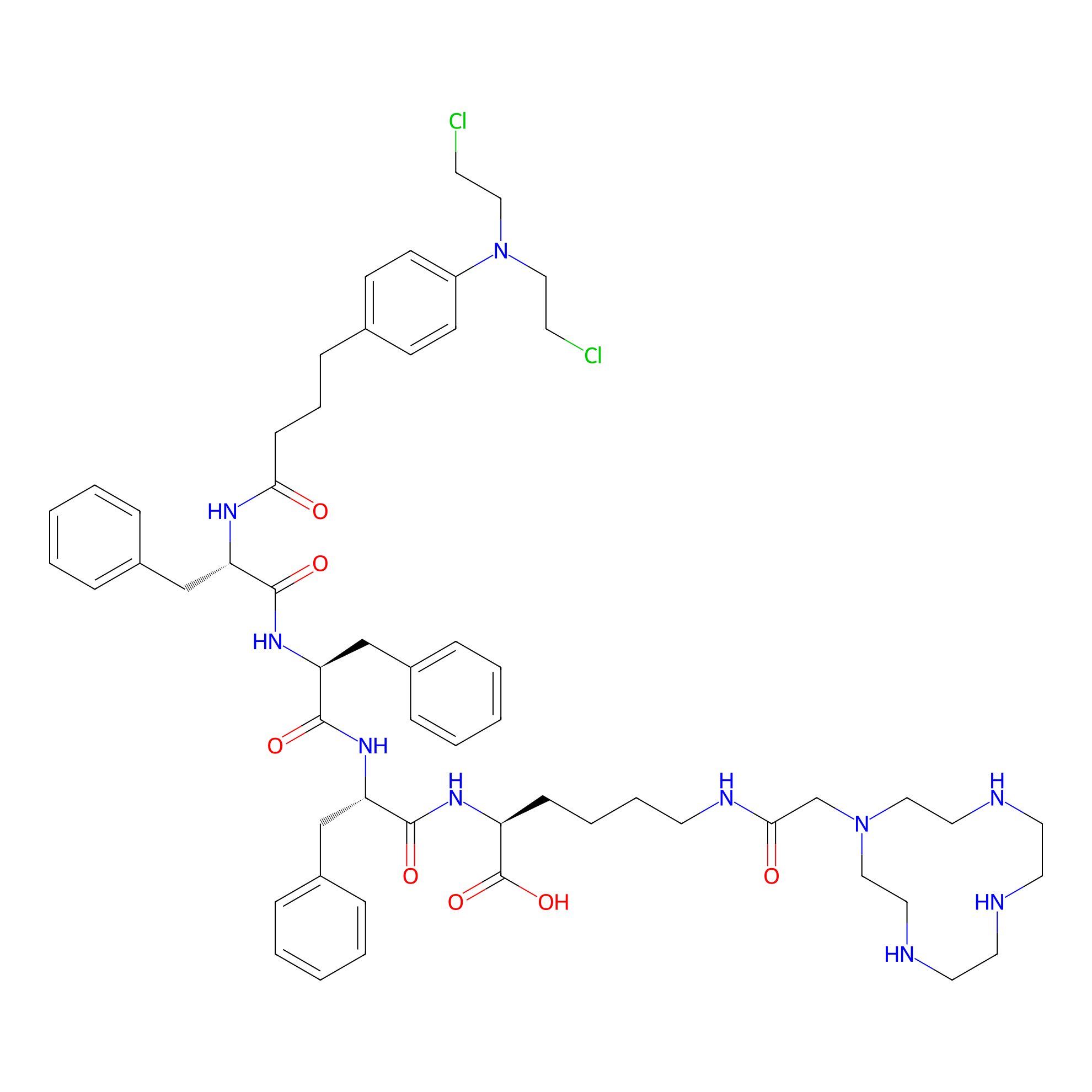
CRB-FFFK-cyclen
|
|||||
| PDC Status |
Investigative
|
|||||
| Indication |
In total 1 Indication(s)
 Solid tumor
|
|||||
| Structure |
|
|||||
| Peptide Name |
FFFK
|
Peptide Info | ||||
| Drug Name |
Chlorambucil
|
Drug Info | ||||
| Therapeutic Target |
DNA topoisomerase 2-alpha (TOP2A)
|
Target Info | ||||
| Linker Name |
Amide bond
|
Linker Info | ||||
| Peptide Modified Type |
Self-assembling
|
|||||
| Formula |
C57H78Cl2N10O7
|
|||||
| #Ro5 Violations (Lipinski): 4 | Molecular Weight | 1086.22 | ||||
| Lipid-water partition coefficient (xlogp) | 3.4161 | |||||
| Hydrogen Bond Donor Count (hbonddonor) | 9 | |||||
| Hydrogen Bond Acceptor Count (hbondacc) | 11 | |||||
| Rotatable Bond Count (rotbonds) | 30 | |||||
Full List of Activity Data of This Peptide-drug Conjugate
Revealed Based on the Cell Line Data
| Experiment 1 Reporting the Activity Data of This PDC | [1] | ||||
| Indication | Solid tumor | ||||
| Efficacy Data | Cell viability |
15.00%
|
|||
| Administration Time | 48 h | ||||
| Administration Dosage | 500 μM | ||||
| Evaluation Method | MTT assay | ||||
| MOA of PDC |
The DNA-alkylating agent chlorambucil (CRB) belongs to aryl nitrogen mustard antitumor drugs, and has been widely used for treating different types of cancerous diseases. However, the clinical application of CRB is severely restricted by its poor aqueous solubility, lack of targeting, short degradation half-life and severe side effects. Macrocyclic polyamines have many applications in medicine, industry and other fields, owing to their chemical and biological properties. Some of them, such as cyclen and cyclam, could be protonated below physiological pH (7.4), and the lower the pH, the higher the degree of protonation. It is reported that the pH of the tumor environment is lower than the physiological pH, which is beneficial to the protonation of macrocyclic polyamines. Modification of macrocyclic polyamine to self-assembling peptide-drug amphiphiles can increase the cell accumulation of the hydrogel, because the cationic hydrogel has a high affinity to a negatively charged cell membrane and nucleus. Therefore, a macrocyclic polyamine containing peptide hydrogel could serve as a suitable delivery system to improve the pharmacokinetic properties of CRB, achieving improved delivery efficacy and enhanced antitumor activity without severe side effects. Herein, we report a self-assembling peptide-based cationic supramolecular nanomedicine bearing the small molecule agent CRB and macrocyclic polyamine cyclen. We found that the CRB-FFFK-cyclen conjugate could readily transform into a hydrogel through a heating-cooling process, and the resulting hydrogel could significantly improve drug stability, cellular uptake and, antitumor activity.
Click to Show/Hide
|
||||
| Description |
CRB and CRB-FFFK-cyclen hydrogel both exhibited broad-spectrum anticancer activities against different types of cancer cells in a dose-dependent manner.
|
||||
| In Vitro Model | Lung adenocarcinoma | A-549 cell | CVCL_0023 | ||
| Experiment 2 Reporting the Activity Data of This PDC | [1] | ||||
| Indication | Solid tumor | ||||
| Efficacy Data | Cell viability |
15.00%
|
|||
| Administration Time | 48 h | ||||
| Administration Dosage | 500 μM | ||||
| Evaluation Method | MTT assay | ||||
| MOA of PDC |
The DNA-alkylating agent chlorambucil (CRB) belongs to aryl nitrogen mustard antitumor drugs, and has been widely used for treating different types of cancerous diseases. However, the clinical application of CRB is severely restricted by its poor aqueous solubility, lack of targeting, short degradation half-life and severe side effects. Macrocyclic polyamines have many applications in medicine, industry and other fields, owing to their chemical and biological properties. Some of them, such as cyclen and cyclam, could be protonated below physiological pH (7.4), and the lower the pH, the higher the degree of protonation. It is reported that the pH of the tumor environment is lower than the physiological pH, which is beneficial to the protonation of macrocyclic polyamines. Modification of macrocyclic polyamine to self-assembling peptide-drug amphiphiles can increase the cell accumulation of the hydrogel, because the cationic hydrogel has a high affinity to a negatively charged cell membrane and nucleus. Therefore, a macrocyclic polyamine containing peptide hydrogel could serve as a suitable delivery system to improve the pharmacokinetic properties of CRB, achieving improved delivery efficacy and enhanced antitumor activity without severe side effects. Herein, we report a self-assembling peptide-based cationic supramolecular nanomedicine bearing the small molecule agent CRB and macrocyclic polyamine cyclen. We found that the CRB-FFFK-cyclen conjugate could readily transform into a hydrogel through a heating-cooling process, and the resulting hydrogel could significantly improve drug stability, cellular uptake and, antitumor activity.
Click to Show/Hide
|
||||
| Description |
CRB and CRB-FFFK-cyclen hydrogel both exhibited broad-spectrum anticancer activities against different types of cancer cells in a dose-dependent manner.
|
||||
| In Vitro Model | Human papillomavirus-related cervical adenocarcinoma | HeLa cell | CVCL_0030 | ||
| Experiment 3 Reporting the Activity Data of This PDC | [1] | ||||
| Indication | Solid tumor | ||||
| Efficacy Data | Cell viability |
20.00%
|
|||
| Administration Time | 48 h | ||||
| Administration Dosage | 250 μM | ||||
| Evaluation Method | MTT assay | ||||
| MOA of PDC |
The DNA-alkylating agent chlorambucil (CRB) belongs to aryl nitrogen mustard antitumor drugs, and has been widely used for treating different types of cancerous diseases. However, the clinical application of CRB is severely restricted by its poor aqueous solubility, lack of targeting, short degradation half-life and severe side effects. Macrocyclic polyamines have many applications in medicine, industry and other fields, owing to their chemical and biological properties. Some of them, such as cyclen and cyclam, could be protonated below physiological pH (7.4), and the lower the pH, the higher the degree of protonation. It is reported that the pH of the tumor environment is lower than the physiological pH, which is beneficial to the protonation of macrocyclic polyamines. Modification of macrocyclic polyamine to self-assembling peptide-drug amphiphiles can increase the cell accumulation of the hydrogel, because the cationic hydrogel has a high affinity to a negatively charged cell membrane and nucleus. Therefore, a macrocyclic polyamine containing peptide hydrogel could serve as a suitable delivery system to improve the pharmacokinetic properties of CRB, achieving improved delivery efficacy and enhanced antitumor activity without severe side effects. Herein, we report a self-assembling peptide-based cationic supramolecular nanomedicine bearing the small molecule agent CRB and macrocyclic polyamine cyclen. We found that the CRB-FFFK-cyclen conjugate could readily transform into a hydrogel through a heating-cooling process, and the resulting hydrogel could significantly improve drug stability, cellular uptake and, antitumor activity.
Click to Show/Hide
|
||||
| Description |
CRB and CRB-FFFK-cyclen hydrogel both exhibited broad-spectrum anticancer activities against different types of cancer cells in a dose-dependent manner.
|
||||
| In Vitro Model | Lung adenocarcinoma | A-549 cell | CVCL_0023 | ||
| Experiment 4 Reporting the Activity Data of This PDC | [1] | ||||
| Indication | Solid tumor | ||||
| Efficacy Data | Cell viability |
20.00%
|
|||
| Administration Time | 48 h | ||||
| Administration Dosage | 250 μM | ||||
| Evaluation Method | MTT assay | ||||
| MOA of PDC |
The DNA-alkylating agent chlorambucil (CRB) belongs to aryl nitrogen mustard antitumor drugs, and has been widely used for treating different types of cancerous diseases. However, the clinical application of CRB is severely restricted by its poor aqueous solubility, lack of targeting, short degradation half-life and severe side effects. Macrocyclic polyamines have many applications in medicine, industry and other fields, owing to their chemical and biological properties. Some of them, such as cyclen and cyclam, could be protonated below physiological pH (7.4), and the lower the pH, the higher the degree of protonation. It is reported that the pH of the tumor environment is lower than the physiological pH, which is beneficial to the protonation of macrocyclic polyamines. Modification of macrocyclic polyamine to self-assembling peptide-drug amphiphiles can increase the cell accumulation of the hydrogel, because the cationic hydrogel has a high affinity to a negatively charged cell membrane and nucleus. Therefore, a macrocyclic polyamine containing peptide hydrogel could serve as a suitable delivery system to improve the pharmacokinetic properties of CRB, achieving improved delivery efficacy and enhanced antitumor activity without severe side effects. Herein, we report a self-assembling peptide-based cationic supramolecular nanomedicine bearing the small molecule agent CRB and macrocyclic polyamine cyclen. We found that the CRB-FFFK-cyclen conjugate could readily transform into a hydrogel through a heating-cooling process, and the resulting hydrogel could significantly improve drug stability, cellular uptake and, antitumor activity.
Click to Show/Hide
|
||||
| Description |
CRB and CRB-FFFK-cyclen hydrogel both exhibited broad-spectrum anticancer activities against different types of cancer cells in a dose-dependent manner.
|
||||
| In Vitro Model | Human papillomavirus-related cervical adenocarcinoma | HeLa cell | CVCL_0030 | ||
| Experiment 5 Reporting the Activity Data of This PDC | [1] | ||||
| Indication | Solid tumor | ||||
| Efficacy Data | Cell viability |
20.00%
|
|||
| Administration Time | 48 h | ||||
| Administration Dosage | 500 μM | ||||
| Evaluation Method | MTT assay | ||||
| MOA of PDC |
The DNA-alkylating agent chlorambucil (CRB) belongs to aryl nitrogen mustard antitumor drugs, and has been widely used for treating different types of cancerous diseases. However, the clinical application of CRB is severely restricted by its poor aqueous solubility, lack of targeting, short degradation half-life and severe side effects. Macrocyclic polyamines have many applications in medicine, industry and other fields, owing to their chemical and biological properties. Some of them, such as cyclen and cyclam, could be protonated below physiological pH (7.4), and the lower the pH, the higher the degree of protonation. It is reported that the pH of the tumor environment is lower than the physiological pH, which is beneficial to the protonation of macrocyclic polyamines. Modification of macrocyclic polyamine to self-assembling peptide-drug amphiphiles can increase the cell accumulation of the hydrogel, because the cationic hydrogel has a high affinity to a negatively charged cell membrane and nucleus. Therefore, a macrocyclic polyamine containing peptide hydrogel could serve as a suitable delivery system to improve the pharmacokinetic properties of CRB, achieving improved delivery efficacy and enhanced antitumor activity without severe side effects. Herein, we report a self-assembling peptide-based cationic supramolecular nanomedicine bearing the small molecule agent CRB and macrocyclic polyamine cyclen. We found that the CRB-FFFK-cyclen conjugate could readily transform into a hydrogel through a heating-cooling process, and the resulting hydrogel could significantly improve drug stability, cellular uptake and, antitumor activity.
Click to Show/Hide
|
||||
| Description |
CRB and CRB-FFFK-cyclen hydrogel both exhibited broad-spectrum anticancer activities against different types of cancer cells in a dose-dependent manner.
|
||||
| In Vitro Model | Invasive breast carcinoma | MCF-7 cell | CVCL_0031 | ||
| Experiment 6 Reporting the Activity Data of This PDC | [1] | ||||
| Indication | Solid tumor | ||||
| Efficacy Data | Cell viability |
28.00%
|
|||
| Administration Time | 48 h | ||||
| Administration Dosage | 125 μM | ||||
| Evaluation Method | MTT assay | ||||
| MOA of PDC |
The DNA-alkylating agent chlorambucil (CRB) belongs to aryl nitrogen mustard antitumor drugs, and has been widely used for treating different types of cancerous diseases. However, the clinical application of CRB is severely restricted by its poor aqueous solubility, lack of targeting, short degradation half-life and severe side effects. Macrocyclic polyamines have many applications in medicine, industry and other fields, owing to their chemical and biological properties. Some of them, such as cyclen and cyclam, could be protonated below physiological pH (7.4), and the lower the pH, the higher the degree of protonation. It is reported that the pH of the tumor environment is lower than the physiological pH, which is beneficial to the protonation of macrocyclic polyamines. Modification of macrocyclic polyamine to self-assembling peptide-drug amphiphiles can increase the cell accumulation of the hydrogel, because the cationic hydrogel has a high affinity to a negatively charged cell membrane and nucleus. Therefore, a macrocyclic polyamine containing peptide hydrogel could serve as a suitable delivery system to improve the pharmacokinetic properties of CRB, achieving improved delivery efficacy and enhanced antitumor activity without severe side effects. Herein, we report a self-assembling peptide-based cationic supramolecular nanomedicine bearing the small molecule agent CRB and macrocyclic polyamine cyclen. We found that the CRB-FFFK-cyclen conjugate could readily transform into a hydrogel through a heating-cooling process, and the resulting hydrogel could significantly improve drug stability, cellular uptake and, antitumor activity.
Click to Show/Hide
|
||||
| Description |
CRB and CRB-FFFK-cyclen hydrogel both exhibited broad-spectrum anticancer activities against different types of cancer cells in a dose-dependent manner.
|
||||
| In Vitro Model | Lung adenocarcinoma | A-549 cell | CVCL_0023 | ||
| Experiment 7 Reporting the Activity Data of This PDC | [1] | ||||
| Indication | Solid tumor | ||||
| Efficacy Data | Cell viability |
30.00%
|
|||
| Administration Time | 48 h | ||||
| Administration Dosage | 62.5 μM | ||||
| Evaluation Method | MTT assay | ||||
| MOA of PDC |
The DNA-alkylating agent chlorambucil (CRB) belongs to aryl nitrogen mustard antitumor drugs, and has been widely used for treating different types of cancerous diseases. However, the clinical application of CRB is severely restricted by its poor aqueous solubility, lack of targeting, short degradation half-life and severe side effects. Macrocyclic polyamines have many applications in medicine, industry and other fields, owing to their chemical and biological properties. Some of them, such as cyclen and cyclam, could be protonated below physiological pH (7.4), and the lower the pH, the higher the degree of protonation. It is reported that the pH of the tumor environment is lower than the physiological pH, which is beneficial to the protonation of macrocyclic polyamines. Modification of macrocyclic polyamine to self-assembling peptide-drug amphiphiles can increase the cell accumulation of the hydrogel, because the cationic hydrogel has a high affinity to a negatively charged cell membrane and nucleus. Therefore, a macrocyclic polyamine containing peptide hydrogel could serve as a suitable delivery system to improve the pharmacokinetic properties of CRB, achieving improved delivery efficacy and enhanced antitumor activity without severe side effects. Herein, we report a self-assembling peptide-based cationic supramolecular nanomedicine bearing the small molecule agent CRB and macrocyclic polyamine cyclen. We found that the CRB-FFFK-cyclen conjugate could readily transform into a hydrogel through a heating-cooling process, and the resulting hydrogel could significantly improve drug stability, cellular uptake and, antitumor activity.
Click to Show/Hide
|
||||
| Description |
CRB and CRB-FFFK-cyclen hydrogel both exhibited broad-spectrum anticancer activities against different types of cancer cells in a dose-dependent manner.
|
||||
| In Vitro Model | Lung adenocarcinoma | A-549 cell | CVCL_0023 | ||
| Experiment 8 Reporting the Activity Data of This PDC | [1] | ||||
| Indication | Solid tumor | ||||
| Efficacy Data | Cell viability |
30.00%
|
|||
| Administration Time | 48 h | ||||
| Administration Dosage | 125 μM | ||||
| Evaluation Method | MTT assay | ||||
| MOA of PDC |
The DNA-alkylating agent chlorambucil (CRB) belongs to aryl nitrogen mustard antitumor drugs, and has been widely used for treating different types of cancerous diseases. However, the clinical application of CRB is severely restricted by its poor aqueous solubility, lack of targeting, short degradation half-life and severe side effects. Macrocyclic polyamines have many applications in medicine, industry and other fields, owing to their chemical and biological properties. Some of them, such as cyclen and cyclam, could be protonated below physiological pH (7.4), and the lower the pH, the higher the degree of protonation. It is reported that the pH of the tumor environment is lower than the physiological pH, which is beneficial to the protonation of macrocyclic polyamines. Modification of macrocyclic polyamine to self-assembling peptide-drug amphiphiles can increase the cell accumulation of the hydrogel, because the cationic hydrogel has a high affinity to a negatively charged cell membrane and nucleus. Therefore, a macrocyclic polyamine containing peptide hydrogel could serve as a suitable delivery system to improve the pharmacokinetic properties of CRB, achieving improved delivery efficacy and enhanced antitumor activity without severe side effects. Herein, we report a self-assembling peptide-based cationic supramolecular nanomedicine bearing the small molecule agent CRB and macrocyclic polyamine cyclen. We found that the CRB-FFFK-cyclen conjugate could readily transform into a hydrogel through a heating-cooling process, and the resulting hydrogel could significantly improve drug stability, cellular uptake and, antitumor activity.
Click to Show/Hide
|
||||
| Description |
CRB and CRB-FFFK-cyclen hydrogel both exhibited broad-spectrum anticancer activities against different types of cancer cells in a dose-dependent manner.
|
||||
| In Vitro Model | Human papillomavirus-related cervical adenocarcinoma | HeLa cell | CVCL_0030 | ||
| Experiment 9 Reporting the Activity Data of This PDC | [1] | ||||
| Indication | Solid tumor | ||||
| Efficacy Data | Cell viability |
35.00%
|
|||
| Administration Time | 48 h | ||||
| Administration Dosage | 31.3 μM | ||||
| Evaluation Method | MTT assay | ||||
| MOA of PDC |
The DNA-alkylating agent chlorambucil (CRB) belongs to aryl nitrogen mustard antitumor drugs, and has been widely used for treating different types of cancerous diseases. However, the clinical application of CRB is severely restricted by its poor aqueous solubility, lack of targeting, short degradation half-life and severe side effects. Macrocyclic polyamines have many applications in medicine, industry and other fields, owing to their chemical and biological properties. Some of them, such as cyclen and cyclam, could be protonated below physiological pH (7.4), and the lower the pH, the higher the degree of protonation. It is reported that the pH of the tumor environment is lower than the physiological pH, which is beneficial to the protonation of macrocyclic polyamines. Modification of macrocyclic polyamine to self-assembling peptide-drug amphiphiles can increase the cell accumulation of the hydrogel, because the cationic hydrogel has a high affinity to a negatively charged cell membrane and nucleus. Therefore, a macrocyclic polyamine containing peptide hydrogel could serve as a suitable delivery system to improve the pharmacokinetic properties of CRB, achieving improved delivery efficacy and enhanced antitumor activity without severe side effects. Herein, we report a self-assembling peptide-based cationic supramolecular nanomedicine bearing the small molecule agent CRB and macrocyclic polyamine cyclen. We found that the CRB-FFFK-cyclen conjugate could readily transform into a hydrogel through a heating-cooling process, and the resulting hydrogel could significantly improve drug stability, cellular uptake and, antitumor activity.
Click to Show/Hide
|
||||
| Description |
CRB and CRB-FFFK-cyclen hydrogel both exhibited broad-spectrum anticancer activities against different types of cancer cells in a dose-dependent manner.
|
||||
| In Vitro Model | Lung adenocarcinoma | A-549 cell | CVCL_0023 | ||
| Experiment 10 Reporting the Activity Data of This PDC | [1] | ||||
| Indication | Solid tumor | ||||
| Efficacy Data | Cell viability |
40.00%
|
|||
| Administration Time | 48 h | ||||
| Administration Dosage | 250 μM | ||||
| Evaluation Method | MTT assay | ||||
| MOA of PDC |
The DNA-alkylating agent chlorambucil (CRB) belongs to aryl nitrogen mustard antitumor drugs, and has been widely used for treating different types of cancerous diseases. However, the clinical application of CRB is severely restricted by its poor aqueous solubility, lack of targeting, short degradation half-life and severe side effects. Macrocyclic polyamines have many applications in medicine, industry and other fields, owing to their chemical and biological properties. Some of them, such as cyclen and cyclam, could be protonated below physiological pH (7.4), and the lower the pH, the higher the degree of protonation. It is reported that the pH of the tumor environment is lower than the physiological pH, which is beneficial to the protonation of macrocyclic polyamines. Modification of macrocyclic polyamine to self-assembling peptide-drug amphiphiles can increase the cell accumulation of the hydrogel, because the cationic hydrogel has a high affinity to a negatively charged cell membrane and nucleus. Therefore, a macrocyclic polyamine containing peptide hydrogel could serve as a suitable delivery system to improve the pharmacokinetic properties of CRB, achieving improved delivery efficacy and enhanced antitumor activity without severe side effects. Herein, we report a self-assembling peptide-based cationic supramolecular nanomedicine bearing the small molecule agent CRB and macrocyclic polyamine cyclen. We found that the CRB-FFFK-cyclen conjugate could readily transform into a hydrogel through a heating-cooling process, and the resulting hydrogel could significantly improve drug stability, cellular uptake and, antitumor activity.
Click to Show/Hide
|
||||
| Description |
CRB and CRB-FFFK-cyclen hydrogel both exhibited broad-spectrum anticancer activities against different types of cancer cells in a dose-dependent manner.
|
||||
| In Vitro Model | Invasive breast carcinoma | MCF-7 cell | CVCL_0031 | ||
| Experiment 11 Reporting the Activity Data of This PDC | [1] | ||||
| Indication | Solid tumor | ||||
| Efficacy Data | Cell viability |
50.00%
|
|||
| Administration Time | 48 h | ||||
| Administration Dosage | 125 μM | ||||
| Evaluation Method | MTT assay | ||||
| MOA of PDC |
The DNA-alkylating agent chlorambucil (CRB) belongs to aryl nitrogen mustard antitumor drugs, and has been widely used for treating different types of cancerous diseases. However, the clinical application of CRB is severely restricted by its poor aqueous solubility, lack of targeting, short degradation half-life and severe side effects. Macrocyclic polyamines have many applications in medicine, industry and other fields, owing to their chemical and biological properties. Some of them, such as cyclen and cyclam, could be protonated below physiological pH (7.4), and the lower the pH, the higher the degree of protonation. It is reported that the pH of the tumor environment is lower than the physiological pH, which is beneficial to the protonation of macrocyclic polyamines. Modification of macrocyclic polyamine to self-assembling peptide-drug amphiphiles can increase the cell accumulation of the hydrogel, because the cationic hydrogel has a high affinity to a negatively charged cell membrane and nucleus. Therefore, a macrocyclic polyamine containing peptide hydrogel could serve as a suitable delivery system to improve the pharmacokinetic properties of CRB, achieving improved delivery efficacy and enhanced antitumor activity without severe side effects. Herein, we report a self-assembling peptide-based cationic supramolecular nanomedicine bearing the small molecule agent CRB and macrocyclic polyamine cyclen. We found that the CRB-FFFK-cyclen conjugate could readily transform into a hydrogel through a heating-cooling process, and the resulting hydrogel could significantly improve drug stability, cellular uptake and, antitumor activity.
Click to Show/Hide
|
||||
| Description |
CRB and CRB-FFFK-cyclen hydrogel both exhibited broad-spectrum anticancer activities against different types of cancer cells in a dose-dependent manner.
|
||||
| In Vitro Model | Invasive breast carcinoma | MCF-7 cell | CVCL_0031 | ||
| Experiment 12 Reporting the Activity Data of This PDC | [1] | ||||
| Indication | Solid tumor | ||||
| Efficacy Data | Cell viability |
55.00%
|
|||
| Administration Time | 48 h | ||||
| Administration Dosage | 62.5 μM | ||||
| Evaluation Method | MTT assay | ||||
| MOA of PDC |
The DNA-alkylating agent chlorambucil (CRB) belongs to aryl nitrogen mustard antitumor drugs, and has been widely used for treating different types of cancerous diseases. However, the clinical application of CRB is severely restricted by its poor aqueous solubility, lack of targeting, short degradation half-life and severe side effects. Macrocyclic polyamines have many applications in medicine, industry and other fields, owing to their chemical and biological properties. Some of them, such as cyclen and cyclam, could be protonated below physiological pH (7.4), and the lower the pH, the higher the degree of protonation. It is reported that the pH of the tumor environment is lower than the physiological pH, which is beneficial to the protonation of macrocyclic polyamines. Modification of macrocyclic polyamine to self-assembling peptide-drug amphiphiles can increase the cell accumulation of the hydrogel, because the cationic hydrogel has a high affinity to a negatively charged cell membrane and nucleus. Therefore, a macrocyclic polyamine containing peptide hydrogel could serve as a suitable delivery system to improve the pharmacokinetic properties of CRB, achieving improved delivery efficacy and enhanced antitumor activity without severe side effects. Herein, we report a self-assembling peptide-based cationic supramolecular nanomedicine bearing the small molecule agent CRB and macrocyclic polyamine cyclen. We found that the CRB-FFFK-cyclen conjugate could readily transform into a hydrogel through a heating-cooling process, and the resulting hydrogel could significantly improve drug stability, cellular uptake and, antitumor activity.
Click to Show/Hide
|
||||
| Description |
CRB and CRB-FFFK-cyclen hydrogel both exhibited broad-spectrum anticancer activities against different types of cancer cells in a dose-dependent manner.
|
||||
| In Vitro Model | Human papillomavirus-related cervical adenocarcinoma | HeLa cell | CVCL_0030 | ||
| Experiment 13 Reporting the Activity Data of This PDC | [1] | ||||
| Indication | Solid tumor | ||||
| Efficacy Data | Cell viability |
60.00%
|
|||
| Administration Time | 48 h | ||||
| Administration Dosage | 15.6 μM | ||||
| Evaluation Method | MTT assay | ||||
| MOA of PDC |
The DNA-alkylating agent chlorambucil (CRB) belongs to aryl nitrogen mustard antitumor drugs, and has been widely used for treating different types of cancerous diseases. However, the clinical application of CRB is severely restricted by its poor aqueous solubility, lack of targeting, short degradation half-life and severe side effects. Macrocyclic polyamines have many applications in medicine, industry and other fields, owing to their chemical and biological properties. Some of them, such as cyclen and cyclam, could be protonated below physiological pH (7.4), and the lower the pH, the higher the degree of protonation. It is reported that the pH of the tumor environment is lower than the physiological pH, which is beneficial to the protonation of macrocyclic polyamines. Modification of macrocyclic polyamine to self-assembling peptide-drug amphiphiles can increase the cell accumulation of the hydrogel, because the cationic hydrogel has a high affinity to a negatively charged cell membrane and nucleus. Therefore, a macrocyclic polyamine containing peptide hydrogel could serve as a suitable delivery system to improve the pharmacokinetic properties of CRB, achieving improved delivery efficacy and enhanced antitumor activity without severe side effects. Herein, we report a self-assembling peptide-based cationic supramolecular nanomedicine bearing the small molecule agent CRB and macrocyclic polyamine cyclen. We found that the CRB-FFFK-cyclen conjugate could readily transform into a hydrogel through a heating-cooling process, and the resulting hydrogel could significantly improve drug stability, cellular uptake and, antitumor activity.
Click to Show/Hide
|
||||
| Description |
CRB and CRB-FFFK-cyclen hydrogel both exhibited broad-spectrum anticancer activities against different types of cancer cells in a dose-dependent manner.
|
||||
| In Vitro Model | Lung adenocarcinoma | A-549 cell | CVCL_0023 | ||
| Experiment 14 Reporting the Activity Data of This PDC | [1] | ||||
| Indication | Solid tumor | ||||
| Efficacy Data | Cell viability |
60.00%
|
|||
| Administration Time | 48 h | ||||
| Administration Dosage | 31.3 μM | ||||
| Evaluation Method | MTT assay | ||||
| MOA of PDC |
The DNA-alkylating agent chlorambucil (CRB) belongs to aryl nitrogen mustard antitumor drugs, and has been widely used for treating different types of cancerous diseases. However, the clinical application of CRB is severely restricted by its poor aqueous solubility, lack of targeting, short degradation half-life and severe side effects. Macrocyclic polyamines have many applications in medicine, industry and other fields, owing to their chemical and biological properties. Some of them, such as cyclen and cyclam, could be protonated below physiological pH (7.4), and the lower the pH, the higher the degree of protonation. It is reported that the pH of the tumor environment is lower than the physiological pH, which is beneficial to the protonation of macrocyclic polyamines. Modification of macrocyclic polyamine to self-assembling peptide-drug amphiphiles can increase the cell accumulation of the hydrogel, because the cationic hydrogel has a high affinity to a negatively charged cell membrane and nucleus. Therefore, a macrocyclic polyamine containing peptide hydrogel could serve as a suitable delivery system to improve the pharmacokinetic properties of CRB, achieving improved delivery efficacy and enhanced antitumor activity without severe side effects. Herein, we report a self-assembling peptide-based cationic supramolecular nanomedicine bearing the small molecule agent CRB and macrocyclic polyamine cyclen. We found that the CRB-FFFK-cyclen conjugate could readily transform into a hydrogel through a heating-cooling process, and the resulting hydrogel could significantly improve drug stability, cellular uptake and, antitumor activity.
Click to Show/Hide
|
||||
| Description |
CRB and CRB-FFFK-cyclen hydrogel both exhibited broad-spectrum anticancer activities against different types of cancer cells in a dose-dependent manner.
|
||||
| In Vitro Model | Human papillomavirus-related cervical adenocarcinoma | HeLa cell | CVCL_0030 | ||
| Experiment 15 Reporting the Activity Data of This PDC | [1] | ||||
| Indication | Solid tumor | ||||
| Efficacy Data | Cell viability |
62.00%
|
|||
| Administration Time | 48 h | ||||
| Administration Dosage | 15.6 μM | ||||
| Evaluation Method | MTT assay | ||||
| MOA of PDC |
The DNA-alkylating agent chlorambucil (CRB) belongs to aryl nitrogen mustard antitumor drugs, and has been widely used for treating different types of cancerous diseases. However, the clinical application of CRB is severely restricted by its poor aqueous solubility, lack of targeting, short degradation half-life and severe side effects. Macrocyclic polyamines have many applications in medicine, industry and other fields, owing to their chemical and biological properties. Some of them, such as cyclen and cyclam, could be protonated below physiological pH (7.4), and the lower the pH, the higher the degree of protonation. It is reported that the pH of the tumor environment is lower than the physiological pH, which is beneficial to the protonation of macrocyclic polyamines. Modification of macrocyclic polyamine to self-assembling peptide-drug amphiphiles can increase the cell accumulation of the hydrogel, because the cationic hydrogel has a high affinity to a negatively charged cell membrane and nucleus. Therefore, a macrocyclic polyamine containing peptide hydrogel could serve as a suitable delivery system to improve the pharmacokinetic properties of CRB, achieving improved delivery efficacy and enhanced antitumor activity without severe side effects. Herein, we report a self-assembling peptide-based cationic supramolecular nanomedicine bearing the small molecule agent CRB and macrocyclic polyamine cyclen. We found that the CRB-FFFK-cyclen conjugate could readily transform into a hydrogel through a heating-cooling process, and the resulting hydrogel could significantly improve drug stability, cellular uptake and, antitumor activity.
Click to Show/Hide
|
||||
| Description |
CRB and CRB-FFFK-cyclen hydrogel both exhibited broad-spectrum anticancer activities against different types of cancer cells in a dose-dependent manner.
|
||||
| In Vitro Model | Human papillomavirus-related cervical adenocarcinoma | HeLa cell | CVCL_0030 | ||
| Experiment 16 Reporting the Activity Data of This PDC | [1] | ||||
| Indication | Solid tumor | ||||
| Efficacy Data | Cell viability |
64.00%
|
|||
| Administration Time | 48 h | ||||
| Administration Dosage | 7.8 μM | ||||
| Evaluation Method | MTT assay | ||||
| MOA of PDC |
The DNA-alkylating agent chlorambucil (CRB) belongs to aryl nitrogen mustard antitumor drugs, and has been widely used for treating different types of cancerous diseases. However, the clinical application of CRB is severely restricted by its poor aqueous solubility, lack of targeting, short degradation half-life and severe side effects. Macrocyclic polyamines have many applications in medicine, industry and other fields, owing to their chemical and biological properties. Some of them, such as cyclen and cyclam, could be protonated below physiological pH (7.4), and the lower the pH, the higher the degree of protonation. It is reported that the pH of the tumor environment is lower than the physiological pH, which is beneficial to the protonation of macrocyclic polyamines. Modification of macrocyclic polyamine to self-assembling peptide-drug amphiphiles can increase the cell accumulation of the hydrogel, because the cationic hydrogel has a high affinity to a negatively charged cell membrane and nucleus. Therefore, a macrocyclic polyamine containing peptide hydrogel could serve as a suitable delivery system to improve the pharmacokinetic properties of CRB, achieving improved delivery efficacy and enhanced antitumor activity without severe side effects. Herein, we report a self-assembling peptide-based cationic supramolecular nanomedicine bearing the small molecule agent CRB and macrocyclic polyamine cyclen. We found that the CRB-FFFK-cyclen conjugate could readily transform into a hydrogel through a heating-cooling process, and the resulting hydrogel could significantly improve drug stability, cellular uptake and, antitumor activity.
Click to Show/Hide
|
||||
| Description |
CRB and CRB-FFFK-cyclen hydrogel both exhibited broad-spectrum anticancer activities against different types of cancer cells in a dose-dependent manner.
|
||||
| In Vitro Model | Human papillomavirus-related cervical adenocarcinoma | HeLa cell | CVCL_0030 | ||
| Experiment 17 Reporting the Activity Data of This PDC | [1] | ||||
| Indication | Solid tumor | ||||
| Efficacy Data | Cell viability |
70.00%
|
|||
| Administration Time | 48 h | ||||
| Administration Dosage | 62.5 μM | ||||
| Evaluation Method | MTT assay | ||||
| MOA of PDC |
The DNA-alkylating agent chlorambucil (CRB) belongs to aryl nitrogen mustard antitumor drugs, and has been widely used for treating different types of cancerous diseases. However, the clinical application of CRB is severely restricted by its poor aqueous solubility, lack of targeting, short degradation half-life and severe side effects. Macrocyclic polyamines have many applications in medicine, industry and other fields, owing to their chemical and biological properties. Some of them, such as cyclen and cyclam, could be protonated below physiological pH (7.4), and the lower the pH, the higher the degree of protonation. It is reported that the pH of the tumor environment is lower than the physiological pH, which is beneficial to the protonation of macrocyclic polyamines. Modification of macrocyclic polyamine to self-assembling peptide-drug amphiphiles can increase the cell accumulation of the hydrogel, because the cationic hydrogel has a high affinity to a negatively charged cell membrane and nucleus. Therefore, a macrocyclic polyamine containing peptide hydrogel could serve as a suitable delivery system to improve the pharmacokinetic properties of CRB, achieving improved delivery efficacy and enhanced antitumor activity without severe side effects. Herein, we report a self-assembling peptide-based cationic supramolecular nanomedicine bearing the small molecule agent CRB and macrocyclic polyamine cyclen. We found that the CRB-FFFK-cyclen conjugate could readily transform into a hydrogel through a heating-cooling process, and the resulting hydrogel could significantly improve drug stability, cellular uptake and, antitumor activity.
Click to Show/Hide
|
||||
| Description |
CRB and CRB-FFFK-cyclen hydrogel both exhibited broad-spectrum anticancer activities against different types of cancer cells in a dose-dependent manner.
|
||||
| In Vitro Model | Invasive breast carcinoma | MCF-7 cell | CVCL_0031 | ||
| Experiment 18 Reporting the Activity Data of This PDC | [1] | ||||
| Indication | Solid tumor | ||||
| Efficacy Data | Cell viability |
78.00%
|
|||
| Administration Time | 48 h | ||||
| Administration Dosage | 7.8 μM | ||||
| Evaluation Method | MTT assay | ||||
| MOA of PDC |
The DNA-alkylating agent chlorambucil (CRB) belongs to aryl nitrogen mustard antitumor drugs, and has been widely used for treating different types of cancerous diseases. However, the clinical application of CRB is severely restricted by its poor aqueous solubility, lack of targeting, short degradation half-life and severe side effects. Macrocyclic polyamines have many applications in medicine, industry and other fields, owing to their chemical and biological properties. Some of them, such as cyclen and cyclam, could be protonated below physiological pH (7.4), and the lower the pH, the higher the degree of protonation. It is reported that the pH of the tumor environment is lower than the physiological pH, which is beneficial to the protonation of macrocyclic polyamines. Modification of macrocyclic polyamine to self-assembling peptide-drug amphiphiles can increase the cell accumulation of the hydrogel, because the cationic hydrogel has a high affinity to a negatively charged cell membrane and nucleus. Therefore, a macrocyclic polyamine containing peptide hydrogel could serve as a suitable delivery system to improve the pharmacokinetic properties of CRB, achieving improved delivery efficacy and enhanced antitumor activity without severe side effects. Herein, we report a self-assembling peptide-based cationic supramolecular nanomedicine bearing the small molecule agent CRB and macrocyclic polyamine cyclen. We found that the CRB-FFFK-cyclen conjugate could readily transform into a hydrogel through a heating-cooling process, and the resulting hydrogel could significantly improve drug stability, cellular uptake and, antitumor activity.
Click to Show/Hide
|
||||
| Description |
CRB and CRB-FFFK-cyclen hydrogel both exhibited broad-spectrum anticancer activities against different types of cancer cells in a dose-dependent manner.
|
||||
| In Vitro Model | Lung adenocarcinoma | A-549 cell | CVCL_0023 | ||
| Experiment 19 Reporting the Activity Data of This PDC | [1] | ||||
| Indication | Solid tumor | ||||
| Efficacy Data | Cell viability |
78.00%
|
|||
| Administration Time | 48 h | ||||
| Administration Dosage | 31.3 μM | ||||
| Evaluation Method | MTT assay | ||||
| MOA of PDC |
The DNA-alkylating agent chlorambucil (CRB) belongs to aryl nitrogen mustard antitumor drugs, and has been widely used for treating different types of cancerous diseases. However, the clinical application of CRB is severely restricted by its poor aqueous solubility, lack of targeting, short degradation half-life and severe side effects. Macrocyclic polyamines have many applications in medicine, industry and other fields, owing to their chemical and biological properties. Some of them, such as cyclen and cyclam, could be protonated below physiological pH (7.4), and the lower the pH, the higher the degree of protonation. It is reported that the pH of the tumor environment is lower than the physiological pH, which is beneficial to the protonation of macrocyclic polyamines. Modification of macrocyclic polyamine to self-assembling peptide-drug amphiphiles can increase the cell accumulation of the hydrogel, because the cationic hydrogel has a high affinity to a negatively charged cell membrane and nucleus. Therefore, a macrocyclic polyamine containing peptide hydrogel could serve as a suitable delivery system to improve the pharmacokinetic properties of CRB, achieving improved delivery efficacy and enhanced antitumor activity without severe side effects. Herein, we report a self-assembling peptide-based cationic supramolecular nanomedicine bearing the small molecule agent CRB and macrocyclic polyamine cyclen. We found that the CRB-FFFK-cyclen conjugate could readily transform into a hydrogel through a heating-cooling process, and the resulting hydrogel could significantly improve drug stability, cellular uptake and, antitumor activity.
Click to Show/Hide
|
||||
| Description |
CRB and CRB-FFFK-cyclen hydrogel both exhibited broad-spectrum anticancer activities against different types of cancer cells in a dose-dependent manner.
|
||||
| In Vitro Model | Invasive breast carcinoma | MCF-7 cell | CVCL_0031 | ||
| Experiment 20 Reporting the Activity Data of This PDC | [1] | ||||
| Indication | Solid tumor | ||||
| Efficacy Data | Cell viability |
80.00%
|
|||
| Administration Time | 48 h | ||||
| Administration Dosage | 15.6 μM | ||||
| Evaluation Method | MTT assay | ||||
| MOA of PDC |
The DNA-alkylating agent chlorambucil (CRB) belongs to aryl nitrogen mustard antitumor drugs, and has been widely used for treating different types of cancerous diseases. However, the clinical application of CRB is severely restricted by its poor aqueous solubility, lack of targeting, short degradation half-life and severe side effects. Macrocyclic polyamines have many applications in medicine, industry and other fields, owing to their chemical and biological properties. Some of them, such as cyclen and cyclam, could be protonated below physiological pH (7.4), and the lower the pH, the higher the degree of protonation. It is reported that the pH of the tumor environment is lower than the physiological pH, which is beneficial to the protonation of macrocyclic polyamines. Modification of macrocyclic polyamine to self-assembling peptide-drug amphiphiles can increase the cell accumulation of the hydrogel, because the cationic hydrogel has a high affinity to a negatively charged cell membrane and nucleus. Therefore, a macrocyclic polyamine containing peptide hydrogel could serve as a suitable delivery system to improve the pharmacokinetic properties of CRB, achieving improved delivery efficacy and enhanced antitumor activity without severe side effects. Herein, we report a self-assembling peptide-based cationic supramolecular nanomedicine bearing the small molecule agent CRB and macrocyclic polyamine cyclen. We found that the CRB-FFFK-cyclen conjugate could readily transform into a hydrogel through a heating-cooling process, and the resulting hydrogel could significantly improve drug stability, cellular uptake and, antitumor activity.
Click to Show/Hide
|
||||
| Description |
CRB and CRB-FFFK-cyclen hydrogel both exhibited broad-spectrum anticancer activities against different types of cancer cells in a dose-dependent manner.
|
||||
| In Vitro Model | Invasive breast carcinoma | MCF-7 cell | CVCL_0031 | ||
| Experiment 21 Reporting the Activity Data of This PDC | [1] | ||||
| Indication | Solid tumor | ||||
| Efficacy Data | Cell viability |
83.00%
|
|||
| Administration Time | 48 h | ||||
| Administration Dosage | 7.8 μM | ||||
| Evaluation Method | MTT assay | ||||
| MOA of PDC |
The DNA-alkylating agent chlorambucil (CRB) belongs to aryl nitrogen mustard antitumor drugs, and has been widely used for treating different types of cancerous diseases. However, the clinical application of CRB is severely restricted by its poor aqueous solubility, lack of targeting, short degradation half-life and severe side effects. Macrocyclic polyamines have many applications in medicine, industry and other fields, owing to their chemical and biological properties. Some of them, such as cyclen and cyclam, could be protonated below physiological pH (7.4), and the lower the pH, the higher the degree of protonation. It is reported that the pH of the tumor environment is lower than the physiological pH, which is beneficial to the protonation of macrocyclic polyamines. Modification of macrocyclic polyamine to self-assembling peptide-drug amphiphiles can increase the cell accumulation of the hydrogel, because the cationic hydrogel has a high affinity to a negatively charged cell membrane and nucleus. Therefore, a macrocyclic polyamine containing peptide hydrogel could serve as a suitable delivery system to improve the pharmacokinetic properties of CRB, achieving improved delivery efficacy and enhanced antitumor activity without severe side effects. Herein, we report a self-assembling peptide-based cationic supramolecular nanomedicine bearing the small molecule agent CRB and macrocyclic polyamine cyclen. We found that the CRB-FFFK-cyclen conjugate could readily transform into a hydrogel through a heating-cooling process, and the resulting hydrogel could significantly improve drug stability, cellular uptake and, antitumor activity.
Click to Show/Hide
|
||||
| Description |
CRB and CRB-FFFK-cyclen hydrogel both exhibited broad-spectrum anticancer activities against different types of cancer cells in a dose-dependent manner.
|
||||
| In Vitro Model | Invasive breast carcinoma | MCF-7 cell | CVCL_0031 | ||
| Experiment 22 Reporting the Activity Data of This PDC | [1] | ||||
| Indication | Solid tumor | ||||
| Efficacy Data | Half maximal inhibitory concentration (IC50) |
23.8 μM
|
|||
| Evaluation Method | MTT assay | ||||
| MOA of PDC |
The DNA-alkylating agent chlorambucil (CRB) belongs to aryl nitrogen mustard antitumor drugs, and has been widely used for treating different types of cancerous diseases. However, the clinical application of CRB is severely restricted by its poor aqueous solubility, lack of targeting, short degradation half-life and severe side effects. Macrocyclic polyamines have many applications in medicine, industry and other fields, owing to their chemical and biological properties. Some of them, such as cyclen and cyclam, could be protonated below physiological pH (7.4), and the lower the pH, the higher the degree of protonation. It is reported that the pH of the tumor environment is lower than the physiological pH, which is beneficial to the protonation of macrocyclic polyamines. Modification of macrocyclic polyamine to self-assembling peptide-drug amphiphiles can increase the cell accumulation of the hydrogel, because the cationic hydrogel has a high affinity to a negatively charged cell membrane and nucleus. Therefore, a macrocyclic polyamine containing peptide hydrogel could serve as a suitable delivery system to improve the pharmacokinetic properties of CRB, achieving improved delivery efficacy and enhanced antitumor activity without severe side effects. Herein, we report a self-assembling peptide-based cationic supramolecular nanomedicine bearing the small molecule agent CRB and macrocyclic polyamine cyclen. We found that the CRB-FFFK-cyclen conjugate could readily transform into a hydrogel through a heating-cooling process, and the resulting hydrogel could significantly improve drug stability, cellular uptake and, antitumor activity.
Click to Show/Hide
|
||||
| Description |
The IC50 values of CRB-FFFK-cyclen nanofiber against A549 cells, HeLa cells and MCF-7 cells were 23.8, 50.2, and 127.4 μM, respectively.
|
||||
| In Vitro Model | Lung adenocarcinoma | A-549 cell | CVCL_0023 | ||
| Experiment 23 Reporting the Activity Data of This PDC | [1] | ||||
| Indication | Solid tumor | ||||
| Efficacy Data | Half maximal inhibitory concentration (IC50) |
50.2 μM
|
|||
| Evaluation Method | MTT assay | ||||
| MOA of PDC |
The DNA-alkylating agent chlorambucil (CRB) belongs to aryl nitrogen mustard antitumor drugs, and has been widely used for treating different types of cancerous diseases. However, the clinical application of CRB is severely restricted by its poor aqueous solubility, lack of targeting, short degradation half-life and severe side effects. Macrocyclic polyamines have many applications in medicine, industry and other fields, owing to their chemical and biological properties. Some of them, such as cyclen and cyclam, could be protonated below physiological pH (7.4), and the lower the pH, the higher the degree of protonation. It is reported that the pH of the tumor environment is lower than the physiological pH, which is beneficial to the protonation of macrocyclic polyamines. Modification of macrocyclic polyamine to self-assembling peptide-drug amphiphiles can increase the cell accumulation of the hydrogel, because the cationic hydrogel has a high affinity to a negatively charged cell membrane and nucleus. Therefore, a macrocyclic polyamine containing peptide hydrogel could serve as a suitable delivery system to improve the pharmacokinetic properties of CRB, achieving improved delivery efficacy and enhanced antitumor activity without severe side effects. Herein, we report a self-assembling peptide-based cationic supramolecular nanomedicine bearing the small molecule agent CRB and macrocyclic polyamine cyclen. We found that the CRB-FFFK-cyclen conjugate could readily transform into a hydrogel through a heating-cooling process, and the resulting hydrogel could significantly improve drug stability, cellular uptake and, antitumor activity.
Click to Show/Hide
|
||||
| Description |
The IC50 values of CRB-FFFK-cyclen nanofiber against A549 cells, HeLa cells and MCF-7 cells were 23.8, 50.2, and 127.4 μM, respectively.
|
||||
| In Vitro Model | Human papillomavirus-related cervical adenocarcinoma | HeLa cell | CVCL_0030 | ||
| Experiment 24 Reporting the Activity Data of This PDC | [1] | ||||
| Indication | Solid tumor | ||||
| Efficacy Data | Half maximal inhibitory concentration (IC50) |
127.4 μM
|
|||
| Evaluation Method | MTT assay | ||||
| MOA of PDC |
The DNA-alkylating agent chlorambucil (CRB) belongs to aryl nitrogen mustard antitumor drugs, and has been widely used for treating different types of cancerous diseases. However, the clinical application of CRB is severely restricted by its poor aqueous solubility, lack of targeting, short degradation half-life and severe side effects. Macrocyclic polyamines have many applications in medicine, industry and other fields, owing to their chemical and biological properties. Some of them, such as cyclen and cyclam, could be protonated below physiological pH (7.4), and the lower the pH, the higher the degree of protonation. It is reported that the pH of the tumor environment is lower than the physiological pH, which is beneficial to the protonation of macrocyclic polyamines. Modification of macrocyclic polyamine to self-assembling peptide-drug amphiphiles can increase the cell accumulation of the hydrogel, because the cationic hydrogel has a high affinity to a negatively charged cell membrane and nucleus. Therefore, a macrocyclic polyamine containing peptide hydrogel could serve as a suitable delivery system to improve the pharmacokinetic properties of CRB, achieving improved delivery efficacy and enhanced antitumor activity without severe side effects. Herein, we report a self-assembling peptide-based cationic supramolecular nanomedicine bearing the small molecule agent CRB and macrocyclic polyamine cyclen. We found that the CRB-FFFK-cyclen conjugate could readily transform into a hydrogel through a heating-cooling process, and the resulting hydrogel could significantly improve drug stability, cellular uptake and, antitumor activity.
Click to Show/Hide
|
||||
| Description |
The IC50 values of CRB-FFFK-cyclen nanofiber against A549 cells, HeLa cells and MCF-7 cells were 23.8, 50.2, and 127.4 μM, respectively.
|
||||
| In Vitro Model | Invasive breast carcinoma | MCF-7 cell | CVCL_0031 | ||
References