Drug Information
General Information of This Drug
| Drug ID | DRG00034 | |||||
|---|---|---|---|---|---|---|
| Drug Name | Chlorin e6 | |||||
| Synonyms |
Chlorin e6 dimethylester; 197444-89-6; (17S,18S)-12-Ethenyl-7-ethyl-20-(2-methoxy-2-oxoethyl)-18-(3-methoxy-3-oxopropyl)-3,8,13,17-tetramethyl-17,18,22,23-tetrahydroporphyrin-2-carboxylic acid; SCHEMBL21184917
Click to Show/Hide
|
|||||
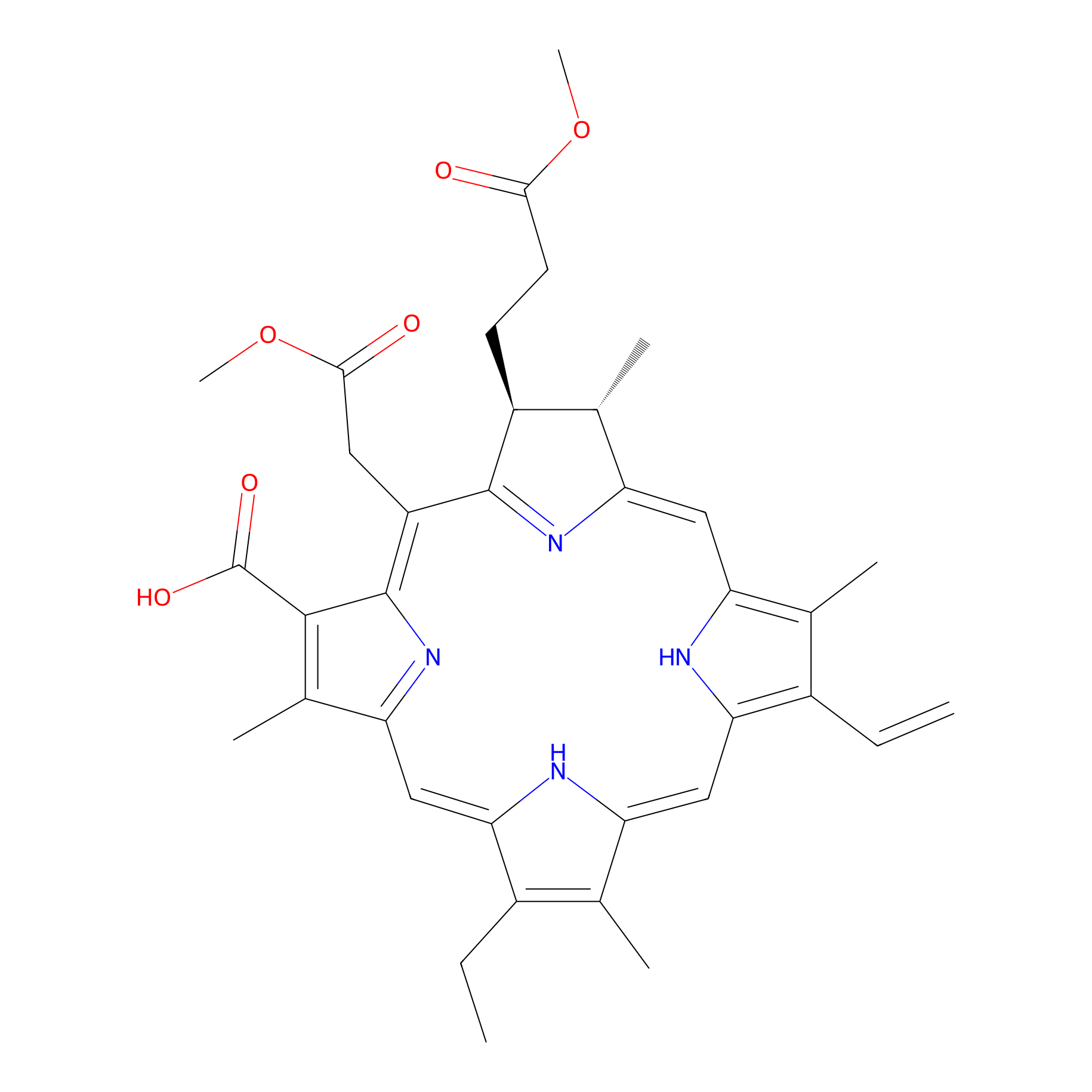
| Structure |
|
|||||
| Formula |
C36H40N4O6
|
|||||
| #Ro5 Violations (Lipinski): 2 | Molecular Weight (mw) | 624.7 | ||||
| Lipid-water partition coefficient (xlogp) | 5.3 | |||||
| Hydrogen Bond Donor Count (hbonddonor) | 3 | |||||
| Hydrogen Bond Acceptor Count (hbondacc) | 8 | |||||
| Rotatable Bond Count (rotbonds) | 10 | |||||
| PubChem CID | ||||||
| Canonical smiles |
CCC1=C(C2=CC3=C(C(=C(N3)C=C4C(C(C(=N4)C(=C5C(=C(C(=N5)C=C1N2)C)C(=O)O)CC(=O)OC)CCC(=O)OC)C)C)C=C)C
|
|||||
| InChI |
InChI=1S/C36H40N4O6/c1-9-21-17(3)25-14-27-19(5)23(11-12-31(41)45-7)34(39-27)24(13-32(42)46-8)35-33(36(43)44)20(6)28(40-35)16-30-22(10-2)18(4)26(38-30)15-29(21)37-25/h9,14-16,19,23,37-38H,1,10-13H2,2-8H3,(H,43,44)/t19-,23-/m0/s1
|
|||||
| InChIKey |
NPPMFOPRYHLUDZ-CVDCTZTESA-N
|
|||||
| IUPAC Name |
(17S,18S)-12-ethenyl-7-ethyl-20-(2-methoxy-2-oxoethyl)-18-(3-methoxy-3-oxopropyl)-3,8,13,17-tetramethyl-17,18,22,23-tetrahydroporphyrin-2-carboxylic acid
|
|||||
The activity data of This Drug
| Standard Type | Value | Administration times | Cell line | Cell line ID | Ref. | |
|---|---|---|---|---|---|---|
| Half Maximal Inhibitory Concentration (IC50) | 10 µM | 24 h | GPC3-negative HeLa cell | CVCL_0030 | [1] | |
| Half Maximal Inhibitory Concentration (IC50) | 10 µM | 24 h | GPC3 negative MCF7 cell | CVCL_0031 | [1] | |
| Half Maximal Inhibitory Concentration (IC50) | 10 µM | 24 h | Human umbilical vein endothelial cell | N.A. | [1] | |
| Half Maximal Inhibitory Concentration (IC50) | 16±4.2 µM | 24 h | L-O2 cell line | CVCL_0027 | [1] | |
| Half Maximal Inhibitory Concentration (IC50) | 18±3.9 µM | 24 h | GPC3-positive Huh-7 cell | CVCL_0336 | [1] | |
| Half Maximal Inhibitory Concentration (IC50) | 100 µM | 24 h | L-O2 cell line | CVCL_0027 | [1] | |
| Half Maximal Inhibitory Concentration (IC50) | 100 µM | 24 h | GPC3-negative HeLa cell | CVCL_0030 | [1] | |
| Half Maximal Inhibitory Concentration (IC50) | 100 µM | 24 h | GPC3 negative MCF7 cell | CVCL_0031 | [1] | |
| Half Maximal Inhibitory Concentration (IC50) | 100 µM | 24 h | GPC3-positive Huh-7 cell | CVCL_0336 | [1] | |
| Half Maximal Inhibitory Concentration (IC50) | 200 µM | 24 h | Human umbilical vein endothelial cell | N.A. | [1] | |
Full Information of The Activity Data of The PDC(s) Related to This Drug
Glypican-3-targeting peptide-chlorin e6 conjugates 8c [Investigative]
Revealed Based on the Cell Line Data
| Experiment 1 Reporting the Activity Data of This PDC | [1] | ||||
| Indication | Liver cancer | ||||
| Efficacy Data | Half Maximal Inhibitory Concentration (IC50) | 0.25 ± 0.03 µM | |||
| Evaluation Method | Annexin V/PI staining assay | ||||
| Administration Time | 24 h | ||||
| MOA of PDC |
Hepatocellular carcinoma (HCC) is a highly aggressive and lethal malignancy with poor prognosis, necessitating the urgent development of effective treatments. Targeted photodynamic therapy (PDT) offers a promising way to selectively eradicate tumor cells without affecting normal cells. Inspired by promising features of peptide-drug conjugates (PDCs) in targeted cancer therapy, herein a novel glypican-3 (GPC3)-targeting PDC-PDT strategy was developed for the precise PDT treatment of HCC. The GPC3-targeting photosensitizer conjugates were developed by attaching GPC3-targeting peptides to chlorin e6. Conjugate 8b demonstrated the ability to penetrate HCC cells via GPC3-mediated entry process, exhibiting remarkable tumor-targeting capacity, superior antitumor efficacy, and minimal toxicity towards normal cells. Notably, conjugate 8b achieved complete tumor elimination upon light illumination in a HepG2 xenograft model without harm to normal tissues. Overall, this innovative GPC3-targeting conjugation strategy demonstrates considerable promise for clinical applications for the treatment of HCC.
Click to Show/Hide
|
||||
| Description |
Subsequently, the antiproliferative activities of the PS conjugates, including dark toxicity and phototoxicity (660 nM, light dose: 10 J/cm2), were evaluated. Dark toxicity refers to the toxicity of PS conjugates against cancer cells in the absence of light and can be regarded as a crucial measure of the safety profile, while phototoxicity is the most direct indicator of the PDT efficacy of PS. The results showed that the dark toxicity of all the compounds against the five cell lines was comparatively low, demonstrating that the PS conjugates exhibited a high safety index in the absence of light. Compound 8b exhibited the optimum tumor cell selectivity in terms of phototoxicity, with the IC50 values of 0.82 uM against HepG2 cells and 2.4 uM against Huh-7 cells, respectively, whereas its toxicity against GPC3-negative cell lines was >10 uM. Although compounds 8a and 8c-d exhibited excellent phototoxicity against HepG2 and Huh-7 cells, (IC50 range: 0.2-2.0 uM), these compounds lacked selectivity between GPC3-overexpressed and GPC3-negative cells because they also showed considerable phototoxicity against the cell lines with minimal GPC3 expression. Notably, compound 1 showed low phototoxicity and selectivity against all the tested cell lines (IC50 > 10 uM).
Click to Show/Hide
|
||||
| In Vitro Model | Adult hepatocellular carcinoma | GPC3-positive Huh-7 cell | CVCL_0336 | ||
| Experiment 2 Reporting the Activity Data of This PDC | [1] | ||||
| Indication | Liver cancer | ||||
| Efficacy Data | Half Maximal Inhibitory Concentration (IC50) | 0.31 ± 0.01 µM | |||
| Evaluation Method | Annexin V/PI staining assay | ||||
| Administration Time | 24 h | ||||
| MOA of PDC |
Hepatocellular carcinoma (HCC) is a highly aggressive and lethal malignancy with poor prognosis, necessitating the urgent development of effective treatments. Targeted photodynamic therapy (PDT) offers a promising way to selectively eradicate tumor cells without affecting normal cells. Inspired by promising features of peptide-drug conjugates (PDCs) in targeted cancer therapy, herein a novel glypican-3 (GPC3)-targeting PDC-PDT strategy was developed for the precise PDT treatment of HCC. The GPC3-targeting photosensitizer conjugates were developed by attaching GPC3-targeting peptides to chlorin e6. Conjugate 8b demonstrated the ability to penetrate HCC cells via GPC3-mediated entry process, exhibiting remarkable tumor-targeting capacity, superior antitumor efficacy, and minimal toxicity towards normal cells. Notably, conjugate 8b achieved complete tumor elimination upon light illumination in a HepG2 xenograft model without harm to normal tissues. Overall, this innovative GPC3-targeting conjugation strategy demonstrates considerable promise for clinical applications for the treatment of HCC.
Click to Show/Hide
|
||||
| Description |
Subsequently, the antiproliferative activities of the PS conjugates, including dark toxicity and phototoxicity (660 nM, light dose: 10 J/cm2), were evaluated. Dark toxicity refers to the toxicity of PS conjugates against cancer cells in the absence of light and can be regarded as a crucial measure of the safety profile, while phototoxicity is the most direct indicator of the PDT efficacy of PS. The results showed that the dark toxicity of all the compounds against the five cell lines was comparatively low, demonstrating that the PS conjugates exhibited a high safety index in the absence of light. Compound 8b exhibited the optimum tumor cell selectivity in terms of phototoxicity, with the IC50 values of 0.82 uM against HepG2 cells and 2.4 uM against Huh-7 cells, respectively, whereas its toxicity against GPC3-negative cell lines was >10 uM. Although compounds 8a and 8c-d exhibited excellent phototoxicity against HepG2 and Huh-7 cells, (IC50 range: 0.2-2.0 uM), these compounds lacked selectivity between GPC3-overexpressed and GPC3-negative cells because they also showed considerable phototoxicity against the cell lines with minimal GPC3 expression. Notably, compound 1 showed low phototoxicity and selectivity against all the tested cell lines (IC50 > 10 uM).
Click to Show/Hide
|
||||
| In Vitro Model | Hepatoblastoma | L-O2 cell line | CVCL_0027 | ||
| Experiment 3 Reporting the Activity Data of This PDC | [1] | ||||
| Indication | Cervical cancer | ||||
| Efficacy Data | Half Maximal Inhibitory Concentration (IC50) | 0.72 ± 0.12 µM | |||
| Evaluation Method | Annexin V/PI staining assay | ||||
| Administration Time | 24 h | ||||
| MOA of PDC |
Hepatocellular carcinoma (HCC) is a highly aggressive and lethal malignancy with poor prognosis, necessitating the urgent development of effective treatments. Targeted photodynamic therapy (PDT) offers a promising way to selectively eradicate tumor cells without affecting normal cells. Inspired by promising features of peptide-drug conjugates (PDCs) in targeted cancer therapy, herein a novel glypican-3 (GPC3)-targeting PDC-PDT strategy was developed for the precise PDT treatment of HCC. The GPC3-targeting photosensitizer conjugates were developed by attaching GPC3-targeting peptides to chlorin e6. Conjugate 8b demonstrated the ability to penetrate HCC cells via GPC3-mediated entry process, exhibiting remarkable tumor-targeting capacity, superior antitumor efficacy, and minimal toxicity towards normal cells. Notably, conjugate 8b achieved complete tumor elimination upon light illumination in a HepG2 xenograft model without harm to normal tissues. Overall, this innovative GPC3-targeting conjugation strategy demonstrates considerable promise for clinical applications for the treatment of HCC.
Click to Show/Hide
|
||||
| Description |
Subsequently, the antiproliferative activities of the PS conjugates, including dark toxicity and phototoxicity (660 nM, light dose: 10 J/cm2), were evaluated. Dark toxicity refers to the toxicity of PS conjugates against cancer cells in the absence of light and can be regarded as a crucial measure of the safety profile, while phototoxicity is the most direct indicator of the PDT efficacy of PS. The results showed that the dark toxicity of all the compounds against the five cell lines was comparatively low, demonstrating that the PS conjugates exhibited a high safety index in the absence of light. Compound 8b exhibited the optimum tumor cell selectivity in terms of phototoxicity, with the IC50 values of 0.82 uM against HepG2 cells and 2.4 uM against Huh-7 cells, respectively, whereas its toxicity against GPC3-negative cell lines was >10 uM. Although compounds 8a and 8c-d exhibited excellent phototoxicity against HepG2 and Huh-7 cells, (IC50 range: 0.2-2.0 uM), these compounds lacked selectivity between GPC3-overexpressed and GPC3-negative cells because they also showed considerable phototoxicity against the cell lines with minimal GPC3 expression. Notably, compound 1 showed low phototoxicity and selectivity against all the tested cell lines (IC50 > 10 uM).
Click to Show/Hide
|
||||
| In Vitro Model | Human papillomavirus-related cervical adenocarcinoma | GPC3-negative HeLa cell | CVCL_0030 | ||
| Experiment 4 Reporting the Activity Data of This PDC | [1] | ||||
| Indication | Breast cancer | ||||
| Efficacy Data | Half Maximal Inhibitory Concentration (IC50) | 0.88 ± 0.07 µM | |||
| Evaluation Method | Annexin V/PI staining assay | ||||
| Administration Time | 24 h | ||||
| MOA of PDC |
Hepatocellular carcinoma (HCC) is a highly aggressive and lethal malignancy with poor prognosis, necessitating the urgent development of effective treatments. Targeted photodynamic therapy (PDT) offers a promising way to selectively eradicate tumor cells without affecting normal cells. Inspired by promising features of peptide-drug conjugates (PDCs) in targeted cancer therapy, herein a novel glypican-3 (GPC3)-targeting PDC-PDT strategy was developed for the precise PDT treatment of HCC. The GPC3-targeting photosensitizer conjugates were developed by attaching GPC3-targeting peptides to chlorin e6. Conjugate 8b demonstrated the ability to penetrate HCC cells via GPC3-mediated entry process, exhibiting remarkable tumor-targeting capacity, superior antitumor efficacy, and minimal toxicity towards normal cells. Notably, conjugate 8b achieved complete tumor elimination upon light illumination in a HepG2 xenograft model without harm to normal tissues. Overall, this innovative GPC3-targeting conjugation strategy demonstrates considerable promise for clinical applications for the treatment of HCC.
Click to Show/Hide
|
||||
| Description |
Subsequently, the antiproliferative activities of the PS conjugates, including dark toxicity and phototoxicity (660 nM, light dose: 10 J/cm2), were evaluated. Dark toxicity refers to the toxicity of PS conjugates against cancer cells in the absence of light and can be regarded as a crucial measure of the safety profile, while phototoxicity is the most direct indicator of the PDT efficacy of PS. The results showed that the dark toxicity of all the compounds against the five cell lines was comparatively low, demonstrating that the PS conjugates exhibited a high safety index in the absence of light. Compound 8b exhibited the optimum tumor cell selectivity in terms of phototoxicity, with the IC50 values of 0.82 uM against HepG2 cells and 2.4 uM against Huh-7 cells, respectively, whereas its toxicity against GPC3-negative cell lines was >10 uM. Although compounds 8a and 8c-d exhibited excellent phototoxicity against HepG2 and Huh-7 cells, (IC50 range: 0.2-2.0 uM), these compounds lacked selectivity between GPC3-overexpressed and GPC3-negative cells because they also showed considerable phototoxicity against the cell lines with minimal GPC3 expression. Notably, compound 1 showed low phototoxicity and selectivity against all the tested cell lines (IC50 > 10 uM).
Click to Show/Hide
|
||||
| In Vitro Model | Invasive breast carcinoma | GPC3 negative MCF7 cell | CVCL_0031 | ||
| Experiment 5 Reporting the Activity Data of This PDC | [1] | ||||
| Indication | Solid tumor | ||||
| Efficacy Data | Half Maximal Inhibitory Concentration (IC50) | 2.1 ± 0.9 µM | |||
| Evaluation Method | Annexin V/PI staining assay | ||||
| Administration Time | 24 h | ||||
| MOA of PDC |
Hepatocellular carcinoma (HCC) is a highly aggressive and lethal malignancy with poor prognosis, necessitating the urgent development of effective treatments. Targeted photodynamic therapy (PDT) offers a promising way to selectively eradicate tumor cells without affecting normal cells. Inspired by promising features of peptide-drug conjugates (PDCs) in targeted cancer therapy, herein a novel glypican-3 (GPC3)-targeting PDC-PDT strategy was developed for the precise PDT treatment of HCC. The GPC3-targeting photosensitizer conjugates were developed by attaching GPC3-targeting peptides to chlorin e6. Conjugate 8b demonstrated the ability to penetrate HCC cells via GPC3-mediated entry process, exhibiting remarkable tumor-targeting capacity, superior antitumor efficacy, and minimal toxicity towards normal cells. Notably, conjugate 8b achieved complete tumor elimination upon light illumination in a HepG2 xenograft model without harm to normal tissues. Overall, this innovative GPC3-targeting conjugation strategy demonstrates considerable promise for clinical applications for the treatment of HCC.
Click to Show/Hide
|
||||
| Description |
Subsequently, the antiproliferative activities of the PS conjugates, including dark toxicity and phototoxicity (660 nM, light dose: 10 J/cm2), were evaluated. Dark toxicity refers to the toxicity of PS conjugates against cancer cells in the absence of light and can be regarded as a crucial measure of the safety profile, while phototoxicity is the most direct indicator of the PDT efficacy of PS. The results showed that the dark toxicity of all the compounds against the five cell lines was comparatively low, demonstrating that the PS conjugates exhibited a high safety index in the absence of light. Compound 8b exhibited the optimum tumor cell selectivity in terms of phototoxicity, with the IC50 values of 0.82 uM against HepG2 cells and 2.4 uM against Huh-7 cells, respectively, whereas its toxicity against GPC3-negative cell lines was >10 uM. Although compounds 8a and 8c-d exhibited excellent phototoxicity against HepG2 and Huh-7 cells, (IC50 range: 0.2-2.0 uM), these compounds lacked selectivity between GPC3-overexpressed and GPC3-negative cells because they also showed considerable phototoxicity against the cell lines with minimal GPC3 expression. Notably, compound 1 showed low phototoxicity and selectivity against all the tested cell lines (IC50 > 10 uM).
Click to Show/Hide
|
||||
| In Vitro Model | Normal | Human umbilical vein endothelial cell | Homo sapiens | ||
| Experiment 6 Reporting the Activity Data of This PDC | [1] | ||||
| Indication | Liver cancer | ||||
| Efficacy Data | Half Maximal Inhibitory Concentration (IC50) | > 100 µM | |||
| Evaluation Method | Annexin V/PI staining assay | ||||
| Administration Time | 24 h | ||||
| MOA of PDC |
Hepatocellular carcinoma (HCC) is a highly aggressive and lethal malignancy with poor prognosis, necessitating the urgent development of effective treatments. Targeted photodynamic therapy (PDT) offers a promising way to selectively eradicate tumor cells without affecting normal cells. Inspired by promising features of peptide-drug conjugates (PDCs) in targeted cancer therapy, herein a novel glypican-3 (GPC3)-targeting PDC-PDT strategy was developed for the precise PDT treatment of HCC. The GPC3-targeting photosensitizer conjugates were developed by attaching GPC3-targeting peptides to chlorin e6. Conjugate 8b demonstrated the ability to penetrate HCC cells via GPC3-mediated entry process, exhibiting remarkable tumor-targeting capacity, superior antitumor efficacy, and minimal toxicity towards normal cells. Notably, conjugate 8b achieved complete tumor elimination upon light illumination in a HepG2 xenograft model without harm to normal tissues. Overall, this innovative GPC3-targeting conjugation strategy demonstrates considerable promise for clinical applications for the treatment of HCC.
Click to Show/Hide
|
||||
| Description |
Subsequently, the antiproliferative activities of the PS conjugates, including dark toxicity and phototoxicity (660 nM, light dose: 10 J/cm2), were evaluated. Dark toxicity refers to the toxicity of PS conjugates against cancer cells in the absence of light and can be regarded as a crucial measure of the safety profile, while phototoxicity is the most direct indicator of the PDT efficacy of PS. The results showed that the dark toxicity of all the compounds against the five cell lines was comparatively low, demonstrating that the PS conjugates exhibited a high safety index in the absence of light. Compound 8b exhibited the optimum tumor cell selectivity in terms of phototoxicity, with the IC50 values of 0.82 uM against HepG2 cells and 2.4 uM against Huh-7 cells, respectively, whereas its toxicity against GPC3-negative cell lines was >10 uM. Although compounds 8a and 8c-d exhibited excellent phototoxicity against HepG2 and Huh-7 cells, (IC50 range: 0.2-2.0 uM), these compounds lacked selectivity between GPC3-overexpressed and GPC3-negative cells because they also showed considerable phototoxicity against the cell lines with minimal GPC3 expression. Notably, compound 1 showed low phototoxicity and selectivity against all the tested cell lines (IC50 > 10 uM).
Click to Show/Hide
|
||||
| In Vitro Model | Hepatoblastoma | L-O2 cell line | CVCL_0027 | ||
| Experiment 7 Reporting the Activity Data of This PDC | [1] | ||||
| Indication | Liver cancer | ||||
| Efficacy Data | Half Maximal Inhibitory Concentration (IC50) | > 100 µM | |||
| Evaluation Method | Annexin V/PI staining assay | ||||
| Administration Time | 24 h | ||||
| MOA of PDC |
Hepatocellular carcinoma (HCC) is a highly aggressive and lethal malignancy with poor prognosis, necessitating the urgent development of effective treatments. Targeted photodynamic therapy (PDT) offers a promising way to selectively eradicate tumor cells without affecting normal cells. Inspired by promising features of peptide-drug conjugates (PDCs) in targeted cancer therapy, herein a novel glypican-3 (GPC3)-targeting PDC-PDT strategy was developed for the precise PDT treatment of HCC. The GPC3-targeting photosensitizer conjugates were developed by attaching GPC3-targeting peptides to chlorin e6. Conjugate 8b demonstrated the ability to penetrate HCC cells via GPC3-mediated entry process, exhibiting remarkable tumor-targeting capacity, superior antitumor efficacy, and minimal toxicity towards normal cells. Notably, conjugate 8b achieved complete tumor elimination upon light illumination in a HepG2 xenograft model without harm to normal tissues. Overall, this innovative GPC3-targeting conjugation strategy demonstrates considerable promise for clinical applications for the treatment of HCC.
Click to Show/Hide
|
||||
| Description |
Subsequently, the antiproliferative activities of the PS conjugates, including dark toxicity and phototoxicity (660 nM, light dose: 10 J/cm2), were evaluated. Dark toxicity refers to the toxicity of PS conjugates against cancer cells in the absence of light and can be regarded as a crucial measure of the safety profile, while phototoxicity is the most direct indicator of the PDT efficacy of PS. The results showed that the dark toxicity of all the compounds against the five cell lines was comparatively low, demonstrating that the PS conjugates exhibited a high safety index in the absence of light. Compound 8b exhibited the optimum tumor cell selectivity in terms of phototoxicity, with the IC50 values of 0.82 uM against HepG2 cells and 2.4 uM against Huh-7 cells, respectively, whereas its toxicity against GPC3-negative cell lines was >10 uM. Although compounds 8a and 8c-d exhibited excellent phototoxicity against HepG2 and Huh-7 cells, (IC50 range: 0.2-2.0 uM), these compounds lacked selectivity between GPC3-overexpressed and GPC3-negative cells because they also showed considerable phototoxicity against the cell lines with minimal GPC3 expression. Notably, compound 1 showed low phototoxicity and selectivity against all the tested cell lines (IC50 > 10 uM).
Click to Show/Hide
|
||||
| In Vitro Model | Adult hepatocellular carcinoma | GPC3-positive Huh-7 cell | CVCL_0336 | ||
| Experiment 8 Reporting the Activity Data of This PDC | [1] | ||||
| Indication | Breast cancer | ||||
| Efficacy Data | Half Maximal Inhibitory Concentration (IC50) | > 100 µM | |||
| Evaluation Method | Annexin V/PI staining assay | ||||
| Administration Time | 24 h | ||||
| MOA of PDC |
Hepatocellular carcinoma (HCC) is a highly aggressive and lethal malignancy with poor prognosis, necessitating the urgent development of effective treatments. Targeted photodynamic therapy (PDT) offers a promising way to selectively eradicate tumor cells without affecting normal cells. Inspired by promising features of peptide-drug conjugates (PDCs) in targeted cancer therapy, herein a novel glypican-3 (GPC3)-targeting PDC-PDT strategy was developed for the precise PDT treatment of HCC. The GPC3-targeting photosensitizer conjugates were developed by attaching GPC3-targeting peptides to chlorin e6. Conjugate 8b demonstrated the ability to penetrate HCC cells via GPC3-mediated entry process, exhibiting remarkable tumor-targeting capacity, superior antitumor efficacy, and minimal toxicity towards normal cells. Notably, conjugate 8b achieved complete tumor elimination upon light illumination in a HepG2 xenograft model without harm to normal tissues. Overall, this innovative GPC3-targeting conjugation strategy demonstrates considerable promise for clinical applications for the treatment of HCC.
Click to Show/Hide
|
||||
| Description |
Subsequently, the antiproliferative activities of the PS conjugates, including dark toxicity and phototoxicity (660 nM, light dose: 10 J/cm2), were evaluated. Dark toxicity refers to the toxicity of PS conjugates against cancer cells in the absence of light and can be regarded as a crucial measure of the safety profile, while phototoxicity is the most direct indicator of the PDT efficacy of PS. The results showed that the dark toxicity of all the compounds against the five cell lines was comparatively low, demonstrating that the PS conjugates exhibited a high safety index in the absence of light. Compound 8b exhibited the optimum tumor cell selectivity in terms of phototoxicity, with the IC50 values of 0.82 uM against HepG2 cells and 2.4 uM against Huh-7 cells, respectively, whereas its toxicity against GPC3-negative cell lines was >10 uM. Although compounds 8a and 8c-d exhibited excellent phototoxicity against HepG2 and Huh-7 cells, (IC50 range: 0.2-2.0 uM), these compounds lacked selectivity between GPC3-overexpressed and GPC3-negative cells because they also showed considerable phototoxicity against the cell lines with minimal GPC3 expression. Notably, compound 1 showed low phototoxicity and selectivity against all the tested cell lines (IC50 > 10 uM).
Click to Show/Hide
|
||||
| In Vitro Model | Invasive breast carcinoma | GPC3 negative MCF7 cell | CVCL_0031 | ||
| Experiment 9 Reporting the Activity Data of This PDC | [1] | ||||
| Indication | Cervical cancer | ||||
| Efficacy Data | Half Maximal Inhibitory Concentration (IC50) | > 100 µM | |||
| Evaluation Method | Annexin V/PI staining assay | ||||
| Administration Time | 24 h | ||||
| MOA of PDC |
Hepatocellular carcinoma (HCC) is a highly aggressive and lethal malignancy with poor prognosis, necessitating the urgent development of effective treatments. Targeted photodynamic therapy (PDT) offers a promising way to selectively eradicate tumor cells without affecting normal cells. Inspired by promising features of peptide-drug conjugates (PDCs) in targeted cancer therapy, herein a novel glypican-3 (GPC3)-targeting PDC-PDT strategy was developed for the precise PDT treatment of HCC. The GPC3-targeting photosensitizer conjugates were developed by attaching GPC3-targeting peptides to chlorin e6. Conjugate 8b demonstrated the ability to penetrate HCC cells via GPC3-mediated entry process, exhibiting remarkable tumor-targeting capacity, superior antitumor efficacy, and minimal toxicity towards normal cells. Notably, conjugate 8b achieved complete tumor elimination upon light illumination in a HepG2 xenograft model without harm to normal tissues. Overall, this innovative GPC3-targeting conjugation strategy demonstrates considerable promise for clinical applications for the treatment of HCC.
Click to Show/Hide
|
||||
| Description |
Subsequently, the antiproliferative activities of the PS conjugates, including dark toxicity and phototoxicity (660 nM, light dose: 10 J/cm2), were evaluated. Dark toxicity refers to the toxicity of PS conjugates against cancer cells in the absence of light and can be regarded as a crucial measure of the safety profile, while phototoxicity is the most direct indicator of the PDT efficacy of PS. The results showed that the dark toxicity of all the compounds against the five cell lines was comparatively low, demonstrating that the PS conjugates exhibited a high safety index in the absence of light. Compound 8b exhibited the optimum tumor cell selectivity in terms of phototoxicity, with the IC50 values of 0.82 uM against HepG2 cells and 2.4 uM against Huh-7 cells, respectively, whereas its toxicity against GPC3-negative cell lines was >10 uM. Although compounds 8a and 8c-d exhibited excellent phototoxicity against HepG2 and Huh-7 cells, (IC50 range: 0.2-2.0 uM), these compounds lacked selectivity between GPC3-overexpressed and GPC3-negative cells because they also showed considerable phototoxicity against the cell lines with minimal GPC3 expression. Notably, compound 1 showed low phototoxicity and selectivity against all the tested cell lines (IC50 > 10 uM).
Click to Show/Hide
|
||||
| In Vitro Model | Human papillomavirus-related cervical adenocarcinoma | GPC3-negative HeLa cell | CVCL_0030 | ||
| Experiment 10 Reporting the Activity Data of This PDC | [1] | ||||
| Indication | Solid tumor | ||||
| Efficacy Data | Half Maximal Inhibitory Concentration (IC50) | > 200 µM | |||
| Evaluation Method | Annexin V/PI staining assay | ||||
| Administration Time | 24 h | ||||
| MOA of PDC |
Hepatocellular carcinoma (HCC) is a highly aggressive and lethal malignancy with poor prognosis, necessitating the urgent development of effective treatments. Targeted photodynamic therapy (PDT) offers a promising way to selectively eradicate tumor cells without affecting normal cells. Inspired by promising features of peptide-drug conjugates (PDCs) in targeted cancer therapy, herein a novel glypican-3 (GPC3)-targeting PDC-PDT strategy was developed for the precise PDT treatment of HCC. The GPC3-targeting photosensitizer conjugates were developed by attaching GPC3-targeting peptides to chlorin e6. Conjugate 8b demonstrated the ability to penetrate HCC cells via GPC3-mediated entry process, exhibiting remarkable tumor-targeting capacity, superior antitumor efficacy, and minimal toxicity towards normal cells. Notably, conjugate 8b achieved complete tumor elimination upon light illumination in a HepG2 xenograft model without harm to normal tissues. Overall, this innovative GPC3-targeting conjugation strategy demonstrates considerable promise for clinical applications for the treatment of HCC.
Click to Show/Hide
|
||||
| Description |
Subsequently, the antiproliferative activities of the PS conjugates, including dark toxicity and phototoxicity (660 nM, light dose: 10 J/cm2), were evaluated. Dark toxicity refers to the toxicity of PS conjugates against cancer cells in the absence of light and can be regarded as a crucial measure of the safety profile, while phototoxicity is the most direct indicator of the PDT efficacy of PS. The results showed that the dark toxicity of all the compounds against the five cell lines was comparatively low, demonstrating that the PS conjugates exhibited a high safety index in the absence of light. Compound 8b exhibited the optimum tumor cell selectivity in terms of phototoxicity, with the IC50 values of 0.82 uM against HepG2 cells and 2.4 uM against Huh-7 cells, respectively, whereas its toxicity against GPC3-negative cell lines was >10 uM. Although compounds 8a and 8c-d exhibited excellent phototoxicity against HepG2 and Huh-7 cells, (IC50 range: 0.2-2.0 uM), these compounds lacked selectivity between GPC3-overexpressed and GPC3-negative cells because they also showed considerable phototoxicity against the cell lines with minimal GPC3 expression. Notably, compound 1 showed low phototoxicity and selectivity against all the tested cell lines (IC50 > 10 uM).
Click to Show/Hide
|
||||
| In Vitro Model | Normal | Human umbilical vein endothelial cell | Homo sapiens | ||
Glypican-3-targeting peptide-chlorin e6 conjugates 8d [Investigative]
Revealed Based on the Cell Line Data
| Experiment 1 Reporting the Activity Data of This PDC | [1] | ||||
| Indication | Liver cancer | ||||
| Efficacy Data | Half Maximal Inhibitory Concentration (IC50) | 0.33 ± 0.01 µM | |||
| Evaluation Method | Annexin V/PI staining assay | ||||
| Administration Time | 24 h | ||||
| MOA of PDC |
Hepatocellular carcinoma (HCC) is a highly aggressive and lethal malignancy with poor prognosis, necessitating the urgent development of effective treatments. Targeted photodynamic therapy (PDT) offers a promising way to selectively eradicate tumor cells without affecting normal cells. Inspired by promising features of peptide-drug conjugates (PDCs) in targeted cancer therapy, herein a novel glypican-3 (GPC3)-targeting PDC-PDT strategy was developed for the precise PDT treatment of HCC. The GPC3-targeting photosensitizer conjugates were developed by attaching GPC3-targeting peptides to chlorin e6. Conjugate 8b demonstrated the ability to penetrate HCC cells via GPC3-mediated entry process, exhibiting remarkable tumor-targeting capacity, superior antitumor efficacy, and minimal toxicity towards normal cells. Notably, conjugate 8b achieved complete tumor elimination upon light illumination in a HepG2 xenograft model without harm to normal tissues. Overall, this innovative GPC3-targeting conjugation strategy demonstrates considerable promise for clinical applications for the treatment of HCC.
Click to Show/Hide
|
||||
| Description |
Subsequently, the antiproliferative activities of the PS conjugates, including dark toxicity and phototoxicity (660 nM, light dose: 10 J/cm2), were evaluated. Dark toxicity refers to the toxicity of PS conjugates against cancer cells in the absence of light and can be regarded as a crucial measure of the safety profile, while phototoxicity is the most direct indicator of the PDT efficacy of PS. The results showed that the dark toxicity of all the compounds against the five cell lines was comparatively low, demonstrating that the PS conjugates exhibited a high safety index in the absence of light. Compound 8b exhibited the optimum tumor cell selectivity in terms of phototoxicity, with the IC50 values of 0.82 uM against HepG2 cells and 2.4 uM against Huh-7 cells, respectively, whereas its toxicity against GPC3-negative cell lines was >10 uM. Although compounds 8a and 8c-d exhibited excellent phototoxicity against HepG2 and Huh-7 cells, (IC50 range: 0.2-2.0 uM), these compounds lacked selectivity between GPC3-overexpressed and GPC3-negative cells because they also showed considerable phototoxicity against the cell lines with minimal GPC3 expression. Notably, compound 1 showed low phototoxicity and selectivity against all the tested cell lines (IC50 > 10 uM).
Click to Show/Hide
|
||||
| In Vitro Model | Hepatoblastoma | L-O2 cell line | CVCL_0027 | ||
| Experiment 2 Reporting the Activity Data of This PDC | [1] | ||||
| Indication | Liver cancer | ||||
| Efficacy Data | Half Maximal Inhibitory Concentration (IC50) | 0.34 ± 0.01 µM | |||
| Evaluation Method | Annexin V/PI staining assay | ||||
| Administration Time | 24 h | ||||
| MOA of PDC |
Hepatocellular carcinoma (HCC) is a highly aggressive and lethal malignancy with poor prognosis, necessitating the urgent development of effective treatments. Targeted photodynamic therapy (PDT) offers a promising way to selectively eradicate tumor cells without affecting normal cells. Inspired by promising features of peptide-drug conjugates (PDCs) in targeted cancer therapy, herein a novel glypican-3 (GPC3)-targeting PDC-PDT strategy was developed for the precise PDT treatment of HCC. The GPC3-targeting photosensitizer conjugates were developed by attaching GPC3-targeting peptides to chlorin e6. Conjugate 8b demonstrated the ability to penetrate HCC cells via GPC3-mediated entry process, exhibiting remarkable tumor-targeting capacity, superior antitumor efficacy, and minimal toxicity towards normal cells. Notably, conjugate 8b achieved complete tumor elimination upon light illumination in a HepG2 xenograft model without harm to normal tissues. Overall, this innovative GPC3-targeting conjugation strategy demonstrates considerable promise for clinical applications for the treatment of HCC.
Click to Show/Hide
|
||||
| Description |
Subsequently, the antiproliferative activities of the PS conjugates, including dark toxicity and phototoxicity (660 nM, light dose: 10 J/cm2), were evaluated. Dark toxicity refers to the toxicity of PS conjugates against cancer cells in the absence of light and can be regarded as a crucial measure of the safety profile, while phototoxicity is the most direct indicator of the PDT efficacy of PS. The results showed that the dark toxicity of all the compounds against the five cell lines was comparatively low, demonstrating that the PS conjugates exhibited a high safety index in the absence of light. Compound 8b exhibited the optimum tumor cell selectivity in terms of phototoxicity, with the IC50 values of 0.82 uM against HepG2 cells and 2.4 uM against Huh-7 cells, respectively, whereas its toxicity against GPC3-negative cell lines was >10 uM. Although compounds 8a and 8c-d exhibited excellent phototoxicity against HepG2 and Huh-7 cells, (IC50 range: 0.2-2.0 uM), these compounds lacked selectivity between GPC3-overexpressed and GPC3-negative cells because they also showed considerable phototoxicity against the cell lines with minimal GPC3 expression. Notably, compound 1 showed low phototoxicity and selectivity against all the tested cell lines (IC50 > 10 uM).
Click to Show/Hide
|
||||
| In Vitro Model | Adult hepatocellular carcinoma | GPC3-positive Huh-7 cell | CVCL_0336 | ||
| Experiment 3 Reporting the Activity Data of This PDC | [1] | ||||
| Indication | Solid tumor | ||||
| Efficacy Data | Half Maximal Inhibitory Concentration (IC50) | 0.38 ± 0.03 µM | |||
| Evaluation Method | Annexin V/PI staining assay | ||||
| Administration Time | 24 h | ||||
| MOA of PDC |
Hepatocellular carcinoma (HCC) is a highly aggressive and lethal malignancy with poor prognosis, necessitating the urgent development of effective treatments. Targeted photodynamic therapy (PDT) offers a promising way to selectively eradicate tumor cells without affecting normal cells. Inspired by promising features of peptide-drug conjugates (PDCs) in targeted cancer therapy, herein a novel glypican-3 (GPC3)-targeting PDC-PDT strategy was developed for the precise PDT treatment of HCC. The GPC3-targeting photosensitizer conjugates were developed by attaching GPC3-targeting peptides to chlorin e6. Conjugate 8b demonstrated the ability to penetrate HCC cells via GPC3-mediated entry process, exhibiting remarkable tumor-targeting capacity, superior antitumor efficacy, and minimal toxicity towards normal cells. Notably, conjugate 8b achieved complete tumor elimination upon light illumination in a HepG2 xenograft model without harm to normal tissues. Overall, this innovative GPC3-targeting conjugation strategy demonstrates considerable promise for clinical applications for the treatment of HCC.
Click to Show/Hide
|
||||
| Description |
Subsequently, the antiproliferative activities of the PS conjugates, including dark toxicity and phototoxicity (660 nM, light dose: 10 J/cm2), were evaluated. Dark toxicity refers to the toxicity of PS conjugates against cancer cells in the absence of light and can be regarded as a crucial measure of the safety profile, while phototoxicity is the most direct indicator of the PDT efficacy of PS. The results showed that the dark toxicity of all the compounds against the five cell lines was comparatively low, demonstrating that the PS conjugates exhibited a high safety index in the absence of light. Compound 8b exhibited the optimum tumor cell selectivity in terms of phototoxicity, with the IC50 values of 0.82 uM against HepG2 cells and 2.4 uM against Huh-7 cells, respectively, whereas its toxicity against GPC3-negative cell lines was >10 uM. Although compounds 8a and 8c-d exhibited excellent phototoxicity against HepG2 and Huh-7 cells, (IC50 range: 0.2-2.0 uM), these compounds lacked selectivity between GPC3-overexpressed and GPC3-negative cells because they also showed considerable phototoxicity against the cell lines with minimal GPC3 expression. Notably, compound 1 showed low phototoxicity and selectivity against all the tested cell lines (IC50 > 10 uM).
Click to Show/Hide
|
||||
| In Vitro Model | Normal | Human umbilical vein endothelial cell | Homo sapiens | ||
| Experiment 4 Reporting the Activity Data of This PDC | [1] | ||||
| Indication | Cervical cancer | ||||
| Efficacy Data | Half Maximal Inhibitory Concentration (IC50) | 0.57 ± 0.05 µM | |||
| Evaluation Method | Annexin V/PI staining assay | ||||
| Administration Time | 24 h | ||||
| MOA of PDC |
Hepatocellular carcinoma (HCC) is a highly aggressive and lethal malignancy with poor prognosis, necessitating the urgent development of effective treatments. Targeted photodynamic therapy (PDT) offers a promising way to selectively eradicate tumor cells without affecting normal cells. Inspired by promising features of peptide-drug conjugates (PDCs) in targeted cancer therapy, herein a novel glypican-3 (GPC3)-targeting PDC-PDT strategy was developed for the precise PDT treatment of HCC. The GPC3-targeting photosensitizer conjugates were developed by attaching GPC3-targeting peptides to chlorin e6. Conjugate 8b demonstrated the ability to penetrate HCC cells via GPC3-mediated entry process, exhibiting remarkable tumor-targeting capacity, superior antitumor efficacy, and minimal toxicity towards normal cells. Notably, conjugate 8b achieved complete tumor elimination upon light illumination in a HepG2 xenograft model without harm to normal tissues. Overall, this innovative GPC3-targeting conjugation strategy demonstrates considerable promise for clinical applications for the treatment of HCC.
Click to Show/Hide
|
||||
| Description |
Subsequently, the antiproliferative activities of the PS conjugates, including dark toxicity and phototoxicity (660 nM, light dose: 10 J/cm2), were evaluated. Dark toxicity refers to the toxicity of PS conjugates against cancer cells in the absence of light and can be regarded as a crucial measure of the safety profile, while phototoxicity is the most direct indicator of the PDT efficacy of PS. The results showed that the dark toxicity of all the compounds against the five cell lines was comparatively low, demonstrating that the PS conjugates exhibited a high safety index in the absence of light. Compound 8b exhibited the optimum tumor cell selectivity in terms of phototoxicity, with the IC50 values of 0.82 uM against HepG2 cells and 2.4 uM against Huh-7 cells, respectively, whereas its toxicity against GPC3-negative cell lines was >10 uM. Although compounds 8a and 8c-d exhibited excellent phototoxicity against HepG2 and Huh-7 cells, (IC50 range: 0.2-2.0 uM), these compounds lacked selectivity between GPC3-overexpressed and GPC3-negative cells because they also showed considerable phototoxicity against the cell lines with minimal GPC3 expression. Notably, compound 1 showed low phototoxicity and selectivity against all the tested cell lines (IC50 > 10 uM).
Click to Show/Hide
|
||||
| In Vitro Model | Human papillomavirus-related cervical adenocarcinoma | GPC3-negative HeLa cell | CVCL_0030 | ||
| Experiment 5 Reporting the Activity Data of This PDC | [1] | ||||
| Indication | Breast cancer | ||||
| Efficacy Data | Half Maximal Inhibitory Concentration (IC50) | 0.79 ± 0.01 µM | |||
| Evaluation Method | Annexin V/PI staining assay | ||||
| Administration Time | 24 h | ||||
| MOA of PDC |
Hepatocellular carcinoma (HCC) is a highly aggressive and lethal malignancy with poor prognosis, necessitating the urgent development of effective treatments. Targeted photodynamic therapy (PDT) offers a promising way to selectively eradicate tumor cells without affecting normal cells. Inspired by promising features of peptide-drug conjugates (PDCs) in targeted cancer therapy, herein a novel glypican-3 (GPC3)-targeting PDC-PDT strategy was developed for the precise PDT treatment of HCC. The GPC3-targeting photosensitizer conjugates were developed by attaching GPC3-targeting peptides to chlorin e6. Conjugate 8b demonstrated the ability to penetrate HCC cells via GPC3-mediated entry process, exhibiting remarkable tumor-targeting capacity, superior antitumor efficacy, and minimal toxicity towards normal cells. Notably, conjugate 8b achieved complete tumor elimination upon light illumination in a HepG2 xenograft model without harm to normal tissues. Overall, this innovative GPC3-targeting conjugation strategy demonstrates considerable promise for clinical applications for the treatment of HCC.
Click to Show/Hide
|
||||
| Description |
Subsequently, the antiproliferative activities of the PS conjugates, including dark toxicity and phototoxicity (660 nM, light dose: 10 J/cm2), were evaluated. Dark toxicity refers to the toxicity of PS conjugates against cancer cells in the absence of light and can be regarded as a crucial measure of the safety profile, while phototoxicity is the most direct indicator of the PDT efficacy of PS. The results showed that the dark toxicity of all the compounds against the five cell lines was comparatively low, demonstrating that the PS conjugates exhibited a high safety index in the absence of light. Compound 8b exhibited the optimum tumor cell selectivity in terms of phototoxicity, with the IC50 values of 0.82 uM against HepG2 cells and 2.4 uM against Huh-7 cells, respectively, whereas its toxicity against GPC3-negative cell lines was >10 uM. Although compounds 8a and 8c-d exhibited excellent phototoxicity against HepG2 and Huh-7 cells, (IC50 range: 0.2-2.0 uM), these compounds lacked selectivity between GPC3-overexpressed and GPC3-negative cells because they also showed considerable phototoxicity against the cell lines with minimal GPC3 expression. Notably, compound 1 showed low phototoxicity and selectivity against all the tested cell lines (IC50 > 10 uM).
Click to Show/Hide
|
||||
| In Vitro Model | Invasive breast carcinoma | GPC3 negative MCF7 cell | CVCL_0031 | ||
| Experiment 6 Reporting the Activity Data of This PDC | [1] | ||||
| Indication | Liver cancer | ||||
| Efficacy Data | Half Maximal Inhibitory Concentration (IC50) | > 200 µM | |||
| Evaluation Method | Annexin V/PI staining assay | ||||
| Administration Time | 24 h | ||||
| MOA of PDC |
Hepatocellular carcinoma (HCC) is a highly aggressive and lethal malignancy with poor prognosis, necessitating the urgent development of effective treatments. Targeted photodynamic therapy (PDT) offers a promising way to selectively eradicate tumor cells without affecting normal cells. Inspired by promising features of peptide-drug conjugates (PDCs) in targeted cancer therapy, herein a novel glypican-3 (GPC3)-targeting PDC-PDT strategy was developed for the precise PDT treatment of HCC. The GPC3-targeting photosensitizer conjugates were developed by attaching GPC3-targeting peptides to chlorin e6. Conjugate 8b demonstrated the ability to penetrate HCC cells via GPC3-mediated entry process, exhibiting remarkable tumor-targeting capacity, superior antitumor efficacy, and minimal toxicity towards normal cells. Notably, conjugate 8b achieved complete tumor elimination upon light illumination in a HepG2 xenograft model without harm to normal tissues. Overall, this innovative GPC3-targeting conjugation strategy demonstrates considerable promise for clinical applications for the treatment of HCC.
Click to Show/Hide
|
||||
| Description |
Subsequently, the antiproliferative activities of the PS conjugates, including dark toxicity and phototoxicity (660 nM, light dose: 10 J/cm2), were evaluated. Dark toxicity refers to the toxicity of PS conjugates against cancer cells in the absence of light and can be regarded as a crucial measure of the safety profile, while phototoxicity is the most direct indicator of the PDT efficacy of PS. The results showed that the dark toxicity of all the compounds against the five cell lines was comparatively low, demonstrating that the PS conjugates exhibited a high safety index in the absence of light. Compound 8b exhibited the optimum tumor cell selectivity in terms of phototoxicity, with the IC50 values of 0.82 uM against HepG2 cells and 2.4 uM against Huh-7 cells, respectively, whereas its toxicity against GPC3-negative cell lines was >10 uM. Although compounds 8a and 8c-d exhibited excellent phototoxicity against HepG2 and Huh-7 cells, (IC50 range: 0.2-2.0 uM), these compounds lacked selectivity between GPC3-overexpressed and GPC3-negative cells because they also showed considerable phototoxicity against the cell lines with minimal GPC3 expression. Notably, compound 1 showed low phototoxicity and selectivity against all the tested cell lines (IC50 > 10 uM).
Click to Show/Hide
|
||||
| In Vitro Model | Hepatoblastoma | L-O2 cell line | CVCL_0027 | ||
| Experiment 7 Reporting the Activity Data of This PDC | [1] | ||||
| Indication | Liver cancer | ||||
| Efficacy Data | Half Maximal Inhibitory Concentration (IC50) | > 200 µM | |||
| Evaluation Method | Annexin V/PI staining assay | ||||
| Administration Time | 24 h | ||||
| MOA of PDC |
Hepatocellular carcinoma (HCC) is a highly aggressive and lethal malignancy with poor prognosis, necessitating the urgent development of effective treatments. Targeted photodynamic therapy (PDT) offers a promising way to selectively eradicate tumor cells without affecting normal cells. Inspired by promising features of peptide-drug conjugates (PDCs) in targeted cancer therapy, herein a novel glypican-3 (GPC3)-targeting PDC-PDT strategy was developed for the precise PDT treatment of HCC. The GPC3-targeting photosensitizer conjugates were developed by attaching GPC3-targeting peptides to chlorin e6. Conjugate 8b demonstrated the ability to penetrate HCC cells via GPC3-mediated entry process, exhibiting remarkable tumor-targeting capacity, superior antitumor efficacy, and minimal toxicity towards normal cells. Notably, conjugate 8b achieved complete tumor elimination upon light illumination in a HepG2 xenograft model without harm to normal tissues. Overall, this innovative GPC3-targeting conjugation strategy demonstrates considerable promise for clinical applications for the treatment of HCC.
Click to Show/Hide
|
||||
| Description |
Subsequently, the antiproliferative activities of the PS conjugates, including dark toxicity and phototoxicity (660 nM, light dose: 10 J/cm2), were evaluated. Dark toxicity refers to the toxicity of PS conjugates against cancer cells in the absence of light and can be regarded as a crucial measure of the safety profile, while phototoxicity is the most direct indicator of the PDT efficacy of PS. The results showed that the dark toxicity of all the compounds against the five cell lines was comparatively low, demonstrating that the PS conjugates exhibited a high safety index in the absence of light. Compound 8b exhibited the optimum tumor cell selectivity in terms of phototoxicity, with the IC50 values of 0.82 uM against HepG2 cells and 2.4 uM against Huh-7 cells, respectively, whereas its toxicity against GPC3-negative cell lines was >10 uM. Although compounds 8a and 8c-d exhibited excellent phototoxicity against HepG2 and Huh-7 cells, (IC50 range: 0.2-2.0 uM), these compounds lacked selectivity between GPC3-overexpressed and GPC3-negative cells because they also showed considerable phototoxicity against the cell lines with minimal GPC3 expression. Notably, compound 1 showed low phototoxicity and selectivity against all the tested cell lines (IC50 > 10 uM).
Click to Show/Hide
|
||||
| In Vitro Model | Adult hepatocellular carcinoma | GPC3-positive Huh-7 cell | CVCL_0336 | ||
| Experiment 8 Reporting the Activity Data of This PDC | [1] | ||||
| Indication | Breast cancer | ||||
| Efficacy Data | Half Maximal Inhibitory Concentration (IC50) | > 200 µM | |||
| Evaluation Method | Annexin V/PI staining assay | ||||
| Administration Time | 24 h | ||||
| MOA of PDC |
Hepatocellular carcinoma (HCC) is a highly aggressive and lethal malignancy with poor prognosis, necessitating the urgent development of effective treatments. Targeted photodynamic therapy (PDT) offers a promising way to selectively eradicate tumor cells without affecting normal cells. Inspired by promising features of peptide-drug conjugates (PDCs) in targeted cancer therapy, herein a novel glypican-3 (GPC3)-targeting PDC-PDT strategy was developed for the precise PDT treatment of HCC. The GPC3-targeting photosensitizer conjugates were developed by attaching GPC3-targeting peptides to chlorin e6. Conjugate 8b demonstrated the ability to penetrate HCC cells via GPC3-mediated entry process, exhibiting remarkable tumor-targeting capacity, superior antitumor efficacy, and minimal toxicity towards normal cells. Notably, conjugate 8b achieved complete tumor elimination upon light illumination in a HepG2 xenograft model without harm to normal tissues. Overall, this innovative GPC3-targeting conjugation strategy demonstrates considerable promise for clinical applications for the treatment of HCC.
Click to Show/Hide
|
||||
| Description |
Subsequently, the antiproliferative activities of the PS conjugates, including dark toxicity and phototoxicity (660 nM, light dose: 10 J/cm2), were evaluated. Dark toxicity refers to the toxicity of PS conjugates against cancer cells in the absence of light and can be regarded as a crucial measure of the safety profile, while phototoxicity is the most direct indicator of the PDT efficacy of PS. The results showed that the dark toxicity of all the compounds against the five cell lines was comparatively low, demonstrating that the PS conjugates exhibited a high safety index in the absence of light. Compound 8b exhibited the optimum tumor cell selectivity in terms of phototoxicity, with the IC50 values of 0.82 uM against HepG2 cells and 2.4 uM against Huh-7 cells, respectively, whereas its toxicity against GPC3-negative cell lines was >10 uM. Although compounds 8a and 8c-d exhibited excellent phototoxicity against HepG2 and Huh-7 cells, (IC50 range: 0.2-2.0 uM), these compounds lacked selectivity between GPC3-overexpressed and GPC3-negative cells because they also showed considerable phototoxicity against the cell lines with minimal GPC3 expression. Notably, compound 1 showed low phototoxicity and selectivity against all the tested cell lines (IC50 > 10 uM).
Click to Show/Hide
|
||||
| In Vitro Model | Invasive breast carcinoma | GPC3 negative MCF7 cell | CVCL_0031 | ||
| Experiment 9 Reporting the Activity Data of This PDC | [1] | ||||
| Indication | Cervical cancer | ||||
| Efficacy Data | Half Maximal Inhibitory Concentration (IC50) | > 200 µM | |||
| Evaluation Method | Annexin V/PI staining assay | ||||
| Administration Time | 24 h | ||||
| MOA of PDC |
Hepatocellular carcinoma (HCC) is a highly aggressive and lethal malignancy with poor prognosis, necessitating the urgent development of effective treatments. Targeted photodynamic therapy (PDT) offers a promising way to selectively eradicate tumor cells without affecting normal cells. Inspired by promising features of peptide-drug conjugates (PDCs) in targeted cancer therapy, herein a novel glypican-3 (GPC3)-targeting PDC-PDT strategy was developed for the precise PDT treatment of HCC. The GPC3-targeting photosensitizer conjugates were developed by attaching GPC3-targeting peptides to chlorin e6. Conjugate 8b demonstrated the ability to penetrate HCC cells via GPC3-mediated entry process, exhibiting remarkable tumor-targeting capacity, superior antitumor efficacy, and minimal toxicity towards normal cells. Notably, conjugate 8b achieved complete tumor elimination upon light illumination in a HepG2 xenograft model without harm to normal tissues. Overall, this innovative GPC3-targeting conjugation strategy demonstrates considerable promise for clinical applications for the treatment of HCC.
Click to Show/Hide
|
||||
| Description |
Subsequently, the antiproliferative activities of the PS conjugates, including dark toxicity and phototoxicity (660 nM, light dose: 10 J/cm2), were evaluated. Dark toxicity refers to the toxicity of PS conjugates against cancer cells in the absence of light and can be regarded as a crucial measure of the safety profile, while phototoxicity is the most direct indicator of the PDT efficacy of PS. The results showed that the dark toxicity of all the compounds against the five cell lines was comparatively low, demonstrating that the PS conjugates exhibited a high safety index in the absence of light. Compound 8b exhibited the optimum tumor cell selectivity in terms of phototoxicity, with the IC50 values of 0.82 uM against HepG2 cells and 2.4 uM against Huh-7 cells, respectively, whereas its toxicity against GPC3-negative cell lines was >10 uM. Although compounds 8a and 8c-d exhibited excellent phototoxicity against HepG2 and Huh-7 cells, (IC50 range: 0.2-2.0 uM), these compounds lacked selectivity between GPC3-overexpressed and GPC3-negative cells because they also showed considerable phototoxicity against the cell lines with minimal GPC3 expression. Notably, compound 1 showed low phototoxicity and selectivity against all the tested cell lines (IC50 > 10 uM).
Click to Show/Hide
|
||||
| In Vitro Model | Human papillomavirus-related cervical adenocarcinoma | GPC3-negative HeLa cell | CVCL_0030 | ||
| Experiment 10 Reporting the Activity Data of This PDC | [1] | ||||
| Indication | Solid tumor | ||||
| Efficacy Data | Half Maximal Inhibitory Concentration (IC50) | > 200 µM | |||
| Evaluation Method | Annexin V/PI staining assay | ||||
| Administration Time | 24 h | ||||
| MOA of PDC |
Hepatocellular carcinoma (HCC) is a highly aggressive and lethal malignancy with poor prognosis, necessitating the urgent development of effective treatments. Targeted photodynamic therapy (PDT) offers a promising way to selectively eradicate tumor cells without affecting normal cells. Inspired by promising features of peptide-drug conjugates (PDCs) in targeted cancer therapy, herein a novel glypican-3 (GPC3)-targeting PDC-PDT strategy was developed for the precise PDT treatment of HCC. The GPC3-targeting photosensitizer conjugates were developed by attaching GPC3-targeting peptides to chlorin e6. Conjugate 8b demonstrated the ability to penetrate HCC cells via GPC3-mediated entry process, exhibiting remarkable tumor-targeting capacity, superior antitumor efficacy, and minimal toxicity towards normal cells. Notably, conjugate 8b achieved complete tumor elimination upon light illumination in a HepG2 xenograft model without harm to normal tissues. Overall, this innovative GPC3-targeting conjugation strategy demonstrates considerable promise for clinical applications for the treatment of HCC.
Click to Show/Hide
|
||||
| Description |
Subsequently, the antiproliferative activities of the PS conjugates, including dark toxicity and phototoxicity (660 nM, light dose: 10 J/cm2), were evaluated. Dark toxicity refers to the toxicity of PS conjugates against cancer cells in the absence of light and can be regarded as a crucial measure of the safety profile, while phototoxicity is the most direct indicator of the PDT efficacy of PS. The results showed that the dark toxicity of all the compounds against the five cell lines was comparatively low, demonstrating that the PS conjugates exhibited a high safety index in the absence of light. Compound 8b exhibited the optimum tumor cell selectivity in terms of phototoxicity, with the IC50 values of 0.82 uM against HepG2 cells and 2.4 uM against Huh-7 cells, respectively, whereas its toxicity against GPC3-negative cell lines was >10 uM. Although compounds 8a and 8c-d exhibited excellent phototoxicity against HepG2 and Huh-7 cells, (IC50 range: 0.2-2.0 uM), these compounds lacked selectivity between GPC3-overexpressed and GPC3-negative cells because they also showed considerable phototoxicity against the cell lines with minimal GPC3 expression. Notably, compound 1 showed low phototoxicity and selectivity against all the tested cell lines (IC50 > 10 uM).
Click to Show/Hide
|
||||
| In Vitro Model | Normal | Human umbilical vein endothelial cell | Homo sapiens | ||
Glypican-3-targeting peptide-chlorin e6 conjugates 8b [Investigative]
Revealed Based on the Cell Line Data
| Experiment 1 Reporting the Activity Data of This PDC | [1] | ||||
| Indication | Liver cancer | ||||
| Efficacy Data | Half Maximal Inhibitory Concentration (IC50) | 0.82 ± 0.06 µM | |||
| Evaluation Method | Annexin V/PI staining assay | ||||
| Administration Time | 24 h | ||||
| MOA of PDC |
Hepatocellular carcinoma (HCC) is a highly aggressive and lethal malignancy with poor prognosis, necessitating the urgent development of effective treatments. Targeted photodynamic therapy (PDT) offers a promising way to selectively eradicate tumor cells without affecting normal cells. Inspired by promising features of peptide-drug conjugates (PDCs) in targeted cancer therapy, herein a novel glypican-3 (GPC3)-targeting PDC-PDT strategy was developed for the precise PDT treatment of HCC. The GPC3-targeting photosensitizer conjugates were developed by attaching GPC3-targeting peptides to chlorin e6. Conjugate 8b demonstrated the ability to penetrate HCC cells via GPC3-mediated entry process, exhibiting remarkable tumor-targeting capacity, superior antitumor efficacy, and minimal toxicity towards normal cells. Notably, conjugate 8b achieved complete tumor elimination upon light illumination in a HepG2 xenograft model without harm to normal tissues. Overall, this innovative GPC3-targeting conjugation strategy demonstrates considerable promise for clinical applications for the treatment of HCC.
Click to Show/Hide
|
||||
| Description |
Subsequently, the antiproliferative activities of the PS conjugates, including dark toxicity and phototoxicity (660 nM, light dose: 10 J/cm2), were evaluated. Dark toxicity refers to the toxicity of PS conjugates against cancer cells in the absence of light and can be regarded as a crucial measure of the safety profile, while phototoxicity is the most direct indicator of the PDT efficacy of PS. The results showed that the dark toxicity of all the compounds against the five cell lines was comparatively low, demonstrating that the PS conjugates exhibited a high safety index in the absence of light. Compound 8b exhibited the optimum tumor cell selectivity in terms of phototoxicity, with the IC50 values of 0.82 uM against HepG2 cells and 2.4 uM against Huh-7 cells, respectively, whereas its toxicity against GPC3-negative cell lines was >10 uM. Although compounds 8a and 8c-d exhibited excellent phototoxicity against HepG2 and Huh-7 cells, (IC50 range: 0.2-2.0 uM), these compounds lacked selectivity between GPC3-overexpressed and GPC3-negative cells because they also showed considerable phototoxicity against the cell lines with minimal GPC3 expression. Notably, compound 1 showed low phototoxicity and selectivity against all the tested cell lines (IC50 > 10 uM).
Click to Show/Hide
|
||||
| In Vitro Model | Hepatoblastoma | L-O2 cell line | CVCL_0027 | ||
| Experiment 2 Reporting the Activity Data of This PDC | [1] | ||||
| Indication | Liver cancer | ||||
| Efficacy Data | Half Maximal Inhibitory Concentration (IC50) | 2.4 ± 0.60 µM | |||
| Evaluation Method | Annexin V/PI staining assay | ||||
| Administration Time | 24 h | ||||
| MOA of PDC |
Hepatocellular carcinoma (HCC) is a highly aggressive and lethal malignancy with poor prognosis, necessitating the urgent development of effective treatments. Targeted photodynamic therapy (PDT) offers a promising way to selectively eradicate tumor cells without affecting normal cells. Inspired by promising features of peptide-drug conjugates (PDCs) in targeted cancer therapy, herein a novel glypican-3 (GPC3)-targeting PDC-PDT strategy was developed for the precise PDT treatment of HCC. The GPC3-targeting photosensitizer conjugates were developed by attaching GPC3-targeting peptides to chlorin e6. Conjugate 8b demonstrated the ability to penetrate HCC cells via GPC3-mediated entry process, exhibiting remarkable tumor-targeting capacity, superior antitumor efficacy, and minimal toxicity towards normal cells. Notably, conjugate 8b achieved complete tumor elimination upon light illumination in a HepG2 xenograft model without harm to normal tissues. Overall, this innovative GPC3-targeting conjugation strategy demonstrates considerable promise for clinical applications for the treatment of HCC.
Click to Show/Hide
|
||||
| Description |
Subsequently, the antiproliferative activities of the PS conjugates, including dark toxicity and phototoxicity (660 nM, light dose: 10 J/cm2), were evaluated. Dark toxicity refers to the toxicity of PS conjugates against cancer cells in the absence of light and can be regarded as a crucial measure of the safety profile, while phototoxicity is the most direct indicator of the PDT efficacy of PS. The results showed that the dark toxicity of all the compounds against the five cell lines was comparatively low, demonstrating that the PS conjugates exhibited a high safety index in the absence of light. Compound 8b exhibited the optimum tumor cell selectivity in terms of phototoxicity, with the IC50 values of 0.82 uM against HepG2 cells and 2.4 uM against Huh-7 cells, respectively, whereas its toxicity against GPC3-negative cell lines was >10 uM. Although compounds 8a and 8c-d exhibited excellent phototoxicity against HepG2 and Huh-7 cells, (IC50 range: 0.2-2.0 uM), these compounds lacked selectivity between GPC3-overexpressed and GPC3-negative cells because they also showed considerable phototoxicity against the cell lines with minimal GPC3 expression. Notably, compound 1 showed low phototoxicity and selectivity against all the tested cell lines (IC50 > 10 uM).
Click to Show/Hide
|
||||
| In Vitro Model | Adult hepatocellular carcinoma | GPC3-positive Huh-7 cell | CVCL_0336 | ||
| Experiment 3 Reporting the Activity Data of This PDC | [1] | ||||
| Indication | Breast cancer | ||||
| Efficacy Data | Half Maximal Inhibitory Concentration (IC50) | > 10 µM | |||
| Evaluation Method | Annexin V/PI staining assay | ||||
| Administration Time | 24 h | ||||
| MOA of PDC |
Hepatocellular carcinoma (HCC) is a highly aggressive and lethal malignancy with poor prognosis, necessitating the urgent development of effective treatments. Targeted photodynamic therapy (PDT) offers a promising way to selectively eradicate tumor cells without affecting normal cells. Inspired by promising features of peptide-drug conjugates (PDCs) in targeted cancer therapy, herein a novel glypican-3 (GPC3)-targeting PDC-PDT strategy was developed for the precise PDT treatment of HCC. The GPC3-targeting photosensitizer conjugates were developed by attaching GPC3-targeting peptides to chlorin e6. Conjugate 8b demonstrated the ability to penetrate HCC cells via GPC3-mediated entry process, exhibiting remarkable tumor-targeting capacity, superior antitumor efficacy, and minimal toxicity towards normal cells. Notably, conjugate 8b achieved complete tumor elimination upon light illumination in a HepG2 xenograft model without harm to normal tissues. Overall, this innovative GPC3-targeting conjugation strategy demonstrates considerable promise for clinical applications for the treatment of HCC.
Click to Show/Hide
|
||||
| Description |
Subsequently, the antiproliferative activities of the PS conjugates, including dark toxicity and phototoxicity (660 nM, light dose: 10 J/cm2), were evaluated. Dark toxicity refers to the toxicity of PS conjugates against cancer cells in the absence of light and can be regarded as a crucial measure of the safety profile, while phototoxicity is the most direct indicator of the PDT efficacy of PS. The results showed that the dark toxicity of all the compounds against the five cell lines was comparatively low, demonstrating that the PS conjugates exhibited a high safety index in the absence of light. Compound 8b exhibited the optimum tumor cell selectivity in terms of phototoxicity, with the IC50 values of 0.82 uM against HepG2 cells and 2.4 uM against Huh-7 cells, respectively, whereas its toxicity against GPC3-negative cell lines was >10 uM. Although compounds 8a and 8c-d exhibited excellent phototoxicity against HepG2 and Huh-7 cells, (IC50 range: 0.2-2.0 uM), these compounds lacked selectivity between GPC3-overexpressed and GPC3-negative cells because they also showed considerable phototoxicity against the cell lines with minimal GPC3 expression. Notably, compound 1 showed low phototoxicity and selectivity against all the tested cell lines (IC50 > 10 uM).
Click to Show/Hide
|
||||
| In Vitro Model | Invasive breast carcinoma | GPC3 negative MCF7 cell | CVCL_0031 | ||
| Experiment 4 Reporting the Activity Data of This PDC | [1] | ||||
| Indication | Cervical cancer | ||||
| Efficacy Data | Half Maximal Inhibitory Concentration (IC50) | > 10 µM | |||
| Evaluation Method | Annexin V/PI staining assay | ||||
| Administration Time | 24 h | ||||
| MOA of PDC |
Hepatocellular carcinoma (HCC) is a highly aggressive and lethal malignancy with poor prognosis, necessitating the urgent development of effective treatments. Targeted photodynamic therapy (PDT) offers a promising way to selectively eradicate tumor cells without affecting normal cells. Inspired by promising features of peptide-drug conjugates (PDCs) in targeted cancer therapy, herein a novel glypican-3 (GPC3)-targeting PDC-PDT strategy was developed for the precise PDT treatment of HCC. The GPC3-targeting photosensitizer conjugates were developed by attaching GPC3-targeting peptides to chlorin e6. Conjugate 8b demonstrated the ability to penetrate HCC cells via GPC3-mediated entry process, exhibiting remarkable tumor-targeting capacity, superior antitumor efficacy, and minimal toxicity towards normal cells. Notably, conjugate 8b achieved complete tumor elimination upon light illumination in a HepG2 xenograft model without harm to normal tissues. Overall, this innovative GPC3-targeting conjugation strategy demonstrates considerable promise for clinical applications for the treatment of HCC.
Click to Show/Hide
|
||||
| Description |
Subsequently, the antiproliferative activities of the PS conjugates, including dark toxicity and phototoxicity (660 nM, light dose: 10 J/cm2), were evaluated. Dark toxicity refers to the toxicity of PS conjugates against cancer cells in the absence of light and can be regarded as a crucial measure of the safety profile, while phototoxicity is the most direct indicator of the PDT efficacy of PS. The results showed that the dark toxicity of all the compounds against the five cell lines was comparatively low, demonstrating that the PS conjugates exhibited a high safety index in the absence of light. Compound 8b exhibited the optimum tumor cell selectivity in terms of phototoxicity, with the IC50 values of 0.82 uM against HepG2 cells and 2.4 uM against Huh-7 cells, respectively, whereas its toxicity against GPC3-negative cell lines was >10 uM. Although compounds 8a and 8c-d exhibited excellent phototoxicity against HepG2 and Huh-7 cells, (IC50 range: 0.2-2.0 uM), these compounds lacked selectivity between GPC3-overexpressed and GPC3-negative cells because they also showed considerable phototoxicity against the cell lines with minimal GPC3 expression. Notably, compound 1 showed low phototoxicity and selectivity against all the tested cell lines (IC50 > 10 uM).
Click to Show/Hide
|
||||
| In Vitro Model | Human papillomavirus-related cervical adenocarcinoma | GPC3-negative HeLa cell | CVCL_0030 | ||
| Experiment 5 Reporting the Activity Data of This PDC | [1] | ||||
| Indication | Solid tumor | ||||
| Efficacy Data | Half Maximal Inhibitory Concentration (IC50) | > 10 µM | |||
| Evaluation Method | Annexin V/PI staining assay | ||||
| Administration Time | 24 h | ||||
| MOA of PDC |
Hepatocellular carcinoma (HCC) is a highly aggressive and lethal malignancy with poor prognosis, necessitating the urgent development of effective treatments. Targeted photodynamic therapy (PDT) offers a promising way to selectively eradicate tumor cells without affecting normal cells. Inspired by promising features of peptide-drug conjugates (PDCs) in targeted cancer therapy, herein a novel glypican-3 (GPC3)-targeting PDC-PDT strategy was developed for the precise PDT treatment of HCC. The GPC3-targeting photosensitizer conjugates were developed by attaching GPC3-targeting peptides to chlorin e6. Conjugate 8b demonstrated the ability to penetrate HCC cells via GPC3-mediated entry process, exhibiting remarkable tumor-targeting capacity, superior antitumor efficacy, and minimal toxicity towards normal cells. Notably, conjugate 8b achieved complete tumor elimination upon light illumination in a HepG2 xenograft model without harm to normal tissues. Overall, this innovative GPC3-targeting conjugation strategy demonstrates considerable promise for clinical applications for the treatment of HCC.
Click to Show/Hide
|
||||
| Description |
Subsequently, the antiproliferative activities of the PS conjugates, including dark toxicity and phototoxicity (660 nM, light dose: 10 J/cm2), were evaluated. Dark toxicity refers to the toxicity of PS conjugates against cancer cells in the absence of light and can be regarded as a crucial measure of the safety profile, while phototoxicity is the most direct indicator of the PDT efficacy of PS. The results showed that the dark toxicity of all the compounds against the five cell lines was comparatively low, demonstrating that the PS conjugates exhibited a high safety index in the absence of light. Compound 8b exhibited the optimum tumor cell selectivity in terms of phototoxicity, with the IC50 values of 0.82 uM against HepG2 cells and 2.4 uM against Huh-7 cells, respectively, whereas its toxicity against GPC3-negative cell lines was >10 uM. Although compounds 8a and 8c-d exhibited excellent phototoxicity against HepG2 and Huh-7 cells, (IC50 range: 0.2-2.0 uM), these compounds lacked selectivity between GPC3-overexpressed and GPC3-negative cells because they also showed considerable phototoxicity against the cell lines with minimal GPC3 expression. Notably, compound 1 showed low phototoxicity and selectivity against all the tested cell lines (IC50 > 10 uM).
Click to Show/Hide
|
||||
| In Vitro Model | Normal | Human umbilical vein endothelial cell | Homo sapiens | ||
| Experiment 6 Reporting the Activity Data of This PDC | [1] | ||||
| Indication | Liver cancer | ||||
| Efficacy Data | Half Maximal Inhibitory Concentration (IC50) | > 100 µM | |||
| Evaluation Method | Annexin V/PI staining assay | ||||
| Administration Time | 24 h | ||||
| MOA of PDC |
Hepatocellular carcinoma (HCC) is a highly aggressive and lethal malignancy with poor prognosis, necessitating the urgent development of effective treatments. Targeted photodynamic therapy (PDT) offers a promising way to selectively eradicate tumor cells without affecting normal cells. Inspired by promising features of peptide-drug conjugates (PDCs) in targeted cancer therapy, herein a novel glypican-3 (GPC3)-targeting PDC-PDT strategy was developed for the precise PDT treatment of HCC. The GPC3-targeting photosensitizer conjugates were developed by attaching GPC3-targeting peptides to chlorin e6. Conjugate 8b demonstrated the ability to penetrate HCC cells via GPC3-mediated entry process, exhibiting remarkable tumor-targeting capacity, superior antitumor efficacy, and minimal toxicity towards normal cells. Notably, conjugate 8b achieved complete tumor elimination upon light illumination in a HepG2 xenograft model without harm to normal tissues. Overall, this innovative GPC3-targeting conjugation strategy demonstrates considerable promise for clinical applications for the treatment of HCC.
Click to Show/Hide
|
||||
| Description |
Subsequently, the antiproliferative activities of the PS conjugates, including dark toxicity and phototoxicity (660 nM, light dose: 10 J/cm2), were evaluated. Dark toxicity refers to the toxicity of PS conjugates against cancer cells in the absence of light and can be regarded as a crucial measure of the safety profile, while phototoxicity is the most direct indicator of the PDT efficacy of PS. The results showed that the dark toxicity of all the compounds against the five cell lines was comparatively low, demonstrating that the PS conjugates exhibited a high safety index in the absence of light. Compound 8b exhibited the optimum tumor cell selectivity in terms of phototoxicity, with the IC50 values of 0.82 uM against HepG2 cells and 2.4 uM against Huh-7 cells, respectively, whereas its toxicity against GPC3-negative cell lines was >10 uM. Although compounds 8a and 8c-d exhibited excellent phototoxicity against HepG2 and Huh-7 cells, (IC50 range: 0.2-2.0 uM), these compounds lacked selectivity between GPC3-overexpressed and GPC3-negative cells because they also showed considerable phototoxicity against the cell lines with minimal GPC3 expression. Notably, compound 1 showed low phototoxicity and selectivity against all the tested cell lines (IC50 > 10 uM).
Click to Show/Hide
|
||||
| In Vitro Model | Hepatoblastoma | L-O2 cell line | CVCL_0027 | ||
| Experiment 7 Reporting the Activity Data of This PDC | [1] | ||||
| Indication | Liver cancer | ||||
| Efficacy Data | Half Maximal Inhibitory Concentration (IC50) | > 100 µM | |||
| Evaluation Method | Annexin V/PI staining assay | ||||
| Administration Time | 24 h | ||||
| MOA of PDC |
Hepatocellular carcinoma (HCC) is a highly aggressive and lethal malignancy with poor prognosis, necessitating the urgent development of effective treatments. Targeted photodynamic therapy (PDT) offers a promising way to selectively eradicate tumor cells without affecting normal cells. Inspired by promising features of peptide-drug conjugates (PDCs) in targeted cancer therapy, herein a novel glypican-3 (GPC3)-targeting PDC-PDT strategy was developed for the precise PDT treatment of HCC. The GPC3-targeting photosensitizer conjugates were developed by attaching GPC3-targeting peptides to chlorin e6. Conjugate 8b demonstrated the ability to penetrate HCC cells via GPC3-mediated entry process, exhibiting remarkable tumor-targeting capacity, superior antitumor efficacy, and minimal toxicity towards normal cells. Notably, conjugate 8b achieved complete tumor elimination upon light illumination in a HepG2 xenograft model without harm to normal tissues. Overall, this innovative GPC3-targeting conjugation strategy demonstrates considerable promise for clinical applications for the treatment of HCC.
Click to Show/Hide
|
||||
| Description |
Subsequently, the antiproliferative activities of the PS conjugates, including dark toxicity and phototoxicity (660 nM, light dose: 10 J/cm2), were evaluated. Dark toxicity refers to the toxicity of PS conjugates against cancer cells in the absence of light and can be regarded as a crucial measure of the safety profile, while phototoxicity is the most direct indicator of the PDT efficacy of PS. The results showed that the dark toxicity of all the compounds against the five cell lines was comparatively low, demonstrating that the PS conjugates exhibited a high safety index in the absence of light. Compound 8b exhibited the optimum tumor cell selectivity in terms of phototoxicity, with the IC50 values of 0.82 uM against HepG2 cells and 2.4 uM against Huh-7 cells, respectively, whereas its toxicity against GPC3-negative cell lines was >10 uM. Although compounds 8a and 8c-d exhibited excellent phototoxicity against HepG2 and Huh-7 cells, (IC50 range: 0.2-2.0 uM), these compounds lacked selectivity between GPC3-overexpressed and GPC3-negative cells because they also showed considerable phototoxicity against the cell lines with minimal GPC3 expression. Notably, compound 1 showed low phototoxicity and selectivity against all the tested cell lines (IC50 > 10 uM).
Click to Show/Hide
|
||||
| In Vitro Model | Adult hepatocellular carcinoma | GPC3-positive Huh-7 cell | CVCL_0336 | ||
| Experiment 8 Reporting the Activity Data of This PDC | [1] | ||||
| Indication | Breast cancer | ||||
| Efficacy Data | Half Maximal Inhibitory Concentration (IC50) | > 100 µM | |||
| Evaluation Method | Annexin V/PI staining assay | ||||
| Administration Time | 24 h | ||||
| MOA of PDC |
Hepatocellular carcinoma (HCC) is a highly aggressive and lethal malignancy with poor prognosis, necessitating the urgent development of effective treatments. Targeted photodynamic therapy (PDT) offers a promising way to selectively eradicate tumor cells without affecting normal cells. Inspired by promising features of peptide-drug conjugates (PDCs) in targeted cancer therapy, herein a novel glypican-3 (GPC3)-targeting PDC-PDT strategy was developed for the precise PDT treatment of HCC. The GPC3-targeting photosensitizer conjugates were developed by attaching GPC3-targeting peptides to chlorin e6. Conjugate 8b demonstrated the ability to penetrate HCC cells via GPC3-mediated entry process, exhibiting remarkable tumor-targeting capacity, superior antitumor efficacy, and minimal toxicity towards normal cells. Notably, conjugate 8b achieved complete tumor elimination upon light illumination in a HepG2 xenograft model without harm to normal tissues. Overall, this innovative GPC3-targeting conjugation strategy demonstrates considerable promise for clinical applications for the treatment of HCC.
Click to Show/Hide
|
||||
| Description |
Subsequently, the antiproliferative activities of the PS conjugates, including dark toxicity and phototoxicity (660 nM, light dose: 10 J/cm2), were evaluated. Dark toxicity refers to the toxicity of PS conjugates against cancer cells in the absence of light and can be regarded as a crucial measure of the safety profile, while phototoxicity is the most direct indicator of the PDT efficacy of PS. The results showed that the dark toxicity of all the compounds against the five cell lines was comparatively low, demonstrating that the PS conjugates exhibited a high safety index in the absence of light. Compound 8b exhibited the optimum tumor cell selectivity in terms of phototoxicity, with the IC50 values of 0.82 uM against HepG2 cells and 2.4 uM against Huh-7 cells, respectively, whereas its toxicity against GPC3-negative cell lines was >10 uM. Although compounds 8a and 8c-d exhibited excellent phototoxicity against HepG2 and Huh-7 cells, (IC50 range: 0.2-2.0 uM), these compounds lacked selectivity between GPC3-overexpressed and GPC3-negative cells because they also showed considerable phototoxicity against the cell lines with minimal GPC3 expression. Notably, compound 1 showed low phototoxicity and selectivity against all the tested cell lines (IC50 > 10 uM).
Click to Show/Hide
|
||||
| In Vitro Model | Invasive breast carcinoma | GPC3 negative MCF7 cell | CVCL_0031 | ||
| Experiment 9 Reporting the Activity Data of This PDC | [1] | ||||
| Indication | Cervical cancer | ||||
| Efficacy Data | Half Maximal Inhibitory Concentration (IC50) | > 100 µM | |||
| Evaluation Method | Annexin V/PI staining assay | ||||
| Administration Time | 24 h | ||||
| MOA of PDC |
Hepatocellular carcinoma (HCC) is a highly aggressive and lethal malignancy with poor prognosis, necessitating the urgent development of effective treatments. Targeted photodynamic therapy (PDT) offers a promising way to selectively eradicate tumor cells without affecting normal cells. Inspired by promising features of peptide-drug conjugates (PDCs) in targeted cancer therapy, herein a novel glypican-3 (GPC3)-targeting PDC-PDT strategy was developed for the precise PDT treatment of HCC. The GPC3-targeting photosensitizer conjugates were developed by attaching GPC3-targeting peptides to chlorin e6. Conjugate 8b demonstrated the ability to penetrate HCC cells via GPC3-mediated entry process, exhibiting remarkable tumor-targeting capacity, superior antitumor efficacy, and minimal toxicity towards normal cells. Notably, conjugate 8b achieved complete tumor elimination upon light illumination in a HepG2 xenograft model without harm to normal tissues. Overall, this innovative GPC3-targeting conjugation strategy demonstrates considerable promise for clinical applications for the treatment of HCC.
Click to Show/Hide
|
||||
| Description |
Subsequently, the antiproliferative activities of the PS conjugates, including dark toxicity and phototoxicity (660 nM, light dose: 10 J/cm2), were evaluated. Dark toxicity refers to the toxicity of PS conjugates against cancer cells in the absence of light and can be regarded as a crucial measure of the safety profile, while phototoxicity is the most direct indicator of the PDT efficacy of PS. The results showed that the dark toxicity of all the compounds against the five cell lines was comparatively low, demonstrating that the PS conjugates exhibited a high safety index in the absence of light. Compound 8b exhibited the optimum tumor cell selectivity in terms of phototoxicity, with the IC50 values of 0.82 uM against HepG2 cells and 2.4 uM against Huh-7 cells, respectively, whereas its toxicity against GPC3-negative cell lines was >10 uM. Although compounds 8a and 8c-d exhibited excellent phototoxicity against HepG2 and Huh-7 cells, (IC50 range: 0.2-2.0 uM), these compounds lacked selectivity between GPC3-overexpressed and GPC3-negative cells because they also showed considerable phototoxicity against the cell lines with minimal GPC3 expression. Notably, compound 1 showed low phototoxicity and selectivity against all the tested cell lines (IC50 > 10 uM).
Click to Show/Hide
|
||||
| In Vitro Model | Human papillomavirus-related cervical adenocarcinoma | GPC3-negative HeLa cell | CVCL_0030 | ||
| Experiment 10 Reporting the Activity Data of This PDC | [1] | ||||
| Indication | Solid tumor | ||||
| Efficacy Data | Half Maximal Inhibitory Concentration (IC50) | > 200 µM | |||
| Evaluation Method | Annexin V/PI staining assay | ||||
| Administration Time | 24 h | ||||
| MOA of PDC |
Hepatocellular carcinoma (HCC) is a highly aggressive and lethal malignancy with poor prognosis, necessitating the urgent development of effective treatments. Targeted photodynamic therapy (PDT) offers a promising way to selectively eradicate tumor cells without affecting normal cells. Inspired by promising features of peptide-drug conjugates (PDCs) in targeted cancer therapy, herein a novel glypican-3 (GPC3)-targeting PDC-PDT strategy was developed for the precise PDT treatment of HCC. The GPC3-targeting photosensitizer conjugates were developed by attaching GPC3-targeting peptides to chlorin e6. Conjugate 8b demonstrated the ability to penetrate HCC cells via GPC3-mediated entry process, exhibiting remarkable tumor-targeting capacity, superior antitumor efficacy, and minimal toxicity towards normal cells. Notably, conjugate 8b achieved complete tumor elimination upon light illumination in a HepG2 xenograft model without harm to normal tissues. Overall, this innovative GPC3-targeting conjugation strategy demonstrates considerable promise for clinical applications for the treatment of HCC.
Click to Show/Hide
|
||||
| Description |
Subsequently, the antiproliferative activities of the PS conjugates, including dark toxicity and phototoxicity (660 nM, light dose: 10 J/cm2), were evaluated. Dark toxicity refers to the toxicity of PS conjugates against cancer cells in the absence of light and can be regarded as a crucial measure of the safety profile, while phototoxicity is the most direct indicator of the PDT efficacy of PS. The results showed that the dark toxicity of all the compounds against the five cell lines was comparatively low, demonstrating that the PS conjugates exhibited a high safety index in the absence of light. Compound 8b exhibited the optimum tumor cell selectivity in terms of phototoxicity, with the IC50 values of 0.82 uM against HepG2 cells and 2.4 uM against Huh-7 cells, respectively, whereas its toxicity against GPC3-negative cell lines was >10 uM. Although compounds 8a and 8c-d exhibited excellent phototoxicity against HepG2 and Huh-7 cells, (IC50 range: 0.2-2.0 uM), these compounds lacked selectivity between GPC3-overexpressed and GPC3-negative cells because they also showed considerable phototoxicity against the cell lines with minimal GPC3 expression. Notably, compound 1 showed low phototoxicity and selectivity against all the tested cell lines (IC50 > 10 uM).
Click to Show/Hide
|
||||
| In Vitro Model | Normal | Human umbilical vein endothelial cell | Homo sapiens | ||
Glypican-3-targeting peptide-chlorin e6 conjugates 8a [Investigative]
Revealed Based on the Cell Line Data
| Experiment 1 Reporting the Activity Data of This PDC | [1] | ||||
| Indication | Liver cancer | ||||
| Efficacy Data | Half Maximal Inhibitory Concentration (IC50) | 1.7 ± 0.19 µM | |||
| Evaluation Method | Annexin V/PI staining assay | ||||
| Administration Time | 24 h | ||||
| MOA of PDC |
Hepatocellular carcinoma (HCC) is a highly aggressive and lethal malignancy with poor prognosis, necessitating the urgent development of effective treatments. Targeted photodynamic therapy (PDT) offers a promising way to selectively eradicate tumor cells without affecting normal cells. Inspired by promising features of peptide-drug conjugates (PDCs) in targeted cancer therapy, herein a novel glypican-3 (GPC3)-targeting PDC-PDT strategy was developed for the precise PDT treatment of HCC. The GPC3-targeting photosensitizer conjugates were developed by attaching GPC3-targeting peptides to chlorin e6. Conjugate 8b demonstrated the ability to penetrate HCC cells via GPC3-mediated entry process, exhibiting remarkable tumor-targeting capacity, superior antitumor efficacy, and minimal toxicity towards normal cells. Notably, conjugate 8b achieved complete tumor elimination upon light illumination in a HepG2 xenograft model without harm to normal tissues. Overall, this innovative GPC3-targeting conjugation strategy demonstrates considerable promise for clinical applications for the treatment of HCC.
Click to Show/Hide
|
||||
| Description |
Subsequently, the antiproliferative activities of the PS conjugates, including dark toxicity and phototoxicity (660 nM, light dose: 10 J/cm2), were evaluated. Dark toxicity refers to the toxicity of PS conjugates against cancer cells in the absence of light and can be regarded as a crucial measure of the safety profile, while phototoxicity is the most direct indicator of the PDT efficacy of PS. The results showed that the dark toxicity of all the compounds against the five cell lines was comparatively low, demonstrating that the PS conjugates exhibited a high safety index in the absence of light. Compound 8b exhibited the optimum tumor cell selectivity in terms of phototoxicity, with the IC50 values of 0.82 uM against HepG2 cells and 2.4 uM against Huh-7 cells, respectively, whereas its toxicity against GPC3-negative cell lines was >10 uM. Although compounds 8a and 8c-d exhibited excellent phototoxicity against HepG2 and Huh-7 cells, (IC50 range: 0.2-2.0 uM), these compounds lacked selectivity between GPC3-overexpressed and GPC3-negative cells because they also showed considerable phototoxicity against the cell lines with minimal GPC3 expression. Notably, compound 1 showed low phototoxicity and selectivity against all the tested cell lines (IC50 > 10 uM).
Click to Show/Hide
|
||||
| In Vitro Model | Hepatoblastoma | L-O2 cell line | CVCL_0027 | ||
| Experiment 2 Reporting the Activity Data of This PDC | [1] | ||||
| Indication | Liver cancer | ||||
| Efficacy Data | Half Maximal Inhibitory Concentration (IC50) | 1.9 ± 0.44 µM | |||
| Evaluation Method | Annexin V/PI staining assay | ||||
| Administration Time | 24 h | ||||
| MOA of PDC |
Hepatocellular carcinoma (HCC) is a highly aggressive and lethal malignancy with poor prognosis, necessitating the urgent development of effective treatments. Targeted photodynamic therapy (PDT) offers a promising way to selectively eradicate tumor cells without affecting normal cells. Inspired by promising features of peptide-drug conjugates (PDCs) in targeted cancer therapy, herein a novel glypican-3 (GPC3)-targeting PDC-PDT strategy was developed for the precise PDT treatment of HCC. The GPC3-targeting photosensitizer conjugates were developed by attaching GPC3-targeting peptides to chlorin e6. Conjugate 8b demonstrated the ability to penetrate HCC cells via GPC3-mediated entry process, exhibiting remarkable tumor-targeting capacity, superior antitumor efficacy, and minimal toxicity towards normal cells. Notably, conjugate 8b achieved complete tumor elimination upon light illumination in a HepG2 xenograft model without harm to normal tissues. Overall, this innovative GPC3-targeting conjugation strategy demonstrates considerable promise for clinical applications for the treatment of HCC.
Click to Show/Hide
|
||||
| Description |
Subsequently, the antiproliferative activities of the PS conjugates, including dark toxicity and phototoxicity (660 nM, light dose: 10 J/cm2), were evaluated. Dark toxicity refers to the toxicity of PS conjugates against cancer cells in the absence of light and can be regarded as a crucial measure of the safety profile, while phototoxicity is the most direct indicator of the PDT efficacy of PS. The results showed that the dark toxicity of all the compounds against the five cell lines was comparatively low, demonstrating that the PS conjugates exhibited a high safety index in the absence of light. Compound 8b exhibited the optimum tumor cell selectivity in terms of phototoxicity, with the IC50 values of 0.82 uM against HepG2 cells and 2.4 uM against Huh-7 cells, respectively, whereas its toxicity against GPC3-negative cell lines was >10 uM. Although compounds 8a and 8c-d exhibited excellent phototoxicity against HepG2 and Huh-7 cells, (IC50 range: 0.2-2.0 uM), these compounds lacked selectivity between GPC3-overexpressed and GPC3-negative cells because they also showed considerable phototoxicity against the cell lines with minimal GPC3 expression. Notably, compound 1 showed low phototoxicity and selectivity against all the tested cell lines (IC50 > 10 uM).
Click to Show/Hide
|
||||
| In Vitro Model | Adult hepatocellular carcinoma | GPC3-positive Huh-7 cell | CVCL_0336 | ||
| Experiment 3 Reporting the Activity Data of This PDC | [1] | ||||
| Indication | Cervical cancer | ||||
| Efficacy Data | Half Maximal Inhibitory Concentration (IC50) | 4.7 ± 1.1 µM | |||
| Evaluation Method | Annexin V/PI staining assay | ||||
| Administration Time | 24 h | ||||
| MOA of PDC |
Hepatocellular carcinoma (HCC) is a highly aggressive and lethal malignancy with poor prognosis, necessitating the urgent development of effective treatments. Targeted photodynamic therapy (PDT) offers a promising way to selectively eradicate tumor cells without affecting normal cells. Inspired by promising features of peptide-drug conjugates (PDCs) in targeted cancer therapy, herein a novel glypican-3 (GPC3)-targeting PDC-PDT strategy was developed for the precise PDT treatment of HCC. The GPC3-targeting photosensitizer conjugates were developed by attaching GPC3-targeting peptides to chlorin e6. Conjugate 8b demonstrated the ability to penetrate HCC cells via GPC3-mediated entry process, exhibiting remarkable tumor-targeting capacity, superior antitumor efficacy, and minimal toxicity towards normal cells. Notably, conjugate 8b achieved complete tumor elimination upon light illumination in a HepG2 xenograft model without harm to normal tissues. Overall, this innovative GPC3-targeting conjugation strategy demonstrates considerable promise for clinical applications for the treatment of HCC.
Click to Show/Hide
|
||||
| Description |
Subsequently, the antiproliferative activities of the PS conjugates, including dark toxicity and phototoxicity (660 nM, light dose: 10 J/cm2), were evaluated. Dark toxicity refers to the toxicity of PS conjugates against cancer cells in the absence of light and can be regarded as a crucial measure of the safety profile, while phototoxicity is the most direct indicator of the PDT efficacy of PS. The results showed that the dark toxicity of all the compounds against the five cell lines was comparatively low, demonstrating that the PS conjugates exhibited a high safety index in the absence of light. Compound 8b exhibited the optimum tumor cell selectivity in terms of phototoxicity, with the IC50 values of 0.82 uM against HepG2 cells and 2.4 uM against Huh-7 cells, respectively, whereas its toxicity against GPC3-negative cell lines was >10 uM. Although compounds 8a and 8c-d exhibited excellent phototoxicity against HepG2 and Huh-7 cells, (IC50 range: 0.2-2.0 uM), these compounds lacked selectivity between GPC3-overexpressed and GPC3-negative cells because they also showed considerable phototoxicity against the cell lines with minimal GPC3 expression. Notably, compound 1 showed low phototoxicity and selectivity against all the tested cell lines (IC50 > 10 uM).
Click to Show/Hide
|
||||
| In Vitro Model | Human papillomavirus-related cervical adenocarcinoma | GPC3-negative HeLa cell | CVCL_0030 | ||
| Experiment 4 Reporting the Activity Data of This PDC | [1] | ||||
| Indication | Breast cancer | ||||
| Efficacy Data | Half Maximal Inhibitory Concentration (IC50) | 5.3 ± 1.0 µM | |||
| Evaluation Method | Annexin V/PI staining assay | ||||
| Administration Time | 24 h | ||||
| MOA of PDC |
Hepatocellular carcinoma (HCC) is a highly aggressive and lethal malignancy with poor prognosis, necessitating the urgent development of effective treatments. Targeted photodynamic therapy (PDT) offers a promising way to selectively eradicate tumor cells without affecting normal cells. Inspired by promising features of peptide-drug conjugates (PDCs) in targeted cancer therapy, herein a novel glypican-3 (GPC3)-targeting PDC-PDT strategy was developed for the precise PDT treatment of HCC. The GPC3-targeting photosensitizer conjugates were developed by attaching GPC3-targeting peptides to chlorin e6. Conjugate 8b demonstrated the ability to penetrate HCC cells via GPC3-mediated entry process, exhibiting remarkable tumor-targeting capacity, superior antitumor efficacy, and minimal toxicity towards normal cells. Notably, conjugate 8b achieved complete tumor elimination upon light illumination in a HepG2 xenograft model without harm to normal tissues. Overall, this innovative GPC3-targeting conjugation strategy demonstrates considerable promise for clinical applications for the treatment of HCC.
Click to Show/Hide
|
||||
| Description |
Subsequently, the antiproliferative activities of the PS conjugates, including dark toxicity and phototoxicity (660 nM, light dose: 10 J/cm2), were evaluated. Dark toxicity refers to the toxicity of PS conjugates against cancer cells in the absence of light and can be regarded as a crucial measure of the safety profile, while phototoxicity is the most direct indicator of the PDT efficacy of PS. The results showed that the dark toxicity of all the compounds against the five cell lines was comparatively low, demonstrating that the PS conjugates exhibited a high safety index in the absence of light. Compound 8b exhibited the optimum tumor cell selectivity in terms of phototoxicity, with the IC50 values of 0.82 uM against HepG2 cells and 2.4 uM against Huh-7 cells, respectively, whereas its toxicity against GPC3-negative cell lines was >10 uM. Although compounds 8a and 8c-d exhibited excellent phototoxicity against HepG2 and Huh-7 cells, (IC50 range: 0.2-2.0 uM), these compounds lacked selectivity between GPC3-overexpressed and GPC3-negative cells because they also showed considerable phototoxicity against the cell lines with minimal GPC3 expression. Notably, compound 1 showed low phototoxicity and selectivity against all the tested cell lines (IC50 > 10 uM).
Click to Show/Hide
|
||||
| In Vitro Model | Invasive breast carcinoma | GPC3 negative MCF7 cell | CVCL_0031 | ||
| Experiment 5 Reporting the Activity Data of This PDC | [1] | ||||
| Indication | Solid tumor | ||||
| Efficacy Data | Half Maximal Inhibitory Concentration (IC50) | 9.8 ± 1.0 µM | |||
| Evaluation Method | Annexin V/PI staining assay | ||||
| Administration Time | 24 h | ||||
| MOA of PDC |
Hepatocellular carcinoma (HCC) is a highly aggressive and lethal malignancy with poor prognosis, necessitating the urgent development of effective treatments. Targeted photodynamic therapy (PDT) offers a promising way to selectively eradicate tumor cells without affecting normal cells. Inspired by promising features of peptide-drug conjugates (PDCs) in targeted cancer therapy, herein a novel glypican-3 (GPC3)-targeting PDC-PDT strategy was developed for the precise PDT treatment of HCC. The GPC3-targeting photosensitizer conjugates were developed by attaching GPC3-targeting peptides to chlorin e6. Conjugate 8b demonstrated the ability to penetrate HCC cells via GPC3-mediated entry process, exhibiting remarkable tumor-targeting capacity, superior antitumor efficacy, and minimal toxicity towards normal cells. Notably, conjugate 8b achieved complete tumor elimination upon light illumination in a HepG2 xenograft model without harm to normal tissues. Overall, this innovative GPC3-targeting conjugation strategy demonstrates considerable promise for clinical applications for the treatment of HCC.
Click to Show/Hide
|
||||
| Description |
Subsequently, the antiproliferative activities of the PS conjugates, including dark toxicity and phototoxicity (660 nM, light dose: 10 J/cm2), were evaluated. Dark toxicity refers to the toxicity of PS conjugates against cancer cells in the absence of light and can be regarded as a crucial measure of the safety profile, while phototoxicity is the most direct indicator of the PDT efficacy of PS. The results showed that the dark toxicity of all the compounds against the five cell lines was comparatively low, demonstrating that the PS conjugates exhibited a high safety index in the absence of light. Compound 8b exhibited the optimum tumor cell selectivity in terms of phototoxicity, with the IC50 values of 0.82 uM against HepG2 cells and 2.4 uM against Huh-7 cells, respectively, whereas its toxicity against GPC3-negative cell lines was >10 uM. Although compounds 8a and 8c-d exhibited excellent phototoxicity against HepG2 and Huh-7 cells, (IC50 range: 0.2-2.0 uM), these compounds lacked selectivity between GPC3-overexpressed and GPC3-negative cells because they also showed considerable phototoxicity against the cell lines with minimal GPC3 expression. Notably, compound 1 showed low phototoxicity and selectivity against all the tested cell lines (IC50 > 10 uM).
Click to Show/Hide
|
||||
| In Vitro Model | Normal | Human umbilical vein endothelial cell | Homo sapiens | ||
| Experiment 6 Reporting the Activity Data of This PDC | [1] | ||||
| Indication | Liver cancer | ||||
| Efficacy Data | Half Maximal Inhibitory Concentration (IC50) | > 200 µM | |||
| Evaluation Method | Annexin V/PI staining assay | ||||
| Administration Time | 24 h | ||||
| MOA of PDC |
Hepatocellular carcinoma (HCC) is a highly aggressive and lethal malignancy with poor prognosis, necessitating the urgent development of effective treatments. Targeted photodynamic therapy (PDT) offers a promising way to selectively eradicate tumor cells without affecting normal cells. Inspired by promising features of peptide-drug conjugates (PDCs) in targeted cancer therapy, herein a novel glypican-3 (GPC3)-targeting PDC-PDT strategy was developed for the precise PDT treatment of HCC. The GPC3-targeting photosensitizer conjugates were developed by attaching GPC3-targeting peptides to chlorin e6. Conjugate 8b demonstrated the ability to penetrate HCC cells via GPC3-mediated entry process, exhibiting remarkable tumor-targeting capacity, superior antitumor efficacy, and minimal toxicity towards normal cells. Notably, conjugate 8b achieved complete tumor elimination upon light illumination in a HepG2 xenograft model without harm to normal tissues. Overall, this innovative GPC3-targeting conjugation strategy demonstrates considerable promise for clinical applications for the treatment of HCC.
Click to Show/Hide
|
||||
| Description |
Subsequently, the antiproliferative activities of the PS conjugates, including dark toxicity and phototoxicity (660 nM, light dose: 10 J/cm2), were evaluated. Dark toxicity refers to the toxicity of PS conjugates against cancer cells in the absence of light and can be regarded as a crucial measure of the safety profile, while phototoxicity is the most direct indicator of the PDT efficacy of PS. The results showed that the dark toxicity of all the compounds against the five cell lines was comparatively low, demonstrating that the PS conjugates exhibited a high safety index in the absence of light. Compound 8b exhibited the optimum tumor cell selectivity in terms of phototoxicity, with the IC50 values of 0.82 uM against HepG2 cells and 2.4 uM against Huh-7 cells, respectively, whereas its toxicity against GPC3-negative cell lines was >10 uM. Although compounds 8a and 8c-d exhibited excellent phototoxicity against HepG2 and Huh-7 cells, (IC50 range: 0.2-2.0 uM), these compounds lacked selectivity between GPC3-overexpressed and GPC3-negative cells because they also showed considerable phototoxicity against the cell lines with minimal GPC3 expression. Notably, compound 1 showed low phototoxicity and selectivity against all the tested cell lines (IC50 > 10 uM).
Click to Show/Hide
|
||||
| In Vitro Model | Hepatoblastoma | L-O2 cell line | CVCL_0027 | ||
| Experiment 7 Reporting the Activity Data of This PDC | [1] | ||||
| Indication | Liver cancer | ||||
| Efficacy Data | Half Maximal Inhibitory Concentration (IC50) | > 200 µM | |||
| Evaluation Method | Annexin V/PI staining assay | ||||
| Administration Time | 24 h | ||||
| MOA of PDC |
Hepatocellular carcinoma (HCC) is a highly aggressive and lethal malignancy with poor prognosis, necessitating the urgent development of effective treatments. Targeted photodynamic therapy (PDT) offers a promising way to selectively eradicate tumor cells without affecting normal cells. Inspired by promising features of peptide-drug conjugates (PDCs) in targeted cancer therapy, herein a novel glypican-3 (GPC3)-targeting PDC-PDT strategy was developed for the precise PDT treatment of HCC. The GPC3-targeting photosensitizer conjugates were developed by attaching GPC3-targeting peptides to chlorin e6. Conjugate 8b demonstrated the ability to penetrate HCC cells via GPC3-mediated entry process, exhibiting remarkable tumor-targeting capacity, superior antitumor efficacy, and minimal toxicity towards normal cells. Notably, conjugate 8b achieved complete tumor elimination upon light illumination in a HepG2 xenograft model without harm to normal tissues. Overall, this innovative GPC3-targeting conjugation strategy demonstrates considerable promise for clinical applications for the treatment of HCC.
Click to Show/Hide
|
||||
| Description |
Subsequently, the antiproliferative activities of the PS conjugates, including dark toxicity and phototoxicity (660 nM, light dose: 10 J/cm2), were evaluated. Dark toxicity refers to the toxicity of PS conjugates against cancer cells in the absence of light and can be regarded as a crucial measure of the safety profile, while phototoxicity is the most direct indicator of the PDT efficacy of PS. The results showed that the dark toxicity of all the compounds against the five cell lines was comparatively low, demonstrating that the PS conjugates exhibited a high safety index in the absence of light. Compound 8b exhibited the optimum tumor cell selectivity in terms of phototoxicity, with the IC50 values of 0.82 uM against HepG2 cells and 2.4 uM against Huh-7 cells, respectively, whereas its toxicity against GPC3-negative cell lines was >10 uM. Although compounds 8a and 8c-d exhibited excellent phototoxicity against HepG2 and Huh-7 cells, (IC50 range: 0.2-2.0 uM), these compounds lacked selectivity between GPC3-overexpressed and GPC3-negative cells because they also showed considerable phototoxicity against the cell lines with minimal GPC3 expression. Notably, compound 1 showed low phototoxicity and selectivity against all the tested cell lines (IC50 > 10 uM).
Click to Show/Hide
|
||||
| In Vitro Model | Adult hepatocellular carcinoma | GPC3-positive Huh-7 cell | CVCL_0336 | ||
| Experiment 8 Reporting the Activity Data of This PDC | [1] | ||||
| Indication | Breast cancer | ||||
| Efficacy Data | Half Maximal Inhibitory Concentration (IC50) | > 200 µM | |||
| Evaluation Method | Annexin V/PI staining assay | ||||
| Administration Time | 24 h | ||||
| MOA of PDC |
Hepatocellular carcinoma (HCC) is a highly aggressive and lethal malignancy with poor prognosis, necessitating the urgent development of effective treatments. Targeted photodynamic therapy (PDT) offers a promising way to selectively eradicate tumor cells without affecting normal cells. Inspired by promising features of peptide-drug conjugates (PDCs) in targeted cancer therapy, herein a novel glypican-3 (GPC3)-targeting PDC-PDT strategy was developed for the precise PDT treatment of HCC. The GPC3-targeting photosensitizer conjugates were developed by attaching GPC3-targeting peptides to chlorin e6. Conjugate 8b demonstrated the ability to penetrate HCC cells via GPC3-mediated entry process, exhibiting remarkable tumor-targeting capacity, superior antitumor efficacy, and minimal toxicity towards normal cells. Notably, conjugate 8b achieved complete tumor elimination upon light illumination in a HepG2 xenograft model without harm to normal tissues. Overall, this innovative GPC3-targeting conjugation strategy demonstrates considerable promise for clinical applications for the treatment of HCC.
Click to Show/Hide
|
||||
| Description |
Subsequently, the antiproliferative activities of the PS conjugates, including dark toxicity and phototoxicity (660 nM, light dose: 10 J/cm2), were evaluated. Dark toxicity refers to the toxicity of PS conjugates against cancer cells in the absence of light and can be regarded as a crucial measure of the safety profile, while phototoxicity is the most direct indicator of the PDT efficacy of PS. The results showed that the dark toxicity of all the compounds against the five cell lines was comparatively low, demonstrating that the PS conjugates exhibited a high safety index in the absence of light. Compound 8b exhibited the optimum tumor cell selectivity in terms of phototoxicity, with the IC50 values of 0.82 uM against HepG2 cells and 2.4 uM against Huh-7 cells, respectively, whereas its toxicity against GPC3-negative cell lines was >10 uM. Although compounds 8a and 8c-d exhibited excellent phototoxicity against HepG2 and Huh-7 cells, (IC50 range: 0.2-2.0 uM), these compounds lacked selectivity between GPC3-overexpressed and GPC3-negative cells because they also showed considerable phototoxicity against the cell lines with minimal GPC3 expression. Notably, compound 1 showed low phototoxicity and selectivity against all the tested cell lines (IC50 > 10 uM).
Click to Show/Hide
|
||||
| In Vitro Model | Invasive breast carcinoma | GPC3 negative MCF7 cell | CVCL_0031 | ||
| Experiment 9 Reporting the Activity Data of This PDC | [1] | ||||
| Indication | Cervical cancer | ||||
| Efficacy Data | Half Maximal Inhibitory Concentration (IC50) | > 200 µM | |||
| Evaluation Method | Annexin V/PI staining assay | ||||
| Administration Time | 24 h | ||||
| MOA of PDC |
Hepatocellular carcinoma (HCC) is a highly aggressive and lethal malignancy with poor prognosis, necessitating the urgent development of effective treatments. Targeted photodynamic therapy (PDT) offers a promising way to selectively eradicate tumor cells without affecting normal cells. Inspired by promising features of peptide-drug conjugates (PDCs) in targeted cancer therapy, herein a novel glypican-3 (GPC3)-targeting PDC-PDT strategy was developed for the precise PDT treatment of HCC. The GPC3-targeting photosensitizer conjugates were developed by attaching GPC3-targeting peptides to chlorin e6. Conjugate 8b demonstrated the ability to penetrate HCC cells via GPC3-mediated entry process, exhibiting remarkable tumor-targeting capacity, superior antitumor efficacy, and minimal toxicity towards normal cells. Notably, conjugate 8b achieved complete tumor elimination upon light illumination in a HepG2 xenograft model without harm to normal tissues. Overall, this innovative GPC3-targeting conjugation strategy demonstrates considerable promise for clinical applications for the treatment of HCC.
Click to Show/Hide
|
||||
| Description |
Subsequently, the antiproliferative activities of the PS conjugates, including dark toxicity and phototoxicity (660 nM, light dose: 10 J/cm2), were evaluated. Dark toxicity refers to the toxicity of PS conjugates against cancer cells in the absence of light and can be regarded as a crucial measure of the safety profile, while phototoxicity is the most direct indicator of the PDT efficacy of PS. The results showed that the dark toxicity of all the compounds against the five cell lines was comparatively low, demonstrating that the PS conjugates exhibited a high safety index in the absence of light. Compound 8b exhibited the optimum tumor cell selectivity in terms of phototoxicity, with the IC50 values of 0.82 uM against HepG2 cells and 2.4 uM against Huh-7 cells, respectively, whereas its toxicity against GPC3-negative cell lines was >10 uM. Although compounds 8a and 8c-d exhibited excellent phototoxicity against HepG2 and Huh-7 cells, (IC50 range: 0.2-2.0 uM), these compounds lacked selectivity between GPC3-overexpressed and GPC3-negative cells because they also showed considerable phototoxicity against the cell lines with minimal GPC3 expression. Notably, compound 1 showed low phototoxicity and selectivity against all the tested cell lines (IC50 > 10 uM).
Click to Show/Hide
|
||||
| In Vitro Model | Human papillomavirus-related cervical adenocarcinoma | GPC3-negative HeLa cell | CVCL_0030 | ||
| Experiment 10 Reporting the Activity Data of This PDC | [1] | ||||
| Indication | Solid tumor | ||||
| Efficacy Data | Half Maximal Inhibitory Concentration (IC50) | > 200 µM | |||
| Evaluation Method | Annexin V/PI staining assay | ||||
| Administration Time | 24 h | ||||
| MOA of PDC |
Hepatocellular carcinoma (HCC) is a highly aggressive and lethal malignancy with poor prognosis, necessitating the urgent development of effective treatments. Targeted photodynamic therapy (PDT) offers a promising way to selectively eradicate tumor cells without affecting normal cells. Inspired by promising features of peptide-drug conjugates (PDCs) in targeted cancer therapy, herein a novel glypican-3 (GPC3)-targeting PDC-PDT strategy was developed for the precise PDT treatment of HCC. The GPC3-targeting photosensitizer conjugates were developed by attaching GPC3-targeting peptides to chlorin e6. Conjugate 8b demonstrated the ability to penetrate HCC cells via GPC3-mediated entry process, exhibiting remarkable tumor-targeting capacity, superior antitumor efficacy, and minimal toxicity towards normal cells. Notably, conjugate 8b achieved complete tumor elimination upon light illumination in a HepG2 xenograft model without harm to normal tissues. Overall, this innovative GPC3-targeting conjugation strategy demonstrates considerable promise for clinical applications for the treatment of HCC.
Click to Show/Hide
|
||||
| Description |
Subsequently, the antiproliferative activities of the PS conjugates, including dark toxicity and phototoxicity (660 nM, light dose: 10 J/cm2), were evaluated. Dark toxicity refers to the toxicity of PS conjugates against cancer cells in the absence of light and can be regarded as a crucial measure of the safety profile, while phototoxicity is the most direct indicator of the PDT efficacy of PS. The results showed that the dark toxicity of all the compounds against the five cell lines was comparatively low, demonstrating that the PS conjugates exhibited a high safety index in the absence of light. Compound 8b exhibited the optimum tumor cell selectivity in terms of phototoxicity, with the IC50 values of 0.82 uM against HepG2 cells and 2.4 uM against Huh-7 cells, respectively, whereas its toxicity against GPC3-negative cell lines was >10 uM. Although compounds 8a and 8c-d exhibited excellent phototoxicity against HepG2 and Huh-7 cells, (IC50 range: 0.2-2.0 uM), these compounds lacked selectivity between GPC3-overexpressed and GPC3-negative cells because they also showed considerable phototoxicity against the cell lines with minimal GPC3 expression. Notably, compound 1 showed low phototoxicity and selectivity against all the tested cell lines (IC50 > 10 uM).
Click to Show/Hide
|
||||
| In Vitro Model | Normal | Human umbilical vein endothelial cell | Homo sapiens | ||
POSS-p18-4-Ce6(PPC) [Investigative]
Revealed Based on the Cell Line Data
| Experiment 1 Reporting the Activity Data of This PDC | [2] | ||||
| Indication | Triple-negative breast cancer | ||||
| Efficacy Data | Cell viability | 10% | |||
| Evaluation Method | MTT assay | ||||
| Administration Time | 24 h | ||||
| MOA of PDC |
Polyhedral oligomeric silsesquioxane (POSS) molecules have a distinct nanostructure, consisting of an inner inorganic cage core of silicon and oxygen atoms and an outer shell of organic functional groups. The unique structure of POSS molecules containing reactive functionalities and their superior biocompatibility make them suitable drug-delivery carriers. In the present study, we prepared p 18-4/chlorin e6 (Ce6)-conjugated POSS (PPC) nanoparticles for improving the targeting ability of Ce6 to breast cancer cells. To fabricate PPC nanoparticles, p 18-4 was first covalently conjugated on OctaMaleamicacid POSS (OM-POSS), and subsequently, amino-terminated Ce6 was introduced. To verify the availability of the PPC nanoparticles for cancer therapy, their physicochemical properties, including morphology, chemical structure, and particle size, were systematically characterized. The cellular uptake, phototoxicity, and targeting ability of the PPC nanoparticles were assessed using a human breast cancer cell line MDA-MB-231. In addition, PPC nanoparticles was injected intravenously into tumor-bearing mice to evaluate in vivo biodistribution and PDT efficacy.
Click to Show/Hide
|
||||
| Description |
The internalization of nanoparticles in cancer cells is the foremost step in PDT. Targeting ligand decoration and reducing nanoparticle size have been intensively explored to enhance the intracellular uptake of nanoparticles. Therefore, the PPC nanoparticles were designed to offer the appropriate size and targeting ability for delivery of Ce6 to tumor tissues via active and passive targeting mechanisms. The cellular internalization of free Ce6 and PPC into various cancer cells, i.e., MDA-MB-231, MKN-28, and HeLa, was assessed by fluorescence-activated cell sorting (FACS) analysis using a flow cytometer. When compared with free Ce6, the higher cellular internalization of PPC was observed in all cancer cells tested. In particular, the fluorescence intensity due to the intracellular uptake of PPC in MDA-MB-231 cells increased more dramatically than in the other cancer cells.
Click to Show/Hide
|
||||
| In Vitro Model | Breast adenocarcinoma | MDA-MB-231 cell | CVCL_0062 | ||
References