Peptide-drug Conjugate Information
General Information of This Peptide-drug Conjugate (PDC)
| PDC ID |
PDC_00125
|
|||||
|---|---|---|---|---|---|---|
| PDC Name |
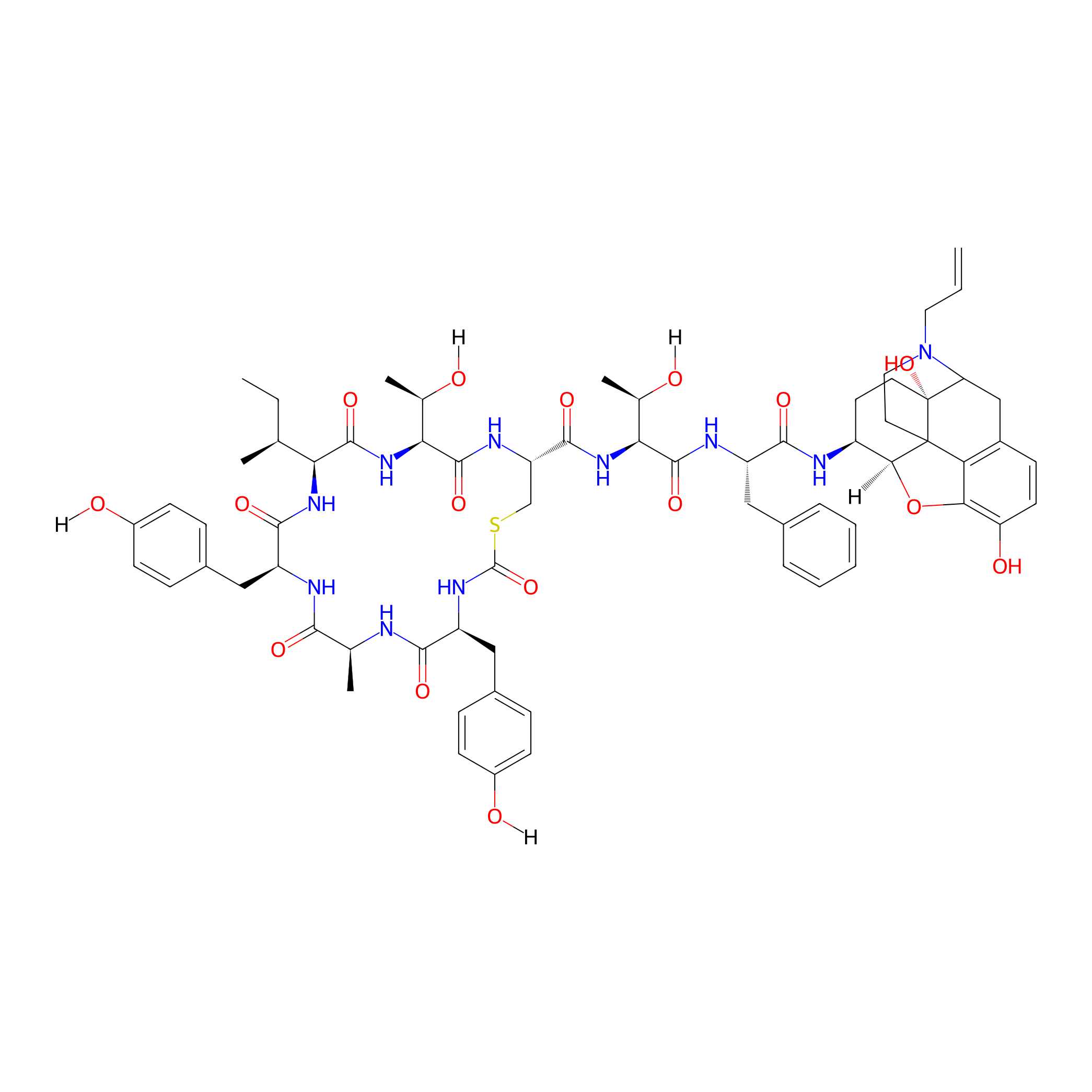
De Novo Cyclic Peptide (DNCP)-β-naloxamine (NalA) conjugates 1
|
|||||
| PDC Status |
Investigative
|
|||||
| Indication |
In total 1 Indication(s)
 Pain
Pain
|
|||||
| Structure |
|
|||||
| Peptide Name |
YAyITCTF
|
Peptide Info | ||||
| Receptor Name |
Kappa-type opioid receptor (OPRK1)
|
Receptor Info | ||||
| Drug Name |
β-Naloxamine
|
Drug Info | ||||
| Therapeutic Target |
Kappa-type opioid receptor (OPRK1)
|
Target Info | ||||
| Linker Name |
Amide bond
|
Linker Info | ||||
| Peptide Modified Type |
Cyclization modification
|
|||||
| Modified Segment |
Side-chain cyclization
|
|||||
| Formula |
C67H84N10O16S
|
|||||
| #Ro5 Violations (Lipinski): 4 | Molecular Weight | 1317.53 | ||||
| Lipid-water partition coefficient (xlogp) | 0.4026 | |||||
| Hydrogen Bond Donor Count (hbonddonor) | 15 | |||||
| Hydrogen Bond Acceptor Count (hbondacc) | 18 | |||||
| Rotatable Bond Count (rotbonds) | 22 | |||||
Full List of Activity Data of This Peptide-drug Conjugate
Discovered Using Cell Line-derived Xenograft Model
| Experiment 1 Reporting the Activity Data of This PDC | [1] | ||||
| Indication | Pain | ||||
| Efficacy Data | Half Maximal Effect Concentration (EC50) |
0.1 ± 0.0 x 10⁻⁹ mol
|
|||
| MOA of PDC |
Here, we exploit the crystal structure of KOR bound to the dual KOR/delta-opioid receptor (DOR) epoxymorphinan opioid agonist MP11048 and use the Rosetta protein and peptide design software to computationally design peptide-small molecule conjugates targeting KOR. Utilizing the high affinity interaction of MP1104 with KOR as an anchor to initiate the design calculations, we seek to computationally design thioether cyclic peptides that interact with ECL2 and ECL3 of the receptor.
Click to Show/Hide
|
||||
| Description |
The TRUPATH screening platform has been developed as an alternative to cAMP second messenger assays to minimize signal overamplification35. Intriguingly, in contrast to U50,488 and MP1104, but similar to the mixed-action KOR agonist pentazocine, DNCP--NalA(1) exhibited KOR partial agonism at Gi2, Gi3, GoA, GoB and Ggastducin subtypes with Emax values ranging from 48% to 77%, whereas it elicited full agonism at Gi1 and Gz with Emax values of 81% and 101%, respectively. The highest potency in the picomolar range was observed at Gz subtype for DNCP--NalA(1), U50,488 and MP1104, while pentazocine revealed the least variation in potency and efficacy across the transducerome.
Click to Show/Hide
|
||||
| In Vivo Model | Experiments were performed in male SWISS mice. Radioligand binding (n=3) and functional cAMP assays (n=3-4) of DNCP-beta-NalA conjugates were performed on HEK293T cell membranes stably expressing mouse KOR. | ||||
| Experiment 2 Reporting the Activity Data of This PDC | [1] | ||||
| Indication | Pain | ||||
| Efficacy Data | Half Maximal Effect Concentration (EC50) |
0.7 ± 0.2 x 10⁻⁹ mol
|
|||
| MOA of PDC |
Here, we exploit the crystal structure of KOR bound to the dual KOR/delta-opioid receptor (DOR) epoxymorphinan opioid agonist MP11048 and use the Rosetta protein and peptide design software to computationally design peptide-small molecule conjugates targeting KOR. Utilizing the high affinity interaction of MP1104 with KOR as an anchor to initiate the design calculations, we seek to computationally design thioether cyclic peptides that interact with ECL2 and ECL3 of the receptor.
Click to Show/Hide
|
||||
| Description |
The TRUPATH screening platform has been developed as an alternative to cAMP second messenger assays to minimize signal overamplification35. Intriguingly, in contrast to U50,488 and MP1104, but similar to the mixed-action KOR agonist pentazocine, DNCP--NalA(1) exhibited KOR partial agonism at Gi2, Gi3, GoA, GoB and Ggastducin subtypes with Emax values ranging from 48% to 77%, whereas it elicited full agonism at Gi1 and Gz with Emax values of 81% and 101%, respectively. The highest potency in the picomolar range was observed at Gz subtype for DNCP--NalA(1), U50,488 and MP1104, while pentazocine revealed the least variation in potency and efficacy across the transducerome.
Click to Show/Hide
|
||||
| In Vivo Model | Experiments were performed in male SWISS mice. Radioligand binding (n=3) and functional cAMP assays (n=3-4) of DNCP-beta-NalA conjugates were performed on HEK293T cell membranes stably expressing mouse KOR. | ||||
| Experiment 3 Reporting the Activity Data of This PDC | [1] | ||||
| Indication | Pain | ||||
| Efficacy Data | Half Maximal Effect Concentration (EC50) |
0.9 ± 0.4 x 10⁻⁹ mol
|
|||
| MOA of PDC |
Here, we exploit the crystal structure of KOR bound to the dual KOR/delta-opioid receptor (DOR) epoxymorphinan opioid agonist MP11048 and use the Rosetta protein and peptide design software to computationally design peptide-small molecule conjugates targeting KOR. Utilizing the high affinity interaction of MP1104 with KOR as an anchor to initiate the design calculations, we seek to computationally design thioether cyclic peptides that interact with ECL2 and ECL3 of the receptor.
Click to Show/Hide
|
||||
| Description |
The TRUPATH screening platform has been developed as an alternative to cAMP second messenger assays to minimize signal overamplification35. Intriguingly, in contrast to U50,488 and MP1104, but similar to the mixed-action KOR agonist pentazocine, DNCP--NalA(1) exhibited KOR partial agonism at Gi2, Gi3, GoA, GoB and Ggastducin subtypes with Emax values ranging from 48% to 77%, whereas it elicited full agonism at Gi1 and Gz with Emax values of 81% and 101%, respectively. The highest potency in the picomolar range was observed at Gz subtype for DNCP--NalA(1), U50,488 and MP1104, while pentazocine revealed the least variation in potency and efficacy across the transducerome.
Click to Show/Hide
|
||||
| In Vivo Model | Experiments were performed in male SWISS mice. Radioligand binding (n=3) and functional cAMP assays (n=3-4) of DNCP-beta-NalA conjugates were performed on HEK293T cell membranes stably expressing mouse KOR. | ||||
| Experiment 4 Reporting the Activity Data of This PDC | [1] | ||||
| Indication | Pain | ||||
| Efficacy Data | Half Maximal Effect Concentration (EC50) |
1.4 ± 0.3 x 10⁻⁹ mol
|
|||
| MOA of PDC |
Here, we exploit the crystal structure of KOR bound to the dual KOR/delta-opioid receptor (DOR) epoxymorphinan opioid agonist MP11048 and use the Rosetta protein and peptide design software to computationally design peptide-small molecule conjugates targeting KOR. Utilizing the high affinity interaction of MP1104 with KOR as an anchor to initiate the design calculations, we seek to computationally design thioether cyclic peptides that interact with ECL2 and ECL3 of the receptor.
Click to Show/Hide
|
||||
| Description |
The TRUPATH screening platform has been developed as an alternative to cAMP second messenger assays to minimize signal overamplification35. Intriguingly, in contrast to U50,488 and MP1104, but similar to the mixed-action KOR agonist pentazocine, DNCP--NalA(1) exhibited KOR partial agonism at Gi2, Gi3, GoA, GoB and Ggastducin subtypes with Emax values ranging from 48% to 77%, whereas it elicited full agonism at Gi1 and Gz with Emax values of 81% and 101%, respectively. The highest potency in the picomolar range was observed at Gz subtype for DNCP--NalA(1), U50,488 and MP1104, while pentazocine revealed the least variation in potency and efficacy across the transducerome.
Click to Show/Hide
|
||||
| In Vivo Model | Experiments were performed in male SWISS mice. Radioligand binding (n=3) and functional cAMP assays (n=3-4) of DNCP-beta-NalA conjugates were performed on HEK293T cell membranes stably expressing mouse KOR. | ||||
| Experiment 5 Reporting the Activity Data of This PDC | [1] | ||||
| Indication | Pain | ||||
| Efficacy Data | Half Maximal Effect Concentration (EC50) |
1.7 ± 0.5 x 10⁻⁹ mol
|
|||
| MOA of PDC |
Here, we exploit the crystal structure of KOR bound to the dual KOR/delta-opioid receptor (DOR) epoxymorphinan opioid agonist MP11048 and use the Rosetta protein and peptide design software to computationally design peptide-small molecule conjugates targeting KOR. Utilizing the high affinity interaction of MP1104 with KOR as an anchor to initiate the design calculations, we seek to computationally design thioether cyclic peptides that interact with ECL2 and ECL3 of the receptor.
Click to Show/Hide
|
||||
| Description |
The TRUPATH screening platform has been developed as an alternative to cAMP second messenger assays to minimize signal overamplification35. Intriguingly, in contrast to U50,488 and MP1104, but similar to the mixed-action KOR agonist pentazocine, DNCP--NalA(1) exhibited KOR partial agonism at Gi2, Gi3, GoA, GoB and Ggastducin subtypes with Emax values ranging from 48% to 77%, whereas it elicited full agonism at Gi1 and Gz with Emax values of 81% and 101%, respectively. The highest potency in the picomolar range was observed at Gz subtype for DNCP--NalA(1), U50,488 and MP1104, while pentazocine revealed the least variation in potency and efficacy across the transducerome.
Click to Show/Hide
|
||||
| In Vivo Model | Experiments were performed in male SWISS mice. Radioligand binding (n=3) and functional cAMP assays (n=3-4) of DNCP-beta-NalA conjugates were performed on HEK293T cell membranes stably expressing mouse KOR. | ||||
| Experiment 6 Reporting the Activity Data of This PDC | [1] | ||||
| Indication | Pain | ||||
| Efficacy Data | Half Maximal Effect Concentration (EC50) |
2.4 ± 0.9 x 10⁻⁹ mol
|
|||
| MOA of PDC |
Here, we exploit the crystal structure of KOR bound to the dual KOR/delta-opioid receptor (DOR) epoxymorphinan opioid agonist MP11048 and use the Rosetta protein and peptide design software to computationally design peptide-small molecule conjugates targeting KOR. Utilizing the high affinity interaction of MP1104 with KOR as an anchor to initiate the design calculations, we seek to computationally design thioether cyclic peptides that interact with ECL2 and ECL3 of the receptor.
Click to Show/Hide
|
||||
| Description |
The TRUPATH screening platform has been developed as an alternative to cAMP second messenger assays to minimize signal overamplification35. Intriguingly, in contrast to U50,488 and MP1104, but similar to the mixed-action KOR agonist pentazocine, DNCP--NalA(1) exhibited KOR partial agonism at Gi2, Gi3, GoA, GoB and Ggastducin subtypes with Emax values ranging from 48% to 77%, whereas it elicited full agonism at Gi1 and Gz with Emax values of 81% and 101%, respectively. The highest potency in the picomolar range was observed at Gz subtype for DNCP--NalA(1), U50,488 and MP1104, while pentazocine revealed the least variation in potency and efficacy across the transducerome.
Click to Show/Hide
|
||||
| In Vivo Model | Experiments were performed in male SWISS mice. Radioligand binding (n=3) and functional cAMP assays (n=3-4) of DNCP-beta-NalA conjugates were performed on HEK293T cell membranes stably expressing mouse KOR. | ||||
| Experiment 7 Reporting the Activity Data of This PDC | [1] | ||||
| Indication | Pain | ||||
| Efficacy Data | Half Maximal Effect Concentration (EC50) |
3.1 ± 1.5 x 10⁻⁸ mol
|
|||
| MOA of PDC |
Here, we exploit the crystal structure of KOR bound to the dual KOR/delta-opioid receptor (DOR) epoxymorphinan opioid agonist MP11048 and use the Rosetta protein and peptide design software to computationally design peptide-small molecule conjugates targeting KOR. Utilizing the high affinity interaction of MP1104 with KOR as an anchor to initiate the design calculations, we seek to computationally design thioether cyclic peptides that interact with ECL2 and ECL3 of the receptor.
Click to Show/Hide
|
||||
| Description |
The TRUPATH screening platform has been developed as an alternative to cAMP second messenger assays to minimize signal overamplification35. Intriguingly, in contrast to U50,488 and MP1104, but similar to the mixed-action KOR agonist pentazocine, DNCP--NalA(1) exhibited KOR partial agonism at Gi2, Gi3, GoA, GoB and Ggastducin subtypes with Emax values ranging from 48% to 77%, whereas it elicited full agonism at Gi1 and Gz with Emax values of 81% and 101%, respectively. The highest potency in the picomolar range was observed at Gz subtype for DNCP--NalA(1), U50,488 and MP1104, while pentazocine revealed the least variation in potency and efficacy across the transducerome.
Click to Show/Hide
|
||||
| In Vivo Model | Experiments were performed in male SWISS mice. Radioligand binding (n=3) and functional cAMP assays (n=3-4) of DNCP-beta-NalA conjugates were performed on HEK293T cell membranes stably expressing mouse KOR. | ||||
Revealed Based on the Cell Line Data
| Experiment 1 Reporting the Activity Data of This PDC | [1] | ||||
| Indication | Pain | ||||
| Efficacy Data | Half Maximal Effect Concentration (EC50) |
2.0 ± 0.1 x 10⁻⁹ mol
|
|||
| Evaluation Method | Potency/efficacy cAMP assay) | ||||
| MOA of PDC |
Here, we exploit the crystal structure of KOR bound to the dual KOR/delta-opioid receptor (DOR) epoxymorphinan opioid agonist MP11048 and use the Rosetta protein and peptide design software to computationally design peptide-small molecule conjugates targeting KOR. Utilizing the high affinity interaction of MP1104 with KOR as an anchor to initiate the design calculations, we seek to computationally design thioether cyclic peptides that interact with ECL2 and ECL3 of the receptor.
Click to Show/Hide
|
||||
| Description |
We obtained four DNCP--NalA conjugates (1-4); the conjugation of DNCP (35) and DNCP (36) was unsuccessful. DNCP--NalA conjugates (1-4) were pharmacologically characterized via radioligand binding and functional cAMP assays to investigate their affinity, potency and efficacy at the mouse KOR. The DNCP--NalA conjugates exhibited affinities in the low nanomolar range, with DNCP--NalA(1) being the strongest binder at KOR with a Ki value of 3.9 nM, as compared to -NalA, which has an affinity Ki of 72 nM. All four DNCP--NalA conjugates were full agonists at KOR (Emax = 89-101%), while -NalA alone was only a partial agonist with an EC50 of 130 nM and Emax of 61%. The most potent conjugates were DNCP--NalA(1) and (4) with EC50 values of 2.0 nM and 1.0 nM, respectively. DNCP--NalA(2) and DNCP--NalA(3) showed agonist activities at KOR with EC50 values of 7.5 and 14 nM in cAMP assay, respectively, while their Ki values were 31 and 24 nM in radioligand binding assay, respectively. Receptor reserve may account for this discrepancy between potency and affinity values of DNCP--NalA(2) and DNCP--NalA(4) which can be observed in functional GPCR assays with opioid receptors30. The higher potency and efficacy of the conjugates at KOR compared to -NalA can be attributed to interactions of the macrocycles with the ECL2 region as described later.
Click to Show/Hide
|
||||
| In Vitro Model | Normal | HEK-293T cell | CVCL_0063 | ||
| Experiment 2 Reporting the Activity Data of This PDC | [1] | ||||
| Indication | Pain | ||||
| Efficacy Data | Half Maximal Effect Concentration (EC50) |
5.5 ± 1.7 x 10⁻⁹ mol
|
|||
| Evaluation Method | [35S]GTPγS binding assay | ||||
| MOA of PDC |
Here, we exploit the crystal structure of KOR bound to the dual KOR/delta-opioid receptor (DOR) epoxymorphinan opioid agonist MP11048 and use the Rosetta protein and peptide design software to computationally design peptide-small molecule conjugates targeting KOR. Utilizing the high affinity interaction of MP1104 with KOR as an anchor to initiate the design calculations, we seek to computationally design thioether cyclic peptides that interact with ECL2 and ECL3 of the receptor.
Click to Show/Hide
|
||||
| Description |
Next, we determined the opioid receptor subtype selectivity profile of DNCP--NalA(1) in radioligand binding assays with membrane preparations from HEK293 cells stably expressing the mouse MOR and DOR, and CHO cells stably expressing human nociceptin (NOP) receptor. Herein, DNCP--NalA(1) bound to mouse MOR and DOR with Ki values of 5.4 and 318 nM, respectively, supporting an ~80-fold selectivity for KOR over DOR whereas it bound to the human NOP with a Ki value of ~1.3 μM, thus having an ~330-fold selectivity for KOR over NOP receptor. In the functional cAMP assay, DNCP--NalA(1) was inactive at both mouse MOR and DOR up to 10 μM. This was confirmed at the human MOR and DOR in the [35S]GTPγS binding assay. We next determined the mechanism of antagonism of DNCP--NalA(1) by measuring adenylyl cyclase-mediated cAMP inhibition and [35S]GTPγS binding at mouse and human MOR, respectively, using Schild regression analysis. The MOR expressed in HEK293 and CHO cells was activated by DAMGO in the absence and presence of increasing concentrations of DNCP--NalA(1). We observed a rightward shift of the concentration-response curves of DAMGO in cAMP and [35S]GTPγS binding assays. Schild analysis of DNCP--NalA(1) exhibited linear regression slopes of 0.9 and 1.5 and pA2 values of 9.1 and 7.9 in cAMP and [35S]GTPγS binding assays, respectively, which corresponds to an average functional affinity of 0.8 and 13 nM, respectively, thus demonstrating the competitive antagonism of the DNCP--NalA(1) at MOR.
Click to Show/Hide
|
||||
| In Vitro Model | Normal | CHO cell | CVCL_0213 | ||
| Experiment 3 Reporting the Activity Data of This PDC | [1] | ||||
| Indication | Pain | ||||
| Efficacy Data | Half Maximal Effect Concentration (EC50) |
2.2 ± 1.3 x 10⁻⁸ mol
|
|||
| Evaluation Method | Potency/efficacy β-arrestin-2 recruitment assay | ||||
| MOA of PDC |
Here, we exploit the crystal structure of KOR bound to the dual KOR/delta-opioid receptor (DOR) epoxymorphinan opioid agonist MP11048 and use the Rosetta protein and peptide design software to computationally design peptide-small molecule conjugates targeting KOR. Utilizing the high affinity interaction of MP1104 with KOR as an anchor to initiate the design calculations, we seek to computationally design thioether cyclic peptides that interact with ECL2 and ECL3 of the receptor.
Click to Show/Hide
|
||||
| Description |
We obtained four DNCP--NalA conjugates (1-4); the conjugation of DNCP (35) and DNCP (36) was unsuccessful. DNCP--NalA conjugates (1-4) were pharmacologically characterized via radioligand binding and functional cAMP assays to investigate their affinity, potency and efficacy at the mouse KOR. The DNCP--NalA conjugates exhibited affinities in the low nanomolar range, with DNCP--NalA(1) being the strongest binder at KOR with a Ki value of 3.9 nM, as compared to -NalA, which has an affinity Ki of 72 nM. All four DNCP--NalA conjugates were full agonists at KOR (Emax = 89-101%), while -NalA alone was only a partial agonist with an EC50 of 130 nM and Emax of 61%. The most potent conjugates were DNCP--NalA(1) and (4) with EC50 values of 2.0 nM and 1.0 nM, respectively. DNCP--NalA(2) and DNCP--NalA(3) showed agonist activities at KOR with EC50 values of 7.5 and 14 nM in cAMP assay, respectively, while their Ki values were 31 and 24 nM in radioligand binding assay, respectively. Receptor reserve may account for this discrepancy between potency and affinity values of DNCP--NalA(2) and DNCP--NalA(4) which can be observed in functional GPCR assays with opioid receptors30. The higher potency and efficacy of the conjugates at KOR compared to -NalA can be attributed to interactions of the macrocycles with the ECL2 region as described later.
Click to Show/Hide
|
||||
| In Vitro Model | Normal | HEK-293T cell | CVCL_0063 | ||
| Experiment 4 Reporting the Activity Data of This PDC | [1] | ||||
| Indication | Pain | ||||
| Efficacy Data | Half Maximal Effect Concentration (EC50) |
2.8 ± 0.7 x 10⁻⁸ mol
|
|||
| Evaluation Method | Potency/efficacy β-arrestin-1 recruitment assay | ||||
| MOA of PDC |
Here, we exploit the crystal structure of KOR bound to the dual KOR/delta-opioid receptor (DOR) epoxymorphinan opioid agonist MP11048 and use the Rosetta protein and peptide design software to computationally design peptide-small molecule conjugates targeting KOR. Utilizing the high affinity interaction of MP1104 with KOR as an anchor to initiate the design calculations, we seek to computationally design thioether cyclic peptides that interact with ECL2 and ECL3 of the receptor.
Click to Show/Hide
|
||||
| Description |
We obtained four DNCP--NalA conjugates (1-4); the conjugation of DNCP (35) and DNCP (36) was unsuccessful. DNCP--NalA conjugates (1-4) were pharmacologically characterized via radioligand binding and functional cAMP assays to investigate their affinity, potency and efficacy at the mouse KOR. The DNCP--NalA conjugates exhibited affinities in the low nanomolar range, with DNCP--NalA(1) being the strongest binder at KOR with a Ki value of 3.9 nM, as compared to -NalA, which has an affinity Ki of 72 nM. All four DNCP--NalA conjugates were full agonists at KOR (Emax = 89-101%), while -NalA alone was only a partial agonist with an EC50 of 130 nM and Emax of 61%. The most potent conjugates were DNCP--NalA(1) and (4) with EC50 values of 2.0 nM and 1.0 nM, respectively. DNCP--NalA(2) and DNCP--NalA(3) showed agonist activities at KOR with EC50 values of 7.5 and 14 nM in cAMP assay, respectively, while their Ki values were 31 and 24 nM in radioligand binding assay, respectively. Receptor reserve may account for this discrepancy between potency and affinity values of DNCP--NalA(2) and DNCP--NalA(4) which can be observed in functional GPCR assays with opioid receptors30. The higher potency and efficacy of the conjugates at KOR compared to -NalA can be attributed to interactions of the macrocycles with the ECL2 region as described later.
Click to Show/Hide
|
||||
| In Vitro Model | Normal | HEK-293T cell | CVCL_0063 | ||
| Experiment 5 Reporting the Activity Data of This PDC | [1] | ||||
| Indication | Pain | ||||
| Efficacy Data | Half Maximal Effective Concentration (EC50) |
31 ± 15 μM
|
|||
| Evaluation Method | [35S]GTPγS binding assay | ||||
| MOA of PDC |
Here, we exploit the crystal structure of KOR bound to the dual KOR/delta-opioid receptor (DOR) epoxymorphinan opioid agonist MP11048 and use the Rosetta protein and peptide design software to computationally design peptide-small molecule conjugates targeting KOR. Utilizing the high affinity interaction of MP1104 with KOR as an anchor to initiate the design calculations, we seek to computationally design thioether cyclic peptides that interact with ECL2 and ECL3 of the receptor.
Click to Show/Hide
|
||||
| Description |
Next, we determined the opioid receptor subtype selectivity profile of DNCP--NalA(1) in radioligand binding assays with membrane preparations from HEK293 cells stably expressing the mouse MOR and DOR, and CHO cells stably expressing human nociceptin (NOP) receptor. Herein, DNCP--NalA(1) bound to mouse MOR and DOR with Ki values of 5.4 and 318 nM, respectively, supporting an ~80-fold selectivity for KOR over DOR whereas it bound to the human NOP with a Ki value of ~1.3 μM, thus having an ~330-fold selectivity for KOR over NOP receptor. In the functional cAMP assay, DNCP--NalA(1) was inactive at both mouse MOR and DOR up to 10 μM. This was confirmed at the human MOR and DOR in the [35S]GTPγS binding assay. We next determined the mechanism of antagonism of DNCP--NalA(1) by measuring adenylyl cyclase-mediated cAMP inhibition and [35S]GTPγS binding at mouse and human MOR, respectively, using Schild regression analysis. The MOR expressed in HEK293 and CHO cells was activated by DAMGO in the absence and presence of increasing concentrations of DNCP--NalA(1). We observed a rightward shift of the concentration-response curves of DAMGO in cAMP and [35S]GTPγS binding assays. Schild analysis of DNCP--NalA(1) exhibited linear regression slopes of 0.9 and 1.5 and pA2 values of 9.1 and 7.9 in cAMP and [35S]GTPγS binding assays, respectively, which corresponds to an average functional affinity of 0.8 and 13 nM, respectively, thus demonstrating the competitive antagonism of the DNCP--NalA(1) at MOR.
Click to Show/Hide
|
||||
| In Vitro Model | Normal | CHO cell | CVCL_0213 | ||
References