Peptide-drug Conjugate Information
General Information of This Peptide-drug Conjugate (PDC)
| PDC ID |
PDC_00364
|
|||||
|---|---|---|---|---|---|---|
| PDC Name |
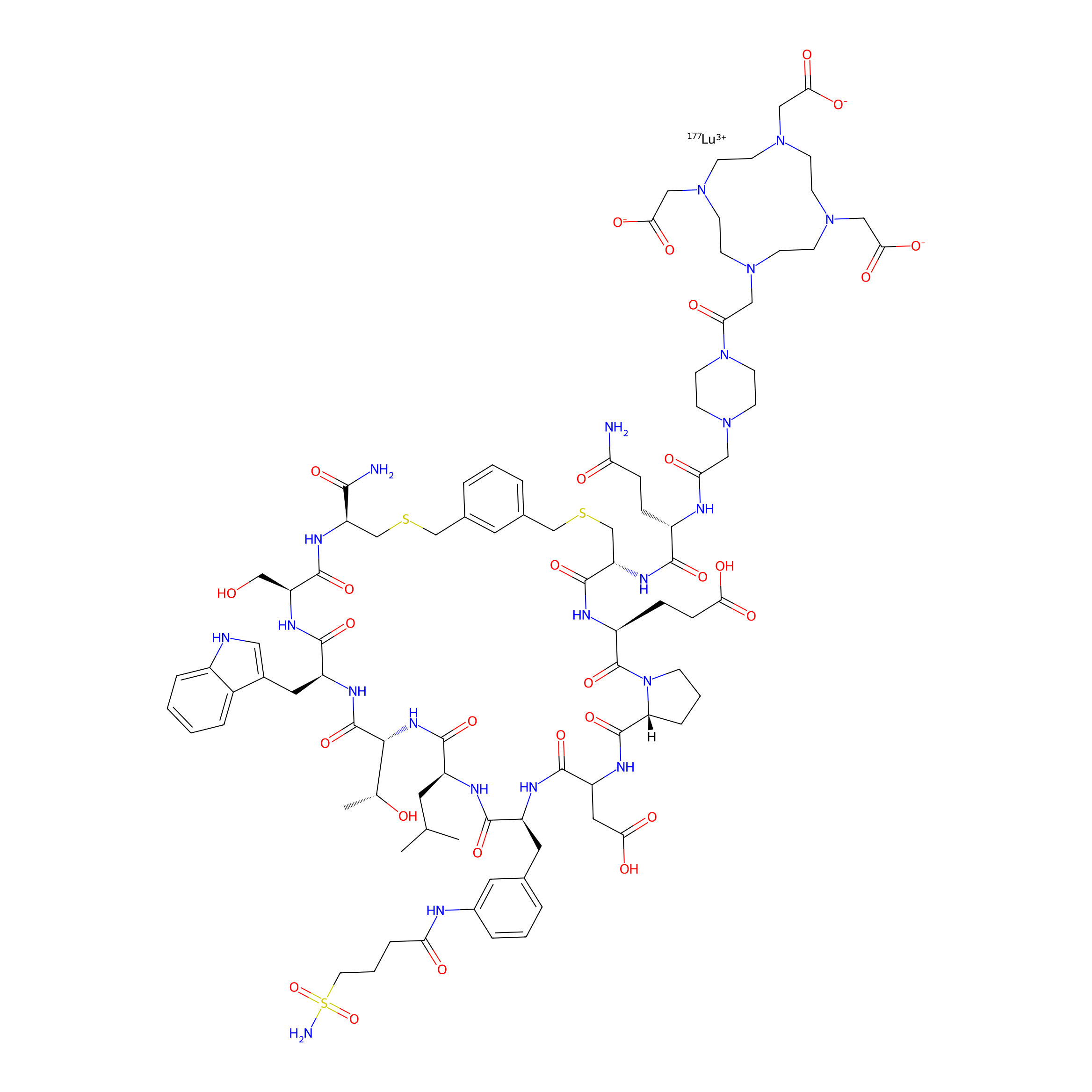
[177Lu]Lu-DPI-4452
|
|||||
| PDC Status |
Phase 1/2
|
|||||
| Indication |
In total 2 Indication(s)
 Colon adenocarcinoma
Renal cancer
Colon adenocarcinoma
Renal cancer
|
|||||
| Structure |
|
|||||
| Peptide Name |
DPI-4452
|
Peptide Info | ||||
| Drug Name |
Lutetium-177
|
Drug Info | ||||
| Therapeutic Target |
Human Deoxyribonucleic acid (hDNA)
|
Target Info | ||||
| Linker Name |
Ethyl 2-(piperazin-1-yl)acetate
|
Linker Info | ||||
| Formula |
C92H129LuN22O29S3
|
|||||
| #Ro5 Violations (Lipinski): 5 | Molecular Weight | 2280.313758 | ||||
| Lipid-water partition coefficient (xlogp) | -10.8955 | |||||
| Hydrogen Bond Donor Count (hbonddonor) | 19 | |||||
| Hydrogen Bond Acceptor Count (hbondacc) | 34 | |||||
| Rotatable Bond Count (rotbonds) | 35 | |||||
Full List of Activity Data of This Peptide-drug Conjugate
Discovered Using Cell Line-derived Xenograft Model
| Experiment 1 Reporting the Activity Data of This PDC | [1] | ||||
| Indication | Colon adenocarcinoma | ||||
| Efficacy Data | Tumor Growth Inhibition value (TGI) |
29.40%
|
|||
| Administration Time | 23 days | ||||
| Administration Dosage | 33 MBq, single dose | ||||
| MOA of PDC |
Carbonic anhydrases (CAs) catalyze the reversible hydration of carbon dioxide to bicarbonate ions and protons. Of the 12 catalytically active CAs in humans, 4 are located on the extracellular surface. Two of these, CAIX and CAXII, are highly expressed in tumors and contribute to maintenance of the acidic tumor microenvironment. Many healthy tissues express CAXII, whereas normal CAIX expression is restricted to the gastrointestinal epithelia. In clear cell renal cell carcinomas (ccRCC), impaired von Hippel-Lindau tumor suppressor function causes deregulation of hypoxia-inducible factor 1α expression, resulting in constitutive CAIX expression. Transcriptional regulation by hypoxia-inducible factor 1α leads to CAIX overexpression in hypoxic conditions and aberrant expression in some solid tumors, including colorectal cancer (CRC), breast cancer, and pancreatic ductal adenocarcinoma (PDAC). CAIX overexpression is associated with tumor progression, poor prognosis, and metastasis development. With restricted expression in healthy tissues and near ubiquitous cell surface expression in ccRCC and hypoxic tumors (7), CAIX represents a promising diagnostic and therapeutic target. DPI-4452 is a CAIX-targeting peptidomimetic carrying a DOTA cage, allowing chelation with radionuclides such as 68Ga ([68Ga]Ga) or 177Lu ([177Lu]Lu) for theranostic purposes. Here, we report on the tumor-specific expression of CAIX and preclinical characterization of DPI-4452 in proof-of-concept studies, including safety, biodistribution, pharmacokinetics, and antitumor efficacy.
Click to Show/Hide
|
||||
| Description |
The antitumor effects of [177Lu]Lu-DPI-4452 were assessed in HT-29 and SK-RC-52 xenografts. Tumor-bearing mice were randomized into 4 groups and injected with single doses of vehicle, 100 or 33 MBq of [177Lu]Lu-DPI-4452, or 3 once-weekly 33-MBq doses of [177Lu]Lu-DPI-4452. Treatment was well tolerated, including no significant changes in kidney function biomarkers (Supplemental Figs. 911). All treatment groups, except HT-29 xenograft-bearing mice receiving a single dose of 33 MBq, had significantly reduced tumor volumes compared with vehicle controls by day 16 (HT-29) or day 13 (SK-RC-52). Both 100-MBq and 3 once-weekly 33-MBq doses produced maximal tumor growth inhibition at day 23 for HT-29 xenografts and day 36 for SK-RC-52 xenografts, although 3 once-weekly 33-MBq doses produced a more sustained effect than a single 100-MBq dose in both models. No significant difference in tumor size for SK-RC-52 xenografts was observed at day 36 after treatment with single 100- or 33-MBq doses of [177Lu]Lu-DPI-4452 (Supplemental Table 4). These findings were consistent with the improved survival seen in treated mice compared with control mice (Supplemental Fig. 14; Supplemental Table 5). SPECT/CT analysis of 3 mice with xenografts per treatment arm revealed high tumor uptake in both models that was not modulated by repeated [177Lu]Lu-DPI-4452 treatments. Similar radioactivity was found in SK-RC-52 tumors for all doses, suggesting that uptake was already maximal at the lowest dose of 33 MBq. These findings demonstrated a strong antitumor effect of [177Lu]Lu-DPI-4452 on CAIX-expressing tumors and suggested dose fractionation may be beneficial.
Click to Show/Hide
|
||||
| In Vivo Model | Female Swiss nude mice HT-29 CRC cells xenograft models. | ||||
| In Vitro Model | Colon cancer | HT29 cell | CVCL_A8EZ | ||
| Experiment 2 Reporting the Activity Data of This PDC | [1] | ||||
| Indication | Renal cancer | ||||
| Efficacy Data | Tumor Growth Inhibition value (TGI) |
73.30%
|
|||
| Administration Time | 15 days | ||||
| Administration Dosage | 100 MBq, single dose | ||||
| MOA of PDC |
Carbonic anhydrases (CAs) catalyze the reversible hydration of carbon dioxide to bicarbonate ions and protons. Of the 12 catalytically active CAs in humans, 4 are located on the extracellular surface. Two of these, CAIX and CAXII, are highly expressed in tumors and contribute to maintenance of the acidic tumor microenvironment. Many healthy tissues express CAXII, whereas normal CAIX expression is restricted to the gastrointestinal epithelia. In clear cell renal cell carcinomas (ccRCC), impaired von Hippel-Lindau tumor suppressor function causes deregulation of hypoxia-inducible factor 1α expression, resulting in constitutive CAIX expression. Transcriptional regulation by hypoxia-inducible factor 1α leads to CAIX overexpression in hypoxic conditions and aberrant expression in some solid tumors, including colorectal cancer (CRC), breast cancer, and pancreatic ductal adenocarcinoma (PDAC). CAIX overexpression is associated with tumor progression, poor prognosis, and metastasis development. With restricted expression in healthy tissues and near ubiquitous cell surface expression in ccRCC and hypoxic tumors (7), CAIX represents a promising diagnostic and therapeutic target. DPI-4452 is a CAIX-targeting peptidomimetic carrying a DOTA cage, allowing chelation with radionuclides such as 68Ga ([68Ga]Ga) or 177Lu ([177Lu]Lu) for theranostic purposes. Here, we report on the tumor-specific expression of CAIX and preclinical characterization of DPI-4452 in proof-of-concept studies, including safety, biodistribution, pharmacokinetics, and antitumor efficacy.
Click to Show/Hide
|
||||
| Description |
The antitumor effects of [177Lu]Lu-DPI-4452 were assessed in HT-29 and SK-RC-52 xenografts. Tumor-bearing mice were randomized into 4 groups and injected with single doses of vehicle, 100 or 33 MBq of [177Lu]Lu-DPI-4452, or 3 once-weekly 33-MBq doses of [177Lu]Lu-DPI-4452. Treatment was well tolerated, including no significant changes in kidney function biomarkers (Supplemental Figs. 911). All treatment groups, except HT-29 xenograft-bearing mice receiving a single dose of 33 MBq, had significantly reduced tumor volumes compared with vehicle controls by day 16 (HT-29) or day 13 (SK-RC-52). Both 100-MBq and 3 once-weekly 33-MBq doses produced maximal tumor growth inhibition at day 23 for HT-29 xenografts and day 36 for SK-RC-52 xenografts, although 3 once-weekly 33-MBq doses produced a more sustained effect than a single 100-MBq dose in both models. No significant difference in tumor size for SK-RC-52 xenografts was observed at day 36 after treatment with single 100- or 33-MBq doses of [177Lu]Lu-DPI-4452 (Supplemental Table 4). These findings were consistent with the improved survival seen in treated mice compared with control mice (Supplemental Fig. 14; Supplemental Table 5). SPECT/CT analysis of 3 mice with xenografts per treatment arm revealed high tumor uptake in both models that was not modulated by repeated [177Lu]Lu-DPI-4452 treatments. Similar radioactivity was found in SK-RC-52 tumors for all doses, suggesting that uptake was already maximal at the lowest dose of 33 MBq. These findings demonstrated a strong antitumor effect of [177Lu]Lu-DPI-4452 on CAIX-expressing tumors and suggested dose fractionation may be beneficial.
Click to Show/Hide
|
||||
| In Vivo Model | Female Swiss nude mice SK-RC-52 ccRCC cells xenograft models. | ||||
| In Vitro Model | Renal cell carcinoma | SK-RC-52 cell | CVCL_6198 | ||
| Experiment 3 Reporting the Activity Data of This PDC | [1] | ||||
| Indication | Renal cancer | ||||
| Efficacy Data | Tumor Growth Inhibition value (TGI) |
77.80%
|
|||
| Administration Time | 15 days | ||||
| Administration Dosage | 33 MBq, single dose | ||||
| MOA of PDC |
Carbonic anhydrases (CAs) catalyze the reversible hydration of carbon dioxide to bicarbonate ions and protons. Of the 12 catalytically active CAs in humans, 4 are located on the extracellular surface. Two of these, CAIX and CAXII, are highly expressed in tumors and contribute to maintenance of the acidic tumor microenvironment. Many healthy tissues express CAXII, whereas normal CAIX expression is restricted to the gastrointestinal epithelia. In clear cell renal cell carcinomas (ccRCC), impaired von Hippel-Lindau tumor suppressor function causes deregulation of hypoxia-inducible factor 1α expression, resulting in constitutive CAIX expression. Transcriptional regulation by hypoxia-inducible factor 1α leads to CAIX overexpression in hypoxic conditions and aberrant expression in some solid tumors, including colorectal cancer (CRC), breast cancer, and pancreatic ductal adenocarcinoma (PDAC). CAIX overexpression is associated with tumor progression, poor prognosis, and metastasis development. With restricted expression in healthy tissues and near ubiquitous cell surface expression in ccRCC and hypoxic tumors (7), CAIX represents a promising diagnostic and therapeutic target. DPI-4452 is a CAIX-targeting peptidomimetic carrying a DOTA cage, allowing chelation with radionuclides such as 68Ga ([68Ga]Ga) or 177Lu ([177Lu]Lu) for theranostic purposes. Here, we report on the tumor-specific expression of CAIX and preclinical characterization of DPI-4452 in proof-of-concept studies, including safety, biodistribution, pharmacokinetics, and antitumor efficacy.
Click to Show/Hide
|
||||
| Description |
The antitumor effects of [177Lu]Lu-DPI-4452 were assessed in HT-29 and SK-RC-52 xenografts. Tumor-bearing mice were randomized into 4 groups and injected with single doses of vehicle, 100 or 33 MBq of [177Lu]Lu-DPI-4452, or 3 once-weekly 33-MBq doses of [177Lu]Lu-DPI-4452. Treatment was well tolerated, including no significant changes in kidney function biomarkers (Supplemental Figs. 911). All treatment groups, except HT-29 xenograft-bearing mice receiving a single dose of 33 MBq, had significantly reduced tumor volumes compared with vehicle controls by day 16 (HT-29) or day 13 (SK-RC-52). Both 100-MBq and 3 once-weekly 33-MBq doses produced maximal tumor growth inhibition at day 23 for HT-29 xenografts and day 36 for SK-RC-52 xenografts, although 3 once-weekly 33-MBq doses produced a more sustained effect than a single 100-MBq dose in both models. No significant difference in tumor size for SK-RC-52 xenografts was observed at day 36 after treatment with single 100- or 33-MBq doses of [177Lu]Lu-DPI-4452 (Supplemental Table 4). These findings were consistent with the improved survival seen in treated mice compared with control mice (Supplemental Fig. 14; Supplemental Table 5). SPECT/CT analysis of 3 mice with xenografts per treatment arm revealed high tumor uptake in both models that was not modulated by repeated [177Lu]Lu-DPI-4452 treatments. Similar radioactivity was found in SK-RC-52 tumors for all doses, suggesting that uptake was already maximal at the lowest dose of 33 MBq. These findings demonstrated a strong antitumor effect of [177Lu]Lu-DPI-4452 on CAIX-expressing tumors and suggested dose fractionation may be beneficial.
Click to Show/Hide
|
||||
| In Vivo Model | Female Swiss nude mice SK-RC-52 ccRCC cells xenograft models. | ||||
| In Vitro Model | Renal cell carcinoma | SK-RC-52 cell | CVCL_6198 | ||
| Experiment 4 Reporting the Activity Data of This PDC | [1] | ||||
| Indication | Colon adenocarcinoma | ||||
| Efficacy Data | Tumor Growth Inhibition value (TGI) |
82.40%
|
|||
| Administration Time | 23 days | ||||
| Administration Dosage | 100 MBq, single dose | ||||
| MOA of PDC |
Carbonic anhydrases (CAs) catalyze the reversible hydration of carbon dioxide to bicarbonate ions and protons. Of the 12 catalytically active CAs in humans, 4 are located on the extracellular surface. Two of these, CAIX and CAXII, are highly expressed in tumors and contribute to maintenance of the acidic tumor microenvironment. Many healthy tissues express CAXII, whereas normal CAIX expression is restricted to the gastrointestinal epithelia. In clear cell renal cell carcinomas (ccRCC), impaired von Hippel-Lindau tumor suppressor function causes deregulation of hypoxia-inducible factor 1α expression, resulting in constitutive CAIX expression. Transcriptional regulation by hypoxia-inducible factor 1α leads to CAIX overexpression in hypoxic conditions and aberrant expression in some solid tumors, including colorectal cancer (CRC), breast cancer, and pancreatic ductal adenocarcinoma (PDAC). CAIX overexpression is associated with tumor progression, poor prognosis, and metastasis development. With restricted expression in healthy tissues and near ubiquitous cell surface expression in ccRCC and hypoxic tumors (7), CAIX represents a promising diagnostic and therapeutic target. DPI-4452 is a CAIX-targeting peptidomimetic carrying a DOTA cage, allowing chelation with radionuclides such as 68Ga ([68Ga]Ga) or 177Lu ([177Lu]Lu) for theranostic purposes. Here, we report on the tumor-specific expression of CAIX and preclinical characterization of DPI-4452 in proof-of-concept studies, including safety, biodistribution, pharmacokinetics, and antitumor efficacy.
Click to Show/Hide
|
||||
| Description |
The antitumor effects of [177Lu]Lu-DPI-4452 were assessed in HT-29 and SK-RC-52 xenografts. Tumor-bearing mice were randomized into 4 groups and injected with single doses of vehicle, 100 or 33 MBq of [177Lu]Lu-DPI-4452, or 3 once-weekly 33-MBq doses of [177Lu]Lu-DPI-4452. Treatment was well tolerated, including no significant changes in kidney function biomarkers (Supplemental Figs. 911). All treatment groups, except HT-29 xenograft-bearing mice receiving a single dose of 33 MBq, had significantly reduced tumor volumes compared with vehicle controls by day 16 (HT-29) or day 13 (SK-RC-52). Both 100-MBq and 3 once-weekly 33-MBq doses produced maximal tumor growth inhibition at day 23 for HT-29 xenografts and day 36 for SK-RC-52 xenografts, although 3 once-weekly 33-MBq doses produced a more sustained effect than a single 100-MBq dose in both models. No significant difference in tumor size for SK-RC-52 xenografts was observed at day 36 after treatment with single 100- or 33-MBq doses of [177Lu]Lu-DPI-4452 (Supplemental Table 4). These findings were consistent with the improved survival seen in treated mice compared with control mice (Supplemental Fig. 14; Supplemental Table 5). SPECT/CT analysis of 3 mice with xenografts per treatment arm revealed high tumor uptake in both models that was not modulated by repeated [177Lu]Lu-DPI-4452 treatments. Similar radioactivity was found in SK-RC-52 tumors for all doses, suggesting that uptake was already maximal at the lowest dose of 33 MBq. These findings demonstrated a strong antitumor effect of [177Lu]Lu-DPI-4452 on CAIX-expressing tumors and suggested dose fractionation may be beneficial.
Click to Show/Hide
|
||||
| In Vivo Model | Female Swiss nude mice HT-29 CRC cells xenograft models. | ||||
| In Vitro Model | Colon cancer | HT29 cell | CVCL_A8EZ | ||
| Experiment 5 Reporting the Activity Data of This PDC | [1] | ||||
| Indication | Colon adenocarcinoma | ||||
| Efficacy Data | Tumor Growth Inhibition value (TGI) |
82.40%
|
|||
| Administration Time | 23 days | ||||
| Administration Dosage | 33 MBq, QW3 | ||||
| MOA of PDC |
Carbonic anhydrases (CAs) catalyze the reversible hydration of carbon dioxide to bicarbonate ions and protons. Of the 12 catalytically active CAs in humans, 4 are located on the extracellular surface. Two of these, CAIX and CAXII, are highly expressed in tumors and contribute to maintenance of the acidic tumor microenvironment. Many healthy tissues express CAXII, whereas normal CAIX expression is restricted to the gastrointestinal epithelia. In clear cell renal cell carcinomas (ccRCC), impaired von Hippel-Lindau tumor suppressor function causes deregulation of hypoxia-inducible factor 1α expression, resulting in constitutive CAIX expression. Transcriptional regulation by hypoxia-inducible factor 1α leads to CAIX overexpression in hypoxic conditions and aberrant expression in some solid tumors, including colorectal cancer (CRC), breast cancer, and pancreatic ductal adenocarcinoma (PDAC). CAIX overexpression is associated with tumor progression, poor prognosis, and metastasis development. With restricted expression in healthy tissues and near ubiquitous cell surface expression in ccRCC and hypoxic tumors (7), CAIX represents a promising diagnostic and therapeutic target. DPI-4452 is a CAIX-targeting peptidomimetic carrying a DOTA cage, allowing chelation with radionuclides such as 68Ga ([68Ga]Ga) or 177Lu ([177Lu]Lu) for theranostic purposes. Here, we report on the tumor-specific expression of CAIX and preclinical characterization of DPI-4452 in proof-of-concept studies, including safety, biodistribution, pharmacokinetics, and antitumor efficacy.
Click to Show/Hide
|
||||
| Description |
The antitumor effects of [177Lu]Lu-DPI-4452 were assessed in HT-29 and SK-RC-52 xenografts. Tumor-bearing mice were randomized into 4 groups and injected with single doses of vehicle, 100 or 33 MBq of [177Lu]Lu-DPI-4452, or 3 once-weekly 33-MBq doses of [177Lu]Lu-DPI-4452. Treatment was well tolerated, including no significant changes in kidney function biomarkers (Supplemental Figs. 911). All treatment groups, except HT-29 xenograft-bearing mice receiving a single dose of 33 MBq, had significantly reduced tumor volumes compared with vehicle controls by day 16 (HT-29) or day 13 (SK-RC-52). Both 100-MBq and 3 once-weekly 33-MBq doses produced maximal tumor growth inhibition at day 23 for HT-29 xenografts and day 36 for SK-RC-52 xenografts, although 3 once-weekly 33-MBq doses produced a more sustained effect than a single 100-MBq dose in both models. No significant difference in tumor size for SK-RC-52 xenografts was observed at day 36 after treatment with single 100- or 33-MBq doses of [177Lu]Lu-DPI-4452 (Supplemental Table 4). These findings were consistent with the improved survival seen in treated mice compared with control mice (Supplemental Fig. 14; Supplemental Table 5). SPECT/CT analysis of 3 mice with xenografts per treatment arm revealed high tumor uptake in both models that was not modulated by repeated [177Lu]Lu-DPI-4452 treatments. Similar radioactivity was found in SK-RC-52 tumors for all doses, suggesting that uptake was already maximal at the lowest dose of 33 MBq. These findings demonstrated a strong antitumor effect of [177Lu]Lu-DPI-4452 on CAIX-expressing tumors and suggested dose fractionation may be beneficial.
Click to Show/Hide
|
||||
| In Vivo Model | Female Swiss nude mice HT-29 CRC cells xenograft models. | ||||
| In Vitro Model | Colon cancer | HT29 cell | CVCL_A8EZ | ||
| Experiment 6 Reporting the Activity Data of This PDC | [1] | ||||
| Indication | Renal cancer | ||||
| Efficacy Data | Tumor Growth Inhibition value (TGI) |
84.40%
|
|||
| Administration Time | 15 days | ||||
| Administration Dosage | 33 MBq, QW3 | ||||
| MOA of PDC |
Carbonic anhydrases (CAs) catalyze the reversible hydration of carbon dioxide to bicarbonate ions and protons. Of the 12 catalytically active CAs in humans, 4 are located on the extracellular surface. Two of these, CAIX and CAXII, are highly expressed in tumors and contribute to maintenance of the acidic tumor microenvironment. Many healthy tissues express CAXII, whereas normal CAIX expression is restricted to the gastrointestinal epithelia. In clear cell renal cell carcinomas (ccRCC), impaired von Hippel-Lindau tumor suppressor function causes deregulation of hypoxia-inducible factor 1α expression, resulting in constitutive CAIX expression. Transcriptional regulation by hypoxia-inducible factor 1α leads to CAIX overexpression in hypoxic conditions and aberrant expression in some solid tumors, including colorectal cancer (CRC), breast cancer, and pancreatic ductal adenocarcinoma (PDAC). CAIX overexpression is associated with tumor progression, poor prognosis, and metastasis development. With restricted expression in healthy tissues and near ubiquitous cell surface expression in ccRCC and hypoxic tumors (7), CAIX represents a promising diagnostic and therapeutic target. DPI-4452 is a CAIX-targeting peptidomimetic carrying a DOTA cage, allowing chelation with radionuclides such as 68Ga ([68Ga]Ga) or 177Lu ([177Lu]Lu) for theranostic purposes. Here, we report on the tumor-specific expression of CAIX and preclinical characterization of DPI-4452 in proof-of-concept studies, including safety, biodistribution, pharmacokinetics, and antitumor efficacy.
Click to Show/Hide
|
||||
| Description |
The antitumor effects of [177Lu]Lu-DPI-4452 were assessed in HT-29 and SK-RC-52 xenografts. Tumor-bearing mice were randomized into 4 groups and injected with single doses of vehicle, 100 or 33 MBq of [177Lu]Lu-DPI-4452, or 3 once-weekly 33-MBq doses of [177Lu]Lu-DPI-4452. Treatment was well tolerated, including no significant changes in kidney function biomarkers (Supplemental Figs. 911). All treatment groups, except HT-29 xenograft-bearing mice receiving a single dose of 33 MBq, had significantly reduced tumor volumes compared with vehicle controls by day 16 (HT-29) or day 13 (SK-RC-52). Both 100-MBq and 3 once-weekly 33-MBq doses produced maximal tumor growth inhibition at day 23 for HT-29 xenografts and day 36 for SK-RC-52 xenografts, although 3 once-weekly 33-MBq doses produced a more sustained effect than a single 100-MBq dose in both models. No significant difference in tumor size for SK-RC-52 xenografts was observed at day 36 after treatment with single 100- or 33-MBq doses of [177Lu]Lu-DPI-4452 (Supplemental Table 4). These findings were consistent with the improved survival seen in treated mice compared with control mice (Supplemental Fig. 14; Supplemental Table 5). SPECT/CT analysis of 3 mice with xenografts per treatment arm revealed high tumor uptake in both models that was not modulated by repeated [177Lu]Lu-DPI-4452 treatments. Similar radioactivity was found in SK-RC-52 tumors for all doses, suggesting that uptake was already maximal at the lowest dose of 33 MBq. These findings demonstrated a strong antitumor effect of [177Lu]Lu-DPI-4452 on CAIX-expressing tumors and suggested dose fractionation may be beneficial.
Click to Show/Hide
|
||||
| In Vivo Model | Female Swiss nude mice SK-RC-52 ccRCC cells xenograft models. | ||||
| In Vitro Model | Renal cell carcinoma | SK-RC-52 cell | CVCL_6198 | ||
References