Peptide-drug Conjugate Information
General Information of This Peptide-drug Conjugate (PDC)
| PDC ID |
PDC_01018
|
|||||
|---|---|---|---|---|---|---|
| PDC Name |
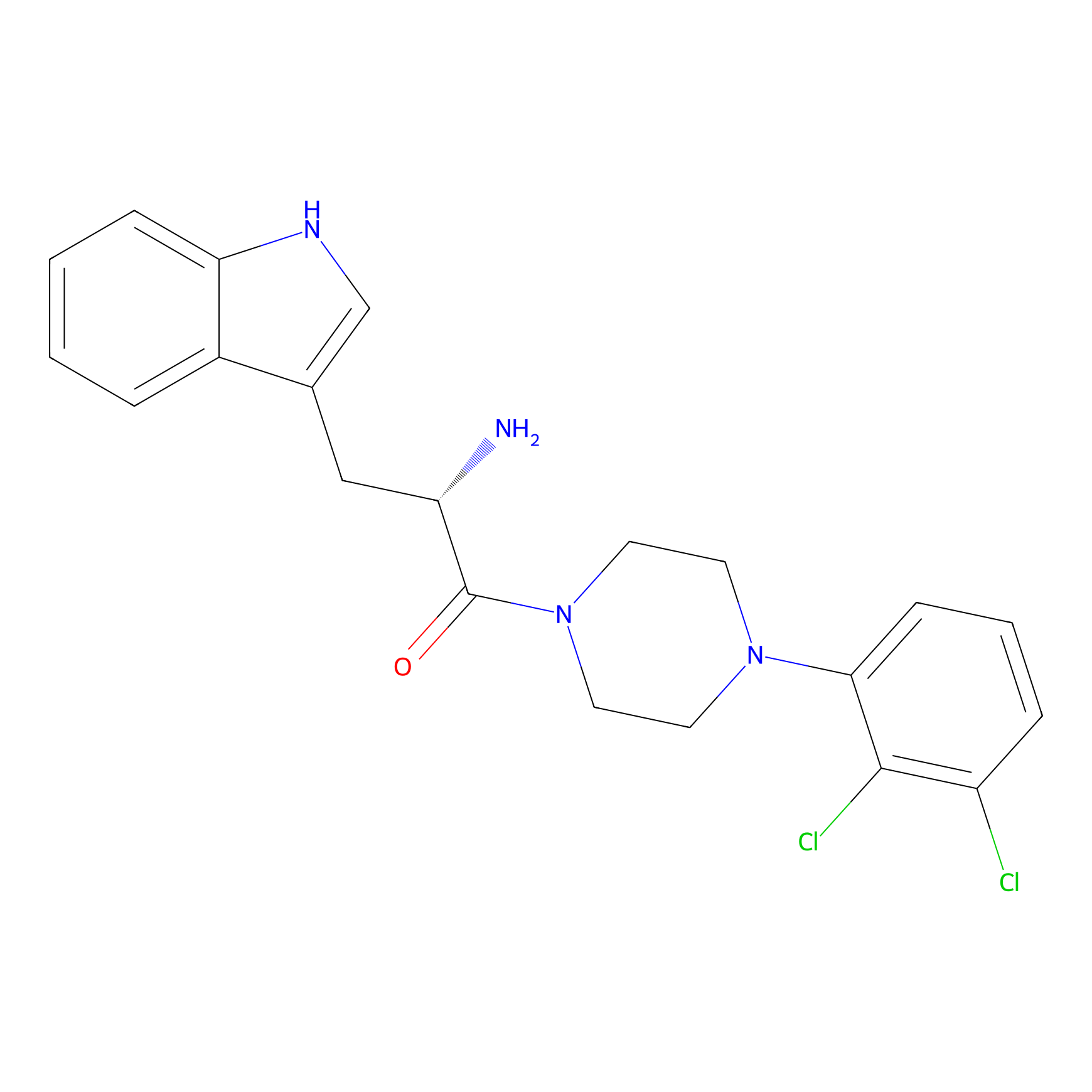
Pentapeptide 8 - 1-(2,3-Dichlorophenyl)piperazine conjugate
|
|||||
| PDC Status |
Investigative
|
|||||
| Indication |
In total 1 Indication(s)
 Bacterial infection
|
|||||
| Structure |
|
|||||
| Peptide Name |
Tryptophan
|
Peptide Info | ||||
| Drug Name |
1-(2,3-Dichlorophenyl)piperazine
|
Drug Info | ||||
| Linker Name |
Amide bond
|
Linker Info | ||||
| Formula |
C21H22Cl2N4O
|
|||||
| #Ro5 Violations (Lipinski): 0 | Molecular Weight | 417.34 | ||||
| Lipid-water partition coefficient (xlogp) | 3.6933 | |||||
| Hydrogen Bond Donor Count (hbonddonor) | 2 | |||||
| Hydrogen Bond Acceptor Count (hbondacc) | 3 | |||||
| Rotatable Bond Count (rotbonds) | 4 | |||||
Full List of Activity Data of This Peptide-drug Conjugate
Revealed Based on the Cell Line Data
| Experiment 1 Reporting the Activity Data of This PDC | [1] | ||||
| Indication | Bacterial infection | ||||
| Efficacy Data | Minimum inhibitory concentration (MIC) |
27 μg/mL
|
|||
| Administration Time | 16-18 h | ||||
| Evaluation Method | Microdilution method | ||||
| MOA of PDC |
Elastin protein-based polymers have their origin in repeating sequences of the mammalian elastic protein, elastin. The sequences of elastin peptides chosen are tetrapeptides, pentapeptides and tricosamers (30 amino acids) and also aromatic amino acids. These have been conjugated to 1-(2,3-dichlorophenyl)piperazine to study the effect of conjugation on the activity. The conjugates so obtained were characterized by physical and analytical techniques followed by the antimicrobial evaluation. The study revealed that all the conjugates have exhibited enhanced activity than the conventional drugs. Further, the conjugates of tricosamers have shown extraordinary activity against the fungal species with MIC value of 3-5 μg/ml which is five fold more potent than the antibiotic used.
Click to Show/Hide
|
||||
| Description |
Based on this observation we were very much projected towards the conjugation of elastin based peptides with varying chain length and hydrophobicity. We focused our attention on tetrapeptide elastin sequences with varying hydrophobicity. Among the analogs tested GGAP (29), GGIP (30) and GGFP (31), the latter has exhibited more activity i.e., GGFP with Phe unit has exerted nearly two times more potent activity than the antibiotics used where as the other two tetrapeptides conjugated heterocycle have shown comparatively less activity than GGFP which could be due to less hydrophobicity of amino acids present at the second position. Thus the order of activity among tetrapeptide conjugates is GGFP > GGIP > GGAP. In the light of the above findings, our subsequent goal was to incorporate GVGVP and GFGFP pentapeptide elastin sequences for conjugation. The pentapeptide conjugates have shown more than two fold potent activity compared to reference drugs used. Among these, GFGFP conjugate (33) has shown slight enhancement in the activity over GVGVP conjugate (32) which may be due to the presence of two more hydrophobic Phe units in 33. Inspection of the results further revealed that the conjugate 26 having single Phe residue has shown enhanced activity. On the other hand, retaining of only one Phe unit and increasing the peptide chain length has caused further increase in the activity (~two times) which is evident from the conjugate GGFP (31). Similarly, the remaining two tetrapeptide conjugates GGIP and GGAP have shown increased activity compared to Phe alone (26). Also, when the length of the peptide chain increased as well as two Phe residues were introduced (greater hydrophobicity) as in GFGFP (33) has exhibited two times greater activity than the standard drugs. This trend was followed in GVGVP conjugate (32) also. Hence, it can be inferred that as the length of the peptide chain as well as the hydrophobicity increases the activity also increases. Thus, the order of activity of the heterocyclic conjugated peptides is found to be GFGFP > GVGVP > GGFP > GGIP > GGAP > Phe > Trp > Tyr.
Click to Show/Hide
|
||||
| In Vitro Model | Xanthomonas oryzae infection | Xanthomonas oryzae | 347 | ||
| Experiment 2 Reporting the Activity Data of This PDC | [1] | ||||
| Indication | Bacterial infection | ||||
| Efficacy Data | Minimum inhibitory concentration (MIC) |
31 μg/mL
|
|||
| Administration Time | 16-18 h | ||||
| Evaluation Method | Microdilution method | ||||
| MOA of PDC |
Elastin protein-based polymers have their origin in repeating sequences of the mammalian elastic protein, elastin. The sequences of elastin peptides chosen are tetrapeptides, pentapeptides and tricosamers (30 amino acids) and also aromatic amino acids. These have been conjugated to 1-(2,3-dichlorophenyl)piperazine to study the effect of conjugation on the activity. The conjugates so obtained were characterized by physical and analytical techniques followed by the antimicrobial evaluation. The study revealed that all the conjugates have exhibited enhanced activity than the conventional drugs. Further, the conjugates of tricosamers have shown extraordinary activity against the fungal species with MIC value of 3-5 μg/ml which is five fold more potent than the antibiotic used.
Click to Show/Hide
|
||||
| Description |
Based on this observation we were very much projected towards the conjugation of elastin based peptides with varying chain length and hydrophobicity. We focused our attention on tetrapeptide elastin sequences with varying hydrophobicity. Among the analogs tested GGAP (29), GGIP (30) and GGFP (31), the latter has exhibited more activity i.e., GGFP with Phe unit has exerted nearly two times more potent activity than the antibiotics used where as the other two tetrapeptides conjugated heterocycle have shown comparatively less activity than GGFP which could be due to less hydrophobicity of amino acids present at the second position. Thus the order of activity among tetrapeptide conjugates is GGFP > GGIP > GGAP. In the light of the above findings, our subsequent goal was to incorporate GVGVP and GFGFP pentapeptide elastin sequences for conjugation. The pentapeptide conjugates have shown more than two fold potent activity compared to reference drugs used. Among these, GFGFP conjugate (33) has shown slight enhancement in the activity over GVGVP conjugate (32) which may be due to the presence of two more hydrophobic Phe units in 33. Inspection of the results further revealed that the conjugate 26 having single Phe residue has shown enhanced activity. On the other hand, retaining of only one Phe unit and increasing the peptide chain length has caused further increase in the activity (~two times) which is evident from the conjugate GGFP (31). Similarly, the remaining two tetrapeptide conjugates GGIP and GGAP have shown increased activity compared to Phe alone (26). Also, when the length of the peptide chain increased as well as two Phe residues were introduced (greater hydrophobicity) as in GFGFP (33) has exhibited two times greater activity than the standard drugs. This trend was followed in GVGVP conjugate (32) also. Hence, it can be inferred that as the length of the peptide chain as well as the hydrophobicity increases the activity also increases. Thus, the order of activity of the heterocyclic conjugated peptides is found to be GFGFP > GVGVP > GGFP > GGIP > GGAP > Phe > Trp > Tyr.
Click to Show/Hide
|
||||
| In Vitro Model | Klebsiella pneumoniae infection | Klebsiella pneumoniae | 573 | ||
| Experiment 3 Reporting the Activity Data of This PDC | [1] | ||||
| Indication | Bacterial infection | ||||
| Efficacy Data | Minimum inhibitory concentration (MIC) |
32 μg/mL
|
|||
| Administration Time | 16-18 h | ||||
| Evaluation Method | Microdilution method | ||||
| MOA of PDC |
Elastin protein-based polymers have their origin in repeating sequences of the mammalian elastic protein, elastin. The sequences of elastin peptides chosen are tetrapeptides, pentapeptides and tricosamers (30 amino acids) and also aromatic amino acids. These have been conjugated to 1-(2,3-dichlorophenyl)piperazine to study the effect of conjugation on the activity. The conjugates so obtained were characterized by physical and analytical techniques followed by the antimicrobial evaluation. The study revealed that all the conjugates have exhibited enhanced activity than the conventional drugs. Further, the conjugates of tricosamers have shown extraordinary activity against the fungal species with MIC value of 3-5 μg/ml which is five fold more potent than the antibiotic used.
Click to Show/Hide
|
||||
| Description |
Based on this observation we were very much projected towards the conjugation of elastin based peptides with varying chain length and hydrophobicity. We focused our attention on tetrapeptide elastin sequences with varying hydrophobicity. Among the analogs tested GGAP (29), GGIP (30) and GGFP (31), the latter has exhibited more activity i.e., GGFP with Phe unit has exerted nearly two times more potent activity than the antibiotics used where as the other two tetrapeptides conjugated heterocycle have shown comparatively less activity than GGFP which could be due to less hydrophobicity of amino acids present at the second position. Thus the order of activity among tetrapeptide conjugates is GGFP > GGIP > GGAP. In the light of the above findings, our subsequent goal was to incorporate GVGVP and GFGFP pentapeptide elastin sequences for conjugation. The pentapeptide conjugates have shown more than two fold potent activity compared to reference drugs used. Among these, GFGFP conjugate (33) has shown slight enhancement in the activity over GVGVP conjugate (32) which may be due to the presence of two more hydrophobic Phe units in 33. Inspection of the results further revealed that the conjugate 26 having single Phe residue has shown enhanced activity. On the other hand, retaining of only one Phe unit and increasing the peptide chain length has caused further increase in the activity (~two times) which is evident from the conjugate GGFP (31). Similarly, the remaining two tetrapeptide conjugates GGIP and GGAP have shown increased activity compared to Phe alone (26). Also, when the length of the peptide chain increased as well as two Phe residues were introduced (greater hydrophobicity) as in GFGFP (33) has exhibited two times greater activity than the standard drugs. This trend was followed in GVGVP conjugate (32) also. Hence, it can be inferred that as the length of the peptide chain as well as the hydrophobicity increases the activity also increases. Thus, the order of activity of the heterocyclic conjugated peptides is found to be GFGFP > GVGVP > GGFP > GGIP > GGAP > Phe > Trp > Tyr.
Click to Show/Hide
|
||||
| In Vitro Model | Aspergillus niger infection | Aspergillus niger | 5061 | ||
| Experiment 4 Reporting the Activity Data of This PDC | [1] | ||||
| Indication | Bacterial infection | ||||
| Efficacy Data | Minimum inhibitory concentration (MIC) |
35 μg/mL
|
|||
| Administration Time | 16-18 h | ||||
| Evaluation Method | Microdilution method | ||||
| MOA of PDC |
Elastin protein-based polymers have their origin in repeating sequences of the mammalian elastic protein, elastin. The sequences of elastin peptides chosen are tetrapeptides, pentapeptides and tricosamers (30 amino acids) and also aromatic amino acids. These have been conjugated to 1-(2,3-dichlorophenyl)piperazine to study the effect of conjugation on the activity. The conjugates so obtained were characterized by physical and analytical techniques followed by the antimicrobial evaluation. The study revealed that all the conjugates have exhibited enhanced activity than the conventional drugs. Further, the conjugates of tricosamers have shown extraordinary activity against the fungal species with MIC value of 3-5 μg/ml which is five fold more potent than the antibiotic used.
Click to Show/Hide
|
||||
| Description |
Based on this observation we were very much projected towards the conjugation of elastin based peptides with varying chain length and hydrophobicity. We focused our attention on tetrapeptide elastin sequences with varying hydrophobicity. Among the analogs tested GGAP (29), GGIP (30) and GGFP (31), the latter has exhibited more activity i.e., GGFP with Phe unit has exerted nearly two times more potent activity than the antibiotics used where as the other two tetrapeptides conjugated heterocycle have shown comparatively less activity than GGFP which could be due to less hydrophobicity of amino acids present at the second position. Thus the order of activity among tetrapeptide conjugates is GGFP > GGIP > GGAP. In the light of the above findings, our subsequent goal was to incorporate GVGVP and GFGFP pentapeptide elastin sequences for conjugation. The pentapeptide conjugates have shown more than two fold potent activity compared to reference drugs used. Among these, GFGFP conjugate (33) has shown slight enhancement in the activity over GVGVP conjugate (32) which may be due to the presence of two more hydrophobic Phe units in 33. Inspection of the results further revealed that the conjugate 26 having single Phe residue has shown enhanced activity. On the other hand, retaining of only one Phe unit and increasing the peptide chain length has caused further increase in the activity (~two times) which is evident from the conjugate GGFP (31). Similarly, the remaining two tetrapeptide conjugates GGIP and GGAP have shown increased activity compared to Phe alone (26). Also, when the length of the peptide chain increased as well as two Phe residues were introduced (greater hydrophobicity) as in GFGFP (33) has exhibited two times greater activity than the standard drugs. This trend was followed in GVGVP conjugate (32) also. Hence, it can be inferred that as the length of the peptide chain as well as the hydrophobicity increases the activity also increases. Thus, the order of activity of the heterocyclic conjugated peptides is found to be GFGFP > GVGVP > GGFP > GGIP > GGAP > Phe > Trp > Tyr.
Click to Show/Hide
|
||||
| In Vitro Model | Staphylococcus infection | Staphylococcus | 1279 | ||
| Experiment 5 Reporting the Activity Data of This PDC | [1] | ||||
| Indication | Bacterial infection | ||||
| Efficacy Data | Minimum inhibitory concentration (MIC) |
39 μg/mL
|
|||
| Administration Time | 16-18 h | ||||
| Evaluation Method | Microdilution method | ||||
| MOA of PDC |
Elastin protein-based polymers have their origin in repeating sequences of the mammalian elastic protein, elastin. The sequences of elastin peptides chosen are tetrapeptides, pentapeptides and tricosamers (30 amino acids) and also aromatic amino acids. These have been conjugated to 1-(2,3-dichlorophenyl)piperazine to study the effect of conjugation on the activity. The conjugates so obtained were characterized by physical and analytical techniques followed by the antimicrobial evaluation. The study revealed that all the conjugates have exhibited enhanced activity than the conventional drugs. Further, the conjugates of tricosamers have shown extraordinary activity against the fungal species with MIC value of 3-5 μg/ml which is five fold more potent than the antibiotic used.
Click to Show/Hide
|
||||
| Description |
Based on this observation we were very much projected towards the conjugation of elastin based peptides with varying chain length and hydrophobicity. We focused our attention on tetrapeptide elastin sequences with varying hydrophobicity. Among the analogs tested GGAP (29), GGIP (30) and GGFP (31), the latter has exhibited more activity i.e., GGFP with Phe unit has exerted nearly two times more potent activity than the antibiotics used where as the other two tetrapeptides conjugated heterocycle have shown comparatively less activity than GGFP which could be due to less hydrophobicity of amino acids present at the second position. Thus the order of activity among tetrapeptide conjugates is GGFP > GGIP > GGAP. In the light of the above findings, our subsequent goal was to incorporate GVGVP and GFGFP pentapeptide elastin sequences for conjugation. The pentapeptide conjugates have shown more than two fold potent activity compared to reference drugs used. Among these, GFGFP conjugate (33) has shown slight enhancement in the activity over GVGVP conjugate (32) which may be due to the presence of two more hydrophobic Phe units in 33. Inspection of the results further revealed that the conjugate 26 having single Phe residue has shown enhanced activity. On the other hand, retaining of only one Phe unit and increasing the peptide chain length has caused further increase in the activity (~two times) which is evident from the conjugate GGFP (31). Similarly, the remaining two tetrapeptide conjugates GGIP and GGAP have shown increased activity compared to Phe alone (26). Also, when the length of the peptide chain increased as well as two Phe residues were introduced (greater hydrophobicity) as in GFGFP (33) has exhibited two times greater activity than the standard drugs. This trend was followed in GVGVP conjugate (32) also. Hence, it can be inferred that as the length of the peptide chain as well as the hydrophobicity increases the activity also increases. Thus, the order of activity of the heterocyclic conjugated peptides is found to be GFGFP > GVGVP > GGFP > GGIP > GGAP > Phe > Trp > Tyr.
Click to Show/Hide
|
||||
| In Vitro Model | Escherichia coli infection | Escherichia coli | 562 | ||
| Experiment 6 Reporting the Activity Data of This PDC | [1] | ||||
| Indication | Bacterial infection | ||||
| Efficacy Data | Minimum inhibitory concentration (MIC) |
39 μg/mL
|
|||
| Administration Time | 16-18 h | ||||
| Evaluation Method | Microdilution method | ||||
| MOA of PDC |
Elastin protein-based polymers have their origin in repeating sequences of the mammalian elastic protein, elastin. The sequences of elastin peptides chosen are tetrapeptides, pentapeptides and tricosamers (30 amino acids) and also aromatic amino acids. These have been conjugated to 1-(2,3-dichlorophenyl)piperazine to study the effect of conjugation on the activity. The conjugates so obtained were characterized by physical and analytical techniques followed by the antimicrobial evaluation. The study revealed that all the conjugates have exhibited enhanced activity than the conventional drugs. Further, the conjugates of tricosamers have shown extraordinary activity against the fungal species with MIC value of 3-5 μg/ml which is five fold more potent than the antibiotic used.
Click to Show/Hide
|
||||
| Description |
Based on this observation we were very much projected towards the conjugation of elastin based peptides with varying chain length and hydrophobicity. We focused our attention on tetrapeptide elastin sequences with varying hydrophobicity. Among the analogs tested GGAP (29), GGIP (30) and GGFP (31), the latter has exhibited more activity i.e., GGFP with Phe unit has exerted nearly two times more potent activity than the antibiotics used where as the other two tetrapeptides conjugated heterocycle have shown comparatively less activity than GGFP which could be due to less hydrophobicity of amino acids present at the second position. Thus the order of activity among tetrapeptide conjugates is GGFP > GGIP > GGAP. In the light of the above findings, our subsequent goal was to incorporate GVGVP and GFGFP pentapeptide elastin sequences for conjugation. The pentapeptide conjugates have shown more than two fold potent activity compared to reference drugs used. Among these, GFGFP conjugate (33) has shown slight enhancement in the activity over GVGVP conjugate (32) which may be due to the presence of two more hydrophobic Phe units in 33. Inspection of the results further revealed that the conjugate 26 having single Phe residue has shown enhanced activity. On the other hand, retaining of only one Phe unit and increasing the peptide chain length has caused further increase in the activity (~two times) which is evident from the conjugate GGFP (31). Similarly, the remaining two tetrapeptide conjugates GGIP and GGAP have shown increased activity compared to Phe alone (26). Also, when the length of the peptide chain increased as well as two Phe residues were introduced (greater hydrophobicity) as in GFGFP (33) has exhibited two times greater activity than the standard drugs. This trend was followed in GVGVP conjugate (32) also. Hence, it can be inferred that as the length of the peptide chain as well as the hydrophobicity increases the activity also increases. Thus, the order of activity of the heterocyclic conjugated peptides is found to be GFGFP > GVGVP > GGFP > GGIP > GGAP > Phe > Trp > Tyr.
Click to Show/Hide
|
||||
| In Vitro Model | Fusarium oxysporum infection | Fusarium oxysporum | 5507 | ||
| Experiment 7 Reporting the Activity Data of This PDC | [1] | ||||
| Indication | Bacterial infection | ||||
| Efficacy Data | Minimum inhibitory concentration (MIC) |
42 μg/mL
|
|||
| Administration Time | 16-18 h | ||||
| Evaluation Method | Microdilution method | ||||
| MOA of PDC |
Elastin protein-based polymers have their origin in repeating sequences of the mammalian elastic protein, elastin. The sequences of elastin peptides chosen are tetrapeptides, pentapeptides and tricosamers (30 amino acids) and also aromatic amino acids. These have been conjugated to 1-(2,3-dichlorophenyl)piperazine to study the effect of conjugation on the activity. The conjugates so obtained were characterized by physical and analytical techniques followed by the antimicrobial evaluation. The study revealed that all the conjugates have exhibited enhanced activity than the conventional drugs. Further, the conjugates of tricosamers have shown extraordinary activity against the fungal species with MIC value of 3-5 μg/ml which is five fold more potent than the antibiotic used.
Click to Show/Hide
|
||||
| Description |
Based on this observation we were very much projected towards the conjugation of elastin based peptides with varying chain length and hydrophobicity. We focused our attention on tetrapeptide elastin sequences with varying hydrophobicity. Among the analogs tested GGAP (29), GGIP (30) and GGFP (31), the latter has exhibited more activity i.e., GGFP with Phe unit has exerted nearly two times more potent activity than the antibiotics used where as the other two tetrapeptides conjugated heterocycle have shown comparatively less activity than GGFP which could be due to less hydrophobicity of amino acids present at the second position. Thus the order of activity among tetrapeptide conjugates is GGFP > GGIP > GGAP. In the light of the above findings, our subsequent goal was to incorporate GVGVP and GFGFP pentapeptide elastin sequences for conjugation. The pentapeptide conjugates have shown more than two fold potent activity compared to reference drugs used. Among these, GFGFP conjugate (33) has shown slight enhancement in the activity over GVGVP conjugate (32) which may be due to the presence of two more hydrophobic Phe units in 33. Inspection of the results further revealed that the conjugate 26 having single Phe residue has shown enhanced activity. On the other hand, retaining of only one Phe unit and increasing the peptide chain length has caused further increase in the activity (~two times) which is evident from the conjugate GGFP (31). Similarly, the remaining two tetrapeptide conjugates GGIP and GGAP have shown increased activity compared to Phe alone (26). Also, when the length of the peptide chain increased as well as two Phe residues were introduced (greater hydrophobicity) as in GFGFP (33) has exhibited two times greater activity than the standard drugs. This trend was followed in GVGVP conjugate (32) also. Hence, it can be inferred that as the length of the peptide chain as well as the hydrophobicity increases the activity also increases. Thus, the order of activity of the heterocyclic conjugated peptides is found to be GFGFP > GVGVP > GGFP > GGIP > GGAP > Phe > Trp > Tyr.
Click to Show/Hide
|
||||
| In Vitro Model | Aspergillus flavus infection | Aspergillus flavus | 5059 | ||
| Experiment 8 Reporting the Activity Data of This PDC | [1] | ||||
| Indication | Bacterial infection | ||||
| Efficacy Data | Zone of inhibition |
4 ± 0.11 mm
|
|||
| Administration Time | 24 h | ||||
| Administration Dosage | 50 μg/ml | ||||
| Evaluation Method | Agar well diffusion method | ||||
| MOA of PDC |
Elastin protein-based polymers have their origin in repeating sequences of the mammalian elastic protein, elastin. The sequences of elastin peptides chosen are tetrapeptides, pentapeptides and tricosamers (30 amino acids) and also aromatic amino acids. These have been conjugated to 1-(2,3-dichlorophenyl)piperazine to study the effect of conjugation on the activity. The conjugates so obtained were characterized by physical and analytical techniques followed by the antimicrobial evaluation. The study revealed that all the conjugates have exhibited enhanced activity than the conventional drugs. Further, the conjugates of tricosamers have shown extraordinary activity against the fungal species with MIC value of 3-5 μg/ml which is five fold more potent than the antibiotic used.
Click to Show/Hide
|
||||
| Description |
Based on this observation we were very much projected towards the conjugation of elastin based peptides with varying chain length and hydrophobicity. We focused our attention on tetrapeptide elastin sequences with varying hydrophobicity. Among the analogs tested GGAP (29), GGIP (30) and GGFP (31), the latter has exhibited more activity i.e., GGFP with Phe unit has exerted nearly two times more potent activity than the antibiotics used where as the other two tetrapeptides conjugated heterocycle have shown comparatively less activity than GGFP which could be due to less hydrophobicity of amino acids present at the second position. Thus the order of activity among tetrapeptide conjugates is GGFP > GGIP > GGAP. In the light of the above findings, our subsequent goal was to incorporate GVGVP and GFGFP pentapeptide elastin sequences for conjugation. The pentapeptide conjugates have shown more than two fold potent activity compared to reference drugs used. Among these, GFGFP conjugate (33) has shown slight enhancement in the activity over GVGVP conjugate (32) which may be due to the presence of two more hydrophobic Phe units in 33. Inspection of the results further revealed that the conjugate 26 having single Phe residue has shown enhanced activity. On the other hand, retaining of only one Phe unit and increasing the peptide chain length has caused further increase in the activity (~two times) which is evident from the conjugate GGFP (31). Similarly, the remaining two tetrapeptide conjugates GGIP and GGAP have shown increased activity compared to Phe alone (26). Also, when the length of the peptide chain increased as well as two Phe residues were introduced (greater hydrophobicity) as in GFGFP (33) has exhibited two times greater activity than the standard drugs. This trend was followed in GVGVP conjugate (32) also. Hence, it can be inferred that as the length of the peptide chain as well as the hydrophobicity increases the activity also increases. Thus, the order of activity of the heterocyclic conjugated peptides is found to be GFGFP > GVGVP > GGFP > GGIP > GGAP > Phe > Trp > Tyr.
Click to Show/Hide
|
||||
| In Vitro Model | Staphylococcus infection | Staphylococcus | 1279 | ||
| Experiment 9 Reporting the Activity Data of This PDC | [1] | ||||
| Indication | Bacterial infection | ||||
| Efficacy Data | Zone of inhibition |
5 ± 0.10 mm
|
|||
| Administration Time | 24 h | ||||
| Administration Dosage | 50 μg/ml | ||||
| Evaluation Method | Agar well diffusion method | ||||
| MOA of PDC |
Elastin protein-based polymers have their origin in repeating sequences of the mammalian elastic protein, elastin. The sequences of elastin peptides chosen are tetrapeptides, pentapeptides and tricosamers (30 amino acids) and also aromatic amino acids. These have been conjugated to 1-(2,3-dichlorophenyl)piperazine to study the effect of conjugation on the activity. The conjugates so obtained were characterized by physical and analytical techniques followed by the antimicrobial evaluation. The study revealed that all the conjugates have exhibited enhanced activity than the conventional drugs. Further, the conjugates of tricosamers have shown extraordinary activity against the fungal species with MIC value of 3-5 μg/ml which is five fold more potent than the antibiotic used.
Click to Show/Hide
|
||||
| Description |
Based on this observation we were very much projected towards the conjugation of elastin based peptides with varying chain length and hydrophobicity. We focused our attention on tetrapeptide elastin sequences with varying hydrophobicity. Among the analogs tested GGAP (29), GGIP (30) and GGFP (31), the latter has exhibited more activity i.e., GGFP with Phe unit has exerted nearly two times more potent activity than the antibiotics used where as the other two tetrapeptides conjugated heterocycle have shown comparatively less activity than GGFP which could be due to less hydrophobicity of amino acids present at the second position. Thus the order of activity among tetrapeptide conjugates is GGFP > GGIP > GGAP. In the light of the above findings, our subsequent goal was to incorporate GVGVP and GFGFP pentapeptide elastin sequences for conjugation. The pentapeptide conjugates have shown more than two fold potent activity compared to reference drugs used. Among these, GFGFP conjugate (33) has shown slight enhancement in the activity over GVGVP conjugate (32) which may be due to the presence of two more hydrophobic Phe units in 33. Inspection of the results further revealed that the conjugate 26 having single Phe residue has shown enhanced activity. On the other hand, retaining of only one Phe unit and increasing the peptide chain length has caused further increase in the activity (~two times) which is evident from the conjugate GGFP (31). Similarly, the remaining two tetrapeptide conjugates GGIP and GGAP have shown increased activity compared to Phe alone (26). Also, when the length of the peptide chain increased as well as two Phe residues were introduced (greater hydrophobicity) as in GFGFP (33) has exhibited two times greater activity than the standard drugs. This trend was followed in GVGVP conjugate (32) also. Hence, it can be inferred that as the length of the peptide chain as well as the hydrophobicity increases the activity also increases. Thus, the order of activity of the heterocyclic conjugated peptides is found to be GFGFP > GVGVP > GGFP > GGIP > GGAP > Phe > Trp > Tyr.
Click to Show/Hide
|
||||
| In Vitro Model | Xanthomonas oryzae infection | Xanthomonas oryzae | 347 | ||
| Experiment 10 Reporting the Activity Data of This PDC | [1] | ||||
| Indication | Bacterial infection | ||||
| Efficacy Data | Zone of inhibition |
5 ± 0.10 mm
|
|||
| Administration Time | 24 h | ||||
| Administration Dosage | 50 μg/ml | ||||
| Evaluation Method | Agar well diffusion method | ||||
| MOA of PDC |
Elastin protein-based polymers have their origin in repeating sequences of the mammalian elastic protein, elastin. The sequences of elastin peptides chosen are tetrapeptides, pentapeptides and tricosamers (30 amino acids) and also aromatic amino acids. These have been conjugated to 1-(2,3-dichlorophenyl)piperazine to study the effect of conjugation on the activity. The conjugates so obtained were characterized by physical and analytical techniques followed by the antimicrobial evaluation. The study revealed that all the conjugates have exhibited enhanced activity than the conventional drugs. Further, the conjugates of tricosamers have shown extraordinary activity against the fungal species with MIC value of 3-5 μg/ml which is five fold more potent than the antibiotic used.
Click to Show/Hide
|
||||
| Description |
Based on this observation we were very much projected towards the conjugation of elastin based peptides with varying chain length and hydrophobicity. We focused our attention on tetrapeptide elastin sequences with varying hydrophobicity. Among the analogs tested GGAP (29), GGIP (30) and GGFP (31), the latter has exhibited more activity i.e., GGFP with Phe unit has exerted nearly two times more potent activity than the antibiotics used where as the other two tetrapeptides conjugated heterocycle have shown comparatively less activity than GGFP which could be due to less hydrophobicity of amino acids present at the second position. Thus the order of activity among tetrapeptide conjugates is GGFP > GGIP > GGAP. In the light of the above findings, our subsequent goal was to incorporate GVGVP and GFGFP pentapeptide elastin sequences for conjugation. The pentapeptide conjugates have shown more than two fold potent activity compared to reference drugs used. Among these, GFGFP conjugate (33) has shown slight enhancement in the activity over GVGVP conjugate (32) which may be due to the presence of two more hydrophobic Phe units in 33. Inspection of the results further revealed that the conjugate 26 having single Phe residue has shown enhanced activity. On the other hand, retaining of only one Phe unit and increasing the peptide chain length has caused further increase in the activity (~two times) which is evident from the conjugate GGFP (31). Similarly, the remaining two tetrapeptide conjugates GGIP and GGAP have shown increased activity compared to Phe alone (26). Also, when the length of the peptide chain increased as well as two Phe residues were introduced (greater hydrophobicity) as in GFGFP (33) has exhibited two times greater activity than the standard drugs. This trend was followed in GVGVP conjugate (32) also. Hence, it can be inferred that as the length of the peptide chain as well as the hydrophobicity increases the activity also increases. Thus, the order of activity of the heterocyclic conjugated peptides is found to be GFGFP > GVGVP > GGFP > GGIP > GGAP > Phe > Trp > Tyr.
Click to Show/Hide
|
||||
| In Vitro Model | Klebsiella pneumoniae infection | Klebsiella pneumoniae | 573 | ||
| Experiment 11 Reporting the Activity Data of This PDC | [1] | ||||
| Indication | Bacterial infection | ||||
| Efficacy Data | Zone of inhibition |
5 ± 0.05 mm
|
|||
| Administration Time | 24 h | ||||
| Administration Dosage | 50 μg/ml | ||||
| Evaluation Method | Agar well diffusion method | ||||
| MOA of PDC |
Elastin protein-based polymers have their origin in repeating sequences of the mammalian elastic protein, elastin. The sequences of elastin peptides chosen are tetrapeptides, pentapeptides and tricosamers (30 amino acids) and also aromatic amino acids. These have been conjugated to 1-(2,3-dichlorophenyl)piperazine to study the effect of conjugation on the activity. The conjugates so obtained were characterized by physical and analytical techniques followed by the antimicrobial evaluation. The study revealed that all the conjugates have exhibited enhanced activity than the conventional drugs. Further, the conjugates of tricosamers have shown extraordinary activity against the fungal species with MIC value of 3-5 μg/ml which is five fold more potent than the antibiotic used.
Click to Show/Hide
|
||||
| Description |
Based on this observation we were very much projected towards the conjugation of elastin based peptides with varying chain length and hydrophobicity. We focused our attention on tetrapeptide elastin sequences with varying hydrophobicity. Among the analogs tested GGAP (29), GGIP (30) and GGFP (31), the latter has exhibited more activity i.e., GGFP with Phe unit has exerted nearly two times more potent activity than the antibiotics used where as the other two tetrapeptides conjugated heterocycle have shown comparatively less activity than GGFP which could be due to less hydrophobicity of amino acids present at the second position. Thus the order of activity among tetrapeptide conjugates is GGFP > GGIP > GGAP. In the light of the above findings, our subsequent goal was to incorporate GVGVP and GFGFP pentapeptide elastin sequences for conjugation. The pentapeptide conjugates have shown more than two fold potent activity compared to reference drugs used. Among these, GFGFP conjugate (33) has shown slight enhancement in the activity over GVGVP conjugate (32) which may be due to the presence of two more hydrophobic Phe units in 33. Inspection of the results further revealed that the conjugate 26 having single Phe residue has shown enhanced activity. On the other hand, retaining of only one Phe unit and increasing the peptide chain length has caused further increase in the activity (~two times) which is evident from the conjugate GGFP (31). Similarly, the remaining two tetrapeptide conjugates GGIP and GGAP have shown increased activity compared to Phe alone (26). Also, when the length of the peptide chain increased as well as two Phe residues were introduced (greater hydrophobicity) as in GFGFP (33) has exhibited two times greater activity than the standard drugs. This trend was followed in GVGVP conjugate (32) also. Hence, it can be inferred that as the length of the peptide chain as well as the hydrophobicity increases the activity also increases. Thus, the order of activity of the heterocyclic conjugated peptides is found to be GFGFP > GVGVP > GGFP > GGIP > GGAP > Phe > Trp > Tyr.
Click to Show/Hide
|
||||
| In Vitro Model | Aspergillus flavus infection | Aspergillus flavus | 5059 | ||
| Experiment 12 Reporting the Activity Data of This PDC | [1] | ||||
| Indication | Bacterial infection | ||||
| Efficacy Data | Zone of inhibition |
5 ± 0.15 mm
|
|||
| Administration Time | 24 h | ||||
| Administration Dosage | 50 μg/ml | ||||
| Evaluation Method | Agar well diffusion method | ||||
| MOA of PDC |
Elastin protein-based polymers have their origin in repeating sequences of the mammalian elastic protein, elastin. The sequences of elastin peptides chosen are tetrapeptides, pentapeptides and tricosamers (30 amino acids) and also aromatic amino acids. These have been conjugated to 1-(2,3-dichlorophenyl)piperazine to study the effect of conjugation on the activity. The conjugates so obtained were characterized by physical and analytical techniques followed by the antimicrobial evaluation. The study revealed that all the conjugates have exhibited enhanced activity than the conventional drugs. Further, the conjugates of tricosamers have shown extraordinary activity against the fungal species with MIC value of 3-5 μg/ml which is five fold more potent than the antibiotic used.
Click to Show/Hide
|
||||
| Description |
Based on this observation we were very much projected towards the conjugation of elastin based peptides with varying chain length and hydrophobicity. We focused our attention on tetrapeptide elastin sequences with varying hydrophobicity. Among the analogs tested GGAP (29), GGIP (30) and GGFP (31), the latter has exhibited more activity i.e., GGFP with Phe unit has exerted nearly two times more potent activity than the antibiotics used where as the other two tetrapeptides conjugated heterocycle have shown comparatively less activity than GGFP which could be due to less hydrophobicity of amino acids present at the second position. Thus the order of activity among tetrapeptide conjugates is GGFP > GGIP > GGAP. In the light of the above findings, our subsequent goal was to incorporate GVGVP and GFGFP pentapeptide elastin sequences for conjugation. The pentapeptide conjugates have shown more than two fold potent activity compared to reference drugs used. Among these, GFGFP conjugate (33) has shown slight enhancement in the activity over GVGVP conjugate (32) which may be due to the presence of two more hydrophobic Phe units in 33. Inspection of the results further revealed that the conjugate 26 having single Phe residue has shown enhanced activity. On the other hand, retaining of only one Phe unit and increasing the peptide chain length has caused further increase in the activity (~two times) which is evident from the conjugate GGFP (31). Similarly, the remaining two tetrapeptide conjugates GGIP and GGAP have shown increased activity compared to Phe alone (26). Also, when the length of the peptide chain increased as well as two Phe residues were introduced (greater hydrophobicity) as in GFGFP (33) has exhibited two times greater activity than the standard drugs. This trend was followed in GVGVP conjugate (32) also. Hence, it can be inferred that as the length of the peptide chain as well as the hydrophobicity increases the activity also increases. Thus, the order of activity of the heterocyclic conjugated peptides is found to be GFGFP > GVGVP > GGFP > GGIP > GGAP > Phe > Trp > Tyr.
Click to Show/Hide
|
||||
| In Vitro Model | Fusarium oxysporum infection | Fusarium oxysporum | 5507 | ||
| Experiment 13 Reporting the Activity Data of This PDC | [1] | ||||
| Indication | Bacterial infection | ||||
| Efficacy Data | Zone of inhibition |
6 ± 0.21 mm
|
|||
| Administration Time | 24 h | ||||
| Administration Dosage | 50 μg/ml | ||||
| Evaluation Method | Agar well diffusion method | ||||
| MOA of PDC |
Elastin protein-based polymers have their origin in repeating sequences of the mammalian elastic protein, elastin. The sequences of elastin peptides chosen are tetrapeptides, pentapeptides and tricosamers (30 amino acids) and also aromatic amino acids. These have been conjugated to 1-(2,3-dichlorophenyl)piperazine to study the effect of conjugation on the activity. The conjugates so obtained were characterized by physical and analytical techniques followed by the antimicrobial evaluation. The study revealed that all the conjugates have exhibited enhanced activity than the conventional drugs. Further, the conjugates of tricosamers have shown extraordinary activity against the fungal species with MIC value of 3-5 μg/ml which is five fold more potent than the antibiotic used.
Click to Show/Hide
|
||||
| Description |
Based on this observation we were very much projected towards the conjugation of elastin based peptides with varying chain length and hydrophobicity. We focused our attention on tetrapeptide elastin sequences with varying hydrophobicity. Among the analogs tested GGAP (29), GGIP (30) and GGFP (31), the latter has exhibited more activity i.e., GGFP with Phe unit has exerted nearly two times more potent activity than the antibiotics used where as the other two tetrapeptides conjugated heterocycle have shown comparatively less activity than GGFP which could be due to less hydrophobicity of amino acids present at the second position. Thus the order of activity among tetrapeptide conjugates is GGFP > GGIP > GGAP. In the light of the above findings, our subsequent goal was to incorporate GVGVP and GFGFP pentapeptide elastin sequences for conjugation. The pentapeptide conjugates have shown more than two fold potent activity compared to reference drugs used. Among these, GFGFP conjugate (33) has shown slight enhancement in the activity over GVGVP conjugate (32) which may be due to the presence of two more hydrophobic Phe units in 33. Inspection of the results further revealed that the conjugate 26 having single Phe residue has shown enhanced activity. On the other hand, retaining of only one Phe unit and increasing the peptide chain length has caused further increase in the activity (~two times) which is evident from the conjugate GGFP (31). Similarly, the remaining two tetrapeptide conjugates GGIP and GGAP have shown increased activity compared to Phe alone (26). Also, when the length of the peptide chain increased as well as two Phe residues were introduced (greater hydrophobicity) as in GFGFP (33) has exhibited two times greater activity than the standard drugs. This trend was followed in GVGVP conjugate (32) also. Hence, it can be inferred that as the length of the peptide chain as well as the hydrophobicity increases the activity also increases. Thus, the order of activity of the heterocyclic conjugated peptides is found to be GFGFP > GVGVP > GGFP > GGIP > GGAP > Phe > Trp > Tyr.
Click to Show/Hide
|
||||
| In Vitro Model | Escherichia coli infection | Escherichia coli | 562 | ||
| Experiment 14 Reporting the Activity Data of This PDC | [1] | ||||
| Indication | Bacterial infection | ||||
| Efficacy Data | Zone of inhibition |
7 ± 0.20 mm
|
|||
| Administration Time | 24 h | ||||
| Administration Dosage | 50 μg/ml | ||||
| Evaluation Method | Agar well diffusion method | ||||
| MOA of PDC |
Elastin protein-based polymers have their origin in repeating sequences of the mammalian elastic protein, elastin. The sequences of elastin peptides chosen are tetrapeptides, pentapeptides and tricosamers (30 amino acids) and also aromatic amino acids. These have been conjugated to 1-(2,3-dichlorophenyl)piperazine to study the effect of conjugation on the activity. The conjugates so obtained were characterized by physical and analytical techniques followed by the antimicrobial evaluation. The study revealed that all the conjugates have exhibited enhanced activity than the conventional drugs. Further, the conjugates of tricosamers have shown extraordinary activity against the fungal species with MIC value of 3-5 μg/ml which is five fold more potent than the antibiotic used.
Click to Show/Hide
|
||||
| Description |
Based on this observation we were very much projected towards the conjugation of elastin based peptides with varying chain length and hydrophobicity. We focused our attention on tetrapeptide elastin sequences with varying hydrophobicity. Among the analogs tested GGAP (29), GGIP (30) and GGFP (31), the latter has exhibited more activity i.e., GGFP with Phe unit has exerted nearly two times more potent activity than the antibiotics used where as the other two tetrapeptides conjugated heterocycle have shown comparatively less activity than GGFP which could be due to less hydrophobicity of amino acids present at the second position. Thus the order of activity among tetrapeptide conjugates is GGFP > GGIP > GGAP. In the light of the above findings, our subsequent goal was to incorporate GVGVP and GFGFP pentapeptide elastin sequences for conjugation. The pentapeptide conjugates have shown more than two fold potent activity compared to reference drugs used. Among these, GFGFP conjugate (33) has shown slight enhancement in the activity over GVGVP conjugate (32) which may be due to the presence of two more hydrophobic Phe units in 33. Inspection of the results further revealed that the conjugate 26 having single Phe residue has shown enhanced activity. On the other hand, retaining of only one Phe unit and increasing the peptide chain length has caused further increase in the activity (~two times) which is evident from the conjugate GGFP (31). Similarly, the remaining two tetrapeptide conjugates GGIP and GGAP have shown increased activity compared to Phe alone (26). Also, when the length of the peptide chain increased as well as two Phe residues were introduced (greater hydrophobicity) as in GFGFP (33) has exhibited two times greater activity than the standard drugs. This trend was followed in GVGVP conjugate (32) also. Hence, it can be inferred that as the length of the peptide chain as well as the hydrophobicity increases the activity also increases. Thus, the order of activity of the heterocyclic conjugated peptides is found to be GFGFP > GVGVP > GGFP > GGIP > GGAP > Phe > Trp > Tyr.
Click to Show/Hide
|
||||
| In Vitro Model | Aspergillus niger infection | Aspergillus niger | 5061 | ||
References