Peptide-drug Conjugate Information
General Information of This Peptide-drug Conjugate (PDC)
| PDC ID |
PDC_02016
|
|||||
|---|---|---|---|---|---|---|
| PDC Name |
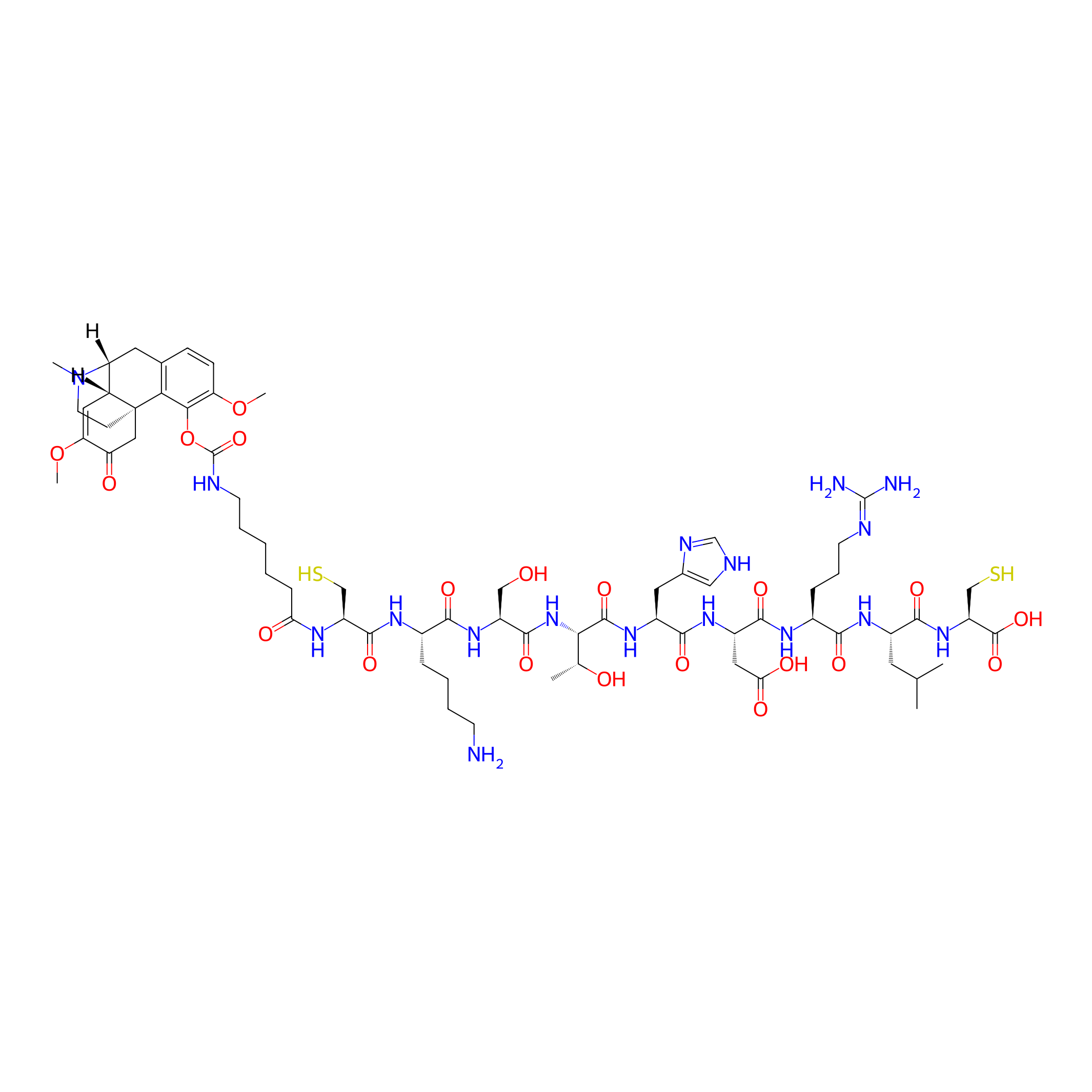
Sinomenine-synovial homing peptide conjugate (L)
|
|||||
| PDC Status |
Investigative
|
|||||
| Indication |
In total 1 Indication(s)
 Rheumatoid arthritis
|
|||||
| Structure |
|
|||||
| Peptide Name |
Synovial homing peptide (L)
|
Peptide Info | ||||
| Drug Name |
Sinomenine
|
Drug Info | ||||
| Linker Name |
Aminocaproic acid
|
Linker Info | ||||
| Formula |
C67H103N17O20S2
|
|||||
| #Ro5 Violations (Lipinski): 5 | Molecular Weight | 1530.794 | ||||
| Lipid-water partition coefficient (xlogp) | -3.689 | |||||
| Hydrogen Bond Donor Count (hbonddonor) | 20 | |||||
| Hydrogen Bond Acceptor Count (hbondacc) | 24 | |||||
| Rotatable Bond Count (rotbonds) | 50 | |||||
Full List of Activity Data of This Peptide-drug Conjugate
Obtained from the Model Organism Data
| Experiment 1 Reporting the Activity Data of This PDC | [1] | ||||
| Indication | Rheumatoid arthritis | ||||
| Efficacy Data | Swelling inhibition value |
41.00%
|
|||
| Administration Time | 4 h | ||||
| Administration Dosage | 90.96 mg/kg | ||||
| MOA of PDC |
In this study, we utilized a synovial endothelium targeting peptide (CKSTHDRLC), which was identified and shown to preferentially locate at synovial xenografts in a human/SCID chimeric model of RA using ex vivo and in vivo screening of a phage peptide-display library. This peptide was subsequently developed as a targeting carrier for selective delivery of recombinant antibodies, cytokines, and nanoparticles. In this work, this target peptide was conjugated to SIN with a 6-aminocaproic acid linker to construct peptide-drug conjugates, and their characterization, stability, drugs released in vitro, therapeutic efficacy and in vivo bio-distribution are reported.
Click to Show/Hide
|
||||
| Description |
To assess the anti-inflammatory efficacy of the conjugates, a carrageenan-induced acute inflammation model was developed in Balb/c male mice. Experimental mice were treated by injection of saline, free SIN, conjugate (L) or conjugate (C) in the tail vein at 1 h prior to the induction of paw edema. Photographs of the right hind paws indicated that swelling was milder in the mice treated with conjugate (C) and conjugate (L) than in the model group. Data for hind paw volumes suggested that conjugate (C) had the strongest therapeutic efficacy compared to that of the free drug SIN at 20.96 mg/kg and the model group. As previously reported, effective doses of SIN against experimental arthritis in vivo range from 15 mg/kg to 300 mg/kg body weight. Therefore, the dose of SIN was considered since the administration of 20.96 mg/kg is widely identified in the literature as a low dose for treating animals in arthritis mouse models without inducing side effects. The benefit of IV injections of conjugates at 90.96 mg/kg (eq. SIN) was clearly demonstrated by comparison with free SIN at the same molar dose. To verify the therapeutic efficacies of the conjugates, histological structures of paws were evaluated. Histological examination of the right hind paws revealed that the pedis skins contained massive lymphocyte, plasma cell and neutrophil infiltration in the paws of animals treated with saline. Animals treated with conjugates and free SIN showed less inflammatory cell infiltration, and conjugate (C) showed the mildest inflammation compared to the same dose of free SIN. To characterize the therapeutic efficacies of the conjugates more clearly, Image J software was used to statistically analyze the inflammatory cells in pathological sections (n = 7), and the results are shown in Fig. 6D. There were significant differences between the treatment groups and the model group (*p < 0.05, **p < 0.01, ***p < 0.001).
Click to Show/Hide
|
||||
| In Vivo Model | BALB/c male mice carrageenan-induced acute inflammation model. | ||||
| Half life period | 24.866 h | ||||
References