Peptide Information
General Information of This Peptide
| Peptide ID |
PEP00118
|
|||||
|---|---|---|---|---|---|---|
| Peptide Name |
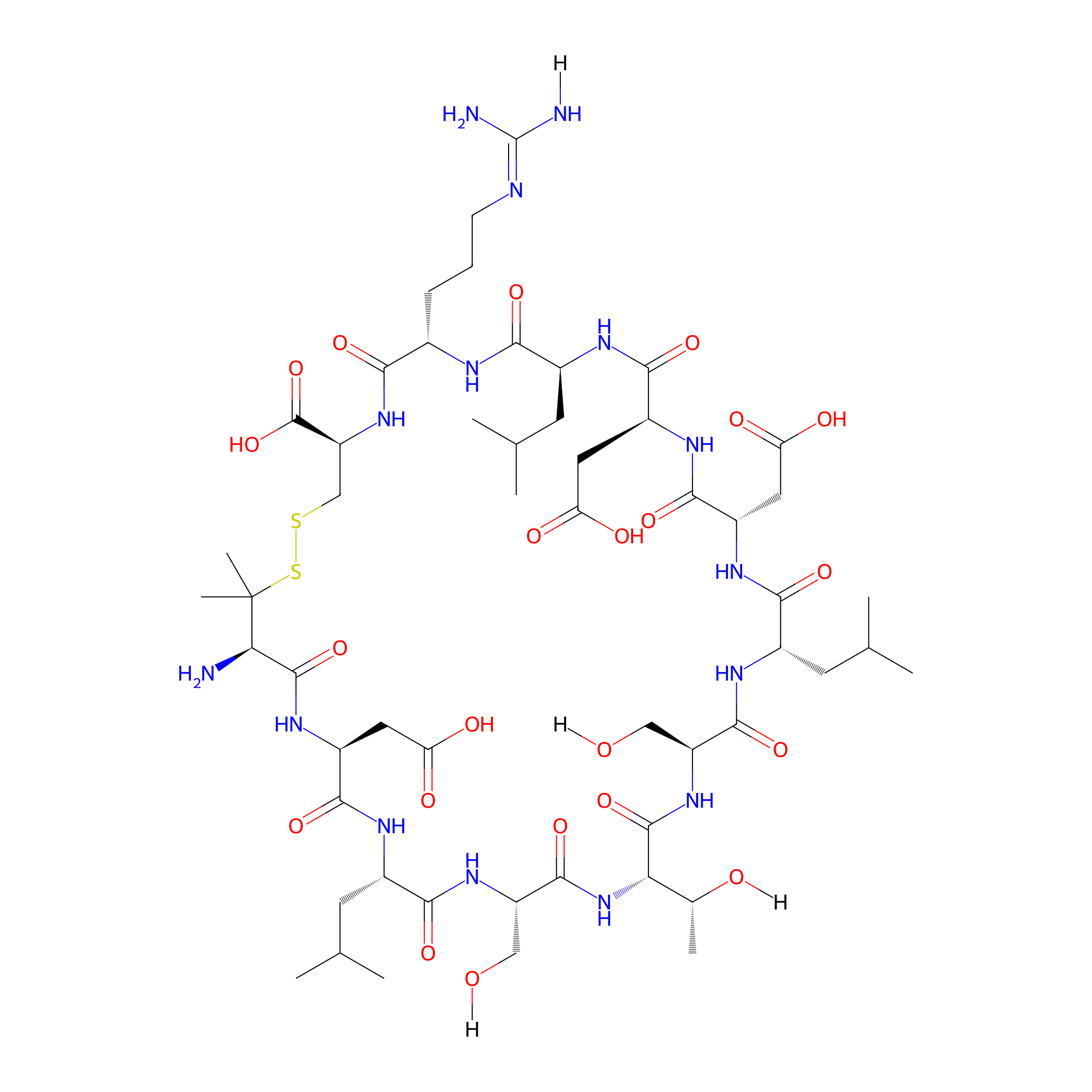
cLBEL
|
|||||
| Structure |
|
|||||
| Sequence |
Penicillamine-DLSTSLDDLRC
|
|||||
| Peptide Type |
Cyclic
|
|||||
| Receptor Name |
Intercellular adhesion molecule 1 (ICAM1)
|
Receptor Info | ||||
| PDC Transmembrane Types | Cell targeting peptides (CTPs) | |||||
| Formula |
C54H91N15O22S2
|
|||||
| Isosmiles |
[H]N/C(N)=N/CCC[C@@H]1NC(=O)[C@H](CC(C)C)NC(=O)[C@H](CC(=O)O)NC(=O)[C@H](CC(=O)O)NC(=O)[C@H](CC(C)C)NC(=O)[C@H](CO[H])NC(=O)[C@]([H])([C@@H](C)O[H])NC(=O)[C@H](CO[H])NC(=O)[C@H](CC(C)C)NC(=O)[C@H](CC(=O)O)NC(=O)[C@@H](N)C(C)(C)SSC[C@@H](C(=O)O)NC1=O
|
|||||
| InChI |
InChI=1S/C54H91N15O22S2/c1-22(2)13-27-42(80)59-26(11-10-12-58-53(56)57)41(79)68-35(52(90)91)21-92-93-54(8,9)40(55)51(89)65-32(18-38(77)78)47(85)61-29(15-24(5)6)44(82)66-34(20-71)49(87)69-39(25(7)72)50(88)67-33(19-70)48(86)62-28(14-23(3)4)43(81)63-31(17-37(75)76)46(84)64-30(16-36(73)74)45(83)60-27/h22-35,39-40,70-72H,10-21,55H2,1-9H3,(H,59,80)(H,60,83)(H,61,85)(H,62,86)(H,63,81)(H,64,84)(H,65,89)(H,66,82)(H,67,88)(H,68,79)(H,69,87)(H,73,74)(H,75,76)(H,77,78)(H,90,91)(H4,56,57,58)/t25-,26+,27+,28+,29+,30+,31+,32+,33+,34+,35+,39+,40-/m1/s1
|
|||||
| InChIKey |
NLUUOMLJWISHAB-ISCCUBOJSA-N
|
|||||
| Pharmaceutical Properties |
Molecule Weight
|
1366.539
|
Polar area
|
620.41
|
||
|
Complexity
|
1365.590452
|
xlogp Value
|
-7.1139
|
|||
|
Heavy Count
|
93
|
Rot Bonds
|
23
|
|||
|
Hbond acc
|
22
|
Hbond Donor
|
21
|
|||
Each Peptide-drug Conjugate Related to This Peptide
Full Information of The Activity Data of The PDC(s) Related to This Peptide
MTX-cLBEL [Investigative]
Revealed Based on the Cell Line Data
| Experiment 1 Reporting the Activity Data of This PDC | [1] | ||||
| Indication | Inflammation | ||||
| Efficacy Data | Half Maximal Inhibitory Concentration (IC50) | > 100 µM | |||
| Administration Time | 1 h | ||||
| Evaluation Method | Propidium iodide (PI) assay | ||||
| MOA of PDC |
In this study, cLABL and cLBEL peptides were linked to methotrexate (MTX) to produce MTX-cLABL and MTX-cLBEL conjugates. The goal was to target MTX to human coronary artery endothelial cells (HCAEC) via the ICAM-1 receptor to lower MTX toxicity and side effects. The biological abilities of MTX-cLABL, MTX-cLBEL, cLABL, cLBEL, and MTX were compared by their activities to inhibit binding of anti-ICAM-1 mAb to ICAM-1 on the surface of HCAEC. In addition, these molecules were compared in inhibiting T cell adhesion to HCAEC monolayers. Finally, their activities in suppressing IL-6 and IL-8 production as inflammatory cytokines were determined. The toxicities of MTX-cLABL and MTX-cLBEL conjugates were also determined relative to MTX alone as well as cLABL and cLBEL peptides.
Click to Show/Hide
|
||||
| Description |
We next determined whether treatment of HCAEC and Molt-3 T cells with peptides, MTX, and MTX-peptide conjugates resulted in inhibition of cell proliferation. Both HCAEC and Molt-3 T cells were affected by test compound in different levels. None of the molecules caused growth stimulation or total culture extinction. A net cell killing of HCAEC was observed upon treatment with MTX at all test concentrations while MTX affected net killing at ≥1.0 uM in Molt-3 T cells. The MTX-peptide conjugates were less toxic than MTX. In HCAEC, the net cell killing was at lower concentration for MTX at ≥0.1 uM compared to MTX-peptide conjugates at ≥500 uM. The net cell killing of Molt-3 T cells was found at ≥1.0 uM for MTX and ≥50 uM for MTX-peptide conjugates. For all test concentrations, the conjugates only resulted in HCAEC partial growth inhibition. For Molt-3 T cells, a total growth inhibition emerged at 100 uM for cLABL and cLBEL; however, 500 uM cLABL and cLBEL did not cause total cell killing for T cells.
Click to Show/Hide
|
||||
| In Vitro Model | human coronary artery endothelial cell | Human coronary artery endothelial cell | Homo sapiens | ||
| Experiment 2 Reporting the Activity Data of This PDC | [1] | ||||
| Indication | Inflammation | ||||
| Efficacy Data | Half Maximal Inhibitory Concentration (IC50) | > 500 µM | |||
| Administration Time | 1 h | ||||
| Evaluation Method | Propidium iodide (PI) assay | ||||
| MOA of PDC |
In this study, cLABL and cLBEL peptides were linked to methotrexate (MTX) to produce MTX-cLABL and MTX-cLBEL conjugates. The goal was to target MTX to human coronary artery endothelial cells (HCAEC) via the ICAM-1 receptor to lower MTX toxicity and side effects. The biological abilities of MTX-cLABL, MTX-cLBEL, cLABL, cLBEL, and MTX were compared by their activities to inhibit binding of anti-ICAM-1 mAb to ICAM-1 on the surface of HCAEC. In addition, these molecules were compared in inhibiting T cell adhesion to HCAEC monolayers. Finally, their activities in suppressing IL-6 and IL-8 production as inflammatory cytokines were determined. The toxicities of MTX-cLABL and MTX-cLBEL conjugates were also determined relative to MTX alone as well as cLABL and cLBEL peptides.
Click to Show/Hide
|
||||
| Description |
We next determined whether treatment of HCAEC and Molt-3 T cells with peptides, MTX, and MTX-peptide conjugates resulted in inhibition of cell proliferation. Both HCAEC and Molt-3 T cells were affected by test compound in different levels. None of the molecules caused growth stimulation or total culture extinction. A net cell killing of HCAEC was observed upon treatment with MTX at all test concentrations while MTX affected net killing at ≥1.0 uM in Molt-3 T cells. The MTX-peptide conjugates were less toxic than MTX. In HCAEC, the net cell killing was at lower concentration for MTX at ≥0.1 uM compared to MTX-peptide conjugates at ≥500 uM. The net cell killing of Molt-3 T cells was found at ≥1.0 uM for MTX and ≥50 uM for MTX-peptide conjugates. For all test concentrations, the conjugates only resulted in HCAEC partial growth inhibition. For Molt-3 T cells, a total growth inhibition emerged at 100 uM for cLABL and cLBEL; however, 500 uM cLABL and cLBEL did not cause total cell killing for T cells.
Click to Show/Hide
|
||||
| In Vitro Model | Adult T acute lymphoblastic leukemia | Molt-3 T cell | CVCL_0624 | ||
References