Peptide Information
General Information of This Peptide
| Peptide ID |
PEP00130
|
|||||
|---|---|---|---|---|---|---|
| Peptide Name |
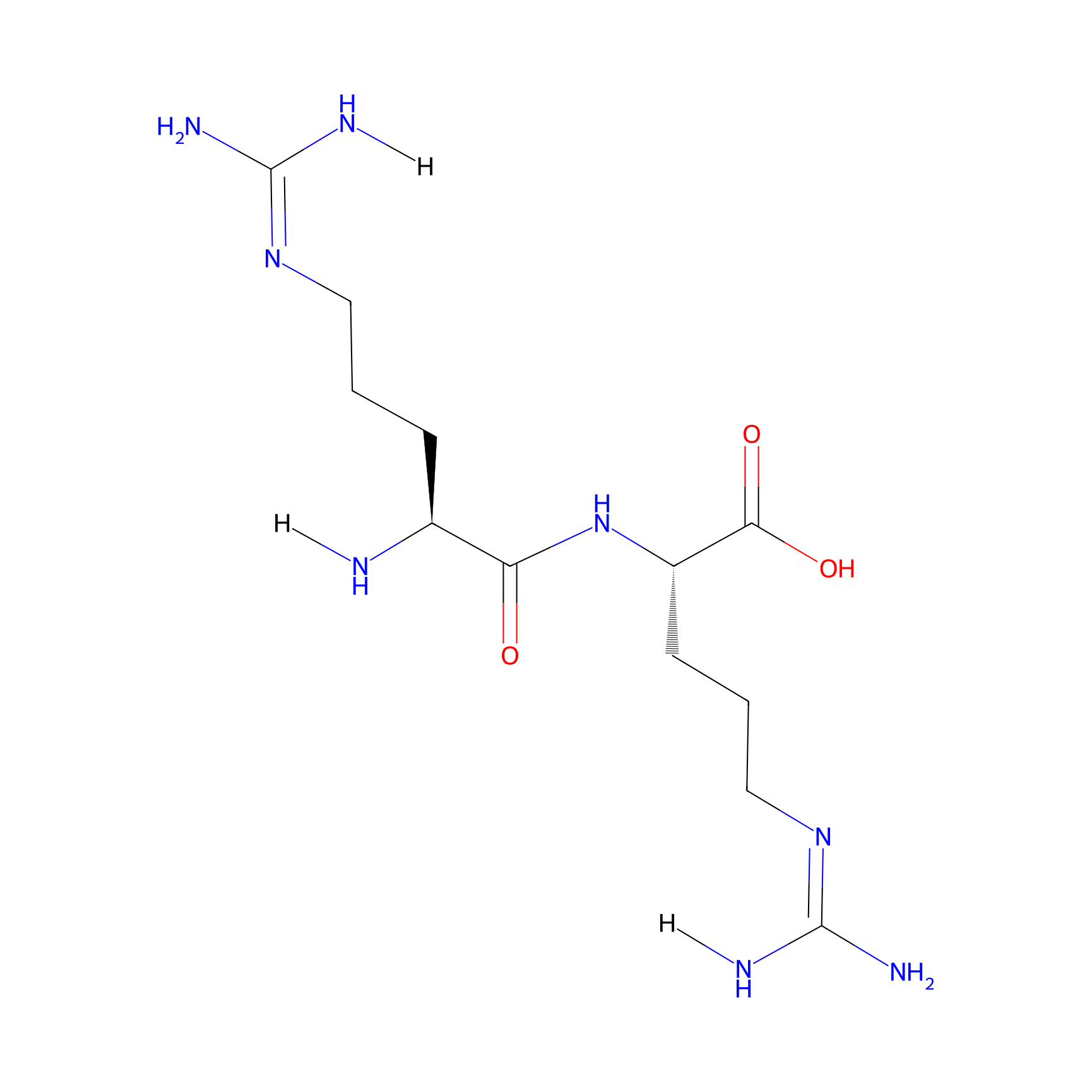
RR
|
|||||
| Structure |
|
|||||
| Sequence |
RR
|
|||||
| Peptide Type |
Linear
|
|||||
| Receptor Name |
Cathepsin B (CTSB)
|
Receptor Info | ||||
| PDC Transmembrane Types | Cell targeting peptides (CTPs) | |||||
| Formula |
C12H26N8O3
|
|||||
| Isosmiles |
[H]N/C(N)=N\CCC[C@H](NC(=O)[C@H](CCC/N=C(/N)N[H])N[H])C(=O)O
|
|||||
| InChI |
InChI=1S/C12H26N8O3/c13-7(3-1-5-18-11(14)15)9(21)20-8(10(22)23)4-2-6-19-12(16)17/h7-8H,1-6,13H2,(H,20,21)(H,22,23)(H4,14,15,18)(H4,16,17,19)/t7-,8-/m0/s1
|
|||||
| InChIKey |
OMLWNBVRVJYMBQ-YUMQZZPRSA-N
|
|||||
| Pharmaceutical Properties |
Molecule Weight
|
330.393
|
Polar area
|
221.22
|
||
|
Complexity
|
330.2127867
|
xlogp Value
|
-3.0097
|
|||
|
Heavy Count
|
23
|
Rot Bonds
|
12
|
|||
|
Hbond acc
|
5
|
Hbond Donor
|
7
|
|||
Each Peptide-drug Conjugate Related to This Peptide
Full Information of The Activity Data of The PDC(s) Related to This Peptide
RR-BA [Investigative]
Revealed Based on the Cell Line Data
| Experiment 1 Reporting the Activity Data of This PDC | [1] | ||||
| Indication | Colorectal cancer | ||||
| Efficacy Data | Half Maximal Inhibitory Concentration (IC50) |
149.5 µM
|
|||
| Administration Time | 48 h | ||||
| Evaluation Method | Ez Cytox cell viability assay kit | ||||
| MOA of PDC |
Here, we developed a cathepsin B inhibitor using a peptide and bile acid for anticancer therapy. Among the peptide sequences that cathepsin B can recognize, positively charged Arg-Arg (RR) was used as a cathepsin-B-specific peptide without any linkers. A hydrophobic bile acid (BA) was coupled via amide linkages to further enhance the inhibitory effects of the peptides. Out of several types of bile acids, ursodeoxycholic acid (UDCA), a safe drug approved by the US Food and Drug Administration (FDA), was used for this study. The nano-sized Arg-Arg and BA conjugate (RR-BA) can be self-assembled in an aqueous solution, forming nanoparticles due to the strong positive charge and the hydrophobicity of bile acids. This pharmaceutical substance has shown promising results in mouse colorectal cancer (CT26) cell treatment and animal experiments. This type of pharmaceutical therapy could be a potential option for cancer treatment.
Click to Show/Hide
|
||||
| Description |
Cell viability and corresponding IC50 values of CT26 tumor cells in the concentration range of 0.1-1000 μM RR-BA, RR peptides, or BA were measured after 24 h and 48 h incubation. The 24 h cytotoxicity IC50 value of RR peptide and BA is NA and RR-BA is 375.5 μM. The 48 h cytotoxicity IC50 value of RR peptide and BA is NA and RR-BA is 149.5 μM. *** Denotes statistically significant differences in a comparison of RR-BA with RR peptides and BA (*** p < 0.001). Results represent means ± S.D.
Click to Show/Hide
|
||||
| In Vitro Model | Colon carcinoma | CT26 cell | CVCL_7254 | ||
| Experiment 2 Reporting the Activity Data of This PDC | [1] | ||||
| Indication | Colorectal cancer | ||||
| Efficacy Data | Half Maximal Inhibitory Concentration (IC50) |
375.5 µM
|
|||
| Administration Time | 24 h | ||||
| Evaluation Method | Ez Cytox cell viability assay kit assay | ||||
| MOA of PDC |
Here, we developed a cathepsin B inhibitor using a peptide and bile acid for anticancer therapy. Among the peptide sequences that cathepsin B can recognize, positively charged Arg-Arg (RR) was used as a cathepsin-B-specific peptide without any linkers. A hydrophobic bile acid (BA) was coupled via amide linkages to further enhance the inhibitory effects of the peptides. Out of several types of bile acids, ursodeoxycholic acid (UDCA), a safe drug approved by the US Food and Drug Administration (FDA), was used for this study. The nano-sized Arg-Arg and BA conjugate (RR-BA) can be self-assembled in an aqueous solution, forming nanoparticles due to the strong positive charge and the hydrophobicity of bile acids. This pharmaceutical substance has shown promising results in mouse colorectal cancer (CT26) cell treatment and animal experiments. This type of pharmaceutical therapy could be a potential option for cancer treatment.
Click to Show/Hide
|
||||
| Description |
Cell viability and corresponding IC50 values of CT26 tumor cells in the concentration range of 0.1-1000 μM RR-BA, RR peptides, or BA were measured after 24 h and 48 h incubation. The 24 h cytotoxicity IC50 value of RR peptide and BA is NA and RR-BA is 375.5 μM. The 48 h cytotoxicity IC50 value of RR peptide and BA is NA and RR-BA is 149.5 μM. *** Denotes statistically significant differences in a comparison of RR-BA with RR peptides and BA (*** p < 0.001). Results represent means ± S.D.
Click to Show/Hide
|
||||
| In Vitro Model | Colon carcinoma | CT26 cell | CVCL_7254 | ||
References