Drug Information
General Information of This Drug
| Drug ID | DRG00023 | |||||
|---|---|---|---|---|---|---|
| Drug Name | Tesaglitazar | |||||
| Synonyms |
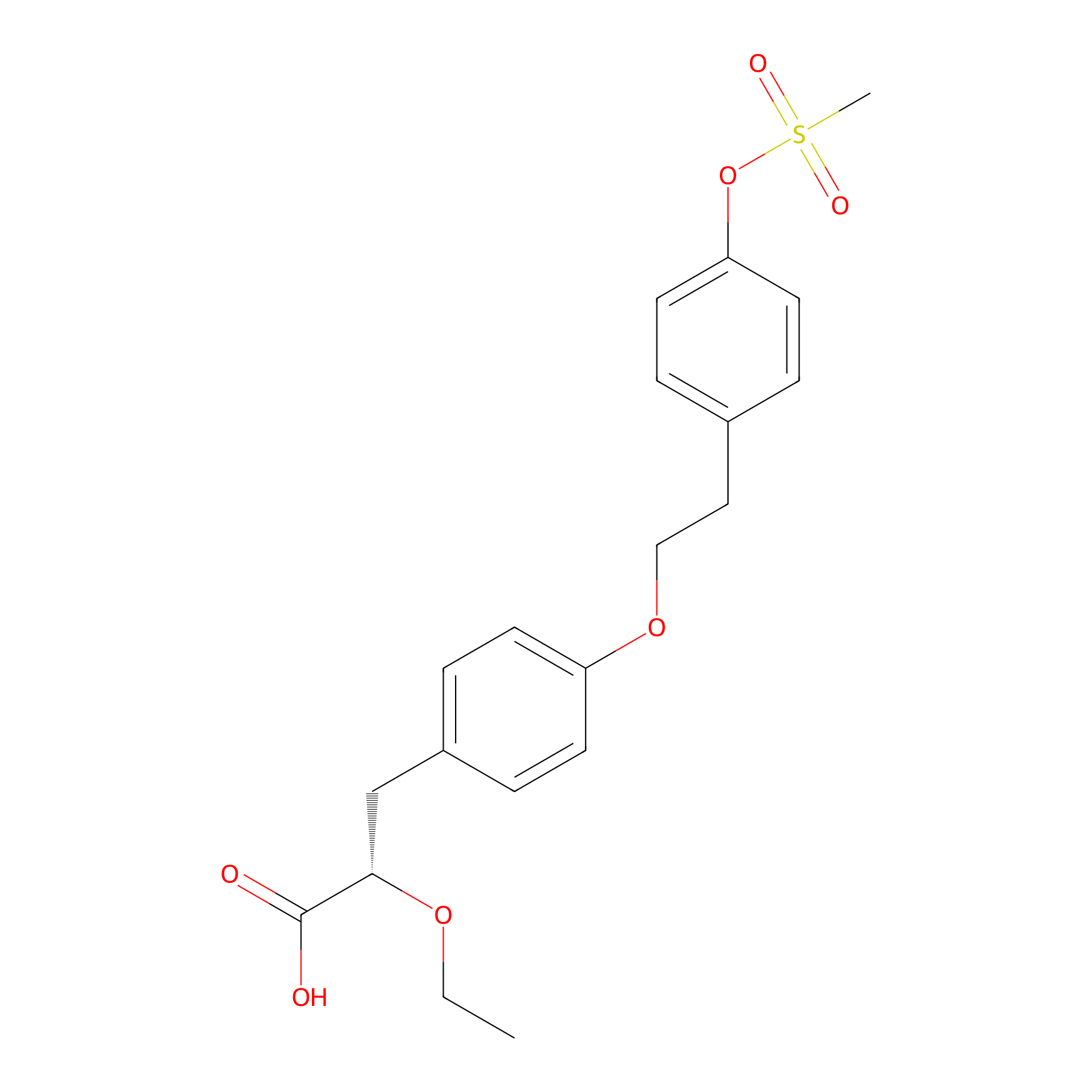
Tesaglitazar; 251565-85-2; Galida; AZ 242; AZ-242; (S)-2-Ethoxy-3-(4-(4-((methylsulfonyl)oxy)phenethoxy)phenyl)propanoic acid; AR-H039242XX; (S)-2-Ethoxy-3-{4-[2-(4-methanesulfonyloxy-phenyl)-ethoxy]-phenyl}-propionic acid; (S)-2-Ethoxy-3-{4-[2-(4-methanesulfonyloxyphenyl)ethoxy]phenyl}propionic acid; BR-44608; (S)-2-Ethoxy-3-[4-[2-(4-methanesulfonyloxyphenyl)ethoxy]phenyl]propanoic acid; (2S)-2-ETHOXY-3-[4-(2-{4-[(METHYLSULFONYL)OXY]PHENYL}ETHOXY)PHENYL]PROPANOIC ACID; AR-H-039242; 6734037O3L; (2S)-2-Ethoxy-3-(4-(2-(4-((methylsulfonyl)oxy)phenyl)ethoxy)phenyl)propanoic acid; (S)-2-ETHOXY-3-[4-[2-(4-METHANESULFONYLOXY-PHENYL)-ETHOXY]-PHENYL]-PROPIONIC ACID; Benzenepropanoic acid, alpha-ethoxy-4-(2-(4-((methylsulfonyl)oxy)phenyl)ethoxy)-, (alphaS)-; Benzenepropanoic acid, alpha-ethoxy-4-[2-[4-[(methylsulfonyl)oxy]phenyl]ethoxy]-, (alphaS)-; Tesaglitazar [INN]; Tesaglitazar [USAN:INN]; DTXSID4048773; Tesaglitizar; (s)-2-ethoxy-3-(4-(2-(4-methylsulphonyloxyphenyl)ethoxy)phenyl)propanoic acid; C20H24O7S; (2S)-2-Ethoxy-3-[4-[2-[4-[(methylsulfonyl)oxy]phenyl]ethoxy]phenyl]propanoic acid; (s)-2-ethoxy-3-(4-[2-(4-methanesulfonyloxy-phenyl)-ethoxy]-phenyl)-propionic acid; (S)-2-ethoxy-3-[4-(2-{4-methanesulfonyloxyphenyl}ethoxy)phenyl]propanoic acid; (s)-2-ethoxy-3-[4-[2-(4-methanesulfonyloxyphenyl)ethoxy]phenyl]propionic acid; (S)-2-Ethoxy-3-[4-[4-[(methylsulfonyl)oxy]phenethoxy]phenyl]propanoic Acid; UNII-6734037O3L; NCGC00182082-02; 1i7g; 1i7i; TESAGLITAZAR [MI]; TESAGLITAZAR [JAN]; TESAGLITAZAR [USAN]; SCHEMBL16594; MLS004774044; TESAGLITAZAR [WHO-DD]; CHEMBL282686; Tesaglitazar (JAN/USAN/INN); BDBM28798; Tesaglitazar, >=98% (HPLC); CXGTZJYQWSUFET-IBGZPJMESA-N; GLXC-03119; MFCD07784004; (S)-2-ethoxy-3-(4-((4-(methylsulfonyloxy)phenethyl)oxy)phenyl)propanoic acid; 2-ethoxy-3-(4-((4-(methylsulfonyloxy)phenethyl)oxy)phenyl)propanoic acid; AKOS015920483; AC-6748; DB06536; DB07399; (2S)-2-ethoxy-3-(4-{2-[4-(methanesulfonyloxy)phenyl]ethoxy}phenyl)propanoic acid; AS-35360; HY-17444; SMR003500714; CS-0008240; FT-0674871; NS00068654; T3497; D01274; A817671; J-015842; Q7705411; (S)-2-Ethoxy-3-(4-(4-((methylsulfonyl)oxy)phenethoxy)phenyl)propanoicacid; (S)-2-ethoxy-3-(4-(4-(methylsulfonyloxy)phenethoxy)phenyl)propanoic acid; (2S)-2-Ethoxy-3-(4-(2-(4-((methylsulfonyl)oxy)phenyl)ethoxy)phenyl)propionic acid; (S)-2-ETHOXY-3-(4-(2-(4-METHYLSULFONYLOXYPHENYL)ETHOXY)PHENYL)PROPANOIC ACID; (S)-2-Ethoxy-3-(4-(4-((methylsulfonyl)-oxy)phenethoxy)phenyl)propanoic acid; (S)-2-ethoxy-3-[4-(2-{4-methanesulfonyloxyphenyl} ethoxy)phenyl]propanoic acid; (S)-2-ethoxy-3-[4-(2-{4-methanesulfonyloxyphenyl}-ethoxy)phenyl]propanoic acid; (S)-2-ethoxy-3-[4-(2-{4-methanesulfonyloxyphenyl}ethoxy) phenyl]propanoic acid; (S)-2-Ethoxy-3-[4-[[4-(methylsulphonyloxy)phenethyl]oxy]phenyl]propanoic acid; (S)-2-Ethoxy-3-[4-[2-(4-methanesulf onyloxyphenyl)ethoxy]phenyl]propanoic acid; benzenepropanoic acid, a-ethoxy-4-[2-[4-[(methylsulfonyl)oxy]phenyl]ethoxy]-, (as)-; BENZENEPROPANOIC ACID,.ALPHA.-ETHOXY-4-(2-(4-((METHYLSULFONYL)OXY)PHENYL)ETHOXY) ,(.ALPHA.S)-
Click to Show/Hide
|
|||||
| Target(s) | Peroxisome proliferator-activated receptor alpha (PPARA) | Target Info | ||||
| Structure |
|
|||||
| Formula |
C20H24O7S
|
|||||
| #Ro5 Violations (Lipinski): 1 | Molecular Weight (mw) | 408.5 | ||||
| Lipid-water partition coefficient (xlogp) | 3.5 | |||||
| Hydrogen Bond Donor Count (hbonddonor) | 1 | |||||
| Hydrogen Bond Acceptor Count (hbondacc) | 7 | |||||
| Rotatable Bond Count (rotbonds) | 11 | |||||
| PubChem CID | ||||||
| Canonical smiles |
CCOC(CC1=CC=C(C=C1)OCCC2=CC=C(C=C2)OS(=O)(=O)C)C(=O)O
|
|||||
| InChI |
InChI=1S/C20H24O7S/c1-3-25-19(20(21)22)14-16-6-8-17(9-7-16)26-13-12-15-4-10-18(11-5-15)27-28(2,23)24/h4-11,19H,3,12-14H2,1-2H3,(H,21,22)/t19-/m0/s1
|
|||||
| InChIKey |
CXGTZJYQWSUFET-IBGZPJMESA-N
|
|||||
| IUPAC Name |
(2S)-2-ethoxy-3-[4-[2-(4-methylsulfonyloxyphenyl)ethoxy]phenyl]propanoic acid
|
|||||
The activity data of This Drug
| Standard Type | Value | Administration times | Administration dosage | Vivo model | Ref. | |
|---|---|---|---|---|---|---|
| Adiponectin level | 120 µg/mL | Every day | 2.5 μM | db/db mice model. | [1] | |
| Body weigth change | 3% | Every day; over 8 days | 2.5 μM | db/db mice model. | [1] | |
| Cholesterol level | 2.9 mmol/L | Every day | 2.5 μM | db/db mice model. | [1] | |
| HbA1C change | 0.55% | Every day | 2.5 μM | db/db mice model. | [1] | |
| Insulin level | 3.1 ng/mL | Every day | 2.5 μM | db/db mice model. | [1] | |
| Ketone level | 0.55 mM/L | Every day | 2.5 μM | db/db mice model. | [1] | |
| Leptin level | 50 ng/mL | Every day | 2.5 μM | db/db mice model. | [1] | |
| Mcp-1 level | 298 pg/mL | Every day | 2.5 μM | db/db mice model. | [1] | |
| Triglycerides level | 0.55 mmol/L | Every day | 2.5 μM | db/db mice model. | [1] | |
Each Peptide-drug Conjugate Related to This Drug
Full Information of The Activity Data of The PDC(s) Related to This Drug
Tesaglitazar-[F7, P34]-NPY [Investigative]
Obtained from the Model Organism Data
| Experiment 1 Reporting the Activity Data of This PDC | [1] | ||||
| Indication | Type 2 diabetes | ||||
| Efficacy Data | Triglycerides level | 0.65 | |||
| Administration Time | Every day; over 8 days | ||||
| Administration Dosage | 2.5 µM | ||||
| MOA of PDC |
In vitro studies revealed that the tesaglitazar-[F7, P34]-NPY conjugate selectively activates PPARγ in NPY1R-expressing cells and enhances adipocyte differentiation and adiponectin expression in adipocyte precursor cells.Additionally, tesa-NPY induces adipocyte differentiation in vivo.
|
||||
| Description |
The influence of tesa, tesa-NPY (3), and [F7, P34]-NPY (2) on the plasma lipids was also analyzed (Figure 9). The vehicle/untreated db/db mice showed elevated levels of triglycerides and free fatty acids (FFA) compared to the lean C57BL/6N mice. Treatment with tesa and tesa-NPY (3) led to a normalization of the triglycerides, FFA, whereas [F7, P34]-NPY (2) and vehicle/untreated had no influence on the lipid metabolism (Figure 9A/B). The cholesterol levels were unchanged by any treatment as these levels were also comparable in the untreated db/db mice compared to the lean mice (Figure 9C).
Click to Show/Hide
|
||||
| In Vivo Model | db/db mice model. | ||||
| Experiment 2 Reporting the Activity Data of This PDC | [1] | ||||
| Indication | Type 2 diabetes | ||||
| Efficacy Data | Triglycerides level | 0.9 | |||
| Administration Time | Every day; over 8 days | ||||
| Administration Dosage | 2.5 µM | ||||
| MOA of PDC |
In vitro studies revealed that the tesaglitazar-[F7, P34]-NPY conjugate selectively activates PPARγ in NPY1R-expressing cells and enhances adipocyte differentiation and adiponectin expression in adipocyte precursor cells.Additionally, tesa-NPY induces adipocyte differentiation in vivo.
|
||||
| Description |
The influence of tesa, tesa-NPY (3), and [F7, P34]-NPY (2) on the plasma lipids was also analyzed (Figure 9). The vehicle/untreated db/db mice showed elevated levels of triglycerides and free fatty acids (FFA) compared to the lean C57BL/6N mice. Treatment with tesa and tesa-NPY (3) led to a normalization of the triglycerides, FFA, whereas [F7, P34]-NPY (2) and vehicle/untreated had no influence on the lipid metabolism (Figure 9A/B). The cholesterol levels were unchanged by any treatment as these levels were also comparable in the untreated db/db mice compared to the lean mice (Figure 9C).
Click to Show/Hide
|
||||
| In Vivo Model | db/db mice model. | ||||
| Experiment 3 Reporting the Activity Data of This PDC | [1] | ||||
| Indication | Type 2 diabetes | ||||
| Efficacy Data | Mcp-1 level | 305 pg/mL | |||
| Administration Time | Every day; over 8 days | ||||
| Administration Dosage | 2.5 µM | ||||
| MOA of PDC |
In vitro studies revealed that the tesaglitazar-[F7, P34]-NPY conjugate selectively activates PPARγ in NPY1R-expressing cells and enhances adipocyte differentiation and adiponectin expression in adipocyte precursor cells.Additionally, tesa-NPY induces adipocyte differentiation in vivo.
|
||||
| Description |
Whereas in the vehicle/untreated mice, the HbA1C values increased by approximately 2%, a graduated reduced increase was seen for [F7, P34]-NPY (2), peptide conjugate (3), and tesa (Figure 8A). Body temperature, which decreased to 35 C in the vehicle/untreated db/db controls, was normalized to 36 C in all of the treated mice including the mice treated with [F7, P34]-NPY (2) (Figure 8B). Treatment with tesa and tesa-NPY (3) led to normalization of the plasma concentration of ketone bodies and adiponectin, whereas [F7, P34]-NPY (2) and vehicle/untreated showed no effect (Figure 8C/E). Treatment had no major influence on the insulin and Mcp-1 levels (Figure 8D/G). The serum leptin concentration was reduced in the mice treated with tesa, whereas no reduction was detectable in all of the other treated mice (Figure 8F).
Click to Show/Hide
|
||||
| In Vivo Model | db/db mice model. | ||||
| Experiment 4 Reporting the Activity Data of This PDC | [1] | ||||
| Indication | Type 2 diabetes | ||||
| Efficacy Data | Leptin level | 82 ng/mL | |||
| Administration Time | Every day; over 8 days | ||||
| Administration Dosage | 2.5 µM | ||||
| MOA of PDC |
In vitro studies revealed that the tesaglitazar-[F7, P34]-NPY conjugate selectively activates PPARγ in NPY1R-expressing cells and enhances adipocyte differentiation and adiponectin expression in adipocyte precursor cells.Additionally, tesa-NPY induces adipocyte differentiation in vivo.
|
||||
| Description |
Whereas in the vehicle/untreated mice, the HbA1C values increased by approximately 2%, a graduated reduced increase was seen for [F7, P34]-NPY (2), peptide conjugate (3), and tesa (Figure 8A). Body temperature, which decreased to 35 C in the vehicle/untreated db/db controls, was normalized to 36 C in all of the treated mice including the mice treated with [F7, P34]-NPY (2) (Figure 8B). Treatment with tesa and tesa-NPY (3) led to normalization of the plasma concentration of ketone bodies and adiponectin, whereas [F7, P34]-NPY (2) and vehicle/untreated showed no effect (Figure 8C/E). Treatment had no major influence on the insulin and Mcp-1 levels (Figure 8D/G). The serum leptin concentration was reduced in the mice treated with tesa, whereas no reduction was detectable in all of the other treated mice (Figure 8F).
Click to Show/Hide
|
||||
| In Vivo Model | db/db mice model. | ||||
| Experiment 5 Reporting the Activity Data of This PDC | [1] | ||||
| Indication | Type 2 diabetes | ||||
| Efficacy Data | Ketone level | 0.5 mM/L | |||
| Administration Time | Every day; over 8 days | ||||
| Administration Dosage | 2.5 µM | ||||
| MOA of PDC |
In vitro studies revealed that the tesaglitazar-[F7, P34]-NPY conjugate selectively activates PPARγ in NPY1R-expressing cells and enhances adipocyte differentiation and adiponectin expression in adipocyte precursor cells.Additionally, tesa-NPY induces adipocyte differentiation in vivo.
|
||||
| Description |
Whereas in the vehicle/untreated mice, the HbA1C values increased by approximately 2%, a graduated reduced increase was seen for [F7, P34]-NPY (2), peptide conjugate (3), and tesa (Figure 8A). Body temperature, which decreased to 35 C in the vehicle/untreated db/db controls, was normalized to 36 C in all of the treated mice including the mice treated with [F7, P34]-NPY (2) (Figure 8B). Treatment with tesa and tesa-NPY (3) led to normalization of the plasma concentration of ketone bodies and adiponectin, whereas [F7, P34]-NPY (2) and vehicle/untreated showed no effect (Figure 8C/E). Treatment had no major influence on the insulin and Mcp-1 levels (Figure 8D/G). The serum leptin concentration was reduced in the mice treated with tesa, whereas no reduction was detectable in all of the other treated mice (Figure 8F).
Click to Show/Hide
|
||||
| In Vivo Model | db/db mice model. | ||||
| Experiment 6 Reporting the Activity Data of This PDC | [1] | ||||
| Indication | Type 2 diabetes | ||||
| Efficacy Data | Insulin level | 2 ng/mL | |||
| Administration Time | Every day; over 8 days | ||||
| Administration Dosage | 2.5 µM | ||||
| MOA of PDC |
In vitro studies revealed that the tesaglitazar-[F7, P34]-NPY conjugate selectively activates PPARγ in NPY1R-expressing cells and enhances adipocyte differentiation and adiponectin expression in adipocyte precursor cells.Additionally, tesa-NPY induces adipocyte differentiation in vivo.
|
||||
| Description |
Whereas in the vehicle/untreated mice, the HbA1C values increased by approximately 2%, a graduated reduced increase was seen for [F7, P34]-NPY (2), peptide conjugate (3), and tesa (Figure 8A). Body temperature, which decreased to 35 C in the vehicle/untreated db/db controls, was normalized to 36 C in all of the treated mice including the mice treated with [F7, P34]-NPY (2) (Figure 8B). Treatment with tesa and tesa-NPY (3) led to normalization of the plasma concentration of ketone bodies and adiponectin, whereas [F7, P34]-NPY (2) and vehicle/untreated showed no effect (Figure 8C/E). Treatment had no major influence on the insulin and Mcp-1 levels (Figure 8D/G). The serum leptin concentration was reduced in the mice treated with tesa, whereas no reduction was detectable in all of the other treated mice (Figure 8F).
Click to Show/Hide
|
||||
| In Vivo Model | db/db mice model. | ||||
| Experiment 7 Reporting the Activity Data of This PDC | [1] | ||||
| Indication | Type 2 diabetes | ||||
| Efficacy Data | HbA1C change | 1.05% | |||
| Administration Time | Every day; over 8 days | ||||
| Administration Dosage | 2.5 µM | ||||
| MOA of PDC |
In vitro studies revealed that the tesaglitazar-[F7, P34]-NPY conjugate selectively activates PPARγ in NPY1R-expressing cells and enhances adipocyte differentiation and adiponectin expression in adipocyte precursor cells.Additionally, tesa-NPY induces adipocyte differentiation in vivo.
|
||||
| Description |
Whereas in the vehicle/untreated mice, the HbA1C values increased by approximately 2%, a graduated reduced increase was seen for [F7, P34]-NPY (2), peptide conjugate (3), and tesa (Figure 8A). Body temperature, which decreased to 35 C in the vehicle/untreated db/db controls, was normalized to 36 C in all of the treated mice including the mice treated with [F7, P34]-NPY (2) (Figure 8B). Treatment with tesa and tesa-NPY (3) led to normalization of the plasma concentration of ketone bodies and adiponectin, whereas [F7, P34]-NPY (2) and vehicle/untreated showed no effect (Figure 8C/E). Treatment had no major influence on the insulin and Mcp-1 levels (Figure 8D/G). The serum leptin concentration was reduced in the mice treated with tesa, whereas no reduction was detectable in all of the other treated mice (Figure 8F).
Click to Show/Hide
|
||||
| In Vivo Model | db/db mice model. | ||||
| Experiment 8 Reporting the Activity Data of This PDC | [1] | ||||
| Indication | Type 2 diabetes | ||||
| Efficacy Data | Cholesterol level | 2.8 | |||
| Administration Time | Every day; over 8 days | ||||
| Administration Dosage | 2.5 µM | ||||
| MOA of PDC |
In vitro studies revealed that the tesaglitazar-[F7, P34]-NPY conjugate selectively activates PPARγ in NPY1R-expressing cells and enhances adipocyte differentiation and adiponectin expression in adipocyte precursor cells.Additionally, tesa-NPY induces adipocyte differentiation in vivo.
|
||||
| Description |
The influence of tesa, tesa-NPY (3), and [F7, P34]-NPY (2) on the plasma lipids was also analyzed (Figure 9). The vehicle/untreated db/db mice showed elevated levels of triglycerides and free fatty acids (FFA) compared to the lean C57BL/6N mice. Treatment with tesa and tesa-NPY (3) led to a normalization of the triglycerides, FFA, whereas [F7, P34]-NPY (2) and vehicle/untreated had no influence on the lipid metabolism (Figure 9A/B). The cholesterol levels were unchanged by any treatment as these levels were also comparable in the untreated db/db mice compared to the lean mice (Figure 9C).
Click to Show/Hide
|
||||
| In Vivo Model | db/db mice model. | ||||
| Experiment 9 Reporting the Activity Data of This PDC | [1] | ||||
| Indication | Type 2 diabetes | ||||
| Efficacy Data | Body weigth change | 10% | |||
| Evaluation Method | Body weigth change assay | ||||
| Administration Time | Every day; over 8 days | ||||
| Administration Dosage | 2.5 µM | ||||
| MOA of PDC |
In vitro studies revealed that the tesaglitazar-[F7, P34]-NPY conjugate selectively activates PPARγ in NPY7R-expressing cells and enhances adipocyte differentiation and adiponectin expression in adipocyte precursor cells.Additionally, tesa-NPY induces adipocyte differentiation in vivo.
|
||||
| Description |
The mice treated with tesa and tesa-NPY (3) did not change significantly, whereas their littermates treated with [F7, P34]-NPY (2) or vehicle/untreated lost approximately 3% of their body weight (Figure 7A).
|
||||
| In Vivo Model | db/db mice model. | ||||
References