Peptide-drug Conjugate Information
General Information of This Peptide-drug Conjugate (PDC)
| PDC ID |
PDC_00005
|
|||||
|---|---|---|---|---|---|---|
| PDC Name |
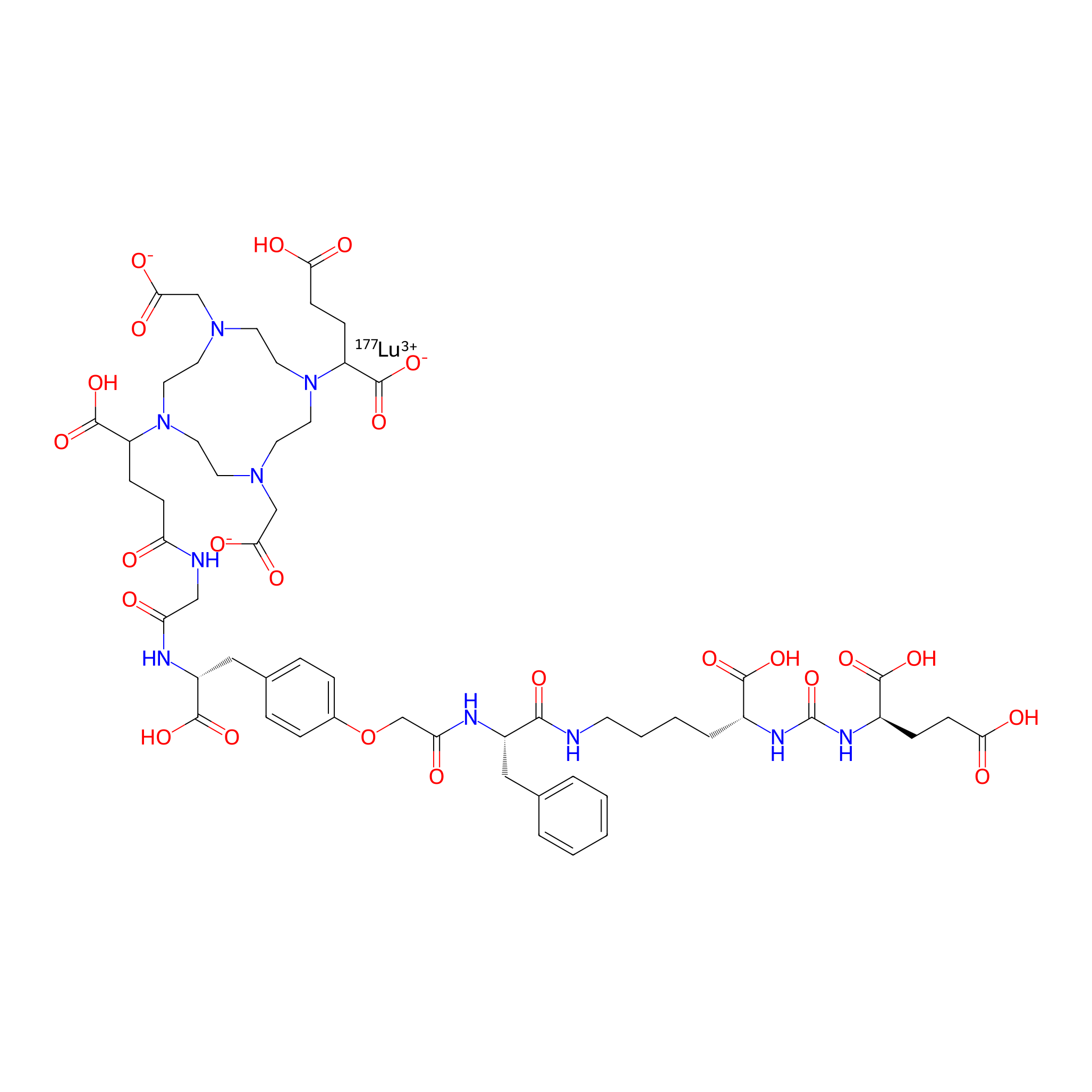
[177Lu]Lu-4
|
|||||
| PDC Status |
Investigative
|
|||||
| Indication |
In total 1 Indication(s)
 Metastatic castration-resistant prostate cancer
|
|||||
| Structure |
|
|||||
| Peptide Name |
PSMA-617
|
Peptide Info | ||||
| Receptor Name |
Glutamate carboxypeptidase 2 (FOLH1)
|
Receptor Info | ||||
| Drug Name |
Lutetium-177
|
Drug Info | ||||
| Therapeutic Target |
Human Deoxyribonucleic acid (hDNA)
|
Target Info | ||||
| Linker Name |
rac-(R)-2-(2-aminoacetamido)-3-(4-(2-(((R)-1-carboxy-2-phenylethyl)amino)-2-oxoethoxy)phenyl)propanoic acid
|
Linker Info | ||||
| Peptide Modified Type |
The modification of binding with chemical molecules
|
|||||
| Modified Segment |
Urea
|
|||||
| Formula |
C56H75LuN10O24
|
|||||
| #Ro5 Violations (Lipinski): 5 | Molecular Weight | 1449.205758 | ||||
| Lipid-water partition coefficient (xlogp) | -6.684 | |||||
| Hydrogen Bond Donor Count (hbonddonor) | 12 | |||||
| Hydrogen Bond Acceptor Count (hbondacc) | 22 | |||||
| Rotatable Bond Count (rotbonds) | 39 | |||||
Full List of Activity Data of This Peptide-drug Conjugate
Revealed Based on the Cell Line Data
| Experiment 1 Reporting the Activity Data of This PDC | [1] | ||||
| Indication | Metastatic castration-resistant prostate cancer | ||||
| Efficacy Data | Half Maximal Inhibitory Concentration (IC50) |
18.7 ± 0.3 nM
|
|||
| Administration Time | 1 h | ||||
| Evaluation Method | Gamma counter assay | ||||
| MOA of PDC |
Prostate-specific membrane antigen (PSMA) is a promising target for the diagnosis and radionuclide therapy of prostate cancer. This study reports conversion of a previously reported 68Ga-imaging agent, [68Ga]Ga-P16-093, to a Lu-177 radionuclide therapeutic agent. Substitution of the HBED-CC metal chelating group with DOTA(GA)2 led to P17-087 (4) and P17-088 (7). Both agents showed excellent PSMA binding affinity (IC50 = 10-30 nM) comparable to that of recently FDA-approved [177Lu]Lu-PSMA-617 (Pluvicto). Biodistribution studies in PSMA expressing tumor bearing mice showed that [177Lu]Lu-4 exhibited very high tumor uptake and a fast blood clearance similar to those of [177Lu]Lu-PSMA-617. Conversely, [177Lu]Lu-7, containing an albumin binder, extended its blood half-life and exhibited significantly higher uptake and longer tumor residence time than [177Lu]Lu-4 and [177Lu]Lu-PSMA-617. The switch from chelator HBED-CC to DOTA(GA)2 and the switch from the imaging isotope gallium-68 to the therapeutic isotope lutetium-177 have successfully transformed a PSMA-targeting agent from diagnosis to promising radionuclide therapeutic agents.
Click to Show/Hide
|
||||
| Description |
The PSMA binding affinities were determined by a competitive binding assay using PSMA-overexpressing LNCaP human prostate carcinoma cell homogenates and a known high affinity 125I-labeled PSMA ligand, [125I]MIP-1095, as the radioligand. The IC50 values for the metal-free PSMA-inhibiting compounds and metal complexes are summarized in Table 1. PSMA-617 and P16-093 were included in this study as reference compounds. The PSMA affinities of 4 and 7 as well as their natLu-labeled complexes were comparable to those of the reference compounds and displayed excellent binding affinities (IC50 = 28.7, 15.4, 18.7, and 20.2 nM, respectively). The addition of the p-iodophenylbutanoyl group in compound 7 did not change the PSMA binding affinity because of the small molecular size and remote position from the PSMA binding site.
Click to Show/Hide
|
||||
| In Vitro Model | Prostate carcinoma | LNCaP cell | CVCL_0395 | ||
| Half life period | 162 ± 4.86 h | ||||
References