Peptide-drug Conjugate Information
General Information of This Peptide-drug Conjugate (PDC)
| PDC ID |
PDC_00143
|
|||||
|---|---|---|---|---|---|---|
| PDC Name |
DTX-P7
|
|||||
| PDC Status |
Preclinical
|
|||||
| Indication |
In total 1 Indication(s)
 Non-small cell lung cancer
|
|||||
| Structure |
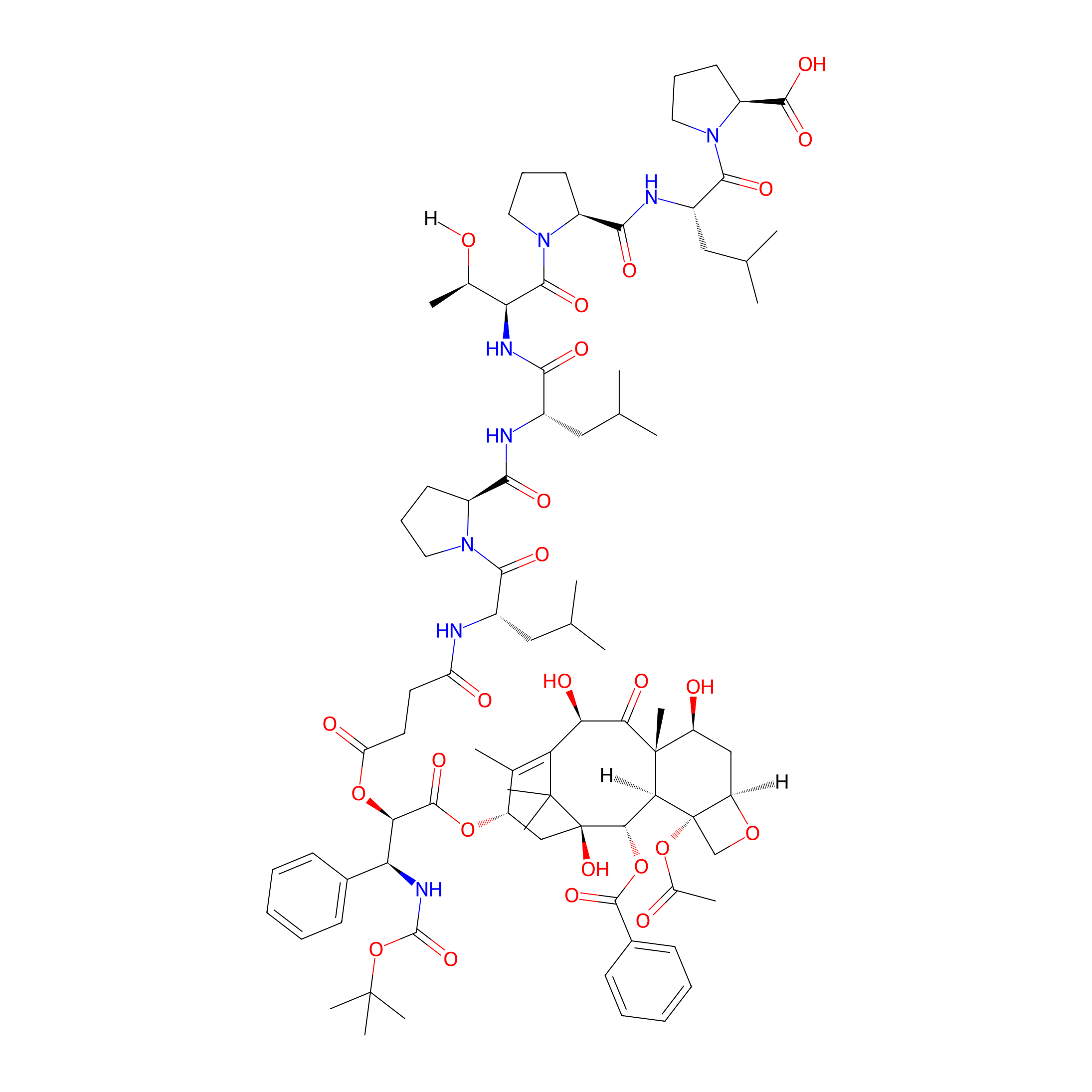
|
|||||
| Peptide Name |
Heptapeptide
|
Peptide Info | ||||
| Receptor Name |
Heat shock protein HSP 90-alpha (HSP90AA1)
|
Receptor Info | ||||
| Drug Name |
Docetaxel
|
Drug Info | ||||
| Therapeutic Target |
Microtubule (MT)
|
Target Info | ||||
| Linker Name |
Succinic Acid
|
Linker Info | ||||
| Formula |
C84H118N8O25
|
|||||
| #Ro5 Violations (Lipinski): 4 | Molecular Weight | 1639.899 | ||||
| Lipid-water partition coefficient (xlogp) | 4.1066 | |||||
| Hydrogen Bond Donor Count (hbonddonor) | 10 | |||||
| Hydrogen Bond Acceptor Count (hbondacc) | 24 | |||||
| Rotatable Bond Count (rotbonds) | 31 | |||||
Full List of Activity Data of This Peptide-drug Conjugate
Discovered Using Cell Line-derived Xenograft Model
| Experiment 1 Reporting the Activity Data of This PDC | [1] | ||||
| Indication | Non-small cell lung cancer | ||||
| Efficacy Data | Tumor Growth Inhibition value (TGI) |
93.2% (Day 28)
|
|||
| Administration Time | Once a week for 4 weeks | ||||
| Administration Dosage | 20 mg/kg | ||||
| Evaluation Method | Tumor volume detection assay | ||||
| MOA of PDC |
Collecitvely, by force of active targeting delivery of DTX via membrane-bound Hsp90, DTX-P7 induces unfolded protein response and subsequent apoptosis by degrading Hsp90, meanwhile awakens and kills the dormant cancer stem cells.
|
||||
| Description |
Intraperitoneal administration of 20 mg/kg DTX-P7 (equivalent to DTX dose calculated as DTX) reduced tumor growth by 93.2% compared with control mice, whereas the tumor growth inhibition of DTX was only 35.9%.
|
||||
| In Vivo Model | A549 cells mouse xenograft model. | ||||
| In Vitro Model | Lung adenocarcinoma | A-549 cell | CVCL_0023 | ||
Revealed Based on the Cell Line Data
| Experiment 1 Reporting the Activity Data of This PDC | [1] | ||||
| Indication | Non-small cell lung cancer | ||||
| Efficacy Data | Half Maximal Inhibitory Concentration (IC50) |
0.62 nM
|
|||
| Administration Time | 48 h | ||||
| Evaluation Method | CCK-8 assay | ||||
| MOA of PDC |
Collecitvely, by force of active targeting delivery of DTX via membrane-bound Hsp90, DTX-P7 induces unfolded protein response and subsequent apoptosis by degrading Hsp90, meanwhile awakens and kills the dormant cancer stem cells.
|
||||
| Description |
Intraperitoneal administration of 20 mg/kg DTX-P7 (equivalent to DTX dose calculated as DTX) reduced tumor growth by 93.2% compared with control mice, whereas the tumor growth inhibition of DTX was only 35.9%.
|
||||
| In Vitro Model | Lung adenocarcinoma | H1975 cell | CVCL_1511 | ||
| Experiment 2 Reporting the Activity Data of This PDC | [1] | ||||
| Indication | Non-small cell lung cancer | ||||
| Efficacy Data | Half Maximal Inhibitory Concentration (IC50) |
11.4 nM
|
|||
| Administration Time | 48 h | ||||
| Evaluation Method | CCK-8 assay | ||||
| MOA of PDC |
Collecitvely, by force of active targeting delivery of DTX via membrane-bound Hsp90, DTX-P7 induces unfolded protein response and subsequent apoptosis by degrading Hsp90, meanwhile awakens and kills the dormant cancer stem cells.
|
||||
| Description |
Intraperitoneal administration of 20 mg/kg DTX-P7 (equivalent to DTX dose calculated as DTX) reduced tumor growth by 93.2% compared with control mice, whereas the tumor growth inhibition of DTX was only 35.9%.
|
||||
| In Vitro Model | Lung adenocarcinoma | A-549 cell | CVCL_0023 | ||
References