Peptide-drug Conjugate Information
General Information of This Peptide-drug Conjugate (PDC)
| PDC ID |
PDC_00365
|
|||||
|---|---|---|---|---|---|---|
| PDC Name |
Debio-0328
|
|||||
| PDC Status |
Phase 1
|
|||||
| Indication |
In total 1 Indication(s)
 Clear cell renal cell carcinoma
|
|||||
| Structure |
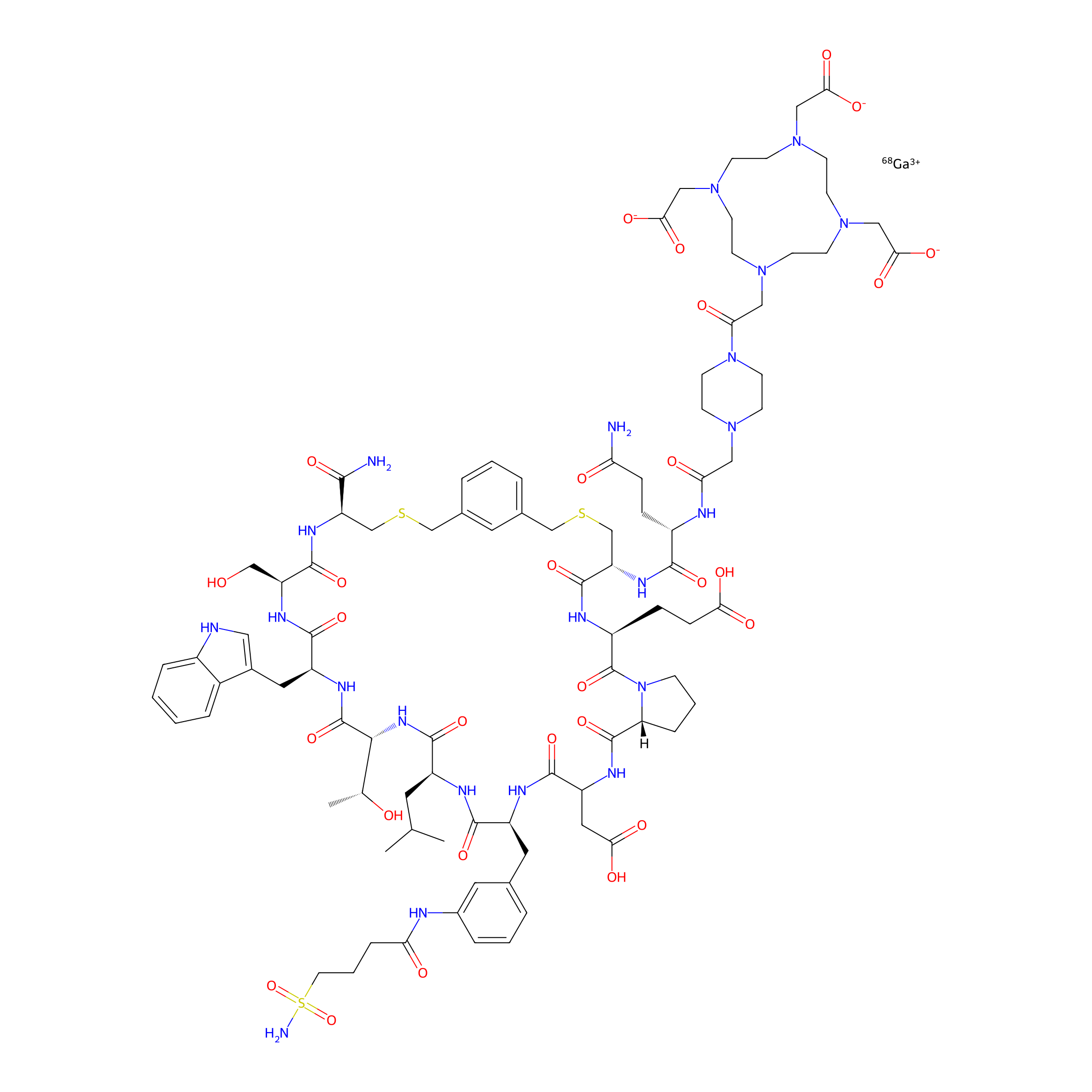
|
|||||
| Peptide Name |
DPI-4452
|
Peptide Info | ||||
| Drug Name |
Gallium-68
|
Drug Info | ||||
| Therapeutic Target |
Human Deoxyribonucleic acid (hDNA)
|
Target Info | ||||
| Linker Name |
Ethyl 2-(piperazin-1-yl)acetate
|
Linker Info | ||||
| Formula |
C92H129GaN22O29S3
|
|||||
| #Ro5 Violations (Lipinski): 5 | Molecular Weight | 2171.29798 | ||||
| Lipid-water partition coefficient (xlogp) | -11.2763 | |||||
| Hydrogen Bond Donor Count (hbonddonor) | 19 | |||||
| Hydrogen Bond Acceptor Count (hbondacc) | 34 | |||||
| Rotatable Bond Count (rotbonds) | 35 | |||||
Full List of Activity Data of This Peptide-drug Conjugate
Identified from the Human Clinical Data
| Experiment 1 Reporting the Activity Data of This PDC | [1] | ||||
| Indication | Clear cell renal cell carcinoma | ||||
| Efficacy Data | Blood creatine kinase increase |
33.30%
|
|||
| Patients Enrolled |
3 patients with metastatic ccRCC.
|
||||
| Administration Dosage | 185 MBq (±20%) | ||||
| MOA of PDC |
Carbonic anhydrase IX (CAIX) is a cell-surface glycoprotein involved in acidbase regulation. Aberrant tumor expression contributes to extracellular acidification, promoting tumor progression. The CAIX-encoding gene is overexpressed in more than 90% of ccRCC cases, often because of alterations in the von HippelLindau gene. With physiologic CAIX expression restricted to gastrointestinal epithelia, high tumoral expression presents diagnostic and therapeutic opportunities. Indeed, PET/CT-based tumor visualization with 89Zr-labeled anti-CAIX antibodies ([89Zr]Zr-girentuximab) can aid diagnosis of localized and metastatic ccRCC and enable differentiation of indolent versus benign tumors, which is challenging with conventional imaging. The CAIX-binding cyclic peptide DPI-4452, labeled with diagnostic (68Ga) or therapeutic (177Lu) radioisotopes, provides a novel theranostic pair to target CAIX-expressing tumors. Here, we report the characteristics of diagnostic [68Ga]Ga-DPI-4452 in patients with ccRCC.
Click to Show/Hide
|
||||
| Description |
No clinically significant toxicity was observed; treatment-emergent adverse events (headache and increased blood creatine kinase [1 each; 33.3%]) were not causally related to [68Ga]Ga-DPI-4452. No significant changes in vital signs, laboratory assessments, or electrocardiograms were observed.
|
||||
| Experiment 2 Reporting the Activity Data of This PDC | [1] | ||||
| Indication | Clear cell renal cell carcinoma | ||||
| Efficacy Data | Headache |
33.30%
|
|||
| Patients Enrolled |
3 patients with metastatic ccRCC.
|
||||
| Administration Dosage | 185 MBq (±20%) | ||||
| MOA of PDC |
Carbonic anhydrase IX (CAIX) is a cell-surface glycoprotein involved in acidbase regulation. Aberrant tumor expression contributes to extracellular acidification, promoting tumor progression. The CAIX-encoding gene is overexpressed in more than 90% of ccRCC cases, often because of alterations in the von HippelLindau gene. With physiologic CAIX expression restricted to gastrointestinal epithelia, high tumoral expression presents diagnostic and therapeutic opportunities. Indeed, PET/CT-based tumor visualization with 89Zr-labeled anti-CAIX antibodies ([89Zr]Zr-girentuximab) can aid diagnosis of localized and metastatic ccRCC and enable differentiation of indolent versus benign tumors, which is challenging with conventional imaging. The CAIX-binding cyclic peptide DPI-4452, labeled with diagnostic (68Ga) or therapeutic (177Lu) radioisotopes, provides a novel theranostic pair to target CAIX-expressing tumors. Here, we report the characteristics of diagnostic [68Ga]Ga-DPI-4452 in patients with ccRCC.
Click to Show/Hide
|
||||
| Description |
No clinically significant toxicity was observed; treatment-emergent adverse events (headache and increased blood creatine kinase [1 each; 33.3%]) were not causally related to [68Ga]Ga-DPI-4452. No significant changes in vital signs, laboratory assessments, or electrocardiograms were observed.
|
||||
| Experiment 3 Reporting the Activity Data of This PDC | [1] | ||||
| Indication | Clear cell renal cell carcinoma | ||||
| Efficacy Data | SUV max values |
106
|
|||
| Patients Enrolled |
51 years old patient with metastatic ccRCC.
|
||||
| Administration Dosage | 185 MBq (±20%) | ||||
| MOA of PDC |
Carbonic anhydrase IX (CAIX) is a cell-surface glycoprotein involved in acidbase regulation. Aberrant tumor expression contributes to extracellular acidification, promoting tumor progression. The CAIX-encoding gene is overexpressed in more than 90% of ccRCC cases, often because of alterations in the von HippelLindau gene. With physiologic CAIX expression restricted to gastrointestinal epithelia, high tumoral expression presents diagnostic and therapeutic opportunities. Indeed, PET/CT-based tumor visualization with 89Zr-labeled anti-CAIX antibodies ([89Zr]Zr-girentuximab) can aid diagnosis of localized and metastatic ccRCC and enable differentiation of indolent versus benign tumors, which is challenging with conventional imaging. The CAIX-binding cyclic peptide DPI-4452, labeled with diagnostic (68Ga) or therapeutic (177Lu) radioisotopes, provides a novel theranostic pair to target CAIX-expressing tumors. Here, we report the characteristics of diagnostic [68Ga]Ga-DPI-4452 in patients with ccRCC.
Click to Show/Hide
|
||||
| Description |
After [68Ga]Ga-DPI-4452 administration, high tumor-specific uptake was observed as early as 15min and was sustained for all time points assessed. One hour was chosen as the optimal time point on the basis of central reader visual assessment of image quality, visualization of all lesions, and heterogeneity in tumor uptake. Among all lesions, 17 metastases in bone, lymph nodes, lungs, pancreas, and parotid glands were not readily identifiable by conventional imaging. Low renal parenchymal uptake enabled identification of renal tumors. SUVmax 1h after administration across 36 lesions ranged from 6.8 to 211.6 (mean, 64.6 [SD, 54.8]). In patients 1, 2, and 3, the highest SUVmax was 109, 106, and 212, respectively, whereas the highest SUVmean was 39, 62, and 89, respectively.
Click to Show/Hide
|
||||
| Experiment 4 Reporting the Activity Data of This PDC | [1] | ||||
| Indication | Clear cell renal cell carcinoma | ||||
| Efficacy Data | SUV max values |
109
|
|||
| Patients Enrolled |
48 years old patient with metastatic ccRCC.
|
||||
| Administration Dosage | 185 MBq (±20%) | ||||
| MOA of PDC |
Carbonic anhydrase IX (CAIX) is a cell-surface glycoprotein involved in acidbase regulation. Aberrant tumor expression contributes to extracellular acidification, promoting tumor progression. The CAIX-encoding gene is overexpressed in more than 90% of ccRCC cases, often because of alterations in the von HippelLindau gene. With physiologic CAIX expression restricted to gastrointestinal epithelia, high tumoral expression presents diagnostic and therapeutic opportunities. Indeed, PET/CT-based tumor visualization with 89Zr-labeled anti-CAIX antibodies ([89Zr]Zr-girentuximab) can aid diagnosis of localized and metastatic ccRCC and enable differentiation of indolent versus benign tumors, which is challenging with conventional imaging. The CAIX-binding cyclic peptide DPI-4452, labeled with diagnostic (68Ga) or therapeutic (177Lu) radioisotopes, provides a novel theranostic pair to target CAIX-expressing tumors. Here, we report the characteristics of diagnostic [68Ga]Ga-DPI-4452 in patients with ccRCC.
Click to Show/Hide
|
||||
| Description |
After [68Ga]Ga-DPI-4452 administration, high tumor-specific uptake was observed as early as 15min and was sustained for all time points assessed. One hour was chosen as the optimal time point on the basis of central reader visual assessment of image quality, visualization of all lesions, and heterogeneity in tumor uptake. Among all lesions, 17 metastases in bone, lymph nodes, lungs, pancreas, and parotid glands were not readily identifiable by conventional imaging. Low renal parenchymal uptake enabled identification of renal tumors. SUVmax 1h after administration across 36 lesions ranged from 6.8 to 211.6 (mean, 64.6 [SD, 54.8]). In patients 1, 2, and 3, the highest SUVmax was 109, 106, and 212, respectively, whereas the highest SUVmean was 39, 62, and 89, respectively.
Click to Show/Hide
|
||||
| Experiment 5 Reporting the Activity Data of This PDC | [1] | ||||
| Indication | Clear cell renal cell carcinoma | ||||
| Efficacy Data | SUV max values |
212
|
|||
| Patients Enrolled |
54 years old patient with metastatic ccRCC.
|
||||
| Administration Dosage | 185 MBq (±20%) | ||||
| MOA of PDC |
Carbonic anhydrase IX (CAIX) is a cell-surface glycoprotein involved in acidbase regulation. Aberrant tumor expression contributes to extracellular acidification, promoting tumor progression. The CAIX-encoding gene is overexpressed in more than 90% of ccRCC cases, often because of alterations in the von HippelLindau gene. With physiologic CAIX expression restricted to gastrointestinal epithelia, high tumoral expression presents diagnostic and therapeutic opportunities. Indeed, PET/CT-based tumor visualization with 89Zr-labeled anti-CAIX antibodies ([89Zr]Zr-girentuximab) can aid diagnosis of localized and metastatic ccRCC and enable differentiation of indolent versus benign tumors, which is challenging with conventional imaging. The CAIX-binding cyclic peptide DPI-4452, labeled with diagnostic (68Ga) or therapeutic (177Lu) radioisotopes, provides a novel theranostic pair to target CAIX-expressing tumors. Here, we report the characteristics of diagnostic [68Ga]Ga-DPI-4452 in patients with ccRCC.
Click to Show/Hide
|
||||
| Description |
After [68Ga]Ga-DPI-4452 administration, high tumor-specific uptake was observed as early as 15min and was sustained for all time points assessed. One hour was chosen as the optimal time point on the basis of central reader visual assessment of image quality, visualization of all lesions, and heterogeneity in tumor uptake. Among all lesions, 17 metastases in bone, lymph nodes, lungs, pancreas, and parotid glands were not readily identifiable by conventional imaging. Low renal parenchymal uptake enabled identification of renal tumors. SUVmax 1h after administration across 36 lesions ranged from 6.8 to 211.6 (mean, 64.6 [SD, 54.8]). In patients 1, 2, and 3, the highest SUVmax was 109, 106, and 212, respectively, whereas the highest SUVmean was 39, 62, and 89, respectively.
Click to Show/Hide
|
||||
| Experiment 6 Reporting the Activity Data of This PDC | [1] | ||||
| Indication | Clear cell renal cell carcinoma | ||||
| Efficacy Data | SUV mean values |
39
|
|||
| Patients Enrolled |
48 years old patient with metastatic ccRCC.
|
||||
| Administration Dosage | 185 MBq (±20%) | ||||
| MOA of PDC |
Carbonic anhydrase IX (CAIX) is a cell-surface glycoprotein involved in acidbase regulation. Aberrant tumor expression contributes to extracellular acidification, promoting tumor progression. The CAIX-encoding gene is overexpressed in more than 90% of ccRCC cases, often because of alterations in the von HippelLindau gene. With physiologic CAIX expression restricted to gastrointestinal epithelia, high tumoral expression presents diagnostic and therapeutic opportunities. Indeed, PET/CT-based tumor visualization with 89Zr-labeled anti-CAIX antibodies ([89Zr]Zr-girentuximab) can aid diagnosis of localized and metastatic ccRCC and enable differentiation of indolent versus benign tumors, which is challenging with conventional imaging. The CAIX-binding cyclic peptide DPI-4452, labeled with diagnostic (68Ga) or therapeutic (177Lu) radioisotopes, provides a novel theranostic pair to target CAIX-expressing tumors. Here, we report the characteristics of diagnostic [68Ga]Ga-DPI-4452 in patients with ccRCC.
Click to Show/Hide
|
||||
| Description |
After [68Ga]Ga-DPI-4452 administration, high tumor-specific uptake was observed as early as 15min and was sustained for all time points assessed. One hour was chosen as the optimal time point on the basis of central reader visual assessment of image quality, visualization of all lesions, and heterogeneity in tumor uptake. Among all lesions, 17 metastases in bone, lymph nodes, lungs, pancreas, and parotid glands were not readily identifiable by conventional imaging. Low renal parenchymal uptake enabled identification of renal tumors. SUVmax 1h after administration across 36 lesions ranged from 6.8 to 211.6 (mean, 64.6 [SD, 54.8]). In patients 1, 2, and 3, the highest SUVmax was 109, 106, and 212, respectively, whereas the highest SUVmean was 39, 62, and 89, respectively.
Click to Show/Hide
|
||||
| Experiment 7 Reporting the Activity Data of This PDC | [1] | ||||
| Indication | Clear cell renal cell carcinoma | ||||
| Efficacy Data | SUV mean values |
62
|
|||
| Patients Enrolled |
51 years old patient with metastatic ccRCC.
|
||||
| Administration Dosage | 185 MBq (±20%) | ||||
| MOA of PDC |
Carbonic anhydrase IX (CAIX) is a cell-surface glycoprotein involved in acidbase regulation. Aberrant tumor expression contributes to extracellular acidification, promoting tumor progression. The CAIX-encoding gene is overexpressed in more than 90% of ccRCC cases, often because of alterations in the von HippelLindau gene. With physiologic CAIX expression restricted to gastrointestinal epithelia, high tumoral expression presents diagnostic and therapeutic opportunities. Indeed, PET/CT-based tumor visualization with 89Zr-labeled anti-CAIX antibodies ([89Zr]Zr-girentuximab) can aid diagnosis of localized and metastatic ccRCC and enable differentiation of indolent versus benign tumors, which is challenging with conventional imaging. The CAIX-binding cyclic peptide DPI-4452, labeled with diagnostic (68Ga) or therapeutic (177Lu) radioisotopes, provides a novel theranostic pair to target CAIX-expressing tumors. Here, we report the characteristics of diagnostic [68Ga]Ga-DPI-4452 in patients with ccRCC.
Click to Show/Hide
|
||||
| Description |
After [68Ga]Ga-DPI-4452 administration, high tumor-specific uptake was observed as early as 15min and was sustained for all time points assessed. One hour was chosen as the optimal time point on the basis of central reader visual assessment of image quality, visualization of all lesions, and heterogeneity in tumor uptake. Among all lesions, 17 metastases in bone, lymph nodes, lungs, pancreas, and parotid glands were not readily identifiable by conventional imaging. Low renal parenchymal uptake enabled identification of renal tumors. SUVmax 1h after administration across 36 lesions ranged from 6.8 to 211.6 (mean, 64.6 [SD, 54.8]). In patients 1, 2, and 3, the highest SUVmax was 109, 106, and 212, respectively, whereas the highest SUVmean was 39, 62, and 89, respectively.
Click to Show/Hide
|
||||
| Experiment 8 Reporting the Activity Data of This PDC | [1] | ||||
| Indication | Clear cell renal cell carcinoma | ||||
| Efficacy Data | SUV mean values |
89
|
|||
| Patients Enrolled |
54 years old patient with metastatic ccRCC.
|
||||
| Administration Dosage | 185 MBq (±20%) | ||||
| MOA of PDC |
Carbonic anhydrase IX (CAIX) is a cell-surface glycoprotein involved in acidbase regulation. Aberrant tumor expression contributes to extracellular acidification, promoting tumor progression. The CAIX-encoding gene is overexpressed in more than 90% of ccRCC cases, often because of alterations in the von HippelLindau gene. With physiologic CAIX expression restricted to gastrointestinal epithelia, high tumoral expression presents diagnostic and therapeutic opportunities. Indeed, PET/CT-based tumor visualization with 89Zr-labeled anti-CAIX antibodies ([89Zr]Zr-girentuximab) can aid diagnosis of localized and metastatic ccRCC and enable differentiation of indolent versus benign tumors, which is challenging with conventional imaging. The CAIX-binding cyclic peptide DPI-4452, labeled with diagnostic (68Ga) or therapeutic (177Lu) radioisotopes, provides a novel theranostic pair to target CAIX-expressing tumors. Here, we report the characteristics of diagnostic [68Ga]Ga-DPI-4452 in patients with ccRCC.
Click to Show/Hide
|
||||
| Description |
After [68Ga]Ga-DPI-4452 administration, high tumor-specific uptake was observed as early as 15min and was sustained for all time points assessed. One hour was chosen as the optimal time point on the basis of central reader visual assessment of image quality, visualization of all lesions, and heterogeneity in tumor uptake. Among all lesions, 17 metastases in bone, lymph nodes, lungs, pancreas, and parotid glands were not readily identifiable by conventional imaging. Low renal parenchymal uptake enabled identification of renal tumors. SUVmax 1h after administration across 36 lesions ranged from 6.8 to 211.6 (mean, 64.6 [SD, 54.8]). In patients 1, 2, and 3, the highest SUVmax was 109, 106, and 212, respectively, whereas the highest SUVmean was 39, 62, and 89, respectively.
Click to Show/Hide
|
||||
References