Peptide Information
General Information of This Peptide
| Peptide ID |
PEP00027
|
|||||
|---|---|---|---|---|---|---|
| Peptide Name |
GnRH analogs 3
|
|||||
| Structure |
|
|||||
| Sequence |
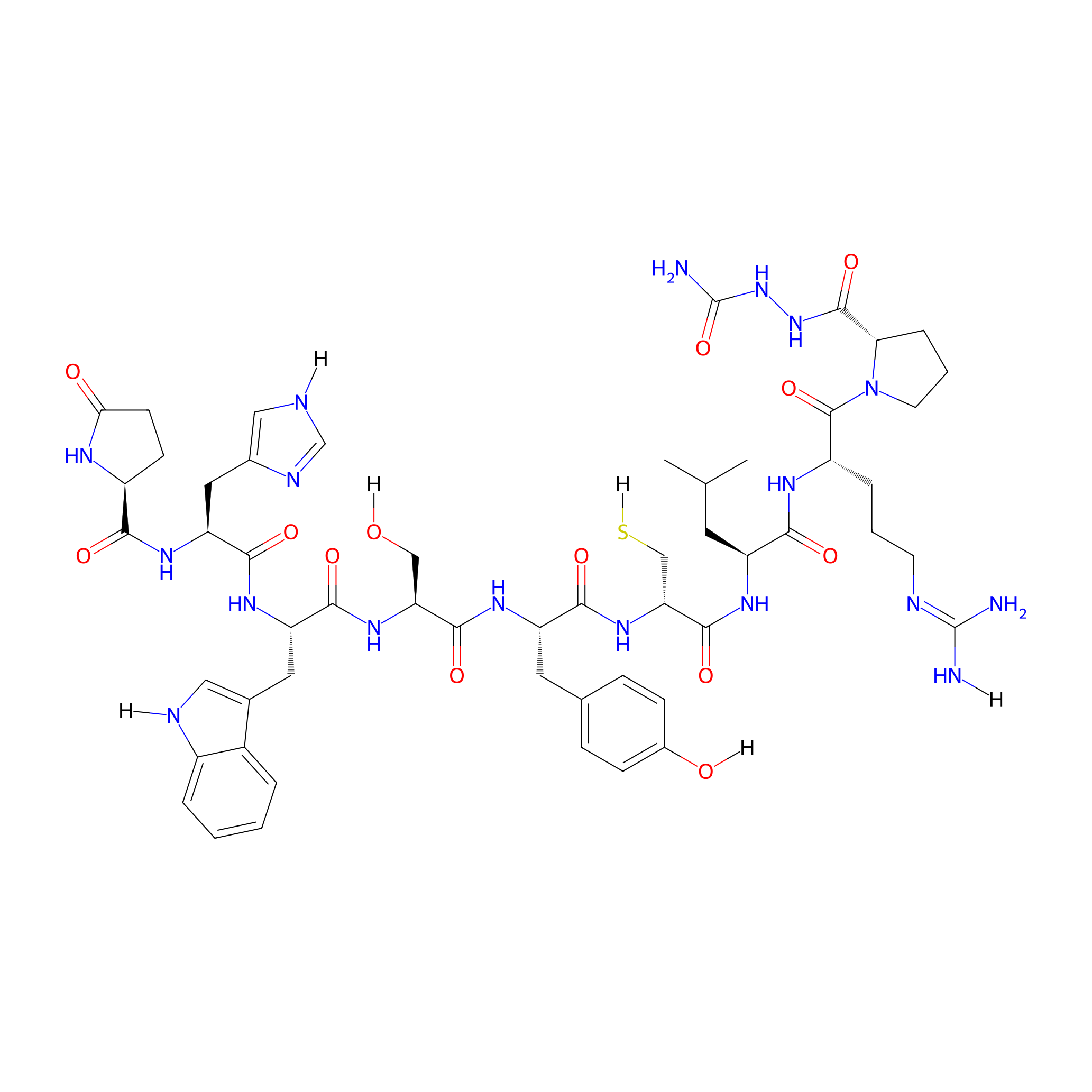
EHWSYCLRPG-NH2
|
|||||
| Peptide Type |
Linear
|
|||||
| Receptor Name |
Gonadotropin-releasing hormone receptor (GNRHR)
|
Receptor Info | ||||
| PDC Transmembrane Types | Cell targeting peptides (CTPs) | |||||
| Formula |
C55H76N18O13S
|
|||||
| Isosmiles |
[H]N/C(N)=N/CCC[C@H](NC(=O)[C@H](CC(C)C)NC(=O)[C@@H](CS[H])NC(=O)[C@H](Cc1ccc(O[H])cc1)NC(=O)[C@H](CO[H])NC(=O)[C@H](Cc1cn([H])c2ccccc12)NC(=O)[C@H](Cc1cn([H])cn1)NC(=O)[C@@H]1CCC(=O)N1)C(=O)N1CCC[C@H]1C(=O)NNC(N)=O
|
|||||
| InChI |
InChI=1S/C55H76N18O13S/c1-28(2)19-37(46(78)64-36(9-5-17-60-54(56)57)53(85)73-18-6-10-43(73)52(84)71-72-55(58)86)65-51(83)42(26-87)70-47(79)38(20-29-11-13-32(75)14-12-29)66-50(82)41(25-74)69-48(80)39(21-30-23-61-34-8-4-3-7-33(30)34)67-49(81)40(22-31-24-59-27-62-31)68-45(77)35-15-16-44(76)63-35/h3-4,7-8,11-14,23-24,27-28,35-43,61,74-75,87H,5-6,9-10,15-22,25-26H2,1-2H3,(H,59,62)(H,63,76)(H,64,78)(H,65,83)(H,66,82)(H,67,81)(H,68,77)(H,69,80)(H,70,79)(H,71,84)(H4,56,57,60)(H3,58,72,86)/t35-,36-,37-,38-,39-,40-,41-,42+,43-/m0/s1
|
|||||
| InChIKey |
DTTVWTUMGAVWIK-STITWECQSA-N
|
|||||
| Pharmaceutical Properties |
Molecule Weight
|
1229.393
|
Polar area
|
486.66
|
||
|
Complexity
|
1228.555995
|
xlogp Value
|
-3.991
|
|||
|
Heavy Count
|
87
|
Rot Bonds
|
33
|
|||
|
Hbond acc
|
16
|
Hbond Donor
|
18
|
|||
The Activity Data of This Peptide
| Peptide Activity Information 1 | [1] | |||||
| Cell viability | 26% | |||||
|---|---|---|---|---|---|---|
| Binding Affinity Assay |
The antiproliferative effects of Dox and GnRH-Dox conjugates were determined in MCF-7 cells using the MTT assay.The results of antiproliferative activity of the three conjugates demonstrated that [d-Cys6-des-Gly10-Pro9-NHEt]-GnRH might have higher binding affinity to GnRH receptors than that of [d-Cys6, desGly10, Pro9-NH2]-GnRH and [d-Cys6, a-aza-Gly10-NH2]-GnRH.
Click to Show/Hide
|
|||||
| Experimental Condition | MCF-7 cell; 100 μM | |||||
| Peptide Activity Information 2 | [1] | |||||
| Cell viability | 35% | |||||
| Binding Affinity Assay |
The antiproliferative effects of Dox and GnRH-Dox conjugates were determined in MCF-7 cells using the MTT assay.The results of antiproliferative activity of the three conjugates demonstrated that [d-Cys6-des-Gly10-Pro9-NHEt]-GnRH might have higher binding affinity to GnRH receptors than that of [d-Cys6, desGly10, Pro9-NH2]-GnRH and [d-Cys6, a-aza-Gly10-NH2]-GnRH.
Click to Show/Hide
|
|||||
| Experimental Condition | MCF-7 cell; 75 μM | |||||
| Peptide Activity Information 3 | [1] | |||||
| Cell viability | 48% | |||||
| Binding Affinity Assay |
The antiproliferative effects of Dox and GnRH-Dox conjugates were determined in MCF-7 cells using the MTT assay.The results of antiproliferative activity of the three conjugates demonstrated that [d-Cys6-des-Gly10-Pro9-NHEt]-GnRH might have higher binding affinity to GnRH receptors than that of [d-Cys6, desGly10, Pro9-NH2]-GnRH and [d-Cys6, a-aza-Gly10-NH2]-GnRH.
Click to Show/Hide
|
|||||
| Experimental Condition | MCF-7 cell; 50 μM | |||||
| Peptide Activity Information 4 | [1] | |||||
| Cell viability | 56% | |||||
| Binding Affinity Assay |
The antiproliferative effects of Dox and GnRH-Dox conjugates were determined in MCF-7 cells using the MTT assay.The results of antiproliferative activity of the three conjugates demonstrated that [d-Cys6-des-Gly10-Pro9-NHEt]-GnRH might have higher binding affinity to GnRH receptors than that of [d-Cys6, desGly10, Pro9-NH2]-GnRH and [d-Cys6, a-aza-Gly10-NH2]-GnRH.
Click to Show/Hide
|
|||||
| Experimental Condition | MCF-7 cell; 25 μM | |||||
Each Peptide-drug Conjugate Related to This Peptide
Full Information of The Activity Data of The PDC(s) Related to This Peptide
[d-Cys6-des-Gly10-Pro9-α-azaGly-NH2]-GnRH-Dox [Investigative]
Revealed Based on the Cell Line Data
| Experiment 1 Reporting the Activity Data of This PDC | [1] | ||||
| Indication | Tumor | ||||
| Efficacy Data | Cell viability |
0.3
|
|||
| Administration Time | 48 h | ||||
| Administration Dosage | 100 µM | ||||
| Evaluation Method | MTT assay | ||||
| Description |
The results showed that all the conjugates had lower antiproliferative effects than Dox at the tested concentrations (Figure 2A); this may be related to inefficient release of Dox from the conjugate caused by the relative stable thioether bond linkage between Dox-SMP and GnRH analog. The antiproliferative effects of the three conjugates were close at 25, 50, and 75 uM. While at 100 uM, conjugate II exhibited higher inhibitory effect than that of I and III.
Click to Show/Hide
|
||||
| In Vitro Model | Invasive breast carcinoma | MCF-7 cell | CVCL_0031 | ||
| Half life period | 5.23 h | ||||
| Experiment 2 Reporting the Activity Data of This PDC | [1] | ||||
| Indication | Tumor | ||||
| Efficacy Data | Cell viability |
0.38
|
|||
| Administration Time | 48 h | ||||
| Administration Dosage | 75 µM | ||||
| Evaluation Method | MTT assay | ||||
| MOA of PDC |
Vitamin C as a water-soluble vitamin is the reduced form of ascorbic acid. No significant adverse effect of taking high doses of vitamin C (over 2000 mg/day) has been reported due to the water-soluble feature of vitamin C. Vitamin C directly reacts with hydroxy, alkoxyl, and lipid peroxyl radicals and converts them to alcohol, water, and hydroperoxide lipid, respectively. It has been shown that taking vitamin C before radioiodine therapy can ameliorate the oxidative stress effect of radioiodine. The radioprotective effects of vitamin C are mainly due to its free radical scavenging activity.
Click to Show/Hide
|
||||
| Description |
The results showed that all the conjugates had lower antiproliferative effects than Dox at the tested concentrations (Figure 2A); this may be related to inefficient release of Dox from the conjugate caused by the relative stable thioether bond linkage between Dox-SMP and GnRH analog. The antiproliferative effects of the three conjugates were close at 25, 50, and 75 uM. While at 100 uM, conjugate II exhibited higher inhibitory effect than that of I and III.
Click to Show/Hide
|
||||
| In Vitro Model | Invasive breast carcinoma | MCF-7 cell | CVCL_0031 | ||
| Half life period | 5.23 h | ||||
| Experiment 3 Reporting the Activity Data of This PDC | [1] | ||||
| Indication | Tumor | ||||
| Efficacy Data | Cell viability |
0.5
|
|||
| Administration Time | 48 h | ||||
| Administration Dosage | 50 µM | ||||
| Evaluation Method | MTT assay | ||||
| Description |
The results showed that all the conjugates had lower antiproliferative effects than Dox at the tested concentrations (Figure 2A); this may be related to inefficient release of Dox from the conjugate caused by the relative stable thioether bond linkage between Dox-SMP and GnRH analog. The antiproliferative effects of the three conjugates were close at 25, 50, and 75 uM. While at 100 uM, conjugate II exhibited higher inhibitory effect than that of I and III.
Click to Show/Hide
|
||||
| In Vitro Model | Invasive breast carcinoma | MCF-7 cell | CVCL_0031 | ||
| Half life period | 5.23 h | ||||
| Experiment 4 Reporting the Activity Data of This PDC | [1] | ||||
| Indication | Tumor | ||||
| Efficacy Data | Cell viability |
0.59
|
|||
| Administration Time | 48 h | ||||
| Administration Dosage | 25 µM | ||||
| Evaluation Method | MTT assay | ||||
| Description |
The results showed that all the conjugates had lower antiproliferative effects than Dox at the tested concentrations (Figure 2A); this may be related to inefficient release of Dox from the conjugate caused by the relative stable thioether bond linkage between Dox-SMP and GnRH analog. The antiproliferative effects of the three conjugates were close at 25, 50, and 75 uM. While at 100 uM, conjugate II exhibited higher inhibitory effect than that of I and III.
Click to Show/Hide
|
||||
| In Vitro Model | Invasive breast carcinoma | MCF-7 cell | CVCL_0031 | ||
| Half life period | 5.23 h | ||||
References