Drug Information
General Information of This Drug
| Drug ID | DRG00063 | |||||
|---|---|---|---|---|---|---|
| Drug Name | Pyrrolobenzodiazepine (PBD) dimer | |||||
| Target(s) | Human Deoxyribonucleic acid (hDNA) | Target Info | ||||
| Structure |
|
|||||
| Formula |
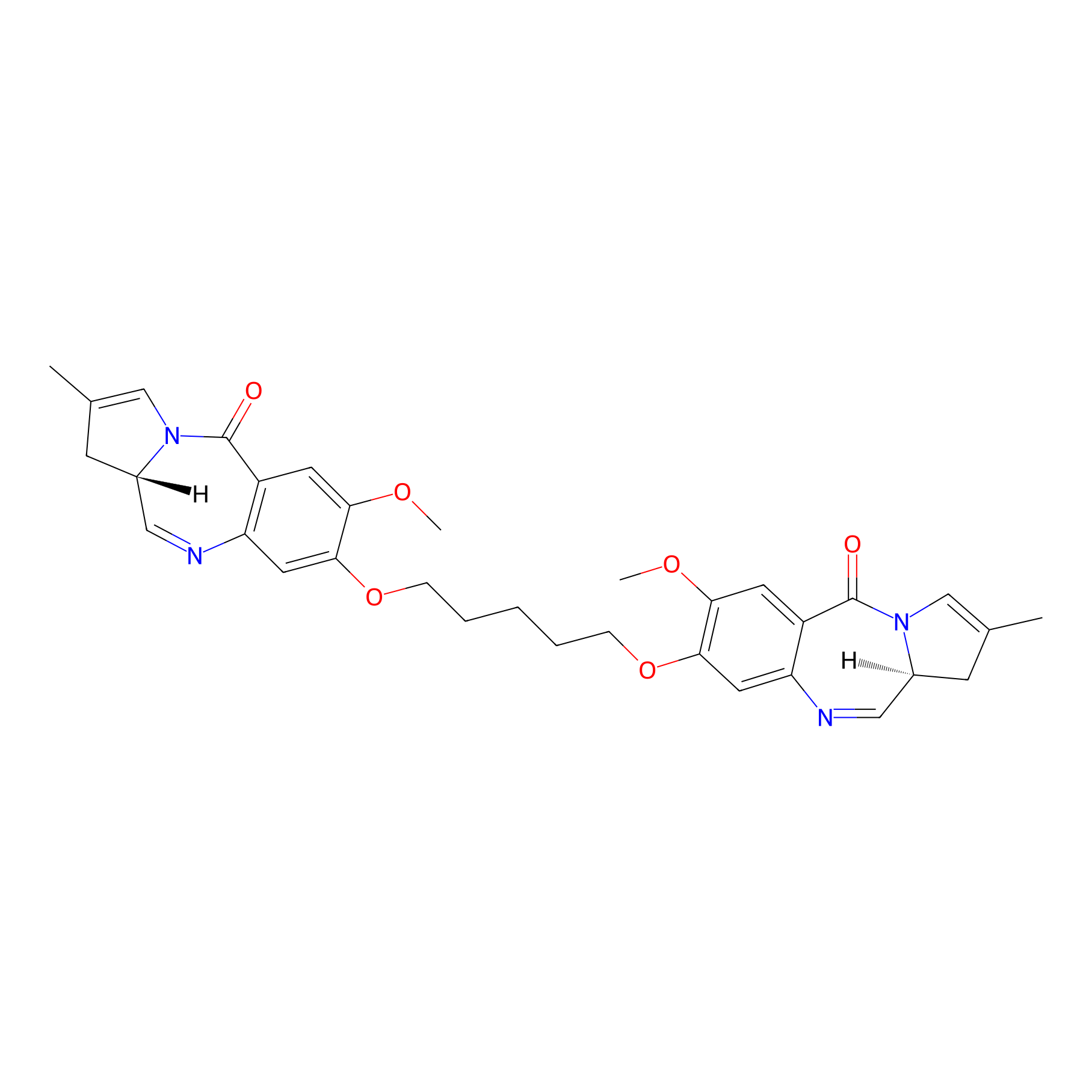
C33H36N4O6
|
|||||
| #Ro5 Violations (Lipinski): 2 | Molecular Weight (mw) | 584.673 | ||||
| Lipid-water partition coefficient (xlogp) | 6.0003 | |||||
| Hydrogen Bond Donor Count (hbonddonor) | 0 | |||||
| Hydrogen Bond Acceptor Count (hbondacc) | 8 | |||||
| Rotatable Bond Count (rotbonds) | 10 | |||||
| Canonical smiles |
[H]C12C=Nc3cc(OCCCCCOc4cc5c(cc4OC)C(=O)N4C=C(C)CC4([H])C=N5)c(OC)cc3C(=O)N1C=C(C)C2
|
|||||
| InChI |
InChI=1S/C33H36N4O6/c1-20-10-22-16-34-26-14-30(28(40-3)12-24(26)32(38)36(22)18-20)42-8-6-5-7-9-43-31-15-27-25(13-29(31)41-4)33(39)37-19-21(2)11-23(37)17-35-27/h12-19,22-23H,5-11H2,1-4H3/t22-,23-/m0/s1
|
|||||
| InChIKey |
YMTZZJOPSATRTO-GOTSBHOMSA-N
|
|||||
Each Peptide-drug Conjugate Related to This Drug
Full Information of The Activity Data of The PDC(s) Related to This Drug
SG3511 [Investigative]
Discovered Using Cell Line-derived Xenograft Model
| Experiment 1 Reporting the Activity Data of This PDC | [1] | ||||
| Indication | Pancreatic ductal adenocarcinoma | ||||
| Efficacy Data | Tumor Growth Inhibition value (TGI) | 34% (Day 28) | |||
| Evaluation Method | Tumor volume detection assay | ||||
| Administration Time | Bi-weekly for 4 weeks | ||||
| Administration Dosage | 20 µg/kg | ||||
| MOA of PDC |
Non-targeting SG3511 also produced a significant increase in apoptosis and DNA damage (P<0.05) again, probably as a result of the inherent lipophilicity of tesirine, but there was no significant change in tumor cell number, as measured by tumour cell area, CK-expression and confirmed with E-cadherin expression.
|
||||
| Description |
SG3299 significantly reduced Panc0403/PS1 xenograft tumor growth by 75.8±6% (P<0.001) compared with PBS treatment and by 60.4±9.8% (P<0.05) compared with SG3511 therapy.
|
||||
| In Vivo Model | Athymic CD1Nu/Nu female mice bearing human A375Pbeta6 xenograft tumours. | ||||
| In Vitro Model | Pancreatic ductal adenocarcinoma | Panc 04.03 PS1 cell | CVCL_1636 | ||
| Experiment 2 Reporting the Activity Data of This PDC | [1] | ||||
| Indication | Pancreatic ductal adenocarcinoma | ||||
| Efficacy Data | Tumor Growth Inhibition value (TGI) | 34.8 ± 4.6% (Day 28) | |||
| Evaluation Method | Tumor volume detection assay | ||||
| Administration Time | T hrice weekly for 4 consecutive weeks | ||||
| Administration Dosage | 10 µg/kg | ||||
| MOA of PDC |
Non-targeting SG3511 also produced a significant increase in apoptosis and DNA damage (P<0.05) again, probably as a result of the inherent lipophilicity of tesirine, but there was no significant change in tumor cell number, as measured by tumour cell area, CK-expression and confirmed with E-cadherin expression.
|
||||
| Description |
Tumors treated with SG3511 and SG3299 exhibited significant reductions in size (P<0.0001, 53.9±23.7% and 34.8±4.6% after 21 days respectively) but there was no significant difference in the effect of either treatment (P=0.24, after 30 days).
|
||||
| In Vivo Model | Athymic CD1Nu/Nu female mice bearing human A375Ppuro xenograft tumours. | ||||
| In Vitro Model | Amelanotic melanoma | A375P-puro cell | CVCL_5F66 | ||
| Experiment 3 Reporting the Activity Data of This PDC | [1] | ||||
| Indication | Pancreatic ductal adenocarcinoma | ||||
| Efficacy Data | Tumor Growth Inhibition value (TGI) | 56.9 ± 16.2% (Day 28) | |||
| Evaluation Method | Tumor volume detection assay | ||||
| Administration Time | T hrice weekly for 4 consecutive weeks | ||||
| Administration Dosage | 10 µg/kg | ||||
| MOA of PDC |
Non-targeting SG3511 also produced a significant increase in apoptosis and DNA damage (P<0.05) again, probably as a result of the inherent lipophilicity of tesirine, but there was no significant change in tumor cell number, as measured by tumour cell area, CK-expression and confirmed with E-cadherin expression.
|
||||
| Description |
In contrast, both SG3299 and SG3511 reduced A375P6 tumor growth compared with PBS treatment (79±7% and 56.9±16.2% respectively, P<0.0001) and SG3299 reduced growth by 2.3-fold more than SG3511 (P<0.0001).
|
||||
| In Vivo Model | Athymic CD1Nu/Nu female mice bearing human A375Pbeta6 xenograft tumours. | ||||
| In Vitro Model | Amelanotic melanoma | A375P-beta6 cell | CVCL_5F66 | ||
| Experiment 4 Reporting the Activity Data of This PDC | [1] | ||||
| Indication | Pancreatic ductal adenocarcinoma | ||||
| Efficacy Data | Tumor Growth Inhibition value (TGI) | 75% (Day 35) | |||
| Evaluation Method | Tumor volume detection assay | ||||
| Administration Time | T hrice weekly for 5 consecutive weeks | ||||
| Administration Dosage | 10 µg/kg | ||||
| MOA of PDC |
Non-targeting SG3511 also produced a significant increase in apoptosis and DNA damage (P<0.05) again, probably as a result of the inherent lipophilicity of tesirine, but there was no significant change in tumor cell number, as measured by tumour cell area, CK-expression and confirmed with E-cadherin expression.
|
||||
| Description |
Capan-1 xenografts responded in a similar manner to A375P6 xenografts upon 10 ug/kg tri-weekly treatment, with significant growth inhibition with SG3511 and SG3299 (P<0.0001). Again, SG3299 inhibited tumor growth significantly more than SG3511 (P<0.0001).
|
||||
| In Vivo Model | Athymic CD1Nu/Nu female mice bearing human Capan-1 xenograft tumours. | ||||
| In Vitro Model | Pancreatic ductal adenocarcinoma | Capan-1 cell | CVCL_0237 | ||
| Experiment 5 Reporting the Activity Data of This PDC | [1] | ||||
| Indication | Pancreatic ductal adenocarcinoma | ||||
| Efficacy Data | Tumor Growth Inhibition value (TGI) | 96.1 ± 3.4% (Day 28) | |||
| Evaluation Method | Tumor volume detection assay | ||||
| Administration Time | Bi-weekly for 4 weeks | ||||
| Administration Dosage | 25 µg/kg | ||||
| MOA of PDC |
Non-targeting SG3511 also produced a significant increase in apoptosis and DNA damage (P<0.05) again, probably as a result of the inherent lipophilicity of tesirine, but there was no significant change in tumor cell number, as measured by tumour cell area, CK-expression and confirmed with E-cadherin expression.
|
||||
| Description |
Again, SG3299 significantly reduced Capan-1 tumor growth achieving 97.7±2% (P<0.0001) and 96.1±3.4% (P<0.0001) reductions compared to PBS and SG3511, respectively.
|
||||
| In Vivo Model | Athymic CD1Nu/Nu female mice bearing human A375Pbeta6 xenograft tumours. | ||||
| In Vitro Model | Pancreatic ductal adenocarcinoma | Capan-1 cell | CVCL_0237 | ||
Revealed Based on the Cell Line Data
| Experiment 1 Reporting the Activity Data of This PDC | [2] | ||||
| Indication | Pancreatic cancer | ||||
| Efficacy Data | Half Maximal Inhibitory Concentration (IC50) | 223 nM | |||
| Evaluation Method | WST-1 assay | ||||
| Administration Time | 48 h | ||||
| MOA of PDC |
The integrin vβ6 is expressed on ˜85% of pancreatic cancers with minimal expression in healthy tissues, and thus is a valid therapeutic target. We previously developed the A20FMDV2 peptide that binds with high-affinity to vβ6. SG3299 is a peptide-toxin conjugate that conjugates A20FMDV2 to a synthetic pyrrolobenzodiazepine (PBD) dimer cytotoxic warhead with a cathepsin B-cleavable valine-alanine linker. We have shown that SG3299 is highly effective in subcutaneous pancreatic cancer xenografts in immunodeficient models, with prolonged survival and tumour eliminations.
Click to Show/Hide
|
||||
| Description |
The relative specificity of SG3299 for v6, and the in vitro cytotoxic effect of SG3299 on v6-expressing murine cancer cells was confirmed with a growth inhibition assay performed on TB32043mb6s2 and TB32043 cells (high & negative v6 expression respectively). Cell viability was evaluated with a WST-1 assay following treatment with 0-105 nM of SG3299 or SG3511. The IC50 of v6-targeted SG3299 in TB32043mb6s2 was over 15-fold lower than in TB32043 cells (24 nM vs 418 nM, p < 0.001). There was no significant difference in the IC50 values for the non-targeted SG3511 between TB32043mb6s2 and TB32043 cells (223 vs 300 nM, p = 0.17).
Click to Show/Hide
|
||||
| In Vitro Model | Pancreatic ductal adenocarcinoma | Pancreatic ductal adenocarcinoma cell TB32043mb6s2 | Homo sapiens | ||
| Experiment 2 Reporting the Activity Data of This PDC | [2] | ||||
| Indication | Pancreatic cancer | ||||
| Efficacy Data | Half Maximal Inhibitory Concentration (IC50) | 300 nM | |||
| Evaluation Method | WST-1 assay | ||||
| Administration Time | 48 h | ||||
| MOA of PDC |
The integrin vβ6 is expressed on ˜85% of pancreatic cancers with minimal expression in healthy tissues, and thus is a valid therapeutic target. We previously developed the A20FMDV2 peptide that binds with high-affinity to vβ6. SG3299 is a peptide-toxin conjugate that conjugates A20FMDV2 to a synthetic pyrrolobenzodiazepine (PBD) dimer cytotoxic warhead with a cathepsin B-cleavable valine-alanine linker. We have shown that SG3299 is highly effective in subcutaneous pancreatic cancer xenografts in immunodeficient models, with prolonged survival and tumour eliminations.
Click to Show/Hide
|
||||
| Description |
The relative specificity of SG3299 for v6, and the in vitro cytotoxic effect of SG3299 on v6-expressing murine cancer cells was confirmed with a growth inhibition assay performed on TB32043mb6s2 and TB32043 cells (high & negative v6 expression respectively). Cell viability was evaluated with a WST-1 assay following treatment with 0-105 nM of SG3299 or SG3511. The IC50 of v6-targeted SG3299 in TB32043mb6s2 was over 15-fold lower than in TB32043 cells (24 nM vs 418 nM, p < 0.001). There was no significant difference in the IC50 values for the non-targeted SG3511 between TB32043mb6s2 and TB32043 cells (223 vs 300 nM, p = 0.17).
Click to Show/Hide
|
||||
| In Vitro Model | Pancreatic ductal adenocarcinoma | Pancreatic ductal adenocarcinoma cell TB32043 | Homo sapiens | ||
SG3299 [Investigative]
Discovered Using Cell Line-derived Xenograft Model
| Experiment 1 Reporting the Activity Data of This PDC | [1] | ||||
| Indication | Pancreatic ductal adenocarcinoma | ||||
| Efficacy Data | Tumor Growth Inhibition value (TGI) | 53.9 ± 23.7% | |||
| Evaluation Method | Tumor volume detection assay | ||||
| Administration Time | 28 days | ||||
| Administration Dosage | 10 µg/kg | ||||
| MOA of PDC |
SG3299 Treatment Reduces Pancreatic Tumor Growth by inducing DNA Damage and Apoptosis
|
||||
| Description |
Tumors treated with SG3511 and SG3299 exhibited significant reductions in size (P<0.0001, 53.9±23.7% and 34.8±4.6% after 21 days respectively) but there was no significant difference in the effect of either treatment (P=0.24, after 30 days).
|
||||
| In Vivo Model | Athymic CD1Nu/Nu female mice bearing human A375Ppuro xenograft tumours. | ||||
| In Vitro Model | Amelanotic melanoma | A375P-puro cell | CVCL_5F66 | ||
| Experiment 2 Reporting the Activity Data of This PDC | [1] | ||||
| Indication | Pancreatic ductal adenocarcinoma | ||||
| Efficacy Data | Tumor Growth Inhibition value (TGI) | 76% | |||
| Evaluation Method | Tumor volume detection assay | ||||
| Administration Time | 28 days | ||||
| Administration Dosage | 20 µg/kg | ||||
| MOA of PDC |
SG3299 Treatment Reduces Pancreatic Tumor Growth by inducing DNA Damage and Apoptosis
|
||||
| Description |
SG3299 significantly reduced Panc0403/PS1 xenograft tumor growth by 75.8±6% (P<0.001) compared with PBS treatment and by 60.4±9.8% (P<0.05) compared with SG3511 therapy.
|
||||
| In Vivo Model | Athymic CD1Nu/Nu female mice bearing human A375Pbeta6 xenograft tumours. | ||||
| In Vitro Model | Pancreatic ductal adenocarcinoma | Panc 04.03 PS1 cell | CVCL_1636 | ||
| Experiment 3 Reporting the Activity Data of This PDC | [1] | ||||
| Indication | Pancreatic ductal adenocarcinoma | ||||
| Efficacy Data | Tumor Growth Inhibition value (TGI) | 79 ± 7% | |||
| Evaluation Method | Tumor volume detection assay | ||||
| Administration Time | 28 days | ||||
| Administration Dosage | 10 µg/kg | ||||
| MOA of PDC |
SG3299 Treatment Reduces Pancreatic Tumor Growth by inducing DNA Damage and Apoptosis
|
||||
| Description |
In contrast, both SG3299 and SG3511 reduced A375P6 tumor growth compared with PBS treatment (79±7% and 56.9±16.2% respectively, P<0.0001) and SG3299 reduced growth by 2.3-fold more than SG3511 (P<0.0001).
|
||||
| In Vivo Model | Athymic CD1Nu/Nu female mice bearing human A375Pbeta6 xenograft tumours. | ||||
| In Vitro Model | Amelanotic melanoma | A375P-beta6 cell | CVCL_5F66 | ||
| Experiment 4 Reporting the Activity Data of This PDC | [1] | ||||
| Indication | Pancreatic ductal adenocarcinoma | ||||
| Efficacy Data | Tumor Growth Inhibition value (TGI) | 84% | |||
| Evaluation Method | Tumor volume detection assay | ||||
| Administration Time | 35 days | ||||
| Administration Dosage | 10 µg/kg | ||||
| MOA of PDC |
SG3299 Treatment Reduces Pancreatic Tumor Growth by inducing DNA Damage and Apoptosis
|
||||
| Description |
Capan-1 xenografts responded in a similar manner to A375P6 xenografts upon 10 ug/kg tri-weekly treatment, with significant growth inhibition with SG3511 and SG3299 (P<0.0001). Again, SG3299 inhibited tumor growth significantly more than SG3511 (P<0.0001).
|
||||
| In Vivo Model | Athymic CD1Nu/Nu female mice bearing human Capan-1 xenograft tumours. | ||||
| In Vitro Model | Pancreatic ductal adenocarcinoma | Capan-1 cell | CVCL_0237 | ||
| Experiment 5 Reporting the Activity Data of This PDC | [1] | ||||
| Indication | Pancreatic ductal adenocarcinoma | ||||
| Efficacy Data | Tumor Growth Inhibition value (TGI) | 97.7 ± 2 | |||
| Evaluation Method | Tumor volume detection assay | ||||
| Administration Time | Bi-weekly for 4 weeks | ||||
| Administration Dosage | 25 µg/kg | ||||
| MOA of PDC |
SG3299 Treatment Reduces Pancreatic Tumor Growth by inducing DNA Damage and Apoptosis
|
||||
| Description |
Again, SG3299 significantly reduced Capan-1 tumor growth achieving 97.7±2% (P<0.0001) and 96.1±3.4% (P<0.0001) reductions compared to PBS and SG3511, respectively.
|
||||
| In Vivo Model | Athymic CD1Nu/Nu female mice bearing human A375Pbeta6 xenograft tumours. | ||||
| In Vitro Model | Pancreatic ductal adenocarcinoma | Capan-1 cell | CVCL_0237 | ||
Revealed Based on the Cell Line Data
| Experiment 1 Reporting the Activity Data of This PDC | [2] | ||||
| Indication | Pancreatic cancer | ||||
| Efficacy Data | Half Maximal Inhibitory Concentration (IC50) | 24 nM | |||
| Evaluation Method | WST-1 assay | ||||
| Administration Time | 48 h | ||||
| MOA of PDC |
The integrin vβ6 is expressed on ˜85% of pancreatic cancers with minimal expression in healthy tissues, and thus is a valid therapeutic target. We previously developed the A20FMDV2 peptide that binds with high-affinity to vβ6. SG3299 is a peptide-toxin conjugate that conjugates A20FMDV2 to a synthetic pyrrolobenzodiazepine (PBD) dimer cytotoxic warhead with a cathepsin B-cleavable valine-alanine linker. We have shown that SG3299 is highly effective in subcutaneous pancreatic cancer xenografts in immunodeficient models, with prolonged survival and tumour eliminations.
Click to Show/Hide
|
||||
| Description |
The relative specificity of SG3299 for v6, and the in vitro cytotoxic effect of SG3299 on v6-expressing murine cancer cells was confirmed with a growth inhibition assay performed on TB32043mb6s2 and TB32043 cells (high & negative v6 expression respectively). Cell viability was evaluated with a WST-1 assay following treatment with 0-105 nM of SG3299 or SG3511. The IC50 of v6-targeted SG3299 in TB32043mb6s2 was over 15-fold lower than in TB32043 cells (24 nM vs 418 nM, p < 0.001). There was no significant difference in the IC50 values for the non-targeted SG3511 between TB32043mb6s2 and TB32043 cells (223 vs 300 nM, p = 0.17).
Click to Show/Hide
|
||||
| In Vitro Model | Pancreatic ductal adenocarcinoma | Pancreatic ductal adenocarcinoma cell TB32043mb6s2 | Homo sapiens | ||
| Experiment 2 Reporting the Activity Data of This PDC | [2] | ||||
| Indication | Pancreatic cancer | ||||
| Efficacy Data | Half Maximal Inhibitory Concentration (IC50) | 418 nM | |||
| Evaluation Method | WST-1 assay | ||||
| Administration Time | 48 h | ||||
| MOA of PDC |
The integrin vβ6 is expressed on ˜85% of pancreatic cancers with minimal expression in healthy tissues, and thus is a valid therapeutic target. We previously developed the A20FMDV2 peptide that binds with high-affinity to vβ6. SG3299 is a peptide-toxin conjugate that conjugates A20FMDV2 to a synthetic pyrrolobenzodiazepine (PBD) dimer cytotoxic warhead with a cathepsin B-cleavable valine-alanine linker. We have shown that SG3299 is highly effective in subcutaneous pancreatic cancer xenografts in immunodeficient models, with prolonged survival and tumour eliminations.
Click to Show/Hide
|
||||
| Description |
The relative specificity of SG3299 for v6, and the in vitro cytotoxic effect of SG3299 on v6-expressing murine cancer cells was confirmed with a growth inhibition assay performed on TB32043mb6s2 and TB32043 cells (high & negative v6 expression respectively). Cell viability was evaluated with a WST-1 assay following treatment with 0-105 nM of SG3299 or SG3511. The IC50 of v6-targeted SG3299 in TB32043mb6s2 was over 15-fold lower than in TB32043 cells (24 nM vs 418 nM, p < 0.001). There was no significant difference in the IC50 values for the non-targeted SG3511 between TB32043mb6s2 and TB32043 cells (223 vs 300 nM, p = 0.17).
Click to Show/Hide
|
||||
| In Vitro Model | Pancreatic ductal adenocarcinoma | Pancreatic ductal adenocarcinoma cell TB32043 | Homo sapiens | ||
References