Peptide-drug Conjugate Information
General Information of This Peptide-drug Conjugate (PDC)
| PDC ID |
PDC_00009
|
|||||
|---|---|---|---|---|---|---|
| PDC Name |
[64Cu]PDC-1
|
|||||
| PDC Status |
Investigative
|
|||||
| Indication |
In total 2 Indication(s)
 Pancreatic cancer
Melanoma
Pancreatic cancer
Melanoma
|
|||||
| Structure |
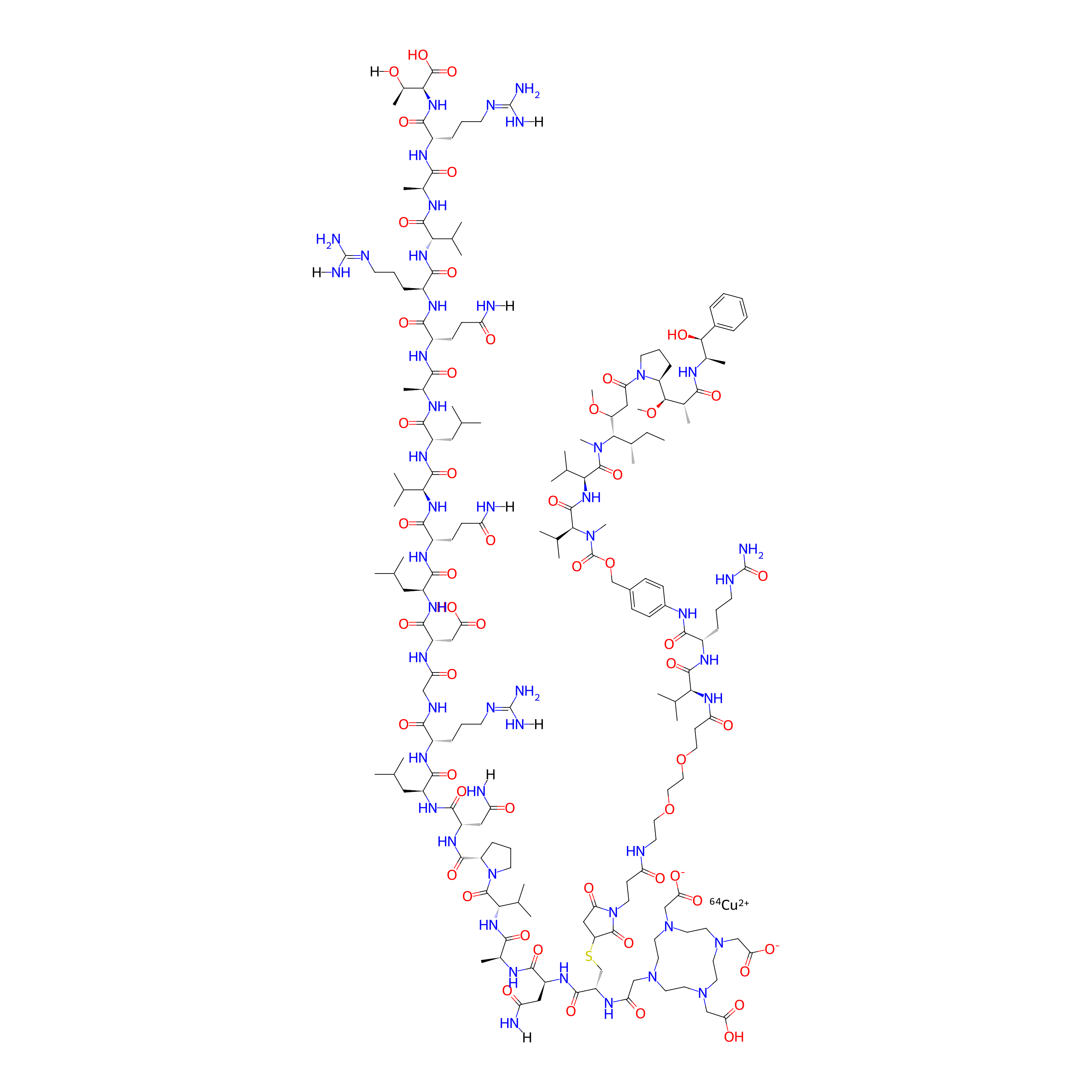
|
|||||
| Peptide Name |
αvβ6-BP
|
Peptide Info | ||||
| Receptor Name |
Integrin alpha-V; Integrin beta-6 (ITGAV; ITGB6)
|
Receptor Info | ||||
| Drug Name |
Monomethyl auristatin E
|
Drug Info | ||||
| Therapeutic Target |
Microtubule (MT)
|
Target Info | ||||
| Linker Name |
Mc-PEG2-Val-Cit-PABC
|
Linker Info | ||||
| Formula |
C184H304CuN50O54S
|
|||||
| #Ro5 Violations (Lipinski): 5 | Molecular Weight | 4176.748764 | ||||
| Lipid-water partition coefficient (xlogp) | -14.9475 | |||||
| Hydrogen Bond Donor Count (hbonddonor) | 43 | |||||
| Hydrogen Bond Acceptor Count (hbondacc) | 59 | |||||
| Rotatable Bond Count (rotbonds) | 131 | |||||
Full List of Activity Data of This Peptide-drug Conjugate
Revealed Based on the Cell Line Data
| Experiment 1 Reporting the Activity Data of This PDC | [1] | ||||
| Indication | Melanoma | ||||
| Efficacy Data | Half Maximal Effective Concentration (EC50) |
0.058 ± 0.003 nM
|
|||
| Administration Time | 48 h | ||||
| Evaluation Method | WST-1 assay | ||||
| MOA of PDC |
Many anticancer drugs exhibit high systemic off-target toxicities causing severe side effects. Peptide-drug conjugates (PDCs) that target tumor-specific receptors such as integrin vβ6 are emerging as powerful tools to overcome these challenges. The development of an integrin vβ6-selective PDC was achieved by combining the therapeutic efficacy of the cytotoxic drug monomethyl auristatin E with the selectivity of the vβ6-binding peptide (vβ6-BP) and with the ability of positron emission tomography (PET) imaging by copper-64. The [64Cu]PDC-1 was produced efficiently and in high purity. The PDC exhibited high human serum stability, integrin vβ6-selective internalization, cell binding, and cytotoxicity. Integrin vβ6-selective tumor accumulation of the [64Cu]PDC-1 was visualized with PET-imaging and corroborated by biodistribution, and [64Cu]PDC-1 showed promising in vivo pharmacokinetics. The [natCu]PDC-1 treatment resulted in prolonged survival of mice bearing vβ6 (+) tumors (median survival: 77 days, vs vβ6 (-) tumor group 49 days, and all other control groups 37 days).
Click to Show/Hide
|
||||
| Description |
Both NH2-PDC-1 and [natCu]PDC-1 exhibited integrin v6-dependent cytotoxicity, only reducing cell viability of the v6-positive cells. For [natCu]PDC-1 high cytotoxicity was observed in DX3puro6 (+) cells (EC50: 0.058 ± 0.003 nM) with no observable cytotoxic effects in the DX3puro (-) cells, while free MMAE had almost equal cytotoxicity to both DX3puro6 (+) and DX3puro cells (-) (EC50: 0.14-0.15 nM). The pancreatic cells also showed v6-dependent cytotoxicity for [natCu]PDC-1 (EC50: BxPC-3 65.1 ± 10.6 nM) and required high concentrations of ≥250 nM for noticeable cytotoxic effects in the minimally integrin v6-expressing MIA PaCa-2 cells. Again, free, non-targeted MMAE exhibited nondiscriminatory cytotoxicity among the pancreatic cells with an effective concentration range of EC50 = 0.16-0.5 nM. Peptides NH2-2 and [natCu]2 were not toxic to any cells.
Click to Show/Hide
|
||||
| In Vitro Model | Melanoma | DX3-puro/beta6 cell | CVCL_1D33 | ||
| Experiment 2 Reporting the Activity Data of This PDC | [1] | ||||
| Indication | Melanoma | ||||
| Efficacy Data | Half Maximal Effective Concentration (EC50) | > 5 nM | |||
| Administration Time | 48 h | ||||
| Evaluation Method | WST-1 assay | ||||
| MOA of PDC |
Many anticancer drugs exhibit high systemic off-target toxicities causing severe side effects. Peptide-drug conjugates (PDCs) that target tumor-specific receptors such as integrin vβ6 are emerging as powerful tools to overcome these challenges. The development of an integrin vβ6-selective PDC was achieved by combining the therapeutic efficacy of the cytotoxic drug monomethyl auristatin E with the selectivity of the vβ6-binding peptide (vβ6-BP) and with the ability of positron emission tomography (PET) imaging by copper-64. The [64Cu]PDC-1 was produced efficiently and in high purity. The PDC exhibited high human serum stability, integrin vβ6-selective internalization, cell binding, and cytotoxicity. Integrin vβ6-selective tumor accumulation of the [64Cu]PDC-1 was visualized with PET-imaging and corroborated by biodistribution, and [64Cu]PDC-1 showed promising in vivo pharmacokinetics. The [natCu]PDC-1 treatment resulted in prolonged survival of mice bearing vβ6 (+) tumors (median survival: 77 days, vs vβ6 (-) tumor group 49 days, and all other control groups 37 days).
Click to Show/Hide
|
||||
| Description |
Both NH2-PDC-1 and [natCu]PDC-1 exhibited integrin v6-dependent cytotoxicity, only reducing cell viability of the v6-positive cells. For [natCu]PDC-1 high cytotoxicity was observed in DX3puro6 (+) cells (EC50: 0.058 ± 0.003 nM) with no observable cytotoxic effects in the DX3puro (-) cells, while free MMAE had almost equal cytotoxicity to both DX3puro6 (+) and DX3puro cells (-) (EC50: 0.14-0.15 nM). The pancreatic cells also showed v6-dependent cytotoxicity for [natCu]PDC-1 (EC50: BxPC-3 65.1 ± 10.6 nM) and required high concentrations of ≥250 nM for noticeable cytotoxic effects in the minimally integrin v6-expressing MIA PaCa-2 cells. Again, free, non-targeted MMAE exhibited nondiscriminatory cytotoxicity among the pancreatic cells with an effective concentration range of EC50 = 0.16-0.5 nM. Peptides NH2-2 and [natCu]2 were not toxic to any cells.
Click to Show/Hide
|
||||
| In Vitro Model | Melanoma | DX3-puro cell | CVCL_1D33 | ||
| Experiment 3 Reporting the Activity Data of This PDC | [1] | ||||
| Indication | Pancreatic cancer | ||||
| Efficacy Data | Half Maximal Effective Concentration (EC50) |
65.1 ± 10.6 nM
|
|||
| Administration Time | 48 h | ||||
| Evaluation Method | WST-1 assay | ||||
| MOA of PDC |
Many anticancer drugs exhibit high systemic off-target toxicities causing severe side effects. Peptide-drug conjugates (PDCs) that target tumor-specific receptors such as integrin vβ6 are emerging as powerful tools to overcome these challenges. The development of an integrin vβ6-selective PDC was achieved by combining the therapeutic efficacy of the cytotoxic drug monomethyl auristatin E with the selectivity of the vβ6-binding peptide (vβ6-BP) and with the ability of positron emission tomography (PET) imaging by copper-64. The [64Cu]PDC-1 was produced efficiently and in high purity. The PDC exhibited high human serum stability, integrin vβ6-selective internalization, cell binding, and cytotoxicity. Integrin vβ6-selective tumor accumulation of the [64Cu]PDC-1 was visualized with PET-imaging and corroborated by biodistribution, and [64Cu]PDC-1 showed promising in vivo pharmacokinetics. The [natCu]PDC-1 treatment resulted in prolonged survival of mice bearing vβ6 (+) tumors (median survival: 77 days, vs vβ6 (-) tumor group 49 days, and all other control groups 37 days).
Click to Show/Hide
|
||||
| Description |
Both NH2-PDC-1 and [natCu]PDC-1 exhibited integrin v6-dependent cytotoxicity, only reducing cell viability of the v6-positive cells. For [natCu]PDC-1 high cytotoxicity was observed in DX3puro6 (+) cells (EC50: 0.058 ± 0.003 nM) with no observable cytotoxic effects in the DX3puro (-) cells, while free MMAE had almost equal cytotoxicity to both DX3puro6 (+) and DX3puro cells (-) (EC50: 0.14-0.15 nM). The pancreatic cells also showed v6-dependent cytotoxicity for [natCu]PDC-1 (EC50: BxPC-3 65.1 ± 10.6 nM) and required high concentrations of ≥250 nM for noticeable cytotoxic effects in the minimally integrin v6-expressing MIA PaCa-2 cells. Again, free, non-targeted MMAE exhibited nondiscriminatory cytotoxicity among the pancreatic cells with an effective concentration range of EC50 = 0.16-0.5 nM. Peptides NH2-2 and [natCu]2 were not toxic to any cells.
Click to Show/Hide
|
||||
| In Vitro Model | Pancreatic ductal adenocarcinoma | BxPC-3 (+) cells | CVCL_0186 | ||
| Experiment 4 Reporting the Activity Data of This PDC | [1] | ||||
| Indication | Pancreatic cancer | ||||
| Efficacy Data | Half Maximal Effective Concentration (EC50) | > 250 nM | |||
| Administration Time | 48 h | ||||
| Evaluation Method | WST-1 assay | ||||
| MOA of PDC |
Many anticancer drugs exhibit high systemic off-target toxicities causing severe side effects. Peptide-drug conjugates (PDCs) that target tumor-specific receptors such as integrin vβ6 are emerging as powerful tools to overcome these challenges. The development of an integrin vβ6-selective PDC was achieved by combining the therapeutic efficacy of the cytotoxic drug monomethyl auristatin E with the selectivity of the vβ6-binding peptide (vβ6-BP) and with the ability of positron emission tomography (PET) imaging by copper-64. The [64Cu]PDC-1 was produced efficiently and in high purity. The PDC exhibited high human serum stability, integrin vβ6-selective internalization, cell binding, and cytotoxicity. Integrin vβ6-selective tumor accumulation of the [64Cu]PDC-1 was visualized with PET-imaging and corroborated by biodistribution, and [64Cu]PDC-1 showed promising in vivo pharmacokinetics. The [natCu]PDC-1 treatment resulted in prolonged survival of mice bearing vβ6 (+) tumors (median survival: 77 days, vs vβ6 (-) tumor group 49 days, and all other control groups 37 days).
Click to Show/Hide
|
||||
| Description |
Both NH2-PDC-1 and [natCu]PDC-1 exhibited integrin v6-dependent cytotoxicity, only reducing cell viability of the v6-positive cells. For [natCu]PDC-1 high cytotoxicity was observed in DX3puro6 (+) cells (EC50: 0.058 ± 0.003 nM) with no observable cytotoxic effects in the DX3puro (-) cells, while free MMAE had almost equal cytotoxicity to both DX3puro6 (+) and DX3puro cells (-) (EC50: 0.14-0.15 nM). The pancreatic cells also showed v6-dependent cytotoxicity for [natCu]PDC-1 (EC50: BxPC-3 65.1 ± 10.6 nM) and required high concentrations of ≥250 nM for noticeable cytotoxic effects in the minimally integrin v6-expressing MIA PaCa-2 cells. Again, free, non-targeted MMAE exhibited nondiscriminatory cytotoxicity among the pancreatic cells with an effective concentration range of EC50 = 0.16-0.5 nM. Peptides NH2-2 and [natCu]2 were not toxic to any cells.
Click to Show/Hide
|
||||
| In Vitro Model | Pancreatic ductal adenocarcinoma | MIA PaCa-2 cell | CVCL_0428 | ||
References