Peptide-drug Conjugate Information
General Information of This Peptide-drug Conjugate (PDC)
| PDC ID |
PDC_00027
|
|||||
|---|---|---|---|---|---|---|
| PDC Name |
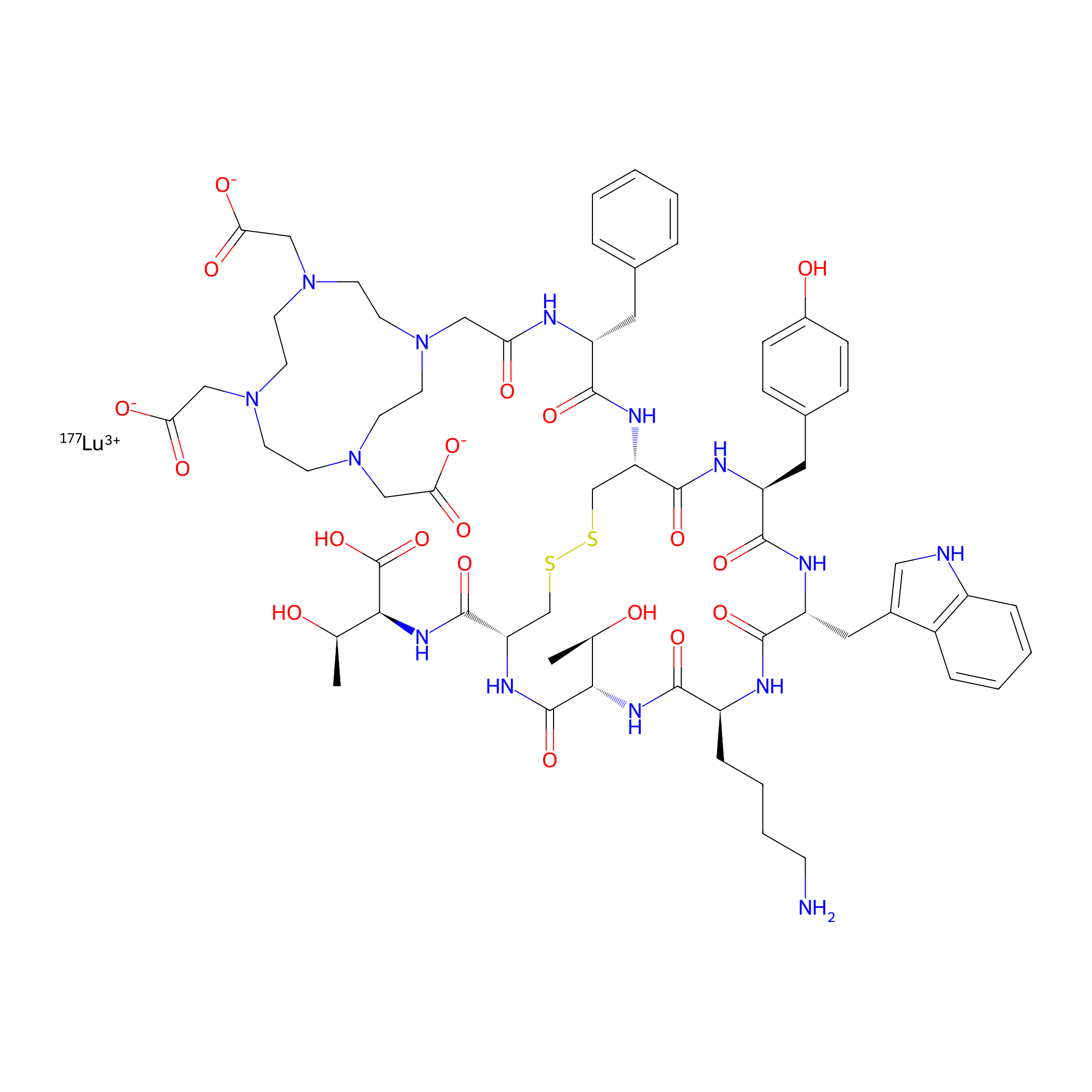
177Lu-DOTATATE
|
|||||
| Synonyms |
Dotatate lutenium Lu-177; Lutetium Lu 177 Dotatate; 177Lu-dotatate; Lutetium dotatate lu-177; Lutetium oxodotreotide lu-177; 177Lu-DOTA-Tyr3-octreotate; Lutetium (177lu) oxodotreotide; 437608-50-9; (177)lu-dotatate; Dotatate lutetium lu-177; Lutetium lu-177 dotatate; Lutetium dotatate, lu-177; Oxodotreotide lutetium lu-177; Oxodotreotide lutetium, lu-177; Dota-octreotate lutetium lu-177; DB13985; lutetium ((1)Lu) oxodotreotide [INN]; Lutetium (177Lu) dotatate [WHO-DD]; LUTETIUM (177LU) OXODOTREOTIDE [MI]; LUTETIUM DOTATATE LU-177 [ORANGE BOOK]; ((177)LU-DOTA(0)-TYR(3))-OCTREOTATE; Q27273888; LUTETATE(1-)-177LU, (N-((4,7,10-TRIS((CARBOXY-.KAPPA.O)METHYL)-1,4,7,10-TETRAAZACYCLODODEC-1-YL-.KAPPA.N1,.KAPPA.N4,.KAPPA.N7,.KAPPA.N10)ACETYL)-D-PHENYLALANYL-L-CYSTEINYL-L-TYROSYL-D-TRYPTOPHYL-L-LYSYL-L-THREONYL-L-CYSTEINYL-L-THREONINE CYCLIC (2-7)-DISULFIDATO(4-))-; LUTETIUM-177(3+), S2,S7-CYCLO(N-(4,7,10-TRICARBOXYMETHYL-1,4,7,10-TETRAAZA-CYCLODODECAN-1-YL-ACETYL)-4-CHLORO-L-PHENYLALANYL-D-CYSTEINYL-4-((4S)-2,6-DIOXO-1,3-DIAZINANE-4-CARBOXAMIDO)-L-PHENYLALANYL-4-(CARBAMOYLAMINO)-D-PHENYLALANYL-L-LYSYL-L-THREONYL-L-CYSTEINYL-D-TYROSINAMIDE)-
Click to Show/Hide
|
|||||
| PDC Status |
Approved
|
|||||
| Indication |
In total 51 Indication(s)
 Malignant insilinoma
High-grade gliomas
Atypical and anaplastic meningiomas
Intracranial meningioma
Meningiomas
Well-differentiated pancreatic neuroendocrine tumor
Advanced medullary thyroid carcinoma
Differentiated thyroid cancer
Medullary thyroid carcinoma
Metastatic medullary thyroid carcinoma
Advanced paraganglioma
Head and neck paraganglioma
Inoperable or metastatic paragangliomas
Negative progressive/Symptomatic locally advanced/Metastatic paragangliomas
Paraganglioma
Primary cardiac paragangliomas
SDHB positive metastatic paraganglioma
Advanced neuroendocrine tumour
Bronchial and gastroenteropancreatic neuroendocrine tumour
Bronchial neuroendocrine tumour
Functioning pancreatic neuroendocrine tumour
Gastroenteropancreatic neuroendocrine tumor
Gastroenteropancreatic neuroendocrine tumour
High-grade (WHO G3) neuroendocrine tumour
Hindgut neuroendocrine tumour
Inoperable grade I/II neuroendocrine tumor
Metastatic midgut neuroendocrine tumor
Metastatic neuroendocrine tumor
Metastatic/Advanced neuroendocrine tumour
Metastatic/Advanced pulmonary neuroendocrine tumor
Midgut neuroendocrine tumor
Midgut neuroendocrine tumour
Neuroendocrine prostate cancer
Neuroendocrine tumour
Pancreatic neuroendocrine tumor
PPGLa neuroendocrine tumor
Progressive well-differentiated neuroendocrine tumour
Progressive, well-differentiated neuroendocrine tumor
Sinonasal neuroendocrine carcinomas
Small bowel neuroendocrine tumor
SSR positive lung neuroendocrine tumor
Unknown originb neuroendocrine tumor
Well-differentiated high-grade neuroendocrine tumor
Well-differentiated neuroendocrine tumor
Atypical bronchial carcinoids
Bronchial carcinoids
Typical bronchial carcinoids
Inoperable or metastatic pheochromocytomas
Phaeochromocytoma
Phaeochromocytoma/Paraganglioma
Carcinoid heart valve disease
Malignant insilinoma
High-grade gliomas
Atypical and anaplastic meningiomas
Intracranial meningioma
Meningiomas
Well-differentiated pancreatic neuroendocrine tumor
Advanced medullary thyroid carcinoma
Differentiated thyroid cancer
Medullary thyroid carcinoma
Metastatic medullary thyroid carcinoma
Advanced paraganglioma
Head and neck paraganglioma
Inoperable or metastatic paragangliomas
Negative progressive/Symptomatic locally advanced/Metastatic paragangliomas
Paraganglioma
Primary cardiac paragangliomas
SDHB positive metastatic paraganglioma
Advanced neuroendocrine tumour
Bronchial and gastroenteropancreatic neuroendocrine tumour
Bronchial neuroendocrine tumour
Functioning pancreatic neuroendocrine tumour
Gastroenteropancreatic neuroendocrine tumor
Gastroenteropancreatic neuroendocrine tumour
High-grade (WHO G3) neuroendocrine tumour
Hindgut neuroendocrine tumour
Inoperable grade I/II neuroendocrine tumor
Metastatic midgut neuroendocrine tumor
Metastatic neuroendocrine tumor
Metastatic/Advanced neuroendocrine tumour
Metastatic/Advanced pulmonary neuroendocrine tumor
Midgut neuroendocrine tumor
Midgut neuroendocrine tumour
Neuroendocrine prostate cancer
Neuroendocrine tumour
Pancreatic neuroendocrine tumor
PPGLa neuroendocrine tumor
Progressive well-differentiated neuroendocrine tumour
Progressive, well-differentiated neuroendocrine tumor
Sinonasal neuroendocrine carcinomas
Small bowel neuroendocrine tumor
SSR positive lung neuroendocrine tumor
Unknown originb neuroendocrine tumor
Well-differentiated high-grade neuroendocrine tumor
Well-differentiated neuroendocrine tumor
Atypical bronchial carcinoids
Bronchial carcinoids
Typical bronchial carcinoids
Inoperable or metastatic pheochromocytomas
Phaeochromocytoma
Phaeochromocytoma/Paraganglioma
Carcinoid heart valve disease
|
|||||
| Structure |
|
|||||
| Peptide Name |
3-Tyr-Octreotate
|
Peptide Info | ||||
| Receptor Name |
Somatostatin receptor type 1 (SSTR1)
|
Receptor Info | ||||
| Drug Name |
Lutetium-177
|
Drug Info | ||||
| Therapeutic Target |
Human Deoxyribonucleic acid (hDNA)
|
Target Info | ||||
| Linker Name |
Amide bond
|
Linker Info | ||||
| Peptide Modified Type |
Amino acid modifications; Cyclization modification
|
|||||
| Modified Segment |
D-amino acids
|
|||||
| Ternimal Modification |
N-terminal modification
|
|||||
| Absorption |
At the recommended intravenous dose, the mean blood exposure (AUC) of lutetium Lu 177 dotatate was 41 ng.h/mL (coefficient of variation, or CV, 36 %). The mean maximum plasma concentration (Cmax) was 10 ng/mL (CV 50%) and was observed at the end of the intravenous infusion of lutetium Lu 177 dotatate.
|
|||||
| Distribution |
The mean volume of distribution is 460 L (CV 54%). Within 4 hours of administration, distribution in kidneys, tumor lesions, liver, spleen, and, in some patients, pituitary gland and thyroid was observed. High uptake of the radiolabeled peptide in the pancreas in animal biodistribution studies was observed due to high expression of SSTR2. Co-administration of amino acids with lutetium Lu 177 dotatate may decrease the extent of drug distribution to the kidneys.
|
|||||
| Metabolism |
Lutetium Lu 177 dotatate does not undergo hepatic metabolism.
|
|||||
| Excretion |
Lutetium Lu 177 dotatate predominantly undergoes renal excretion with cumulative excretion of 44% within 5 hours, 58% within 24 hours, and 65% within 48 hours following intravenous administration. Greater than 99% of total administered dose is expected to be eliminated within 14 days after administration although prolonged renal elimination is expected.
|
|||||
| Drugbank ID | ||||||
| DrugMap ID | ||||||
| TTD ID | ||||||
| ChEBI ID | ||||||
| Formula |
C65H87LuN14O19S2
|
|||||
| #Ro5 Violations (Lipinski): 4 | Molecular Weight (mw) | 1609.5 | ||||
| Lipid-water partition coefficient (xlogp) | Not Available | |||||
| Hydrogen Bond Donor Count (hbonddonor) | 14 | |||||
| Hydrogen Bond Acceptor Count (hbondacc) | 26 | |||||
| Rotatable Bond Count (rotbonds) | 23 | |||||
Full List of Activity Data of This Peptide-drug Conjugate
Identified from the Human Clinical Data
| Experiment 1 Reporting the Activity Data of This PDC | [1] | ||||
| Indication | Metastatic/Advanced pulmonary neuroendocrine tumor | ||||
| Efficacy Data | 1-year objective response rate (ORR) |
94.70%
|
|||
| Patients Enrolled |
Patients treated with Lu-DOTATATE.
|
||||
| Administration Time | 12-16 weeks' intervals [range, 1-5 cycles; average, 4 cycles] | ||||
| Administration Dosage | 150 mCi [5.55 GBq]/cycle | ||||
| Description |
The observed annual OS rates were as follows: 1 year: 94.7% (95% CI, 68.1%-99.2%), 2 years: 66% (95% CI, 35.5%-84.5%), 3 years: 57.7% (95% CI, 28-78.9%), and 4 years: 38.5% (95% CI, 8.1%-69.5%); median OS was 40 months with 39% (95% CI, 13.1%-64.8%).
|
||||
| Experiment 2 Reporting the Activity Data of This PDC | [2] | ||||
| Indication | Small bowel neuroendocrine tumor | ||||
| Efficacy Data | 1-year overall survival (OS) |
97.40%
|
|||
| Patients Enrolled |
Patients with consecutive patients with small bowel neuroendocrine tumour.
|
||||
| Administration Time | Every eight to 12 weeks | ||||
| Administration Dosage | 7.4 GBq (200 mCi) | ||||
| Evaluation Method | 68Ga-DOTATATE PET/CT assay | ||||
| MOA of PDC |
Surgery combined with 177Lu PRRT is safe and provides favourable PFS and OS in selected patients with advanced SBNEN. Liquid biopsy (NETest) has the potential to accurately delineate disease status.
|
||||
| Description |
A surgical cohort of 39 SBNEN patients met eligibility criteria. Thirty-two patients underwent ileal resection and 7 right hemicolectomy. The mean number of 177Lu PRRT cycles was 4. Mortality was nil. Surgical morbidity was 10.3%. Transient grade 1/2 toxicity occurred in 41% (PRRT). NETest scores (n=9 patients) decreased in 100% following treatment and correlated with diminished tumour volume and disease stabilization following surgery and PRRT. Median follow-up: 78 months. Median PFS and OS: 42.7 and 110 months, respectively. Progression-free survival at 1-, 3-, and 5-years was 79.4%, 57.1% and 40.5%, respectively. Overall survival at 1-, 3-, and 5-years was 97.4%, 97.4%, and 94.1%, respectively
Click to Show/Hide
|
||||
| Experiment 3 Reporting the Activity Data of This PDC | [1] | ||||
| Indication | Metastatic/Advanced pulmonary neuroendocrine tumor | ||||
| Efficacy Data | 2-year objective response rate (ORR) |
66.00%
|
|||
| Patients Enrolled |
Patients treated with Lu-DOTATATE.
|
||||
| Administration Time | 12-16 weeks' intervals [range, 1-5 cycles; average, 4 cycles] | ||||
| Administration Dosage | 150 mCi [5.55 GBq]/cycle | ||||
| Description |
The observed annual OS rates were as follows: 1 year: 94.7% (95% CI, 68.1%-99.2%), 2 years: 66% (95% CI, 35.5%-84.5%), 3 years: 57.7% (95% CI, 28-78.9%), and 4 years: 38.5% (95% CI, 8.1%-69.5%); median OS was 40 months with 39% (95% CI, 13.1%-64.8%).
|
||||
| Experiment 4 Reporting the Activity Data of This PDC | [1] | ||||
| Indication | Metastatic/Advanced pulmonary neuroendocrine tumor | ||||
| Efficacy Data | 3-year objective response rate (ORR) |
57.70%
|
|||
| Patients Enrolled |
Patients treated with Lu-DOTATATE.
|
||||
| Administration Time | 12-16 weeks' intervals [range, 1-5 cycles; average, 4 cycles] | ||||
| Administration Dosage | 150 mCi [5.55 GBq]/cycle | ||||
| Description |
The observed annual OS rates were as follows: 1 year: 94.7% (95% CI, 68.1%-99.2%), 2 years: 66% (95% CI, 35.5%-84.5%), 3 years: 57.7% (95% CI, 28-78.9%), and 4 years: 38.5% (95% CI, 8.1%-69.5%); median OS was 40 months with 39% (95% CI, 13.1%-64.8%).
|
||||
| Experiment 5 Reporting the Activity Data of This PDC | [2] | ||||
| Indication | Small bowel neuroendocrine tumor | ||||
| Efficacy Data | 3-years overall survival (OS) |
97.40%
|
|||
| Patients Enrolled |
Patients with consecutive patients with small bowel neuroendocrine tumour.
|
||||
| Administration Time | Every eight to 12 weeks | ||||
| Administration Dosage | 7.4 GBq (200 mCi) | ||||
| Evaluation Method | 68Ga-DOTATATE PET/CT assay | ||||
| MOA of PDC |
Surgery combined with 177Lu PRRT is safe and provides favourable PFS and OS in selected patients with advanced SBNEN. Liquid biopsy (NETest) has the potential to accurately delineate disease status.
|
||||
| Description |
A surgical cohort of 39 SBNEN patients met eligibility criteria. Thirty-two patients underwent ileal resection and 7 right hemicolectomy. The mean number of 177Lu PRRT cycles was 4. Mortality was nil. Surgical morbidity was 10.3%. Transient grade 1/2 toxicity occurred in 41% (PRRT). NETest scores (n=9 patients) decreased in 100% following treatment and correlated with diminished tumour volume and disease stabilization following surgery and PRRT. Median follow-up: 78 months. Median PFS and OS: 42.7 and 110 months, respectively. Progression-free survival at 1-, 3-, and 5-years was 79.4%, 57.1% and 40.5%, respectively. Overall survival at 1-, 3-, and 5-years was 97.4%, 97.4%, and 94.1%, respectively
Click to Show/Hide
|
||||
| Experiment 6 Reporting the Activity Data of This PDC | [1] | ||||
| Indication | Metastatic/Advanced pulmonary neuroendocrine tumor | ||||
| Efficacy Data | 4-year objective response rate (ORR) |
38.50%
|
|||
| Patients Enrolled |
Patients treated with Lu-DOTATATE.
|
||||
| Administration Time | 12-16 weeks' intervals [range, 1-5 cycles; average, 4 cycles] | ||||
| Administration Dosage | 150 mCi [5.55 GBq]/cycle | ||||
| Description |
The observed annual OS rates were as follows: 1 year: 94.7% (95% CI, 68.1%-99.2%), 2 years: 66% (95% CI, 35.5%-84.5%), 3 years: 57.7% (95% CI, 28-78.9%), and 4 years: 38.5% (95% CI, 8.1%-69.5%); median OS was 40 months with 39% (95% CI, 13.1%-64.8%).
|
||||
| Experiment 7 Reporting the Activity Data of This PDC | [3] | ||||
| Indication | Progressive, well-differentiated neuroendocrine tumor | ||||
| Efficacy Data | 5-hydroxyindolacetic acid decrease rate (≥30%) |
56.00%
|
|||
| Patients Enrolled |
22 patients with a metastatic midgut neuroendocrine tumour.
|
||||
| Administration Dosage | Intended cumulative dose: 29.6 GBq | ||||
| MOA of PDC |
PRRT with 177Lu-DOTATATE effectively reduced diarrhea and flushing in patients with carcinoid syndrome and can be considered for symptomatic treatment of carcinoid syndrome insufficiently controlled with somatostatin analogs.
|
||||
| Description |
After PRRT, mean bowel movement frequency (BMF) decreased from 6.1 ± 3.4 to 4.6 ± 3.6 per day (P = 0.009). Flushes decreased from 4.3 ± 2.9 to 2.4 ± 2.7 flushes per day (P = 0.002). A decrease of BMF of more than 30% occurred in 47% of patients with baseline BMF of 4 or more (n = 17). In patients with ≥2 episodes of flushing a day (n = 15), 67% of patients had more than 50% decrease of daily flushing. A decrease in urinary 5-hydroxyindolacetic acid excretion of more than 30% was seen in 56% of patients. The European Organization for Research and Treatment of Cancer-Core Module diarrhea subscale score showed a trend toward improvement by an average of 16.7 ± 33.3 points (P = 0.11).
Click to Show/Hide
|
||||
| Experiment 8 Reporting the Activity Data of This PDC | [2] | ||||
| Indication | Small bowel neuroendocrine tumor | ||||
| Efficacy Data | 5-years overall survival overall survival (OS) |
94.10%
|
|||
| Patients Enrolled |
Patients with consecutive patients with small bowel neuroendocrine tumour.
|
||||
| Administration Time | Every eight to 12 weeks | ||||
| Administration Dosage | 7.4 GBq (200 mCi) | ||||
| Evaluation Method | 68Ga-DOTATATE PET/CT assay | ||||
| MOA of PDC |
Surgery combined with 177Lu PRRT is safe and provides favourable PFS and OS in selected patients with advanced SBNEN. Liquid biopsy (NETest) has the potential to accurately delineate disease status.
|
||||
| Description |
A surgical cohort of 39 SBNEN patients met eligibility criteria. Thirty-two patients underwent ileal resection and 7 right hemicolectomy. The mean number of 177Lu PRRT cycles was 4. Mortality was nil. Surgical morbidity was 10.3%. Transient grade 1/2 toxicity occurred in 41% (PRRT). NETest scores (n=9 patients) decreased in 100% following treatment and correlated with diminished tumour volume and disease stabilization following surgery and PRRT. Median follow-up: 78 months. Median PFS and OS: 42.7 and 110 months, respectively. Progression-free survival at 1-, 3-, and 5-years was 79.4%, 57.1% and 40.5%, respectively. Overall survival at 1-, 3-, and 5-years was 97.4%, 97.4%, and 94.1%, respectively
Click to Show/Hide
|
||||
| Experiment 9 Reporting the Activity Data of This PDC | [4] | ||||
| Indication | Neuroendocrine tumour | ||||
| Efficacy Data | Alanine aminotransferase grade ≥3 |
1.50%
|
|||
| Patients Enrolled |
534 male patients with neuroendocrine tumour.
|
||||
| Administration Time | Median of 4 cycles | ||||
| Administration Dosage | Cumulative administered activity 29.6 GBq (25.9-29.6 GBq) (800 mCi [700-800 mCi]) | ||||
| MOA of PDC |
Subacute PRRT-related toxicities are commonly detected and can lead to dose adjustments, treatment delay, and treatment discontinuation in a limited number of patients. Severe platelet and hemoglobin toxicities were more frequently observed in female than male NET patients, without evidently leading to a lower cumulative 177Lu-DOTATATE activity. Future research should focus on the etiology and on the impact on the treatment efficacy and long-term safety of PRRT between sexes.
Click to Show/Hide
|
||||
| Description |
Grade 2, 3, or 4 thrombocytopenia occurred more often in women (25%) than in men (18%, P = 0.004), which was driven by a significant increase in grade ≥3 thrombocytopenia in women (11% vs 6%, P = 0.008). Grade ≥3 anemia was likewise more prevalent in women (7%) than in men (3%, P = 0.002). A ≥ 25% decrease from the baseline hemoglobin level occurred in 55 women (13%) and 38 men (7%) (P = 0.004). Of the patients with grade ≥3 anemia, 21 (66%) female and 10 (63%) male patients also developed grade ≥2 thrombocytopenia (P = 0.831). Grade ≥3 pancytopenia (thrombocytopenia, leukopenia, and anemia) occurred in 1% of both sexes. Of all study patients, 52 female patients (12%) and 47 male patients (9%) received a cumulative activity of <27.8 GBq (750 mCi) as a result of a bone marrow DLT (P = 0.122).
Click to Show/Hide
|
||||
| Experiment 10 Reporting the Activity Data of This PDC | [4] | ||||
| Indication | Neuroendocrine tumour | ||||
| Efficacy Data | Alanine aminotransferase grade ≥3 |
3.02%
|
|||
| Patients Enrolled |
439 female patients with neuroendocrine tumour.
|
||||
| Administration Time | Median of 4 cycles | ||||
| Administration Dosage | Cumulative administered activity 29.6 GBq (22.2-29.6 GBq) (800 mCi [600-800 mCi]) | ||||
| MOA of PDC |
Subacute PRRT-related toxicities are commonly detected and can lead to dose adjustments, treatment delay, and treatment discontinuation in a limited number of patients. Severe platelet and hemoglobin toxicities were more frequently observed in female than male NET patients, without evidently leading to a lower cumulative 177Lu-DOTATATE activity. Future research should focus on the etiology and on the impact on the treatment efficacy and long-term safety of PRRT between sexes.
Click to Show/Hide
|
||||
| Description |
Grade 2, 3, or 4 thrombocytopenia occurred more often in women (25%) than in men (18%, P = 0.004), which was driven by a significant increase in grade ≥3 thrombocytopenia in women (11% vs 6%, P = 0.008). Grade ≥3 anemia was likewise more prevalent in women (7%) than in men (3%, P = 0.002). A ≥ 25% decrease from the baseline hemoglobin level occurred in 55 women (13%) and 38 men (7%) (P = 0.004). Of the patients with grade ≥3 anemia, 21 (66%) female and 10 (63%) male patients also developed grade ≥2 thrombocytopenia (P = 0.831). Grade ≥3 pancytopenia (thrombocytopenia, leukopenia, and anemia) occurred in 1% of both sexes. Of all study patients, 52 female patients (12%) and 47 male patients (9%) received a cumulative activity of <27.8 GBq (750 mCi) as a result of a bone marrow DLT (P = 0.122).
Click to Show/Hide
|
||||
| Experiment 11 Reporting the Activity Data of This PDC | [4] | ||||
| Indication | Neuroendocrine tumour | ||||
| Efficacy Data | Albumin grade ≥3 |
0.19%
|
|||
| Patients Enrolled |
534 male patients with neuroendocrine tumour.
|
||||
| Administration Time | Median of 4 cycles | ||||
| Administration Dosage | Cumulative administered activity 29.6 GBq (25.9-29.6 GBq) (800 mCi [700-800 mCi]) | ||||
| MOA of PDC |
Subacute PRRT-related toxicities are commonly detected and can lead to dose adjustments, treatment delay, and treatment discontinuation in a limited number of patients. Severe platelet and hemoglobin toxicities were more frequently observed in female than male NET patients, without evidently leading to a lower cumulative 177Lu-DOTATATE activity. Future research should focus on the etiology and on the impact on the treatment efficacy and long-term safety of PRRT between sexes.
Click to Show/Hide
|
||||
| Description |
Grade 2, 3, or 4 thrombocytopenia occurred more often in women (25%) than in men (18%, P = 0.004), which was driven by a significant increase in grade ≥3 thrombocytopenia in women (11% vs 6%, P = 0.008). Grade ≥3 anemia was likewise more prevalent in women (7%) than in men (3%, P = 0.002). A ≥ 25% decrease from the baseline hemoglobin level occurred in 55 women (13%) and 38 men (7%) (P = 0.004). Of the patients with grade ≥3 anemia, 21 (66%) female and 10 (63%) male patients also developed grade ≥2 thrombocytopenia (P = 0.831). Grade ≥3 pancytopenia (thrombocytopenia, leukopenia, and anemia) occurred in 1% of both sexes. Of all study patients, 52 female patients (12%) and 47 male patients (9%) received a cumulative activity of <27.8 GBq (750 mCi) as a result of a bone marrow DLT (P = 0.122).
Click to Show/Hide
|
||||
| Experiment 12 Reporting the Activity Data of This PDC | [4] | ||||
| Indication | Neuroendocrine tumour | ||||
| Efficacy Data | Albumin grade ≥3 |
0.23%
|
|||
| Patients Enrolled |
439 female patients with neuroendocrine tumour.
|
||||
| Administration Time | Median of 4 cycles | ||||
| Administration Dosage | Cumulative administered activity 29.6 GBq (22.2-29.6 GBq) (800 mCi [600-800 mCi]) | ||||
| MOA of PDC |
Subacute PRRT-related toxicities are commonly detected and can lead to dose adjustments, treatment delay, and treatment discontinuation in a limited number of patients. Severe platelet and hemoglobin toxicities were more frequently observed in female than male NET patients, without evidently leading to a lower cumulative 177Lu-DOTATATE activity. Future research should focus on the etiology and on the impact on the treatment efficacy and long-term safety of PRRT between sexes.
Click to Show/Hide
|
||||
| Description |
Grade 2, 3, or 4 thrombocytopenia occurred more often in women (25%) than in men (18%, P = 0.004), which was driven by a significant increase in grade ≥3 thrombocytopenia in women (11% vs 6%, P = 0.008). Grade ≥3 anemia was likewise more prevalent in women (7%) than in men (3%, P = 0.002). A ≥ 25% decrease from the baseline hemoglobin level occurred in 55 women (13%) and 38 men (7%) (P = 0.004). Of the patients with grade ≥3 anemia, 21 (66%) female and 10 (63%) male patients also developed grade ≥2 thrombocytopenia (P = 0.831). Grade ≥3 pancytopenia (thrombocytopenia, leukopenia, and anemia) occurred in 1% of both sexes. Of all study patients, 52 female patients (12%) and 47 male patients (9%) received a cumulative activity of <27.8 GBq (750 mCi) as a result of a bone marrow DLT (P = 0.122).
Click to Show/Hide
|
||||
| Experiment 13 Reporting the Activity Data of This PDC | [4] | ||||
| Indication | Neuroendocrine tumour | ||||
| Efficacy Data | Alkaline phosphatase grade ≥3 |
2.31%
|
|||
| Patients Enrolled |
534 male patients with neuroendocrine tumour.
|
||||
| Administration Time | Median of 4 cycles | ||||
| Administration Dosage | Cumulative administered activity 29.6 GBq (25.9-29.6 GBq) (800 mCi [700-800 mCi]) | ||||
| MOA of PDC |
Subacute PRRT-related toxicities are commonly detected and can lead to dose adjustments, treatment delay, and treatment discontinuation in a limited number of patients. Severe platelet and hemoglobin toxicities were more frequently observed in female than male NET patients, without evidently leading to a lower cumulative 177Lu-DOTATATE activity. Future research should focus on the etiology and on the impact on the treatment efficacy and long-term safety of PRRT between sexes.
Click to Show/Hide
|
||||
| Description |
Grade 2, 3, or 4 thrombocytopenia occurred more often in women (25%) than in men (18%, P = 0.004), which was driven by a significant increase in grade ≥3 thrombocytopenia in women (11% vs 6%, P = 0.008). Grade ≥3 anemia was likewise more prevalent in women (7%) than in men (3%, P = 0.002). A ≥ 25% decrease from the baseline hemoglobin level occurred in 55 women (13%) and 38 men (7%) (P = 0.004). Of the patients with grade ≥3 anemia, 21 (66%) female and 10 (63%) male patients also developed grade ≥2 thrombocytopenia (P = 0.831). Grade ≥3 pancytopenia (thrombocytopenia, leukopenia, and anemia) occurred in 1% of both sexes. Of all study patients, 52 female patients (12%) and 47 male patients (9%) received a cumulative activity of <27.8 GBq (750 mCi) as a result of a bone marrow DLT (P = 0.122).
Click to Show/Hide
|
||||
| Experiment 14 Reporting the Activity Data of This PDC | [4] | ||||
| Indication | Neuroendocrine tumour | ||||
| Efficacy Data | Alkaline phosphatase grade ≥3 |
3.54%
|
|||
| Patients Enrolled |
439 female patients with neuroendocrine tumour.
|
||||
| Administration Time | Median of 4 cycles | ||||
| Administration Dosage | Cumulative administered activity 29.6 GBq (22.2-29.6 GBq) (800 mCi [600-800 mCi]) | ||||
| MOA of PDC |
Subacute PRRT-related toxicities are commonly detected and can lead to dose adjustments, treatment delay, and treatment discontinuation in a limited number of patients. Severe platelet and hemoglobin toxicities were more frequently observed in female than male NET patients, without evidently leading to a lower cumulative 177Lu-DOTATATE activity. Future research should focus on the etiology and on the impact on the treatment efficacy and long-term safety of PRRT between sexes.
Click to Show/Hide
|
||||
| Description |
Grade 2, 3, or 4 thrombocytopenia occurred more often in women (25%) than in men (18%, P = 0.004), which was driven by a significant increase in grade ≥3 thrombocytopenia in women (11% vs 6%, P = 0.008). Grade ≥3 anemia was likewise more prevalent in women (7%) than in men (3%, P = 0.002). A ≥ 25% decrease from the baseline hemoglobin level occurred in 55 women (13%) and 38 men (7%) (P = 0.004). Of the patients with grade ≥3 anemia, 21 (66%) female and 10 (63%) male patients also developed grade ≥2 thrombocytopenia (P = 0.831). Grade ≥3 pancytopenia (thrombocytopenia, leukopenia, and anemia) occurred in 1% of both sexes. Of all study patients, 52 female patients (12%) and 47 male patients (9%) received a cumulative activity of <27.8 GBq (750 mCi) as a result of a bone marrow DLT (P = 0.122).
Click to Show/Hide
|
||||
| Experiment 15 Reporting the Activity Data of This PDC | [5] | ||||
| Indication | Neuroendocrine tumour | ||||
| Efficacy Data | Anemia |
6.67%
|
|||
| Patients Enrolled |
30 patients with pheocromocytomas (PCCs) and paragangliomas (PGLs) (3 PCC, 27PGL).
|
||||
| Administration Time | 73% of patients received 4 cycles | ||||
| Administration Dosage | 7.4 GBq/cycle | ||||
| MOA of PDC |
We showed that PRRT based on 177Lu-DOTATATE and 90-YDOTATOC without radiosensitizers are efficacious therapeutic options (DCR of 83% and 76%, respectively) and can be considered in the multidisciplinary treatment of PCCs and PGLs as alternatives to I-131 MIBG and chemotherapy.
|
||||
| Description |
In detail, we report pooled data on 149 177Lu- and 64 90Y-treated patients (total: 213 patients). Most studies were retrospective. The largest one included 46 patients (34 treated with 177Lu-, 12 with 90Y- PRRTs). Median ages ranged from 32.5 to 60.4 years. The female gender was slightly predominant (83 women, 74 men, gender not specified in 3 studies). When reported, mutations of SDHB (Succinate Dehydrogenase Complex Iron Sulfur Subunit B) were the most frequent genetic alterations. According to the predominant retrospective and real practice nature of the selected studies, sites of metastases and previous treatments were heterogeneous, with bone the metastatic site most often involved, and surgery the most frequent previous therapy. Paramount descriptive information on PRRT doses per cycle, number of cycles, response criteria, best responses to treatments, and frequency of G3/G4 hematologic toxicities is reported in Table 2. The lowest applied dose was 3.4 GBq per cycle; the number of administered cycles was heterogeneous (at least 3 cycles in 7 studies). The most used response criteria were the RECIST 1.1. Only one study evaluated the response with SWOG criteria, which are more conservative with regard to the definition of PR (50% or greater reduction in the sum of the product of the perpendicular diameters of target lesions). The majority of the patients experienced PR or SD. Hematologic toxicity was manageable. Funnel plot of selected studies did not show publication bias. The MINORS and Newcastle-Ottawa Scale scoring for the selected articles are reported in Table 3.
Click to Show/Hide
|
||||
| Experiment 16 Reporting the Activity Data of This PDC | [6] | ||||
| Indication | SDHB positive metastatic paraganglioma | ||||
| Efficacy Data | Anti-thyroglobulin antibody level |
668 IU/ml
|
|||
| Administration Time | 1 month | ||||
| Administration Dosage | 200mCi | ||||
| Description |
The patient was diagnosed with Hashimoto's thyrotoxicosis. However, the patient was asymptomatic. One month after the first dose of 200mCi 177Lu-DOTATATE, the patient noted fatigue and a 2.6 Kg weight gain. The TSH (73.04 μIU/ml), anti-TPO antibodies (>1,000 IU/ml), and anti-Tg antibodies (668 IU/ml) had substantially increased, with reductions in FT4 (0.3 ng/dl) and TT3 [54 ng/dl (87-169 ng/dl)]. Diagnostic gallium 68 - DOTATATE positron emission tomography-computed tomography performed prior to 177Lu-DOTATATE treatment revealed diffuse thyroid uptake. Post-therapy single-photon emission computed tomography also revealed diffuse uptake of 177Lu-DOTATATE in the thyroid gland. Levothyroxine therapy was initiated, and the patient's symptoms resolved.
Click to Show/Hide
|
||||
| In Vivo Model | A 29-year-old male with SDHB positive metastatic paraganglioma. | ||||
| Related Clinical Trial | |||||
| NCT Number | NCT03206060 | Clinical Status | Phase 2 | ||
| Clinical Description | Background:Pheochromocytoma and paraganglioma are rare tumors. They usually form inside and near the adrenal gland or in the neck region. Not all these tumors can be removed with surgery, and there are no good treatments if the disease has spread. Researchers think a new drug may be able to help.Objective:To learn the safety and tolerability of Lu-177-DOTATATE. Also, to see if it improves the length of time it takes for the cancer to return.Eligibility:Adults who have an inoperable tumor of the study cancer that can be detected with Ga-68-DOTATATE PET/CT imagingDesign:Participants will be screened with a medical history, physical exam, and blood tests.Eligible participants will be admitted to the NIH Clinical Center.Participants will get the study drug in an intravenous infusion. They will get 4 doses, given about 8 weeks apart.Between 4 and 24 hours after each study drug dose, participants will have scans taken. They will lie on their back on a scanner table.Participants will have vital signs taken. They will give blood and urine samples.During the study, participants will have other scans taken. Some scans will use a radioactive tracer.Participants will complete quality of life questionnaires.Participants will be contacted by phone 1-3 days after they leave the Clinical Center. They will then be followed every 3 to 6 months for 3 years or until their disease gets worse. | ||||
| Experiment 17 Reporting the Activity Data of This PDC | [6] | ||||
| Indication | SDHB positive metastatic paraganglioma | ||||
| Efficacy Data | Anti-thyroid peroxidase antibody level | > 1,000 IU/ml | |||
| Administration Time | 1 month | ||||
| Administration Dosage | 200mCi | ||||
| Description |
The patient was diagnosed with Hashimoto's thyrotoxicosis. However, the patient was asymptomatic. One month after the first dose of 200mCi 177Lu-DOTATATE, the patient noted fatigue and a 2.6 Kg weight gain. The TSH (73.04 μIU/ml), anti-TPO antibodies (>1,000 IU/ml), and anti-Tg antibodies (668 IU/ml) had substantially increased, with reductions in FT4 (0.3 ng/dl) and TT3 [54 ng/dl (87-169 ng/dl)]. Diagnostic gallium 68 - DOTATATE positron emission tomography-computed tomography performed prior to 177Lu-DOTATATE treatment revealed diffuse thyroid uptake. Post-therapy single-photon emission computed tomography also revealed diffuse uptake of 177Lu-DOTATATE in the thyroid gland. Levothyroxine therapy was initiated, and the patient's symptoms resolved.
Click to Show/Hide
|
||||
| In Vivo Model | A 29-year-old male with SDHB positive metastatic paraganglioma. | ||||
| Related Clinical Trial | |||||
| NCT Number | NCT03206060 | Clinical Status | Phase 2 | ||
| Clinical Description | Background:Pheochromocytoma and paraganglioma are rare tumors. They usually form inside and near the adrenal gland or in the neck region. Not all these tumors can be removed with surgery, and there are no good treatments if the disease has spread. Researchers think a new drug may be able to help.Objective:To learn the safety and tolerability of Lu-177-DOTATATE. Also, to see if it improves the length of time it takes for the cancer to return.Eligibility:Adults who have an inoperable tumor of the study cancer that can be detected with Ga-68-DOTATATE PET/CT imagingDesign:Participants will be screened with a medical history, physical exam, and blood tests.Eligible participants will be admitted to the NIH Clinical Center.Participants will get the study drug in an intravenous infusion. They will get 4 doses, given about 8 weeks apart.Between 4 and 24 hours after each study drug dose, participants will have scans taken. They will lie on their back on a scanner table.Participants will have vital signs taken. They will give blood and urine samples.During the study, participants will have other scans taken. Some scans will use a radioactive tracer.Participants will complete quality of life questionnaires.Participants will be contacted by phone 1-3 days after they leave the Clinical Center. They will then be followed every 3 to 6 months for 3 years or until their disease gets worse. | ||||
| Experiment 18 Reporting the Activity Data of This PDC | [7] | ||||
| Indication | Inoperable or metastatic paragangliomas | ||||
| Efficacy Data | Best tumour response |
23%
|
|||
| Patients Enrolled |
Patients with inoperable or metastatic paragangliomas and pheochromocytomas.
|
||||
| Administration Time | Four cycles | ||||
| Administration Dosage | 7.4 Gb per cycle | ||||
| Description |
Best tumour response was partial response in 7 (23%) and stable disease in 20 (67%)
|
||||
| Experiment 19 Reporting the Activity Data of This PDC | [7] | ||||
| Indication | Inoperable or metastatic pheochromocytomas | ||||
| Efficacy Data | Best tumour response |
23%
|
|||
| Patients Enrolled |
Patients with inoperable or metastatic paragangliomas and pheochromocytomas.
|
||||
| Administration Time | Four cycles | ||||
| Administration Dosage | 7.4 Gb per cycle | ||||
| Description |
Best tumour response was partial response in 7 (23%) and stable disease in 20 (67%)
|
||||
| Experiment 20 Reporting the Activity Data of This PDC | [8] | ||||
| Indication | Differentiated thyroid cancer | ||||
| Efficacy Data | Biochemical response rate |
25.30%
|
|||
| Patients Enrolled |
157 patients with RR-DTC treated with PPRT.
|
||||
| MOA of PDC |
Findings of the study revealed that in the absence of the established treatment for the patients with RR-DTC and metastatic MTC, PRRT could be effective with few adverse events.
|
||||
| Description |
Among 2284 related papers, 41 papers met the inclusion criteria. A total of 157 patients with RR-DTC were treated with PPRT. Biochemical and objective responses (partial and complete) were observed in 25.3 and 10.5% of patients, respectively. Among 220 patients with metastatic MTC, biochemical and objective responses were observed in 37.2 and 10.6% of the patients, respectively. Forty-six deaths were reported in 95 patients with advanced RR-DTC. In addition, 63 deaths were observed in 144 patients with metastatic MTC. Major side effects were reported in 124 patients treated with 90Y -based agent. In the patients treated with 177Lu-DOTA-TATE and 111In-Octreotide, mild and transient hematologic or renal complications were reported.
Click to Show/Hide
|
||||
| Experiment 21 Reporting the Activity Data of This PDC | [8] | ||||
| Indication | Medullary thyroid carcinoma | ||||
| Efficacy Data | Biochemical response rate |
37.20%
|
|||
| Patients Enrolled |
220 patients with metastatic medullary thyroid cancer.
|
||||
| MOA of PDC |
Findings of the study revealed that in the absence of the established treatment for the patients with RR-DTC and metastatic MTC, PRRT could be effective with few adverse events.
|
||||
| Description |
Among 2284 related papers, 41 papers met the inclusion criteria. A total of 157 patients with RR-DTC were treated with PPRT. Biochemical and objective responses (partial and complete) were observed in 25.3 and 10.5% of patients, respectively. Among 220 patients with metastatic MTC, biochemical and objective responses were observed in 37.2 and 10.6% of the patients, respectively. Forty-six deaths were reported in 95 patients with advanced RR-DTC. In addition, 63 deaths were observed in 144 patients with metastatic MTC. Major side effects were reported in 124 patients treated with 90Y -based agent. In the patients treated with 177Lu-DOTA-TATE and 111In-Octreotide, mild and transient hematologic or renal complications were reported.
Click to Show/Hide
|
||||
| Experiment 22 Reporting the Activity Data of This PDC | [9] | ||||
| Indication | Advanced paraganglioma | ||||
| Efficacy Data | Biochemical response rate |
64%
|
|||
| Patients Enrolled |
A total of 201 patients with advanced paragangliomas.
|
||||
| MOA of PDC |
The clinical applications of radiolabeled SSAs and DOTA-SSA compounds in imaging and radionuclide therapy have been rapidly increasing over the past 2 decades and have been integrated into the current management guidelines of NETs. Several studies support the safety and clinical efficacy of FDA-approved radionuclide therapies including 177Lu-DOTATATE in advanced GEP NETs and 131I-MIBG in advanced paragangliomas and pheochromocytomas. The utility of SSTR-based imaging in PRRT response assessment and surveillance of NETs remains to be established.
Click to Show/Hide
|
||||
| Description |
Over the past decade, a small number of studies have evaluated the efficacy and safety of PRRT with 177Lu-DOTA-SSA in patients with metastatic or inoperable paragangliomas [66, 67]. A recent meta-analysis of 12 studies including a total of 201 patients with advanced paragangliomas showed an objective response rate of 25%, biochemical response rate of 64%, and disease control rate of 84% after treatment with PRRT (either 90Y- or 177Lu-based agents) [67]. The following minimal treatment-related adverse effects were observed: grade 3 or 4 lymphopenia, thrombocytopenia, neutropenia, and nephrotoxicity in 11%, 9%, 3%, and 4% of the patients, respectively.
Click to Show/Hide
|
||||
| Experiment 23 Reporting the Activity Data of This PDC | [10] | ||||
| Indication | Gastroenteropancreatic neuroendocrine tumour | ||||
| Efficacy Data | Bone marrow failure rate |
1.10%
|
|||
| Patients Enrolled |
Patients with gastroenteropancreatic neuroendocrine tumors.
|
||||
| Description |
8 patients (2.9%) developed a hematopoietic neoplasm (4 MDS, 1 AML, 1 MPN, and 2 MDS/MPN) and 3 patients (1.1%) developed BM failure characterized by cytopenia and BM aplasia.
|
||||
| Experiment 24 Reporting the Activity Data of This PDC | [4] | ||||
| Indication | Neuroendocrine tumour | ||||
| Efficacy Data | Bone marrow toxicity |
56.01%
|
|||
| Patients Enrolled |
534 male patients with neuroendocrine tumour.
|
||||
| Administration Time | Median of 4 cycles | ||||
| Administration Dosage | Cumulative administered activity 29.6 GBq (25.9-29.6 GBq) (800 mCi [700-800 mCi]) | ||||
| MOA of PDC |
Subacute PRRT-related toxicities are commonly detected and can lead to dose adjustments, treatment delay, and treatment discontinuation in a limited number of patients. Severe platelet and hemoglobin toxicities were more frequently observed in female than male NET patients, without evidently leading to a lower cumulative 177Lu-DOTATATE activity. Future research should focus on the etiology and on the impact on the treatment efficacy and long-term safety of PRRT between sexes.
Click to Show/Hide
|
||||
| Description |
Grade 2, 3, or 4 thrombocytopenia occurred more often in women (25%) than in men (18%, P = 0.004), which was driven by a significant increase in grade ≥3 thrombocytopenia in women (11% vs 6%, P = 0.008). Grade ≥3 anemia was likewise more prevalent in women (7%) than in men (3%, P = 0.002). A ≥ 25% decrease from the baseline hemoglobin level occurred in 55 women (13%) and 38 men (7%) (P = 0.004). Of the patients with grade ≥3 anemia, 21 (66%) female and 10 (63%) male patients also developed grade ≥2 thrombocytopenia (P = 0.831). Grade ≥3 pancytopenia (thrombocytopenia, leukopenia, and anemia) occurred in 1% of both sexes. Of all study patients, 52 female patients (12%) and 47 male patients (9%) received a cumulative activity of <27.8 GBq (750 mCi) as a result of a bone marrow DLT (P = 0.122).
Click to Show/Hide
|
||||
| Experiment 25 Reporting the Activity Data of This PDC | [4] | ||||
| Indication | Neuroendocrine tumour | ||||
| Efficacy Data | Bone marrow toxicity |
58.77%
|
|||
| Patients Enrolled |
439 female patients with neuroendocrine tumour.
|
||||
| Administration Time | Median of 4 cycles | ||||
| Administration Dosage | Cumulative administered activity 29.6 GBq (22.2-29.6 GBq) (800 mCi [600-800 mCi]) | ||||
| MOA of PDC |
Subacute PRRT-related toxicities are commonly detected and can lead to dose adjustments, treatment delay, and treatment discontinuation in a limited number of patients. Severe platelet and hemoglobin toxicities were more frequently observed in female than male NET patients, without evidently leading to a lower cumulative 177Lu-DOTATATE activity. Future research should focus on the etiology and on the impact on the treatment efficacy and long-term safety of PRRT between sexes.
Click to Show/Hide
|
||||
| Description |
Grade 2, 3, or 4 thrombocytopenia occurred more often in women (25%) than in men (18%, P = 0.004), which was driven by a significant increase in grade ≥3 thrombocytopenia in women (11% vs 6%, P = 0.008). Grade ≥3 anemia was likewise more prevalent in women (7%) than in men (3%, P = 0.002). A ≥ 25% decrease from the baseline hemoglobin level occurred in 55 women (13%) and 38 men (7%) (P = 0.004). Of the patients with grade ≥3 anemia, 21 (66%) female and 10 (63%) male patients also developed grade ≥2 thrombocytopenia (P = 0.831). Grade ≥3 pancytopenia (thrombocytopenia, leukopenia, and anemia) occurred in 1% of both sexes. Of all study patients, 52 female patients (12%) and 47 male patients (9%) received a cumulative activity of <27.8 GBq (750 mCi) as a result of a bone marrow DLT (P = 0.122).
Click to Show/Hide
|
||||
| Experiment 26 Reporting the Activity Data of This PDC | [4] | ||||
| Indication | Neuroendocrine tumour | ||||
| Efficacy Data | Bone marrow, liver or renal toxicity rate |
60.86%
|
|||
| Patients Enrolled |
534 male patients with neuroendocrine tumour.
|
||||
| Administration Time | Median of 4 cycles | ||||
| Administration Dosage | Cumulative administered activity 29.6 GBq (25.9-29.6 GBq) (800 mCi [700-800 mCi]) | ||||
| MOA of PDC |
Subacute PRRT-related toxicities are commonly detected and can lead to dose adjustments, treatment delay, and treatment discontinuation in a limited number of patients. Severe platelet and hemoglobin toxicities were more frequently observed in female than male NET patients, without evidently leading to a lower cumulative 177Lu-DOTATATE activity. Future research should focus on the etiology and on the impact on the treatment efficacy and long-term safety of PRRT between sexes.
Click to Show/Hide
|
||||
| Description |
Grade 2, 3, or 4 thrombocytopenia occurred more often in women (25%) than in men (18%, P = 0.004), which was driven by a significant increase in grade ≥3 thrombocytopenia in women (11% vs 6%, P = 0.008). Grade ≥3 anemia was likewise more prevalent in women (7%) than in men (3%, P = 0.002). A ≥ 25% decrease from the baseline hemoglobin level occurred in 55 women (13%) and 38 men (7%) (P = 0.004). Of the patients with grade ≥3 anemia, 21 (66%) female and 10 (63%) male patients also developed grade ≥2 thrombocytopenia (P = 0.831). Grade ≥3 pancytopenia (thrombocytopenia, leukopenia, and anemia) occurred in 1% of both sexes. Of all study patients, 52 female patients (12%) and 47 male patients (9%) received a cumulative activity of <27.8 GBq (750 mCi) as a result of a bone marrow DLT (P = 0.122).
Click to Show/Hide
|
||||
| Experiment 27 Reporting the Activity Data of This PDC | [4] | ||||
| Indication | Neuroendocrine tumour | ||||
| Efficacy Data | Bone marrow, liver or renal toxicity rate |
65.38%
|
|||
| Patients Enrolled |
439 female patients with neuroendocrine tumour.
|
||||
| Administration Time | Median of 4 cycles | ||||
| Administration Dosage | Cumulative administered activity 29.6 GBq (22.2-29.6 GBq) (800 mCi [600-800 mCi]) | ||||
| MOA of PDC |
Subacute PRRT-related toxicities are commonly detected and can lead to dose adjustments, treatment delay, and treatment discontinuation in a limited number of patients. Severe platelet and hemoglobin toxicities were more frequently observed in female than male NET patients, without evidently leading to a lower cumulative 177Lu-DOTATATE activity. Future research should focus on the etiology and on the impact on the treatment efficacy and long-term safety of PRRT between sexes.
Click to Show/Hide
|
||||
| Description |
Grade 2, 3, or 4 thrombocytopenia occurred more often in women (25%) than in men (18%, P = 0.004), which was driven by a significant increase in grade ≥3 thrombocytopenia in women (11% vs 6%, P = 0.008). Grade ≥3 anemia was likewise more prevalent in women (7%) than in men (3%, P = 0.002). A ≥ 25% decrease from the baseline hemoglobin level occurred in 55 women (13%) and 38 men (7%) (P = 0.004). Of the patients with grade ≥3 anemia, 21 (66%) female and 10 (63%) male patients also developed grade ≥2 thrombocytopenia (P = 0.831). Grade ≥3 pancytopenia (thrombocytopenia, leukopenia, and anemia) occurred in 1% of both sexes. Of all study patients, 52 female patients (12%) and 47 male patients (9%) received a cumulative activity of <27.8 GBq (750 mCi) as a result of a bone marrow DLT (P = 0.122).
Click to Show/Hide
|
||||
| Experiment 28 Reporting the Activity Data of This PDC | [11] | ||||
| Indication | Metastatic midgut neuroendocrine tumor | ||||
| Efficacy Data | C-reactive protein level | < 5 mg/L | |||
| Administration Dosage | 7.4 GBq | ||||
| Description |
Initial laboratory tests showed normocytic regenerative anemia (hemoglobin 85g/dL), thrombocytopenia (54 109/L), no signs of hemolysis, no schistocytes, prolonged prothrombin time (25.8seconds, 35%) and prolonged activated partial thromboplastin time (1.63), low fibrinogen (0.3g/L), elevated fibrin monomer (>400ug/mL) and elevated fibrin degradation products (>20ug/mL). Coagulation factors II (49%) and V (44%) were low; factors VII (97%) and X (81%) were normal. Liver function tests were normal with the exception of moderate elevation of gamma Glutamyl Transferase (γGT=100UI/L, N<38UI/L). C-reactive protein was <5mg/L. There was no sign of tumor lysis syndrome. The bone marrow aspirate and medullar karyotype were normal. Computed tomography showed stable metastatic disease, including a large stable necrotic liver metastasis.
Click to Show/Hide
|
||||
| In Vivo Model | 55-year-old woman with metastatic midgut neuroendocrine tumor. | ||||
| Experiment 29 Reporting the Activity Data of This PDC | [12] | ||||
| Indication | Gastroenteropancreatic neuroendocrine tumour | ||||
| Efficacy Data | CgA levels (≥1000 ng/mL) |
33.30%
|
|||
| Patients Enrolled |
3 patients with GEP neuroendocrine tumour.
|
||||
| Administration Time | 4 cycles | ||||
| Administration Dosage | 7.4 GBq (200mCi) | ||||
| MOA of PDC |
From our initial experience, Lutathera has been well tolerated in patients with GEP-NET. Additional studies are needed to examine long-term clinical and patient-reported outcomes associated with treatment of GEP-NETs as well as financial considerations for hospitals embarking on a PRRT program. A multidisciplinary team and complete collaboration between hospital administration and clinical teams are required for successful implementation of a PRRT program.
Click to Show/Hide
|
||||
| Description |
CgA is a marker used in the diagnosis of NETs. Pre-treatment CgA levels were measured in 25 patients. Of the 25 patients, 6 (24.0%), 13 (52.0%), and 6 (24.0%) patients had pretreatment CgA blood level less than 95ng/mL, between 95 and 1000ng/mL, and greater than 1000ng/mL, respectively. After all 4 PRRT cycles were completed; CgA levels were measured in 3 patients. Two (66.7%) patients had post-treatment CgA between 95 and 1000 ng/mL while 1 (33.3%) patient had levels above 1000 ng/mL.
Click to Show/Hide
|
||||
| Experiment 30 Reporting the Activity Data of This PDC | [12] | ||||
| Indication | Gastroenteropancreatic neuroendocrine tumour | ||||
| Efficacy Data | CgA levels (95-1000 ng/mL) |
66.70%
|
|||
| Patients Enrolled |
3 patients with GEP neuroendocrine tumour.
|
||||
| Administration Time | 4 cycles | ||||
| Administration Dosage | 7.4 GBq (200mCi) | ||||
| MOA of PDC |
From our initial experience, Lutathera has been well tolerated in patients with GEP-NET. Additional studies are needed to examine long-term clinical and patient-reported outcomes associated with treatment of GEP-NETs as well as financial considerations for hospitals embarking on a PRRT program. A multidisciplinary team and complete collaboration between hospital administration and clinical teams are required for successful implementation of a PRRT program.
Click to Show/Hide
|
||||
| Description |
CgA is a marker used in the diagnosis of NETs. Pre-treatment CgA levels were measured in 25 patients. Of the 25 patients, 6 (24.0%), 13 (52.0%), and 6 (24.0%) patients had pretreatment CgA blood level less than 95ng/mL, between 95 and 1000ng/mL, and greater than 1000ng/mL, respectively. After all 4 PRRT cycles were completed; CgA levels were measured in 3 patients. Two (66.7%) patients had post-treatment CgA between 95 and 1000 ng/mL while 1 (33.3%) patient had levels above 1000 ng/mL.
Click to Show/Hide
|
||||
| Experiment 31 Reporting the Activity Data of This PDC | [11] | ||||
| Indication | Metastatic midgut neuroendocrine tumor | ||||
| Efficacy Data | Coagulation factors II decrease rate |
49%
|
|||
| Administration Dosage | 7.4 GBq | ||||
| Description |
Initial laboratory tests showed normocytic regenerative anemia (hemoglobin 85g/dL), thrombocytopenia (54 109/L), no signs of hemolysis, no schistocytes, prolonged prothrombin time (25.8seconds, 35%) and prolonged activated partial thromboplastin time (1.63), low fibrinogen (0.3g/L), elevated fibrin monomer (>400ug/mL) and elevated fibrin degradation products (>20ug/mL). Coagulation factors II (49%) and V (44%) were low; factors VII (97%) and X (81%) were normal. Liver function tests were normal with the exception of moderate elevation of gamma Glutamyl Transferase (γGT=100UI/L, N<38UI/L). C-reactive protein was <5mg/L. There was no sign of tumor lysis syndrome. The bone marrow aspirate and medullar karyotype were normal. Computed tomography showed stable metastatic disease, including a large stable necrotic liver metastasis.
Click to Show/Hide
|
||||
| In Vivo Model | 55-year-old woman with metastatic midgut neuroendocrine tumor. | ||||
| Experiment 32 Reporting the Activity Data of This PDC | [11] | ||||
| Indication | Metastatic midgut neuroendocrine tumor | ||||
| Efficacy Data | Coagulation factors V decrease rate |
44%
|
|||
| Administration Dosage | 7.4 GBq | ||||
| Description |
Initial laboratory tests showed normocytic regenerative anemia (hemoglobin 85g/dL), thrombocytopenia (54 109/L), no signs of hemolysis, no schistocytes, prolonged prothrombin time (25.8seconds, 35%) and prolonged activated partial thromboplastin time (1.63), low fibrinogen (0.3g/L), elevated fibrin monomer (>400ug/mL) and elevated fibrin degradation products (>20ug/mL). Coagulation factors II (49%) and V (44%) were low; factors VII (97%) and X (81%) were normal. Liver function tests were normal with the exception of moderate elevation of gamma Glutamyl Transferase (γGT=100UI/L, N<38UI/L). C-reactive protein was <5mg/L. There was no sign of tumor lysis syndrome. The bone marrow aspirate and medullar karyotype were normal. Computed tomography showed stable metastatic disease, including a large stable necrotic liver metastasis.
Click to Show/Hide
|
||||
| In Vivo Model | 55-year-old woman with metastatic midgut neuroendocrine tumor. | ||||
| Experiment 33 Reporting the Activity Data of This PDC | [11] | ||||
| Indication | Metastatic midgut neuroendocrine tumor | ||||
| Efficacy Data | Coagulation factors VII decrease rate |
97%
|
|||
| Administration Dosage | 7.4 GBq | ||||
| Description |
Initial laboratory tests showed normocytic regenerative anemia (hemoglobin 85g/dL), thrombocytopenia (54 109/L), no signs of hemolysis, no schistocytes, prolonged prothrombin time (25.8seconds, 35%) and prolonged activated partial thromboplastin time (1.63), low fibrinogen (0.3g/L), elevated fibrin monomer (>400ug/mL) and elevated fibrin degradation products (>20ug/mL). Coagulation factors II (49%) and V (44%) were low; factors VII (97%) and X (81%) were normal. Liver function tests were normal with the exception of moderate elevation of gamma Glutamyl Transferase (γGT=100UI/L, N<38UI/L). C-reactive protein was <5mg/L. There was no sign of tumor lysis syndrome. The bone marrow aspirate and medullar karyotype were normal. Computed tomography showed stable metastatic disease, including a large stable necrotic liver metastasis.
Click to Show/Hide
|
||||
| In Vivo Model | 55-year-old woman with metastatic midgut neuroendocrine tumor. | ||||
| Experiment 34 Reporting the Activity Data of This PDC | [11] | ||||
| Indication | Metastatic midgut neuroendocrine tumor | ||||
| Efficacy Data | Coagulation factors X decrease rate |
81%
|
|||
| Administration Dosage | 7.4 GBq | ||||
| Description |
Initial laboratory tests showed normocytic regenerative anemia (hemoglobin 85g/dL), thrombocytopenia (54 109/L), no signs of hemolysis, no schistocytes, prolonged prothrombin time (25.8seconds, 35%) and prolonged activated partial thromboplastin time (1.63), low fibrinogen (0.3g/L), elevated fibrin monomer (>400ug/mL) and elevated fibrin degradation products (>20ug/mL). Coagulation factors II (49%) and V (44%) were low; factors VII (97%) and X (81%) were normal. Liver function tests were normal with the exception of moderate elevation of gamma Glutamyl Transferase (γGT=100UI/L, N<38UI/L). C-reactive protein was <5mg/L. There was no sign of tumor lysis syndrome. The bone marrow aspirate and medullar karyotype were normal. Computed tomography showed stable metastatic disease, including a large stable necrotic liver metastasis.
Click to Show/Hide
|
||||
| In Vivo Model | 55-year-old woman with metastatic midgut neuroendocrine tumor. | ||||
| Experiment 35 Reporting the Activity Data of This PDC | [13] | ||||
| Indication | Metastatic/Advanced neuroendocrine tumour | ||||
| Efficacy Data | Complete response (CR) |
3%
|
|||
| Patients Enrolled |
468 patients with metastatic/advanced neuroendocrine tumor.
|
||||
| Administration Time | At least two cycles at 10-12 weeks interval | ||||
| Administration Dosage | 5.55 to 7.4 GBq per patient | ||||
| Description |
On RECIST 1.1 criteria, CR was observed in 14 patients (3%), PR in 126 patients (27%), SD in 282 patients (60%) and PD in 46 patients (10%).
|
||||
| Experiment 36 Reporting the Activity Data of This PDC | [14] | ||||
| Indication | High-grade (WHO G3) neuroendocrine tumour | ||||
| Efficacy Data | Complete response (CR) |
3.10%
|
|||
| Patients Enrolled |
Patients with neuroendocrine tumours including high-grade (WHO G3) neuroendocrine tumours.
|
||||
| Evaluation Method | RECIST criteria assay | ||||
| Description |
Among 160 patients whose responses to treatment could be evaluated according to the RECIST criteria, 28.1% (n=45) had a progressive disease, 21.9% (n=35) had a stable disease, 46.9% (n=75) had a partial response and 3.1% (n=5) had a complete response.
|
||||
| Experiment 37 Reporting the Activity Data of This PDC | [13] | ||||
| Indication | Metastatic/Advanced neuroendocrine tumour | ||||
| Efficacy Data | Complete response (CR) |
6%
|
|||
| Patients Enrolled |
468 patients with metastatic/advanced neuroendocrine tumor.
|
||||
| Administration Time | At least two cycles at 10-12 weeks interval | ||||
| Administration Dosage | 5.55 to 7.4 GBq per patient | ||||
| Evaluation Method | PERCIST criteria assay | ||||
| Description |
Molecular imaging response (by PERCIST criteria) showed CR in 29 (6%), PR in 116 (25%), SD in 267 (57%) and PD in 56 (12%) patients.
|
||||
| Experiment 38 Reporting the Activity Data of This PDC | [13] | ||||
| Indication | Metastatic/Advanced neuroendocrine tumour | ||||
| Efficacy Data | Complete response (CR) |
12%
|
|||
| Patients Enrolled |
468 patients with metastatic/advanced neuroendocrine tumor.
|
||||
| Administration Time | At least two cycles at 10-12 weeks interval | ||||
| Administration Dosage | 5.55 to 7.4 GBq per patient | ||||
| Description |
Biochemical response evaluation showed CR in 52 (12%), PR in 172 (40%), SD in 161 (38%), and PD in 42 patients (10%).
|
||||
| Experiment 39 Reporting the Activity Data of This PDC | [15] | ||||
| Indication | High-grade gliomas | ||||
| Efficacy Data | Complete response (CR) |
12.50%
|
|||
| Patients Enrolled |
16 patients with high-grade gliomas (10 males and 6 females).
|
||||
| Administration Time | 1 to 4 cycles | ||||
| Administration Dosage | 3.7 to 29.6 GBq (median, 10.45 GBq) | ||||
| Evaluation Method | MRI assay | ||||
| Description |
In total, 16 subjects (10 males and 6 females) with a mean age of 55.68 ± 13.17 years (26-73 years) participated in the study. Of them, 8 patients were new HGG cases, and 8 patients had recurrent tumors. The participants' responses to treatments were complete remission in 12.5% of (n = 2), partial remission in 31.25% (n = 5), disease stability in 18.7% (n = 3), and disease progression in 37.5% (n = 6). In total, pretreatment and posttreatment Karnofsky Performance Score and Eastern Cooperative Oncology Group scores did not improved (P > 0.05). The patients were followed up from 1 month to 26 months (median, 3 months).
Click to Show/Hide
|
||||
| Experiment 40 Reporting the Activity Data of This PDC | [13] | ||||
| Indication | Metastatic/Advanced neuroendocrine tumour | ||||
| Efficacy Data | Complete response (CR) |
45.70%
|
|||
| Patients Enrolled |
468 patients with metastatic/advanced neuroendocrine tumor.
|
||||
| Administration Time | At least two cycles at 10-12 weeks interval | ||||
| Administration Dosage | 5.55 to 7.4 GBq per patient | ||||
| Description |
Long-term outcome (follow-up ranging from 4 to 97.6 months; median period:46 months following first 177Lu-DOTATATE PRRT) results showed, (i) on symptomatic response evaluation scale, complete response (CR) in 214 patients (45.7%), partial response (PR) in 108 (23.1%), stable disease (SD) in 118 (25.2%), progressive disease (PD) in 28 (6%).
Click to Show/Hide
|
||||
| Experiment 41 Reporting the Activity Data of This PDC | [4] | ||||
| Indication | Neuroendocrine tumour | ||||
| Efficacy Data | Creatinine |
1.13%
|
|||
| Patients Enrolled |
534 male patients with neuroendocrine tumour.
|
||||
| Administration Time | Median of 4 cycles | ||||
| Administration Dosage | Cumulative administered activity 29.6 GBq (25.9-29.6 GBq) (800 mCi [700-800 mCi]) | ||||
| MOA of PDC |
Subacute PRRT-related toxicities are commonly detected and can lead to dose adjustments, treatment delay, and treatment discontinuation in a limited number of patients. Severe platelet and hemoglobin toxicities were more frequently observed in female than male NET patients, without evidently leading to a lower cumulative 177Lu-DOTATATE activity. Future research should focus on the etiology and on the impact on the treatment efficacy and long-term safety of PRRT between sexes.
Click to Show/Hide
|
||||
| Description |
Grade 2, 3, or 4 thrombocytopenia occurred more often in women (25%) than in men (18%, P = 0.004), which was driven by a significant increase in grade ≥3 thrombocytopenia in women (11% vs 6%, P = 0.008). Grade ≥3 anemia was likewise more prevalent in women (7%) than in men (3%, P = 0.002). A ≥ 25% decrease from the baseline hemoglobin level occurred in 55 women (13%) and 38 men (7%) (P = 0.004). Of the patients with grade ≥3 anemia, 21 (66%) female and 10 (63%) male patients also developed grade ≥2 thrombocytopenia (P = 0.831). Grade ≥3 pancytopenia (thrombocytopenia, leukopenia, and anemia) occurred in 1% of both sexes. Of all study patients, 52 female patients (12%) and 47 male patients (9%) received a cumulative activity of <27.8 GBq (750 mCi) as a result of a bone marrow DLT (P = 0.122).
Click to Show/Hide
|
||||
| Experiment 42 Reporting the Activity Data of This PDC | [4] | ||||
| Indication | Neuroendocrine tumour | ||||
| Efficacy Data | Creatinine |
2.29%
|
|||
| Patients Enrolled |
439 female patients with neuroendocrine tumour.
|
||||
| Administration Time | Median of 4 cycles | ||||
| Administration Dosage | Cumulative administered activity 29.6 GBq (22.2-29.6 GBq) (800 mCi [600-800 mCi]) | ||||
| MOA of PDC |
Subacute PRRT-related toxicities are commonly detected and can lead to dose adjustments, treatment delay, and treatment discontinuation in a limited number of patients. Severe platelet and hemoglobin toxicities were more frequently observed in female than male NET patients, without evidently leading to a lower cumulative 177Lu-DOTATATE activity. Future research should focus on the etiology and on the impact on the treatment efficacy and long-term safety of PRRT between sexes.
Click to Show/Hide
|
||||
| Description |
Grade 2, 3, or 4 thrombocytopenia occurred more often in women (25%) than in men (18%, P = 0.004), which was driven by a significant increase in grade ≥3 thrombocytopenia in women (11% vs 6%, P = 0.008). Grade ≥3 anemia was likewise more prevalent in women (7%) than in men (3%, P = 0.002). A ≥ 25% decrease from the baseline hemoglobin level occurred in 55 women (13%) and 38 men (7%) (P = 0.004). Of the patients with grade ≥3 anemia, 21 (66%) female and 10 (63%) male patients also developed grade ≥2 thrombocytopenia (P = 0.831). Grade ≥3 pancytopenia (thrombocytopenia, leukopenia, and anemia) occurred in 1% of both sexes. Of all study patients, 52 female patients (12%) and 47 male patients (9%) received a cumulative activity of <27.8 GBq (750 mCi) as a result of a bone marrow DLT (P = 0.122).
Click to Show/Hide
|
||||
| Experiment 43 Reporting the Activity Data of This PDC | [4] | ||||
| Indication | Neuroendocrine tumour | ||||
| Efficacy Data | Creatinine |
2.46%
|
|||
| Patients Enrolled |
534 male patients with neuroendocrine tumour.
|
||||
| Administration Time | Median of 4 cycles | ||||
| Administration Dosage | Cumulative administered activity 29.6 GBq (25.9-29.6 GBq) (800 mCi [700-800 mCi]) | ||||
| MOA of PDC |
Subacute PRRT-related toxicities are commonly detected and can lead to dose adjustments, treatment delay, and treatment discontinuation in a limited number of patients. Severe platelet and hemoglobin toxicities were more frequently observed in female than male NET patients, without evidently leading to a lower cumulative 177Lu-DOTATATE activity. Future research should focus on the etiology and on the impact on the treatment efficacy and long-term safety of PRRT between sexes.
Click to Show/Hide
|
||||
| Description |
Grade 2, 3, or 4 thrombocytopenia occurred more often in women (25%) than in men (18%, P = 0.004), which was driven by a significant increase in grade ≥3 thrombocytopenia in women (11% vs 6%, P = 0.008). Grade ≥3 anemia was likewise more prevalent in women (7%) than in men (3%, P = 0.002). A ≥ 25% decrease from the baseline hemoglobin level occurred in 55 women (13%) and 38 men (7%) (P = 0.004). Of the patients with grade ≥3 anemia, 21 (66%) female and 10 (63%) male patients also developed grade ≥2 thrombocytopenia (P = 0.831). Grade ≥3 pancytopenia (thrombocytopenia, leukopenia, and anemia) occurred in 1% of both sexes. Of all study patients, 52 female patients (12%) and 47 male patients (9%) received a cumulative activity of <27.8 GBq (750 mCi) as a result of a bone marrow DLT (P = 0.122).
Click to Show/Hide
|
||||
| Experiment 44 Reporting the Activity Data of This PDC | [4] | ||||
| Indication | Neuroendocrine tumour | ||||
| Efficacy Data | Creatinine |
3.93%
|
|||
| Patients Enrolled |
439 female patients with neuroendocrine tumour.
|
||||
| Administration Time | Median of 4 cycles | ||||
| Administration Dosage | Cumulative administered activity 29.6 GBq (22.2-29.6 GBq) (800 mCi [600-800 mCi]) | ||||
| MOA of PDC |
Subacute PRRT-related toxicities are commonly detected and can lead to dose adjustments, treatment delay, and treatment discontinuation in a limited number of patients. Severe platelet and hemoglobin toxicities were more frequently observed in female than male NET patients, without evidently leading to a lower cumulative 177Lu-DOTATATE activity. Future research should focus on the etiology and on the impact on the treatment efficacy and long-term safety of PRRT between sexes.
Click to Show/Hide
|
||||
| Description |
Grade 2, 3, or 4 thrombocytopenia occurred more often in women (25%) than in men (18%, P = 0.004), which was driven by a significant increase in grade ≥3 thrombocytopenia in women (11% vs 6%, P = 0.008). Grade ≥3 anemia was likewise more prevalent in women (7%) than in men (3%, P = 0.002). A ≥ 25% decrease from the baseline hemoglobin level occurred in 55 women (13%) and 38 men (7%) (P = 0.004). Of the patients with grade ≥3 anemia, 21 (66%) female and 10 (63%) male patients also developed grade ≥2 thrombocytopenia (P = 0.831). Grade ≥3 pancytopenia (thrombocytopenia, leukopenia, and anemia) occurred in 1% of both sexes. Of all study patients, 52 female patients (12%) and 47 male patients (9%) received a cumulative activity of <27.8 GBq (750 mCi) as a result of a bone marrow DLT (P = 0.122).
Click to Show/Hide
|
||||
| Experiment 45 Reporting the Activity Data of This PDC | [4] | ||||
| Indication | Neuroendocrine tumour | ||||
| Efficacy Data | Creatinine increase ≥40% |
3.75%
|
|||
| Patients Enrolled |
534 male patients with neuroendocrine tumour.
|
||||
| Administration Time | Median of 4 cycles | ||||
| Administration Dosage | Cumulative administered activity 29.6 GBq (25.9-29.6 GBq) (800 mCi [700-800 mCi]) | ||||
| MOA of PDC |
Subacute PRRT-related toxicities are commonly detected and can lead to dose adjustments, treatment delay, and treatment discontinuation in a limited number of patients. Severe platelet and hemoglobin toxicities were more frequently observed in female than male NET patients, without evidently leading to a lower cumulative 177Lu-DOTATATE activity. Future research should focus on the etiology and on the impact on the treatment efficacy and long-term safety of PRRT between sexes.
Click to Show/Hide
|
||||
| Description |
Grade 2, 3, or 4 thrombocytopenia occurred more often in women (25%) than in men (18%, P = 0.004), which was driven by a significant increase in grade ≥3 thrombocytopenia in women (11% vs 6%, P = 0.008). Grade ≥3 anemia was likewise more prevalent in women (7%) than in men (3%, P = 0.002). A ≥ 25% decrease from the baseline hemoglobin level occurred in 55 women (13%) and 38 men (7%) (P = 0.004). Of the patients with grade ≥3 anemia, 21 (66%) female and 10 (63%) male patients also developed grade ≥2 thrombocytopenia (P = 0.831). Grade ≥3 pancytopenia (thrombocytopenia, leukopenia, and anemia) occurred in 1% of both sexes. Of all study patients, 52 female patients (12%) and 47 male patients (9%) received a cumulative activity of <27.8 GBq (750 mCi) as a result of a bone marrow DLT (P = 0.122).
Click to Show/Hide
|
||||
| Experiment 46 Reporting the Activity Data of This PDC | [4] | ||||
| Indication | Neuroendocrine tumour | ||||
| Efficacy Data | Creatinine increase ≥40% |
5.26%
|
|||
| Patients Enrolled |
439 female patients with neuroendocrine tumour.
|
||||
| Administration Time | Median of 4 cycles | ||||
| Administration Dosage | Cumulative administered activity 29.6 GBq (22.2-29.6 GBq) (800 mCi [600-800 mCi]) | ||||
| MOA of PDC |
Subacute PRRT-related toxicities are commonly detected and can lead to dose adjustments, treatment delay, and treatment discontinuation in a limited number of patients. Severe platelet and hemoglobin toxicities were more frequently observed in female than male NET patients, without evidently leading to a lower cumulative 177Lu-DOTATATE activity. Future research should focus on the etiology and on the impact on the treatment efficacy and long-term safety of PRRT between sexes.
Click to Show/Hide
|
||||
| Description |
Grade 2, 3, or 4 thrombocytopenia occurred more often in women (25%) than in men (18%, P = 0.004), which was driven by a significant increase in grade ≥3 thrombocytopenia in women (11% vs 6%, P = 0.008). Grade ≥3 anemia was likewise more prevalent in women (7%) than in men (3%, P = 0.002). A ≥ 25% decrease from the baseline hemoglobin level occurred in 55 women (13%) and 38 men (7%) (P = 0.004). Of the patients with grade ≥3 anemia, 21 (66%) female and 10 (63%) male patients also developed grade ≥2 thrombocytopenia (P = 0.831). Grade ≥3 pancytopenia (thrombocytopenia, leukopenia, and anemia) occurred in 1% of both sexes. Of all study patients, 52 female patients (12%) and 47 male patients (9%) received a cumulative activity of <27.8 GBq (750 mCi) as a result of a bone marrow DLT (P = 0.122).
Click to Show/Hide
|
||||
| Experiment 47 Reporting the Activity Data of This PDC | [8] | ||||
| Indication | Medullary thyroid carcinoma | ||||
| Efficacy Data | Death rate |
43.75%
|
|||
| Patients Enrolled |
144 patients with metastatic medullary thyroid carcinoma.
|
||||
| MOA of PDC |
Findings of the study revealed that in the absence of the established treatment for the patients with RR-DTC and metastatic MTC, PRRT could be effective with few adverse events.
|
||||
| Description |
Among 2284 related papers, 41 papers met the inclusion criteria. A total of 157 patients with RR-DTC were treated with PPRT. Biochemical and objective responses (partial and complete) were observed in 25.3 and 10.5% of patients, respectively. Among 220 patients with metastatic MTC, biochemical and objective responses were observed in 37.2 and 10.6% of the patients, respectively. Forty-six deaths were reported in 95 patients with advanced RR-DTC. In addition, 63 deaths were observed in 144 patients with metastatic MTC. Major side effects were reported in 124 patients treated with 90Y -based agent. In the patients treated with 177Lu-DOTA-TATE and 111In-Octreotide, mild and transient hematologic or renal complications were reported.
Click to Show/Hide
|
||||
| Experiment 48 Reporting the Activity Data of This PDC | [8] | ||||
| Indication | Differentiated thyroid cancer | ||||
| Efficacy Data | Death rate |
48.42%
|
|||
| Patients Enrolled |
95 patients with advanced radioiodine-refractory differentiated thyroid cancer.
|
||||
| MOA of PDC |
Findings of the study revealed that in the absence of the established treatment for the patients with RR-DTC and metastatic MTC, PRRT could be effective with few adverse events.
|
||||
| Description |
Among 2284 related papers, 41 papers met the inclusion criteria. A total of 157 patients with RR-DTC were treated with PPRT. Biochemical and objective responses (partial and complete) were observed in 25.3 and 10.5% of patients, respectively. Among 220 patients with metastatic MTC, biochemical and objective responses were observed in 37.2 and 10.6% of the patients, respectively. Forty-six deaths were reported in 95 patients with advanced RR-DTC. In addition, 63 deaths were observed in 144 patients with metastatic MTC. Major side effects were reported in 124 patients treated with 90Y -based agent. In the patients treated with 177Lu-DOTA-TATE and 111In-Octreotide, mild and transient hematologic or renal complications were reported.
Click to Show/Hide
|
||||
| Experiment 49 Reporting the Activity Data of This PDC | [16] | ||||
| Indication | Phaeochromocytoma/Paraganglioma | ||||
| Efficacy Data | Disease control rate (DCR) |
18%
|
|||
| Patients Enrolled |
34 patients with SSTr2-positive progressive locally advanced or metastatic PPGLs.
|
||||
| Administration Time | 5 cycles | ||||
| Administration Dosage | 18.5/27.5 GBq | ||||
| MOA of PDC |
In a long-term follow-up of patients with mPPGL, PRRT demonstrated a tolerability and efficacy comparable to those obtained in GEP-NETs. Our results highlight the need for an appropriate cumulative administered dosage to achieve a very prolonged result and underline the importance of specific symptoms and presence of bone lesions as predictive factors. Given the substantial number of patients evaluated over time, the superior mOS of 177Lu-DOTATATE with respect to 90Y-DOTATOC indicates the former radiopharmaceutical as the better candidate for new prospective studies of single or associated therapies.
Click to Show/Hide
|
||||
| Description |
Both 90Y-DOTATOC and 177Lu-DOTATATE PRRT were well tolerated by patients without significant renal or bone marrow toxicity. The median follow-up was 73 months (range 5-146 months). The overall disease control rate (DCR) was 80% [95% confidence interval (CI) 68.9% to 91.9%] with a mean five cycles of therapy. However, 177Lu-DOTATATE patients showed a longer median overall survival (mOS) than those receiving 90Y-Dotatoc and a better DCR when higher dosages were administered, even if a direct comparison was not carried out. Syndromic patients had a poorer mOS. SDHx mutations did not interfere with treatment efficacy.
Click to Show/Hide
|
||||
| Experiment 50 Reporting the Activity Data of This PDC | [17] | ||||
| Indication | Meningiomas | ||||
| Efficacy Data | Disease control rate (DCR) |
40%
|
|||
| Patients Enrolled |
15 patients with meningiomas.
|
||||
| Administration Time | 4 cycles | ||||
| MOA of PDC |
Radioligand therapy (RLT) with radiolabeled somatostatin analogues (SSA) is currently a mainstay in advanced gastroenteropancreatic (GEP) neuroendocrine tumor (NET) treatment, as it represents an ideal model of a modern system of personalized medicine. However, to reach this achievement required quite a long and challenging scientific journey. The first experiences with radiolabeled SSA, dating back to the late 1990s, employed yttrium-90 labelled SSA as radiopharmaceutical for RLT. However, renal toxicities were not negligible, hindering the widespread of this therapeutic option. Afterwards, the attention shifted to lutetium-177 labelled SSA, due to their more favorable toxicity profile and to the first positive experiences obtained with [177Lu][Lu-DOTA,Tyr3]octreotate ([177Lu]Lu-DOTATATE). The growing interest in this radiopharmaceutical led to the NETTER-1 study, a phase III multicenter trial whose results started a new era, demonstrating the most favorable outcomes of [177Lu]Lu-DOTATATE RLT plus octreotide LAR 30 mg versus octreotide LAR 60 mg alone. As a consequence of NETTER-1 results, [177Lu]Lu-DOTATATE was finally approved by the European Medicines Agency (EMA) in September 2017, the Food and Drug Administration (FDA) in January 2018, the Canada Health in January 2019, and the State of Israel Ministry of Health in July 2019 (Lutathera). Currently, Lutathera is approved in 23 countries worldwide. However, this should be considered only a partial achievement as a large portion of tumors overexpressing somatostatin receptors (SSTR) still cannot be treated with Lutathera, giving rise to the so-called Lutathera Orphans. Indeed, Lutathera is currently administered in a protected hospitalization regime and is indicated in adult patients diagnosed with well-differentiated (G1 and G2) gastroenteropancreatic neuroendocrine tumors (GEP-NET) that are progressive, non-removable or metastatic, and positive to the receptors for somatostatin. Therefore, paediatric patients cannot be treated with Lutathera.
Click to Show/Hide
|
||||
| Description |
A few studies evaluated the efficacy of RLT in meningiomas, administrating 2-5 cycles of [90Y]Y-DOTATATE/-DOTATOC or [177Lu]Lu-DOTATATE/-DOTATOC. In a meta-analysis performed by Mirian et al., RLToffered as mono-therapy or in combination with other oncological treatmentsallowed a comprehensive DCR of 63% in refractory meningiomas. The 6-month PFS rates were 94%, 48%, and 0% for patients with WHO grade I, II, and III meningiomas, respectively, whereas the corresponding 1-year OS rates were 88%, 71%, and 52%, respectively. In a study by Seystahl et al. RLT, offered mainly with [177Lu]Lu-DOTATATE (85% of patients), obtained 6-month PFS rates of 100%, 57%, and 0% for grade I, II, and III refractory meningiomas, respectively. In a recent study on a small group of selected patients affected by WHO grade II refractory meningiomas, 6-month PFS was 85.7% and 1-year PFS was 66.7%. The treatment was safe and well tolerated.
Click to Show/Hide
|
||||
| Experiment 51 Reporting the Activity Data of This PDC | [18] | ||||
| Indication | Advanced neuroendocrine tumour | ||||
| Efficacy Data | Disease control rate (DCR) |
48.50%
|
|||
| Patients Enrolled |
33 patients with neuroendocrine tumour.
|
||||
| Administration Time | 2 cycles | ||||
| Administration Dosage | 7.4 GBq | ||||
| MOA of PDC |
In conclusion, our patient is a good example of re-treatment with PRRT, due to its initial response to 177Lu-DOTATATE, which lasted more than 3 years. In that moment, two additional cycles of PRRT were administered, reaching again partial response without significant toxicity. 177Lu-DOTATATE is an effective therapy in NETs with an excellent safety profile. There is evidence that salvage therapy following progression to PRRT after a long response is an option in these patients, with high disease control rates and acceptable safety profile. Nevertheless, large prospective randomized studies are needed to confirm these findings.
Click to Show/Hide
|
||||
| Description |
This case report is a good example of the efficacy and safety of salvage therapy with 177Lu-DOTATATE in heavily pretreated patients after an initial response to PRRT, an especially challenging context with a limited number of alternatives. Currently, 177Lu-DOTATATE is an established therapeutic option for the treatment of metastatic NETs. However, there is a lack of evidence for salvage therapy. Recently, published studies have shown the efficacy and acceptable tolerance of re-treatment with PRRT. Nevertheless, these studies are heterogeneous and mostly retrospective, with significant differences between them regarding the patients included, the cumulative dose of PRRT, or the radiolabeled drug used.
Click to Show/Hide
|
||||
| Experiment 52 Reporting the Activity Data of This PDC | [17] | ||||
| Indication | Meningiomas | ||||
| Efficacy Data | Disease control rate (DCR) |
50%
|
|||
| Patients Enrolled |
20 patients with meningiomas.
|
||||
| Administration Time | Median 3 cycles | ||||
| MOA of PDC |
Radioligand therapy (RLT) with radiolabeled somatostatin analogues (SSA) is currently a mainstay in advanced gastroenteropancreatic (GEP) neuroendocrine tumor (NET) treatment, as it represents an ideal model of a modern system of personalized medicine. However, to reach this achievement required quite a long and challenging scientific journey. The first experiences with radiolabeled SSA, dating back to the late 1990s, employed yttrium-90 labelled SSA as radiopharmaceutical for RLT. However, renal toxicities were not negligible, hindering the widespread of this therapeutic option. Afterwards, the attention shifted to lutetium-177 labelled SSA, due to their more favorable toxicity profile and to the first positive experiences obtained with [177Lu][Lu-DOTA,Tyr3]octreotate ([177Lu]Lu-DOTATATE). The growing interest in this radiopharmaceutical led to the NETTER-1 study, a phase III multicenter trial whose results started a new era, demonstrating the most favorable outcomes of [177Lu]Lu-DOTATATE RLT plus octreotide LAR 30 mg versus octreotide LAR 60 mg alone. As a consequence of NETTER-1 results, [177Lu]Lu-DOTATATE was finally approved by the European Medicines Agency (EMA) in September 2017, the Food and Drug Administration (FDA) in January 2018, the Canada Health in January 2019, and the State of Israel Ministry of Health in July 2019 (Lutathera). Currently, Lutathera is approved in 23 countries worldwide. However, this should be considered only a partial achievement as a large portion of tumors overexpressing somatostatin receptors (SSTR) still cannot be treated with Lutathera, giving rise to the so-called Lutathera Orphans. Indeed, Lutathera is currently administered in a protected hospitalization regime and is indicated in adult patients diagnosed with well-differentiated (G1 and G2) gastroenteropancreatic neuroendocrine tumors (GEP-NET) that are progressive, non-removable or metastatic, and positive to the receptors for somatostatin. Therefore, paediatric patients cannot be treated with Lutathera.
Click to Show/Hide
|
||||
| Description |
A few studies evaluated the efficacy of RLT in meningiomas, administrating 2-5 cycles of [90Y]Y-DOTATATE/-DOTATOC or [177Lu]Lu-DOTATATE/-DOTATOC. In a meta-analysis performed by Mirian et al., RLToffered as mono-therapy or in combination with other oncological treatmentsallowed a comprehensive DCR of 63% in refractory meningiomas. The 6-month PFS rates were 94%, 48%, and 0% for patients with WHO grade I, II, and III meningiomas, respectively, whereas the corresponding 1-year OS rates were 88%, 71%, and 52%, respectively. In a study by Seystahl et al. RLT, offered mainly with [177Lu]Lu-DOTATATE (85% of patients), obtained 6-month PFS rates of 100%, 57%, and 0% for grade I, II, and III refractory meningiomas, respectively. In a recent study on a small group of selected patients affected by WHO grade II refractory meningiomas, 6-month PFS was 85.7% and 1-year PFS was 66.7%. The treatment was safe and well tolerated.
Click to Show/Hide
|
||||
| Experiment 53 Reporting the Activity Data of This PDC | [14] | ||||
| Indication | High-grade (WHO G3) neuroendocrine tumour | ||||
| Efficacy Data | Disease control rate (DCR) |
60%
|
|||
| Patients Enrolled |
Patients with WHO grades III.
|
||||
| Description |
The disease control rates in patients with WHO grades I, II and III were 74, 73 and 60%, respectively, and the OS rates were 61.9, 52.2 and 38.4 months, respectively.
|
||||
| Experiment 54 Reporting the Activity Data of This PDC | [17] | ||||
| Indication | Bronchial carcinoids | ||||
| Efficacy Data | Disease control rate (DCR) |
60%
|
|||
| Patients Enrolled |
443 patients with bronchial carcinoids.
|
||||
| Administration Dosage | Cumulative dose: 27.8-29.6 GBq | ||||
| MOA of PDC |
Radioligand therapy (RLT) with radiolabeled somatostatin analogues (SSA) is currently a mainstay in advanced gastroenteropancreatic (GEP) neuroendocrine tumor (NET) treatment, as it represents an ideal model of a modern system of personalized medicine. However, to reach this achievement required quite a long and challenging scientific journey. The first experiences with radiolabeled SSA, dating back to the late 1990s, employed yttrium-90 labelled SSA as radiopharmaceutical for RLT. However, renal toxicities were not negligible, hindering the widespread of this therapeutic option. Afterwards, the attention shifted to lutetium-177 labelled SSA, due to their more favorable toxicity profile and to the first positive experiences obtained with [177Lu][Lu-DOTA,Tyr3]octreotate ([177Lu]Lu-DOTATATE). The growing interest in this radiopharmaceutical led to the NETTER-1 study, a phase III multicenter trial whose results started a new era, demonstrating the most favorable outcomes of [177Lu]Lu-DOTATATE RLT plus octreotide LAR 30 mg versus octreotide LAR 60 mg alone. As a consequence of NETTER-1 results, [177Lu]Lu-DOTATATE was finally approved by the European Medicines Agency (EMA) in September 2017, the Food and Drug Administration (FDA) in January 2018, the Canada Health in January 2019, and the State of Israel Ministry of Health in July 2019 (Lutathera). Currently, Lutathera is approved in 23 countries worldwide. However, this should be considered only a partial achievement as a large portion of tumors overexpressing somatostatin receptors (SSTR) still cannot be treated with Lutathera, giving rise to the so-called Lutathera Orphans. Indeed, Lutathera is currently administered in a protected hospitalization regime and is indicated in adult patients diagnosed with well-differentiated (G1 and G2) gastroenteropancreatic neuroendocrine tumors (GEP-NET) that are progressive, non-removable or metastatic, and positive to the receptors for somatostatin. Therefore, paediatric patients cannot be treated with Lutathera.
Click to Show/Hide
|
||||
| Description |
Treatment of bronchial carcinoids is not simple and requires a multidisciplinary approach. Surgery remains the mainstay of treatment for local disease, while in advanced disease, management includes chemotherapy, cold somatostatin analogues, immunotherapy, everolimus, and others target therapies. RLT is an option for selected patients with advanced or metastatic BCs overexpressing SSTR in progression to cold SSAs therapy. Although the experience of [177Lu]Lu-DOTATATE is more limited in BCs than GEP-NET, off-label use can be considered with promising results. A prospective phase II trial in 34 patients with stage IV BCs treated with cumulative activity of 18.5-27.8 GBq in four or five cycles of [177Lu]Lu-DOTATATE documented a DCR of 80% (6% complete response, 27% partial response, and 47% stable disease) and a median PFS of 20 months. In this study, negative prognostic factors were AC histology, tumor thyroid transcription factor-1 (TTF-1) expression, and a positive [18F]FDG PET imaging. Comparable results (median PFS of 17 months) were reported in a group of patients with diffuse extrahepatic metastases treated with RLT after several lines of therapies. Higher activities were administered in a study by van Essen et al., who treated nine patients with metastatic BCs, delivering a cumulative dose of 22.2-29.6 GBq of [177Lu]Lu-DOTATATE, demonstrating an overall response rate comparable to that of other GEP-NET (50% vs. 47%, respectively for BCs and GEP-NET). Moreover, tumor regression was reported in 66.6% of patients, without any outcome discrepancies between TCs and ACs. Comparable median OS and response rate between BCs and others GEP-NETs were reported also in another recent retrospective study. Likewise, the efficacy of RLT in BCs was demonstrated by Brabander et al. in a study involving 443 patients affected by midgut, bronchial, and CUP-NETs treated with 7.4 GBq of [177Lu]Lu-DOTATATE every 8 weeks. The authors found that objective response rate (ORR) for BCs was 30%, and an additional 30% of patients had a stable disease. Nevertheless, median OS for BCs was 52 months versus 71 months for pancreatic-NET. Long term results were analyzed by Mariniello et al. in 114 patients with advanced BCs treated with different RLT protocols. They documented a median PFS and OS of 28.0 and 58.8 months, respectively, while morphological responses were observed in 26.5% of patients. [177Lu]Lu-DOTATATE monotherapy protocol resulted in the highest 5-year OS (61.4%), despite tandem protocol ([90Y]Y-DOTATOC + [177Lu]Lu-DOTATATE) provided the highest response rates (38.1%). Best outcome was reached in patients who underwent RLT in early stage of disease, suggesting that this treatment should also be considered for newly diagnosed unresectable BCs. Moreover, despite most patients having only mild and transient adverse events, patients with hematologic toxicity showed worse survival outcomes.
Click to Show/Hide
|
||||
| Experiment 55 Reporting the Activity Data of This PDC | [18] | ||||
| Indication | Advanced neuroendocrine tumour | ||||
| Efficacy Data | Disease control rate (DCR) |
66.60%
|
|||
| Patients Enrolled |
33 patients with neuroendocrine tumour.
|
||||
| Administration Time | 2-4 cycles | ||||
| Administration Dosage | Mean administered activity during re-treatment: 17.7 GBq | ||||
| MOA of PDC |
In conclusion, our patient is a good example of re-treatment with PRRT, due to its initial response to 177Lu-DOTATATE, which lasted more than 3 years. In that moment, two additional cycles of PRRT were administered, reaching again partial response without significant toxicity. 177Lu-DOTATATE is an effective therapy in NETs with an excellent safety profile. There is evidence that salvage therapy following progression to PRRT after a long response is an option in these patients, with high disease control rates and acceptable safety profile. Nevertheless, large prospective randomized studies are needed to confirm these findings.
Click to Show/Hide
|
||||
| Description |
This case report is a good example of the efficacy and safety of salvage therapy with 177Lu-DOTATATE in heavily pretreated patients after an initial response to PRRT, an especially challenging context with a limited number of alternatives. Currently, 177Lu-DOTATATE is an established therapeutic option for the treatment of metastatic NETs. However, there is a lack of evidence for salvage therapy. Recently, published studies have shown the efficacy and acceptable tolerance of re-treatment with PRRT. Nevertheless, these studies are heterogeneous and mostly retrospective, with significant differences between them regarding the patients included, the cumulative dose of PRRT, or the radiolabeled drug used.
Click to Show/Hide
|
||||
| Experiment 56 Reporting the Activity Data of This PDC | [19] | ||||
| Indication | Negative progressive/Symptomatic locally advanced/Metastatic paragangliomas | ||||
| Efficacy Data | Disease control rate (DCR) |
67%
|
|||
| Patients Enrolled |
9 patients with paragangliomas.
|
||||
| Administration Time | ≥ 4cycles | ||||
| Administration Dosage | > 22.2 GBq) | ||||
| Experiment 57 Reporting the Activity Data of This PDC | [20] | ||||
| Indication | Gastroenteropancreatic neuroendocrine tumor | ||||
| Efficacy Data | Disease control rate (DCR) |
70%
|
|||
| Patients Enrolled |
Patients with advanced GEP-neuroendocrine tumour.
|
||||
| Administration Time | Four or five cycles | ||||
| Administration Dosage | 18.5 GBq/27.8 GBq | ||||
| Description |
Two patients (6%) achieved a partial response and 21 (64%) showed stable disease, giving a disease control rate (DCR) of 70%.
|
||||
| Experiment 58 Reporting the Activity Data of This PDC | [21] | ||||
| Indication | Well-differentiated high-grade neuroendocrine tumor | ||||
| Efficacy Data | Disease control rate (DCR) |
72%
|
|||
| Patients Enrolled |
18 patients with well-differentiated high-grade neuroendocrine tumor.
|
||||
| Administration Time | 4 cycles | ||||
| Administration Dosage | Cumulative activity: 25-28 GBq | ||||
| MOA of PDC |
We observed a meaningful disease control rate of 72% during treatment of WD HG NETs with 177Lu-DOTATATE. In this heavily pre-treated population, more than half of patients received all four treatment cycles with toxicities largely bone marrow-related. As would be expected in WD NETs, the vast majority had alterations in chromatin remodeling genes and no RB1 alterations.
Click to Show/Hide
|
||||
| Description |
Nineteen patients, all with progressive, heavily treated disease, were identified. Sites of tumor origin were: pancreas (74%), small bowel (11%), rectum (11%), and lung (5%); median Ki-67 was 32% (range 22-56). Thirteen patients (68%) completed all four 177Lu-DOTATATE cycles. Best response (N = 18 evaluable) was: 5/18 (28%) partial response, 8/18 (44%) stable disease, and 5/18 (28%) disease progression. Median PFS was 13.1 months (95% CI: 8.7-20.9).
Click to Show/Hide
|
||||
| Experiment 59 Reporting the Activity Data of This PDC | [22] | ||||
| Indication | Pancreatic neuroendocrine tumor | ||||
| Efficacy Data | Disease control rate (DCR) |
72.20%
|
|||
| Patients Enrolled |
18 patients with paraganglioma.
|
||||
| Administration Time | 4 cycles | ||||
| MOA of PDC |
Paragangliomas can metastasize, posing potential challenges in both symptomatic management and disease control. Systemic targeted radiotherapies using 131I-MIBG and 177Lu-DOTATATE are a mainstay in the treatment of metastatic paragangliomas. This clinical scenario and discussion aim to enhance physicians' knowledge of the stepwise approach to treat these patients with paraganglioma targeted radiotherapies. It comprehensively discusses current approaches to selecting paraganglioma patients for targeted radiotherapies and how to choose between the two radiotherapies based on specific patient and tumor characteristics, when either therapy is feasible, or one is superior to another one. The safety, efficacy, toxicity profiles, and optimization of these radiotherapies are also discussed, along with other therapeutic options including radiotherapies, available for patients besides these two therapies. As conclusion, perspectives in radiotherapies of paraganglioma patients are outlined since they hold near future promising approaches that can improve patient outcomes.
Click to Show/Hide
|
||||
| Description |
The efficacy and safety data of the interim analysis of an open-label, single-arm phase 2 study evaluating 177Lu-DOTATATE in paraganglioma patients conducted at the National Institutes of Health (NCT03206060) in 36 patients [(n=18, apparently sporadic cohort and n=18 in patients having germline variant in one of the genes encoding subunits of succinate dehydrogenase complex (SDHA=2, SDHB=15, SDHD=1)), SDHx cohort] after 177LuDOTATATE therapy with 7.4 GBq every 8 weeks for 4 cycles. The progression-free survival at 6 months since initiation of 177Lu-DOTATATE was 19.1 months (22.7 months in apparently sporadic cohort and 15.4 months in SDHx cohort) and overall survival was not reached in both cohorts (80). Per RECIST 1.1, overall, 86.1% patients showed partial response (13.9%) or stable disease (72.2%). In sporadic cohort; partial response was observed in 11.1% and stable disease in 88.9% patients whereas those in SDHx cohort were, 16.7% and 55.5%, respectively at the end of 6 months.
Click to Show/Hide
|
||||
| Experiment 60 Reporting the Activity Data of This PDC | [14] | ||||
| Indication | High-grade (WHO G3) neuroendocrine tumour | ||||
| Efficacy Data | Disease control rate (DCR) |
73%
|
|||
| Patients Enrolled |
Patients with WHO grades II.
|
||||
| Description |
The disease control rates in patients with WHO grades I, II and III were 74, 73 and 60%, respectively, and the OS rates were 61.9, 52.2 and 38.4 months, respectively.
|
||||
| Experiment 61 Reporting the Activity Data of This PDC | [17] | ||||
| Indication | Phaeochromocytoma | ||||
| Efficacy Data | Disease control rate (DCR) |
73%
|
|||
| Patients Enrolled |
12 patients with pheocromocytomas and paragangliomas.
|
||||
| Administration Time | 4 cycles | ||||
| MOA of PDC |
Radioligand therapy (RLT) with radiolabeled somatostatin analogues (SSA) is currently a mainstay in advanced gastroenteropancreatic (GEP) neuroendocrine tumor (NET) treatment, as it represents an ideal model of a modern system of personalized medicine. However, to reach this achievement required quite a long and challenging scientific journey. The first experiences with radiolabeled SSA, dating back to the late 1990s, employed yttrium-90 labelled SSA as radiopharmaceutical for RLT. However, renal toxicities were not negligible, hindering the widespread of this therapeutic option. Afterwards, the attention shifted to lutetium-177 labelled SSA, due to their more favorable toxicity profile and to the first positive experiences obtained with [177Lu][Lu-DOTA,Tyr3]octreotate ([177Lu]Lu-DOTATATE). The growing interest in this radiopharmaceutical led to the NETTER-1 study, a phase III multicenter trial whose results started a new era, demonstrating the most favorable outcomes of [177Lu]Lu-DOTATATE RLT plus octreotide LAR 30 mg versus octreotide LAR 60 mg alone. As a consequence of NETTER-1 results, [177Lu]Lu-DOTATATE was finally approved by the European Medicines Agency (EMA) in September 2017, the Food and Drug Administration (FDA) in January 2018, the Canada Health in January 2019, and the State of Israel Ministry of Health in July 2019 (Lutathera). Currently, Lutathera is approved in 23 countries worldwide. However, this should be considered only a partial achievement as a large portion of tumors overexpressing somatostatin receptors (SSTR) still cannot be treated with Lutathera, giving rise to the so-called Lutathera Orphans. Indeed, Lutathera is currently administered in a protected hospitalization regime and is indicated in adult patients diagnosed with well-differentiated (G1 and G2) gastroenteropancreatic neuroendocrine tumors (GEP-NET) that are progressive, non-removable or metastatic, and positive to the receptors for somatostatin. Therefore, paediatric patients cannot be treated with Lutathera.
Click to Show/Hide
|
||||
| Description |
As a consequence, we saw a rising interest in a potential radiolabeled-SST agonist theranostic approach for PPGLs, with several spontaneous studies reporting of the treatment of metastatic or inoperable tumors with Lutathera and other similar radiocompounds, with promising preliminary results. The first RLT experience in PPGLs was reported by van Essen et al. who treated a heterogeneous cohort of patients, including 12 PGLs. Despite the authors reporting lower response rates than those obtained in GEP-NET patients, ORR and DCR were 18% and 73%, respectively. These results are consistent with other reports in the literature. Kong et al. treated 20 PPGLs (8 PHEOs and 12 PGLs) with [117Lu]Lu-DOTATATE, 14 due to uncontrolled secondary hypertension and 6 to radiological PD. A DCR equal to 86% was reached, including five patients with ORR (36%). Of note, 62% of symptomatic patients required a dose reduction of antihypertensive medications, and 57% reported a subjective therapeutic benefit in terms of tumor-related symptoms. Comprehensive PFS was 39 months, including two patients with early recurrence (2 and 5 months post-RLT, respectively) and one patient with remarkable tumor downsizing that allowed a second-step curative liver surgery. Of note, the patient was still disease-free at the time of the study. The results of the largest cohort of PPGLs treated with RLT were reported by Severi et al., who treated 46 patients reaching a comprehensive DCR of 80%. Interestingly, 34 patients treated with [177Lu]Lu-DOTATATE obtained a longer median OS in comparison to those treated with [90Y]Y-DOTATOC (143 vs. 92 months, respectively). According to the authors, this result may be related both to DOTATATEs higher affinity for SSTR2 (which is the type most overexpressed in PPGLs) and to the longer half-life of 177Lu and, consequently, prolonged residence time within the tumor lesions. Moreover, this study reports that sympathetic functioning PPGLs were associated to a shorter median PFS compared to non-functioning PPGLs. Prado-Wohlwend et al. treated nine patients with [177Lu]Lu-DOTATATE and eight with [131I]MIBG, obtaining a PFS of 29 and 18.5 months and a DCR of 88.8% and 62.5%, respectively, for each therapy. Despite the low number of patients involved, a trend for a longer PFS was found for adrenal primary PPGLs treated with [177Lu]Lu-DOTATATE. Nevertheless, the authors suggest performing both [68Ga]Ga-DOTA-SSA PET/CT and [123I]MIBG SPECT/CT in each patient in order to offer a personalized theranostic approach based on the highest uptake intensity in one of the two imaging scans. This is consistent with the results by Jaiswal et al. who found that a baseline SUVmax > 21 at [68Ga]Ga-DOTA-SSA PET/CT is a very strong predictor of response to [177Lu]Lu-DOTATATE (p < 0.0001).
Click to Show/Hide
|
||||
| Experiment 62 Reporting the Activity Data of This PDC | [17] | ||||
| Indication | Paraganglioma | ||||
| Efficacy Data | Disease control rate (DCR) |
73%
|
|||
| Patients Enrolled |
12 patients with pheocromocytomas and paragangliomas.
|
||||
| Administration Time | 4 cycles | ||||
| MOA of PDC |
Radioligand therapy (RLT) with radiolabeled somatostatin analogues (SSA) is currently a mainstay in advanced gastroenteropancreatic (GEP) neuroendocrine tumor (NET) treatment, as it represents an ideal model of a modern system of personalized medicine. However, to reach this achievement required quite a long and challenging scientific journey. The first experiences with radiolabeled SSA, dating back to the late 1990s, employed yttrium-90 labelled SSA as radiopharmaceutical for RLT. However, renal toxicities were not negligible, hindering the widespread of this therapeutic option. Afterwards, the attention shifted to lutetium-177 labelled SSA, due to their more favorable toxicity profile and to the first positive experiences obtained with [177Lu][Lu-DOTA,Tyr3]octreotate ([177Lu]Lu-DOTATATE). The growing interest in this radiopharmaceutical led to the NETTER-1 study, a phase III multicenter trial whose results started a new era, demonstrating the most favorable outcomes of [177Lu]Lu-DOTATATE RLT plus octreotide LAR 30 mg versus octreotide LAR 60 mg alone. As a consequence of NETTER-1 results, [177Lu]Lu-DOTATATE was finally approved by the European Medicines Agency (EMA) in September 2017, the Food and Drug Administration (FDA) in January 2018, the Canada Health in January 2019, and the State of Israel Ministry of Health in July 2019 (Lutathera). Currently, Lutathera is approved in 23 countries worldwide. However, this should be considered only a partial achievement as a large portion of tumors overexpressing somatostatin receptors (SSTR) still cannot be treated with Lutathera, giving rise to the so-called Lutathera Orphans. Indeed, Lutathera is currently administered in a protected hospitalization regime and is indicated in adult patients diagnosed with well-differentiated (G1 and G2) gastroenteropancreatic neuroendocrine tumors (GEP-NET) that are progressive, non-removable or metastatic, and positive to the receptors for somatostatin. Therefore, paediatric patients cannot be treated with Lutathera.
Click to Show/Hide
|
||||
| Description |
As a consequence, we saw a rising interest in a potential radiolabeled-SST agonist theranostic approach for PPGLs, with several spontaneous studies reporting of the treatment of metastatic or inoperable tumors with Lutathera and other similar radiocompounds, with promising preliminary results. The first RLT experience in PPGLs was reported by van Essen et al. who treated a heterogeneous cohort of patients, including 12 PGLs. Despite the authors reporting lower response rates than those obtained in GEP-NET patients, ORR and DCR were 18% and 73%, respectively. These results are consistent with other reports in the literature. Kong et al. treated 20 PPGLs (8 PHEOs and 12 PGLs) with [117Lu]Lu-DOTATATE, 14 due to uncontrolled secondary hypertension and 6 to radiological PD. A DCR equal to 86% was reached, including five patients with ORR (36%). Of note, 62% of symptomatic patients required a dose reduction of antihypertensive medications, and 57% reported a subjective therapeutic benefit in terms of tumor-related symptoms. Comprehensive PFS was 39 months, including two patients with early recurrence (2 and 5 months post-RLT, respectively) and one patient with remarkable tumor downsizing that allowed a second-step curative liver surgery. Of note, the patient was still disease-free at the time of the study. The results of the largest cohort of PPGLs treated with RLT were reported by Severi et al., who treated 46 patients reaching a comprehensive DCR of 80%. Interestingly, 34 patients treated with [177Lu]Lu-DOTATATE obtained a longer median OS in comparison to those treated with [90Y]Y-DOTATOC (143 vs. 92 months, respectively). According to the authors, this result may be related both to DOTATATEs higher affinity for SSTR2 (which is the type most overexpressed in PPGLs) and to the longer half-life of 177Lu and, consequently, prolonged residence time within the tumor lesions. Moreover, this study reports that sympathetic functioning PPGLs were associated to a shorter median PFS compared to non-functioning PPGLs. Prado-Wohlwend et al. treated nine patients with [177Lu]Lu-DOTATATE and eight with [131I]MIBG, obtaining a PFS of 29 and 18.5 months and a DCR of 88.8% and 62.5%, respectively, for each therapy. Despite the low number of patients involved, a trend for a longer PFS was found for adrenal primary PPGLs treated with [177Lu]Lu-DOTATATE. Nevertheless, the authors suggest performing both [68Ga]Ga-DOTA-SSA PET/CT and [123I]MIBG SPECT/CT in each patient in order to offer a personalized theranostic approach based on the highest uptake intensity in one of the two imaging scans. This is consistent with the results by Jaiswal et al. who found that a baseline SUVmax > 21 at [68Ga]Ga-DOTA-SSA PET/CT is a very strong predictor of response to [177Lu]Lu-DOTATATE (p < 0.0001).
Click to Show/Hide
|
||||
| Experiment 63 Reporting the Activity Data of This PDC | [14] | ||||
| Indication | High-grade (WHO G3) neuroendocrine tumour | ||||
| Efficacy Data | Disease control rate (DCR) |
74%
|
|||
| Patients Enrolled |
Patients with WHO grades I.
|
||||
| Description |
The disease control rates in patients with WHO grades I, II and III were 74, 73 and 60%, respectively, and the OS rates were 61.9, 52.2 and 38.4 months, respectively.
|
||||
| Experiment 64 Reporting the Activity Data of This PDC | [18] | ||||
| Indication | Advanced neuroendocrine tumour | ||||
| Efficacy Data | Disease control rate (DCR) |
75%
|
|||
| Patients Enrolled |
Patients with neuroendocrine tumour (Retreatment).
|
||||
| MOA of PDC |
In conclusion, our patient is a good example of re-treatment with PRRT, due to its initial response to 177Lu-DOTATATE, which lasted more than 3 years. In that moment, two additional cycles of PRRT were administered, reaching again partial response without significant toxicity. 177Lu-DOTATATE is an effective therapy in NETs with an excellent safety profile. There is evidence that salvage therapy following progression to PRRT after a long response is an option in these patients, with high disease control rates and acceptable safety profile. Nevertheless, large prospective randomized studies are needed to confirm these findings.
Click to Show/Hide
|
||||
| Description |
This case report is a good example of the efficacy and safety of salvage therapy with 177Lu-DOTATATE in heavily pretreated patients after an initial response to PRRT, an especially challenging context with a limited number of alternatives. Currently, 177Lu-DOTATATE is an established therapeutic option for the treatment of metastatic NETs. However, there is a lack of evidence for salvage therapy. Recently, published studies have shown the efficacy and acceptable tolerance of re-treatment with PRRT. Nevertheless, these studies are heterogeneous and mostly retrospective, with significant differences between them regarding the patients included, the cumulative dose of PRRT, or the radiolabeled drug used.
Click to Show/Hide
|
||||
| Experiment 65 Reporting the Activity Data of This PDC | [18] | ||||
| Indication | Advanced neuroendocrine tumour | ||||
| Efficacy Data | Disease control rate (DCR) |
75%
|
|||
| Patients Enrolled |
168 patients with neuroendocrine tumour.
|
||||
| Administration Time | 2 cycles | ||||
| Administration Dosage | Median cumulative dose: 44.7 GBq | ||||
| MOA of PDC |
In conclusion, our patient is a good example of re-treatment with PRRT, due to its initial response to 177Lu-DOTATATE, which lasted more than 3 years. In that moment, two additional cycles of PRRT were administered, reaching again partial response without significant toxicity. 177Lu-DOTATATE is an effective therapy in NETs with an excellent safety profile. There is evidence that salvage therapy following progression to PRRT after a long response is an option in these patients, with high disease control rates and acceptable safety profile. Nevertheless, large prospective randomized studies are needed to confirm these findings.
Click to Show/Hide
|
||||
| Description |
This case report is a good example of the efficacy and safety of salvage therapy with 177Lu-DOTATATE in heavily pretreated patients after an initial response to PRRT, an especially challenging context with a limited number of alternatives. Currently, 177Lu-DOTATATE is an established therapeutic option for the treatment of metastatic NETs. However, there is a lack of evidence for salvage therapy. Recently, published studies have shown the efficacy and acceptable tolerance of re-treatment with PRRT. Nevertheless, these studies are heterogeneous and mostly retrospective, with significant differences between them regarding the patients included, the cumulative dose of PRRT, or the radiolabeled drug used.
Click to Show/Hide
|
||||
| Experiment 66 Reporting the Activity Data of This PDC | [17] | ||||
| Indication | Bronchial carcinoids | ||||
| Efficacy Data | Disease control rate (DCR) |
75%
|
|||
| Patients Enrolled |
114 patients with bronchial carcinoids.
|
||||
| Administration Time | 4-6 cycles | ||||
| MOA of PDC |
Radioligand therapy (RLT) with radiolabeled somatostatin analogues (SSA) is currently a mainstay in advanced gastroenteropancreatic (GEP) neuroendocrine tumor (NET) treatment, as it represents an ideal model of a modern system of personalized medicine. However, to reach this achievement required quite a long and challenging scientific journey. The first experiences with radiolabeled SSA, dating back to the late 1990s, employed yttrium-90 labelled SSA as radiopharmaceutical for RLT. However, renal toxicities were not negligible, hindering the widespread of this therapeutic option. Afterwards, the attention shifted to lutetium-177 labelled SSA, due to their more favorable toxicity profile and to the first positive experiences obtained with [177Lu][Lu-DOTA,Tyr3]octreotate ([177Lu]Lu-DOTATATE). The growing interest in this radiopharmaceutical led to the NETTER-1 study, a phase III multicenter trial whose results started a new era, demonstrating the most favorable outcomes of [177Lu]Lu-DOTATATE RLT plus octreotide LAR 30 mg versus octreotide LAR 60 mg alone. As a consequence of NETTER-1 results, [177Lu]Lu-DOTATATE was finally approved by the European Medicines Agency (EMA) in September 2017, the Food and Drug Administration (FDA) in January 2018, the Canada Health in January 2019, and the State of Israel Ministry of Health in July 2019 (Lutathera). Currently, Lutathera is approved in 23 countries worldwide. However, this should be considered only a partial achievement as a large portion of tumors overexpressing somatostatin receptors (SSTR) still cannot be treated with Lutathera, giving rise to the so-called Lutathera Orphans. Indeed, Lutathera is currently administered in a protected hospitalization regime and is indicated in adult patients diagnosed with well-differentiated (G1 and G2) gastroenteropancreatic neuroendocrine tumors (GEP-NET) that are progressive, non-removable or metastatic, and positive to the receptors for somatostatin. Therefore, paediatric patients cannot be treated with Lutathera.
Click to Show/Hide
|
||||
| Description |
Treatment of bronchial carcinoids is not simple and requires a multidisciplinary approach. Surgery remains the mainstay of treatment for local disease, while in advanced disease, management includes chemotherapy, cold somatostatin analogues, immunotherapy, everolimus, and others target therapies. RLT is an option for selected patients with advanced or metastatic BCs overexpressing SSTR in progression to cold SSAs therapy. Although the experience of [177Lu]Lu-DOTATATE is more limited in BCs than GEP-NET, off-label use can be considered with promising results. A prospective phase II trial in 34 patients with stage IV BCs treated with cumulative activity of 18.5-27.8 GBq in four or five cycles of [177Lu]Lu-DOTATATE documented a DCR of 80% (6% complete response, 27% partial response, and 47% stable disease) and a median PFS of 20 months. In this study, negative prognostic factors were AC histology, tumor thyroid transcription factor-1 (TTF-1) expression, and a positive [18F]FDG PET imaging. Comparable results (median PFS of 17 months) were reported in a group of patients with diffuse extrahepatic metastases treated with RLT after several lines of therapies. Higher activities were administered in a study by van Essen et al., who treated nine patients with metastatic BCs, delivering a cumulative dose of 22.2-29.6 GBq of [177Lu]Lu-DOTATATE, demonstrating an overall response rate comparable to that of other GEP-NET (50% vs. 47%, respectively for BCs and GEP-NET). Moreover, tumor regression was reported in 66.6% of patients, without any outcome discrepancies between TCs and ACs. Comparable median OS and response rate between BCs and others GEP-NETs were reported also in another recent retrospective study. Likewise, the efficacy of RLT in BCs was demonstrated by Brabander et al. in a study involving 443 patients affected by midgut, bronchial, and CUP-NETs treated with 7.4 GBq of [177Lu]Lu-DOTATATE every 8 weeks. The authors found that objective response rate (ORR) for BCs was 30%, and an additional 30% of patients had a stable disease. Nevertheless, median OS for BCs was 52 months versus 71 months for pancreatic-NET. Long term results were analyzed by Mariniello et al. in 114 patients with advanced BCs treated with different RLT protocols. They documented a median PFS and OS of 28.0 and 58.8 months, respectively, while morphological responses were observed in 26.5% of patients. [177Lu]Lu-DOTATATE monotherapy protocol resulted in the highest 5-year OS (61.4%), despite tandem protocol ([90Y]Y-DOTATOC + [177Lu]Lu-DOTATATE) provided the highest response rates (38.1%). Best outcome was reached in patients who underwent RLT in early stage of disease, suggesting that this treatment should also be considered for newly diagnosed unresectable BCs. Moreover, despite most patients having only mild and transient adverse events, patients with hematologic toxicity showed worse survival outcomes.
Click to Show/Hide
|
||||
| Experiment 67 Reporting the Activity Data of This PDC | [18] | ||||
| Indication | Advanced neuroendocrine tumour | ||||
| Efficacy Data | Disease control rate (DCR) |
77.10%
|
|||
| Patients Enrolled |
35 patients with neuroendocrine tumour.
|
||||
| Administration Time | 1-4 cycles | ||||
| Administration Dosage | Median cumulative activity 44 GBq | ||||
| MOA of PDC |
In conclusion, our patient is a good example of re-treatment with PRRT, due to its initial response to 177Lu-DOTATATE, which lasted more than 3 years. In that moment, two additional cycles of PRRT were administered, reaching again partial response without significant toxicity. 177Lu-DOTATATE is an effective therapy in NETs with an excellent safety profile. There is evidence that salvage therapy following progression to PRRT after a long response is an option in these patients, with high disease control rates and acceptable safety profile. Nevertheless, large prospective randomized studies are needed to confirm these findings.
Click to Show/Hide
|
||||
| Description |
This case report is a good example of the efficacy and safety of salvage therapy with 177Lu-DOTATATE in heavily pretreated patients after an initial response to PRRT, an especially challenging context with a limited number of alternatives. Currently, 177Lu-DOTATATE is an established therapeutic option for the treatment of metastatic NETs. However, there is a lack of evidence for salvage therapy. Recently, published studies have shown the efficacy and acceptable tolerance of re-treatment with PRRT. Nevertheless, these studies are heterogeneous and mostly retrospective, with significant differences between them regarding the patients included, the cumulative dose of PRRT, or the radiolabeled drug used.
Click to Show/Hide
|
||||
| Experiment 68 Reporting the Activity Data of This PDC | [23] | ||||
| Indication | Functioning pancreatic neuroendocrine tumour | ||||
| Efficacy Data | Disease control rate (DCR) |
78%
|
|||
| Patients Enrolled |
Patients with functioning pancreatic neuroendocrine tumors.
|
||||
| Administration Time | 4 cycles | ||||
| Administration Dosage | 7.4 GBq/cycle | ||||
| Description |
Subacute hematological toxicity, grade 3 or 4 occurred in 4 patients (12%) and a hormonal crisis in 3 patients (9%). PRRT resulted in partial or complete response in 59% of patients and the disease control rate was 78% in patients with baseline progression. 71% of patients with uncontrolled symptoms had a reduction of symptoms and a more than 80% decrease of circulating hormone levels was measured during follow-up. After PRRT, median progression-free survival was 18.1 months (interquartile range: 3.3 to 35.7) with a concurrent increase in QOL.
Click to Show/Hide
|
||||
| Experiment 69 Reporting the Activity Data of This PDC | [17] | ||||
| Indication | Neuroendocrine tumour | ||||
| Efficacy Data | Disease control rate (DCR) |
78%
|
|||
| Patients Enrolled |
82 patients with CUP-neuroendocrine tumour.
|
||||
| Administration Time | 4 cycles | ||||
| MOA of PDC |
Radioligand therapy (RLT) with radiolabeled somatostatin analogues (SSA) is currently a mainstay in advanced gastroenteropancreatic (GEP) neuroendocrine tumor (NET) treatment, as it represents an ideal model of a modern system of personalized medicine. However, to reach this achievement required quite a long and challenging scientific journey. The first experiences with radiolabeled SSA, dating back to the late 1990s, employed yttrium-90 labelled SSA as radiopharmaceutical for RLT. However, renal toxicities were not negligible, hindering the widespread of this therapeutic option. Afterwards, the attention shifted to lutetium-177 labelled SSA, due to their more favorable toxicity profile and to the first positive experiences obtained with [177Lu][Lu-DOTA,Tyr3]octreotate ([177Lu]Lu-DOTATATE). The growing interest in this radiopharmaceutical led to the NETTER-1 study, a phase III multicenter trial whose results started a new era, demonstrating the most favorable outcomes of [177Lu]Lu-DOTATATE RLT plus octreotide LAR 30 mg versus octreotide LAR 60 mg alone. As a consequence of NETTER-1 results, [177Lu]Lu-DOTATATE was finally approved by the European Medicines Agency (EMA) in September 2017, the Food and Drug Administration (FDA) in January 2018, the Canada Health in January 2019, and the State of Israel Ministry of Health in July 2019 (Lutathera). Currently, Lutathera is approved in 23 countries worldwide. However, this should be considered only a partial achievement as a large portion of tumors overexpressing somatostatin receptors (SSTR) still cannot be treated with Lutathera, giving rise to the so-called Lutathera Orphans. Indeed, Lutathera is currently administered in a protected hospitalization regime and is indicated in adult patients diagnosed with well-differentiated (G1 and G2) gastroenteropancreatic neuroendocrine tumors (GEP-NET) that are progressive, non-removable or metastatic, and positive to the receptors for somatostatin. Therefore, paediatric patients cannot be treated with Lutathera.
Click to Show/Hide
|
||||
| Description |
Unfortunately, the literature lacks specific trials assessing RLT efficacy and safety on CUP-NETs, and the only available literature evidence is provided by mixed trials also including a few patients with SSTR-positive CUP-NETs. In a large cohort of patients treated with [177Lu]Lu-DOTATATE, Brabander et al.reported of 82 CUP-NET patients. Overall, DCR was reached in 78% of patients and median PFS and OS were 29 and 53 months, respectively. These results show that RLT may be effective in CUP-NETs patients, with a response rate intermediate between that obtained in GEP-NETswho showed longer median OS (60 vs. 53 months, respectively)and BCswho showed shorter median PFS (20 vs. 29 months, respectively). These results are consistent with those reported by Demirci et al. who treated 19 CUP-NETs, with an overall DCR of 84.2% and mean PFS and OS of 40 and 48 months, respectively. Once again, RLT outcomes in CUP-NETs were intermediate between those in GEP-NETs and BCs. In a large mixed cohort, Baum et al. treated 151 CUP-NETs (mostly with [177Lu]Lu-DOTATATE, although a small percentage of patients was treated with [90Y]Y-DOTATATE/DOTATOC in the study), obtaining median PFS and OS of 13 and 46 months, respectively. CUP-NETStogether with BCswere associated with a significantly shorter PFS at multivariate analysis if compared to pancreatic NETs despite showing a longer OS (50 vs. 43 months, respectively). Future prospective trials assessing efficacy and safety of RLT in CUP-NETs are desirable.
Click to Show/Hide
|
||||
| Experiment 70 Reporting the Activity Data of This PDC | [24] | ||||
| Indication | Metastatic neuroendocrine tumor | ||||
| Efficacy Data | Disease control rate (DCR) |
78.28%
|
|||
| Patients Enrolled |
Patients with metastatic neuroendocrine tumours.
|
||||
| Evaluation Method | Southwest Oncology Group criteria | ||||
| Description |
The pooled effect in the RECIST group (13 studies) was 27.58% (95% confidence interval (CI) 21.03-35.27%) for the DRR and 79.14% (95% CI 75.83-82.1%) for the DCR. In the SWOG criteria group (7 studies), the pooled effect was 20.59% (95% CI 10.89-35.51%) for the DRR and 78.28% (95% CI 74.39-81.72%) for the DCR.
|
||||
| Experiment 71 Reporting the Activity Data of This PDC | [24] | ||||
| Indication | Metastatic neuroendocrine tumor | ||||
| Efficacy Data | Disease control rate (DCR) |
79.14%
|
|||
| Patients Enrolled |
Patients with metastatic neuroendocrine tumours.
|
||||
| Evaluation Method | Response Evaluation Criteria in Solid Tumours | ||||
| Description |
The pooled effect in the RECIST group (13 studies) was 27.58% (95% confidence interval (CI) 21.03-35.27%) for the DRR and 79.14% (95% CI 75.83-82.1%) for the DCR. In the SWOG criteria group (7 studies), the pooled effect was 20.59% (95% CI 10.89-35.51%) for the DRR and 78.28% (95% CI 74.39-81.72%) for the DCR.
|
||||
| Experiment 72 Reporting the Activity Data of This PDC | [17] | ||||
| Indication | Bronchial carcinoids | ||||
| Efficacy Data | Disease control rate (DCR) |
80%
|
|||
| Patients Enrolled |
34 patients with bronchial carcinoids.
|
||||
| Administration Time | 4-5 cycles | ||||
| MOA of PDC |
Radioligand therapy (RLT) with radiolabeled somatostatin analogues (SSA) is currently a mainstay in advanced gastroenteropancreatic (GEP) neuroendocrine tumor (NET) treatment, as it represents an ideal model of a modern system of personalized medicine. However, to reach this achievement required quite a long and challenging scientific journey. The first experiences with radiolabeled SSA, dating back to the late 1990s, employed yttrium-90 labelled SSA as radiopharmaceutical for RLT. However, renal toxicities were not negligible, hindering the widespread of this therapeutic option. Afterwards, the attention shifted to lutetium-177 labelled SSA, due to their more favorable toxicity profile and to the first positive experiences obtained with [177Lu][Lu-DOTA,Tyr3]octreotate ([177Lu]Lu-DOTATATE). The growing interest in this radiopharmaceutical led to the NETTER-1 study, a phase III multicenter trial whose results started a new era, demonstrating the most favorable outcomes of [177Lu]Lu-DOTATATE RLT plus octreotide LAR 30 mg versus octreotide LAR 60 mg alone. As a consequence of NETTER-1 results, [177Lu]Lu-DOTATATE was finally approved by the European Medicines Agency (EMA) in September 2017, the Food and Drug Administration (FDA) in January 2018, the Canada Health in January 2019, and the State of Israel Ministry of Health in July 2019 (Lutathera). Currently, Lutathera is approved in 23 countries worldwide. However, this should be considered only a partial achievement as a large portion of tumors overexpressing somatostatin receptors (SSTR) still cannot be treated with Lutathera, giving rise to the so-called Lutathera Orphans. Indeed, Lutathera is currently administered in a protected hospitalization regime and is indicated in adult patients diagnosed with well-differentiated (G1 and G2) gastroenteropancreatic neuroendocrine tumors (GEP-NET) that are progressive, non-removable or metastatic, and positive to the receptors for somatostatin. Therefore, paediatric patients cannot be treated with Lutathera.
Click to Show/Hide
|
||||
| Description |
Treatment of bronchial carcinoids is not simple and requires a multidisciplinary approach. Surgery remains the mainstay of treatment for local disease, while in advanced disease, management includes chemotherapy, cold somatostatin analogues, immunotherapy, everolimus, and others target therapies. RLT is an option for selected patients with advanced or metastatic BCs overexpressing SSTR in progression to cold SSAs therapy. Although the experience of [177Lu]Lu-DOTATATE is more limited in BCs than GEP-NET, off-label use can be considered with promising results. A prospective phase II trial in 34 patients with stage IV BCs treated with cumulative activity of 18.5-27.8 GBq in four or five cycles of [177Lu]Lu-DOTATATE documented a DCR of 80% (6% complete response, 27% partial response, and 47% stable disease) and a median PFS of 20 months. In this study, negative prognostic factors were AC histology, tumor thyroid transcription factor-1 (TTF-1) expression, and a positive [18F]FDG PET imaging. Comparable results (median PFS of 17 months) were reported in a group of patients with diffuse extrahepatic metastases treated with RLT after several lines of therapies. Higher activities were administered in a study by van Essen et al., who treated nine patients with metastatic BCs, delivering a cumulative dose of 22.2-29.6 GBq of [177Lu]Lu-DOTATATE, demonstrating an overall response rate comparable to that of other GEP-NET (50% vs. 47%, respectively for BCs and GEP-NET). Moreover, tumor regression was reported in 66.6% of patients, without any outcome discrepancies between TCs and ACs. Comparable median OS and response rate between BCs and others GEP-NETs were reported also in another recent retrospective study. Likewise, the efficacy of RLT in BCs was demonstrated by Brabander et al. in a study involving 443 patients affected by midgut, bronchial, and CUP-NETs treated with 7.4 GBq of [177Lu]Lu-DOTATATE every 8 weeks. The authors found that objective response rate (ORR) for BCs was 30%, and an additional 30% of patients had a stable disease. Nevertheless, median OS for BCs was 52 months versus 71 months for pancreatic-NET. Long term results were analyzed by Mariniello et al. in 114 patients with advanced BCs treated with different RLT protocols. They documented a median PFS and OS of 28.0 and 58.8 months, respectively, while morphological responses were observed in 26.5% of patients. [177Lu]Lu-DOTATATE monotherapy protocol resulted in the highest 5-year OS (61.4%), despite tandem protocol ([90Y]Y-DOTATOC + [177Lu]Lu-DOTATATE) provided the highest response rates (38.1%). Best outcome was reached in patients who underwent RLT in early stage of disease, suggesting that this treatment should also be considered for newly diagnosed unresectable BCs. Moreover, despite most patients having only mild and transient adverse events, patients with hematologic toxicity showed worse survival outcomes.
Click to Show/Hide
|
||||
| Experiment 73 Reporting the Activity Data of This PDC | [17] | ||||
| Indication | Phaeochromocytoma | ||||
| Efficacy Data | Disease control rate (DCR) |
80.40%
|
|||
| Patients Enrolled |
46 patients with Pheochromocytomas (PPGL) and paragangliomas (PHEO).
|
||||
| Administration Time | 4-5 cycles | ||||
| MOA of PDC |
Radioligand therapy (RLT) with radiolabeled somatostatin analogues (SSA) is currently a mainstay in advanced gastroenteropancreatic (GEP) neuroendocrine tumor (NET) treatment, as it represents an ideal model of a modern system of personalized medicine. However, to reach this achievement required quite a long and challenging scientific journey. The first experiences with radiolabeled SSA, dating back to the late 1990s, employed yttrium-90 labelled SSA as radiopharmaceutical for RLT. However, renal toxicities were not negligible, hindering the widespread of this therapeutic option. Afterwards, the attention shifted to lutetium-177 labelled SSA, due to their more favorable toxicity profile and to the first positive experiences obtained with [177Lu][Lu-DOTA,Tyr3]octreotate ([177Lu]Lu-DOTATATE). The growing interest in this radiopharmaceutical led to the NETTER-1 study, a phase III multicenter trial whose results started a new era, demonstrating the most favorable outcomes of [177Lu]Lu-DOTATATE RLT plus octreotide LAR 30 mg versus octreotide LAR 60 mg alone. As a consequence of NETTER-1 results, [177Lu]Lu-DOTATATE was finally approved by the European Medicines Agency (EMA) in September 2017, the Food and Drug Administration (FDA) in January 2018, the Canada Health in January 2019, and the State of Israel Ministry of Health in July 2019 (Lutathera). Currently, Lutathera is approved in 23 countries worldwide. However, this should be considered only a partial achievement as a large portion of tumors overexpressing somatostatin receptors (SSTR) still cannot be treated with Lutathera, giving rise to the so-called Lutathera Orphans. Indeed, Lutathera is currently administered in a protected hospitalization regime and is indicated in adult patients diagnosed with well-differentiated (G1 and G2) gastroenteropancreatic neuroendocrine tumors (GEP-NET) that are progressive, non-removable or metastatic, and positive to the receptors for somatostatin. Therefore, paediatric patients cannot be treated with Lutathera.
Click to Show/Hide
|
||||
| Description |
As a consequence, we saw a rising interest in a potential radiolabeled-SST agonist theranostic approach for PPGLs, with several spontaneous studies reporting of the treatment of metastatic or inoperable tumors with Lutathera and other similar radiocompounds, with promising preliminary results. The first RLT experience in PPGLs was reported by van Essen et al. who treated a heterogeneous cohort of patients, including 12 PGLs. Despite the authors reporting lower response rates than those obtained in GEP-NET patients, ORR and DCR were 18% and 73%, respectively. These results are consistent with other reports in the literature. Kong et al. treated 20 PPGLs (8 PHEOs and 12 PGLs) with [117Lu]Lu-DOTATATE, 14 due to uncontrolled secondary hypertension and 6 to radiological PD. A DCR equal to 86% was reached, including five patients with ORR (36%). Of note, 62% of symptomatic patients required a dose reduction of antihypertensive medications, and 57% reported a subjective therapeutic benefit in terms of tumor-related symptoms. Comprehensive PFS was 39 months, including two patients with early recurrence (2 and 5 months post-RLT, respectively) and one patient with remarkable tumor downsizing that allowed a second-step curative liver surgery. Of note, the patient was still disease-free at the time of the study. The results of the largest cohort of PPGLs treated with RLT were reported by Severi et al., who treated 46 patients reaching a comprehensive DCR of 80%. Interestingly, 34 patients treated with [177Lu]Lu-DOTATATE obtained a longer median OS in comparison to those treated with [90Y]Y-DOTATOC (143 vs. 92 months, respectively). According to the authors, this result may be related both to DOTATATEs higher affinity for SSTR2 (which is the type most overexpressed in PPGLs) and to the longer half-life of 177Lu and, consequently, prolonged residence time within the tumor lesions. Moreover, this study reports that sympathetic functioning PPGLs were associated to a shorter median PFS compared to non-functioning PPGLs. Prado-Wohlwend et al. treated nine patients with [177Lu]Lu-DOTATATE and eight with [131I]MIBG, obtaining a PFS of 29 and 18.5 months and a DCR of 88.8% and 62.5%, respectively, for each therapy. Despite the low number of patients involved, a trend for a longer PFS was found for adrenal primary PPGLs treated with [177Lu]Lu-DOTATATE. Nevertheless, the authors suggest performing both [68Ga]Ga-DOTA-SSA PET/CT and [123I]MIBG SPECT/CT in each patient in order to offer a personalized theranostic approach based on the highest uptake intensity in one of the two imaging scans. This is consistent with the results by Jaiswal et al. who found that a baseline SUVmax > 21 at [68Ga]Ga-DOTA-SSA PET/CT is a very strong predictor of response to [177Lu]Lu-DOTATATE (p < 0.0001).
Click to Show/Hide
|
||||
| Experiment 74 Reporting the Activity Data of This PDC | [17] | ||||
| Indication | Paraganglioma | ||||
| Efficacy Data | Disease control rate (DCR) |
80.40%
|
|||
| Patients Enrolled |
46 patients with Pheochromocytomas (PPGL) and paragangliomas (PHEO).
|
||||
| Administration Time | 4-5 cycles | ||||
| MOA of PDC |
Radioligand therapy (RLT) with radiolabeled somatostatin analogues (SSA) is currently a mainstay in advanced gastroenteropancreatic (GEP) neuroendocrine tumor (NET) treatment, as it represents an ideal model of a modern system of personalized medicine. However, to reach this achievement required quite a long and challenging scientific journey. The first experiences with radiolabeled SSA, dating back to the late 1990s, employed yttrium-90 labelled SSA as radiopharmaceutical for RLT. However, renal toxicities were not negligible, hindering the widespread of this therapeutic option. Afterwards, the attention shifted to lutetium-177 labelled SSA, due to their more favorable toxicity profile and to the first positive experiences obtained with [177Lu][Lu-DOTA,Tyr3]octreotate ([177Lu]Lu-DOTATATE). The growing interest in this radiopharmaceutical led to the NETTER-1 study, a phase III multicenter trial whose results started a new era, demonstrating the most favorable outcomes of [177Lu]Lu-DOTATATE RLT plus octreotide LAR 30 mg versus octreotide LAR 60 mg alone. As a consequence of NETTER-1 results, [177Lu]Lu-DOTATATE was finally approved by the European Medicines Agency (EMA) in September 2017, the Food and Drug Administration (FDA) in January 2018, the Canada Health in January 2019, and the State of Israel Ministry of Health in July 2019 (Lutathera). Currently, Lutathera is approved in 23 countries worldwide. However, this should be considered only a partial achievement as a large portion of tumors overexpressing somatostatin receptors (SSTR) still cannot be treated with Lutathera, giving rise to the so-called Lutathera Orphans. Indeed, Lutathera is currently administered in a protected hospitalization regime and is indicated in adult patients diagnosed with well-differentiated (G1 and G2) gastroenteropancreatic neuroendocrine tumors (GEP-NET) that are progressive, non-removable or metastatic, and positive to the receptors for somatostatin. Therefore, paediatric patients cannot be treated with Lutathera.
Click to Show/Hide
|
||||
| Description |
As a consequence, we saw a rising interest in a potential radiolabeled-SST agonist theranostic approach for PPGLs, with several spontaneous studies reporting of the treatment of metastatic or inoperable tumors with Lutathera and other similar radiocompounds, with promising preliminary results. The first RLT experience in PPGLs was reported by van Essen et al. who treated a heterogeneous cohort of patients, including 12 PGLs. Despite the authors reporting lower response rates than those obtained in GEP-NET patients, ORR and DCR were 18% and 73%, respectively. These results are consistent with other reports in the literature. Kong et al. treated 20 PPGLs (8 PHEOs and 12 PGLs) with [117Lu]Lu-DOTATATE, 14 due to uncontrolled secondary hypertension and 6 to radiological PD. A DCR equal to 86% was reached, including five patients with ORR (36%). Of note, 62% of symptomatic patients required a dose reduction of antihypertensive medications, and 57% reported a subjective therapeutic benefit in terms of tumor-related symptoms. Comprehensive PFS was 39 months, including two patients with early recurrence (2 and 5 months post-RLT, respectively) and one patient with remarkable tumor downsizing that allowed a second-step curative liver surgery. Of note, the patient was still disease-free at the time of the study. The results of the largest cohort of PPGLs treated with RLT were reported by Severi et al., who treated 46 patients reaching a comprehensive DCR of 80%. Interestingly, 34 patients treated with [177Lu]Lu-DOTATATE obtained a longer median OS in comparison to those treated with [90Y]Y-DOTATOC (143 vs. 92 months, respectively). According to the authors, this result may be related both to DOTATATEs higher affinity for SSTR2 (which is the type most overexpressed in PPGLs) and to the longer half-life of 177Lu and, consequently, prolonged residence time within the tumor lesions. Moreover, this study reports that sympathetic functioning PPGLs were associated to a shorter median PFS compared to non-functioning PPGLs. Prado-Wohlwend et al. treated nine patients with [177Lu]Lu-DOTATATE and eight with [131I]MIBG, obtaining a PFS of 29 and 18.5 months and a DCR of 88.8% and 62.5%, respectively, for each therapy. Despite the low number of patients involved, a trend for a longer PFS was found for adrenal primary PPGLs treated with [177Lu]Lu-DOTATATE. Nevertheless, the authors suggest performing both [68Ga]Ga-DOTA-SSA PET/CT and [123I]MIBG SPECT/CT in each patient in order to offer a personalized theranostic approach based on the highest uptake intensity in one of the two imaging scans. This is consistent with the results by Jaiswal et al. who found that a baseline SUVmax > 21 at [68Ga]Ga-DOTA-SSA PET/CT is a very strong predictor of response to [177Lu]Lu-DOTATATE (p < 0.0001).
Click to Show/Hide
|
||||
| Experiment 75 Reporting the Activity Data of This PDC | [5] | ||||
| Indication | Neuroendocrine tumour | ||||
| Efficacy Data | Disease control rate (DCR) |
83%
|
|||
| Patients Enrolled |
Patients with pheocromocytomas (PCCs) and paragangliomas (PGLs) (1 PCC, 11PGL).
|
||||
| MOA of PDC |
We showed that PRRT based on 177Lu-DOTATATE and 90-YDOTATOC without radiosensitizers are efficacious therapeutic options (DCR of 83% and 76%, respectively) and can be considered in the multidisciplinary treatment of PCCs and PGLs as alternatives to I-131 MIBG and chemotherapy.
|
||||
| Description |
There was no statistically significant heterogeneity among the 177Lu- and 90Y- PRRTs studies (I2 value = 0%, p = 0.68 and I2 value = 0%, p = 0.91, respectively). The pooled DCRs were 0.83 (95% CI: 0.75-0.88) and 0.76 (95% CI: 0.56-0.89) for 177Lu- and 90Y-PRRT treatments, respectively. The pooled DCR for PRRT agents was 0.81 (95% CI: 0.74-0.87). Although the present study is the largest description of DCR in PRRT therapy of PCCs and PGLs, given the small sample size, no formal attempts were made to compare efficacy between 177Lu- and 90Y-PRRT treatments. In detail, we report pooled data on 149 177Lu- and 64 90Y-treated patients (total: 213 patients). Most studies were retrospective. The largest one included 46 patients (34 treated with 177Lu-, 12 with 90Y- PRRTs). Median ages ranged from 32.5 to 60.4 years. The female gender was slightly predominant (83 women, 74 men, gender not specified in 3 studies). When reported, mutations of SDHB (Succinate Dehydrogenase Complex Iron Sulfur Subunit B) were the most frequent genetic alterations. According to the predominant retrospective and real practice nature of the selected studies, sites of metastases and previous treatments were heterogeneous, with bone the metastatic site most often involved, and surgery the most frequent previous therapy. Paramount descriptive information on PRRT doses per cycle, number of cycles, response criteria, best responses to treatments, and frequency of G3/G4 hematologic toxicities is reported in Table 2. The lowest applied dose was 3.4 GBq per cycle; the number of administered cycles was heterogeneous (at least 3 cycles in 7 studies). The most used response criteria were the RECIST 1.1. Only one study evaluated the response with SWOG criteria, which are more conservative with regard to the definition of PR (50% or greater reduction in the sum of the product of the perpendicular diameters of target lesions). The majority of the patients experienced PR or SD. Hematologic toxicity was manageable. Funnel plot of selected studies did not show publication bias. The MINORS and Newcastle-Ottawa Scale scoring for the selected articles are reported in Table 3.
Click to Show/Hide
|
||||
| Experiment 76 Reporting the Activity Data of This PDC | [17] | ||||
| Indication | Bronchial carcinoids | ||||
| Efficacy Data | Disease control rate (DCR) |
83%
|
|||
| Patients Enrolled |
48 patients with bronchial carcinoids.
|
||||
| Administration Time | Median 4 cycles | ||||
| MOA of PDC |
Radioligand therapy (RLT) with radiolabeled somatostatin analogues (SSA) is currently a mainstay in advanced gastroenteropancreatic (GEP) neuroendocrine tumor (NET) treatment, as it represents an ideal model of a modern system of personalized medicine. However, to reach this achievement required quite a long and challenging scientific journey. The first experiences with radiolabeled SSA, dating back to the late 1990s, employed yttrium-90 labelled SSA as radiopharmaceutical for RLT. However, renal toxicities were not negligible, hindering the widespread of this therapeutic option. Afterwards, the attention shifted to lutetium-177 labelled SSA, due to their more favorable toxicity profile and to the first positive experiences obtained with [177Lu][Lu-DOTA,Tyr3]octreotate ([177Lu]Lu-DOTATATE). The growing interest in this radiopharmaceutical led to the NETTER-1 study, a phase III multicenter trial whose results started a new era, demonstrating the most favorable outcomes of [177Lu]Lu-DOTATATE RLT plus octreotide LAR 30 mg versus octreotide LAR 60 mg alone. As a consequence of NETTER-1 results, [177Lu]Lu-DOTATATE was finally approved by the European Medicines Agency (EMA) in September 2017, the Food and Drug Administration (FDA) in January 2018, the Canada Health in January 2019, and the State of Israel Ministry of Health in July 2019 (Lutathera). Currently, Lutathera is approved in 23 countries worldwide. However, this should be considered only a partial achievement as a large portion of tumors overexpressing somatostatin receptors (SSTR) still cannot be treated with Lutathera, giving rise to the so-called Lutathera Orphans. Indeed, Lutathera is currently administered in a protected hospitalization regime and is indicated in adult patients diagnosed with well-differentiated (G1 and G2) gastroenteropancreatic neuroendocrine tumors (GEP-NET) that are progressive, non-removable or metastatic, and positive to the receptors for somatostatin. Therefore, paediatric patients cannot be treated with Lutathera.
Click to Show/Hide
|
||||
| Description |
Treatment of bronchial carcinoids is not simple and requires a multidisciplinary approach. Surgery remains the mainstay of treatment for local disease, while in advanced disease, management includes chemotherapy, cold somatostatin analogues, immunotherapy, everolimus, and others target therapies. RLT is an option for selected patients with advanced or metastatic BCs overexpressing SSTR in progression to cold SSAs therapy. Although the experience of [177Lu]Lu-DOTATATE is more limited in BCs than GEP-NET, off-label use can be considered with promising results. A prospective phase II trial in 34 patients with stage IV BCs treated with cumulative activity of 18.5-27.8 GBq in four or five cycles of [177Lu]Lu-DOTATATE documented a DCR of 80% (6% complete response, 27% partial response, and 47% stable disease) and a median PFS of 20 months. In this study, negative prognostic factors were AC histology, tumor thyroid transcription factor-1 (TTF-1) expression, and a positive [18F]FDG PET imaging. Comparable results (median PFS of 17 months) were reported in a group of patients with diffuse extrahepatic metastases treated with RLT after several lines of therapies. Higher activities were administered in a study by van Essen et al., who treated nine patients with metastatic BCs, delivering a cumulative dose of 22.2-29.6 GBq of [177Lu]Lu-DOTATATE, demonstrating an overall response rate comparable to that of other GEP-NET (50% vs. 47%, respectively for BCs and GEP-NET). Moreover, tumor regression was reported in 66.6% of patients, without any outcome discrepancies between TCs and ACs. Comparable median OS and response rate between BCs and others GEP-NETs were reported also in another recent retrospective study. Likewise, the efficacy of RLT in BCs was demonstrated by Brabander et al. in a study involving 443 patients affected by midgut, bronchial, and CUP-NETs treated with 7.4 GBq of [177Lu]Lu-DOTATATE every 8 weeks. The authors found that objective response rate (ORR) for BCs was 30%, and an additional 30% of patients had a stable disease. Nevertheless, median OS for BCs was 52 months versus 71 months for pancreatic-NET. Long term results were analyzed by Mariniello et al. in 114 patients with advanced BCs treated with different RLT protocols. They documented a median PFS and OS of 28.0 and 58.8 months, respectively, while morphological responses were observed in 26.5% of patients. [177Lu]Lu-DOTATATE monotherapy protocol resulted in the highest 5-year OS (61.4%), despite tandem protocol ([90Y]Y-DOTATOC + [177Lu]Lu-DOTATATE) provided the highest response rates (38.1%). Best outcome was reached in patients who underwent RLT in early stage of disease, suggesting that this treatment should also be considered for newly diagnosed unresectable BCs. Moreover, despite most patients having only mild and transient adverse events, patients with hematologic toxicity showed worse survival outcomes.
Click to Show/Hide
|
||||
| Experiment 77 Reporting the Activity Data of This PDC | [22] | ||||
| Indication | Pancreatic neuroendocrine tumor | ||||
| Efficacy Data | Disease control rate (DCR) |
83%
|
|||
| Patients Enrolled |
149 patients with paraganglioma.
|
||||
| Administration Time | 1-5 cycles | ||||
| MOA of PDC |
Paragangliomas can metastasize, posing potential challenges in both symptomatic management and disease control. Systemic targeted radiotherapies using 131I-MIBG and 177Lu-DOTATATE are a mainstay in the treatment of metastatic paragangliomas. This clinical scenario and discussion aim to enhance physicians' knowledge of the stepwise approach to treat these patients with paraganglioma targeted radiotherapies. It comprehensively discusses current approaches to selecting paraganglioma patients for targeted radiotherapies and how to choose between the two radiotherapies based on specific patient and tumor characteristics, when either therapy is feasible, or one is superior to another one. The safety, efficacy, toxicity profiles, and optimization of these radiotherapies are also discussed, along with other therapeutic options including radiotherapies, available for patients besides these two therapies. As conclusion, perspectives in radiotherapies of paraganglioma patients are outlined since they hold near future promising approaches that can improve patient outcomes.
Click to Show/Hide
|
||||
| Description |
The use of PRRT for patients with PPGLs who had high tumor SSTR expression has mainly been reported in retrospective small case series and the protocols varied in all these studies. So far, four meta-analyses (Taieb et al. and Satapathy et al. in 2019 as well as Su et al. and Marretta et al. in 2023) based on PRRT (177Lu/90Y-DOTAT-TATE/TOC) therapy have been reported. The reported number of pooled patients ranged from 179-330 without any complete response. The reported partial response ranged from 20-25% and stable disease from 59-70% giving an objective response rate range of 20-25% and disease control rate range of 8190%. The survival rates were reported by only 3 meta-analyses. The reported progression-free survival were 17-39 months in seven studies by Taieb et al., 10-91 months in 4 studies and a mean of 37.1 months in 2 studies by Satapathy et al., and a median of 31.8 months in 13 studies by Su et al. whereas overall survival were 49.6-68.0 months in 3 studies by Taieb et al., a mean of 54.5 months in 4 studies by Satapathy et al. and a median of 74.3 months in 11 studies by Su et al. Su et al. reports a pooled adverse events data in 274/330 patients which mentions a grade 3/4 hematotoxicity in 4.3% (grade 1-4, 22.3%) and grade 3/4 nephrotoxicity in 1.9% (grade 1-4, 1.9%), and myelodysplastic syndrome in 1 patient. Treatment discontinuation occurred in 4 patients due to thrombocytopenia (n=3) or nephrotoxicity (n=1).
Click to Show/Hide
|
||||
| Experiment 78 Reporting the Activity Data of This PDC | [9] | ||||
| Indication | Advanced paraganglioma | ||||
| Efficacy Data | Disease control rate (DCR) |
84%
|
|||
| Patients Enrolled |
A total of 201 patients with advanced paragangliomas.
|
||||
| MOA of PDC |
The clinical applications of radiolabeled SSAs and DOTA-SSA compounds in imaging and radionuclide therapy have been rapidly increasing over the past 2 decades and have been integrated into the current management guidelines of NETs. Several studies support the safety and clinical efficacy of FDA-approved radionuclide therapies including 177Lu-DOTATATE in advanced GEP NETs and 131I-MIBG in advanced paragangliomas and pheochromocytomas. The utility of SSTR-based imaging in PRRT response assessment and surveillance of NETs remains to be established.
Click to Show/Hide
|
||||
| Description |
Over the past decade, a small number of studies have evaluated the efficacy and safety of PRRT with 177Lu-DOTA-SSA in patients with metastatic or inoperable paragangliomas [66, 67]. A recent meta-analysis of 12 studies including a total of 201 patients with advanced paragangliomas showed an objective response rate of 25%, biochemical response rate of 64%, and disease control rate of 84% after treatment with PRRT (either 90Y- or 177Lu-based agents) [67]. The following minimal treatment-related adverse effects were observed: grade 3 or 4 lymphopenia, thrombocytopenia, neutropenia, and nephrotoxicity in 11%, 9%, 3%, and 4% of the patients, respectively.
Click to Show/Hide
|
||||
| Experiment 79 Reporting the Activity Data of This PDC | [22] | ||||
| Indication | Pancreatic neuroendocrine tumor | ||||
| Efficacy Data | Disease control rate (DCR) |
84%
|
|||
| Patients Enrolled |
201 patients with paraganglioma.
|
||||
| Administration Time | 1-10 cycles | ||||
| MOA of PDC |
Paragangliomas can metastasize, posing potential challenges in both symptomatic management and disease control. Systemic targeted radiotherapies using 131I-MIBG and 177Lu-DOTATATE are a mainstay in the treatment of metastatic paragangliomas. This clinical scenario and discussion aim to enhance physicians' knowledge of the stepwise approach to treat these patients with paraganglioma targeted radiotherapies. It comprehensively discusses current approaches to selecting paraganglioma patients for targeted radiotherapies and how to choose between the two radiotherapies based on specific patient and tumor characteristics, when either therapy is feasible, or one is superior to another one. The safety, efficacy, toxicity profiles, and optimization of these radiotherapies are also discussed, along with other therapeutic options including radiotherapies, available for patients besides these two therapies. As conclusion, perspectives in radiotherapies of paraganglioma patients are outlined since they hold near future promising approaches that can improve patient outcomes.
Click to Show/Hide
|
||||
| Description |
The use of PRRT for patients with PPGLs who had high tumor SSTR expression has mainly been reported in retrospective small case series and the protocols varied in all these studies. So far, four meta-analyses (Taieb et al. and Satapathy et al. in 2019 as well as Su et al. and Marretta et al. in 2023) based on PRRT (177Lu/90Y-DOTAT-TATE/TOC) therapy have been reported. The reported number of pooled patients ranged from 179-330 without any complete response. The reported partial response ranged from 20-25% and stable disease from 59-70% giving an objective response rate range of 20-25% and disease control rate range of 8190%. The survival rates were reported by only 3 meta-analyses. The reported progression-free survival were 17-39 months in seven studies by Taieb et al., 10-91 months in 4 studies and a mean of 37.1 months in 2 studies by Satapathy et al., and a median of 31.8 months in 13 studies by Su et al. whereas overall survival were 49.6-68.0 months in 3 studies by Taieb et al., a mean of 54.5 months in 4 studies by Satapathy et al. and a median of 74.3 months in 11 studies by Su et al. Su et al. reports a pooled adverse events data in 274/330 patients which mentions a grade 3/4 hematotoxicity in 4.3% (grade 1-4, 22.3%) and grade 3/4 nephrotoxicity in 1.9% (grade 1-4, 1.9%), and myelodysplastic syndrome in 1 patient. Treatment discontinuation occurred in 4 patients due to thrombocytopenia (n=3) or nephrotoxicity (n=1).
Click to Show/Hide
|
||||
| Experiment 80 Reporting the Activity Data of This PDC | [17] | ||||
| Indication | Neuroendocrine tumour | ||||
| Efficacy Data | Disease control rate (DCR) |
84.20%
|
|||
| Patients Enrolled |
19 patients with CUP-neuroendocrine tumor.
|
||||
| Administration Time | Median 6 cycles | ||||
| MOA of PDC |
Radioligand therapy (RLT) with radiolabeled somatostatin analogues (SSA) is currently a mainstay in advanced gastroenteropancreatic (GEP) neuroendocrine tumor (NET) treatment, as it represents an ideal model of a modern system of personalized medicine. However, to reach this achievement required quite a long and challenging scientific journey. The first experiences with radiolabeled SSA, dating back to the late 1990s, employed yttrium-90 labelled SSA as radiopharmaceutical for RLT. However, renal toxicities were not negligible, hindering the widespread of this therapeutic option. Afterwards, the attention shifted to lutetium-177 labelled SSA, due to their more favorable toxicity profile and to the first positive experiences obtained with [177Lu][Lu-DOTA,Tyr3]octreotate ([177Lu]Lu-DOTATATE). The growing interest in this radiopharmaceutical led to the NETTER-1 study, a phase III multicenter trial whose results started a new era, demonstrating the most favorable outcomes of [177Lu]Lu-DOTATATE RLT plus octreotide LAR 30 mg versus octreotide LAR 60 mg alone. As a consequence of NETTER-1 results, [177Lu]Lu-DOTATATE was finally approved by the European Medicines Agency (EMA) in September 2017, the Food and Drug Administration (FDA) in January 2018, the Canada Health in January 2019, and the State of Israel Ministry of Health in July 2019 (Lutathera). Currently, Lutathera is approved in 23 countries worldwide. However, this should be considered only a partial achievement as a large portion of tumors overexpressing somatostatin receptors (SSTR) still cannot be treated with Lutathera, giving rise to the so-called Lutathera Orphans. Indeed, Lutathera is currently administered in a protected hospitalization regime and is indicated in adult patients diagnosed with well-differentiated (G1 and G2) gastroenteropancreatic neuroendocrine tumors (GEP-NET) that are progressive, non-removable or metastatic, and positive to the receptors for somatostatin. Therefore, paediatric patients cannot be treated with Lutathera.
Click to Show/Hide
|
||||
| Description |
Unfortunately, the literature lacks specific trials assessing RLT efficacy and safety on CUP-NETs, and the only available literature evidence is provided by mixed trials also including a few patients with SSTR-positive CUP-NETs. In a large cohort of patients treated with [177Lu]Lu-DOTATATE, Brabander et al.reported of 82 CUP-NET patients. Overall, DCR was reached in 78% of patients and median PFS and OS were 29 and 53 months, respectively. These results show that RLT may be effective in CUP-NETs patients, with a response rate intermediate between that obtained in GEP-NETswho showed longer median OS (60 vs. 53 months, respectively)and BCswho showed shorter median PFS (20 vs. 29 months, respectively). These results are consistent with those reported by Demirci et al. who treated 19 CUP-NETs, with an overall DCR of 84.2% and mean PFS and OS of 40 and 48 months, respectively. Once again, RLT outcomes in CUP-NETs were intermediate between those in GEP-NETs and BCs. In a large mixed cohort, Baum et al. treated 151 CUP-NETs (mostly with [177Lu]Lu-DOTATATE, although a small percentage of patients was treated with [90Y]Y-DOTATATE/DOTATOC in the study), obtaining median PFS and OS of 13 and 46 months, respectively. CUP-NETStogether with BCswere associated with a significantly shorter PFS at multivariate analysis if compared to pancreatic NETs despite showing a longer OS (50 vs. 43 months, respectively). Future prospective trials assessing efficacy and safety of RLT in CUP-NETs are desirable.
Click to Show/Hide
|
||||
| Experiment 81 Reporting the Activity Data of This PDC | [18] | ||||
| Indication | Advanced neuroendocrine tumour | ||||
| Efficacy Data | Disease control rate (DCR) |
84.60%
|
|||
| Patients Enrolled |
26 patients with neuroendocrine tumour.
|
||||
| Administration Time | 2-5 cycles | ||||
| Administration Dosage | Median activity for re-treatment: 16.5 GBq | ||||
| MOA of PDC |
In conclusion, our patient is a good example of re-treatment with PRRT, due to its initial response to 177Lu-DOTATATE, which lasted more than 3 years. In that moment, two additional cycles of PRRT were administered, reaching again partial response without significant toxicity. 177Lu-DOTATATE is an effective therapy in NETs with an excellent safety profile. There is evidence that salvage therapy following progression to PRRT after a long response is an option in these patients, with high disease control rates and acceptable safety profile. Nevertheless, large prospective randomized studies are needed to confirm these findings.
Click to Show/Hide
|
||||
| Description |
This case report is a good example of the efficacy and safety of salvage therapy with 177Lu-DOTATATE in heavily pretreated patients after an initial response to PRRT, an especially challenging context with a limited number of alternatives. Currently, 177Lu-DOTATATE is an established therapeutic option for the treatment of metastatic NETs. However, there is a lack of evidence for salvage therapy. Recently, published studies have shown the efficacy and acceptable tolerance of re-treatment with PRRT. Nevertheless, these studies are heterogeneous and mostly retrospective, with significant differences between them regarding the patients included, the cumulative dose of PRRT, or the radiolabeled drug used.
Click to Show/Hide
|
||||
| Experiment 82 Reporting the Activity Data of This PDC | [25] | ||||
| Indication | SDHB positive metastatic paraganglioma | ||||
| Efficacy Data | Disease control rate (DCR) |
85%
|
|||
| Patients Enrolled |
37 patients affected by neuroendocrine tumors.
|
||||
| Administration Time | Five cycles of 5.5 gbq each every 8 weeks | ||||
| Administration Dosage | Cumulative activity of 27.5 GBq | ||||
| Description |
Thirty-three of 37 patients were evaluable for response. Objective responses included partial response (PR) in 10 patients (30%), stable disease (SD) in 18 patients (55%), with a DCR of 85%. Median follow up was 38 months (range 4.6-51.1 months). Median PFS was 31.4 months (17.6-45.4) and mOS was not reached.
|
||||
| Experiment 83 Reporting the Activity Data of This PDC | [26] | ||||
| Indication | Neuroendocrine tumour | ||||
| Efficacy Data | Disease control rate (DCR) |
85.70%
|
|||
| Patients Enrolled |
7 patients with inoperable, progressive, metastatic, or locally advanced, somatostatin receptor-positive neuroendocrine tumours.
|
||||
| Administration Time | 4 cycles | ||||
| Administration Dosage | 21.3-30.1 GBq total dose | ||||
| MOA of PDC |
In conclusion, for the first time in Korea, we have conducted a clinical trial of PRRT with SNU-KB-01, a NCA 177Lu-DOTATATE, in patients with SSTR-positive NET. Treatment with SNU-KB-01 was safe and resulted in control of disease in most of the patients with high SSTR expression. The recommended dose per cycle of SNU-KB-01 was determined to be 7.40 GBq for the phase 2 trial. Our results indicate SNU-KB-01 as a potentially safe and efficacious treatment option for NET patients and are expected to provide a wider choice of treatment opportunities for patients with various types of SSTR-positive tumors in Korea.
Click to Show/Hide
|
||||
| Description |
Grade 3 thrombocytopenia occurred in one patient, but no other grade 3 or 4 major hematologic or renal toxicity was observed. The best objective response to SNU-KB-01 was partial response. Overall response rate was 42.9% and disease control rate was 85.7%.
|
||||
| Experiment 84 Reporting the Activity Data of This PDC | [17] | ||||
| Indication | Phaeochromocytoma | ||||
| Efficacy Data | Disease control rate (DCR) |
86%
|
|||
| Patients Enrolled |
20 patients with phaeochromocytoma and paraganglioma.
|
||||
| Administration Time | 4 cycles | ||||
| MOA of PDC |
Radioligand therapy (RLT) with radiolabeled somatostatin analogues (SSA) is currently a mainstay in advanced gastroenteropancreatic (GEP) neuroendocrine tumor (NET) treatment, as it represents an ideal model of a modern system of personalized medicine. However, to reach this achievement required quite a long and challenging scientific journey. The first experiences with radiolabeled SSA, dating back to the late 1990s, employed yttrium-90 labelled SSA as radiopharmaceutical for RLT. However, renal toxicities were not negligible, hindering the widespread of this therapeutic option. Afterwards, the attention shifted to lutetium-177 labelled SSA, due to their more favorable toxicity profile and to the first positive experiences obtained with [177Lu][Lu-DOTA,Tyr3]octreotate ([177Lu]Lu-DOTATATE). The growing interest in this radiopharmaceutical led to the NETTER-1 study, a phase III multicenter trial whose results started a new era, demonstrating the most favorable outcomes of [177Lu]Lu-DOTATATE RLT plus octreotide LAR 30 mg versus octreotide LAR 60 mg alone. As a consequence of NETTER-1 results, [177Lu]Lu-DOTATATE was finally approved by the European Medicines Agency (EMA) in September 2017, the Food and Drug Administration (FDA) in January 2018, the Canada Health in January 2019, and the State of Israel Ministry of Health in July 2019 (Lutathera). Currently, Lutathera is approved in 23 countries worldwide. However, this should be considered only a partial achievement as a large portion of tumors overexpressing somatostatin receptors (SSTR) still cannot be treated with Lutathera, giving rise to the so-called Lutathera Orphans. Indeed, Lutathera is currently administered in a protected hospitalization regime and is indicated in adult patients diagnosed with well-differentiated (G1 and G2) gastroenteropancreatic neuroendocrine tumors (GEP-NET) that are progressive, non-removable or metastatic, and positive to the receptors for somatostatin. Therefore, paediatric patients cannot be treated with Lutathera.
Click to Show/Hide
|
||||
| Description |
As a consequence, we saw a rising interest in a potential radiolabeled-SST agonist theranostic approach for PPGLs, with several spontaneous studies reporting of the treatment of metastatic or inoperable tumors with Lutathera and other similar radiocompounds, with promising preliminary results. The first RLT experience in PPGLs was reported by van Essen et al. who treated a heterogeneous cohort of patients, including 12 PGLs. Despite the authors reporting lower response rates than those obtained in GEP-NET patients, ORR and DCR were 18% and 73%, respectively. These results are consistent with other reports in the literature. Kong et al. treated 20 PPGLs (8 PHEOs and 12 PGLs) with [117Lu]Lu-DOTATATE, 14 due to uncontrolled secondary hypertension and 6 to radiological PD. A DCR equal to 86% was reached, including five patients with ORR (36%). Of note, 62% of symptomatic patients required a dose reduction of antihypertensive medications, and 57% reported a subjective therapeutic benefit in terms of tumor-related symptoms. Comprehensive PFS was 39 months, including two patients with early recurrence (2 and 5 months post-RLT, respectively) and one patient with remarkable tumor downsizing that allowed a second-step curative liver surgery. Of note, the patient was still disease-free at the time of the study. The results of the largest cohort of PPGLs treated with RLT were reported by Severi et al., who treated 46 patients reaching a comprehensive DCR of 80%. Interestingly, 34 patients treated with [177Lu]Lu-DOTATATE obtained a longer median OS in comparison to those treated with [90Y]Y-DOTATOC (143 vs. 92 months, respectively). According to the authors, this result may be related both to DOTATATEs higher affinity for SSTR2 (which is the type most overexpressed in PPGLs) and to the longer half-life of 177Lu and, consequently, prolonged residence time within the tumor lesions. Moreover, this study reports that sympathetic functioning PPGLs were associated to a shorter median PFS compared to non-functioning PPGLs. Prado-Wohlwend et al. treated nine patients with [177Lu]Lu-DOTATATE and eight with [131I]MIBG, obtaining a PFS of 29 and 18.5 months and a DCR of 88.8% and 62.5%, respectively, for each therapy. Despite the low number of patients involved, a trend for a longer PFS was found for adrenal primary PPGLs treated with [177Lu]Lu-DOTATATE. Nevertheless, the authors suggest performing both [68Ga]Ga-DOTA-SSA PET/CT and [123I]MIBG SPECT/CT in each patient in order to offer a personalized theranostic approach based on the highest uptake intensity in one of the two imaging scans. This is consistent with the results by Jaiswal et al. who found that a baseline SUVmax > 21 at [68Ga]Ga-DOTA-SSA PET/CT is a very strong predictor of response to [177Lu]Lu-DOTATATE (p < 0.0001).
Click to Show/Hide
|
||||
| Experiment 85 Reporting the Activity Data of This PDC | [17] | ||||
| Indication | Paraganglioma | ||||
| Efficacy Data | Disease control rate (DCR) |
86%
|
|||
| Patients Enrolled |
20 patients with phaeochromocytoma and paraganglioma.
|
||||
| Administration Time | 4 cycles | ||||
| MOA of PDC |
Radioligand therapy (RLT) with radiolabeled somatostatin analogues (SSA) is currently a mainstay in advanced gastroenteropancreatic (GEP) neuroendocrine tumor (NET) treatment, as it represents an ideal model of a modern system of personalized medicine. However, to reach this achievement required quite a long and challenging scientific journey. The first experiences with radiolabeled SSA, dating back to the late 1990s, employed yttrium-90 labelled SSA as radiopharmaceutical for RLT. However, renal toxicities were not negligible, hindering the widespread of this therapeutic option. Afterwards, the attention shifted to lutetium-177 labelled SSA, due to their more favorable toxicity profile and to the first positive experiences obtained with [177Lu][Lu-DOTA,Tyr3]octreotate ([177Lu]Lu-DOTATATE). The growing interest in this radiopharmaceutical led to the NETTER-1 study, a phase III multicenter trial whose results started a new era, demonstrating the most favorable outcomes of [177Lu]Lu-DOTATATE RLT plus octreotide LAR 30 mg versus octreotide LAR 60 mg alone. As a consequence of NETTER-1 results, [177Lu]Lu-DOTATATE was finally approved by the European Medicines Agency (EMA) in September 2017, the Food and Drug Administration (FDA) in January 2018, the Canada Health in January 2019, and the State of Israel Ministry of Health in July 2019 (Lutathera). Currently, Lutathera is approved in 23 countries worldwide. However, this should be considered only a partial achievement as a large portion of tumors overexpressing somatostatin receptors (SSTR) still cannot be treated with Lutathera, giving rise to the so-called Lutathera Orphans. Indeed, Lutathera is currently administered in a protected hospitalization regime and is indicated in adult patients diagnosed with well-differentiated (G1 and G2) gastroenteropancreatic neuroendocrine tumors (GEP-NET) that are progressive, non-removable or metastatic, and positive to the receptors for somatostatin. Therefore, paediatric patients cannot be treated with Lutathera.
Click to Show/Hide
|
||||
| Description |
As a consequence, we saw a rising interest in a potential radiolabeled-SST agonist theranostic approach for PPGLs, with several spontaneous studies reporting of the treatment of metastatic or inoperable tumors with Lutathera and other similar radiocompounds, with promising preliminary results. The first RLT experience in PPGLs was reported by van Essen et al. who treated a heterogeneous cohort of patients, including 12 PGLs. Despite the authors reporting lower response rates than those obtained in GEP-NET patients, ORR and DCR were 18% and 73%, respectively. These results are consistent with other reports in the literature. Kong et al. treated 20 PPGLs (8 PHEOs and 12 PGLs) with [117Lu]Lu-DOTATATE, 14 due to uncontrolled secondary hypertension and 6 to radiological PD. A DCR equal to 86% was reached, including five patients with ORR (36%). Of note, 62% of symptomatic patients required a dose reduction of antihypertensive medications, and 57% reported a subjective therapeutic benefit in terms of tumor-related symptoms. Comprehensive PFS was 39 months, including two patients with early recurrence (2 and 5 months post-RLT, respectively) and one patient with remarkable tumor downsizing that allowed a second-step curative liver surgery. Of note, the patient was still disease-free at the time of the study. The results of the largest cohort of PPGLs treated with RLT were reported by Severi et al., who treated 46 patients reaching a comprehensive DCR of 80%. Interestingly, 34 patients treated with [177Lu]Lu-DOTATATE obtained a longer median OS in comparison to those treated with [90Y]Y-DOTATOC (143 vs. 92 months, respectively). According to the authors, this result may be related both to DOTATATEs higher affinity for SSTR2 (which is the type most overexpressed in PPGLs) and to the longer half-life of 177Lu and, consequently, prolonged residence time within the tumor lesions. Moreover, this study reports that sympathetic functioning PPGLs were associated to a shorter median PFS compared to non-functioning PPGLs. Prado-Wohlwend et al. treated nine patients with [177Lu]Lu-DOTATATE and eight with [131I]MIBG, obtaining a PFS of 29 and 18.5 months and a DCR of 88.8% and 62.5%, respectively, for each therapy. Despite the low number of patients involved, a trend for a longer PFS was found for adrenal primary PPGLs treated with [177Lu]Lu-DOTATATE. Nevertheless, the authors suggest performing both [68Ga]Ga-DOTA-SSA PET/CT and [123I]MIBG SPECT/CT in each patient in order to offer a personalized theranostic approach based on the highest uptake intensity in one of the two imaging scans. This is consistent with the results by Jaiswal et al. who found that a baseline SUVmax > 21 at [68Ga]Ga-DOTA-SSA PET/CT is a very strong predictor of response to [177Lu]Lu-DOTATATE (p < 0.0001).
Click to Show/Hide
|
||||
| Experiment 86 Reporting the Activity Data of This PDC | [22] | ||||
| Indication | Pancreatic neuroendocrine tumor | ||||
| Efficacy Data | Disease control rate (DCR) |
86.10%
|
|||
| Patients Enrolled |
36 patients with paraganglioma.
|
||||
| Administration Time | 4 cycles | ||||
| MOA of PDC |
Paragangliomas can metastasize, posing potential challenges in both symptomatic management and disease control. Systemic targeted radiotherapies using 131I-MIBG and 177Lu-DOTATATE are a mainstay in the treatment of metastatic paragangliomas. This clinical scenario and discussion aim to enhance physicians' knowledge of the stepwise approach to treat these patients with paraganglioma targeted radiotherapies. It comprehensively discusses current approaches to selecting paraganglioma patients for targeted radiotherapies and how to choose between the two radiotherapies based on specific patient and tumor characteristics, when either therapy is feasible, or one is superior to another one. The safety, efficacy, toxicity profiles, and optimization of these radiotherapies are also discussed, along with other therapeutic options including radiotherapies, available for patients besides these two therapies. As conclusion, perspectives in radiotherapies of paraganglioma patients are outlined since they hold near future promising approaches that can improve patient outcomes.
Click to Show/Hide
|
||||
| Description |
The efficacy and safety data of the interim analysis of an open-label, single-arm phase 2 study evaluating 177Lu-DOTATATE in paraganglioma patients conducted at the National Institutes of Health (NCT03206060) in 36 patients [(n=18, apparently sporadic cohort and n=18 in patients having germline variant in one of the genes encoding subunits of succinate dehydrogenase complex (SDHA=2, SDHB=15, SDHD=1)), SDHx cohort] after 177LuDOTATATE therapy with 7.4 GBq every 8 weeks for 4 cycles. The progression-free survival at 6 months since initiation of 177Lu-DOTATATE was 19.1 months (22.7 months in apparently sporadic cohort and 15.4 months in SDHx cohort) and overall survival was not reached in both cohorts (80). Per RECIST 1.1, overall, 86.1% patients showed partial response (13.9%) or stable disease (72.2%). In sporadic cohort; partial response was observed in 11.1% and stable disease in 88.9% patients whereas those in SDHx cohort were, 16.7% and 55.5%, respectively at the end of 6 months.
Click to Show/Hide
|
||||
| Experiment 87 Reporting the Activity Data of This PDC | [17] | ||||
| Indication | Phaeochromocytoma | ||||
| Efficacy Data | Disease control rate (DCR) |
88.80%
|
|||
| Patients Enrolled |
9 patients with Pheochromocytomas (PPGL) and paragangliomas (PHEO).
|
||||
| Administration Time | 4 cycles | ||||
| MOA of PDC |
Radioligand therapy (RLT) with radiolabeled somatostatin analogues (SSA) is currently a mainstay in advanced gastroenteropancreatic (GEP) neuroendocrine tumor (NET) treatment, as it represents an ideal model of a modern system of personalized medicine. However, to reach this achievement required quite a long and challenging scientific journey. The first experiences with radiolabeled SSA, dating back to the late 1990s, employed yttrium-90 labelled SSA as radiopharmaceutical for RLT. However, renal toxicities were not negligible, hindering the widespread of this therapeutic option. Afterwards, the attention shifted to lutetium-177 labelled SSA, due to their more favorable toxicity profile and to the first positive experiences obtained with [177Lu][Lu-DOTA,Tyr3]octreotate ([177Lu]Lu-DOTATATE). The growing interest in this radiopharmaceutical led to the NETTER-1 study, a phase III multicenter trial whose results started a new era, demonstrating the most favorable outcomes of [177Lu]Lu-DOTATATE RLT plus octreotide LAR 30 mg versus octreotide LAR 60 mg alone. As a consequence of NETTER-1 results, [177Lu]Lu-DOTATATE was finally approved by the European Medicines Agency (EMA) in September 2017, the Food and Drug Administration (FDA) in January 2018, the Canada Health in January 2019, and the State of Israel Ministry of Health in July 2019 (Lutathera). Currently, Lutathera is approved in 23 countries worldwide. However, this should be considered only a partial achievement as a large portion of tumors overexpressing somatostatin receptors (SSTR) still cannot be treated with Lutathera, giving rise to the so-called Lutathera Orphans. Indeed, Lutathera is currently administered in a protected hospitalization regime and is indicated in adult patients diagnosed with well-differentiated (G1 and G2) gastroenteropancreatic neuroendocrine tumors (GEP-NET) that are progressive, non-removable or metastatic, and positive to the receptors for somatostatin. Therefore, paediatric patients cannot be treated with Lutathera.
Click to Show/Hide
|
||||
| Description |
As a consequence, we saw a rising interest in a potential radiolabeled-SST agonist theranostic approach for PPGLs, with several spontaneous studies reporting of the treatment of metastatic or inoperable tumors with Lutathera and other similar radiocompounds, with promising preliminary results. The first RLT experience in PPGLs was reported by van Essen et al. who treated a heterogeneous cohort of patients, including 12 PGLs. Despite the authors reporting lower response rates than those obtained in GEP-NET patients, ORR and DCR were 18% and 73%, respectively. These results are consistent with other reports in the literature. Kong et al. treated 20 PPGLs (8 PHEOs and 12 PGLs) with [117Lu]Lu-DOTATATE, 14 due to uncontrolled secondary hypertension and 6 to radiological PD. A DCR equal to 86% was reached, including five patients with ORR (36%). Of note, 62% of symptomatic patients required a dose reduction of antihypertensive medications, and 57% reported a subjective therapeutic benefit in terms of tumor-related symptoms. Comprehensive PFS was 39 months, including two patients with early recurrence (2 and 5 months post-RLT, respectively) and one patient with remarkable tumor downsizing that allowed a second-step curative liver surgery. Of note, the patient was still disease-free at the time of the study. The results of the largest cohort of PPGLs treated with RLT were reported by Severi et al., who treated 46 patients reaching a comprehensive DCR of 80%. Interestingly, 34 patients treated with [177Lu]Lu-DOTATATE obtained a longer median OS in comparison to those treated with [90Y]Y-DOTATOC (143 vs. 92 months, respectively). According to the authors, this result may be related both to DOTATATEs higher affinity for SSTR2 (which is the type most overexpressed in PPGLs) and to the longer half-life of 177Lu and, consequently, prolonged residence time within the tumor lesions. Moreover, this study reports that sympathetic functioning PPGLs were associated to a shorter median PFS compared to non-functioning PPGLs. Prado-Wohlwend et al. treated nine patients with [177Lu]Lu-DOTATATE and eight with [131I]MIBG, obtaining a PFS of 29 and 18.5 months and a DCR of 88.8% and 62.5%, respectively, for each therapy. Despite the low number of patients involved, a trend for a longer PFS was found for adrenal primary PPGLs treated with [177Lu]Lu-DOTATATE. Nevertheless, the authors suggest performing both [68Ga]Ga-DOTA-SSA PET/CT and [123I]MIBG SPECT/CT in each patient in order to offer a personalized theranostic approach based on the highest uptake intensity in one of the two imaging scans. This is consistent with the results by Jaiswal et al. who found that a baseline SUVmax > 21 at [68Ga]Ga-DOTA-SSA PET/CT is a very strong predictor of response to [177Lu]Lu-DOTATATE (p < 0.0001).
Click to Show/Hide
|
||||
| Experiment 88 Reporting the Activity Data of This PDC | [17] | ||||
| Indication | Paraganglioma | ||||
| Efficacy Data | Disease control rate (DCR) |
88.80%
|
|||
| Patients Enrolled |
9 patients with Pheochromocytomas (PPGL) and paragangliomas (PHEO).
|
||||
| Administration Time | 4 cycles | ||||
| MOA of PDC |
Radioligand therapy (RLT) with radiolabeled somatostatin analogues (SSA) is currently a mainstay in advanced gastroenteropancreatic (GEP) neuroendocrine tumor (NET) treatment, as it represents an ideal model of a modern system of personalized medicine. However, to reach this achievement required quite a long and challenging scientific journey. The first experiences with radiolabeled SSA, dating back to the late 1990s, employed yttrium-90 labelled SSA as radiopharmaceutical for RLT. However, renal toxicities were not negligible, hindering the widespread of this therapeutic option. Afterwards, the attention shifted to lutetium-177 labelled SSA, due to their more favorable toxicity profile and to the first positive experiences obtained with [177Lu][Lu-DOTA,Tyr3]octreotate ([177Lu]Lu-DOTATATE). The growing interest in this radiopharmaceutical led to the NETTER-1 study, a phase III multicenter trial whose results started a new era, demonstrating the most favorable outcomes of [177Lu]Lu-DOTATATE RLT plus octreotide LAR 30 mg versus octreotide LAR 60 mg alone. As a consequence of NETTER-1 results, [177Lu]Lu-DOTATATE was finally approved by the European Medicines Agency (EMA) in September 2017, the Food and Drug Administration (FDA) in January 2018, the Canada Health in January 2019, and the State of Israel Ministry of Health in July 2019 (Lutathera). Currently, Lutathera is approved in 23 countries worldwide. However, this should be considered only a partial achievement as a large portion of tumors overexpressing somatostatin receptors (SSTR) still cannot be treated with Lutathera, giving rise to the so-called Lutathera Orphans. Indeed, Lutathera is currently administered in a protected hospitalization regime and is indicated in adult patients diagnosed with well-differentiated (G1 and G2) gastroenteropancreatic neuroendocrine tumors (GEP-NET) that are progressive, non-removable or metastatic, and positive to the receptors for somatostatin. Therefore, paediatric patients cannot be treated with Lutathera.
Click to Show/Hide
|
||||
| Description |
As a consequence, we saw a rising interest in a potential radiolabeled-SST agonist theranostic approach for PPGLs, with several spontaneous studies reporting of the treatment of metastatic or inoperable tumors with Lutathera and other similar radiocompounds, with promising preliminary results. The first RLT experience in PPGLs was reported by van Essen et al. who treated a heterogeneous cohort of patients, including 12 PGLs. Despite the authors reporting lower response rates than those obtained in GEP-NET patients, ORR and DCR were 18% and 73%, respectively. These results are consistent with other reports in the literature. Kong et al. treated 20 PPGLs (8 PHEOs and 12 PGLs) with [117Lu]Lu-DOTATATE, 14 due to uncontrolled secondary hypertension and 6 to radiological PD. A DCR equal to 86% was reached, including five patients with ORR (36%). Of note, 62% of symptomatic patients required a dose reduction of antihypertensive medications, and 57% reported a subjective therapeutic benefit in terms of tumor-related symptoms. Comprehensive PFS was 39 months, including two patients with early recurrence (2 and 5 months post-RLT, respectively) and one patient with remarkable tumor downsizing that allowed a second-step curative liver surgery. Of note, the patient was still disease-free at the time of the study. The results of the largest cohort of PPGLs treated with RLT were reported by Severi et al., who treated 46 patients reaching a comprehensive DCR of 80%. Interestingly, 34 patients treated with [177Lu]Lu-DOTATATE obtained a longer median OS in comparison to those treated with [90Y]Y-DOTATOC (143 vs. 92 months, respectively). According to the authors, this result may be related both to DOTATATEs higher affinity for SSTR2 (which is the type most overexpressed in PPGLs) and to the longer half-life of 177Lu and, consequently, prolonged residence time within the tumor lesions. Moreover, this study reports that sympathetic functioning PPGLs were associated to a shorter median PFS compared to non-functioning PPGLs. Prado-Wohlwend et al. treated nine patients with [177Lu]Lu-DOTATATE and eight with [131I]MIBG, obtaining a PFS of 29 and 18.5 months and a DCR of 88.8% and 62.5%, respectively, for each therapy. Despite the low number of patients involved, a trend for a longer PFS was found for adrenal primary PPGLs treated with [177Lu]Lu-DOTATATE. Nevertheless, the authors suggest performing both [68Ga]Ga-DOTA-SSA PET/CT and [123I]MIBG SPECT/CT in each patient in order to offer a personalized theranostic approach based on the highest uptake intensity in one of the two imaging scans. This is consistent with the results by Jaiswal et al. who found that a baseline SUVmax > 21 at [68Ga]Ga-DOTA-SSA PET/CT is a very strong predictor of response to [177Lu]Lu-DOTATATE (p < 0.0001).
Click to Show/Hide
|
||||
| Experiment 89 Reporting the Activity Data of This PDC | [17] | ||||
| Indication | Bronchial carcinoids | ||||
| Efficacy Data | Disease control rate (DCR) |
89%
|
|||
| Patients Enrolled |
9 patients with bronchial carcinoids.
|
||||
| Administration Time | 4 cycles | ||||
| MOA of PDC |
Radioligand therapy (RLT) with radiolabeled somatostatin analogues (SSA) is currently a mainstay in advanced gastroenteropancreatic (GEP) neuroendocrine tumor (NET) treatment, as it represents an ideal model of a modern system of personalized medicine. However, to reach this achievement required quite a long and challenging scientific journey. The first experiences with radiolabeled SSA, dating back to the late 1990s, employed yttrium-90 labelled SSA as radiopharmaceutical for RLT. However, renal toxicities were not negligible, hindering the widespread of this therapeutic option. Afterwards, the attention shifted to lutetium-177 labelled SSA, due to their more favorable toxicity profile and to the first positive experiences obtained with [177Lu][Lu-DOTA,Tyr3]octreotate ([177Lu]Lu-DOTATATE). The growing interest in this radiopharmaceutical led to the NETTER-1 study, a phase III multicenter trial whose results started a new era, demonstrating the most favorable outcomes of [177Lu]Lu-DOTATATE RLT plus octreotide LAR 30 mg versus octreotide LAR 60 mg alone. As a consequence of NETTER-1 results, [177Lu]Lu-DOTATATE was finally approved by the European Medicines Agency (EMA) in September 2017, the Food and Drug Administration (FDA) in January 2018, the Canada Health in January 2019, and the State of Israel Ministry of Health in July 2019 (Lutathera). Currently, Lutathera is approved in 23 countries worldwide. However, this should be considered only a partial achievement as a large portion of tumors overexpressing somatostatin receptors (SSTR) still cannot be treated with Lutathera, giving rise to the so-called Lutathera Orphans. Indeed, Lutathera is currently administered in a protected hospitalization regime and is indicated in adult patients diagnosed with well-differentiated (G1 and G2) gastroenteropancreatic neuroendocrine tumors (GEP-NET) that are progressive, non-removable or metastatic, and positive to the receptors for somatostatin. Therefore, paediatric patients cannot be treated with Lutathera.
Click to Show/Hide
|
||||
| Description |
Treatment of bronchial carcinoids is not simple and requires a multidisciplinary approach. Surgery remains the mainstay of treatment for local disease, while in advanced disease, management includes chemotherapy, cold somatostatin analogues, immunotherapy, everolimus, and others target therapies. RLT is an option for selected patients with advanced or metastatic BCs overexpressing SSTR in progression to cold SSAs therapy. Although the experience of [177Lu]Lu-DOTATATE is more limited in BCs than GEP-NET, off-label use can be considered with promising results. A prospective phase II trial in 34 patients with stage IV BCs treated with cumulative activity of 18.5-27.8 GBq in four or five cycles of [177Lu]Lu-DOTATATE documented a DCR of 80% (6% complete response, 27% partial response, and 47% stable disease) and a median PFS of 20 months. In this study, negative prognostic factors were AC histology, tumor thyroid transcription factor-1 (TTF-1) expression, and a positive [18F]FDG PET imaging. Comparable results (median PFS of 17 months) were reported in a group of patients with diffuse extrahepatic metastases treated with RLT after several lines of therapies. Higher activities were administered in a study by van Essen et al., who treated nine patients with metastatic BCs, delivering a cumulative dose of 22.2-29.6 GBq of [177Lu]Lu-DOTATATE, demonstrating an overall response rate comparable to that of other GEP-NET (50% vs. 47%, respectively for BCs and GEP-NET). Moreover, tumor regression was reported in 66.6% of patients, without any outcome discrepancies between TCs and ACs. Comparable median OS and response rate between BCs and others GEP-NETs were reported also in another recent retrospective study. Likewise, the efficacy of RLT in BCs was demonstrated by Brabander et al. in a study involving 443 patients affected by midgut, bronchial, and CUP-NETs treated with 7.4 GBq of [177Lu]Lu-DOTATATE every 8 weeks. The authors found that objective response rate (ORR) for BCs was 30%, and an additional 30% of patients had a stable disease. Nevertheless, median OS for BCs was 52 months versus 71 months for pancreatic-NET. Long term results were analyzed by Mariniello et al. in 114 patients with advanced BCs treated with different RLT protocols. They documented a median PFS and OS of 28.0 and 58.8 months, respectively, while morphological responses were observed in 26.5% of patients. [177Lu]Lu-DOTATATE monotherapy protocol resulted in the highest 5-year OS (61.4%), despite tandem protocol ([90Y]Y-DOTATOC + [177Lu]Lu-DOTATATE) provided the highest response rates (38.1%). Best outcome was reached in patients who underwent RLT in early stage of disease, suggesting that this treatment should also be considered for newly diagnosed unresectable BCs. Moreover, despite most patients having only mild and transient adverse events, patients with hematologic toxicity showed worse survival outcomes.
Click to Show/Hide
|
||||
| Experiment 90 Reporting the Activity Data of This PDC | [22] | ||||
| Indication | Pancreatic neuroendocrine tumor | ||||
| Efficacy Data | Disease control rate (DCR) |
89.60%
|
|||
| Patients Enrolled |
179 patients with paraganglioma.
|
||||
| Administration Time | 1-11 cycles | ||||
| MOA of PDC |
Paragangliomas can metastasize, posing potential challenges in both symptomatic management and disease control. Systemic targeted radiotherapies using 131I-MIBG and 177Lu-DOTATATE are a mainstay in the treatment of metastatic paragangliomas. This clinical scenario and discussion aim to enhance physicians' knowledge of the stepwise approach to treat these patients with paraganglioma targeted radiotherapies. It comprehensively discusses current approaches to selecting paraganglioma patients for targeted radiotherapies and how to choose between the two radiotherapies based on specific patient and tumor characteristics, when either therapy is feasible, or one is superior to another one. The safety, efficacy, toxicity profiles, and optimization of these radiotherapies are also discussed, along with other therapeutic options including radiotherapies, available for patients besides these two therapies. As conclusion, perspectives in radiotherapies of paraganglioma patients are outlined since they hold near future promising approaches that can improve patient outcomes.
Click to Show/Hide
|
||||
| Description |
The use of PRRT for patients with PPGLs who had high tumor SSTR expression has mainly been reported in retrospective small case series and the protocols varied in all these studies. So far, four meta-analyses (Taieb et al. and Satapathy et al. in 2019 as well as Su et al. and Marretta et al. in 2023) based on PRRT (177Lu/90Y-DOTAT-TATE/TOC) therapy have been reported. The reported number of pooled patients ranged from 179-330 without any complete response. The reported partial response ranged from 20-25% and stable disease from 59-70% giving an objective response rate range of 20-25% and disease control rate range of 8190%. The survival rates were reported by only 3 meta-analyses. The reported progression-free survival were 17-39 months in seven studies by Taieb et al., 10-91 months in 4 studies and a mean of 37.1 months in 2 studies by Satapathy et al., and a median of 31.8 months in 13 studies by Su et al. whereas overall survival were 49.6-68.0 months in 3 studies by Taieb et al., a mean of 54.5 months in 4 studies by Satapathy et al. and a median of 74.3 months in 11 studies by Su et al. Su et al. reports a pooled adverse events data in 274/330 patients which mentions a grade 3/4 hematotoxicity in 4.3% (grade 1-4, 22.3%) and grade 3/4 nephrotoxicity in 1.9% (grade 1-4, 1.9%), and myelodysplastic syndrome in 1 patient. Treatment discontinuation occurred in 4 patients due to thrombocytopenia (n=3) or nephrotoxicity (n=1).
Click to Show/Hide
|
||||
| Experiment 91 Reporting the Activity Data of This PDC | [22] | ||||
| Indication | Pancreatic neuroendocrine tumor | ||||
| Efficacy Data | Disease control rate (DCR) |
90%
|
|||
| Patients Enrolled |
330 patients with paraganglioma.
|
||||
| Administration Time | 1-10 cycles | ||||
| MOA of PDC |
Paragangliomas can metastasize, posing potential challenges in both symptomatic management and disease control. Systemic targeted radiotherapies using 131I-MIBG and 177Lu-DOTATATE are a mainstay in the treatment of metastatic paragangliomas. This clinical scenario and discussion aim to enhance physicians' knowledge of the stepwise approach to treat these patients with paraganglioma targeted radiotherapies. It comprehensively discusses current approaches to selecting paraganglioma patients for targeted radiotherapies and how to choose between the two radiotherapies based on specific patient and tumor characteristics, when either therapy is feasible, or one is superior to another one. The safety, efficacy, toxicity profiles, and optimization of these radiotherapies are also discussed, along with other therapeutic options including radiotherapies, available for patients besides these two therapies. As conclusion, perspectives in radiotherapies of paraganglioma patients are outlined since they hold near future promising approaches that can improve patient outcomes.
Click to Show/Hide
|
||||
| Description |
The use of PRRT for patients with PPGLs who had high tumor SSTR expression has mainly been reported in retrospective small case series and the protocols varied in all these studies. So far, four meta-analyses (Taieb et al. and Satapathy et al. in 2019 as well as Su et al. and Marretta et al. in 2023) based on PRRT (177Lu/90Y-DOTAT-TATE/TOC) therapy have been reported. The reported number of pooled patients ranged from 179-330 without any complete response. The reported partial response ranged from 20-25% and stable disease from 59-70% giving an objective response rate range of 20-25% and disease control rate range of 8190%. The survival rates were reported by only 3 meta-analyses. The reported progression-free survival were 17-39 months in seven studies by Taieb et al., 10-91 months in 4 studies and a mean of 37.1 months in 2 studies by Satapathy et al., and a median of 31.8 months in 13 studies by Su et al. whereas overall survival were 49.6-68.0 months in 3 studies by Taieb et al., a mean of 54.5 months in 4 studies by Satapathy et al. and a median of 74.3 months in 11 studies by Su et al. Su et al. reports a pooled adverse events data in 274/330 patients which mentions a grade 3/4 hematotoxicity in 4.3% (grade 1-4, 22.3%) and grade 3/4 nephrotoxicity in 1.9% (grade 1-4, 1.9%), and myelodysplastic syndrome in 1 patient. Treatment discontinuation occurred in 4 patients due to thrombocytopenia (n=3) or nephrotoxicity (n=1).
Click to Show/Hide
|
||||
| Experiment 92 Reporting the Activity Data of This PDC | [18] | ||||
| Indication | Advanced neuroendocrine tumour | ||||
| Efficacy Data | Disease control rate (DCR) |
92.30%
|
|||
| Patients Enrolled |
13 re-retreatment neuroendocrine tumour patients.
|
||||
| Administration Time | 2 cycles | ||||
| Administration Dosage | Median cumulative dose: 59.7 GBq | ||||
| MOA of PDC |
In conclusion, our patient is a good example of re-treatment with PRRT, due to its initial response to 177Lu-DOTATATE, which lasted more than 3 years. In that moment, two additional cycles of PRRT were administered, reaching again partial response without significant toxicity. 177Lu-DOTATATE is an effective therapy in NETs with an excellent safety profile. There is evidence that salvage therapy following progression to PRRT after a long response is an option in these patients, with high disease control rates and acceptable safety profile. Nevertheless, large prospective randomized studies are needed to confirm these findings.
Click to Show/Hide
|
||||
| Description |
This case report is a good example of the efficacy and safety of salvage therapy with 177Lu-DOTATATE in heavily pretreated patients after an initial response to PRRT, an especially challenging context with a limited number of alternatives. Currently, 177Lu-DOTATATE is an established therapeutic option for the treatment of metastatic NETs. However, there is a lack of evidence for salvage therapy. Recently, published studies have shown the efficacy and acceptable tolerance of re-treatment with PRRT. Nevertheless, these studies are heterogeneous and mostly retrospective, with significant differences between them regarding the patients included, the cumulative dose of PRRT, or the radiolabeled drug used.
Click to Show/Hide
|
||||
| Experiment 93 Reporting the Activity Data of This PDC | [18] | ||||
| Indication | Advanced neuroendocrine tumour | ||||
| Efficacy Data | Disease control rate (DCR) |
100%
|
|||
| Patients Enrolled |
18 patients with neuroendocrine tumour.
|
||||
| MOA of PDC |
In conclusion, our patient is a good example of re-treatment with PRRT, due to its initial response to 177Lu-DOTATATE, which lasted more than 3 years. In that moment, two additional cycles of PRRT were administered, reaching again partial response without significant toxicity. 177Lu-DOTATATE is an effective therapy in NETs with an excellent safety profile. There is evidence that salvage therapy following progression to PRRT after a long response is an option in these patients, with high disease control rates and acceptable safety profile. Nevertheless, large prospective randomized studies are needed to confirm these findings.
Click to Show/Hide
|
||||
| Description |
This case report is a good example of the efficacy and safety of salvage therapy with 177Lu-DOTATATE in heavily pretreated patients after an initial response to PRRT, an especially challenging context with a limited number of alternatives. Currently, 177Lu-DOTATATE is an established therapeutic option for the treatment of metastatic NETs. However, there is a lack of evidence for salvage therapy. Recently, published studies have shown the efficacy and acceptable tolerance of re-treatment with PRRT. Nevertheless, these studies are heterogeneous and mostly retrospective, with significant differences between them regarding the patients included, the cumulative dose of PRRT, or the radiolabeled drug used.
Click to Show/Hide
|
||||
| Experiment 94 Reporting the Activity Data of This PDC | [22] | ||||
| Indication | Pancreatic neuroendocrine tumor | ||||
| Efficacy Data | Disease control rate (DCR) |
100%
|
|||
| Patients Enrolled |
18 patients with paraganglioma.
|
||||
| Administration Time | 4 cycles | ||||
| MOA of PDC |
Paragangliomas can metastasize, posing potential challenges in both symptomatic management and disease control. Systemic targeted radiotherapies using 131I-MIBG and 177Lu-DOTATATE are a mainstay in the treatment of metastatic paragangliomas. This clinical scenario and discussion aim to enhance physicians' knowledge of the stepwise approach to treat these patients with paraganglioma targeted radiotherapies. It comprehensively discusses current approaches to selecting paraganglioma patients for targeted radiotherapies and how to choose between the two radiotherapies based on specific patient and tumor characteristics, when either therapy is feasible, or one is superior to another one. The safety, efficacy, toxicity profiles, and optimization of these radiotherapies are also discussed, along with other therapeutic options including radiotherapies, available for patients besides these two therapies. As conclusion, perspectives in radiotherapies of paraganglioma patients are outlined since they hold near future promising approaches that can improve patient outcomes.
Click to Show/Hide
|
||||
| Description |
The efficacy and safety data of the interim analysis of an open-label, single-arm phase 2 study evaluating 177Lu-DOTATATE in paraganglioma patients conducted at the National Institutes of Health (NCT03206060) in 36 patients [(n=18, apparently sporadic cohort and n=18 in patients having germline variant in one of the genes encoding subunits of succinate dehydrogenase complex (SDHA=2, SDHB=15, SDHD=1)), SDHx cohort] after 177LuDOTATATE therapy with 7.4 GBq every 8 weeks for 4 cycles. The progression-free survival at 6 months since initiation of 177Lu-DOTATATE was 19.1 months (22.7 months in apparently sporadic cohort and 15.4 months in SDHx cohort) and overall survival was not reached in both cohorts (80). Per RECIST 1.1, overall, 86.1% patients showed partial response (13.9%) or stable disease (72.2%). In sporadic cohort; partial response was observed in 11.1% and stable disease in 88.9% patients whereas those in SDHx cohort were, 16.7% and 55.5%, respectively at the end of 6 months.
Click to Show/Hide
|
||||
| Experiment 95 Reporting the Activity Data of This PDC | [27] | ||||
| Indication | Bronchial and gastroenteropancreatic neuroendocrine tumour | ||||
| Efficacy Data | Disease occurrence rate |
2.20%
|
|||
| Patients Enrolled |
Patients with bronchial and gastroenteropancreatic neuroendocrine tumours.
|
||||
| Administration Time | Over two cycles | ||||
| Administration Dosage | 14.8 GBq | ||||
| Description |
The total incidence of acute myeloid leukaemia (AML) and myelodysplastic syndrome (MDS) was 2.2%.
|
||||
| Experiment 96 Reporting the Activity Data of This PDC | [24] | ||||
| Indication | Metastatic neuroendocrine tumor | ||||
| Efficacy Data | Disease response rate (DRR) |
20.59%
|
|||
| Patients Enrolled |
Patients with metastatic neuroendocrine tumours.
|
||||
| Evaluation Method | Southwest Oncology Group criteria | ||||
| Description |
The pooled effect in the RECIST group (13 studies) was 27.58% (95% confidence interval (CI) 21.03-35.27%) for the DRR and 79.14% (95% CI 75.83-82.1%) for the DCR. In the SWOG criteria group (7 studies), the pooled effect was 20.59% (95% CI 10.89-35.51%) for the DRR and 78.28% (95% CI 74.39-81.72%) for the DCR.
|
||||
| Experiment 97 Reporting the Activity Data of This PDC | [24] | ||||
| Indication | Metastatic neuroendocrine tumor | ||||
| Efficacy Data | Disease response rate (DRR) |
27.58%
|
|||
| Patients Enrolled |
Patients with metastatic neuroendocrine tumours.
|
||||
| Evaluation Method | Response Evaluation Criteria in Solid Tumours | ||||
| Description |
The pooled effect in the RECIST group (13 studies) was 27.58% (95% confidence interval (CI) 21.03-35.27%) for the DRR and 79.14% (95% CI 75.83-82.1%) for the DCR. In the SWOG criteria group (7 studies), the pooled effect was 20.59% (95% CI 10.89-35.51%) for the DRR and 78.28% (95% CI 74.39-81.72%) for the DCR.
|
||||
| Experiment 98 Reporting the Activity Data of This PDC | [15] | ||||
| Indication | High-grade gliomas | ||||
| Efficacy Data | Disease stable rate |
18.70%
|
|||
| Patients Enrolled |
16 patients with high-grade gliomas (10 males and 6 females).
|
||||
| Administration Time | 1 to 4 cycles | ||||
| Administration Dosage | 3.7 to 29.6 GBq (median, 10.45 GBq) | ||||
| Evaluation Method | MRI assay | ||||
| Description |
In total, 16 subjects (10 males and 6 females) with a mean age of 55.68 ± 13.17 years (26-73 years) participated in the study. Of them, 8 patients were new HGG cases, and 8 patients had recurrent tumors. The participants' responses to treatments were complete remission in 12.5% of (n = 2), partial remission in 31.25% (n = 5), disease stability in 18.7% (n = 3), and disease progression in 37.5% (n = 6). In total, pretreatment and posttreatment Karnofsky Performance Score and Eastern Cooperative Oncology Group scores did not improved (P > 0.05). The patients were followed up from 1 month to 26 months (median, 3 months).
Click to Show/Hide
|
||||
| Experiment 99 Reporting the Activity Data of This PDC | [11] | ||||
| Indication | Metastatic midgut neuroendocrine tumor | ||||
| Efficacy Data | Fibrin degradation increase rate | > 20 µg/mL | |||
| Administration Dosage | 7.4 GBq | ||||
| Description |
Initial laboratory tests showed normocytic regenerative anemia (hemoglobin 85g/dL), thrombocytopenia (54 109/L), no signs of hemolysis, no schistocytes, prolonged prothrombin time (25.8seconds, 35%) and prolonged activated partial thromboplastin time (1.63), low fibrinogen (0.3g/L), elevated fibrin monomer (>400ug/mL) and elevated fibrin degradation products (>20ug/mL). Coagulation factors II (49%) and V (44%) were low; factors VII (97%) and X (81%) were normal. Liver function tests were normal with the exception of moderate elevation of gamma Glutamyl Transferase (γGT=100UI/L, N<38UI/L). C-reactive protein was <5mg/L. There was no sign of tumor lysis syndrome. The bone marrow aspirate and medullar karyotype were normal. Computed tomography showed stable metastatic disease, including a large stable necrotic liver metastasis.
Click to Show/Hide
|
||||
| In Vivo Model | 55-year-old woman with metastatic midgut neuroendocrine tumor. | ||||
| Experiment 100 Reporting the Activity Data of This PDC | [11] | ||||
| Indication | Metastatic midgut neuroendocrine tumor | ||||
| Efficacy Data | Fibrin degradation increase rate | > 400 µg/mL | |||
| Administration Dosage | 7.4 GBq | ||||
| Description |
Initial laboratory tests showed normocytic regenerative anemia (hemoglobin 85g/dL), thrombocytopenia (54 109/L), no signs of hemolysis, no schistocytes, prolonged prothrombin time (25.8seconds, 35%) and prolonged activated partial thromboplastin time (1.63), low fibrinogen (0.3g/L), elevated fibrin monomer (>400ug/mL) and elevated fibrin degradation products (>20ug/mL). Coagulation factors II (49%) and V (44%) were low; factors VII (97%) and X (81%) were normal. Liver function tests were normal with the exception of moderate elevation of gamma Glutamyl Transferase (γGT=100UI/L, N<38UI/L). C-reactive protein was <5mg/L. There was no sign of tumor lysis syndrome. The bone marrow aspirate and medullar karyotype were normal. Computed tomography showed stable metastatic disease, including a large stable necrotic liver metastasis.
Click to Show/Hide
|
||||
| In Vivo Model | 55-year-old woman with metastatic midgut neuroendocrine tumor. | ||||
| Experiment 101 Reporting the Activity Data of This PDC | [28] | ||||
| Indication | Gastroenteropancreatic neuroendocrine tumour | ||||
| Efficacy Data | Flare reaction rate |
42%
|
|||
| Patients Enrolled |
12 GEP neuroendocrine tumours patients.
|
||||
| Description |
In our first 12 patients who received Lutetium Lu-177 dotatate, tumor flare reactions occurred in 5 patients due to worsening symptoms of bone or soft tissue metastasis. This flare reaction can be mitigated with short course of corticosteroid therapy or other strategies.
|
||||
| Experiment 102 Reporting the Activity Data of This PDC | [3] | ||||
| Indication | Progressive, well-differentiated neuroendocrine tumor | ||||
| Efficacy Data | Flushes decrease rate |
1.9
|
|||
| Patients Enrolled |
22 patients with a metastatic midgut neuroendocrine tumour.
|
||||
| Administration Dosage | Intended cumulative dose: 29.6 GBq | ||||
| MOA of PDC |
PRRT with 177Lu-DOTATATE effectively reduced diarrhea and flushing in patients with carcinoid syndrome and can be considered for symptomatic treatment of carcinoid syndrome insufficiently controlled with somatostatin analogs.
|
||||
| Description |
After PRRT, mean bowel movement frequency (BMF) decreased from 6.1 ± 3.4 to 4.6 ± 3.6 per day (P = 0.009). Flushes decreased from 4.3 ± 2.9 to 2.4 ± 2.7 flushes per day (P = 0.002). A decrease of BMF of more than 30% occurred in 47% of patients with baseline BMF of 4 or more (n = 17). In patients with ≥2 episodes of flushing a day (n = 15), 67% of patients had more than 50% decrease of daily flushing. A decrease in urinary 5-hydroxyindolacetic acid excretion of more than 30% was seen in 56% of patients. The European Organization for Research and Treatment of Cancer-Core Module diarrhea subscale score showed a trend toward improvement by an average of 16.7 ± 33.3 points (P = 0.11).
Click to Show/Hide
|
||||
| Experiment 103 Reporting the Activity Data of This PDC | [6] | ||||
| Indication | SDHB positive metastatic paraganglioma | ||||
| Efficacy Data | Free thyroxine level |
0.3 ng/dl
|
|||
| Administration Time | 1 month | ||||
| Administration Dosage | 200mCi | ||||
| Evaluation Method | Immunoassay | ||||
| Description |
The patient was diagnosed with Hashimoto's thyrotoxicosis. However, the patient was asymptomatic. One month after the first dose of 200mCi 177Lu-DOTATATE, the patient noted fatigue and a 2.6 Kg weight gain. The TSH (73.04 μIU/ml), anti-TPO antibodies (>1,000 IU/ml), and anti-Tg antibodies (668 IU/ml) had substantially increased, with reductions in FT4 (0.3 ng/dl) and TT3 [54 ng/dl (87-169 ng/dl)]. Diagnostic gallium 68 - DOTATATE positron emission tomography-computed tomography performed prior to 177Lu-DOTATATE treatment revealed diffuse thyroid uptake. Post-therapy single-photon emission computed tomography also revealed diffuse uptake of 177Lu-DOTATATE in the thyroid gland. Levothyroxine therapy was initiated, and the patient's symptoms resolved.
Click to Show/Hide
|
||||
| In Vivo Model | A 29-year-old male with SDHB positive metastatic paraganglioma. | ||||
| Related Clinical Trial | |||||
| NCT Number | NCT03206060 | Clinical Status | Phase 2 | ||
| Clinical Description | Background:Pheochromocytoma and paraganglioma are rare tumors. They usually form inside and near the adrenal gland or in the neck region. Not all these tumors can be removed with surgery, and there are no good treatments if the disease has spread. Researchers think a new drug may be able to help.Objective:To learn the safety and tolerability of Lu-177-DOTATATE. Also, to see if it improves the length of time it takes for the cancer to return.Eligibility:Adults who have an inoperable tumor of the study cancer that can be detected with Ga-68-DOTATATE PET/CT imagingDesign:Participants will be screened with a medical history, physical exam, and blood tests.Eligible participants will be admitted to the NIH Clinical Center.Participants will get the study drug in an intravenous infusion. They will get 4 doses, given about 8 weeks apart.Between 4 and 24 hours after each study drug dose, participants will have scans taken. They will lie on their back on a scanner table.Participants will have vital signs taken. They will give blood and urine samples.During the study, participants will have other scans taken. Some scans will use a radioactive tracer.Participants will complete quality of life questionnaires.Participants will be contacted by phone 1-3 days after they leave the Clinical Center. They will then be followed every 3 to 6 months for 3 years or until their disease gets worse. | ||||
| Experiment 104 Reporting the Activity Data of This PDC | [29] | ||||
| Indication | Well-differentiated pancreatic neuroendocrine tumor | ||||
| Efficacy Data | Frequency of N0 |
61%
|
|||
| Patients Enrolled |
24 patients with morphologically WD-PanNETs who underwent PRRT preoperatively.
|
||||
| Administration Time | A median of 6 months (interquartile range [iqr] 6; 8 months) from the last cycle of prrt | ||||
| Evaluation Method | Stained with hematoxylin and eosin (H&E) & Formalin-fixed and paraffin-embedded (FFPE) assay | ||||
| Description |
Patients who underwent PRRT had a trend towards a higher frequency of N0 as compared to control group (61% vs 33%, p = 0.059).
|
||||
| Experiment 105 Reporting the Activity Data of This PDC | [11] | ||||
| Indication | Metastatic midgut neuroendocrine tumor | ||||
| Efficacy Data | Glutamyl Transferase γGT |
100 UI/L
|
|||
| Administration Dosage | 7.4 GBq | ||||
| Description |
Initial laboratory tests showed normocytic regenerative anemia (hemoglobin 85g/dL), thrombocytopenia (54 109/L), no signs of hemolysis, no schistocytes, prolonged prothrombin time (25.8seconds, 35%) and prolonged activated partial thromboplastin time (1.63), low fibrinogen (0.3g/L), elevated fibrin monomer (>400ug/mL) and elevated fibrin degradation products (>20ug/mL). Coagulation factors II (49%) and V (44%) were low; factors VII (97%) and X (81%) were normal. Liver function tests were normal with the exception of moderate elevation of gamma Glutamyl Transferase (γGT=100UI/L, N<38UI/L). C-reactive protein was <5mg/L. There was no sign of tumor lysis syndrome. The bone marrow aspirate and medullar karyotype were normal. Computed tomography showed stable metastatic disease, including a large stable necrotic liver metastasis.
Click to Show/Hide
|
||||
| In Vivo Model | 55-year-old woman with metastatic midgut neuroendocrine tumor. | ||||
| Experiment 106 Reporting the Activity Data of This PDC | [11] | ||||
| Indication | Metastatic midgut neuroendocrine tumor | ||||
| Efficacy Data | Glutamyl Transferase N level | < 38 UI/L | |||
| Administration Dosage | 7.4 GBq | ||||
| Description |
Initial laboratory tests showed normocytic regenerative anemia (hemoglobin 85g/dL), thrombocytopenia (54 109/L), no signs of hemolysis, no schistocytes, prolonged prothrombin time (25.8seconds, 35%) and prolonged activated partial thromboplastin time (1.63), low fibrinogen (0.3g/L), elevated fibrin monomer (>400ug/mL) and elevated fibrin degradation products (>20ug/mL). Coagulation factors II (49%) and V (44%) were low; factors VII (97%) and X (81%) were normal. Liver function tests were normal with the exception of moderate elevation of gamma Glutamyl Transferase (γGT=100UI/L, N<38UI/L). C-reactive protein was <5mg/L. There was no sign of tumor lysis syndrome. The bone marrow aspirate and medullar karyotype were normal. Computed tomography showed stable metastatic disease, including a large stable necrotic liver metastasis.
Click to Show/Hide
|
||||
| In Vivo Model | 55-year-old woman with metastatic midgut neuroendocrine tumor. | ||||
| Experiment 107 Reporting the Activity Data of This PDC | [30] | ||||
| Indication | Neuroendocrine tumour | ||||
| Efficacy Data | Glutathione decrease rate |
0.001 mg/mL
|
|||
| Patients Enrolled |
Prostate cancer and neuroendocrine tumor patients referred to therapy with <sup>177</sup>Lu-PSMA and <sup>177</sup>Lu-DOTATATE, respectively.
|
||||
| Administration Time | 48 h | ||||
| Administration Dosage | 7.4 GBq | ||||
| Description |
In total, 61 RNT cycles were evaluated in 34 patients with age of 65 ± 2.83 (median ± SE) years (range of 27-99); this total included 20 (59%) prostate cancer patients [35 cycles (57.4%)] and 14 patients (41%) with NET [26 cycles (42.6%)]. Of the 61 evaluated cycles, 27 cycles were given in the control group and 34 cycles were given in the intervention group. The serum level of MDA was significantly increased after treatment compared to before treatment (P = 0.02) in the control group, while no significant change in the serum level of MDA was observed in the intervention group (P = 0.52). The serum level of GSH was insignificantly decreased after treatment compared to before treatment in the control group and slightly increased after treatment in the intervention group (P > 0.05). The serum level of glutathione reductase was insignificantly increased in all groups of patients after treatment (P > 0.05).
Click to Show/Hide
|
||||
| Experiment 108 Reporting the Activity Data of This PDC | [30] | ||||
| Indication | Neuroendocrine tumour | ||||
| Efficacy Data | Glutathione reductase increase rate |
4.04 nmol/min/mg
|
|||
| Patients Enrolled |
Prostate cancer and neuroendocrine tumor patients referred to therapy with <sup>177</sup>Lu-PSMA and <sup>177</sup>Lu-DOTATATE, respectively.
|
||||
| Administration Time | 48 h | ||||
| Administration Dosage | 7.4 GBq | ||||
| Description |
In total, 61 RNT cycles were evaluated in 34 patients with age of 65 ± 2.83 (median ± SE) years (range of 27-99); this total included 20 (59%) prostate cancer patients [35 cycles (57.4%)] and 14 patients (41%) with NET [26 cycles (42.6%)]. Of the 61 evaluated cycles, 27 cycles were given in the control group and 34 cycles were given in the intervention group. The serum level of MDA was significantly increased after treatment compared to before treatment (P = 0.02) in the control group, while no significant change in the serum level of MDA was observed in the intervention group (P = 0.52). The serum level of GSH was insignificantly decreased after treatment compared to before treatment in the control group and slightly increased after treatment in the intervention group (P > 0.05). The serum level of glutathione reductase was insignificantly increased in all groups of patients after treatment (P > 0.05).
Click to Show/Hide
|
||||
| Experiment 109 Reporting the Activity Data of This PDC | [4] | ||||
| Indication | Neuroendocrine tumour | ||||
| Efficacy Data | Grade ≥ 2 thrombocytopenia |
17.67%
|
|||
| Patients Enrolled |
534 male patients with neuroendocrine tumour.
|
||||
| Administration Time | Median of 4 cycles | ||||
| Administration Dosage | Cumulative administered activity 29.6 GBq (25.9-29.6 GBq) (800 mCi [700-800 mCi]) | ||||
| MOA of PDC |
Subacute PRRT-related toxicities are commonly detected and can lead to dose adjustments, treatment delay, and treatment discontinuation in a limited number of patients. Severe platelet and hemoglobin toxicities were more frequently observed in female than male NET patients, without evidently leading to a lower cumulative 177Lu-DOTATATE activity. Future research should focus on the etiology and on the impact on the treatment efficacy and long-term safety of PRRT between sexes.
Click to Show/Hide
|
||||
| Description |
Grade 2, 3, or 4 thrombocytopenia occurred more often in women (25%) than in men (18%, P = 0.004), which was driven by a significant increase in grade ≥3 thrombocytopenia in women (11% vs 6%, P = 0.008). Grade ≥3 anemia was likewise more prevalent in women (7%) than in men (3%, P = 0.002). A ≥ 25% decrease from the baseline hemoglobin level occurred in 55 women (13%) and 38 men (7%) (P = 0.004). Of the patients with grade ≥3 anemia, 21 (66%) female and 10 (63%) male patients also developed grade ≥2 thrombocytopenia (P = 0.831). Grade ≥3 pancytopenia (thrombocytopenia, leukopenia, and anemia) occurred in 1% of both sexes. Of all study patients, 52 female patients (12%) and 47 male patients (9%) received a cumulative activity of <27.8 GBq (750 mCi) as a result of a bone marrow DLT (P = 0.122).
Click to Show/Hide
|
||||
| Experiment 110 Reporting the Activity Data of This PDC | [4] | ||||
| Indication | Neuroendocrine tumour | ||||
| Efficacy Data | Grade ≥ 2 thrombocytopenia |
25.28%
|
|||
| Patients Enrolled |
439 female patients with neuroendocrine tumour.
|
||||
| Administration Time | Median of 4 cycles | ||||
| Administration Dosage | Cumulative administered activity 29.6 GBq (22.2-29.6 GBq) (800 mCi [600-800 mCi]) | ||||
| MOA of PDC |
Subacute PRRT-related toxicities are commonly detected and can lead to dose adjustments, treatment delay, and treatment discontinuation in a limited number of patients. Severe platelet and hemoglobin toxicities were more frequently observed in female than male NET patients, without evidently leading to a lower cumulative 177Lu-DOTATATE activity. Future research should focus on the etiology and on the impact on the treatment efficacy and long-term safety of PRRT between sexes.
Click to Show/Hide
|
||||
| Description |
Grade 2, 3, or 4 thrombocytopenia occurred more often in women (25%) than in men (18%, P = 0.004), which was driven by a significant increase in grade ≥3 thrombocytopenia in women (11% vs 6%, P = 0.008). Grade ≥3 anemia was likewise more prevalent in women (7%) than in men (3%, P = 0.002). A ≥ 25% decrease from the baseline hemoglobin level occurred in 55 women (13%) and 38 men (7%) (P = 0.004). Of the patients with grade ≥3 anemia, 21 (66%) female and 10 (63%) male patients also developed grade ≥2 thrombocytopenia (P = 0.831). Grade ≥3 pancytopenia (thrombocytopenia, leukopenia, and anemia) occurred in 1% of both sexes. Of all study patients, 52 female patients (12%) and 47 male patients (9%) received a cumulative activity of <27.8 GBq (750 mCi) as a result of a bone marrow DLT (P = 0.122).
Click to Show/Hide
|
||||
| Experiment 111 Reporting the Activity Data of This PDC | [4] | ||||
| Indication | Neuroendocrine tumour | ||||
| Efficacy Data | Grade ≥ 3 thrombocytopenia |
6.19%
|
|||
| Patients Enrolled |
534 male patients with neuroendocrine tumour.
|
||||
| Administration Time | Median of 4 cycles | ||||
| Administration Dosage | Cumulative administered activity 29.6 GBq (25.9-29.6 GBq) (800 mCi [700-800 mCi]) | ||||
| MOA of PDC |
Subacute PRRT-related toxicities are commonly detected and can lead to dose adjustments, treatment delay, and treatment discontinuation in a limited number of patients. Severe platelet and hemoglobin toxicities were more frequently observed in female than male NET patients, without evidently leading to a lower cumulative 177Lu-DOTATATE activity. Future research should focus on the etiology and on the impact on the treatment efficacy and long-term safety of PRRT between sexes.
Click to Show/Hide
|
||||
| Description |
Grade 2, 3, or 4 thrombocytopenia occurred more often in women (25%) than in men (18%, P = 0.004), which was driven by a significant increase in grade ≥3 thrombocytopenia in women (11% vs 6%, P = 0.008). Grade ≥3 anemia was likewise more prevalent in women (7%) than in men (3%, P = 0.002). A ≥ 25% decrease from the baseline hemoglobin level occurred in 55 women (13%) and 38 men (7%) (P = 0.004). Of the patients with grade ≥3 anemia, 21 (66%) female and 10 (63%) male patients also developed grade ≥2 thrombocytopenia (P = 0.831). Grade ≥3 pancytopenia (thrombocytopenia, leukopenia, and anemia) occurred in 1% of both sexes. Of all study patients, 52 female patients (12%) and 47 male patients (9%) received a cumulative activity of <27.8 GBq (750 mCi) as a result of a bone marrow DLT (P = 0.122).
Click to Show/Hide
|
||||
| Experiment 112 Reporting the Activity Data of This PDC | [4] | ||||
| Indication | Neuroendocrine tumour | ||||
| Efficacy Data | Grade ≥ 3 thrombocytopenia |
8.91%
|
|||
| Patients Enrolled |
439 female patients with neuroendocrine tumour.
|
||||
| Administration Time | Median of 4 cycles | ||||
| Administration Dosage | Cumulative administered activity 29.6 GBq (22.2-29.6 GBq) (800 mCi [600-800 mCi]) | ||||
| MOA of PDC |
Subacute PRRT-related toxicities are commonly detected and can lead to dose adjustments, treatment delay, and treatment discontinuation in a limited number of patients. Severe platelet and hemoglobin toxicities were more frequently observed in female than male NET patients, without evidently leading to a lower cumulative 177Lu-DOTATATE activity. Future research should focus on the etiology and on the impact on the treatment efficacy and long-term safety of PRRT between sexes.
Click to Show/Hide
|
||||
| Description |
Grade 2, 3, or 4 thrombocytopenia occurred more often in women (25%) than in men (18%, P = 0.004), which was driven by a significant increase in grade ≥3 thrombocytopenia in women (11% vs 6%, P = 0.008). Grade ≥3 anemia was likewise more prevalent in women (7%) than in men (3%, P = 0.002). A ≥ 25% decrease from the baseline hemoglobin level occurred in 55 women (13%) and 38 men (7%) (P = 0.004). Of the patients with grade ≥3 anemia, 21 (66%) female and 10 (63%) male patients also developed grade ≥2 thrombocytopenia (P = 0.831). Grade ≥3 pancytopenia (thrombocytopenia, leukopenia, and anemia) occurred in 1% of both sexes. Of all study patients, 52 female patients (12%) and 47 male patients (9%) received a cumulative activity of <27.8 GBq (750 mCi) as a result of a bone marrow DLT (P = 0.122).
Click to Show/Hide
|
||||
| Experiment 113 Reporting the Activity Data of This PDC | [4] | ||||
| Indication | Neuroendocrine tumour | ||||
| Efficacy Data | Grade ≥3 anemia |
3.00%
|
|||
| Patients Enrolled |
534 male patients with neuroendocrine tumour.
|
||||
| Administration Time | Median of 4 cycles | ||||
| Administration Dosage | Cumulative administered activity 29.6 GBq (25.9-29.6 GBq) (800 mCi [700-800 mCi]) | ||||
| MOA of PDC |
Subacute PRRT-related toxicities are commonly detected and can lead to dose adjustments, treatment delay, and treatment discontinuation in a limited number of patients. Severe platelet and hemoglobin toxicities were more frequently observed in female than male NET patients, without evidently leading to a lower cumulative 177Lu-DOTATATE activity. Future research should focus on the etiology and on the impact on the treatment efficacy and long-term safety of PRRT between sexes.
Click to Show/Hide
|
||||
| Description |
Grade 2, 3, or 4 thrombocytopenia occurred more often in women (25%) than in men (18%, P = 0.004), which was driven by a significant increase in grade ≥3 thrombocytopenia in women (11% vs 6%, P = 0.008). Grade ≥3 anemia was likewise more prevalent in women (7%) than in men (3%, P = 0.002). A ≥ 25% decrease from the baseline hemoglobin level occurred in 55 women (13%) and 38 men (7%) (P = 0.004). Of the patients with grade ≥3 anemia, 21 (66%) female and 10 (63%) male patients also developed grade ≥2 thrombocytopenia (P = 0.831). Grade ≥3 pancytopenia (thrombocytopenia, leukopenia, and anemia) occurred in 1% of both sexes. Of all study patients, 52 female patients (12%) and 47 male patients (9%) received a cumulative activity of <27.8 GBq (750 mCi) as a result of a bone marrow DLT (P = 0.122).
Click to Show/Hide
|
||||
| Experiment 114 Reporting the Activity Data of This PDC | [4] | ||||
| Indication | Neuroendocrine tumour | ||||
| Efficacy Data | Grade ≥3 anemia |
7.29%
|
|||
| Patients Enrolled |
439 female patients with neuroendocrine tumour.
|
||||
| Administration Time | Median of 4 cycles | ||||
| Administration Dosage | Cumulative administered activity 29.6 GBq (22.2-29.6 GBq) (800 mCi [600-800 mCi]) | ||||
| MOA of PDC |
Subacute PRRT-related toxicities are commonly detected and can lead to dose adjustments, treatment delay, and treatment discontinuation in a limited number of patients. Severe platelet and hemoglobin toxicities were more frequently observed in female than male NET patients, without evidently leading to a lower cumulative 177Lu-DOTATATE activity. Future research should focus on the etiology and on the impact on the treatment efficacy and long-term safety of PRRT between sexes.
Click to Show/Hide
|
||||
| Description |
Grade 2, 3, or 4 thrombocytopenia occurred more often in women (25%) than in men (18%, P = 0.004), which was driven by a significant increase in grade ≥3 thrombocytopenia in women (11% vs 6%, P = 0.008). Grade ≥3 anemia was likewise more prevalent in women (7%) than in men (3%, P = 0.002). A ≥ 25% decrease from the baseline hemoglobin level occurred in 55 women (13%) and 38 men (7%) (P = 0.004). Of the patients with grade ≥3 anemia, 21 (66%) female and 10 (63%) male patients also developed grade ≥2 thrombocytopenia (P = 0.831). Grade ≥3 pancytopenia (thrombocytopenia, leukopenia, and anemia) occurred in 1% of both sexes. Of all study patients, 52 female patients (12%) and 47 male patients (9%) received a cumulative activity of <27.8 GBq (750 mCi) as a result of a bone marrow DLT (P = 0.122).
Click to Show/Hide
|
||||
| Experiment 115 Reporting the Activity Data of This PDC | [4] | ||||
| Indication | Neuroendocrine tumour | ||||
| Efficacy Data | Grade ≥3 aspartate aminotransferase |
1.51%
|
|||
| Patients Enrolled |
534 male patients with neuroendocrine tumour.
|
||||
| Administration Time | Median of 4 cycles | ||||
| Administration Dosage | Cumulative administered activity 29.6 GBq (25.9-29.6 GBq) (800 mCi [700-800 mCi]) | ||||
| MOA of PDC |
Subacute PRRT-related toxicities are commonly detected and can lead to dose adjustments, treatment delay, and treatment discontinuation in a limited number of patients. Severe platelet and hemoglobin toxicities were more frequently observed in female than male NET patients, without evidently leading to a lower cumulative 177Lu-DOTATATE activity. Future research should focus on the etiology and on the impact on the treatment efficacy and long-term safety of PRRT between sexes.
Click to Show/Hide
|
||||
| Description |
Grade 2, 3, or 4 thrombocytopenia occurred more often in women (25%) than in men (18%, P = 0.004), which was driven by a significant increase in grade ≥3 thrombocytopenia in women (11% vs 6%, P = 0.008). Grade ≥3 anemia was likewise more prevalent in women (7%) than in men (3%, P = 0.002). A ≥ 25% decrease from the baseline hemoglobin level occurred in 55 women (13%) and 38 men (7%) (P = 0.004). Of the patients with grade ≥3 anemia, 21 (66%) female and 10 (63%) male patients also developed grade ≥2 thrombocytopenia (P = 0.831). Grade ≥3 pancytopenia (thrombocytopenia, leukopenia, and anemia) occurred in 1% of both sexes. Of all study patients, 52 female patients (12%) and 47 male patients (9%) received a cumulative activity of <27.8 GBq (750 mCi) as a result of a bone marrow DLT (P = 0.122).
Click to Show/Hide
|
||||
| Experiment 116 Reporting the Activity Data of This PDC | [4] | ||||
| Indication | Neuroendocrine tumour | ||||
| Efficacy Data | Grade ≥3 aspartate aminotransferase |
2.53%
|
|||
| Patients Enrolled |
439 female patients with neuroendocrine tumour.
|
||||
| Administration Time | Median of 4 cycles | ||||
| Administration Dosage | Cumulative administered activity 29.6 GBq (22.2-29.6 GBq) (800 mCi [600-800 mCi]) | ||||
| MOA of PDC |
Subacute PRRT-related toxicities are commonly detected and can lead to dose adjustments, treatment delay, and treatment discontinuation in a limited number of patients. Severe platelet and hemoglobin toxicities were more frequently observed in female than male NET patients, without evidently leading to a lower cumulative 177Lu-DOTATATE activity. Future research should focus on the etiology and on the impact on the treatment efficacy and long-term safety of PRRT between sexes.
Click to Show/Hide
|
||||
| Description |
Grade 2, 3, or 4 thrombocytopenia occurred more often in women (25%) than in men (18%, P = 0.004), which was driven by a significant increase in grade ≥3 thrombocytopenia in women (11% vs 6%, P = 0.008). Grade ≥3 anemia was likewise more prevalent in women (7%) than in men (3%, P = 0.002). A ≥ 25% decrease from the baseline hemoglobin level occurred in 55 women (13%) and 38 men (7%) (P = 0.004). Of the patients with grade ≥3 anemia, 21 (66%) female and 10 (63%) male patients also developed grade ≥2 thrombocytopenia (P = 0.831). Grade ≥3 pancytopenia (thrombocytopenia, leukopenia, and anemia) occurred in 1% of both sexes. Of all study patients, 52 female patients (12%) and 47 male patients (9%) received a cumulative activity of <27.8 GBq (750 mCi) as a result of a bone marrow DLT (P = 0.122).
Click to Show/Hide
|
||||
| Experiment 117 Reporting the Activity Data of This PDC | [4] | ||||
| Indication | Neuroendocrine tumour | ||||
| Efficacy Data | Grade ≥3 bilirubin |
0.76%
|
|||
| Patients Enrolled |
534 male patients with neuroendocrine tumour.
|
||||
| Administration Time | Median of 4 cycles | ||||
| Administration Dosage | Cumulative administered activity 29.6 GBq (25.9-29.6 GBq) (800 mCi [700-800 mCi]) | ||||
| MOA of PDC |
Subacute PRRT-related toxicities are commonly detected and can lead to dose adjustments, treatment delay, and treatment discontinuation in a limited number of patients. Severe platelet and hemoglobin toxicities were more frequently observed in female than male NET patients, without evidently leading to a lower cumulative 177Lu-DOTATATE activity. Future research should focus on the etiology and on the impact on the treatment efficacy and long-term safety of PRRT between sexes.
Click to Show/Hide
|
||||
| Description |
Grade 2, 3, or 4 thrombocytopenia occurred more often in women (25%) than in men (18%, P = 0.004), which was driven by a significant increase in grade ≥3 thrombocytopenia in women (11% vs 6%, P = 0.008). Grade ≥3 anemia was likewise more prevalent in women (7%) than in men (3%, P = 0.002). A ≥ 25% decrease from the baseline hemoglobin level occurred in 55 women (13%) and 38 men (7%) (P = 0.004). Of the patients with grade ≥3 anemia, 21 (66%) female and 10 (63%) male patients also developed grade ≥2 thrombocytopenia (P = 0.831). Grade ≥3 pancytopenia (thrombocytopenia, leukopenia, and anemia) occurred in 1% of both sexes. Of all study patients, 52 female patients (12%) and 47 male patients (9%) received a cumulative activity of <27.8 GBq (750 mCi) as a result of a bone marrow DLT (P = 0.122).
Click to Show/Hide
|
||||
| Experiment 118 Reporting the Activity Data of This PDC | [4] | ||||
| Indication | Neuroendocrine tumour | ||||
| Efficacy Data | Grade ≥3 bilirubin |
1.39%
|
|||
| Patients Enrolled |
439 female patients with neuroendocrine tumour.
|
||||
| Administration Time | Median of 4 cycles | ||||
| Administration Dosage | Cumulative administered activity 29.6 GBq (22.2-29.6 GBq) (800 mCi [600-800 mCi]) | ||||
| MOA of PDC |
Subacute PRRT-related toxicities are commonly detected and can lead to dose adjustments, treatment delay, and treatment discontinuation in a limited number of patients. Severe platelet and hemoglobin toxicities were more frequently observed in female than male NET patients, without evidently leading to a lower cumulative 177Lu-DOTATATE activity. Future research should focus on the etiology and on the impact on the treatment efficacy and long-term safety of PRRT between sexes.
Click to Show/Hide
|
||||
| Description |
Grade 2, 3, or 4 thrombocytopenia occurred more often in women (25%) than in men (18%, P = 0.004), which was driven by a significant increase in grade ≥3 thrombocytopenia in women (11% vs 6%, P = 0.008). Grade ≥3 anemia was likewise more prevalent in women (7%) than in men (3%, P = 0.002). A ≥ 25% decrease from the baseline hemoglobin level occurred in 55 women (13%) and 38 men (7%) (P = 0.004). Of the patients with grade ≥3 anemia, 21 (66%) female and 10 (63%) male patients also developed grade ≥2 thrombocytopenia (P = 0.831). Grade ≥3 pancytopenia (thrombocytopenia, leukopenia, and anemia) occurred in 1% of both sexes. Of all study patients, 52 female patients (12%) and 47 male patients (9%) received a cumulative activity of <27.8 GBq (750 mCi) as a result of a bone marrow DLT (P = 0.122).
Click to Show/Hide
|
||||
| Experiment 119 Reporting the Activity Data of This PDC | [4] | ||||
| Indication | Neuroendocrine tumour | ||||
| Efficacy Data | Grade ≥3 Creatinine |
0%
|
|||
| Patients Enrolled |
439 female patients with neuroendocrine tumour.
|
||||
| Administration Time | Median of 4 cycles | ||||
| Administration Dosage | Cumulative administered activity 29.6 GBq (22.2-29.6 GBq) (800 mCi [600-800 mCi]) | ||||
| MOA of PDC |
Subacute PRRT-related toxicities are commonly detected and can lead to dose adjustments, treatment delay, and treatment discontinuation in a limited number of patients. Severe platelet and hemoglobin toxicities were more frequently observed in female than male NET patients, without evidently leading to a lower cumulative 177Lu-DOTATATE activity. Future research should focus on the etiology and on the impact on the treatment efficacy and long-term safety of PRRT between sexes.
Click to Show/Hide
|
||||
| Description |
Grade 2, 3, or 4 thrombocytopenia occurred more often in women (25%) than in men (18%, P = 0.004), which was driven by a significant increase in grade ≥3 thrombocytopenia in women (11% vs 6%, P = 0.008). Grade ≥3 anemia was likewise more prevalent in women (7%) than in men (3%, P = 0.002). A ≥ 25% decrease from the baseline hemoglobin level occurred in 55 women (13%) and 38 men (7%) (P = 0.004). Of the patients with grade ≥3 anemia, 21 (66%) female and 10 (63%) male patients also developed grade ≥2 thrombocytopenia (P = 0.831). Grade ≥3 pancytopenia (thrombocytopenia, leukopenia, and anemia) occurred in 1% of both sexes. Of all study patients, 52 female patients (12%) and 47 male patients (9%) received a cumulative activity of <27.8 GBq (750 mCi) as a result of a bone marrow DLT (P = 0.122).
Click to Show/Hide
|
||||
| Experiment 120 Reporting the Activity Data of This PDC | [4] | ||||
| Indication | Neuroendocrine tumour | ||||
| Efficacy Data | Grade ≥3 Creatinine |
0.37%
|
|||
| Patients Enrolled |
534 male patients with neuroendocrine tumour.
|
||||
| Administration Time | Median of 4 cycles | ||||
| Administration Dosage | Cumulative administered activity 29.6 GBq (25.9-29.6 GBq) (800 mCi [700-800 mCi]) | ||||
| MOA of PDC |
Subacute PRRT-related toxicities are commonly detected and can lead to dose adjustments, treatment delay, and treatment discontinuation in a limited number of patients. Severe platelet and hemoglobin toxicities were more frequently observed in female than male NET patients, without evidently leading to a lower cumulative 177Lu-DOTATATE activity. Future research should focus on the etiology and on the impact on the treatment efficacy and long-term safety of PRRT between sexes.
Click to Show/Hide
|
||||
| Description |
Grade 2, 3, or 4 thrombocytopenia occurred more often in women (25%) than in men (18%, P = 0.004), which was driven by a significant increase in grade ≥3 thrombocytopenia in women (11% vs 6%, P = 0.008). Grade ≥3 anemia was likewise more prevalent in women (7%) than in men (3%, P = 0.002). A ≥ 25% decrease from the baseline hemoglobin level occurred in 55 women (13%) and 38 men (7%) (P = 0.004). Of the patients with grade ≥3 anemia, 21 (66%) female and 10 (63%) male patients also developed grade ≥2 thrombocytopenia (P = 0.831). Grade ≥3 pancytopenia (thrombocytopenia, leukopenia, and anemia) occurred in 1% of both sexes. Of all study patients, 52 female patients (12%) and 47 male patients (9%) received a cumulative activity of <27.8 GBq (750 mCi) as a result of a bone marrow DLT (P = 0.122).
Click to Show/Hide
|
||||
| Experiment 121 Reporting the Activity Data of This PDC | [4] | ||||
| Indication | Neuroendocrine tumour | ||||
| Efficacy Data | Grade ≥3 leucopenia |
5.63%
|
|||
| Patients Enrolled |
534 male patients with neuroendocrine tumour.
|
||||
| Administration Time | Median of 4 cycles | ||||
| Administration Dosage | Cumulative administered activity 29.6 GBq (25.9-29.6 GBq) (800 mCi [700-800 mCi]) | ||||
| MOA of PDC |
Subacute PRRT-related toxicities are commonly detected and can lead to dose adjustments, treatment delay, and treatment discontinuation in a limited number of patients. Severe platelet and hemoglobin toxicities were more frequently observed in female than male NET patients, without evidently leading to a lower cumulative 177Lu-DOTATATE activity. Future research should focus on the etiology and on the impact on the treatment efficacy and long-term safety of PRRT between sexes.
Click to Show/Hide
|
||||
| Description |
Grade 2, 3, or 4 thrombocytopenia occurred more often in women (25%) than in men (18%, P = 0.004), which was driven by a significant increase in grade ≥3 thrombocytopenia in women (11% vs 6%, P = 0.008). Grade ≥3 anemia was likewise more prevalent in women (7%) than in men (3%, P = 0.002). A ≥ 25% decrease from the baseline hemoglobin level occurred in 55 women (13%) and 38 men (7%) (P = 0.004). Of the patients with grade ≥3 anemia, 21 (66%) female and 10 (63%) male patients also developed grade ≥2 thrombocytopenia (P = 0.831). Grade ≥3 pancytopenia (thrombocytopenia, leukopenia, and anemia) occurred in 1% of both sexes. Of all study patients, 52 female patients (12%) and 47 male patients (9%) received a cumulative activity of <27.8 GBq (750 mCi) as a result of a bone marrow DLT (P = 0.122).
Click to Show/Hide
|
||||
| Experiment 122 Reporting the Activity Data of This PDC | [4] | ||||
| Indication | Neuroendocrine tumour | ||||
| Efficacy Data | Grade ≥3 leucopenia |
7.53%
|
|||
| Patients Enrolled |
439 female patients with neuroendocrine tumour.
|
||||
| Administration Time | Median of 4 cycles | ||||
| Administration Dosage | Cumulative administered activity 29.6 GBq (22.2-29.6 GBq) (800 mCi [600-800 mCi]) | ||||
| MOA of PDC |
Subacute PRRT-related toxicities are commonly detected and can lead to dose adjustments, treatment delay, and treatment discontinuation in a limited number of patients. Severe platelet and hemoglobin toxicities were more frequently observed in female than male NET patients, without evidently leading to a lower cumulative 177Lu-DOTATATE activity. Future research should focus on the etiology and on the impact on the treatment efficacy and long-term safety of PRRT between sexes.
Click to Show/Hide
|
||||
| Description |
Grade 2, 3, or 4 thrombocytopenia occurred more often in women (25%) than in men (18%, P = 0.004), which was driven by a significant increase in grade ≥3 thrombocytopenia in women (11% vs 6%, P = 0.008). Grade ≥3 anemia was likewise more prevalent in women (7%) than in men (3%, P = 0.002). A ≥ 25% decrease from the baseline hemoglobin level occurred in 55 women (13%) and 38 men (7%) (P = 0.004). Of the patients with grade ≥3 anemia, 21 (66%) female and 10 (63%) male patients also developed grade ≥2 thrombocytopenia (P = 0.831). Grade ≥3 pancytopenia (thrombocytopenia, leukopenia, and anemia) occurred in 1% of both sexes. Of all study patients, 52 female patients (12%) and 47 male patients (9%) received a cumulative activity of <27.8 GBq (750 mCi) as a result of a bone marrow DLT (P = 0.122).
Click to Show/Hide
|
||||
| Experiment 123 Reporting the Activity Data of This PDC | [4] | ||||
| Indication | Neuroendocrine tumour | ||||
| Efficacy Data | Grade ≥3 lymphocytopenia |
48.01%
|
|||
| Patients Enrolled |
439 female patients with neuroendocrine tumour.
|
||||
| Administration Time | Median of 4 cycles | ||||
| Administration Dosage | Cumulative administered activity 29.6 GBq (22.2-29.6 GBq) (800 mCi [600-800 mCi]) | ||||
| MOA of PDC |
Subacute PRRT-related toxicities are commonly detected and can lead to dose adjustments, treatment delay, and treatment discontinuation in a limited number of patients. Severe platelet and hemoglobin toxicities were more frequently observed in female than male NET patients, without evidently leading to a lower cumulative 177Lu-DOTATATE activity. Future research should focus on the etiology and on the impact on the treatment efficacy and long-term safety of PRRT between sexes.
Click to Show/Hide
|
||||
| Description |
Grade 2, 3, or 4 thrombocytopenia occurred more often in women (25%) than in men (18%, P = 0.004), which was driven by a significant increase in grade ≥3 thrombocytopenia in women (11% vs 6%, P = 0.008). Grade ≥3 anemia was likewise more prevalent in women (7%) than in men (3%, P = 0.002). A ≥ 25% decrease from the baseline hemoglobin level occurred in 55 women (13%) and 38 men (7%) (P = 0.004). Of the patients with grade ≥3 anemia, 21 (66%) female and 10 (63%) male patients also developed grade ≥2 thrombocytopenia (P = 0.831). Grade ≥3 pancytopenia (thrombocytopenia, leukopenia, and anemia) occurred in 1% of both sexes. Of all study patients, 52 female patients (12%) and 47 male patients (9%) received a cumulative activity of <27.8 GBq (750 mCi) as a result of a bone marrow DLT (P = 0.122).
Click to Show/Hide
|
||||
| Experiment 124 Reporting the Activity Data of This PDC | [4] | ||||
| Indication | Neuroendocrine tumour | ||||
| Efficacy Data | Grade ≥3 lymphocytopenia |
48.85%
|
|||
| Patients Enrolled |
534 male patients with neuroendocrine tumour.
|
||||
| Administration Time | Median of 4 cycles | ||||
| Administration Dosage | Cumulative administered activity 29.6 GBq (25.9-29.6 GBq) (800 mCi [700-800 mCi]) | ||||
| MOA of PDC |
Subacute PRRT-related toxicities are commonly detected and can lead to dose adjustments, treatment delay, and treatment discontinuation in a limited number of patients. Severe platelet and hemoglobin toxicities were more frequently observed in female than male NET patients, without evidently leading to a lower cumulative 177Lu-DOTATATE activity. Future research should focus on the etiology and on the impact on the treatment efficacy and long-term safety of PRRT between sexes.
Click to Show/Hide
|
||||
| Description |
Grade 2, 3, or 4 thrombocytopenia occurred more often in women (25%) than in men (18%, P = 0.004), which was driven by a significant increase in grade ≥3 thrombocytopenia in women (11% vs 6%, P = 0.008). Grade ≥3 anemia was likewise more prevalent in women (7%) than in men (3%, P = 0.002). A ≥ 25% decrease from the baseline hemoglobin level occurred in 55 women (13%) and 38 men (7%) (P = 0.004). Of the patients with grade ≥3 anemia, 21 (66%) female and 10 (63%) male patients also developed grade ≥2 thrombocytopenia (P = 0.831). Grade ≥3 pancytopenia (thrombocytopenia, leukopenia, and anemia) occurred in 1% of both sexes. Of all study patients, 52 female patients (12%) and 47 male patients (9%) received a cumulative activity of <27.8 GBq (750 mCi) as a result of a bone marrow DLT (P = 0.122).
Click to Show/Hide
|
||||
| Experiment 125 Reporting the Activity Data of This PDC | [4] | ||||
| Indication | Neuroendocrine tumour | ||||
| Efficacy Data | Grade ≥3 neutropenia |
2.84%
|
|||
| Patients Enrolled |
534 male patients with neuroendocrine tumour.
|
||||
| Administration Time | Median of 4 cycles | ||||
| Administration Dosage | Cumulative administered activity 29.6 GBq (25.9-29.6 GBq) (800 mCi [700-800 mCi]) | ||||
| MOA of PDC |
Subacute PRRT-related toxicities are commonly detected and can lead to dose adjustments, treatment delay, and treatment discontinuation in a limited number of patients. Severe platelet and hemoglobin toxicities were more frequently observed in female than male NET patients, without evidently leading to a lower cumulative 177Lu-DOTATATE activity. Future research should focus on the etiology and on the impact on the treatment efficacy and long-term safety of PRRT between sexes.
Click to Show/Hide
|
||||
| Description |
Grade 2, 3, or 4 thrombocytopenia occurred more often in women (25%) than in men (18%, P = 0.004), which was driven by a significant increase in grade ≥3 thrombocytopenia in women (11% vs 6%, P = 0.008). Grade ≥3 anemia was likewise more prevalent in women (7%) than in men (3%, P = 0.002). A ≥ 25% decrease from the baseline hemoglobin level occurred in 55 women (13%) and 38 men (7%) (P = 0.004). Of the patients with grade ≥3 anemia, 21 (66%) female and 10 (63%) male patients also developed grade ≥2 thrombocytopenia (P = 0.831). Grade ≥3 pancytopenia (thrombocytopenia, leukopenia, and anemia) occurred in 1% of both sexes. Of all study patients, 52 female patients (12%) and 47 male patients (9%) received a cumulative activity of <27.8 GBq (750 mCi) as a result of a bone marrow DLT (P = 0.122).
Click to Show/Hide
|
||||
| Experiment 126 Reporting the Activity Data of This PDC | [4] | ||||
| Indication | Neuroendocrine tumour | ||||
| Efficacy Data | Grade ≥3 neutropenia |
3.74%
|
|||
| Patients Enrolled |
439 female patients with neuroendocrine tumour.
|
||||
| Administration Time | Median of 4 cycles | ||||
| Administration Dosage | Cumulative administered activity 29.6 GBq (22.2-29.6 GBq) (800 mCi [600-800 mCi]) | ||||
| MOA of PDC |
Subacute PRRT-related toxicities are commonly detected and can lead to dose adjustments, treatment delay, and treatment discontinuation in a limited number of patients. Severe platelet and hemoglobin toxicities were more frequently observed in female than male NET patients, without evidently leading to a lower cumulative 177Lu-DOTATATE activity. Future research should focus on the etiology and on the impact on the treatment efficacy and long-term safety of PRRT between sexes.
Click to Show/Hide
|
||||
| Description |
Grade 2, 3, or 4 thrombocytopenia occurred more often in women (25%) than in men (18%, P = 0.004), which was driven by a significant increase in grade ≥3 thrombocytopenia in women (11% vs 6%, P = 0.008). Grade ≥3 anemia was likewise more prevalent in women (7%) than in men (3%, P = 0.002). A ≥ 25% decrease from the baseline hemoglobin level occurred in 55 women (13%) and 38 men (7%) (P = 0.004). Of the patients with grade ≥3 anemia, 21 (66%) female and 10 (63%) male patients also developed grade ≥2 thrombocytopenia (P = 0.831). Grade ≥3 pancytopenia (thrombocytopenia, leukopenia, and anemia) occurred in 1% of both sexes. Of all study patients, 52 female patients (12%) and 47 male patients (9%) received a cumulative activity of <27.8 GBq (750 mCi) as a result of a bone marrow DLT (P = 0.122).
Click to Show/Hide
|
||||
| Experiment 127 Reporting the Activity Data of This PDC | [18] | ||||
| Indication | Advanced neuroendocrine tumour | ||||
| Efficacy Data | Grade ≥3 toxicity |
Hematologic: n=5
|
|||
| Patients Enrolled |
33 patients with neuroendocrine tumour.
|
||||
| Administration Time | 2 cycles | ||||
| Administration Dosage | 7.4 GBq | ||||
| MOA of PDC |
In conclusion, our patient is a good example of re-treatment with PRRT, due to its initial response to 177Lu-DOTATATE, which lasted more than 3 years. In that moment, two additional cycles of PRRT were administered, reaching again partial response without significant toxicity. 177Lu-DOTATATE is an effective therapy in NETs with an excellent safety profile. There is evidence that salvage therapy following progression to PRRT after a long response is an option in these patients, with high disease control rates and acceptable safety profile. Nevertheless, large prospective randomized studies are needed to confirm these findings.
Click to Show/Hide
|
||||
| Description |
This case report is a good example of the efficacy and safety of salvage therapy with 177Lu-DOTATATE in heavily pretreated patients after an initial response to PRRT, an especially challenging context with a limited number of alternatives. Currently, 177Lu-DOTATATE is an established therapeutic option for the treatment of metastatic NETs. However, there is a lack of evidence for salvage therapy. Recently, published studies have shown the efficacy and acceptable tolerance of re-treatment with PRRT. Nevertheless, these studies are heterogeneous and mostly retrospective, with significant differences between them regarding the patients included, the cumulative dose of PRRT, or the radiolabeled drug used.
Click to Show/Hide
|
||||
| Experiment 128 Reporting the Activity Data of This PDC | [18] | ||||
| Indication | Advanced neuroendocrine tumour | ||||
| Efficacy Data | Grade ≥3 toxicity |
Hematologic: n=7
|
|||
| Patients Enrolled |
33 patients with neuroendocrine tumour.
|
||||
| Administration Time | 2-4 cycles | ||||
| Administration Dosage | Mean administered activity during re-treatment: 17.7 GBq | ||||
| MOA of PDC |
In conclusion, our patient is a good example of re-treatment with PRRT, due to its initial response to 177Lu-DOTATATE, which lasted more than 3 years. In that moment, two additional cycles of PRRT were administered, reaching again partial response without significant toxicity. 177Lu-DOTATATE is an effective therapy in NETs with an excellent safety profile. There is evidence that salvage therapy following progression to PRRT after a long response is an option in these patients, with high disease control rates and acceptable safety profile. Nevertheless, large prospective randomized studies are needed to confirm these findings.
Click to Show/Hide
|
||||
| Description |
This case report is a good example of the efficacy and safety of salvage therapy with 177Lu-DOTATATE in heavily pretreated patients after an initial response to PRRT, an especially challenging context with a limited number of alternatives. Currently, 177Lu-DOTATATE is an established therapeutic option for the treatment of metastatic NETs. However, there is a lack of evidence for salvage therapy. Recently, published studies have shown the efficacy and acceptable tolerance of re-treatment with PRRT. Nevertheless, these studies are heterogeneous and mostly retrospective, with significant differences between them regarding the patients included, the cumulative dose of PRRT, or the radiolabeled drug used.
Click to Show/Hide
|
||||
| Experiment 129 Reporting the Activity Data of This PDC | [18] | ||||
| Indication | Advanced neuroendocrine tumour | ||||
| Efficacy Data | Grade ≥3 toxicity |
Renal: n=1; Hematologic: n=1
|
|||
| Patients Enrolled |
26 patients with neuroendocrine tumour.
|
||||
| Administration Time | 2-5 cycles | ||||
| Administration Dosage | Median activity for re-treatment: 16.5 GBq | ||||
| MOA of PDC |
In conclusion, our patient is a good example of re-treatment with PRRT, due to its initial response to 177Lu-DOTATATE, which lasted more than 3 years. In that moment, two additional cycles of PRRT were administered, reaching again partial response without significant toxicity. 177Lu-DOTATATE is an effective therapy in NETs with an excellent safety profile. There is evidence that salvage therapy following progression to PRRT after a long response is an option in these patients, with high disease control rates and acceptable safety profile. Nevertheless, large prospective randomized studies are needed to confirm these findings.
Click to Show/Hide
|
||||
| Description |
This case report is a good example of the efficacy and safety of salvage therapy with 177Lu-DOTATATE in heavily pretreated patients after an initial response to PRRT, an especially challenging context with a limited number of alternatives. Currently, 177Lu-DOTATATE is an established therapeutic option for the treatment of metastatic NETs. However, there is a lack of evidence for salvage therapy. Recently, published studies have shown the efficacy and acceptable tolerance of re-treatment with PRRT. Nevertheless, these studies are heterogeneous and mostly retrospective, with significant differences between them regarding the patients included, the cumulative dose of PRRT, or the radiolabeled drug used.
Click to Show/Hide
|
||||
| Experiment 130 Reporting the Activity Data of This PDC | [18] | ||||
| Indication | Advanced neuroendocrine tumour | ||||
| Efficacy Data | Grade ≥3 toxicity |
Hematologic: n=2
|
|||
| Patients Enrolled |
15 patients with neuroendocrine tumour.
|
||||
| Administration Time | 3-6 cycles | ||||
| Administration Dosage | Median cumulative activity: 63.9 GBq | ||||
| MOA of PDC |
In conclusion, our patient is a good example of re-treatment with PRRT, due to its initial response to 177Lu-DOTATATE, which lasted more than 3 years. In that moment, two additional cycles of PRRT were administered, reaching again partial response without significant toxicity. 177Lu-DOTATATE is an effective therapy in NETs with an excellent safety profile. There is evidence that salvage therapy following progression to PRRT after a long response is an option in these patients, with high disease control rates and acceptable safety profile. Nevertheless, large prospective randomized studies are needed to confirm these findings.
Click to Show/Hide
|
||||
| Description |
This case report is a good example of the efficacy and safety of salvage therapy with 177Lu-DOTATATE in heavily pretreated patients after an initial response to PRRT, an especially challenging context with a limited number of alternatives. Currently, 177Lu-DOTATATE is an established therapeutic option for the treatment of metastatic NETs. However, there is a lack of evidence for salvage therapy. Recently, published studies have shown the efficacy and acceptable tolerance of re-treatment with PRRT. Nevertheless, these studies are heterogeneous and mostly retrospective, with significant differences between them regarding the patients included, the cumulative dose of PRRT, or the radiolabeled drug used.
Click to Show/Hide
|
||||
| Experiment 131 Reporting the Activity Data of This PDC | [18] | ||||
| Indication | Advanced neuroendocrine tumour | ||||
| Efficacy Data | Grade ≥3 toxicity |
Renal: n=1; Hematologic: n=2; Myelodysplastic syndrome: n=1
|
|||
| Patients Enrolled |
18 patients with neuroendocrine tumour.
|
||||
| MOA of PDC |
In conclusion, our patient is a good example of re-treatment with PRRT, due to its initial response to 177Lu-DOTATATE, which lasted more than 3 years. In that moment, two additional cycles of PRRT were administered, reaching again partial response without significant toxicity. 177Lu-DOTATATE is an effective therapy in NETs with an excellent safety profile. There is evidence that salvage therapy following progression to PRRT after a long response is an option in these patients, with high disease control rates and acceptable safety profile. Nevertheless, large prospective randomized studies are needed to confirm these findings.
Click to Show/Hide
|
||||
| Description |
This case report is a good example of the efficacy and safety of salvage therapy with 177Lu-DOTATATE in heavily pretreated patients after an initial response to PRRT, an especially challenging context with a limited number of alternatives. Currently, 177Lu-DOTATATE is an established therapeutic option for the treatment of metastatic NETs. However, there is a lack of evidence for salvage therapy. Recently, published studies have shown the efficacy and acceptable tolerance of re-treatment with PRRT. Nevertheless, these studies are heterogeneous and mostly retrospective, with significant differences between them regarding the patients included, the cumulative dose of PRRT, or the radiolabeled drug used.
Click to Show/Hide
|
||||
| Experiment 132 Reporting the Activity Data of This PDC | [18] | ||||
| Indication | Advanced neuroendocrine tumour | ||||
| Efficacy Data | Grade ≥3 toxicity |
Renal: n=1; Hematologic: n=2; Myelodysplastic syndrome: n=1
|
|||
| Patients Enrolled |
Patients with neuroendocrine tumour (Retreatment).
|
||||
| MOA of PDC |
In conclusion, our patient is a good example of re-treatment with PRRT, due to its initial response to 177Lu-DOTATATE, which lasted more than 3 years. In that moment, two additional cycles of PRRT were administered, reaching again partial response without significant toxicity. 177Lu-DOTATATE is an effective therapy in NETs with an excellent safety profile. There is evidence that salvage therapy following progression to PRRT after a long response is an option in these patients, with high disease control rates and acceptable safety profile. Nevertheless, large prospective randomized studies are needed to confirm these findings.
Click to Show/Hide
|
||||
| Description |
This case report is a good example of the efficacy and safety of salvage therapy with 177Lu-DOTATATE in heavily pretreated patients after an initial response to PRRT, an especially challenging context with a limited number of alternatives. Currently, 177Lu-DOTATATE is an established therapeutic option for the treatment of metastatic NETs. However, there is a lack of evidence for salvage therapy. Recently, published studies have shown the efficacy and acceptable tolerance of re-treatment with PRRT. Nevertheless, these studies are heterogeneous and mostly retrospective, with significant differences between them regarding the patients included, the cumulative dose of PRRT, or the radiolabeled drug used.
Click to Show/Hide
|
||||
| Experiment 133 Reporting the Activity Data of This PDC | [18] | ||||
| Indication | Advanced neuroendocrine tumour | ||||
| Efficacy Data | Grade ≥3 toxicity |
Hematologic: n=14; Myelodysplastic syndrome: n=2; Acute myeloid leukemia: n=2
|
|||
| Patients Enrolled |
168 patients with neuroendocrine tumour.
|
||||
| Administration Time | 2 cycles | ||||
| Administration Dosage | Median cumulative dose: 44.7 GBq | ||||
| MOA of PDC |
In conclusion, our patient is a good example of re-treatment with PRRT, due to its initial response to 177Lu-DOTATATE, which lasted more than 3 years. In that moment, two additional cycles of PRRT were administered, reaching again partial response without significant toxicity. 177Lu-DOTATATE is an effective therapy in NETs with an excellent safety profile. There is evidence that salvage therapy following progression to PRRT after a long response is an option in these patients, with high disease control rates and acceptable safety profile. Nevertheless, large prospective randomized studies are needed to confirm these findings.
Click to Show/Hide
|
||||
| Description |
This case report is a good example of the efficacy and safety of salvage therapy with 177Lu-DOTATATE in heavily pretreated patients after an initial response to PRRT, an especially challenging context with a limited number of alternatives. Currently, 177Lu-DOTATATE is an established therapeutic option for the treatment of metastatic NETs. However, there is a lack of evidence for salvage therapy. Recently, published studies have shown the efficacy and acceptable tolerance of re-treatment with PRRT. Nevertheless, these studies are heterogeneous and mostly retrospective, with significant differences between them regarding the patients included, the cumulative dose of PRRT, or the radiolabeled drug used.
Click to Show/Hide
|
||||
| Experiment 134 Reporting the Activity Data of This PDC | [18] | ||||
| Indication | Advanced neuroendocrine tumour | ||||
| Efficacy Data | Grade ≥3 toxicity |
Hematologic: n=14; Myelodysplastic syndrome: n=2; Acute myeloid leukemia: n=2
|
|||
| Patients Enrolled |
13 re-retreatment neuroendocrine tumour patients.
|
||||
| Administration Time | 2 cycles | ||||
| Administration Dosage | Median cumulative dose: 59.7 GBq | ||||
| MOA of PDC |
In conclusion, our patient is a good example of re-treatment with PRRT, due to its initial response to 177Lu-DOTATATE, which lasted more than 3 years. In that moment, two additional cycles of PRRT were administered, reaching again partial response without significant toxicity. 177Lu-DOTATATE is an effective therapy in NETs with an excellent safety profile. There is evidence that salvage therapy following progression to PRRT after a long response is an option in these patients, with high disease control rates and acceptable safety profile. Nevertheless, large prospective randomized studies are needed to confirm these findings.
Click to Show/Hide
|
||||
| Description |
This case report is a good example of the efficacy and safety of salvage therapy with 177Lu-DOTATATE in heavily pretreated patients after an initial response to PRRT, an especially challenging context with a limited number of alternatives. Currently, 177Lu-DOTATATE is an established therapeutic option for the treatment of metastatic NETs. However, there is a lack of evidence for salvage therapy. Recently, published studies have shown the efficacy and acceptable tolerance of re-treatment with PRRT. Nevertheless, these studies are heterogeneous and mostly retrospective, with significant differences between them regarding the patients included, the cumulative dose of PRRT, or the radiolabeled drug used.
Click to Show/Hide
|
||||
| Experiment 135 Reporting the Activity Data of This PDC | [18] | ||||
| Indication | Advanced neuroendocrine tumour | ||||
| Efficacy Data | Grade ≥3 toxicity |
Hematologic: n=1
|
|||
| Patients Enrolled |
35 patients with neuroendocrine tumour.
|
||||
| Administration Time | 1-4 cycles | ||||
| Administration Dosage | Median cumulative activity 44 GBq | ||||
| MOA of PDC |
In conclusion, our patient is a good example of re-treatment with PRRT, due to its initial response to 177Lu-DOTATATE, which lasted more than 3 years. In that moment, two additional cycles of PRRT were administered, reaching again partial response without significant toxicity. 177Lu-DOTATATE is an effective therapy in NETs with an excellent safety profile. There is evidence that salvage therapy following progression to PRRT after a long response is an option in these patients, with high disease control rates and acceptable safety profile. Nevertheless, large prospective randomized studies are needed to confirm these findings.
Click to Show/Hide
|
||||
| Description |
This case report is a good example of the efficacy and safety of salvage therapy with 177Lu-DOTATATE in heavily pretreated patients after an initial response to PRRT, an especially challenging context with a limited number of alternatives. Currently, 177Lu-DOTATATE is an established therapeutic option for the treatment of metastatic NETs. However, there is a lack of evidence for salvage therapy. Recently, published studies have shown the efficacy and acceptable tolerance of re-treatment with PRRT. Nevertheless, these studies are heterogeneous and mostly retrospective, with significant differences between them regarding the patients included, the cumulative dose of PRRT, or the radiolabeled drug used.
Click to Show/Hide
|
||||
| Experiment 136 Reporting the Activity Data of This PDC | [21] | ||||
| Indication | Well-differentiated high-grade neuroendocrine tumor | ||||
| Efficacy Data | Grade 1 alopecia |
26%
|
|||
| Patients Enrolled |
18 patients with well-differentiated high-grade neuroendocrine tumor.
|
||||
| Administration Time | 4 cycles | ||||
| Administration Dosage | Cumulative activity: 25-28 GBq | ||||
| MOA of PDC |
We observed a meaningful disease control rate of 72% during treatment of WD HG NETs with 177Lu-DOTATATE. In this heavily pre-treated population, more than half of patients received all four treatment cycles with toxicities largely bone marrow-related. As would be expected in WD NETs, the vast majority had alterations in chromatin remodeling genes and no RB1 alterations.
Click to Show/Hide
|
||||
| Description |
Treatment-related toxicities are listed in Table 3. Five patients (26%) experienced dose modifying toxicity during treatment with 177Lu-DOTATATE. The most common treatment-related toxicities were thrombocytopenia (9 patients, 47%; grade 3/4 in 1 patient, 5%), anemia (7 patients, 37%; grade 3/4 in 2 patients, 11%), leukopenia (6 patients, 32%; grade 3/4 in 0 patients), and elevation of the liver function tests (4 patients, 21%; grade 3/4 in 0 patients).
Click to Show/Hide
|
||||
| Experiment 137 Reporting the Activity Data of This PDC | [21] | ||||
| Indication | Well-differentiated high-grade neuroendocrine tumor | ||||
| Efficacy Data | Grade 1 anemia |
5%
|
|||
| Patients Enrolled |
18 patients with well-differentiated high-grade neuroendocrine tumor.
|
||||
| Administration Time | 4 cycles | ||||
| Administration Dosage | Cumulative activity: 25-28 GBq | ||||
| MOA of PDC |
We observed a meaningful disease control rate of 72% during treatment of WD HG NETs with 177Lu-DOTATATE. In this heavily pre-treated population, more than half of patients received all four treatment cycles with toxicities largely bone marrow-related. As would be expected in WD NETs, the vast majority had alterations in chromatin remodeling genes and no RB1 alterations.
Click to Show/Hide
|
||||
| Description |
Treatment-related toxicities are listed in Table 3. Five patients (26%) experienced dose modifying toxicity during treatment with 177Lu-DOTATATE. The most common treatment-related toxicities were thrombocytopenia (9 patients, 47%; grade 3/4 in 1 patient, 5%), anemia (7 patients, 37%; grade 3/4 in 2 patients, 11%), leukopenia (6 patients, 32%; grade 3/4 in 0 patients), and elevation of the liver function tests (4 patients, 21%; grade 3/4 in 0 patients).
Click to Show/Hide
|
||||
| Experiment 138 Reporting the Activity Data of This PDC | [31] | ||||
| Indication | Neuroendocrine tumour | ||||
| Efficacy Data | Grade 1 anemia |
38%
|
|||
| Patients Enrolled |
363 patients with neuroendocrine tumours.
|
||||
| Administration Time | 4 cycles | ||||
| Administration Dosage | Average activity of 7.477 GBq (SD ±0.02) per cycle | ||||
| MOA of PDC |
In this single centre study of NET patients with generally moderate or large tumour burden, we found that 177Lu-DOTATATE is an effective therapeutic modality for SSR expressing NETs. 177Lu-DOTATATE resulted in DCR of 86% and median PFS and OS at 33 and 46 months, respectively. We found Ki-67, CgA and BMI to be independent predictive factors of PFS on multivariate analysis. 177Lu-DOTATATE was generally well-tolerated, with grade 3 or 4 toxicity renal toxicity <1%, grade 3 or 4 bone marrow toxicity at 8% and MDS recorded in <1%.
Click to Show/Hide
|
||||
| Description |
Safety data was available in 363 patients. A total of 28 patients developed grade 3 or 4 bone marrow toxicity (8%) (excluding lymphopenia). Of these, 21 patients (6%) had anaemia, 10 patients (3%) had leukopenia and five patients (1%) had thrombocytopenia. In addition, grade 3 or 4 lymphopenia was recorded in 79 patients (22%) (Table 3). One patient (0.3%) developed grade 4 nephrotoxicity. This patient developed gradual decline in kidney function and was commenced on haemodialysis. The decline in kidney function was attributed to persistent vomiting with poor oral intake but a contributory role of PRRT cannot be excluded. This patient had a baseline eGFR of 39 ml/min/1.73 m2. No further grade 3/4 renal toxicities were encountered. Myelodysplastic disease (MDS) occurred in one patient (0.3%). This patient had undergone chemotherapy for diffuse large B cell lymphoma with chemotherapy (rituximab, cyclophosphamide, vincristine, prednisolone), followed by etoposide, methylprednisolone, cytarabine, cisplatin 6 months which resulted in a complete metabolic response. The patient's MDS was diagnosed 48 months after the start of chemotherapy and 17 months after commencing PRRT. No acute leukaemia occurred.
Click to Show/Hide
|
||||
| Experiment 139 Reporting the Activity Data of This PDC | [21] | ||||
| Indication | Well-differentiated high-grade neuroendocrine tumor | ||||
| Efficacy Data | Grade 1 ascites |
5%
|
|||
| Patients Enrolled |
18 patients with well-differentiated high-grade neuroendocrine tumor.
|
||||
| Administration Time | 4 cycles | ||||
| Administration Dosage | Cumulative activity: 25-28 GBq | ||||
| MOA of PDC |
We observed a meaningful disease control rate of 72% during treatment of WD HG NETs with 177Lu-DOTATATE. In this heavily pre-treated population, more than half of patients received all four treatment cycles with toxicities largely bone marrow-related. As would be expected in WD NETs, the vast majority had alterations in chromatin remodeling genes and no RB1 alterations.
Click to Show/Hide
|
||||
| Description |
Treatment-related toxicities are listed in Table 3. Five patients (26%) experienced dose modifying toxicity during treatment with 177Lu-DOTATATE. The most common treatment-related toxicities were thrombocytopenia (9 patients, 47%; grade 3/4 in 1 patient, 5%), anemia (7 patients, 37%; grade 3/4 in 2 patients, 11%), leukopenia (6 patients, 32%; grade 3/4 in 0 patients), and elevation of the liver function tests (4 patients, 21%; grade 3/4 in 0 patients).
Click to Show/Hide
|
||||
| Experiment 140 Reporting the Activity Data of This PDC | [16] | ||||
| Indication | Phaeochromocytoma/Paraganglioma | ||||
| Efficacy Data | Grade 1 creatinine toxicity |
0%
|
|||
| Patients Enrolled |
34 patients with SSTr2-positive progressive locally advanced or metastatic PPGLs.
|
||||
| Administration Time | 5 cycles | ||||
| Administration Dosage | 18.5/27.5 GBq | ||||
| MOA of PDC |
In a long-term follow-up of patients with mPPGL, PRRT demonstrated a tolerability and efficacy comparable to those obtained in GEP-NETs. Our results highlight the need for an appropriate cumulative administered dosage to achieve a very prolonged result and underline the importance of specific symptoms and presence of bone lesions as predictive factors. Given the substantial number of patients evaluated over time, the superior mOS of 177Lu-DOTATATE with respect to 90Y-DOTATOC indicates the former radiopharmaceutical as the better candidate for new prospective studies of single or associated therapies.
Click to Show/Hide
|
||||
| Description |
No cases of grade (G) 3/4 bone marrow toxicity were observed in any of the treated patients. G1 and G2 bone marrow toxicity was observed in 19 and 4 patients, respectively. All patients recovered during the interval between cycles, without the need for interference in the treatment schedule. Two patients had G1 renal toxicity and one patient G2 toxicity. The latter patient started treatment (2008) with 1.53 creatinine at baseline and registered a 1.88 creatinine level at the third cycle, at which point therapy was interrupted (cumulative dosage 11.1 GBq 177Lu-DOTATATE). She still has stable disease after >10 years, but a worsening of renal function led to the need for weekly hemodialysis from 2019. No significant differences in toxicity were reported in patients treated with 90Y-DOTATOC or 177Lu-DOTATATE.
Click to Show/Hide
|
||||
| Experiment 141 Reporting the Activity Data of This PDC | [21] | ||||
| Indication | Well-differentiated high-grade neuroendocrine tumor | ||||
| Efficacy Data | Grade 1 dizziness |
5%
|
|||
| Patients Enrolled |
18 patients with well-differentiated high-grade neuroendocrine tumor.
|
||||
| Administration Time | 4 cycles | ||||
| Administration Dosage | Cumulative activity: 25-28 GBq | ||||
| MOA of PDC |
We observed a meaningful disease control rate of 72% during treatment of WD HG NETs with 177Lu-DOTATATE. In this heavily pre-treated population, more than half of patients received all four treatment cycles with toxicities largely bone marrow-related. As would be expected in WD NETs, the vast majority had alterations in chromatin remodeling genes and no RB1 alterations.
Click to Show/Hide
|
||||
| Description |
Treatment-related toxicities are listed in Table 3. Five patients (26%) experienced dose modifying toxicity during treatment with 177Lu-DOTATATE. The most common treatment-related toxicities were thrombocytopenia (9 patients, 47%; grade 3/4 in 1 patient, 5%), anemia (7 patients, 37%; grade 3/4 in 2 patients, 11%), leukopenia (6 patients, 32%; grade 3/4 in 0 patients), and elevation of the liver function tests (4 patients, 21%; grade 3/4 in 0 patients).
Click to Show/Hide
|
||||
| Experiment 142 Reporting the Activity Data of This PDC | [21] | ||||
| Indication | Well-differentiated high-grade neuroendocrine tumor | ||||
| Efficacy Data | Grade 1 edema |
5%
|
|||
| Patients Enrolled |
18 patients with well-differentiated high-grade neuroendocrine tumor.
|
||||
| Administration Time | 4 cycles | ||||
| Administration Dosage | Cumulative activity: 25-28 GBq | ||||
| MOA of PDC |
We observed a meaningful disease control rate of 72% during treatment of WD HG NETs with 177Lu-DOTATATE. In this heavily pre-treated population, more than half of patients received all four treatment cycles with toxicities largely bone marrow-related. As would be expected in WD NETs, the vast majority had alterations in chromatin remodeling genes and no RB1 alterations.
Click to Show/Hide
|
||||
| Description |
Treatment-related toxicities are listed in Table 3. Five patients (26%) experienced dose modifying toxicity during treatment with 177Lu-DOTATATE. The most common treatment-related toxicities were thrombocytopenia (9 patients, 47%; grade 3/4 in 1 patient, 5%), anemia (7 patients, 37%; grade 3/4 in 2 patients, 11%), leukopenia (6 patients, 32%; grade 3/4 in 0 patients), and elevation of the liver function tests (4 patients, 21%; grade 3/4 in 0 patients).
Click to Show/Hide
|
||||
| Experiment 143 Reporting the Activity Data of This PDC | [16] | ||||
| Indication | Phaeochromocytoma/Paraganglioma | ||||
| Efficacy Data | Grade 1 hemoglobin toxicity |
17%
|
|||
| Patients Enrolled |
34 patients with SSTr2-positive progressive locally advanced or metastatic PPGLs.
|
||||
| Administration Time | 5 cycles | ||||
| Administration Dosage | 18.5/27.5 GBq | ||||
| MOA of PDC |
In a long-term follow-up of patients with mPPGL, PRRT demonstrated a tolerability and efficacy comparable to those obtained in GEP-NETs. Our results highlight the need for an appropriate cumulative administered dosage to achieve a very prolonged result and underline the importance of specific symptoms and presence of bone lesions as predictive factors. Given the substantial number of patients evaluated over time, the superior mOS of 177Lu-DOTATATE with respect to 90Y-DOTATOC indicates the former radiopharmaceutical as the better candidate for new prospective studies of single or associated therapies.
Click to Show/Hide
|
||||
| Description |
No cases of grade (G) 3/4 bone marrow toxicity were observed in any of the treated patients. G1 and G2 bone marrow toxicity was observed in 19 and 4 patients, respectively. All patients recovered during the interval between cycles, without the need for interference in the treatment schedule. Two patients had G1 renal toxicity and one patient G2 toxicity. The latter patient started treatment (2008) with 1.53 creatinine at baseline and registered a 1.88 creatinine level at the third cycle, at which point therapy was interrupted (cumulative dosage 11.1 GBq 177Lu-DOTATATE). She still has stable disease after >10 years, but a worsening of renal function led to the need for weekly hemodialysis from 2019. No significant differences in toxicity were reported in patients treated with 90Y-DOTATOC or 177Lu-DOTATATE.
Click to Show/Hide
|
||||
| Experiment 144 Reporting the Activity Data of This PDC | [21] | ||||
| Indication | Well-differentiated high-grade neuroendocrine tumor | ||||
| Efficacy Data | Grade 1 hemorrhage |
5%
|
|||
| Patients Enrolled |
18 patients with well-differentiated high-grade neuroendocrine tumor.
|
||||
| Administration Time | 4 cycles | ||||
| Administration Dosage | Cumulative activity: 25-28 GBq | ||||
| MOA of PDC |
We observed a meaningful disease control rate of 72% during treatment of WD HG NETs with 177Lu-DOTATATE. In this heavily pre-treated population, more than half of patients received all four treatment cycles with toxicities largely bone marrow-related. As would be expected in WD NETs, the vast majority had alterations in chromatin remodeling genes and no RB1 alterations.
Click to Show/Hide
|
||||
| Description |
Treatment-related toxicities are listed in Table 3. Five patients (26%) experienced dose modifying toxicity during treatment with 177Lu-DOTATATE. The most common treatment-related toxicities were thrombocytopenia (9 patients, 47%; grade 3/4 in 1 patient, 5%), anemia (7 patients, 37%; grade 3/4 in 2 patients, 11%), leukopenia (6 patients, 32%; grade 3/4 in 0 patients), and elevation of the liver function tests (4 patients, 21%; grade 3/4 in 0 patients).
Click to Show/Hide
|
||||
| Experiment 145 Reporting the Activity Data of This PDC | [21] | ||||
| Indication | Well-differentiated high-grade neuroendocrine tumor | ||||
| Efficacy Data | Grade 1 hyperglycemia |
16%
|
|||
| Patients Enrolled |
18 patients with well-differentiated high-grade neuroendocrine tumor.
|
||||
| Administration Time | 4 cycles | ||||
| Administration Dosage | Cumulative activity: 25-28 GBq | ||||
| MOA of PDC |
We observed a meaningful disease control rate of 72% during treatment of WD HG NETs with 177Lu-DOTATATE. In this heavily pre-treated population, more than half of patients received all four treatment cycles with toxicities largely bone marrow-related. As would be expected in WD NETs, the vast majority had alterations in chromatin remodeling genes and no RB1 alterations.
Click to Show/Hide
|
||||
| Description |
Treatment-related toxicities are listed in Table 3. Five patients (26%) experienced dose modifying toxicity during treatment with 177Lu-DOTATATE. The most common treatment-related toxicities were thrombocytopenia (9 patients, 47%; grade 3/4 in 1 patient, 5%), anemia (7 patients, 37%; grade 3/4 in 2 patients, 11%), leukopenia (6 patients, 32%; grade 3/4 in 0 patients), and elevation of the liver function tests (4 patients, 21%; grade 3/4 in 0 patients).
Click to Show/Hide
|
||||
| Experiment 146 Reporting the Activity Data of This PDC | [21] | ||||
| Indication | Well-differentiated high-grade neuroendocrine tumor | ||||
| Efficacy Data | Grade 1 hypertension |
5%
|
|||
| Patients Enrolled |
18 patients with well-differentiated high-grade neuroendocrine tumor.
|
||||
| Administration Time | 4 cycles | ||||
| Administration Dosage | Cumulative activity: 25-28 GBq | ||||
| MOA of PDC |
We observed a meaningful disease control rate of 72% during treatment of WD HG NETs with 177Lu-DOTATATE. In this heavily pre-treated population, more than half of patients received all four treatment cycles with toxicities largely bone marrow-related. As would be expected in WD NETs, the vast majority had alterations in chromatin remodeling genes and no RB1 alterations.
Click to Show/Hide
|
||||
| Description |
Treatment-related toxicities are listed in Table 3. Five patients (26%) experienced dose modifying toxicity during treatment with 177Lu-DOTATATE. The most common treatment-related toxicities were thrombocytopenia (9 patients, 47%; grade 3/4 in 1 patient, 5%), anemia (7 patients, 37%; grade 3/4 in 2 patients, 11%), leukopenia (6 patients, 32%; grade 3/4 in 0 patients), and elevation of the liver function tests (4 patients, 21%; grade 3/4 in 0 patients).
Click to Show/Hide
|
||||
| Experiment 147 Reporting the Activity Data of This PDC | [21] | ||||
| Indication | Well-differentiated high-grade neuroendocrine tumor | ||||
| Efficacy Data | Grade 1 irregular menstruation |
5%
|
|||
| Patients Enrolled |
18 patients with well-differentiated high-grade neuroendocrine tumor.
|
||||
| Administration Time | 4 cycles | ||||
| Administration Dosage | Cumulative activity: 25-28 GBq | ||||
| MOA of PDC |
We observed a meaningful disease control rate of 72% during treatment of WD HG NETs with 177Lu-DOTATATE. In this heavily pre-treated population, more than half of patients received all four treatment cycles with toxicities largely bone marrow-related. As would be expected in WD NETs, the vast majority had alterations in chromatin remodeling genes and no RB1 alterations.
Click to Show/Hide
|
||||
| Description |
Treatment-related toxicities are listed in Table 3. Five patients (26%) experienced dose modifying toxicity during treatment with 177Lu-DOTATATE. The most common treatment-related toxicities were thrombocytopenia (9 patients, 47%; grade 3/4 in 1 patient, 5%), anemia (7 patients, 37%; grade 3/4 in 2 patients, 11%), leukopenia (6 patients, 32%; grade 3/4 in 0 patients), and elevation of the liver function tests (4 patients, 21%; grade 3/4 in 0 patients).
Click to Show/Hide
|
||||
| Experiment 148 Reporting the Activity Data of This PDC | [31] | ||||
| Indication | Neuroendocrine tumour | ||||
| Efficacy Data | Grade 1 leukopenia |
8%
|
|||
| Patients Enrolled |
363 patients with neuroendocrine tumours.
|
||||
| Administration Time | 4 cycles | ||||
| Administration Dosage | Average activity of 7.477 GBq (SD ±0.02) per cycle | ||||
| MOA of PDC |
In this single centre study of NET patients with generally moderate or large tumour burden, we found that 177Lu-DOTATATE is an effective therapeutic modality for SSR expressing NETs. 177Lu-DOTATATE resulted in DCR of 86% and median PFS and OS at 33 and 46 months, respectively. We found Ki-67, CgA and BMI to be independent predictive factors of PFS on multivariate analysis. 177Lu-DOTATATE was generally well-tolerated, with grade 3 or 4 toxicity renal toxicity <1%, grade 3 or 4 bone marrow toxicity at 8% and MDS recorded in <1%.
Click to Show/Hide
|
||||
| Description |
Safety data was available in 363 patients. A total of 28 patients developed grade 3 or 4 bone marrow toxicity (8%) (excluding lymphopenia). Of these, 21 patients (6%) had anaemia, 10 patients (3%) had leukopenia and five patients (1%) had thrombocytopenia. In addition, grade 3 or 4 lymphopenia was recorded in 79 patients (22%) (Table 3). One patient (0.3%) developed grade 4 nephrotoxicity. This patient developed gradual decline in kidney function and was commenced on haemodialysis. The decline in kidney function was attributed to persistent vomiting with poor oral intake but a contributory role of PRRT cannot be excluded. This patient had a baseline eGFR of 39 ml/min/1.73 m2. No further grade 3/4 renal toxicities were encountered. Myelodysplastic disease (MDS) occurred in one patient (0.3%). This patient had undergone chemotherapy for diffuse large B cell lymphoma with chemotherapy (rituximab, cyclophosphamide, vincristine, prednisolone), followed by etoposide, methylprednisolone, cytarabine, cisplatin 6 months which resulted in a complete metabolic response. The patient's MDS was diagnosed 48 months after the start of chemotherapy and 17 months after commencing PRRT. No acute leukaemia occurred.
Click to Show/Hide
|
||||
| Experiment 149 Reporting the Activity Data of This PDC | [21] | ||||
| Indication | Well-differentiated high-grade neuroendocrine tumor | ||||
| Efficacy Data | Grade 1 leukopenia |
11%
|
|||
| Patients Enrolled |
18 patients with well-differentiated high-grade neuroendocrine tumor.
|
||||
| Administration Time | 4 cycles | ||||
| Administration Dosage | Cumulative activity: 25-28 GBq | ||||
| MOA of PDC |
We observed a meaningful disease control rate of 72% during treatment of WD HG NETs with 177Lu-DOTATATE. In this heavily pre-treated population, more than half of patients received all four treatment cycles with toxicities largely bone marrow-related. As would be expected in WD NETs, the vast majority had alterations in chromatin remodeling genes and no RB1 alterations.
Click to Show/Hide
|
||||
| Description |
Treatment-related toxicities are listed in Table 3. Five patients (26%) experienced dose modifying toxicity during treatment with 177Lu-DOTATATE. The most common treatment-related toxicities were thrombocytopenia (9 patients, 47%; grade 3/4 in 1 patient, 5%), anemia (7 patients, 37%; grade 3/4 in 2 patients, 11%), leukopenia (6 patients, 32%; grade 3/4 in 0 patients), and elevation of the liver function tests (4 patients, 21%; grade 3/4 in 0 patients).
Click to Show/Hide
|
||||
| Experiment 150 Reporting the Activity Data of This PDC | [21] | ||||
| Indication | Well-differentiated high-grade neuroendocrine tumor | ||||
| Efficacy Data | Grade 1 leukopenia |
16%
|
|||
| Patients Enrolled |
18 patients with well-differentiated high-grade neuroendocrine tumor.
|
||||
| Administration Time | 4 cycles | ||||
| Administration Dosage | Cumulative activity: 25-28 GBq | ||||
| MOA of PDC |
We observed a meaningful disease control rate of 72% during treatment of WD HG NETs with 177Lu-DOTATATE. In this heavily pre-treated population, more than half of patients received all four treatment cycles with toxicities largely bone marrow-related. As would be expected in WD NETs, the vast majority had alterations in chromatin remodeling genes and no RB1 alterations.
Click to Show/Hide
|
||||
| Description |
Treatment-related toxicities are listed in Table 3. Five patients (26%) experienced dose modifying toxicity during treatment with 177Lu-DOTATATE. The most common treatment-related toxicities were thrombocytopenia (9 patients, 47%; grade 3/4 in 1 patient, 5%), anemia (7 patients, 37%; grade 3/4 in 2 patients, 11%), leukopenia (6 patients, 32%; grade 3/4 in 0 patients), and elevation of the liver function tests (4 patients, 21%; grade 3/4 in 0 patients).
Click to Show/Hide
|
||||
| Experiment 151 Reporting the Activity Data of This PDC | [21] | ||||
| Indication | Well-differentiated high-grade neuroendocrine tumor | ||||
| Efficacy Data | Grade 1 liver injury |
21%
|
|||
| Patients Enrolled |
18 patients with well-differentiated high-grade neuroendocrine tumor.
|
||||
| Administration Time | 4 cycles | ||||
| Administration Dosage | Cumulative activity: 25-28 GBq | ||||
| MOA of PDC |
We observed a meaningful disease control rate of 72% during treatment of WD HG NETs with 177Lu-DOTATATE. In this heavily pre-treated population, more than half of patients received all four treatment cycles with toxicities largely bone marrow-related. As would be expected in WD NETs, the vast majority had alterations in chromatin remodeling genes and no RB1 alterations.
Click to Show/Hide
|
||||
| Description |
Treatment-related toxicities are listed in Table 3. Five patients (26%) experienced dose modifying toxicity during treatment with 177Lu-DOTATATE. The most common treatment-related toxicities were thrombocytopenia (9 patients, 47%; grade 3/4 in 1 patient, 5%), anemia (7 patients, 37%; grade 3/4 in 2 patients, 11%), leukopenia (6 patients, 32%; grade 3/4 in 0 patients), and elevation of the liver function tests (4 patients, 21%; grade 3/4 in 0 patients).
Click to Show/Hide
|
||||
| Experiment 152 Reporting the Activity Data of This PDC | [31] | ||||
| Indication | Neuroendocrine tumour | ||||
| Efficacy Data | Grade 1 lymphopenia |
12%
|
|||
| Patients Enrolled |
363 patients with neuroendocrine tumours.
|
||||
| Administration Time | 4 cycles | ||||
| Administration Dosage | Average activity of 7.477 GBq (SD ±0.02) per cycle | ||||
| MOA of PDC |
In this single centre study of NET patients with generally moderate or large tumour burden, we found that 177Lu-DOTATATE is an effective therapeutic modality for SSR expressing NETs. 177Lu-DOTATATE resulted in DCR of 86% and median PFS and OS at 33 and 46 months, respectively. We found Ki-67, CgA and BMI to be independent predictive factors of PFS on multivariate analysis. 177Lu-DOTATATE was generally well-tolerated, with grade 3 or 4 toxicity renal toxicity <1%, grade 3 or 4 bone marrow toxicity at 8% and MDS recorded in <1%.
Click to Show/Hide
|
||||
| Description |
Safety data was available in 363 patients. A total of 28 patients developed grade 3 or 4 bone marrow toxicity (8%) (excluding lymphopenia). Of these, 21 patients (6%) had anaemia, 10 patients (3%) had leukopenia and five patients (1%) had thrombocytopenia. In addition, grade 3 or 4 lymphopenia was recorded in 79 patients (22%) (Table 3). One patient (0.3%) developed grade 4 nephrotoxicity. This patient developed gradual decline in kidney function and was commenced on haemodialysis. The decline in kidney function was attributed to persistent vomiting with poor oral intake but a contributory role of PRRT cannot be excluded. This patient had a baseline eGFR of 39 ml/min/1.73 m2. No further grade 3/4 renal toxicities were encountered. Myelodysplastic disease (MDS) occurred in one patient (0.3%). This patient had undergone chemotherapy for diffuse large B cell lymphoma with chemotherapy (rituximab, cyclophosphamide, vincristine, prednisolone), followed by etoposide, methylprednisolone, cytarabine, cisplatin 6 months which resulted in a complete metabolic response. The patient's MDS was diagnosed 48 months after the start of chemotherapy and 17 months after commencing PRRT. No acute leukaemia occurred.
Click to Show/Hide
|
||||
| Experiment 153 Reporting the Activity Data of This PDC | [21] | ||||
| Indication | Well-differentiated high-grade neuroendocrine tumor | ||||
| Efficacy Data | Grade 1 myopathy |
5%
|
|||
| Patients Enrolled |
18 patients with well-differentiated high-grade neuroendocrine tumor.
|
||||
| Administration Time | 4 cycles | ||||
| Administration Dosage | Cumulative activity: 25-28 GBq | ||||
| MOA of PDC |
We observed a meaningful disease control rate of 72% during treatment of WD HG NETs with 177Lu-DOTATATE. In this heavily pre-treated population, more than half of patients received all four treatment cycles with toxicities largely bone marrow-related. As would be expected in WD NETs, the vast majority had alterations in chromatin remodeling genes and no RB1 alterations.
Click to Show/Hide
|
||||
| Description |
Treatment-related toxicities are listed in Table 3. Five patients (26%) experienced dose modifying toxicity during treatment with 177Lu-DOTATATE. The most common treatment-related toxicities were thrombocytopenia (9 patients, 47%; grade 3/4 in 1 patient, 5%), anemia (7 patients, 37%; grade 3/4 in 2 patients, 11%), leukopenia (6 patients, 32%; grade 3/4 in 0 patients), and elevation of the liver function tests (4 patients, 21%; grade 3/4 in 0 patients).
Click to Show/Hide
|
||||
| Experiment 154 Reporting the Activity Data of This PDC | [21] | ||||
| Indication | Well-differentiated high-grade neuroendocrine tumor | ||||
| Efficacy Data | Grade 1 nausea |
5%
|
|||
| Patients Enrolled |
18 patients with well-differentiated high-grade neuroendocrine tumor.
|
||||
| Administration Time | 4 cycles | ||||
| Administration Dosage | Cumulative activity: 25-28 GBq | ||||
| MOA of PDC |
We observed a meaningful disease control rate of 72% during treatment of WD HG NETs with 177Lu-DOTATATE. In this heavily pre-treated population, more than half of patients received all four treatment cycles with toxicities largely bone marrow-related. As would be expected in WD NETs, the vast majority had alterations in chromatin remodeling genes and no RB1 alterations.
Click to Show/Hide
|
||||
| Description |
Treatment-related toxicities are listed in Table 3. Five patients (26%) experienced dose modifying toxicity during treatment with 177Lu-DOTATATE. The most common treatment-related toxicities were thrombocytopenia (9 patients, 47%; grade 3/4 in 1 patient, 5%), anemia (7 patients, 37%; grade 3/4 in 2 patients, 11%), leukopenia (6 patients, 32%; grade 3/4 in 0 patients), and elevation of the liver function tests (4 patients, 21%; grade 3/4 in 0 patients).
Click to Show/Hide
|
||||
| Experiment 155 Reporting the Activity Data of This PDC | [21] | ||||
| Indication | Well-differentiated high-grade neuroendocrine tumor | ||||
| Efficacy Data | Grade 1 nausea |
11%
|
|||
| Patients Enrolled |
18 patients with well-differentiated high-grade neuroendocrine tumor.
|
||||
| Administration Time | 4 cycles | ||||
| Administration Dosage | Cumulative activity: 25-28 GBq | ||||
| MOA of PDC |
We observed a meaningful disease control rate of 72% during treatment of WD HG NETs with 177Lu-DOTATATE. In this heavily pre-treated population, more than half of patients received all four treatment cycles with toxicities largely bone marrow-related. As would be expected in WD NETs, the vast majority had alterations in chromatin remodeling genes and no RB1 alterations.
Click to Show/Hide
|
||||
| Description |
Treatment-related toxicities are listed in Table 3. Five patients (26%) experienced dose modifying toxicity during treatment with 177Lu-DOTATATE. The most common treatment-related toxicities were thrombocytopenia (9 patients, 47%; grade 3/4 in 1 patient, 5%), anemia (7 patients, 37%; grade 3/4 in 2 patients, 11%), leukopenia (6 patients, 32%; grade 3/4 in 0 patients), and elevation of the liver function tests (4 patients, 21%; grade 3/4 in 0 patients).
Click to Show/Hide
|
||||
| Experiment 156 Reporting the Activity Data of This PDC | [32] | ||||
| Indication | Inoperable grade I/II neuroendocrine tumor | ||||
| Efficacy Data | Grade 1 nausea |
67.70%
|
|||
| Patients Enrolled |
31 patients treated using the fast-infusion protocol.
|
||||
| Administration Time | > 5 min | ||||
| Administration Dosage | 7.4 GBq | ||||
| Description |
Thirty-one patients, treated using the fast-infusion protocol, were included. Clinical toxicity mainly consisted of grade 1/2 fatigue (87.1%) and grade 1 nausea or vomiting (67.7%) during follow-up. No acute or long-term clinical toxicity possibly related to the fast-infusion protocol was reported. Grade 3/4 hematologic toxicity occurred after PRRT in 1 patient (3.2%). No grade 3/4 renal toxicity occurred. The laboratory experiment showed that when using the gravity method for infusion, half of the activity is infused after 3.5 min, and 95% is infused within 15 min.
Click to Show/Hide
|
||||
| Experiment 157 Reporting the Activity Data of This PDC | [31] | ||||
| Indication | Neuroendocrine tumour | ||||
| Efficacy Data | Grade 1 nephrotoxicity |
9%
|
|||
| Patients Enrolled |
363 patients with neuroendocrine tumours.
|
||||
| Administration Time | 4 cycles | ||||
| Administration Dosage | Average activity of 7.477 GBq (SD ±0.02) per cycle | ||||
| MOA of PDC |
In this single centre study of NET patients with generally moderate or large tumour burden, we found that 177Lu-DOTATATE is an effective therapeutic modality for SSR expressing NETs. 177Lu-DOTATATE resulted in DCR of 86% and median PFS and OS at 33 and 46 months, respectively. We found Ki-67, CgA and BMI to be independent predictive factors of PFS on multivariate analysis. 177Lu-DOTATATE was generally well-tolerated, with grade 3 or 4 toxicity renal toxicity <1%, grade 3 or 4 bone marrow toxicity at 8% and MDS recorded in <1%.
Click to Show/Hide
|
||||
| Description |
Safety data was available in 363 patients. A total of 28 patients developed grade 3 or 4 bone marrow toxicity (8%) (excluding lymphopenia). Of these, 21 patients (6%) had anaemia, 10 patients (3%) had leukopenia and five patients (1%) had thrombocytopenia. In addition, grade 3 or 4 lymphopenia was recorded in 79 patients (22%) (Table 3). One patient (0.3%) developed grade 4 nephrotoxicity. This patient developed gradual decline in kidney function and was commenced on haemodialysis. The decline in kidney function was attributed to persistent vomiting with poor oral intake but a contributory role of PRRT cannot be excluded. This patient had a baseline eGFR of 39 ml/min/1.73 m2. No further grade 3/4 renal toxicities were encountered. Myelodysplastic disease (MDS) occurred in one patient (0.3%). This patient had undergone chemotherapy for diffuse large B cell lymphoma with chemotherapy (rituximab, cyclophosphamide, vincristine, prednisolone), followed by etoposide, methylprednisolone, cytarabine, cisplatin 6 months which resulted in a complete metabolic response. The patient's MDS was diagnosed 48 months after the start of chemotherapy and 17 months after commencing PRRT. No acute leukaemia occurred.
Click to Show/Hide
|
||||
| Experiment 158 Reporting the Activity Data of This PDC | [16] | ||||
| Indication | Phaeochromocytoma/Paraganglioma | ||||
| Efficacy Data | Grade 1 neutrophils toxicity |
17%
|
|||
| Patients Enrolled |
34 patients with SSTr2-positive progressive locally advanced or metastatic PPGLs.
|
||||
| Administration Time | 5 cycles | ||||
| Administration Dosage | 18.5/27.5 GBq | ||||
| MOA of PDC |
In a long-term follow-up of patients with mPPGL, PRRT demonstrated a tolerability and efficacy comparable to those obtained in GEP-NETs. Our results highlight the need for an appropriate cumulative administered dosage to achieve a very prolonged result and underline the importance of specific symptoms and presence of bone lesions as predictive factors. Given the substantial number of patients evaluated over time, the superior mOS of 177Lu-DOTATATE with respect to 90Y-DOTATOC indicates the former radiopharmaceutical as the better candidate for new prospective studies of single or associated therapies.
Click to Show/Hide
|
||||
| Description |
No cases of grade (G) 3/4 bone marrow toxicity were observed in any of the treated patients. G1 and G2 bone marrow toxicity was observed in 19 and 4 patients, respectively. All patients recovered during the interval between cycles, without the need for interference in the treatment schedule. Two patients had G1 renal toxicity and one patient G2 toxicity. The latter patient started treatment (2008) with 1.53 creatinine at baseline and registered a 1.88 creatinine level at the third cycle, at which point therapy was interrupted (cumulative dosage 11.1 GBq 177Lu-DOTATATE). She still has stable disease after >10 years, but a worsening of renal function led to the need for weekly hemodialysis from 2019. No significant differences in toxicity were reported in patients treated with 90Y-DOTATOC or 177Lu-DOTATATE.
Click to Show/Hide
|
||||
| Experiment 159 Reporting the Activity Data of This PDC | [16] | ||||
| Indication | Phaeochromocytoma/Paraganglioma | ||||
| Efficacy Data | Grade 1 platelets toxicity |
0%
|
|||
| Patients Enrolled |
34 patients with SSTr2-positive progressive locally advanced or metastatic PPGLs.
|
||||
| Administration Time | 5 cycles | ||||
| Administration Dosage | 18.5/27.5 GBq | ||||
| MOA of PDC |
In a long-term follow-up of patients with mPPGL, PRRT demonstrated a tolerability and efficacy comparable to those obtained in GEP-NETs. Our results highlight the need for an appropriate cumulative administered dosage to achieve a very prolonged result and underline the importance of specific symptoms and presence of bone lesions as predictive factors. Given the substantial number of patients evaluated over time, the superior mOS of 177Lu-DOTATATE with respect to 90Y-DOTATOC indicates the former radiopharmaceutical as the better candidate for new prospective studies of single or associated therapies.
Click to Show/Hide
|
||||
| Description |
No cases of grade (G) 3/4 bone marrow toxicity were observed in any of the treated patients. G1 and G2 bone marrow toxicity was observed in 19 and 4 patients, respectively. All patients recovered during the interval between cycles, without the need for interference in the treatment schedule. Two patients had G1 renal toxicity and one patient G2 toxicity. The latter patient started treatment (2008) with 1.53 creatinine at baseline and registered a 1.88 creatinine level at the third cycle, at which point therapy was interrupted (cumulative dosage 11.1 GBq 177Lu-DOTATATE). She still has stable disease after >10 years, but a worsening of renal function led to the need for weekly hemodialysis from 2019. No significant differences in toxicity were reported in patients treated with 90Y-DOTATOC or 177Lu-DOTATATE.
Click to Show/Hide
|
||||
| Experiment 160 Reporting the Activity Data of This PDC | [26] | ||||
| Indication | Neuroendocrine tumour | ||||
| Efficacy Data | Grade 1 renal toxicity |
14.30%
|
|||
| Patients Enrolled |
7 patients with inoperable, progressive, metastatic, or locally advanced, somatostatin receptor-positive neuroendocrine tumours.
|
||||
| Administration Time | 4 cycles | ||||
| Administration Dosage | 21.3-30.1 GBq total dose | ||||
| MOA of PDC |
In conclusion, for the first time in Korea, we have conducted a clinical trial of PRRT with SNU-KB-01, a NCA 177Lu-DOTATATE, in patients with SSTR-positive NET. Treatment with SNU-KB-01 was safe and resulted in control of disease in most of the patients with high SSTR expression. The recommended dose per cycle of SNU-KB-01 was determined to be 7.40 GBq for the phase 2 trial. Our results indicate SNU-KB-01 as a potentially safe and efficacious treatment option for NET patients and are expected to provide a wider choice of treatment opportunities for patients with various types of SSTR-positive tumors in Korea.
Click to Show/Hide
|
||||
| Description |
There was grade 3 thrombocytopenia in one patient (14.3%), but no other grade 3 or 4 major hematologic, renal, hepatotoxicity was observed. Grade 1 or 2 hematologic toxicities were anemia (28.6%), thrombocytopenia (57.1%), leukopenia (71.4%), and neutropenia (42.9%). Grade 1 renal toxicity occurred in one patient (14.3%). Grade 1 or 2 hepatotoxicities were observed in two patients (28.6%). The trend of the progressive decline of hematological parameters was observed during the treatment cycles.
Click to Show/Hide
|
||||
| Experiment 161 Reporting the Activity Data of This PDC | [21] | ||||
| Indication | Well-differentiated high-grade neuroendocrine tumor | ||||
| Efficacy Data | Grade 1 thrombocytosis |
11%
|
|||
| Patients Enrolled |
18 patients with well-differentiated high-grade neuroendocrine tumor.
|
||||
| Administration Time | 4 cycles | ||||
| Administration Dosage | Cumulative activity: 25-28 GBq | ||||
| MOA of PDC |
We observed a meaningful disease control rate of 72% during treatment of WD HG NETs with 177Lu-DOTATATE. In this heavily pre-treated population, more than half of patients received all four treatment cycles with toxicities largely bone marrow-related. As would be expected in WD NETs, the vast majority had alterations in chromatin remodeling genes and no RB1 alterations.
Click to Show/Hide
|
||||
| Description |
Treatment-related toxicities are listed in Table 3. Five patients (26%) experienced dose modifying toxicity during treatment with 177Lu-DOTATATE. The most common treatment-related toxicities were thrombocytopenia (9 patients, 47%; grade 3/4 in 1 patient, 5%), anemia (7 patients, 37%; grade 3/4 in 2 patients, 11%), leukopenia (6 patients, 32%; grade 3/4 in 0 patients), and elevation of the liver function tests (4 patients, 21%; grade 3/4 in 0 patients).
Click to Show/Hide
|
||||
| Experiment 162 Reporting the Activity Data of This PDC | [31] | ||||
| Indication | Neuroendocrine tumour | ||||
| Efficacy Data | Grade 1 thrombocytosis |
18%
|
|||
| Patients Enrolled |
363 patients with neuroendocrine tumours.
|
||||
| Administration Time | 4 cycles | ||||
| Administration Dosage | Average activity of 7.477 GBq (SD ±0.02) per cycle | ||||
| MOA of PDC |
In this single centre study of NET patients with generally moderate or large tumour burden, we found that 177Lu-DOTATATE is an effective therapeutic modality for SSR expressing NETs. 177Lu-DOTATATE resulted in DCR of 86% and median PFS and OS at 33 and 46 months, respectively. We found Ki-67, CgA and BMI to be independent predictive factors of PFS on multivariate analysis. 177Lu-DOTATATE was generally well-tolerated, with grade 3 or 4 toxicity renal toxicity <1%, grade 3 or 4 bone marrow toxicity at 8% and MDS recorded in <1%.
Click to Show/Hide
|
||||
| Description |
Safety data was available in 363 patients. A total of 28 patients developed grade 3 or 4 bone marrow toxicity (8%) (excluding lymphopenia). Of these, 21 patients (6%) had anaemia, 10 patients (3%) had leukopenia and five patients (1%) had thrombocytopenia. In addition, grade 3 or 4 lymphopenia was recorded in 79 patients (22%) (Table 3). One patient (0.3%) developed grade 4 nephrotoxicity. This patient developed gradual decline in kidney function and was commenced on haemodialysis. The decline in kidney function was attributed to persistent vomiting with poor oral intake but a contributory role of PRRT cannot be excluded. This patient had a baseline eGFR of 39 ml/min/1.73 m2. No further grade 3/4 renal toxicities were encountered. Myelodysplastic disease (MDS) occurred in one patient (0.3%). This patient had undergone chemotherapy for diffuse large B cell lymphoma with chemotherapy (rituximab, cyclophosphamide, vincristine, prednisolone), followed by etoposide, methylprednisolone, cytarabine, cisplatin 6 months which resulted in a complete metabolic response. The patient's MDS was diagnosed 48 months after the start of chemotherapy and 17 months after commencing PRRT. No acute leukaemia occurred.
Click to Show/Hide
|
||||
| Experiment 163 Reporting the Activity Data of This PDC | [21] | ||||
| Indication | Well-differentiated high-grade neuroendocrine tumor | ||||
| Efficacy Data | Grade 1 thrombocytosis |
21%
|
|||
| Patients Enrolled |
18 patients with well-differentiated high-grade neuroendocrine tumor.
|
||||
| Administration Time | 4 cycles | ||||
| Administration Dosage | Cumulative activity: 25-28 GBq | ||||
| MOA of PDC |
We observed a meaningful disease control rate of 72% during treatment of WD HG NETs with 177Lu-DOTATATE. In this heavily pre-treated population, more than half of patients received all four treatment cycles with toxicities largely bone marrow-related. As would be expected in WD NETs, the vast majority had alterations in chromatin remodeling genes and no RB1 alterations.
Click to Show/Hide
|
||||
| Description |
Treatment-related toxicities are listed in Table 3. Five patients (26%) experienced dose modifying toxicity during treatment with 177Lu-DOTATATE. The most common treatment-related toxicities were thrombocytopenia (9 patients, 47%; grade 3/4 in 1 patient, 5%), anemia (7 patients, 37%; grade 3/4 in 2 patients, 11%), leukopenia (6 patients, 32%; grade 3/4 in 0 patients), and elevation of the liver function tests (4 patients, 21%; grade 3/4 in 0 patients).
Click to Show/Hide
|
||||
| Experiment 164 Reporting the Activity Data of This PDC | [14] | ||||
| Indication | High-grade (WHO G3) neuroendocrine tumour | ||||
| Efficacy Data | Grade 1 toxicity |
33.90%
|
|||
| Patients Enrolled |
Patients with neuroendocrine tumours including high-grade (WHO G3) neuroendocrine tumours.
|
||||
| Description |
We observed no major renal toxicity except a minor increase (11.1%) in average serum creatinine levels. In 33.9% (n=56) of the patients, grade I toxicity; in 9.1% (n=15), grade II; and in 1.2% (n=2), grade III toxicity were observed.
|
||||
| Experiment 165 Reporting the Activity Data of This PDC | [21] | ||||
| Indication | Well-differentiated high-grade neuroendocrine tumor | ||||
| Efficacy Data | Grade 1 weight loss |
5%
|
|||
| Patients Enrolled |
18 patients with well-differentiated high-grade neuroendocrine tumor.
|
||||
| Administration Time | 4 cycles | ||||
| Administration Dosage | Cumulative activity: 25-28 GBq | ||||
| MOA of PDC |
We observed a meaningful disease control rate of 72% during treatment of WD HG NETs with 177Lu-DOTATATE. In this heavily pre-treated population, more than half of patients received all four treatment cycles with toxicities largely bone marrow-related. As would be expected in WD NETs, the vast majority had alterations in chromatin remodeling genes and no RB1 alterations.
Click to Show/Hide
|
||||
| Description |
Treatment-related toxicities are listed in Table 3. Five patients (26%) experienced dose modifying toxicity during treatment with 177Lu-DOTATATE. The most common treatment-related toxicities were thrombocytopenia (9 patients, 47%; grade 3/4 in 1 patient, 5%), anemia (7 patients, 37%; grade 3/4 in 2 patients, 11%), leukopenia (6 patients, 32%; grade 3/4 in 0 patients), and elevation of the liver function tests (4 patients, 21%; grade 3/4 in 0 patients).
Click to Show/Hide
|
||||
| Experiment 166 Reporting the Activity Data of This PDC | [26] | ||||
| Indication | Neuroendocrine tumour | ||||
| Efficacy Data | Grade 1/2 anemia |
28.60%
|
|||
| Patients Enrolled |
7 patients with inoperable, progressive, metastatic, or locally advanced, somatostatin receptor-positive neuroendocrine tumours.
|
||||
| Administration Time | 4 cycles | ||||
| Administration Dosage | 21.3-30.1 GBq total dose | ||||
| MOA of PDC |
In conclusion, for the first time in Korea, we have conducted a clinical trial of PRRT with SNU-KB-01, a NCA 177Lu-DOTATATE, in patients with SSTR-positive NET. Treatment with SNU-KB-01 was safe and resulted in control of disease in most of the patients with high SSTR expression. The recommended dose per cycle of SNU-KB-01 was determined to be 7.40 GBq for the phase 2 trial. Our results indicate SNU-KB-01 as a potentially safe and efficacious treatment option for NET patients and are expected to provide a wider choice of treatment opportunities for patients with various types of SSTR-positive tumors in Korea.
Click to Show/Hide
|
||||
| Description |
There was grade 3 thrombocytopenia in one patient (14.3%), but no other grade 3 or 4 major hematologic, renal, hepatotoxicity was observed. Grade 1 or 2 hematologic toxicities were anemia (28.6%), thrombocytopenia (57.1%), leukopenia (71.4%), and neutropenia (42.9%). Grade 1 renal toxicity occurred in one patient (14.3%). Grade 1 or 2 hepatotoxicities were observed in two patients (28.6%). The trend of the progressive decline of hematological parameters was observed during the treatment cycles.
Click to Show/Hide
|
||||
| Experiment 167 Reporting the Activity Data of This PDC | [32] | ||||
| Indication | Inoperable grade I/II neuroendocrine tumor | ||||
| Efficacy Data | Grade 1/2 fatigue |
87.10%
|
|||
| Patients Enrolled |
31 patients treated using the fast-infusion protocol.
|
||||
| Administration Time | > 5 min | ||||
| Administration Dosage | 7.4 GBq | ||||
| Description |
Thirty-one patients, treated using the fast-infusion protocol, were included. Clinical toxicity mainly consisted of grade 1/2 fatigue (87.1%) and grade 1 nausea or vomiting (67.7%) during follow-up. No acute or long-term clinical toxicity possibly related to the fast-infusion protocol was reported. Grade 3/4 hematologic toxicity occurred after PRRT in 1 patient (3.2%). No grade 3/4 renal toxicity occurred. The laboratory experiment showed that when using the gravity method for infusion, half of the activity is infused after 3.5 min, and 95% is infused within 15 min.
Click to Show/Hide
|
||||
| Experiment 168 Reporting the Activity Data of This PDC | [26] | ||||
| Indication | Neuroendocrine tumour | ||||
| Efficacy Data | Grade 1/2 hepatotoxicities |
28.60%
|
|||
| Patients Enrolled |
7 patients with inoperable, progressive, metastatic, or locally advanced, somatostatin receptor-positive neuroendocrine tumours.
|
||||
| Administration Time | 4 cycles | ||||
| Administration Dosage | 21.3-30.1 GBq total dose | ||||
| MOA of PDC |
In conclusion, for the first time in Korea, we have conducted a clinical trial of PRRT with SNU-KB-01, a NCA 177Lu-DOTATATE, in patients with SSTR-positive NET. Treatment with SNU-KB-01 was safe and resulted in control of disease in most of the patients with high SSTR expression. The recommended dose per cycle of SNU-KB-01 was determined to be 7.40 GBq for the phase 2 trial. Our results indicate SNU-KB-01 as a potentially safe and efficacious treatment option for NET patients and are expected to provide a wider choice of treatment opportunities for patients with various types of SSTR-positive tumors in Korea.
Click to Show/Hide
|
||||
| Description |
There was grade 3 thrombocytopenia in one patient (14.3%), but no other grade 3 or 4 major hematologic, renal, hepatotoxicity was observed. Grade 1 or 2 hematologic toxicities were anemia (28.6%), thrombocytopenia (57.1%), leukopenia (71.4%), and neutropenia (42.9%). Grade 1 renal toxicity occurred in one patient (14.3%). Grade 1 or 2 hepatotoxicities were observed in two patients (28.6%). The trend of the progressive decline of hematological parameters was observed during the treatment cycles.
Click to Show/Hide
|
||||
| Experiment 169 Reporting the Activity Data of This PDC | [26] | ||||
| Indication | Neuroendocrine tumour | ||||
| Efficacy Data | Grade 1/2 leukopenia |
71.40%
|
|||
| Patients Enrolled |
7 patients with inoperable, progressive, metastatic, or locally advanced, somatostatin receptor-positive neuroendocrine tumours.
|
||||
| Administration Time | 4 cycles | ||||
| Administration Dosage | 21.3-30.1 GBq total dose | ||||
| MOA of PDC |
In conclusion, for the first time in Korea, we have conducted a clinical trial of PRRT with SNU-KB-01, a NCA 177Lu-DOTATATE, in patients with SSTR-positive NET. Treatment with SNU-KB-01 was safe and resulted in control of disease in most of the patients with high SSTR expression. The recommended dose per cycle of SNU-KB-01 was determined to be 7.40 GBq for the phase 2 trial. Our results indicate SNU-KB-01 as a potentially safe and efficacious treatment option for NET patients and are expected to provide a wider choice of treatment opportunities for patients with various types of SSTR-positive tumors in Korea.
Click to Show/Hide
|
||||
| Description |
There was grade 3 thrombocytopenia in one patient (14.3%), but no other grade 3 or 4 major hematologic, renal, hepatotoxicity was observed. Grade 1 or 2 hematologic toxicities were anemia (28.6%), thrombocytopenia (57.1%), leukopenia (71.4%), and neutropenia (42.9%). Grade 1 renal toxicity occurred in one patient (14.3%). Grade 1 or 2 hepatotoxicities were observed in two patients (28.6%). The trend of the progressive decline of hematological parameters was observed during the treatment cycles.
Click to Show/Hide
|
||||
| Experiment 170 Reporting the Activity Data of This PDC | [26] | ||||
| Indication | Neuroendocrine tumour | ||||
| Efficacy Data | Grade 1/2 neutropenia |
42.90%
|
|||
| Patients Enrolled |
7 patients with inoperable, progressive, metastatic, or locally advanced, somatostatin receptor-positive neuroendocrine tumours.
|
||||
| Administration Time | 4 cycles | ||||
| Administration Dosage | 21.3-30.1 GBq total dose | ||||
| MOA of PDC |
In conclusion, for the first time in Korea, we have conducted a clinical trial of PRRT with SNU-KB-01, a NCA 177Lu-DOTATATE, in patients with SSTR-positive NET. Treatment with SNU-KB-01 was safe and resulted in control of disease in most of the patients with high SSTR expression. The recommended dose per cycle of SNU-KB-01 was determined to be 7.40 GBq for the phase 2 trial. Our results indicate SNU-KB-01 as a potentially safe and efficacious treatment option for NET patients and are expected to provide a wider choice of treatment opportunities for patients with various types of SSTR-positive tumors in Korea.
Click to Show/Hide
|
||||
| Description |
There was grade 3 thrombocytopenia in one patient (14.3%), but no other grade 3 or 4 major hematologic, renal, hepatotoxicity was observed. Grade 1 or 2 hematologic toxicities were anemia (28.6%), thrombocytopenia (57.1%), leukopenia (71.4%), and neutropenia (42.9%). Grade 1 renal toxicity occurred in one patient (14.3%). Grade 1 or 2 hepatotoxicities were observed in two patients (28.6%). The trend of the progressive decline of hematological parameters was observed during the treatment cycles.
Click to Show/Hide
|
||||
| Experiment 171 Reporting the Activity Data of This PDC | [26] | ||||
| Indication | Neuroendocrine tumour | ||||
| Efficacy Data | Grade 1/2 thrombocytopenia |
57.10%
|
|||
| Patients Enrolled |
7 patients with inoperable, progressive, metastatic, or locally advanced, somatostatin receptor-positive neuroendocrine tumours.
|
||||
| Administration Time | 4 cycles | ||||
| Administration Dosage | 21.3-30.1 GBq total dose | ||||
| MOA of PDC |
In conclusion, for the first time in Korea, we have conducted a clinical trial of PRRT with SNU-KB-01, a NCA 177Lu-DOTATATE, in patients with SSTR-positive NET. Treatment with SNU-KB-01 was safe and resulted in control of disease in most of the patients with high SSTR expression. The recommended dose per cycle of SNU-KB-01 was determined to be 7.40 GBq for the phase 2 trial. Our results indicate SNU-KB-01 as a potentially safe and efficacious treatment option for NET patients and are expected to provide a wider choice of treatment opportunities for patients with various types of SSTR-positive tumors in Korea.
Click to Show/Hide
|
||||
| Description |
There was grade 3 thrombocytopenia in one patient (14.3%), but no other grade 3 or 4 major hematologic, renal, hepatotoxicity was observed. Grade 1 or 2 hematologic toxicities were anemia (28.6%), thrombocytopenia (57.1%), leukopenia (71.4%), and neutropenia (42.9%). Grade 1 renal toxicity occurred in one patient (14.3%). Grade 1 or 2 hepatotoxicities were observed in two patients (28.6%). The trend of the progressive decline of hematological parameters was observed during the treatment cycles.
Click to Show/Hide
|
||||
| Experiment 172 Reporting the Activity Data of This PDC | [2] | ||||
| Indication | Small bowel neuroendocrine tumor | ||||
| Efficacy Data | Grade 1/2 toxicity |
41%
|
|||
| Patients Enrolled |
Patients with consecutive patients with small bowel neuroendocrine tumour.
|
||||
| Administration Time | Every eight to 12 weeks | ||||
| Administration Dosage | 7.4 GBq (200 mCi) | ||||
| Evaluation Method | 68Ga-DOTATATE PET/CT assay | ||||
| MOA of PDC |
Surgery combined with 177Lu PRRT is safe and provides favourable PFS and OS in selected patients with advanced SBNEN. Liquid biopsy (NETest) has the potential to accurately delineate disease status.
|
||||
| Description |
A surgical cohort of 39 SBNEN patients met eligibility criteria. Thirty-two patients underwent ileal resection and 7 right hemicolectomy. The mean number of 177Lu PRRT cycles was 4. Mortality was nil. Surgical morbidity was 10.3%. Transient grade 1/2 toxicity occurred in 41% (PRRT). NETest scores (n=9 patients) decreased in 100% following treatment and correlated with diminished tumour volume and disease stabilization following surgery and PRRT. Median follow-up: 78 months. Median PFS and OS: 42.7 and 110 months, respectively. Progression-free survival at 1-, 3-, and 5-years was 79.4%, 57.1% and 40.5%, respectively. Overall survival at 1-, 3-, and 5-years was 97.4%, 97.4%, and 94.1%, respectively
Click to Show/Hide
|
||||
| Experiment 173 Reporting the Activity Data of This PDC | [12] | ||||
| Indication | Gastroenteropancreatic neuroendocrine tumour | ||||
| Efficacy Data | Grade 2 adverse events |
7.70%
|
|||
| Patients Enrolled |
13 GEP-neuroendocrine tumour patients.
|
||||
| Administration Time | 1-4 cycles | ||||
| Administration Dosage | 7.4 GBq (200mCi) | ||||
| MOA of PDC |
From our initial experience, Lutathera has been well tolerated in patients with GEP-NET. Additional studies are needed to examine long-term clinical and patient-reported outcomes associated with treatment of GEP-NETs as well as financial considerations for hospitals embarking on a PRRT program. A multidisciplinary team and complete collaboration between hospital administration and clinical teams are required for successful implementation of a PRRT program.
Click to Show/Hide
|
||||
| Description |
AE was recorded in 13 patients out of the entire 35 patients treated with PRRT. A grade 5 AE was reported in 2 patients (15.4%) and grade 3 AEs were reported in 5 patients (38.5%). Of the 5 grade 3 AE patients, 1 patient developed ascites, pleural effusion, and acute kidney injury; the second patient developed hematoma at the injection site and pain in the lower extremities; the third patient had shortness of breath, cough, and hemoptysis; the fourth patient had nausea, vomiting, and deep vein thrombosis; and the fifth patient developed obstructive jaundice. All 5 grade 3 AE patients were hospitalized and treated. One patient (7.7%) with a grade 2 AE developed an upper respiratory infection and required antibiotics. Five patients (38.5%) with grade 1 AEs had nausea, vomiting, abdominal pain, and/or diarrhea. No patients developed a grade 4 AE.
Click to Show/Hide
|
||||
| Experiment 174 Reporting the Activity Data of This PDC | [31] | ||||
| Indication | Neuroendocrine tumour | ||||
| Efficacy Data | Grade 2 anemia |
9%
|
|||
| Patients Enrolled |
363 patients with neuroendocrine tumours.
|
||||
| Administration Time | 4 cycles | ||||
| Administration Dosage | Average activity of 7.477 GBq (SD ±0.02) per cycle | ||||
| MOA of PDC |
In this single centre study of NET patients with generally moderate or large tumour burden, we found that 177Lu-DOTATATE is an effective therapeutic modality for SSR expressing NETs. 177Lu-DOTATATE resulted in DCR of 86% and median PFS and OS at 33 and 46 months, respectively. We found Ki-67, CgA and BMI to be independent predictive factors of PFS on multivariate analysis. 177Lu-DOTATATE was generally well-tolerated, with grade 3 or 4 toxicity renal toxicity <1%, grade 3 or 4 bone marrow toxicity at 8% and MDS recorded in <1%.
Click to Show/Hide
|
||||
| Description |
Safety data was available in 363 patients. A total of 28 patients developed grade 3 or 4 bone marrow toxicity (8%) (excluding lymphopenia). Of these, 21 patients (6%) had anaemia, 10 patients (3%) had leukopenia and five patients (1%) had thrombocytopenia. In addition, grade 3 or 4 lymphopenia was recorded in 79 patients (22%) (Table 3). One patient (0.3%) developed grade 4 nephrotoxicity. This patient developed gradual decline in kidney function and was commenced on haemodialysis. The decline in kidney function was attributed to persistent vomiting with poor oral intake but a contributory role of PRRT cannot be excluded. This patient had a baseline eGFR of 39 ml/min/1.73 m2. No further grade 3/4 renal toxicities were encountered. Myelodysplastic disease (MDS) occurred in one patient (0.3%). This patient had undergone chemotherapy for diffuse large B cell lymphoma with chemotherapy (rituximab, cyclophosphamide, vincristine, prednisolone), followed by etoposide, methylprednisolone, cytarabine, cisplatin 6 months which resulted in a complete metabolic response. The patient's MDS was diagnosed 48 months after the start of chemotherapy and 17 months after commencing PRRT. No acute leukaemia occurred.
Click to Show/Hide
|
||||
| Experiment 175 Reporting the Activity Data of This PDC | [21] | ||||
| Indication | Well-differentiated high-grade neuroendocrine tumor | ||||
| Efficacy Data | Grade 2 anemia |
21%
|
|||
| Patients Enrolled |
18 patients with well-differentiated high-grade neuroendocrine tumor.
|
||||
| Administration Time | 4 cycles | ||||
| Administration Dosage | Cumulative activity: 25-28 GBq | ||||
| MOA of PDC |
We observed a meaningful disease control rate of 72% during treatment of WD HG NETs with 177Lu-DOTATATE. In this heavily pre-treated population, more than half of patients received all four treatment cycles with toxicities largely bone marrow-related. As would be expected in WD NETs, the vast majority had alterations in chromatin remodeling genes and no RB1 alterations.
Click to Show/Hide
|
||||
| Description |
Treatment-related toxicities are listed in Table 3. Five patients (26%) experienced dose modifying toxicity during treatment with 177Lu-DOTATATE. The most common treatment-related toxicities were thrombocytopenia (9 patients, 47%; grade 3/4 in 1 patient, 5%), anemia (7 patients, 37%; grade 3/4 in 2 patients, 11%), leukopenia (6 patients, 32%; grade 3/4 in 0 patients), and elevation of the liver function tests (4 patients, 21%; grade 3/4 in 0 patients).
Click to Show/Hide
|
||||
| Experiment 176 Reporting the Activity Data of This PDC | [16] | ||||
| Indication | Phaeochromocytoma/Paraganglioma | ||||
| Efficacy Data | Grade 2 creatinine toxicity |
0%
|
|||
| Patients Enrolled |
34 patients with SSTr2-positive progressive locally advanced or metastatic PPGLs.
|
||||
| Administration Time | 5 cycles | ||||
| Administration Dosage | 18.5/27.5 GBq | ||||
| MOA of PDC |
In a long-term follow-up of patients with mPPGL, PRRT demonstrated a tolerability and efficacy comparable to those obtained in GEP-NETs. Our results highlight the need for an appropriate cumulative administered dosage to achieve a very prolonged result and underline the importance of specific symptoms and presence of bone lesions as predictive factors. Given the substantial number of patients evaluated over time, the superior mOS of 177Lu-DOTATATE with respect to 90Y-DOTATOC indicates the former radiopharmaceutical as the better candidate for new prospective studies of single or associated therapies.
Click to Show/Hide
|
||||
| Description |
No cases of grade (G) 3/4 bone marrow toxicity were observed in any of the treated patients. G1 and G2 bone marrow toxicity was observed in 19 and 4 patients, respectively. All patients recovered during the interval between cycles, without the need for interference in the treatment schedule. Two patients had G1 renal toxicity and one patient G2 toxicity. The latter patient started treatment (2008) with 1.53 creatinine at baseline and registered a 1.88 creatinine level at the third cycle, at which point therapy was interrupted (cumulative dosage 11.1 GBq 177Lu-DOTATATE). She still has stable disease after >10 years, but a worsening of renal function led to the need for weekly hemodialysis from 2019. No significant differences in toxicity were reported in patients treated with 90Y-DOTATOC or 177Lu-DOTATATE.
Click to Show/Hide
|
||||
| Experiment 177 Reporting the Activity Data of This PDC | [33] | ||||
| Indication | Neuroendocrine tumour | ||||
| Efficacy Data | Grade 2 haematotoxicity |
38%
|
|||
| Patients Enrolled |
100 neuroendocrine tumour patients.
|
||||
| Administration Time | 4 cycles every 10 weeks | ||||
| Administration Dosage | 7.4 GBq | ||||
| MOA of PDC |
The incidence of severe haematotoxicity was low with extensive screening and monitoring. The vast majority of patients (96/100) was not restricted in treatment continuation by haematotoxicity; therefore, our selection criteria appeared appropriate for safe PRRT treatment. Baseline parameters showed limited correlation with the degree of decline in haematological values.
Click to Show/Hide
|
||||
| Description |
Four cycles were completed by 86/100 of patients, 4/100 patients discontinued due to haematotoxicity, and 10/100 patients due to progressive disease. The treatment course was adjusted due to haematotoxicity in 24/100 patients, including postponed next cycle (n = 17), reduced administered activity (n = 13), and both adjustments (n = 10). The most observed haematotoxicity grade was grade 0-1 in 54/100 patients, grade 2 in 38/100 and grade 3-4 in 8/100. Significant differences in baseline leucocyte, neutrophil and platelet counts were observed between grade 0-1 and grade 2. However, the correlation between baseline and lowest observed values was poor to moderate. No differences between haematotoxicity grades and baseline parameters or somatostatin receptor positive tumour volume was observed.
Click to Show/Hide
|
||||
| Experiment 178 Reporting the Activity Data of This PDC | [16] | ||||
| Indication | Phaeochromocytoma/Paraganglioma | ||||
| Efficacy Data | Grade 2 hemoglobin toxicity |
0%
|
|||
| Patients Enrolled |
34 patients with SSTr2-positive progressive locally advanced or metastatic PPGLs.
|
||||
| Administration Time | 5 cycles | ||||
| Administration Dosage | 18.5/27.5 GBq | ||||
| MOA of PDC |
In a long-term follow-up of patients with mPPGL, PRRT demonstrated a tolerability and efficacy comparable to those obtained in GEP-NETs. Our results highlight the need for an appropriate cumulative administered dosage to achieve a very prolonged result and underline the importance of specific symptoms and presence of bone lesions as predictive factors. Given the substantial number of patients evaluated over time, the superior mOS of 177Lu-DOTATATE with respect to 90Y-DOTATOC indicates the former radiopharmaceutical as the better candidate for new prospective studies of single or associated therapies.
Click to Show/Hide
|
||||
| Description |
No cases of grade (G) 3/4 bone marrow toxicity were observed in any of the treated patients. G1 and G2 bone marrow toxicity was observed in 19 and 4 patients, respectively. All patients recovered during the interval between cycles, without the need for interference in the treatment schedule. Two patients had G1 renal toxicity and one patient G2 toxicity. The latter patient started treatment (2008) with 1.53 creatinine at baseline and registered a 1.88 creatinine level at the third cycle, at which point therapy was interrupted (cumulative dosage 11.1 GBq 177Lu-DOTATATE). She still has stable disease after >10 years, but a worsening of renal function led to the need for weekly hemodialysis from 2019. No significant differences in toxicity were reported in patients treated with 90Y-DOTATOC or 177Lu-DOTATATE.
Click to Show/Hide
|
||||
| Experiment 179 Reporting the Activity Data of This PDC | [31] | ||||
| Indication | Neuroendocrine tumour | ||||
| Efficacy Data | Grade 2 leukopenia |
9%
|
|||
| Patients Enrolled |
363 patients with neuroendocrine tumours.
|
||||
| Administration Time | 4 cycles | ||||
| Administration Dosage | Average activity of 7.477 GBq (SD ±0.02) per cycle | ||||
| MOA of PDC |
In this single centre study of NET patients with generally moderate or large tumour burden, we found that 177Lu-DOTATATE is an effective therapeutic modality for SSR expressing NETs. 177Lu-DOTATATE resulted in DCR of 86% and median PFS and OS at 33 and 46 months, respectively. We found Ki-67, CgA and BMI to be independent predictive factors of PFS on multivariate analysis. 177Lu-DOTATATE was generally well-tolerated, with grade 3 or 4 toxicity renal toxicity <1%, grade 3 or 4 bone marrow toxicity at 8% and MDS recorded in <1%.
Click to Show/Hide
|
||||
| Description |
Safety data was available in 363 patients. A total of 28 patients developed grade 3 or 4 bone marrow toxicity (8%) (excluding lymphopenia). Of these, 21 patients (6%) had anaemia, 10 patients (3%) had leukopenia and five patients (1%) had thrombocytopenia. In addition, grade 3 or 4 lymphopenia was recorded in 79 patients (22%) (Table 3). One patient (0.3%) developed grade 4 nephrotoxicity. This patient developed gradual decline in kidney function and was commenced on haemodialysis. The decline in kidney function was attributed to persistent vomiting with poor oral intake but a contributory role of PRRT cannot be excluded. This patient had a baseline eGFR of 39 ml/min/1.73 m2. No further grade 3/4 renal toxicities were encountered. Myelodysplastic disease (MDS) occurred in one patient (0.3%). This patient had undergone chemotherapy for diffuse large B cell lymphoma with chemotherapy (rituximab, cyclophosphamide, vincristine, prednisolone), followed by etoposide, methylprednisolone, cytarabine, cisplatin 6 months which resulted in a complete metabolic response. The patient's MDS was diagnosed 48 months after the start of chemotherapy and 17 months after commencing PRRT. No acute leukaemia occurred.
Click to Show/Hide
|
||||
| Experiment 180 Reporting the Activity Data of This PDC | [21] | ||||
| Indication | Well-differentiated high-grade neuroendocrine tumor | ||||
| Efficacy Data | Grade 2 leukopenia |
16%
|
|||
| Patients Enrolled |
18 patients with well-differentiated high-grade neuroendocrine tumor.
|
||||
| Administration Time | 4 cycles | ||||
| Administration Dosage | Cumulative activity: 25-28 GBq | ||||
| MOA of PDC |
We observed a meaningful disease control rate of 72% during treatment of WD HG NETs with 177Lu-DOTATATE. In this heavily pre-treated population, more than half of patients received all four treatment cycles with toxicities largely bone marrow-related. As would be expected in WD NETs, the vast majority had alterations in chromatin remodeling genes and no RB1 alterations.
Click to Show/Hide
|
||||
| Description |
Treatment-related toxicities are listed in Table 3. Five patients (26%) experienced dose modifying toxicity during treatment with 177Lu-DOTATATE. The most common treatment-related toxicities were thrombocytopenia (9 patients, 47%; grade 3/4 in 1 patient, 5%), anemia (7 patients, 37%; grade 3/4 in 2 patients, 11%), leukopenia (6 patients, 32%; grade 3/4 in 0 patients), and elevation of the liver function tests (4 patients, 21%; grade 3/4 in 0 patients).
Click to Show/Hide
|
||||
| Experiment 181 Reporting the Activity Data of This PDC | [31] | ||||
| Indication | Neuroendocrine tumour | ||||
| Efficacy Data | Grade 2 lymphopenia |
25%
|
|||
| Patients Enrolled |
363 patients with neuroendocrine tumours.
|
||||
| Administration Time | 4 cycles | ||||
| Administration Dosage | Average activity of 7.477 GBq (SD ±0.02) per cycle | ||||
| MOA of PDC |
In this single centre study of NET patients with generally moderate or large tumour burden, we found that 177Lu-DOTATATE is an effective therapeutic modality for SSR expressing NETs. 177Lu-DOTATATE resulted in DCR of 86% and median PFS and OS at 33 and 46 months, respectively. We found Ki-67, CgA and BMI to be independent predictive factors of PFS on multivariate analysis. 177Lu-DOTATATE was generally well-tolerated, with grade 3 or 4 toxicity renal toxicity <1%, grade 3 or 4 bone marrow toxicity at 8% and MDS recorded in <1%.
Click to Show/Hide
|
||||
| Description |
Safety data was available in 363 patients. A total of 28 patients developed grade 3 or 4 bone marrow toxicity (8%) (excluding lymphopenia). Of these, 21 patients (6%) had anaemia, 10 patients (3%) had leukopenia and five patients (1%) had thrombocytopenia. In addition, grade 3 or 4 lymphopenia was recorded in 79 patients (22%) (Table 3). One patient (0.3%) developed grade 4 nephrotoxicity. This patient developed gradual decline in kidney function and was commenced on haemodialysis. The decline in kidney function was attributed to persistent vomiting with poor oral intake but a contributory role of PRRT cannot be excluded. This patient had a baseline eGFR of 39 ml/min/1.73 m2. No further grade 3/4 renal toxicities were encountered. Myelodysplastic disease (MDS) occurred in one patient (0.3%). This patient had undergone chemotherapy for diffuse large B cell lymphoma with chemotherapy (rituximab, cyclophosphamide, vincristine, prednisolone), followed by etoposide, methylprednisolone, cytarabine, cisplatin 6 months which resulted in a complete metabolic response. The patient's MDS was diagnosed 48 months after the start of chemotherapy and 17 months after commencing PRRT. No acute leukaemia occurred.
Click to Show/Hide
|
||||
| Experiment 182 Reporting the Activity Data of This PDC | [31] | ||||
| Indication | Neuroendocrine tumour | ||||
| Efficacy Data | Grade 2 nephrotoxicity |
2%
|
|||
| Patients Enrolled |
363 patients with neuroendocrine tumours.
|
||||
| Administration Time | 4 cycles | ||||
| Administration Dosage | Average activity of 7.477 GBq (SD ±0.02) per cycle | ||||
| MOA of PDC |
In this single centre study of NET patients with generally moderate or large tumour burden, we found that 177Lu-DOTATATE is an effective therapeutic modality for SSR expressing NETs. 177Lu-DOTATATE resulted in DCR of 86% and median PFS and OS at 33 and 46 months, respectively. We found Ki-67, CgA and BMI to be independent predictive factors of PFS on multivariate analysis. 177Lu-DOTATATE was generally well-tolerated, with grade 3 or 4 toxicity renal toxicity <1%, grade 3 or 4 bone marrow toxicity at 8% and MDS recorded in <1%.
Click to Show/Hide
|
||||
| Description |
Safety data was available in 363 patients. A total of 28 patients developed grade 3 or 4 bone marrow toxicity (8%) (excluding lymphopenia). Of these, 21 patients (6%) had anaemia, 10 patients (3%) had leukopenia and five patients (1%) had thrombocytopenia. In addition, grade 3 or 4 lymphopenia was recorded in 79 patients (22%) (Table 3). One patient (0.3%) developed grade 4 nephrotoxicity. This patient developed gradual decline in kidney function and was commenced on haemodialysis. The decline in kidney function was attributed to persistent vomiting with poor oral intake but a contributory role of PRRT cannot be excluded. This patient had a baseline eGFR of 39 ml/min/1.73 m2. No further grade 3/4 renal toxicities were encountered. Myelodysplastic disease (MDS) occurred in one patient (0.3%). This patient had undergone chemotherapy for diffuse large B cell lymphoma with chemotherapy (rituximab, cyclophosphamide, vincristine, prednisolone), followed by etoposide, methylprednisolone, cytarabine, cisplatin 6 months which resulted in a complete metabolic response. The patient's MDS was diagnosed 48 months after the start of chemotherapy and 17 months after commencing PRRT. No acute leukaemia occurred.
Click to Show/Hide
|
||||
| Experiment 183 Reporting the Activity Data of This PDC | [21] | ||||
| Indication | Well-differentiated high-grade neuroendocrine tumor | ||||
| Efficacy Data | Grade 2 neutropenia |
5%
|
|||
| Patients Enrolled |
18 patients with well-differentiated high-grade neuroendocrine tumor.
|
||||
| Administration Time | 4 cycles | ||||
| Administration Dosage | Cumulative activity: 25-28 GBq | ||||
| MOA of PDC |
We observed a meaningful disease control rate of 72% during treatment of WD HG NETs with 177Lu-DOTATATE. In this heavily pre-treated population, more than half of patients received all four treatment cycles with toxicities largely bone marrow-related. As would be expected in WD NETs, the vast majority had alterations in chromatin remodeling genes and no RB1 alterations.
Click to Show/Hide
|
||||
| Description |
Treatment-related toxicities are listed in Table 3. Five patients (26%) experienced dose modifying toxicity during treatment with 177Lu-DOTATATE. The most common treatment-related toxicities were thrombocytopenia (9 patients, 47%; grade 3/4 in 1 patient, 5%), anemia (7 patients, 37%; grade 3/4 in 2 patients, 11%), leukopenia (6 patients, 32%; grade 3/4 in 0 patients), and elevation of the liver function tests (4 patients, 21%; grade 3/4 in 0 patients).
Click to Show/Hide
|
||||
| Experiment 184 Reporting the Activity Data of This PDC | [16] | ||||
| Indication | Phaeochromocytoma/Paraganglioma | ||||
| Efficacy Data | Grade 2 neutrophils toxicity |
0%
|
|||
| Patients Enrolled |
34 patients with SSTr2-positive progressive locally advanced or metastatic PPGLs.
|
||||
| Administration Time | 5 cycles | ||||
| Administration Dosage | 18.5/27.5 GBq | ||||
| MOA of PDC |
In a long-term follow-up of patients with mPPGL, PRRT demonstrated a tolerability and efficacy comparable to those obtained in GEP-NETs. Our results highlight the need for an appropriate cumulative administered dosage to achieve a very prolonged result and underline the importance of specific symptoms and presence of bone lesions as predictive factors. Given the substantial number of patients evaluated over time, the superior mOS of 177Lu-DOTATATE with respect to 90Y-DOTATOC indicates the former radiopharmaceutical as the better candidate for new prospective studies of single or associated therapies.
Click to Show/Hide
|
||||
| Description |
No cases of grade (G) 3/4 bone marrow toxicity were observed in any of the treated patients. G1 and G2 bone marrow toxicity was observed in 19 and 4 patients, respectively. All patients recovered during the interval between cycles, without the need for interference in the treatment schedule. Two patients had G1 renal toxicity and one patient G2 toxicity. The latter patient started treatment (2008) with 1.53 creatinine at baseline and registered a 1.88 creatinine level at the third cycle, at which point therapy was interrupted (cumulative dosage 11.1 GBq 177Lu-DOTATATE). She still has stable disease after >10 years, but a worsening of renal function led to the need for weekly hemodialysis from 2019. No significant differences in toxicity were reported in patients treated with 90Y-DOTATOC or 177Lu-DOTATATE.
Click to Show/Hide
|
||||
| Experiment 185 Reporting the Activity Data of This PDC | [21] | ||||
| Indication | Well-differentiated high-grade neuroendocrine tumor | ||||
| Efficacy Data | Grade 2 pancytopenia |
5%
|
|||
| Patients Enrolled |
18 patients with well-differentiated high-grade neuroendocrine tumor.
|
||||
| Administration Time | 4 cycles | ||||
| Administration Dosage | Cumulative activity: 25-28 GBq | ||||
| MOA of PDC |
We observed a meaningful disease control rate of 72% during treatment of WD HG NETs with 177Lu-DOTATATE. In this heavily pre-treated population, more than half of patients received all four treatment cycles with toxicities largely bone marrow-related. As would be expected in WD NETs, the vast majority had alterations in chromatin remodeling genes and no RB1 alterations.
Click to Show/Hide
|
||||
| Description |
Treatment-related toxicities are listed in Table 3. Five patients (26%) experienced dose modifying toxicity during treatment with 177Lu-DOTATATE. The most common treatment-related toxicities were thrombocytopenia (9 patients, 47%; grade 3/4 in 1 patient, 5%), anemia (7 patients, 37%; grade 3/4 in 2 patients, 11%), leukopenia (6 patients, 32%; grade 3/4 in 0 patients), and elevation of the liver function tests (4 patients, 21%; grade 3/4 in 0 patients).
Click to Show/Hide
|
||||
| Experiment 186 Reporting the Activity Data of This PDC | [16] | ||||
| Indication | Phaeochromocytoma/Paraganglioma | ||||
| Efficacy Data | Grade 2 platelets toxicity |
0%
|
|||
| Patients Enrolled |
34 patients with SSTr2-positive progressive locally advanced or metastatic PPGLs.
|
||||
| Administration Time | 5 cycles | ||||
| Administration Dosage | 18.5/27.5 GBq | ||||
| MOA of PDC |
In a long-term follow-up of patients with mPPGL, PRRT demonstrated a tolerability and efficacy comparable to those obtained in GEP-NETs. Our results highlight the need for an appropriate cumulative administered dosage to achieve a very prolonged result and underline the importance of specific symptoms and presence of bone lesions as predictive factors. Given the substantial number of patients evaluated over time, the superior mOS of 177Lu-DOTATATE with respect to 90Y-DOTATOC indicates the former radiopharmaceutical as the better candidate for new prospective studies of single or associated therapies.
Click to Show/Hide
|
||||
| Description |
No cases of grade (G) 3/4 bone marrow toxicity were observed in any of the treated patients. G1 and G2 bone marrow toxicity was observed in 19 and 4 patients, respectively. All patients recovered during the interval between cycles, without the need for interference in the treatment schedule. Two patients had G1 renal toxicity and one patient G2 toxicity. The latter patient started treatment (2008) with 1.53 creatinine at baseline and registered a 1.88 creatinine level at the third cycle, at which point therapy was interrupted (cumulative dosage 11.1 GBq 177Lu-DOTATATE). She still has stable disease after >10 years, but a worsening of renal function led to the need for weekly hemodialysis from 2019. No significant differences in toxicity were reported in patients treated with 90Y-DOTATOC or 177Lu-DOTATATE.
Click to Show/Hide
|
||||
| Experiment 187 Reporting the Activity Data of This PDC | [31] | ||||
| Indication | Neuroendocrine tumour | ||||
| Efficacy Data | Grade 2 thrombocytopenia |
3%
|
|||
| Patients Enrolled |
363 patients with neuroendocrine tumours.
|
||||
| Administration Time | 4 cycles | ||||
| Administration Dosage | Average activity of 7.477 GBq (SD ±0.02) per cycle | ||||
| MOA of PDC |
In this single centre study of NET patients with generally moderate or large tumour burden, we found that 177Lu-DOTATATE is an effective therapeutic modality for SSR expressing NETs. 177Lu-DOTATATE resulted in DCR of 86% and median PFS and OS at 33 and 46 months, respectively. We found Ki-67, CgA and BMI to be independent predictive factors of PFS on multivariate analysis. 177Lu-DOTATATE was generally well-tolerated, with grade 3 or 4 toxicity renal toxicity <1%, grade 3 or 4 bone marrow toxicity at 8% and MDS recorded in <1%.
Click to Show/Hide
|
||||
| Description |
Safety data was available in 363 patients. A total of 28 patients developed grade 3 or 4 bone marrow toxicity (8%) (excluding lymphopenia). Of these, 21 patients (6%) had anaemia, 10 patients (3%) had leukopenia and five patients (1%) had thrombocytopenia. In addition, grade 3 or 4 lymphopenia was recorded in 79 patients (22%) (Table 3). One patient (0.3%) developed grade 4 nephrotoxicity. This patient developed gradual decline in kidney function and was commenced on haemodialysis. The decline in kidney function was attributed to persistent vomiting with poor oral intake but a contributory role of PRRT cannot be excluded. This patient had a baseline eGFR of 39 ml/min/1.73 m2. No further grade 3/4 renal toxicities were encountered. Myelodysplastic disease (MDS) occurred in one patient (0.3%). This patient had undergone chemotherapy for diffuse large B cell lymphoma with chemotherapy (rituximab, cyclophosphamide, vincristine, prednisolone), followed by etoposide, methylprednisolone, cytarabine, cisplatin 6 months which resulted in a complete metabolic response. The patient's MDS was diagnosed 48 months after the start of chemotherapy and 17 months after commencing PRRT. No acute leukaemia occurred.
Click to Show/Hide
|
||||
| Experiment 188 Reporting the Activity Data of This PDC | [21] | ||||
| Indication | Well-differentiated high-grade neuroendocrine tumor | ||||
| Efficacy Data | Grade 2 thrombocytopenia |
11%
|
|||
| Patients Enrolled |
18 patients with well-differentiated high-grade neuroendocrine tumor.
|
||||
| Administration Time | 4 cycles | ||||
| Administration Dosage | Cumulative activity: 25-28 GBq | ||||
| MOA of PDC |
We observed a meaningful disease control rate of 72% during treatment of WD HG NETs with 177Lu-DOTATATE. In this heavily pre-treated population, more than half of patients received all four treatment cycles with toxicities largely bone marrow-related. As would be expected in WD NETs, the vast majority had alterations in chromatin remodeling genes and no RB1 alterations.
Click to Show/Hide
|
||||
| Description |
Treatment-related toxicities are listed in Table 3. Five patients (26%) experienced dose modifying toxicity during treatment with 177Lu-DOTATATE. The most common treatment-related toxicities were thrombocytopenia (9 patients, 47%; grade 3/4 in 1 patient, 5%), anemia (7 patients, 37%; grade 3/4 in 2 patients, 11%), leukopenia (6 patients, 32%; grade 3/4 in 0 patients), and elevation of the liver function tests (4 patients, 21%; grade 3/4 in 0 patients).
Click to Show/Hide
|
||||
| Experiment 189 Reporting the Activity Data of This PDC | [14] | ||||
| Indication | High-grade (WHO G3) neuroendocrine tumour | ||||
| Efficacy Data | Grade 2 toxicity |
9.10%
|
|||
| Patients Enrolled |
Patients with neuroendocrine tumours including high-grade (WHO G3) neuroendocrine tumours.
|
||||
| Description |
We observed no major renal toxicity except a minor increase (11.1%) in average serum creatinine levels. In 33.9% (n=56) of the patients, grade I toxicity; in 9.1% (n=15), grade II; and in 1.2% (n=2), grade III toxicity were observed.
|
||||
| Experiment 190 Reporting the Activity Data of This PDC | [21] | ||||
| Indication | Well-differentiated high-grade neuroendocrine tumor | ||||
| Efficacy Data | Grade 3 abdominal distension |
5%
|
|||
| Patients Enrolled |
18 patients with well-differentiated high-grade neuroendocrine tumor.
|
||||
| Administration Time | 4 cycles | ||||
| Administration Dosage | Cumulative activity: 25-28 GBq | ||||
| MOA of PDC |
We observed a meaningful disease control rate of 72% during treatment of WD HG NETs with 177Lu-DOTATATE. In this heavily pre-treated population, more than half of patients received all four treatment cycles with toxicities largely bone marrow-related. As would be expected in WD NETs, the vast majority had alterations in chromatin remodeling genes and no RB1 alterations.
Click to Show/Hide
|
||||
| Description |
Treatment-related toxicities are listed in Table 3. Five patients (26%) experienced dose modifying toxicity during treatment with 177Lu-DOTATATE. The most common treatment-related toxicities were thrombocytopenia (9 patients, 47%; grade 3/4 in 1 patient, 5%), anemia (7 patients, 37%; grade 3/4 in 2 patients, 11%), leukopenia (6 patients, 32%; grade 3/4 in 0 patients), and elevation of the liver function tests (4 patients, 21%; grade 3/4 in 0 patients).
Click to Show/Hide
|
||||
| Experiment 191 Reporting the Activity Data of This PDC | [12] | ||||
| Indication | Gastroenteropancreatic neuroendocrine tumour | ||||
| Efficacy Data | Grade 3 adverse events |
38.50%
|
|||
| Patients Enrolled |
13 GEP-neuroendocrine tumour patients.
|
||||
| Administration Time | 1-4 cycles | ||||
| Administration Dosage | 7.4 GBq (200mCi) | ||||
| MOA of PDC |
From our initial experience, Lutathera has been well tolerated in patients with GEP-NET. Additional studies are needed to examine long-term clinical and patient-reported outcomes associated with treatment of GEP-NETs as well as financial considerations for hospitals embarking on a PRRT program. A multidisciplinary team and complete collaboration between hospital administration and clinical teams are required for successful implementation of a PRRT program.
Click to Show/Hide
|
||||
| Description |
AE was recorded in 13 patients out of the entire 35 patients treated with PRRT. A grade 5 AE was reported in 2 patients (15.4%) and grade 3 AEs were reported in 5 patients (38.5%). Of the 5 grade 3 AE patients, 1 patient developed ascites, pleural effusion, and acute kidney injury; the second patient developed hematoma at the injection site and pain in the lower extremities; the third patient had shortness of breath, cough, and hemoptysis; the fourth patient had nausea, vomiting, and deep vein thrombosis; and the fifth patient developed obstructive jaundice. All 5 grade 3 AE patients were hospitalized and treated. One patient (7.7%) with a grade 2 AE developed an upper respiratory infection and required antibiotics. Five patients (38.5%) with grade 1 AEs had nausea, vomiting, abdominal pain, and/or diarrhea. No patients developed a grade 4 AE.
Click to Show/Hide
|
||||
| Experiment 192 Reporting the Activity Data of This PDC | [31] | ||||
| Indication | Neuroendocrine tumour | ||||
| Efficacy Data | Grade 3 anemia |
6%
|
|||
| Patients Enrolled |
363 patients with neuroendocrine tumours.
|
||||
| Administration Time | 4 cycles | ||||
| Administration Dosage | Average activity of 7.477 GBq (SD ±0.02) per cycle | ||||
| MOA of PDC |
In this single centre study of NET patients with generally moderate or large tumour burden, we found that 177Lu-DOTATATE is an effective therapeutic modality for SSR expressing NETs. 177Lu-DOTATATE resulted in DCR of 86% and median PFS and OS at 33 and 46 months, respectively. We found Ki-67, CgA and BMI to be independent predictive factors of PFS on multivariate analysis. 177Lu-DOTATATE was generally well-tolerated, with grade 3 or 4 toxicity renal toxicity <1%, grade 3 or 4 bone marrow toxicity at 8% and MDS recorded in <1%.
Click to Show/Hide
|
||||
| Description |
Safety data was available in 363 patients. A total of 28 patients developed grade 3 or 4 bone marrow toxicity (8%) (excluding lymphopenia). Of these, 21 patients (6%) had anaemia, 10 patients (3%) had leukopenia and five patients (1%) had thrombocytopenia. In addition, grade 3 or 4 lymphopenia was recorded in 79 patients (22%) (Table 3). One patient (0.3%) developed grade 4 nephrotoxicity. This patient developed gradual decline in kidney function and was commenced on haemodialysis. The decline in kidney function was attributed to persistent vomiting with poor oral intake but a contributory role of PRRT cannot be excluded. This patient had a baseline eGFR of 39 ml/min/1.73 m2. No further grade 3/4 renal toxicities were encountered. Myelodysplastic disease (MDS) occurred in one patient (0.3%). This patient had undergone chemotherapy for diffuse large B cell lymphoma with chemotherapy (rituximab, cyclophosphamide, vincristine, prednisolone), followed by etoposide, methylprednisolone, cytarabine, cisplatin 6 months which resulted in a complete metabolic response. The patient's MDS was diagnosed 48 months after the start of chemotherapy and 17 months after commencing PRRT. No acute leukaemia occurred.
Click to Show/Hide
|
||||
| Experiment 193 Reporting the Activity Data of This PDC | [21] | ||||
| Indication | Well-differentiated high-grade neuroendocrine tumor | ||||
| Efficacy Data | Grade 3 anemia |
11%
|
|||
| Patients Enrolled |
18 patients with well-differentiated high-grade neuroendocrine tumor.
|
||||
| Administration Time | 4 cycles | ||||
| Administration Dosage | Cumulative activity: 25-28 GBq | ||||
| MOA of PDC |
We observed a meaningful disease control rate of 72% during treatment of WD HG NETs with 177Lu-DOTATATE. In this heavily pre-treated population, more than half of patients received all four treatment cycles with toxicities largely bone marrow-related. As would be expected in WD NETs, the vast majority had alterations in chromatin remodeling genes and no RB1 alterations.
Click to Show/Hide
|
||||
| Description |
Treatment-related toxicities are listed in Table 3. Five patients (26%) experienced dose modifying toxicity during treatment with 177Lu-DOTATATE. The most common treatment-related toxicities were thrombocytopenia (9 patients, 47%; grade 3/4 in 1 patient, 5%), anemia (7 patients, 37%; grade 3/4 in 2 patients, 11%), leukopenia (6 patients, 32%; grade 3/4 in 0 patients), and elevation of the liver function tests (4 patients, 21%; grade 3/4 in 0 patients).
Click to Show/Hide
|
||||
| Experiment 194 Reporting the Activity Data of This PDC | [21] | ||||
| Indication | Well-differentiated high-grade neuroendocrine tumor | ||||
| Efficacy Data | Grade 3 diarrhea |
5%
|
|||
| Patients Enrolled |
18 patients with well-differentiated high-grade neuroendocrine tumor.
|
||||
| Administration Time | 4 cycles | ||||
| Administration Dosage | Cumulative activity: 25-28 GBq | ||||
| MOA of PDC |
We observed a meaningful disease control rate of 72% during treatment of WD HG NETs with 177Lu-DOTATATE. In this heavily pre-treated population, more than half of patients received all four treatment cycles with toxicities largely bone marrow-related. As would be expected in WD NETs, the vast majority had alterations in chromatin remodeling genes and no RB1 alterations.
Click to Show/Hide
|
||||
| Description |
Treatment-related toxicities are listed in Table 3. Five patients (26%) experienced dose modifying toxicity during treatment with 177Lu-DOTATATE. The most common treatment-related toxicities were thrombocytopenia (9 patients, 47%; grade 3/4 in 1 patient, 5%), anemia (7 patients, 37%; grade 3/4 in 2 patients, 11%), leukopenia (6 patients, 32%; grade 3/4 in 0 patients), and elevation of the liver function tests (4 patients, 21%; grade 3/4 in 0 patients).
Click to Show/Hide
|
||||
| Experiment 195 Reporting the Activity Data of This PDC | [21] | ||||
| Indication | Well-differentiated high-grade neuroendocrine tumor | ||||
| Efficacy Data | Grade 3 hypertension |
5%
|
|||
| Patients Enrolled |
18 patients with well-differentiated high-grade neuroendocrine tumor.
|
||||
| Administration Time | 4 cycles | ||||
| Administration Dosage | Cumulative activity: 25-28 GBq | ||||
| MOA of PDC |
We observed a meaningful disease control rate of 72% during treatment of WD HG NETs with 177Lu-DOTATATE. In this heavily pre-treated population, more than half of patients received all four treatment cycles with toxicities largely bone marrow-related. As would be expected in WD NETs, the vast majority had alterations in chromatin remodeling genes and no RB1 alterations.
Click to Show/Hide
|
||||
| Description |
Treatment-related toxicities are listed in Table 3. Five patients (26%) experienced dose modifying toxicity during treatment with 177Lu-DOTATATE. The most common treatment-related toxicities were thrombocytopenia (9 patients, 47%; grade 3/4 in 1 patient, 5%), anemia (7 patients, 37%; grade 3/4 in 2 patients, 11%), leukopenia (6 patients, 32%; grade 3/4 in 0 patients), and elevation of the liver function tests (4 patients, 21%; grade 3/4 in 0 patients).
Click to Show/Hide
|
||||
| Experiment 196 Reporting the Activity Data of This PDC | [31] | ||||
| Indication | Neuroendocrine tumour | ||||
| Efficacy Data | Grade 3 leukopenia |
2%
|
|||
| Patients Enrolled |
363 patients with neuroendocrine tumours.
|
||||
| Administration Time | 4 cycles | ||||
| Administration Dosage | Average activity of 7.477 GBq (SD ±0.02) per cycle | ||||
| MOA of PDC |
In this single centre study of NET patients with generally moderate or large tumour burden, we found that 177Lu-DOTATATE is an effective therapeutic modality for SSR expressing NETs. 177Lu-DOTATATE resulted in DCR of 86% and median PFS and OS at 33 and 46 months, respectively. We found Ki-67, CgA and BMI to be independent predictive factors of PFS on multivariate analysis. 177Lu-DOTATATE was generally well-tolerated, with grade 3 or 4 toxicity renal toxicity <1%, grade 3 or 4 bone marrow toxicity at 8% and MDS recorded in <1%.
Click to Show/Hide
|
||||
| Description |
Safety data was available in 363 patients. A total of 28 patients developed grade 3 or 4 bone marrow toxicity (8%) (excluding lymphopenia). Of these, 21 patients (6%) had anaemia, 10 patients (3%) had leukopenia and five patients (1%) had thrombocytopenia. In addition, grade 3 or 4 lymphopenia was recorded in 79 patients (22%) (Table 3). One patient (0.3%) developed grade 4 nephrotoxicity. This patient developed gradual decline in kidney function and was commenced on haemodialysis. The decline in kidney function was attributed to persistent vomiting with poor oral intake but a contributory role of PRRT cannot be excluded. This patient had a baseline eGFR of 39 ml/min/1.73 m2. No further grade 3/4 renal toxicities were encountered. Myelodysplastic disease (MDS) occurred in one patient (0.3%). This patient had undergone chemotherapy for diffuse large B cell lymphoma with chemotherapy (rituximab, cyclophosphamide, vincristine, prednisolone), followed by etoposide, methylprednisolone, cytarabine, cisplatin 6 months which resulted in a complete metabolic response. The patient's MDS was diagnosed 48 months after the start of chemotherapy and 17 months after commencing PRRT. No acute leukaemia occurred.
Click to Show/Hide
|
||||
| Experiment 197 Reporting the Activity Data of This PDC | [31] | ||||
| Indication | Neuroendocrine tumour | ||||
| Efficacy Data | Grade 3 lymphopenia |
22%
|
|||
| Patients Enrolled |
363 patients with neuroendocrine tumours.
|
||||
| Administration Time | 4 cycles | ||||
| Administration Dosage | Average activity of 7.477 GBq (SD ±0.02) per cycle | ||||
| MOA of PDC |
In this single centre study of NET patients with generally moderate or large tumour burden, we found that 177Lu-DOTATATE is an effective therapeutic modality for SSR expressing NETs. 177Lu-DOTATATE resulted in DCR of 86% and median PFS and OS at 33 and 46 months, respectively. We found Ki-67, CgA and BMI to be independent predictive factors of PFS on multivariate analysis. 177Lu-DOTATATE was generally well-tolerated, with grade 3 or 4 toxicity renal toxicity <1%, grade 3 or 4 bone marrow toxicity at 8% and MDS recorded in <1%.
Click to Show/Hide
|
||||
| Description |
Safety data was available in 363 patients. A total of 28 patients developed grade 3 or 4 bone marrow toxicity (8%) (excluding lymphopenia). Of these, 21 patients (6%) had anaemia, 10 patients (3%) had leukopenia and five patients (1%) had thrombocytopenia. In addition, grade 3 or 4 lymphopenia was recorded in 79 patients (22%) (Table 3). One patient (0.3%) developed grade 4 nephrotoxicity. This patient developed gradual decline in kidney function and was commenced on haemodialysis. The decline in kidney function was attributed to persistent vomiting with poor oral intake but a contributory role of PRRT cannot be excluded. This patient had a baseline eGFR of 39 ml/min/1.73 m2. No further grade 3/4 renal toxicities were encountered. Myelodysplastic disease (MDS) occurred in one patient (0.3%). This patient had undergone chemotherapy for diffuse large B cell lymphoma with chemotherapy (rituximab, cyclophosphamide, vincristine, prednisolone), followed by etoposide, methylprednisolone, cytarabine, cisplatin 6 months which resulted in a complete metabolic response. The patient's MDS was diagnosed 48 months after the start of chemotherapy and 17 months after commencing PRRT. No acute leukaemia occurred.
Click to Show/Hide
|
||||
| Experiment 198 Reporting the Activity Data of This PDC | [21] | ||||
| Indication | Well-differentiated high-grade neuroendocrine tumor | ||||
| Efficacy Data | Grade 3 nausea |
5%
|
|||
| Patients Enrolled |
18 patients with well-differentiated high-grade neuroendocrine tumor.
|
||||
| Administration Time | 4 cycles | ||||
| Administration Dosage | Cumulative activity: 25-28 GBq | ||||
| MOA of PDC |
We observed a meaningful disease control rate of 72% during treatment of WD HG NETs with 177Lu-DOTATATE. In this heavily pre-treated population, more than half of patients received all four treatment cycles with toxicities largely bone marrow-related. As would be expected in WD NETs, the vast majority had alterations in chromatin remodeling genes and no RB1 alterations.
Click to Show/Hide
|
||||
| Description |
Treatment-related toxicities are listed in Table 3. Five patients (26%) experienced dose modifying toxicity during treatment with 177Lu-DOTATATE. The most common treatment-related toxicities were thrombocytopenia (9 patients, 47%; grade 3/4 in 1 patient, 5%), anemia (7 patients, 37%; grade 3/4 in 2 patients, 11%), leukopenia (6 patients, 32%; grade 3/4 in 0 patients), and elevation of the liver function tests (4 patients, 21%; grade 3/4 in 0 patients).
Click to Show/Hide
|
||||
| Experiment 199 Reporting the Activity Data of This PDC | [31] | ||||
| Indication | Neuroendocrine tumour | ||||
| Efficacy Data | Grade 3 nephrotoxicity |
0.60%
|
|||
| Patients Enrolled |
363 patients with neuroendocrine tumours.
|
||||
| Administration Time | 4 cycles | ||||
| Administration Dosage | Average activity of 7.477 GBq (SD ±0.02) per cycle | ||||
| MOA of PDC |
In this single centre study of NET patients with generally moderate or large tumour burden, we found that 177Lu-DOTATATE is an effective therapeutic modality for SSR expressing NETs. 177Lu-DOTATATE resulted in DCR of 86% and median PFS and OS at 33 and 46 months, respectively. We found Ki-67, CgA and BMI to be independent predictive factors of PFS on multivariate analysis. 177Lu-DOTATATE was generally well-tolerated, with grade 3 or 4 toxicity renal toxicity <1%, grade 3 or 4 bone marrow toxicity at 8% and MDS recorded in <1%.
Click to Show/Hide
|
||||
| Description |
Safety data was available in 363 patients. A total of 28 patients developed grade 3 or 4 bone marrow toxicity (8%) (excluding lymphopenia). Of these, 21 patients (6%) had anaemia, 10 patients (3%) had leukopenia and five patients (1%) had thrombocytopenia. In addition, grade 3 or 4 lymphopenia was recorded in 79 patients (22%) (Table 3). One patient (0.3%) developed grade 4 nephrotoxicity. This patient developed gradual decline in kidney function and was commenced on haemodialysis. The decline in kidney function was attributed to persistent vomiting with poor oral intake but a contributory role of PRRT cannot be excluded. This patient had a baseline eGFR of 39 ml/min/1.73 m2. No further grade 3/4 renal toxicities were encountered. Myelodysplastic disease (MDS) occurred in one patient (0.3%). This patient had undergone chemotherapy for diffuse large B cell lymphoma with chemotherapy (rituximab, cyclophosphamide, vincristine, prednisolone), followed by etoposide, methylprednisolone, cytarabine, cisplatin 6 months which resulted in a complete metabolic response. The patient's MDS was diagnosed 48 months after the start of chemotherapy and 17 months after commencing PRRT. No acute leukaemia occurred.
Click to Show/Hide
|
||||
| Experiment 200 Reporting the Activity Data of This PDC | [31] | ||||
| Indication | Neuroendocrine tumour | ||||
| Efficacy Data | Grade 3 thrombocytopenia |
1%
|
|||
| Patients Enrolled |
363 patients with neuroendocrine tumours.
|
||||
| Administration Time | 4 cycles | ||||
| Administration Dosage | Average activity of 7.477 GBq (SD ±0.02) per cycle | ||||
| MOA of PDC |
In this single centre study of NET patients with generally moderate or large tumour burden, we found that 177Lu-DOTATATE is an effective therapeutic modality for SSR expressing NETs. 177Lu-DOTATATE resulted in DCR of 86% and median PFS and OS at 33 and 46 months, respectively. We found Ki-67, CgA and BMI to be independent predictive factors of PFS on multivariate analysis. 177Lu-DOTATATE was generally well-tolerated, with grade 3 or 4 toxicity renal toxicity <1%, grade 3 or 4 bone marrow toxicity at 8% and MDS recorded in <1%.
Click to Show/Hide
|
||||
| Description |
Safety data was available in 363 patients. A total of 28 patients developed grade 3 or 4 bone marrow toxicity (8%) (excluding lymphopenia). Of these, 21 patients (6%) had anaemia, 10 patients (3%) had leukopenia and five patients (1%) had thrombocytopenia. In addition, grade 3 or 4 lymphopenia was recorded in 79 patients (22%) (Table 3). One patient (0.3%) developed grade 4 nephrotoxicity. This patient developed gradual decline in kidney function and was commenced on haemodialysis. The decline in kidney function was attributed to persistent vomiting with poor oral intake but a contributory role of PRRT cannot be excluded. This patient had a baseline eGFR of 39 ml/min/1.73 m2. No further grade 3/4 renal toxicities were encountered. Myelodysplastic disease (MDS) occurred in one patient (0.3%). This patient had undergone chemotherapy for diffuse large B cell lymphoma with chemotherapy (rituximab, cyclophosphamide, vincristine, prednisolone), followed by etoposide, methylprednisolone, cytarabine, cisplatin 6 months which resulted in a complete metabolic response. The patient's MDS was diagnosed 48 months after the start of chemotherapy and 17 months after commencing PRRT. No acute leukaemia occurred.
Click to Show/Hide
|
||||
| Experiment 201 Reporting the Activity Data of This PDC | [26] | ||||
| Indication | Neuroendocrine tumour | ||||
| Efficacy Data | Grade 3 thrombocytopenia |
14.30%
|
|||
| Patients Enrolled |
7 patients with inoperable, progressive, metastatic, or locally advanced, somatostatin receptor-positive neuroendocrine tumours.
|
||||
| Administration Time | 4 cycles | ||||
| Administration Dosage | 21.3-30.1 GBq total dose | ||||
| MOA of PDC |
In conclusion, for the first time in Korea, we have conducted a clinical trial of PRRT with SNU-KB-01, a NCA 177Lu-DOTATATE, in patients with SSTR-positive NET. Treatment with SNU-KB-01 was safe and resulted in control of disease in most of the patients with high SSTR expression. The recommended dose per cycle of SNU-KB-01 was determined to be 7.40 GBq for the phase 2 trial. Our results indicate SNU-KB-01 as a potentially safe and efficacious treatment option for NET patients and are expected to provide a wider choice of treatment opportunities for patients with various types of SSTR-positive tumors in Korea.
Click to Show/Hide
|
||||
| Description |
There was grade 3 thrombocytopenia in one patient (14.3%), but no other grade 3 or 4 major hematologic, renal, hepatotoxicity was observed. Grade 1 or 2 hematologic toxicities were anemia (28.6%), thrombocytopenia (57.1%), leukopenia (71.4%), and neutropenia (42.9%). Grade 1 renal toxicity occurred in one patient (14.3%). Grade 1 or 2 hepatotoxicities were observed in two patients (28.6%). The trend of the progressive decline of hematological parameters was observed during the treatment cycles.
Click to Show/Hide
|
||||
| Experiment 202 Reporting the Activity Data of This PDC | [21] | ||||
| Indication | Well-differentiated high-grade neuroendocrine tumor | ||||
| Efficacy Data | Grade 3 thrombocytopenia |
16%
|
|||
| Patients Enrolled |
18 patients with well-differentiated high-grade neuroendocrine tumor.
|
||||
| Administration Time | 4 cycles | ||||
| Administration Dosage | Cumulative activity: 25-28 GBq | ||||
| MOA of PDC |
We observed a meaningful disease control rate of 72% during treatment of WD HG NETs with 177Lu-DOTATATE. In this heavily pre-treated population, more than half of patients received all four treatment cycles with toxicities largely bone marrow-related. As would be expected in WD NETs, the vast majority had alterations in chromatin remodeling genes and no RB1 alterations.
Click to Show/Hide
|
||||
| Description |
Treatment-related toxicities are listed in Table 3. Five patients (26%) experienced dose modifying toxicity during treatment with 177Lu-DOTATATE. The most common treatment-related toxicities were thrombocytopenia (9 patients, 47%; grade 3/4 in 1 patient, 5%), anemia (7 patients, 37%; grade 3/4 in 2 patients, 11%), leukopenia (6 patients, 32%; grade 3/4 in 0 patients), and elevation of the liver function tests (4 patients, 21%; grade 3/4 in 0 patients).
Click to Show/Hide
|
||||
| Experiment 203 Reporting the Activity Data of This PDC | [14] | ||||
| Indication | High-grade (WHO G3) neuroendocrine tumour | ||||
| Efficacy Data | Grade 3 toxicity |
1.20%
|
|||
| Patients Enrolled |
Patients with neuroendocrine tumours including high-grade (WHO G3) neuroendocrine tumours.
|
||||
| Description |
We observed no major renal toxicity except a minor increase (11.1%) in average serum creatinine levels. In 33.9% (n=56) of the patients, grade I toxicity; in 9.1% (n=15), grade II; and in 1.2% (n=2), grade III toxicity were observed.
|
||||
| Experiment 204 Reporting the Activity Data of This PDC | [27] | ||||
| Indication | Bronchial and gastroenteropancreatic neuroendocrine tumour | ||||
| Efficacy Data | Grade 3/4 bone marrow toxicity |
6.60%
|
|||
| Patients Enrolled |
Patients with bronchial and gastroenteropancreatic neuroendocrine tumours.
|
||||
| Administration Time | Over two cycles | ||||
| Administration Dosage | 14.8 GBq | ||||
| Description |
Grade III/IV bone marrow toxicity occurred in 6.6% and 7.7% of patients after R-PRRT and RR-PRRT, respectively.
|
||||
| Experiment 205 Reporting the Activity Data of This PDC | [27] | ||||
| Indication | Bronchial and gastroenteropancreatic neuroendocrine tumour | ||||
| Efficacy Data | Grade 3/4 bone marrow toxicity |
7.70%
|
|||
| Patients Enrolled |
Patients with bronchial and gastroenteropancreatic neuroendocrine tumours.
|
||||
| Administration Time | Over two cycles | ||||
| Administration Dosage | 14.8 GBq | ||||
| Description |
Grade III/IV bone marrow toxicity occurred in 6.6% and 7.7% of patients after R-PRRT and RR-PRRT, respectively.
|
||||
| Experiment 206 Reporting the Activity Data of This PDC | [33] | ||||
| Indication | Neuroendocrine tumour | ||||
| Efficacy Data | Grade 3/4 haematotoxicity |
8%
|
|||
| Patients Enrolled |
100 neuroendocrine tumour patients.
|
||||
| Administration Time | 4 cycles every 10 weeks | ||||
| Administration Dosage | 7.4 GBq | ||||
| MOA of PDC |
The incidence of severe haematotoxicity was low with extensive screening and monitoring. The vast majority of patients (96/100) was not restricted in treatment continuation by haematotoxicity; therefore, our selection criteria appeared appropriate for safe PRRT treatment. Baseline parameters showed limited correlation with the degree of decline in haematological values.
Click to Show/Hide
|
||||
| Description |
Four cycles were completed by 86/100 of patients, 4/100 patients discontinued due to haematotoxicity, and 10/100 patients due to progressive disease. The treatment course was adjusted due to haematotoxicity in 24/100 patients, including postponed next cycle (n = 17), reduced administered activity (n = 13), and both adjustments (n = 10). The most observed haematotoxicity grade was grade 0-1 in 54/100 patients, grade 2 in 38/100 and grade 3-4 in 8/100. Significant differences in baseline leucocyte, neutrophil and platelet counts were observed between grade 0-1 and grade 2. However, the correlation between baseline and lowest observed values was poor to moderate. No differences between haematotoxicity grades and baseline parameters or somatostatin receptor positive tumour volume was observed.
Click to Show/Hide
|
||||
| Experiment 207 Reporting the Activity Data of This PDC | [32] | ||||
| Indication | Inoperable grade I/II neuroendocrine tumor | ||||
| Efficacy Data | Grade 3/4 hematologic toxicity |
3.20%
|
|||
| Patients Enrolled |
31 patients treated using the fast-infusion protocol.
|
||||
| Administration Time | > 5 min | ||||
| Administration Dosage | 7.4 GBq | ||||
| Description |
Thirty-one patients, treated using the fast-infusion protocol, were included. Clinical toxicity mainly consisted of grade 1/2 fatigue (87.1%) and grade 1 nausea or vomiting (67.7%) during follow-up. No acute or long-term clinical toxicity possibly related to the fast-infusion protocol was reported. Grade 3/4 hematologic toxicity occurred after PRRT in 1 patient (3.2%). No grade 3/4 renal toxicity occurred. The laboratory experiment showed that when using the gravity method for infusion, half of the activity is infused after 3.5 min, and 95% is infused within 15 min.
Click to Show/Hide
|
||||
| Experiment 208 Reporting the Activity Data of This PDC | [9] | ||||
| Indication | Advanced paraganglioma | ||||
| Efficacy Data | Grade 3/4 lymphopenia |
11%
|
|||
| Patients Enrolled |
A total of 201 patients with advanced paragangliomas.
|
||||
| MOA of PDC |
The clinical applications of radiolabeled SSAs and DOTA-SSA compounds in imaging and radionuclide therapy have been rapidly increasing over the past 2 decades and have been integrated into the current management guidelines of NETs. Several studies support the safety and clinical efficacy of FDA-approved radionuclide therapies including 177Lu-DOTATATE in advanced GEP NETs and 131I-MIBG in advanced paragangliomas and pheochromocytomas. The utility of SSTR-based imaging in PRRT response assessment and surveillance of NETs remains to be established.
Click to Show/Hide
|
||||
| Description |
Over the past decade, a small number of studies have evaluated the efficacy and safety of PRRT with 177Lu-DOTA-SSA in patients with metastatic or inoperable paragangliomas [66, 67]. A recent meta-analysis of 12 studies including a total of 201 patients with advanced paragangliomas showed an objective response rate of 25%, biochemical response rate of 64%, and disease control rate of 84% after treatment with PRRT (either 90Y- or 177Lu-based agents) [67]. The following minimal treatment-related adverse effects were observed: grade 3 or 4 lymphopenia, thrombocytopenia, neutropenia, and nephrotoxicity in 11%, 9%, 3%, and 4% of the patients, respectively.
Click to Show/Hide
|
||||
| Experiment 209 Reporting the Activity Data of This PDC | [7] | ||||
| Indication | Inoperable or metastatic paragangliomas | ||||
| Efficacy Data | Grade 3/4 subacute haematotoxicity |
20%
|
|||
| Patients Enrolled |
Patients with inoperable or metastatic paragangliomas and pheochromocytomas.
|
||||
| Administration Time | Four cycles | ||||
| Administration Dosage | 7.4 Gb per cycle | ||||
| Description |
Grade 3/4 subacute haematotoxicity occurred in 6 (20%) of patients.
|
||||
| Experiment 210 Reporting the Activity Data of This PDC | [7] | ||||
| Indication | Inoperable or metastatic pheochromocytomas | ||||
| Efficacy Data | Grade 3/4 subacute haematotoxicity |
20%
|
|||
| Patients Enrolled |
Patients with inoperable or metastatic paragangliomas and pheochromocytomas.
|
||||
| Administration Time | Four cycles | ||||
| Administration Dosage | 7.4 Gb per cycle | ||||
| Description |
Grade 3/4 subacute haematotoxicity occurred in 6 (20%) of patients.
|
||||
| Experiment 211 Reporting the Activity Data of This PDC | [23] | ||||
| Indication | Functioning pancreatic neuroendocrine tumour | ||||
| Efficacy Data | Grade 3/4 subacute hematological toxicity |
12%
|
|||
| Patients Enrolled |
Patients with functioning pancreatic neuroendocrine tumors.
|
||||
| Administration Time | 4 cycles | ||||
| Administration Dosage | 7.4 GBq/cycle | ||||
| Description |
Subacute hematological toxicity, grade 3 or 4 occurred in 4 patients (12%) and a hormonal crisis in 3 patients (9%). PRRT resulted in partial or complete response in 59% of patients and the disease control rate was 78% in patients with baseline progression. 71% of patients with uncontrolled symptoms had a reduction of symptoms and a more than 80% decrease of circulating hormone levels was measured during follow-up. After PRRT, median progression-free survival was 18.1 months (interquartile range: 3.3 to 35.7) with a concurrent increase in QOL.
Click to Show/Hide
|
||||
| Experiment 212 Reporting the Activity Data of This PDC | [31] | ||||
| Indication | Neuroendocrine tumour | ||||
| Efficacy Data | Grade 4 anaemia |
0%
|
|||
| Patients Enrolled |
363 patients with neuroendocrine tumours.
|
||||
| Administration Time | 4 cycles | ||||
| Administration Dosage | Average activity of 7.477 GBq (SD ±0.02) per cycle | ||||
| MOA of PDC |
In this single centre study of NET patients with generally moderate or large tumour burden, we found that 177Lu-DOTATATE is an effective therapeutic modality for SSR expressing NETs. 177Lu-DOTATATE resulted in DCR of 86% and median PFS and OS at 33 and 46 months, respectively. We found Ki-67, CgA and BMI to be independent predictive factors of PFS on multivariate analysis. 177Lu-DOTATATE was generally well-tolerated, with grade 3 or 4 toxicity renal toxicity <1%, grade 3 or 4 bone marrow toxicity at 8% and MDS recorded in <1%.
Click to Show/Hide
|
||||
| Description |
Safety data was available in 363 patients. A total of 28 patients developed grade 3 or 4 bone marrow toxicity (8%) (excluding lymphopenia). Of these, 21 patients (6%) had anaemia, 10 patients (3%) had leukopenia and five patients (1%) had thrombocytopenia. In addition, grade 3 or 4 lymphopenia was recorded in 79 patients (22%) (Table 3). One patient (0.3%) developed grade 4 nephrotoxicity. This patient developed gradual decline in kidney function and was commenced on haemodialysis. The decline in kidney function was attributed to persistent vomiting with poor oral intake but a contributory role of PRRT cannot be excluded. This patient had a baseline eGFR of 39 ml/min/1.73 m2. No further grade 3/4 renal toxicities were encountered. Myelodysplastic disease (MDS) occurred in one patient (0.3%). This patient had undergone chemotherapy for diffuse large B cell lymphoma with chemotherapy (rituximab, cyclophosphamide, vincristine, prednisolone), followed by etoposide, methylprednisolone, cytarabine, cisplatin 6 months which resulted in a complete metabolic response. The patient's MDS was diagnosed 48 months after the start of chemotherapy and 17 months after commencing PRRT. No acute leukaemia occurred.
Click to Show/Hide
|
||||
| Experiment 213 Reporting the Activity Data of This PDC | [31] | ||||
| Indication | Neuroendocrine tumour | ||||
| Efficacy Data | Grade 4 leukopenia |
0.30%
|
|||
| Patients Enrolled |
363 patients with neuroendocrine tumours.
|
||||
| Administration Time | 4 cycles | ||||
| Administration Dosage | Average activity of 7.477 GBq (SD ±0.02) per cycle | ||||
| MOA of PDC |
In this single centre study of NET patients with generally moderate or large tumour burden, we found that 177Lu-DOTATATE is an effective therapeutic modality for SSR expressing NETs. 177Lu-DOTATATE resulted in DCR of 86% and median PFS and OS at 33 and 46 months, respectively. We found Ki-67, CgA and BMI to be independent predictive factors of PFS on multivariate analysis. 177Lu-DOTATATE was generally well-tolerated, with grade 3 or 4 toxicity renal toxicity <1%, grade 3 or 4 bone marrow toxicity at 8% and MDS recorded in <1%.
Click to Show/Hide
|
||||
| Description |
Safety data was available in 363 patients. A total of 28 patients developed grade 3 or 4 bone marrow toxicity (8%) (excluding lymphopenia). Of these, 21 patients (6%) had anaemia, 10 patients (3%) had leukopenia and five patients (1%) had thrombocytopenia. In addition, grade 3 or 4 lymphopenia was recorded in 79 patients (22%) (Table 3). One patient (0.3%) developed grade 4 nephrotoxicity. This patient developed gradual decline in kidney function and was commenced on haemodialysis. The decline in kidney function was attributed to persistent vomiting with poor oral intake but a contributory role of PRRT cannot be excluded. This patient had a baseline eGFR of 39 ml/min/1.73 m2. No further grade 3/4 renal toxicities were encountered. Myelodysplastic disease (MDS) occurred in one patient (0.3%). This patient had undergone chemotherapy for diffuse large B cell lymphoma with chemotherapy (rituximab, cyclophosphamide, vincristine, prednisolone), followed by etoposide, methylprednisolone, cytarabine, cisplatin 6 months which resulted in a complete metabolic response. The patient's MDS was diagnosed 48 months after the start of chemotherapy and 17 months after commencing PRRT. No acute leukaemia occurred.
Click to Show/Hide
|
||||
| Experiment 214 Reporting the Activity Data of This PDC | [31] | ||||
| Indication | Neuroendocrine tumour | ||||
| Efficacy Data | Grade 4 lymphopenia |
3%
|
|||
| Patients Enrolled |
363 patients with neuroendocrine tumours.
|
||||
| Administration Time | 4 cycles | ||||
| Administration Dosage | Average activity of 7.477 GBq (SD ±0.02) per cycle | ||||
| MOA of PDC |
In this single centre study of NET patients with generally moderate or large tumour burden, we found that 177Lu-DOTATATE is an effective therapeutic modality for SSR expressing NETs. 177Lu-DOTATATE resulted in DCR of 86% and median PFS and OS at 33 and 46 months, respectively. We found Ki-67, CgA and BMI to be independent predictive factors of PFS on multivariate analysis. 177Lu-DOTATATE was generally well-tolerated, with grade 3 or 4 toxicity renal toxicity <1%, grade 3 or 4 bone marrow toxicity at 8% and MDS recorded in <1%.
Click to Show/Hide
|
||||
| Description |
Safety data was available in 363 patients. A total of 28 patients developed grade 3 or 4 bone marrow toxicity (8%) (excluding lymphopenia). Of these, 21 patients (6%) had anaemia, 10 patients (3%) had leukopenia and five patients (1%) had thrombocytopenia. In addition, grade 3 or 4 lymphopenia was recorded in 79 patients (22%) (Table 3). One patient (0.3%) developed grade 4 nephrotoxicity. This patient developed gradual decline in kidney function and was commenced on haemodialysis. The decline in kidney function was attributed to persistent vomiting with poor oral intake but a contributory role of PRRT cannot be excluded. This patient had a baseline eGFR of 39 ml/min/1.73 m2. No further grade 3/4 renal toxicities were encountered. Myelodysplastic disease (MDS) occurred in one patient (0.3%). This patient had undergone chemotherapy for diffuse large B cell lymphoma with chemotherapy (rituximab, cyclophosphamide, vincristine, prednisolone), followed by etoposide, methylprednisolone, cytarabine, cisplatin 6 months which resulted in a complete metabolic response. The patient's MDS was diagnosed 48 months after the start of chemotherapy and 17 months after commencing PRRT. No acute leukaemia occurred.
Click to Show/Hide
|
||||
| Experiment 215 Reporting the Activity Data of This PDC | [31] | ||||
| Indication | Neuroendocrine tumour | ||||
| Efficacy Data | Grade 4 nephrotoxicity |
0.30%
|
|||
| Patients Enrolled |
363 patients with neuroendocrine tumours.
|
||||
| Administration Time | 4 cycles | ||||
| Administration Dosage | Average activity of 7.477 GBq (SD ±0.02) per cycle | ||||
| MOA of PDC |
In this single centre study of NET patients with generally moderate or large tumour burden, we found that 177Lu-DOTATATE is an effective therapeutic modality for SSR expressing NETs. 177Lu-DOTATATE resulted in DCR of 86% and median PFS and OS at 33 and 46 months, respectively. We found Ki-67, CgA and BMI to be independent predictive factors of PFS on multivariate analysis. 177Lu-DOTATATE was generally well-tolerated, with grade 3 or 4 toxicity renal toxicity <1%, grade 3 or 4 bone marrow toxicity at 8% and MDS recorded in <1%.
Click to Show/Hide
|
||||
| Description |
Safety data was available in 363 patients. A total of 28 patients developed grade 3 or 4 bone marrow toxicity (8%) (excluding lymphopenia). Of these, 21 patients (6%) had anaemia, 10 patients (3%) had leukopenia and five patients (1%) had thrombocytopenia. In addition, grade 3 or 4 lymphopenia was recorded in 79 patients (22%) (Table 3). One patient (0.3%) developed grade 4 nephrotoxicity. This patient developed gradual decline in kidney function and was commenced on haemodialysis. The decline in kidney function was attributed to persistent vomiting with poor oral intake but a contributory role of PRRT cannot be excluded. This patient had a baseline eGFR of 39 ml/min/1.73 m2. No further grade 3/4 renal toxicities were encountered. Myelodysplastic disease (MDS) occurred in one patient (0.3%). This patient had undergone chemotherapy for diffuse large B cell lymphoma with chemotherapy (rituximab, cyclophosphamide, vincristine, prednisolone), followed by etoposide, methylprednisolone, cytarabine, cisplatin 6 months which resulted in a complete metabolic response. The patient's MDS was diagnosed 48 months after the start of chemotherapy and 17 months after commencing PRRT. No acute leukaemia occurred.
Click to Show/Hide
|
||||
| Experiment 216 Reporting the Activity Data of This PDC | [31] | ||||
| Indication | Neuroendocrine tumour | ||||
| Efficacy Data | Grade 4 thrombocytopenia |
0%
|
|||
| Patients Enrolled |
363 patients with neuroendocrine tumours.
|
||||
| Administration Time | 4 cycles | ||||
| Administration Dosage | Average activity of 7.477 GBq (SD ±0.02) per cycle | ||||
| MOA of PDC |
In this single centre study of NET patients with generally moderate or large tumour burden, we found that 177Lu-DOTATATE is an effective therapeutic modality for SSR expressing NETs. 177Lu-DOTATATE resulted in DCR of 86% and median PFS and OS at 33 and 46 months, respectively. We found Ki-67, CgA and BMI to be independent predictive factors of PFS on multivariate analysis. 177Lu-DOTATATE was generally well-tolerated, with grade 3 or 4 toxicity renal toxicity <1%, grade 3 or 4 bone marrow toxicity at 8% and MDS recorded in <1%.
Click to Show/Hide
|
||||
| Description |
Safety data was available in 363 patients. A total of 28 patients developed grade 3 or 4 bone marrow toxicity (8%) (excluding lymphopenia). Of these, 21 patients (6%) had anaemia, 10 patients (3%) had leukopenia and five patients (1%) had thrombocytopenia. In addition, grade 3 or 4 lymphopenia was recorded in 79 patients (22%) (Table 3). One patient (0.3%) developed grade 4 nephrotoxicity. This patient developed gradual decline in kidney function and was commenced on haemodialysis. The decline in kidney function was attributed to persistent vomiting with poor oral intake but a contributory role of PRRT cannot be excluded. This patient had a baseline eGFR of 39 ml/min/1.73 m2. No further grade 3/4 renal toxicities were encountered. Myelodysplastic disease (MDS) occurred in one patient (0.3%). This patient had undergone chemotherapy for diffuse large B cell lymphoma with chemotherapy (rituximab, cyclophosphamide, vincristine, prednisolone), followed by etoposide, methylprednisolone, cytarabine, cisplatin 6 months which resulted in a complete metabolic response. The patient's MDS was diagnosed 48 months after the start of chemotherapy and 17 months after commencing PRRT. No acute leukaemia occurred.
Click to Show/Hide
|
||||
| Experiment 217 Reporting the Activity Data of This PDC | [12] | ||||
| Indication | Gastroenteropancreatic neuroendocrine tumour | ||||
| Efficacy Data | Grade 5 adverse events |
15.40%
|
|||
| Patients Enrolled |
13 GEP-neuroendocrine tumour patients.
|
||||
| Administration Time | 1-4 cycles | ||||
| Administration Dosage | 7.4 GBq (200mCi) | ||||
| MOA of PDC |
From our initial experience, Lutathera has been well tolerated in patients with GEP-NET. Additional studies are needed to examine long-term clinical and patient-reported outcomes associated with treatment of GEP-NETs as well as financial considerations for hospitals embarking on a PRRT program. A multidisciplinary team and complete collaboration between hospital administration and clinical teams are required for successful implementation of a PRRT program.
Click to Show/Hide
|
||||
| Description |
AE was recorded in 13 patients out of the entire 35 patients treated with PRRT. A grade 5 AE was reported in 2 patients (15.4%) and grade 3 AEs were reported in 5 patients (38.5%). Of the 5 grade 3 AE patients, 1 patient developed ascites, pleural effusion, and acute kidney injury; the second patient developed hematoma at the injection site and pain in the lower extremities; the third patient had shortness of breath, cough, and hemoptysis; the fourth patient had nausea, vomiting, and deep vein thrombosis; and the fifth patient developed obstructive jaundice. All 5 grade 3 AE patients were hospitalized and treated. One patient (7.7%) with a grade 2 AE developed an upper respiratory infection and required antibiotics. Five patients (38.5%) with grade 1 AEs had nausea, vomiting, abdominal pain, and/or diarrhea. No patients developed a grade 4 AE.
Click to Show/Hide
|
||||
| Experiment 218 Reporting the Activity Data of This PDC | [34] | ||||
| Indication | Neuroendocrine tumour | ||||
| Efficacy Data | Haematological treatment-related serious adverse events |
9.70%
|
|||
| Patients Enrolled |
Patients with neuroendocrine tumours.
|
||||
| Description |
177Lu-DOTATATE was well tolerated with haematological, renal and hepatic treatment-related serious adverse events experienced by 9.7, 0.4 and 0.4% of patients respectively.
|
||||
| Experiment 219 Reporting the Activity Data of This PDC | [10] | ||||
| Indication | Gastroenteropancreatic neuroendocrine tumour | ||||
| Efficacy Data | Hematopoietic neoplasm |
2.90%
|
|||
| Patients Enrolled |
Patients with gastroenteropancreatic neuroendocrine tumors.
|
||||
| Description |
8 patients (2.9%) developed a hematopoietic neoplasm (4 MDS, 1 AML, 1 MPN, and 2 MDS/MPN) and 3 patients (1.1%) developed BM failure characterized by cytopenia and BM aplasia.
|
||||
| Experiment 220 Reporting the Activity Data of This PDC | [35] | ||||
| Indication | Primary cardiac paragangliomas | ||||
| Efficacy Data | Hemoglobin increase rate |
14 g/L
|
|||
| Patients Enrolled |
47 years old primary cardiac paragangliomas patient.
|
||||
| Administration Time | 4 cycles | ||||
| Administration Dosage | Cumulative activity of 40.7 GBq (1100 mCi) | ||||
| MOA of PDC |
Cardiac PGL is an exceedingly rare tumor and may lead to hemodynamic compromise. Surgical resection, if indicated, is technically challenging and frequently not feasible. This case demonstrates that personalized 177Lu-DOTATATE PRRT can be considered as a safe and effective palliative treatment for unresectable MIBG negative tumor which can substantially improve quality of life.
Click to Show/Hide
|
||||
| Description |
At the end of the 4 cycles, fatigue, chest pain and dyspnea resolved, and episodes of tachyarrhythmia disappeared. The dosage of metoprolol and prazocin was considerably reduced, decreasing respectively from 125 mg to 50 mg and 2 mg to 1 mg TID. The chromogranin A decreased from 585 to 205 ng/mL and the serum norepinephrine decreased from 104 to 37 nmol/L after 4 cycles.
Click to Show/Hide
|
||||
| Experiment 221 Reporting the Activity Data of This PDC | [11] | ||||
| Indication | Metastatic midgut neuroendocrine tumor | ||||
| Efficacy Data | Hemoglobin level |
85 g/dL
|
|||
| Administration Dosage | 7.4 GBq | ||||
| Description |
Initial laboratory tests showed normocytic regenerative anemia (hemoglobin 85g/dL), thrombocytopenia (54 109/L), no signs of hemolysis, no schistocytes, prolonged prothrombin time (25.8seconds, 35%) and prolonged activated partial thromboplastin time (1.63), low fibrinogen (0.3g/L), elevated fibrin monomer (>400ug/mL) and elevated fibrin degradation products (>20ug/mL). Coagulation factors II (49%) and V (44%) were low; factors VII (97%) and X (81%) were normal. Liver function tests were normal with the exception of moderate elevation of gamma Glutamyl Transferase (γGT=100UI/L, N<38UI/L). C-reactive protein was <5mg/L. There was no sign of tumor lysis syndrome. The bone marrow aspirate and medullar karyotype were normal. Computed tomography showed stable metastatic disease, including a large stable necrotic liver metastasis.
Click to Show/Hide
|
||||
| In Vivo Model | 55-year-old woman with metastatic midgut neuroendocrine tumor. | ||||
| Experiment 222 Reporting the Activity Data of This PDC | [34] | ||||
| Indication | Neuroendocrine tumour | ||||
| Efficacy Data | Hepatic treatment-related serious adverse events |
0.40%
|
|||
| Patients Enrolled |
Patients with neuroendocrine tumours.
|
||||
| Description |
177Lu-DOTATATE was well tolerated with haematological, renal and hepatic treatment-related serious adverse events experienced by 9.7, 0.4 and 0.4% of patients respectively.
|
||||
| Experiment 223 Reporting the Activity Data of This PDC | [23] | ||||
| Indication | Functioning pancreatic neuroendocrine tumour | ||||
| Efficacy Data | Hormonal crisis |
9%
|
|||
| Patients Enrolled |
Patients with functioning pancreatic neuroendocrine tumors.
|
||||
| Administration Time | 4 cycles | ||||
| Administration Dosage | 7.4 GBq/cycle | ||||
| Description |
Subacute hematological toxicity, grade 3 or 4 occurred in 4 patients (12%) and a hormonal crisis in 3 patients (9%). PRRT resulted in partial or complete response in 59% of patients and the disease control rate was 78% in patients with baseline progression. 71% of patients with uncontrolled symptoms had a reduction of symptoms and a more than 80% decrease of circulating hormone levels was measured during follow-up. After PRRT, median progression-free survival was 18.1 months (interquartile range: 3.3 to 35.7) with a concurrent increase in QOL.
Click to Show/Hide
|
||||
| Experiment 224 Reporting the Activity Data of This PDC | [4] | ||||
| Indication | Neuroendocrine tumour | ||||
| Efficacy Data | Kidney toxicity |
5.06%
|
|||
| Patients Enrolled |
534 male patients with neuroendocrine tumour.
|
||||
| Administration Time | Median of 4 cycles | ||||
| Administration Dosage | Cumulative administered activity 29.6 GBq (25.9-29.6 GBq) (800 mCi [700-800 mCi]) | ||||
| MOA of PDC |
Subacute PRRT-related toxicities are commonly detected and can lead to dose adjustments, treatment delay, and treatment discontinuation in a limited number of patients. Severe platelet and hemoglobin toxicities were more frequently observed in female than male NET patients, without evidently leading to a lower cumulative 177Lu-DOTATATE activity. Future research should focus on the etiology and on the impact on the treatment efficacy and long-term safety of PRRT between sexes.
Click to Show/Hide
|
||||
| Description |
Grade 2, 3, or 4 thrombocytopenia occurred more often in women (25%) than in men (18%, P = 0.004), which was driven by a significant increase in grade ≥3 thrombocytopenia in women (11% vs 6%, P = 0.008). Grade ≥3 anemia was likewise more prevalent in women (7%) than in men (3%, P = 0.002). A ≥ 25% decrease from the baseline hemoglobin level occurred in 55 women (13%) and 38 men (7%) (P = 0.004). Of the patients with grade ≥3 anemia, 21 (66%) female and 10 (63%) male patients also developed grade ≥2 thrombocytopenia (P = 0.831). Grade ≥3 pancytopenia (thrombocytopenia, leukopenia, and anemia) occurred in 1% of both sexes. Of all study patients, 52 female patients (12%) and 47 male patients (9%) received a cumulative activity of <27.8 GBq (750 mCi) as a result of a bone marrow DLT (P = 0.122).
Click to Show/Hide
|
||||
| Experiment 225 Reporting the Activity Data of This PDC | [4] | ||||
| Indication | Neuroendocrine tumour | ||||
| Efficacy Data | Kidney toxicity |
7.34%
|
|||
| Patients Enrolled |
439 female patients with neuroendocrine tumour.
|
||||
| Administration Time | Median of 4 cycles | ||||
| Administration Dosage | Cumulative administered activity 29.6 GBq (22.2-29.6 GBq) (800 mCi [600-800 mCi]) | ||||
| MOA of PDC |
Subacute PRRT-related toxicities are commonly detected and can lead to dose adjustments, treatment delay, and treatment discontinuation in a limited number of patients. Severe platelet and hemoglobin toxicities were more frequently observed in female than male NET patients, without evidently leading to a lower cumulative 177Lu-DOTATATE activity. Future research should focus on the etiology and on the impact on the treatment efficacy and long-term safety of PRRT between sexes.
Click to Show/Hide
|
||||
| Description |
Grade 2, 3, or 4 thrombocytopenia occurred more often in women (25%) than in men (18%, P = 0.004), which was driven by a significant increase in grade ≥3 thrombocytopenia in women (11% vs 6%, P = 0.008). Grade ≥3 anemia was likewise more prevalent in women (7%) than in men (3%, P = 0.002). A ≥ 25% decrease from the baseline hemoglobin level occurred in 55 women (13%) and 38 men (7%) (P = 0.004). Of the patients with grade ≥3 anemia, 21 (66%) female and 10 (63%) male patients also developed grade ≥2 thrombocytopenia (P = 0.831). Grade ≥3 pancytopenia (thrombocytopenia, leukopenia, and anemia) occurred in 1% of both sexes. Of all study patients, 52 female patients (12%) and 47 male patients (9%) received a cumulative activity of <27.8 GBq (750 mCi) as a result of a bone marrow DLT (P = 0.122).
Click to Show/Hide
|
||||
| Experiment 226 Reporting the Activity Data of This PDC | [36] | ||||
| Indication | SSR positive lung neuroendocrine tumor | ||||
| Efficacy Data | Less progressive disease |
p Values
|
|||
| Patients Enrolled |
Patients with somatostatin-expressing neuroendocrine tumors who underwent Lu-DOTATATE PRRT; with CRHE.
|
||||
| Description |
Following PRRT, 76.5% of patients with CRHE experienced benefit (partial response + stable disease), whereas 23.4% experienced progressive disease. Patients with CRHE showed more stable disease (P = 0.048) and less progressive disease (P = 0.046) following PRRT compared with no CRHE.
|
||||
| Experiment 227 Reporting the Activity Data of This PDC | [5] | ||||
| Indication | Neuroendocrine tumour | ||||
| Efficacy Data | Leukopenia |
10%
|
|||
| Patients Enrolled |
30 patients with pheocromocytomas (PCCs) and paragangliomas (PGLs) (3 PCC, 27PGL).
|
||||
| Administration Time | 73% of patients received 4 cycles | ||||
| Administration Dosage | 7.4 GBq/cycle | ||||
| MOA of PDC |
We showed that PRRT based on 177Lu-DOTATATE and 90-YDOTATOC without radiosensitizers are efficacious therapeutic options (DCR of 83% and 76%, respectively) and can be considered in the multidisciplinary treatment of PCCs and PGLs as alternatives to I-131 MIBG and chemotherapy.
|
||||
| Description |
In detail, we report pooled data on 149 177Lu- and 64 90Y-treated patients (total: 213 patients). Most studies were retrospective. The largest one included 46 patients (34 treated with 177Lu-, 12 with 90Y- PRRTs). Median ages ranged from 32.5 to 60.4 years. The female gender was slightly predominant (83 women, 74 men, gender not specified in 3 studies). When reported, mutations of SDHB (Succinate Dehydrogenase Complex Iron Sulfur Subunit B) were the most frequent genetic alterations. According to the predominant retrospective and real practice nature of the selected studies, sites of metastases and previous treatments were heterogeneous, with bone the metastatic site most often involved, and surgery the most frequent previous therapy. Paramount descriptive information on PRRT doses per cycle, number of cycles, response criteria, best responses to treatments, and frequency of G3/G4 hematologic toxicities is reported in Table 2. The lowest applied dose was 3.4 GBq per cycle; the number of administered cycles was heterogeneous (at least 3 cycles in 7 studies). The most used response criteria were the RECIST 1.1. Only one study evaluated the response with SWOG criteria, which are more conservative with regard to the definition of PR (50% or greater reduction in the sum of the product of the perpendicular diameters of target lesions). The majority of the patients experienced PR or SD. Hematologic toxicity was manageable. Funnel plot of selected studies did not show publication bias. The MINORS and Newcastle-Ottawa Scale scoring for the selected articles are reported in Table 3.
Click to Show/Hide
|
||||
| Experiment 228 Reporting the Activity Data of This PDC | [37] | ||||
| Indication | Sinonasal neuroendocrine carcinomas | ||||
| Efficacy Data | Lymph node decrease rate |
42.30%
|
|||
| Administration Dosage | ˜7.4 GBq [200 mCi] | ||||
| Description |
On follow-up for a second PRRT cycle, there was a complete symptomatic response. Follow-up scans showed a significant decrease in the size of the sinonasal mass (˜1.9 0.8 cm vs. 7.0 4.6 5.0 cm at baseline), with a significant decrease in the size of the left cervical level II lymph node (1.5 1.1 cm vs. 2.2 1.3 cm at baseline) and complete resolution of the right hilar lymph node.
Click to Show/Hide
|
||||
| In Vivo Model | A 52-year-old man with SNC. | ||||
| Experiment 229 Reporting the Activity Data of This PDC | [30] | ||||
| Indication | Neuroendocrine tumour | ||||
| Efficacy Data | Malondialdehyde increase rate |
0.44 µM
|
|||
| Patients Enrolled |
Prostate cancer and neuroendocrine tumor patients referred to therapy with <sup>177</sup>Lu-PSMA and <sup>177</sup>Lu-DOTATATE, respectively.
|
||||
| Administration Time | 48 h | ||||
| Administration Dosage | 7.4 GBq | ||||
| MOA of PDC |
Although RNT with 177Lu-DOTATATE/PSMA is known as a novel and effective therapy option for cancer that significantly improves the quality of life and survival of patients, it may have acute or chronic side effects. Therefore, any method that can ameliorate these side effects is useful in the RNT process. For this purpose, a few clinical studies have reported that antioxidants as free radical scavengers such as amifostine and vitamins C and E can reduce radioiodine-related side effects, particularly in salivary glands in thyroid cancer patients.
Click to Show/Hide
|
||||
| Description |
In total, 61 RNT cycles were evaluated in 34 patients with age of 65 ± 2.83 (median ± SE) years (range of 27-99); this total included 20 (59%) prostate cancer patients [35 cycles (57.4%)] and 14 patients (41%) with NET [26 cycles (42.6%)]. Of the 61 evaluated cycles, 27 cycles were given in the control group and 34 cycles were given in the intervention group. The serum level of MDA was significantly increased after treatment compared to before treatment (P = 0.02) in the control group, while no significant change in the serum level of MDA was observed in the intervention group (P = 0.52). The serum level of GSH was insignificantly decreased after treatment compared to before treatment in the control group and slightly increased after treatment in the intervention group (P > 0.05). The serum level of glutathione reductase was insignificantly increased in all groups of patients after treatment (P > 0.05).
Click to Show/Hide
|
||||
| Experiment 230 Reporting the Activity Data of This PDC | [14] | ||||
| Indication | High-grade (WHO G3) neuroendocrine tumour | ||||
| Efficacy Data | Mean overall survival (mOS) |
55 months
|
|||
| Patients Enrolled |
Patients with neuroendocrine tumours including high-grade (WHO G3) neuroendocrine tumours.
|
||||
| Evaluation Method | Kaplan-Meier estimated assay | ||||
| Description |
The Kaplan-Meier estimated median PFS was 36.4 months, mean PFS was 38 months and the mean OS was 55 months.
|
||||
| Experiment 231 Reporting the Activity Data of This PDC | [14] | ||||
| Indication | High-grade (WHO G3) neuroendocrine tumour | ||||
| Efficacy Data | Mean progression-free survival (mPFS) |
38 months
|
|||
| Patients Enrolled |
Patients with neuroendocrine tumours including high-grade (WHO G3) neuroendocrine tumours.
|
||||
| Evaluation Method | Kaplan-Meier estimated assay | ||||
| Description |
The Kaplan-Meier estimated median PFS was 36.4 months, mean PFS was 38 months and the mean OS was 55 months.
|
||||
| Experiment 232 Reporting the Activity Data of This PDC | [25] | ||||
| Indication | SDHB positive metastatic paraganglioma | ||||
| Efficacy Data | Median follow-up |
38 months
|
|||
| Patients Enrolled |
37 patients affected by neuroendocrine tumors.
|
||||
| Administration Time | Five cycles of 5.5 gbq each every 8 weeks | ||||
| Administration Dosage | Cumulative activity of 27.5 GBq | ||||
| Description |
Thirty-three of 37 patients were evaluable for response. Objective responses included partial response (PR) in 10 patients (30%), stable disease (SD) in 18 patients (55%), with a DCR of 85%. Median follow up was 38 months (range 4.6-51.1 months). Median PFS was 31.4 months (17.6-45.4) and mOS was not reached.
|
||||
| Experiment 233 Reporting the Activity Data of This PDC | [10] | ||||
| Indication | Gastroenteropancreatic neuroendocrine tumour | ||||
| Efficacy Data | Median latency period |
41 months
|
|||
| Patients Enrolled |
Patients with gastroenteropancreatic neuroendocrine tumors.
|
||||
| Description |
The median latency period at diagnosis (or first suspicion of a PHD) was 41 mo (range, 15-84 mo).
|
||||
| Experiment 234 Reporting the Activity Data of This PDC | [38], [39] | ||||
| Indication | Neuroendocrine tumour | ||||
| Efficacy Data | Median overall survival (mOS) |
48.0 months
|
|||
| Patients Enrolled |
Patients were 18 years and older with locally advanced or metastatic, well differentiated, somatostatin receptor-positive midgut neuroendocrine tumours (Karnofsky performance status score 60) and disease progression on fixed-dose long-acting octreotide.
|
||||
| Administration Time | Every 8 weeks for a total of 4 cycles | ||||
| MOA of PDC |
177Lu-DOTATATE is the first FDA-approved PRRT and utilizes a somatostatin analogue (DOTATATE) covalently bound to the beta-minus emitting radioisotope 177Lu in order to provide targeted radiation directly to NET cells overexpressing SSTRs (primarily SSTR2).
|
||||
| Description |
In 2021, Strosberg et al. provided updated survival results from the NETTER-1 trial, which showed no statistically significant difference in median overall survival in the 177Lu-DOTATATE group and octreotide group vs. the control group (48.0 months vs. 36.3 months, respectively, p = 0.30), a result that was likely impacted by the high rate of crossover (36%) in the investigational arm of the study.
Click to Show/Hide
|
||||
| Related Clinical Trial | |||||
| NCT Number | NCT01578239 | Clinical Status | Phase 3 | ||
| Clinical Description | This was a multicenter, stratified, open, randomized, comparator-controlled, parallel-group phase III study comparing treatment with Lutathera plus best supportive care (30 mg Octreotide LAR) to treatment with high dose (60 mg) Octreotide LAR in participants with metastasized or locally advanced, inoperable, somatostatin receptor positive, histologically proven midgut carcinoid tumours with progression despite LAR treatment. | ||||
| Experiment 235 Reporting the Activity Data of This PDC | [19] | ||||
| Indication | Negative progressive/Symptomatic locally advanced/Metastatic paragangliomas | ||||
| Efficacy Data | Median overall survival (mOS) |
65%
|
|||
| Patients Enrolled |
9 patients with paragangliomas.
|
||||
| Administration Time | ≥ 4cycles | ||||
| Administration Dosage | > 22.2 GBq) | ||||
| Experiment 236 Reporting the Activity Data of This PDC | [13] | ||||
| Indication | Metastatic/Advanced neuroendocrine tumour | ||||
| Efficacy Data | Median overall survival (mOS) |
79.40%
|
|||
| Patients Enrolled |
468 patients with metastatic/advanced neuroendocrine tumor.
|
||||
| Administration Time | At least two cycles at 10-12 weeks interval | ||||
| Administration Dosage | 5.55 to 7.4 GBq per patient | ||||
| Description |
The median PFS and OS were not reached at a median follow-up of 46 months. Observed PFS and OS at 7 years were 71.1% 95% CI (62.4-79.7%) and 79.4% 95% CI (71.4-86.9%) respectively.
|
||||
| Experiment 237 Reporting the Activity Data of This PDC | [40] | ||||
| Indication | Well-differentiated neuroendocrine tumor | ||||
| Efficacy Data | Median overall survival (mOS) |
4.53 months
|
|||
| Patients Enrolled |
26 patients with WD neuroendocrine tumour with a clinical score (CS) greater than 4 points.
|
||||
| Administration Time | 1 or 2 doses | ||||
| MOA of PDC |
Increases in CS were associated with worsening PFS in the validation cohort, validating findings from the original cohort. These findings suggest that the CS, to our knowledge, represents the first clinical metric to estimate anticipated benefit from PRRT for patients with WD NETs and may be a clinical tool for patients being considered for PRRT.
|
||||
| Description |
Among patients who received 1 to 2 doses of PRRT, patients with CS less than or equal to 4 points experienced a median OS of 7.98 months (95% CI, 4.37 months to NR) whereas patients with a CS greater than 4 points experienced a median OS of 4.53 months (95% CI, 1.35 months to NR).
|
||||
| Experiment 238 Reporting the Activity Data of This PDC | [40] | ||||
| Indication | Well-differentiated neuroendocrine tumor | ||||
| Efficacy Data | Median overall survival (mOS) |
7.98 months
|
|||
| Patients Enrolled |
26 patients with WD neuroendocrine tumour with a clinical score (CS) less than or equal to 4 points.
|
||||
| Administration Time | 1 or 2 doses | ||||
| MOA of PDC |
Increases in CS were associated with worsening PFS in the validation cohort, validating findings from the original cohort. These findings suggest that the CS, to our knowledge, represents the first clinical metric to estimate anticipated benefit from PRRT for patients with WD NETs and may be a clinical tool for patients being considered for PRRT.
|
||||
| Description |
Among patients who received 1 to 2 doses of PRRT, patients with CS less than or equal to 4 points experienced a median OS of 7.98 months (95% CI, 4.37 months to NR) whereas patients with a CS greater than 4 points experienced a median OS of 4.53 months (95% CI, 1.35 months to NR).
|
||||
| Experiment 239 Reporting the Activity Data of This PDC | [17] | ||||
| Indication | Meningiomas | ||||
| Efficacy Data | Median overall survival (mOS) |
13.6 months
|
|||
| Patients Enrolled |
15 patients with meningiomas.
|
||||
| Administration Time | 4 cycles | ||||
| MOA of PDC |
Radioligand therapy (RLT) with radiolabeled somatostatin analogues (SSA) is currently a mainstay in advanced gastroenteropancreatic (GEP) neuroendocrine tumor (NET) treatment, as it represents an ideal model of a modern system of personalized medicine. However, to reach this achievement required quite a long and challenging scientific journey. The first experiences with radiolabeled SSA, dating back to the late 1990s, employed yttrium-90 labelled SSA as radiopharmaceutical for RLT. However, renal toxicities were not negligible, hindering the widespread of this therapeutic option. Afterwards, the attention shifted to lutetium-177 labelled SSA, due to their more favorable toxicity profile and to the first positive experiences obtained with [177Lu][Lu-DOTA,Tyr3]octreotate ([177Lu]Lu-DOTATATE). The growing interest in this radiopharmaceutical led to the NETTER-1 study, a phase III multicenter trial whose results started a new era, demonstrating the most favorable outcomes of [177Lu]Lu-DOTATATE RLT plus octreotide LAR 30 mg versus octreotide LAR 60 mg alone. As a consequence of NETTER-1 results, [177Lu]Lu-DOTATATE was finally approved by the European Medicines Agency (EMA) in September 2017, the Food and Drug Administration (FDA) in January 2018, the Canada Health in January 2019, and the State of Israel Ministry of Health in July 2019 (Lutathera). Currently, Lutathera is approved in 23 countries worldwide. However, this should be considered only a partial achievement as a large portion of tumors overexpressing somatostatin receptors (SSTR) still cannot be treated with Lutathera, giving rise to the so-called Lutathera Orphans. Indeed, Lutathera is currently administered in a protected hospitalization regime and is indicated in adult patients diagnosed with well-differentiated (G1 and G2) gastroenteropancreatic neuroendocrine tumors (GEP-NET) that are progressive, non-removable or metastatic, and positive to the receptors for somatostatin. Therefore, paediatric patients cannot be treated with Lutathera.
Click to Show/Hide
|
||||
| Description |
A few studies evaluated the efficacy of RLT in meningiomas, administrating 2-5 cycles of [90Y]Y-DOTATATE/-DOTATOC or [177Lu]Lu-DOTATATE/-DOTATOC. In a meta-analysis performed by Mirian et al., RLToffered as mono-therapy or in combination with other oncological treatmentsallowed a comprehensive DCR of 63% in refractory meningiomas. The 6-month PFS rates were 94%, 48%, and 0% for patients with WHO grade I, II, and III meningiomas, respectively, whereas the corresponding 1-year OS rates were 88%, 71%, and 52%, respectively. In a study by Seystahl et al. RLT, offered mainly with [177Lu]Lu-DOTATATE (85% of patients), obtained 6-month PFS rates of 100%, 57%, and 0% for grade I, II, and III refractory meningiomas, respectively. In a recent study on a small group of selected patients affected by WHO grade II refractory meningiomas, 6-month PFS was 85.7% and 1-year PFS was 66.7%. The treatment was safe and well tolerated.
Click to Show/Hide
|
||||
| Experiment 240 Reporting the Activity Data of This PDC | [17] | ||||
| Indication | Meningiomas | ||||
| Efficacy Data | Median overall survival (mOS) |
17.2 months
|
|||
| Patients Enrolled |
20 patients with WHO grade III meningiomas.
|
||||
| Administration Time | Median 3 cycles | ||||
| MOA of PDC |
Radioligand therapy (RLT) with radiolabeled somatostatin analogues (SSA) is currently a mainstay in advanced gastroenteropancreatic (GEP) neuroendocrine tumor (NET) treatment, as it represents an ideal model of a modern system of personalized medicine. However, to reach this achievement required quite a long and challenging scientific journey. The first experiences with radiolabeled SSA, dating back to the late 1990s, employed yttrium-90 labelled SSA as radiopharmaceutical for RLT. However, renal toxicities were not negligible, hindering the widespread of this therapeutic option. Afterwards, the attention shifted to lutetium-177 labelled SSA, due to their more favorable toxicity profile and to the first positive experiences obtained with [177Lu][Lu-DOTA,Tyr3]octreotate ([177Lu]Lu-DOTATATE). The growing interest in this radiopharmaceutical led to the NETTER-1 study, a phase III multicenter trial whose results started a new era, demonstrating the most favorable outcomes of [177Lu]Lu-DOTATATE RLT plus octreotide LAR 30 mg versus octreotide LAR 60 mg alone. As a consequence of NETTER-1 results, [177Lu]Lu-DOTATATE was finally approved by the European Medicines Agency (EMA) in September 2017, the Food and Drug Administration (FDA) in January 2018, the Canada Health in January 2019, and the State of Israel Ministry of Health in July 2019 (Lutathera). Currently, Lutathera is approved in 23 countries worldwide. However, this should be considered only a partial achievement as a large portion of tumors overexpressing somatostatin receptors (SSTR) still cannot be treated with Lutathera, giving rise to the so-called Lutathera Orphans. Indeed, Lutathera is currently administered in a protected hospitalization regime and is indicated in adult patients diagnosed with well-differentiated (G1 and G2) gastroenteropancreatic neuroendocrine tumors (GEP-NET) that are progressive, non-removable or metastatic, and positive to the receptors for somatostatin. Therefore, paediatric patients cannot be treated with Lutathera.
Click to Show/Hide
|
||||
| Description |
A few studies evaluated the efficacy of RLT in meningiomas, administrating 2-5 cycles of [90Y]Y-DOTATATE/-DOTATOC or [177Lu]Lu-DOTATATE/-DOTATOC. In a meta-analysis performed by Mirian et al., RLToffered as mono-therapy or in combination with other oncological treatmentsallowed a comprehensive DCR of 63% in refractory meningiomas. The 6-month PFS rates were 94%, 48%, and 0% for patients with WHO grade I, II, and III meningiomas, respectively, whereas the corresponding 1-year OS rates were 88%, 71%, and 52%, respectively. In a study by Seystahl et al. RLT, offered mainly with [177Lu]Lu-DOTATATE (85% of patients), obtained 6-month PFS rates of 100%, 57%, and 0% for grade I, II, and III refractory meningiomas, respectively. In a recent study on a small group of selected patients affected by WHO grade II refractory meningiomas, 6-month PFS was 85.7% and 1-year PFS was 66.7%. The treatment was safe and well tolerated.
Click to Show/Hide
|
||||
| Experiment 241 Reporting the Activity Data of This PDC | [41] | ||||
| Indication | Metastatic medullary thyroid carcinoma | ||||
| Efficacy Data | Median overall survival (mOS) |
19 months
|
|||
| Patients Enrolled |
6 patients with medullary thyroid cancer (3 males and 3 females).
|
||||
| Administration Time | 3 cycles | ||||
| Administration Dosage | 5.7 GBq/cycle (range, 2.6-7.4 GBq) | ||||
| Evaluation Method | PET/CT assay | ||||
| MOA of PDC |
Radiolabeled somatostatin analogs are contributive for the management of recurrent MTC. 68Ga-DOTATAE PET-CT showed a relatively high detection rate in recurrent MTC. In addition, PRRT with 177Lu-DOTATATE was found to be a safe alternative therapeutic option for MTC.
|
||||
| Description |
Four of the 17 patients with positive SSTR-PET were scheduled for PRRT. In addition, 2 patients had positive 99mTc-octreotide scintigraphy results (Krenning score ≥ 2) and were scheduled for PRRT. Two of the 6 patients who underwent PRRT showed PR, 2 SD and 2 PD. Two patients died during the follow-up period. Median overall survival was 19 months (95% CI: 5.52-29.48). There were no cases of significant toxicity.
Click to Show/Hide
|
||||
| Experiment 242 Reporting the Activity Data of This PDC | [40] | ||||
| Indication | Well-differentiated neuroendocrine tumor | ||||
| Efficacy Data | Median overall survival (mOS) |
27.47 months
|
|||
| Patients Enrolled |
82 patients with WD neuroendocrine tumour with a clinical score (CS) greater than 4 points.
|
||||
| Administration Time | 0 doses | ||||
| MOA of PDC |
Increases in CS were associated with worsening PFS in the validation cohort, validating findings from the original cohort. These findings suggest that the CS, to our knowledge, represents the first clinical metric to estimate anticipated benefit from PRRT for patients with WD NETs and may be a clinical tool for patients being considered for PRRT.
|
||||
| Description |
Among patients who received 0 doses of PRRT, patients with a CS less than or equal to 4 points experienced a median OS of NR (95% CI, NR-NR) whereas patients with a CS greater than 4 points experienced a median OS of 27.47 months (95% CI, 10.35 points to NR).
|
||||
| Experiment 243 Reporting the Activity Data of This PDC | [42] | ||||
| Indication | Metastatic neuroendocrine tumor | ||||
| Efficacy Data | Median overall survival (mOS) |
28 months
|
|||
| Patients Enrolled |
Patients treated with Lu-DOTATATE.
|
||||
| Description |
The overall estimated median time to progression from the start of treatment was 28 months.
|
||||
| Experiment 244 Reporting the Activity Data of This PDC | [17] | ||||
| Indication | Phaeochromocytoma | ||||
| Efficacy Data | Median overall survival (mOS) |
28 months
|
|||
| Patients Enrolled |
20 patients with phaeochromocytoma and paraganglioma.
|
||||
| Administration Time | 4 cycles | ||||
| MOA of PDC |
Radioligand therapy (RLT) with radiolabeled somatostatin analogues (SSA) is currently a mainstay in advanced gastroenteropancreatic (GEP) neuroendocrine tumor (NET) treatment, as it represents an ideal model of a modern system of personalized medicine. However, to reach this achievement required quite a long and challenging scientific journey. The first experiences with radiolabeled SSA, dating back to the late 1990s, employed yttrium-90 labelled SSA as radiopharmaceutical for RLT. However, renal toxicities were not negligible, hindering the widespread of this therapeutic option. Afterwards, the attention shifted to lutetium-177 labelled SSA, due to their more favorable toxicity profile and to the first positive experiences obtained with [177Lu][Lu-DOTA,Tyr3]octreotate ([177Lu]Lu-DOTATATE). The growing interest in this radiopharmaceutical led to the NETTER-1 study, a phase III multicenter trial whose results started a new era, demonstrating the most favorable outcomes of [177Lu]Lu-DOTATATE RLT plus octreotide LAR 30 mg versus octreotide LAR 60 mg alone. As a consequence of NETTER-1 results, [177Lu]Lu-DOTATATE was finally approved by the European Medicines Agency (EMA) in September 2017, the Food and Drug Administration (FDA) in January 2018, the Canada Health in January 2019, and the State of Israel Ministry of Health in July 2019 (Lutathera). Currently, Lutathera is approved in 23 countries worldwide. However, this should be considered only a partial achievement as a large portion of tumors overexpressing somatostatin receptors (SSTR) still cannot be treated with Lutathera, giving rise to the so-called Lutathera Orphans. Indeed, Lutathera is currently administered in a protected hospitalization regime and is indicated in adult patients diagnosed with well-differentiated (G1 and G2) gastroenteropancreatic neuroendocrine tumors (GEP-NET) that are progressive, non-removable or metastatic, and positive to the receptors for somatostatin. Therefore, paediatric patients cannot be treated with Lutathera.
Click to Show/Hide
|
||||
| Description |
As a consequence, we saw a rising interest in a potential radiolabeled-SST agonist theranostic approach for PPGLs, with several spontaneous studies reporting of the treatment of metastatic or inoperable tumors with Lutathera and other similar radiocompounds, with promising preliminary results. The first RLT experience in PPGLs was reported by van Essen et al. who treated a heterogeneous cohort of patients, including 12 PGLs. Despite the authors reporting lower response rates than those obtained in GEP-NET patients, ORR and DCR were 18% and 73%, respectively. These results are consistent with other reports in the literature. Kong et al. treated 20 PPGLs (8 PHEOs and 12 PGLs) with [117Lu]Lu-DOTATATE, 14 due to uncontrolled secondary hypertension and 6 to radiological PD. A DCR equal to 86% was reached, including five patients with ORR (36%). Of note, 62% of symptomatic patients required a dose reduction of antihypertensive medications, and 57% reported a subjective therapeutic benefit in terms of tumor-related symptoms. Comprehensive PFS was 39 months, including two patients with early recurrence (2 and 5 months post-RLT, respectively) and one patient with remarkable tumor downsizing that allowed a second-step curative liver surgery. Of note, the patient was still disease-free at the time of the study. The results of the largest cohort of PPGLs treated with RLT were reported by Severi et al., who treated 46 patients reaching a comprehensive DCR of 80%. Interestingly, 34 patients treated with [177Lu]Lu-DOTATATE obtained a longer median OS in comparison to those treated with [90Y]Y-DOTATOC (143 vs. 92 months, respectively). According to the authors, this result may be related both to DOTATATEs higher affinity for SSTR2 (which is the type most overexpressed in PPGLs) and to the longer half-life of 177Lu and, consequently, prolonged residence time within the tumor lesions. Moreover, this study reports that sympathetic functioning PPGLs were associated to a shorter median PFS compared to non-functioning PPGLs. Prado-Wohlwend et al. treated nine patients with [177Lu]Lu-DOTATATE and eight with [131I]MIBG, obtaining a PFS of 29 and 18.5 months and a DCR of 88.8% and 62.5%, respectively, for each therapy. Despite the low number of patients involved, a trend for a longer PFS was found for adrenal primary PPGLs treated with [177Lu]Lu-DOTATATE. Nevertheless, the authors suggest performing both [68Ga]Ga-DOTA-SSA PET/CT and [123I]MIBG SPECT/CT in each patient in order to offer a personalized theranostic approach based on the highest uptake intensity in one of the two imaging scans. This is consistent with the results by Jaiswal et al. who found that a baseline SUVmax > 21 at [68Ga]Ga-DOTA-SSA PET/CT is a very strong predictor of response to [177Lu]Lu-DOTATATE (p < 0.0001).
Click to Show/Hide
|
||||
| Experiment 245 Reporting the Activity Data of This PDC | [17] | ||||
| Indication | Paraganglioma | ||||
| Efficacy Data | Median overall survival (mOS) |
28 months
|
|||
| Patients Enrolled |
20 patients with phaeochromocytoma and paraganglioma.
|
||||
| Administration Time | 4 cycles | ||||
| MOA of PDC |
Radioligand therapy (RLT) with radiolabeled somatostatin analogues (SSA) is currently a mainstay in advanced gastroenteropancreatic (GEP) neuroendocrine tumor (NET) treatment, as it represents an ideal model of a modern system of personalized medicine. However, to reach this achievement required quite a long and challenging scientific journey. The first experiences with radiolabeled SSA, dating back to the late 1990s, employed yttrium-90 labelled SSA as radiopharmaceutical for RLT. However, renal toxicities were not negligible, hindering the widespread of this therapeutic option. Afterwards, the attention shifted to lutetium-177 labelled SSA, due to their more favorable toxicity profile and to the first positive experiences obtained with [177Lu][Lu-DOTA,Tyr3]octreotate ([177Lu]Lu-DOTATATE). The growing interest in this radiopharmaceutical led to the NETTER-1 study, a phase III multicenter trial whose results started a new era, demonstrating the most favorable outcomes of [177Lu]Lu-DOTATATE RLT plus octreotide LAR 30 mg versus octreotide LAR 60 mg alone. As a consequence of NETTER-1 results, [177Lu]Lu-DOTATATE was finally approved by the European Medicines Agency (EMA) in September 2017, the Food and Drug Administration (FDA) in January 2018, the Canada Health in January 2019, and the State of Israel Ministry of Health in July 2019 (Lutathera). Currently, Lutathera is approved in 23 countries worldwide. However, this should be considered only a partial achievement as a large portion of tumors overexpressing somatostatin receptors (SSTR) still cannot be treated with Lutathera, giving rise to the so-called Lutathera Orphans. Indeed, Lutathera is currently administered in a protected hospitalization regime and is indicated in adult patients diagnosed with well-differentiated (G1 and G2) gastroenteropancreatic neuroendocrine tumors (GEP-NET) that are progressive, non-removable or metastatic, and positive to the receptors for somatostatin. Therefore, paediatric patients cannot be treated with Lutathera.
Click to Show/Hide
|
||||
| Description |
As a consequence, we saw a rising interest in a potential radiolabeled-SST agonist theranostic approach for PPGLs, with several spontaneous studies reporting of the treatment of metastatic or inoperable tumors with Lutathera and other similar radiocompounds, with promising preliminary results. The first RLT experience in PPGLs was reported by van Essen et al. who treated a heterogeneous cohort of patients, including 12 PGLs. Despite the authors reporting lower response rates than those obtained in GEP-NET patients, ORR and DCR were 18% and 73%, respectively. These results are consistent with other reports in the literature. Kong et al. treated 20 PPGLs (8 PHEOs and 12 PGLs) with [117Lu]Lu-DOTATATE, 14 due to uncontrolled secondary hypertension and 6 to radiological PD. A DCR equal to 86% was reached, including five patients with ORR (36%). Of note, 62% of symptomatic patients required a dose reduction of antihypertensive medications, and 57% reported a subjective therapeutic benefit in terms of tumor-related symptoms. Comprehensive PFS was 39 months, including two patients with early recurrence (2 and 5 months post-RLT, respectively) and one patient with remarkable tumor downsizing that allowed a second-step curative liver surgery. Of note, the patient was still disease-free at the time of the study. The results of the largest cohort of PPGLs treated with RLT were reported by Severi et al., who treated 46 patients reaching a comprehensive DCR of 80%. Interestingly, 34 patients treated with [177Lu]Lu-DOTATATE obtained a longer median OS in comparison to those treated with [90Y]Y-DOTATOC (143 vs. 92 months, respectively). According to the authors, this result may be related both to DOTATATEs higher affinity for SSTR2 (which is the type most overexpressed in PPGLs) and to the longer half-life of 177Lu and, consequently, prolonged residence time within the tumor lesions. Moreover, this study reports that sympathetic functioning PPGLs were associated to a shorter median PFS compared to non-functioning PPGLs. Prado-Wohlwend et al. treated nine patients with [177Lu]Lu-DOTATATE and eight with [131I]MIBG, obtaining a PFS of 29 and 18.5 months and a DCR of 88.8% and 62.5%, respectively, for each therapy. Despite the low number of patients involved, a trend for a longer PFS was found for adrenal primary PPGLs treated with [177Lu]Lu-DOTATATE. Nevertheless, the authors suggest performing both [68Ga]Ga-DOTA-SSA PET/CT and [123I]MIBG SPECT/CT in each patient in order to offer a personalized theranostic approach based on the highest uptake intensity in one of the two imaging scans. This is consistent with the results by Jaiswal et al. who found that a baseline SUVmax > 21 at [68Ga]Ga-DOTA-SSA PET/CT is a very strong predictor of response to [177Lu]Lu-DOTATATE (p < 0.0001).
Click to Show/Hide
|
||||
| Experiment 246 Reporting the Activity Data of This PDC | [34] | ||||
| Indication | Neuroendocrine tumour | ||||
| Efficacy Data | Median overall survival (mOS) |
34.2 months
|
|||
| Patients Enrolled |
Patients with neuroendocrine tumours who failed exclusion criteria.
|
||||
| Description |
Estimated median overall survival was significantly longer for patients who met selection criteria compared with those who did not (50.7 vs 34.2 months) (P = 0.018).
|
||||
| Experiment 247 Reporting the Activity Data of This PDC | [31] | ||||
| Indication | Unknown originb neuroendocrine tumor | ||||
| Efficacy Data | Median overall survival (mOS) |
39 months
|
|||
| Patients Enrolled |
22 patients with unknown originb neuroendocrine tumours.
|
||||
| Administration Time | 4 cycles | ||||
| Administration Dosage | Average activity of 7.477 GBq (SD ±0.02) per cycle | ||||
| Evaluation Method | Computed tomography (CT) or magnetic resonance imaging (MRI) assay | ||||
| MOA of PDC |
In this single centre study of NET patients with generally moderate or large tumour burden, we found that 177Lu-DOTATATE is an effective therapeutic modality for SSR expressing NETs. 177Lu-DOTATATE resulted in DCR of 86% and median PFS and OS at 33 and 46 months, respectively. We found Ki-67, CgA and BMI to be independent predictive factors of PFS on multivariate analysis. 177Lu-DOTATATE was generally well-tolerated, with grade 3 or 4 toxicity renal toxicity <1%, grade 3 or 4 bone marrow toxicity at 8% and MDS recorded in <1%.
Click to Show/Hide
|
||||
| Description |
Of the 395 patients, 280 (71%) completed all four cycles, 28 patients (7%) completed three cycles, 54 patients (14%) completed two cycles and 33 patients (8%) completed one cycle. The estimated median PFS for the entire cohort (n = 395) was 33 months (95% CI, 29-37) with 227 (57%) of patients having PD by the end of the study (Figure 1). Mean Follow Up time was 41 months (95% CI, 37-45). The estimated median OS for the entire cohort (n = 395) was 46 months (95% CI, 48-56). The number of patients who had died by the end of the study was 192 (49%). The median OS in patients completing only one or two cycles (n = 87) was 13 months compared to 48 months for patients who had completed three or four cycles (n = 308). Reasons for not completing four cycles were radiological progression in 40 patients, toxicity in seven patients (2 due to extreme fatigue, 5 due to bone marrow toxicity), clinical deterioration in 31 patients, death in 26 patients and other reasons, including patient choice and loss to follow up, in 11 patients. The median OS for patients who had been treated with four cycles of 177Lu-DOTATATE and were retreated with a further two cycles following PD (n = 26) was 59 months. Patients who had early PD (i.e., on the first response assessment cross-sectional study) following 177Lu-DOTATATE had statistically significant worse OS; p-value <.001 (median OS 33 months).
Click to Show/Hide
|
||||
| Experiment 248 Reporting the Activity Data of This PDC | [31] | ||||
| Indication | Neuroendocrine tumour | ||||
| Efficacy Data | Median overall survival (mOS) |
39 months
|
|||
| Patients Enrolled |
20 patients with others neuroendocrine tumours.
|
||||
| Administration Time | 4 cycles | ||||
| Administration Dosage | Average activity of 7.477 GBq (SD ±0.02) per cycle | ||||
| Evaluation Method | Computed tomography (CT) or magnetic resonance imaging (MRI) assay | ||||
| MOA of PDC |
In this single centre study of NET patients with generally moderate or large tumour burden, we found that 177Lu-DOTATATE is an effective therapeutic modality for SSR expressing NETs. 177Lu-DOTATATE resulted in DCR of 86% and median PFS and OS at 33 and 46 months, respectively. We found Ki-67, CgA and BMI to be independent predictive factors of PFS on multivariate analysis. 177Lu-DOTATATE was generally well-tolerated, with grade 3 or 4 toxicity renal toxicity <1%, grade 3 or 4 bone marrow toxicity at 8% and MDS recorded in <1%.
Click to Show/Hide
|
||||
| Description |
Of the 395 patients, 280 (71%) completed all four cycles, 28 patients (7%) completed three cycles, 54 patients (14%) completed two cycles and 33 patients (8%) completed one cycle. The estimated median PFS for the entire cohort (n = 395) was 33 months (95% CI, 29-37) with 227 (57%) of patients having PD by the end of the study (Figure 1). Mean Follow Up time was 41 months (95% CI, 37-45). The estimated median OS for the entire cohort (n = 395) was 46 months (95% CI, 48-56). The number of patients who had died by the end of the study was 192 (49%). The median OS in patients completing only one or two cycles (n = 87) was 13 months compared to 48 months for patients who had completed three or four cycles (n = 308). Reasons for not completing four cycles were radiological progression in 40 patients, toxicity in seven patients (2 due to extreme fatigue, 5 due to bone marrow toxicity), clinical deterioration in 31 patients, death in 26 patients and other reasons, including patient choice and loss to follow up, in 11 patients. The median OS for patients who had been treated with four cycles of 177Lu-DOTATATE and were retreated with a further two cycles following PD (n = 26) was 59 months. Patients who had early PD (i.e., on the first response assessment cross-sectional study) following 177Lu-DOTATATE had statistically significant worse OS; p-value <.001 (median OS 33 months).
Click to Show/Hide
|
||||
| Experiment 249 Reporting the Activity Data of This PDC | [1] | ||||
| Indication | Metastatic/Advanced pulmonary neuroendocrine tumor | ||||
| Efficacy Data | Median overall survival (mOS) |
40 months
|
|||
| Patients Enrolled |
Patients treated with Lu-DOTATATE.
|
||||
| Administration Time | 12-16 weeks' intervals [range, 1-5 cycles; average, 4 cycles] | ||||
| Administration Dosage | 150 mCi [5.55 GBq]/cycle | ||||
| Description |
The observed annual OS rates were as follows: 1 year: 94.7% (95% CI, 68.1%-99.2%), 2 years: 66% (95% CI, 35.5%-84.5%), 3 years: 57.7% (95% CI, 28-78.9%), and 4 years: 38.5% (95% CI, 8.1%-69.5%); median OS was 40 months with 39% (95% CI, 13.1%-64.8%).
|
||||
| Experiment 250 Reporting the Activity Data of This PDC | [31] | ||||
| Indication | PPGLa neuroendocrine tumor | ||||
| Efficacy Data | Median overall survival (mOS) |
44 months
|
|||
| Patients Enrolled |
11 patients with PPGLa neuroendocrine tumours.
|
||||
| Administration Time | 4 cycles | ||||
| Administration Dosage | Average activity of 7.477 GBq (SD ±0.02) per cycle | ||||
| Evaluation Method | Computed tomography (CT) or magnetic resonance imaging (MRI) assay | ||||
| MOA of PDC |
In this single centre study of NET patients with generally moderate or large tumour burden, we found that 177Lu-DOTATATE is an effective therapeutic modality for SSR expressing NETs. 177Lu-DOTATATE resulted in DCR of 86% and median PFS and OS at 33 and 46 months, respectively. We found Ki-67, CgA and BMI to be independent predictive factors of PFS on multivariate analysis. 177Lu-DOTATATE was generally well-tolerated, with grade 3 or 4 toxicity renal toxicity <1%, grade 3 or 4 bone marrow toxicity at 8% and MDS recorded in <1%.
Click to Show/Hide
|
||||
| Description |
Of the 395 patients, 280 (71%) completed all four cycles, 28 patients (7%) completed three cycles, 54 patients (14%) completed two cycles and 33 patients (8%) completed one cycle. The estimated median PFS for the entire cohort (n = 395) was 33 months (95% CI, 29-37) with 227 (57%) of patients having PD by the end of the study (Figure 1). Mean Follow Up time was 41 months (95% CI, 37-45). The estimated median OS for the entire cohort (n = 395) was 46 months (95% CI, 48-56). The number of patients who had died by the end of the study was 192 (49%). The median OS in patients completing only one or two cycles (n = 87) was 13 months compared to 48 months for patients who had completed three or four cycles (n = 308). Reasons for not completing four cycles were radiological progression in 40 patients, toxicity in seven patients (2 due to extreme fatigue, 5 due to bone marrow toxicity), clinical deterioration in 31 patients, death in 26 patients and other reasons, including patient choice and loss to follow up, in 11 patients. The median OS for patients who had been treated with four cycles of 177Lu-DOTATATE and were retreated with a further two cycles following PD (n = 26) was 59 months. Patients who had early PD (i.e., on the first response assessment cross-sectional study) following 177Lu-DOTATATE had statistically significant worse OS; p-value <.001 (median OS 33 months).
Click to Show/Hide
|
||||
| Experiment 251 Reporting the Activity Data of This PDC | [31] | ||||
| Indication | Neuroendocrine tumour | ||||
| Efficacy Data | Median overall survival (mOS) |
46 months
|
|||
| Patients Enrolled |
395 patients with neuroendocrine tumour.
|
||||
| Administration Time | 4 cycles | ||||
| Administration Dosage | Average activity of 7.477 GBq (SD ±0.02) per cycle | ||||
| Evaluation Method | Computed tomography (CT) or magnetic resonance imaging (MRI) assay | ||||
| MOA of PDC |
In this single centre study of NET patients with generally moderate or large tumour burden, we found that 177Lu-DOTATATE is an effective therapeutic modality for SSR expressing NETs. 177Lu-DOTATATE resulted in DCR of 86% and median PFS and OS at 33 and 46 months, respectively. We found Ki-67, CgA and BMI to be independent predictive factors of PFS on multivariate analysis. 177Lu-DOTATATE was generally well-tolerated, with grade 3 or 4 toxicity renal toxicity <1%, grade 3 or 4 bone marrow toxicity at 8% and MDS recorded in <1%.
Click to Show/Hide
|
||||
| Description |
Of the 395 patients, 280 (71%) completed all four cycles, 28 patients (7%) completed three cycles, 54 patients (14%) completed two cycles and 33 patients (8%) completed one cycle. The estimated median PFS for the entire cohort (n = 395) was 33 months (95% CI, 29-37) with 227 (57%) of patients having PD by the end of the study (Figure 1). Mean Follow Up time was 41 months (95% CI, 37-45). The estimated median OS for the entire cohort (n = 395) was 46 months (95% CI, 48-56). The number of patients who had died by the end of the study was 192 (49%). The median OS in patients completing only one or two cycles (n = 87) was 13 months compared to 48 months for patients who had completed three or four cycles (n = 308). Reasons for not completing four cycles were radiological progression in 40 patients, toxicity in seven patients (2 due to extreme fatigue, 5 due to bone marrow toxicity), clinical deterioration in 31 patients, death in 26 patients and other reasons, including patient choice and loss to follow up, in 11 patients. The median OS for patients who had been treated with four cycles of 177Lu-DOTATATE and were retreated with a further two cycles following PD (n = 26) was 59 months. Patients who had early PD (i.e., on the first response assessment cross-sectional study) following 177Lu-DOTATATE had statistically significant worse OS; p-value <.001 (median OS 33 months).
Click to Show/Hide
|
||||
| Experiment 252 Reporting the Activity Data of This PDC | [31] | ||||
| Indication | Midgut neuroendocrine tumor | ||||
| Efficacy Data | Median overall survival (mOS) |
47 months
|
|||
| Patients Enrolled |
229 patients with midgut neuroendocrine tumours.
|
||||
| Administration Time | 4 cycles | ||||
| Administration Dosage | Average activity of 7.477 GBq (SD ±0.02) per cycle | ||||
| Evaluation Method | Computed tomography (CT) or magnetic resonance imaging (MRI) assay | ||||
| MOA of PDC |
In this single centre study of NET patients with generally moderate or large tumour burden, we found that 177Lu-DOTATATE is an effective therapeutic modality for SSR expressing NETs. 177Lu-DOTATATE resulted in DCR of 86% and median PFS and OS at 33 and 46 months, respectively. We found Ki-67, CgA and BMI to be independent predictive factors of PFS on multivariate analysis. 177Lu-DOTATATE was generally well-tolerated, with grade 3 or 4 toxicity renal toxicity <1%, grade 3 or 4 bone marrow toxicity at 8% and MDS recorded in <1%.
Click to Show/Hide
|
||||
| Description |
Of the 395 patients, 280 (71%) completed all four cycles, 28 patients (7%) completed three cycles, 54 patients (14%) completed two cycles and 33 patients (8%) completed one cycle. The estimated median PFS for the entire cohort (n = 395) was 33 months (95% CI, 29-37) with 227 (57%) of patients having PD by the end of the study (Figure 1). Mean Follow Up time was 41 months (95% CI, 37-45). The estimated median OS for the entire cohort (n = 395) was 46 months (95% CI, 48-56). The number of patients who had died by the end of the study was 192 (49%). The median OS in patients completing only one or two cycles (n = 87) was 13 months compared to 48 months for patients who had completed three or four cycles (n = 308). Reasons for not completing four cycles were radiological progression in 40 patients, toxicity in seven patients (2 due to extreme fatigue, 5 due to bone marrow toxicity), clinical deterioration in 31 patients, death in 26 patients and other reasons, including patient choice and loss to follow up, in 11 patients. The median OS for patients who had been treated with four cycles of 177Lu-DOTATATE and were retreated with a further two cycles following PD (n = 26) was 59 months. Patients who had early PD (i.e., on the first response assessment cross-sectional study) following 177Lu-DOTATATE had statistically significant worse OS; p-value <.001 (median OS 33 months).
Click to Show/Hide
|
||||
| Experiment 253 Reporting the Activity Data of This PDC | [43] | ||||
| Indication | Advanced neuroendocrine tumour | ||||
| Efficacy Data | Median overall survival (mOS) |
48 months
|
|||
| Patients Enrolled |
Patients with advanced neuroendocrine tumor.
|
||||
| Description |
According to Response Evaluation Criteria in Solid Tumors 1.1 criteria, in group 1 patients, the response was partial response in 34% of the patients, stable disease in 50.2%, and progressive disease in 6.8% versus partial response in 6.3%, stable disease in 60.9%, and progressive disease in 26.5% among group 2 patients. The median overall survival (OS) and progression-free survival (PFS) was not reached in group 1 patients. The median OS and PFS in group 2 patients were 48 months.
Click to Show/Hide
|
||||
| Experiment 254 Reporting the Activity Data of This PDC | [38] | ||||
| Indication | Midgut neuroendocrine tumor | ||||
| Efficacy Data | Median overall survival (mOS) |
48.0 months
|
|||
| Patients Enrolled |
231 NETTER-1 patients.
|
||||
| Administration Time | 4 cycles every 8 weeks | ||||
| Administration Dosage | 7.4 GBq (200 mCi) | ||||
| MOA of PDC |
177Lu-Dotatate treatment did not significantly improve median overall survival versus high-dose long-acting octreotide. Despite final overall survival not reaching statistical significance, the 117 month difference in median overall survival with 177Lu-Dotatate treatment versus high-dose long-acting octreotide alone might be considered clinically relevant. No new safety signals were reported during long-term follow-up.
Click to Show/Hide
|
||||
| Description |
The secondary endpoint of overall survival was not met: median overall survival was 480 months (95% CI 374-552) in the 177Lu-Dotatate group and 363 months (259-517) in the control group (HR 084 [95% CI 060-117]; two-sided p=030).
|
||||
| Experiment 255 Reporting the Activity Data of This PDC | [17] | ||||
| Indication | Neuroendocrine tumour | ||||
| Efficacy Data | Median overall survival (mOS) |
48.3 months
|
|||
| Patients Enrolled |
19 patients with CUP-neuroendocrine tumor.
|
||||
| Administration Time | Median 6 cycles | ||||
| MOA of PDC |
Radioligand therapy (RLT) with radiolabeled somatostatin analogues (SSA) is currently a mainstay in advanced gastroenteropancreatic (GEP) neuroendocrine tumor (NET) treatment, as it represents an ideal model of a modern system of personalized medicine. However, to reach this achievement required quite a long and challenging scientific journey. The first experiences with radiolabeled SSA, dating back to the late 1990s, employed yttrium-90 labelled SSA as radiopharmaceutical for RLT. However, renal toxicities were not negligible, hindering the widespread of this therapeutic option. Afterwards, the attention shifted to lutetium-177 labelled SSA, due to their more favorable toxicity profile and to the first positive experiences obtained with [177Lu][Lu-DOTA,Tyr3]octreotate ([177Lu]Lu-DOTATATE). The growing interest in this radiopharmaceutical led to the NETTER-1 study, a phase III multicenter trial whose results started a new era, demonstrating the most favorable outcomes of [177Lu]Lu-DOTATATE RLT plus octreotide LAR 30 mg versus octreotide LAR 60 mg alone. As a consequence of NETTER-1 results, [177Lu]Lu-DOTATATE was finally approved by the European Medicines Agency (EMA) in September 2017, the Food and Drug Administration (FDA) in January 2018, the Canada Health in January 2019, and the State of Israel Ministry of Health in July 2019 (Lutathera). Currently, Lutathera is approved in 23 countries worldwide. However, this should be considered only a partial achievement as a large portion of tumors overexpressing somatostatin receptors (SSTR) still cannot be treated with Lutathera, giving rise to the so-called Lutathera Orphans. Indeed, Lutathera is currently administered in a protected hospitalization regime and is indicated in adult patients diagnosed with well-differentiated (G1 and G2) gastroenteropancreatic neuroendocrine tumors (GEP-NET) that are progressive, non-removable or metastatic, and positive to the receptors for somatostatin. Therefore, paediatric patients cannot be treated with Lutathera.
Click to Show/Hide
|
||||
| Description |
Unfortunately, the literature lacks specific trials assessing RLT efficacy and safety on CUP-NETs, and the only available literature evidence is provided by mixed trials also including a few patients with SSTR-positive CUP-NETs. In a large cohort of patients treated with [177Lu]Lu-DOTATATE, Brabander et al.reported of 82 CUP-NET patients. Overall, DCR was reached in 78% of patients and median PFS and OS were 29 and 53 months, respectively. These results show that RLT may be effective in CUP-NETs patients, with a response rate intermediate between that obtained in GEP-NETswho showed longer median OS (60 vs. 53 months, respectively)and BCswho showed shorter median PFS (20 vs. 29 months, respectively). These results are consistent with those reported by Demirci et al. who treated 19 CUP-NETs, with an overall DCR of 84.2% and mean PFS and OS of 40 and 48 months, respectively. Once again, RLT outcomes in CUP-NETs were intermediate between those in GEP-NETs and BCs. In a large mixed cohort, Baum et al. treated 151 CUP-NETs (mostly with [177Lu]Lu-DOTATATE, although a small percentage of patients was treated with [90Y]Y-DOTATATE/DOTATOC in the study), obtaining median PFS and OS of 13 and 46 months, respectively. CUP-NETStogether with BCswere associated with a significantly shorter PFS at multivariate analysis if compared to pancreatic NETs despite showing a longer OS (50 vs. 43 months, respectively). Future prospective trials assessing efficacy and safety of RLT in CUP-NETs are desirable.
Click to Show/Hide
|
||||
| Experiment 256 Reporting the Activity Data of This PDC | [17] | ||||
| Indication | Bronchial carcinoids | ||||
| Efficacy Data | Median overall survival (mOS) |
48.6 months
|
|||
| Patients Enrolled |
34 patients with bronchial carcinoids.
|
||||
| Administration Time | 4-5 cycles | ||||
| MOA of PDC |
Radioligand therapy (RLT) with radiolabeled somatostatin analogues (SSA) is currently a mainstay in advanced gastroenteropancreatic (GEP) neuroendocrine tumor (NET) treatment, as it represents an ideal model of a modern system of personalized medicine. However, to reach this achievement required quite a long and challenging scientific journey. The first experiences with radiolabeled SSA, dating back to the late 1990s, employed yttrium-90 labelled SSA as radiopharmaceutical for RLT. However, renal toxicities were not negligible, hindering the widespread of this therapeutic option. Afterwards, the attention shifted to lutetium-177 labelled SSA, due to their more favorable toxicity profile and to the first positive experiences obtained with [177Lu][Lu-DOTA,Tyr3]octreotate ([177Lu]Lu-DOTATATE). The growing interest in this radiopharmaceutical led to the NETTER-1 study, a phase III multicenter trial whose results started a new era, demonstrating the most favorable outcomes of [177Lu]Lu-DOTATATE RLT plus octreotide LAR 30 mg versus octreotide LAR 60 mg alone. As a consequence of NETTER-1 results, [177Lu]Lu-DOTATATE was finally approved by the European Medicines Agency (EMA) in September 2017, the Food and Drug Administration (FDA) in January 2018, the Canada Health in January 2019, and the State of Israel Ministry of Health in July 2019 (Lutathera). Currently, Lutathera is approved in 23 countries worldwide. However, this should be considered only a partial achievement as a large portion of tumors overexpressing somatostatin receptors (SSTR) still cannot be treated with Lutathera, giving rise to the so-called Lutathera Orphans. Indeed, Lutathera is currently administered in a protected hospitalization regime and is indicated in adult patients diagnosed with well-differentiated (G1 and G2) gastroenteropancreatic neuroendocrine tumors (GEP-NET) that are progressive, non-removable or metastatic, and positive to the receptors for somatostatin. Therefore, paediatric patients cannot be treated with Lutathera.
Click to Show/Hide
|
||||
| Description |
Treatment of bronchial carcinoids is not simple and requires a multidisciplinary approach. Surgery remains the mainstay of treatment for local disease, while in advanced disease, management includes chemotherapy, cold somatostatin analogues, immunotherapy, everolimus, and others target therapies. RLT is an option for selected patients with advanced or metastatic BCs overexpressing SSTR in progression to cold SSAs therapy. Although the experience of [177Lu]Lu-DOTATATE is more limited in BCs than GEP-NET, off-label use can be considered with promising results. A prospective phase II trial in 34 patients with stage IV BCs treated with cumulative activity of 18.5-27.8 GBq in four or five cycles of [177Lu]Lu-DOTATATE documented a DCR of 80% (6% complete response, 27% partial response, and 47% stable disease) and a median PFS of 20 months. In this study, negative prognostic factors were AC histology, tumor thyroid transcription factor-1 (TTF-1) expression, and a positive [18F]FDG PET imaging. Comparable results (median PFS of 17 months) were reported in a group of patients with diffuse extrahepatic metastases treated with RLT after several lines of therapies. Higher activities were administered in a study by van Essen et al., who treated nine patients with metastatic BCs, delivering a cumulative dose of 22.2-29.6 GBq of [177Lu]Lu-DOTATATE, demonstrating an overall response rate comparable to that of other GEP-NET (50% vs. 47%, respectively for BCs and GEP-NET). Moreover, tumor regression was reported in 66.6% of patients, without any outcome discrepancies between TCs and ACs. Comparable median OS and response rate between BCs and others GEP-NETs were reported also in another recent retrospective study. Likewise, the efficacy of RLT in BCs was demonstrated by Brabander et al. in a study involving 443 patients affected by midgut, bronchial, and CUP-NETs treated with 7.4 GBq of [177Lu]Lu-DOTATATE every 8 weeks. The authors found that objective response rate (ORR) for BCs was 30%, and an additional 30% of patients had a stable disease. Nevertheless, median OS for BCs was 52 months versus 71 months for pancreatic-NET. Long term results were analyzed by Mariniello et al. in 114 patients with advanced BCs treated with different RLT protocols. They documented a median PFS and OS of 28.0 and 58.8 months, respectively, while morphological responses were observed in 26.5% of patients. [177Lu]Lu-DOTATATE monotherapy protocol resulted in the highest 5-year OS (61.4%), despite tandem protocol ([90Y]Y-DOTATOC + [177Lu]Lu-DOTATATE) provided the highest response rates (38.1%). Best outcome was reached in patients who underwent RLT in early stage of disease, suggesting that this treatment should also be considered for newly diagnosed unresectable BCs. Moreover, despite most patients having only mild and transient adverse events, patients with hematologic toxicity showed worse survival outcomes.
Click to Show/Hide
|
||||
| Experiment 257 Reporting the Activity Data of This PDC | [17] | ||||
| Indication | Bronchial carcinoids | ||||
| Efficacy Data | Median overall survival (mOS) |
49 months
|
|||
| Patients Enrolled |
48 patients with bronchial carcinoids.
|
||||
| Administration Time | Median 4 cycles | ||||
| MOA of PDC |
Radioligand therapy (RLT) with radiolabeled somatostatin analogues (SSA) is currently a mainstay in advanced gastroenteropancreatic (GEP) neuroendocrine tumor (NET) treatment, as it represents an ideal model of a modern system of personalized medicine. However, to reach this achievement required quite a long and challenging scientific journey. The first experiences with radiolabeled SSA, dating back to the late 1990s, employed yttrium-90 labelled SSA as radiopharmaceutical for RLT. However, renal toxicities were not negligible, hindering the widespread of this therapeutic option. Afterwards, the attention shifted to lutetium-177 labelled SSA, due to their more favorable toxicity profile and to the first positive experiences obtained with [177Lu][Lu-DOTA,Tyr3]octreotate ([177Lu]Lu-DOTATATE). The growing interest in this radiopharmaceutical led to the NETTER-1 study, a phase III multicenter trial whose results started a new era, demonstrating the most favorable outcomes of [177Lu]Lu-DOTATATE RLT plus octreotide LAR 30 mg versus octreotide LAR 60 mg alone. As a consequence of NETTER-1 results, [177Lu]Lu-DOTATATE was finally approved by the European Medicines Agency (EMA) in September 2017, the Food and Drug Administration (FDA) in January 2018, the Canada Health in January 2019, and the State of Israel Ministry of Health in July 2019 (Lutathera). Currently, Lutathera is approved in 23 countries worldwide. However, this should be considered only a partial achievement as a large portion of tumors overexpressing somatostatin receptors (SSTR) still cannot be treated with Lutathera, giving rise to the so-called Lutathera Orphans. Indeed, Lutathera is currently administered in a protected hospitalization regime and is indicated in adult patients diagnosed with well-differentiated (G1 and G2) gastroenteropancreatic neuroendocrine tumors (GEP-NET) that are progressive, non-removable or metastatic, and positive to the receptors for somatostatin. Therefore, paediatric patients cannot be treated with Lutathera.
Click to Show/Hide
|
||||
| Description |
Treatment of bronchial carcinoids is not simple and requires a multidisciplinary approach. Surgery remains the mainstay of treatment for local disease, while in advanced disease, management includes chemotherapy, cold somatostatin analogues, immunotherapy, everolimus, and others target therapies. RLT is an option for selected patients with advanced or metastatic BCs overexpressing SSTR in progression to cold SSAs therapy. Although the experience of [177Lu]Lu-DOTATATE is more limited in BCs than GEP-NET, off-label use can be considered with promising results. A prospective phase II trial in 34 patients with stage IV BCs treated with cumulative activity of 18.5-27.8 GBq in four or five cycles of [177Lu]Lu-DOTATATE documented a DCR of 80% (6% complete response, 27% partial response, and 47% stable disease) and a median PFS of 20 months. In this study, negative prognostic factors were AC histology, tumor thyroid transcription factor-1 (TTF-1) expression, and a positive [18F]FDG PET imaging. Comparable results (median PFS of 17 months) were reported in a group of patients with diffuse extrahepatic metastases treated with RLT after several lines of therapies. Higher activities were administered in a study by van Essen et al., who treated nine patients with metastatic BCs, delivering a cumulative dose of 22.2-29.6 GBq of [177Lu]Lu-DOTATATE, demonstrating an overall response rate comparable to that of other GEP-NET (50% vs. 47%, respectively for BCs and GEP-NET). Moreover, tumor regression was reported in 66.6% of patients, without any outcome discrepancies between TCs and ACs. Comparable median OS and response rate between BCs and others GEP-NETs were reported also in another recent retrospective study. Likewise, the efficacy of RLT in BCs was demonstrated by Brabander et al. in a study involving 443 patients affected by midgut, bronchial, and CUP-NETs treated with 7.4 GBq of [177Lu]Lu-DOTATATE every 8 weeks. The authors found that objective response rate (ORR) for BCs was 30%, and an additional 30% of patients had a stable disease. Nevertheless, median OS for BCs was 52 months versus 71 months for pancreatic-NET. Long term results were analyzed by Mariniello et al. in 114 patients with advanced BCs treated with different RLT protocols. They documented a median PFS and OS of 28.0 and 58.8 months, respectively, while morphological responses were observed in 26.5% of patients. [177Lu]Lu-DOTATATE monotherapy protocol resulted in the highest 5-year OS (61.4%), despite tandem protocol ([90Y]Y-DOTATOC + [177Lu]Lu-DOTATATE) provided the highest response rates (38.1%). Best outcome was reached in patients who underwent RLT in early stage of disease, suggesting that this treatment should also be considered for newly diagnosed unresectable BCs. Moreover, despite most patients having only mild and transient adverse events, patients with hematologic toxicity showed worse survival outcomes.
Click to Show/Hide
|
||||
| Experiment 258 Reporting the Activity Data of This PDC | [31] | ||||
| Indication | Hindgut neuroendocrine tumour | ||||
| Efficacy Data | Median overall survival (mOS) |
50 months
|
|||
| Patients Enrolled |
14 patients with hindgut neuroendocrine tumours.
|
||||
| Administration Time | 4 cycles | ||||
| Administration Dosage | Average activity of 7.477 GBq (SD ±0.02) per cycle | ||||
| Evaluation Method | Computed tomography (CT) or magnetic resonance imaging (MRI) assay | ||||
| MOA of PDC |
In this single centre study of NET patients with generally moderate or large tumour burden, we found that 177Lu-DOTATATE is an effective therapeutic modality for SSR expressing NETs. 177Lu-DOTATATE resulted in DCR of 86% and median PFS and OS at 33 and 46 months, respectively. We found Ki-67, CgA and BMI to be independent predictive factors of PFS on multivariate analysis. 177Lu-DOTATATE was generally well-tolerated, with grade 3 or 4 toxicity renal toxicity <1%, grade 3 or 4 bone marrow toxicity at 8% and MDS recorded in <1%.
Click to Show/Hide
|
||||
| Description |
Of the 395 patients, 280 (71%) completed all four cycles, 28 patients (7%) completed three cycles, 54 patients (14%) completed two cycles and 33 patients (8%) completed one cycle. The estimated median PFS for the entire cohort (n = 395) was 33 months (95% CI, 29-37) with 227 (57%) of patients having PD by the end of the study (Figure 1). Mean Follow Up time was 41 months (95% CI, 37-45). The estimated median OS for the entire cohort (n = 395) was 46 months (95% CI, 48-56). The number of patients who had died by the end of the study was 192 (49%). The median OS in patients completing only one or two cycles (n = 87) was 13 months compared to 48 months for patients who had completed three or four cycles (n = 308). Reasons for not completing four cycles were radiological progression in 40 patients, toxicity in seven patients (2 due to extreme fatigue, 5 due to bone marrow toxicity), clinical deterioration in 31 patients, death in 26 patients and other reasons, including patient choice and loss to follow up, in 11 patients. The median OS for patients who had been treated with four cycles of 177Lu-DOTATATE and were retreated with a further two cycles following PD (n = 26) was 59 months. Patients who had early PD (i.e., on the first response assessment cross-sectional study) following 177Lu-DOTATATE had statistically significant worse OS; p-value <.001 (median OS 33 months).
Click to Show/Hide
|
||||
| Experiment 259 Reporting the Activity Data of This PDC | [31] | ||||
| Indication | Pancreatic neuroendocrine tumor | ||||
| Efficacy Data | Median overall survival (mOS) |
50 months
|
|||
| Patients Enrolled |
78 patients with pancreatic neuroendocrine tumours.
|
||||
| Administration Time | 4 cycles | ||||
| Administration Dosage | Average activity of 7.477 GBq (SD ±0.02) per cycle | ||||
| Evaluation Method | Computed tomography (CT) or magnetic resonance imaging (MRI) assay | ||||
| MOA of PDC |
In this single centre study of NET patients with generally moderate or large tumour burden, we found that 177Lu-DOTATATE is an effective therapeutic modality for SSR expressing NETs. 177Lu-DOTATATE resulted in DCR of 86% and median PFS and OS at 33 and 46 months, respectively. We found Ki-67, CgA and BMI to be independent predictive factors of PFS on multivariate analysis. 177Lu-DOTATATE was generally well-tolerated, with grade 3 or 4 toxicity renal toxicity <1%, grade 3 or 4 bone marrow toxicity at 8% and MDS recorded in <1%.
Click to Show/Hide
|
||||
| Description |
Of the 395 patients, 280 (71%) completed all four cycles, 28 patients (7%) completed three cycles, 54 patients (14%) completed two cycles and 33 patients (8%) completed one cycle. The estimated median PFS for the entire cohort (n = 395) was 33 months (95% CI, 29-37) with 227 (57%) of patients having PD by the end of the study (Figure 1). Mean Follow Up time was 41 months (95% CI, 37-45). The estimated median OS for the entire cohort (n = 395) was 46 months (95% CI, 48-56). The number of patients who had died by the end of the study was 192 (49%). The median OS in patients completing only one or two cycles (n = 87) was 13 months compared to 48 months for patients who had completed three or four cycles (n = 308). Reasons for not completing four cycles were radiological progression in 40 patients, toxicity in seven patients (2 due to extreme fatigue, 5 due to bone marrow toxicity), clinical deterioration in 31 patients, death in 26 patients and other reasons, including patient choice and loss to follow up, in 11 patients. The median OS for patients who had been treated with four cycles of 177Lu-DOTATATE and were retreated with a further two cycles following PD (n = 26) was 59 months. Patients who had early PD (i.e., on the first response assessment cross-sectional study) following 177Lu-DOTATATE had statistically significant worse OS; p-value <.001 (median OS 33 months).
Click to Show/Hide
|
||||
| Experiment 260 Reporting the Activity Data of This PDC | [34] | ||||
| Indication | Neuroendocrine tumour | ||||
| Efficacy Data | Median overall survival (mOS) |
50.7 months
|
|||
| Patients Enrolled |
Patients with neuroendocrine tumours who met selection criteria.
|
||||
| Description |
Estimated median overall survival was significantly longer for patients who met selection criteria compared with those who did not (50.7 vs 34.2 months) (P = 0.018).
|
||||
| Experiment 261 Reporting the Activity Data of This PDC | [20] | ||||
| Indication | Gastroenteropancreatic neuroendocrine tumor | ||||
| Efficacy Data | Median overall survival (mOS) |
52.9 months
|
|||
| Patients Enrolled |
Patients with advanced GEP-neuroendocrine tumour.
|
||||
| Administration Time | Four or five cycles | ||||
| Administration Dosage | 18.5 GBq/27.8 GBq | ||||
| Description |
The median progression-free survival (PFS) was 23 months (95% CI 14.9-31.0 months) and the median overall survival was 52.9 months (95% CI 17.1-68.9 months).
|
||||
| Experiment 262 Reporting the Activity Data of This PDC | [17] | ||||
| Indication | Neuroendocrine tumour | ||||
| Efficacy Data | Median overall survival (mOS) |
53 months
|
|||
| Patients Enrolled |
82 patients with CUP-neuroendocrine tumour.
|
||||
| Administration Time | 4 cycles | ||||
| MOA of PDC |
Radioligand therapy (RLT) with radiolabeled somatostatin analogues (SSA) is currently a mainstay in advanced gastroenteropancreatic (GEP) neuroendocrine tumor (NET) treatment, as it represents an ideal model of a modern system of personalized medicine. However, to reach this achievement required quite a long and challenging scientific journey. The first experiences with radiolabeled SSA, dating back to the late 1990s, employed yttrium-90 labelled SSA as radiopharmaceutical for RLT. However, renal toxicities were not negligible, hindering the widespread of this therapeutic option. Afterwards, the attention shifted to lutetium-177 labelled SSA, due to their more favorable toxicity profile and to the first positive experiences obtained with [177Lu][Lu-DOTA,Tyr3]octreotate ([177Lu]Lu-DOTATATE). The growing interest in this radiopharmaceutical led to the NETTER-1 study, a phase III multicenter trial whose results started a new era, demonstrating the most favorable outcomes of [177Lu]Lu-DOTATATE RLT plus octreotide LAR 30 mg versus octreotide LAR 60 mg alone. As a consequence of NETTER-1 results, [177Lu]Lu-DOTATATE was finally approved by the European Medicines Agency (EMA) in September 2017, the Food and Drug Administration (FDA) in January 2018, the Canada Health in January 2019, and the State of Israel Ministry of Health in July 2019 (Lutathera). Currently, Lutathera is approved in 23 countries worldwide. However, this should be considered only a partial achievement as a large portion of tumors overexpressing somatostatin receptors (SSTR) still cannot be treated with Lutathera, giving rise to the so-called Lutathera Orphans. Indeed, Lutathera is currently administered in a protected hospitalization regime and is indicated in adult patients diagnosed with well-differentiated (G1 and G2) gastroenteropancreatic neuroendocrine tumors (GEP-NET) that are progressive, non-removable or metastatic, and positive to the receptors for somatostatin. Therefore, paediatric patients cannot be treated with Lutathera.
Click to Show/Hide
|
||||
| Description |
Unfortunately, the literature lacks specific trials assessing RLT efficacy and safety on CUP-NETs, and the only available literature evidence is provided by mixed trials also including a few patients with SSTR-positive CUP-NETs. In a large cohort of patients treated with [177Lu]Lu-DOTATATE, Brabander et al.reported of 82 CUP-NET patients. Overall, DCR was reached in 78% of patients and median PFS and OS were 29 and 53 months, respectively. These results show that RLT may be effective in CUP-NETs patients, with a response rate intermediate between that obtained in GEP-NETswho showed longer median OS (60 vs. 53 months, respectively)and BCswho showed shorter median PFS (20 vs. 29 months, respectively). These results are consistent with those reported by Demirci et al. who treated 19 CUP-NETs, with an overall DCR of 84.2% and mean PFS and OS of 40 and 48 months, respectively. Once again, RLT outcomes in CUP-NETs were intermediate between those in GEP-NETs and BCs. In a large mixed cohort, Baum et al. treated 151 CUP-NETs (mostly with [177Lu]Lu-DOTATATE, although a small percentage of patients was treated with [90Y]Y-DOTATATE/DOTATOC in the study), obtaining median PFS and OS of 13 and 46 months, respectively. CUP-NETStogether with BCswere associated with a significantly shorter PFS at multivariate analysis if compared to pancreatic NETs despite showing a longer OS (50 vs. 43 months, respectively). Future prospective trials assessing efficacy and safety of RLT in CUP-NETs are desirable.
Click to Show/Hide
|
||||
| Experiment 263 Reporting the Activity Data of This PDC | [17] | ||||
| Indication | Neuroendocrine tumour | ||||
| Efficacy Data | Median overall survival (mOS) |
53 months
|
|||
| Patients Enrolled |
1048 patients with CUP-neuroendocrine tumour.
|
||||
| Administration Time | 4 cycles | ||||
| MOA of PDC |
Radioligand therapy (RLT) with radiolabeled somatostatin analogues (SSA) is currently a mainstay in advanced gastroenteropancreatic (GEP) neuroendocrine tumor (NET) treatment, as it represents an ideal model of a modern system of personalized medicine. However, to reach this achievement required quite a long and challenging scientific journey. The first experiences with radiolabeled SSA, dating back to the late 1990s, employed yttrium-90 labelled SSA as radiopharmaceutical for RLT. However, renal toxicities were not negligible, hindering the widespread of this therapeutic option. Afterwards, the attention shifted to lutetium-177 labelled SSA, due to their more favorable toxicity profile and to the first positive experiences obtained with [177Lu][Lu-DOTA,Tyr3]octreotate ([177Lu]Lu-DOTATATE). The growing interest in this radiopharmaceutical led to the NETTER-1 study, a phase III multicenter trial whose results started a new era, demonstrating the most favorable outcomes of [177Lu]Lu-DOTATATE RLT plus octreotide LAR 30 mg versus octreotide LAR 60 mg alone. As a consequence of NETTER-1 results, [177Lu]Lu-DOTATATE was finally approved by the European Medicines Agency (EMA) in September 2017, the Food and Drug Administration (FDA) in January 2018, the Canada Health in January 2019, and the State of Israel Ministry of Health in July 2019 (Lutathera). Currently, Lutathera is approved in 23 countries worldwide. However, this should be considered only a partial achievement as a large portion of tumors overexpressing somatostatin receptors (SSTR) still cannot be treated with Lutathera, giving rise to the so-called Lutathera Orphans. Indeed, Lutathera is currently administered in a protected hospitalization regime and is indicated in adult patients diagnosed with well-differentiated (G1 and G2) gastroenteropancreatic neuroendocrine tumors (GEP-NET) that are progressive, non-removable or metastatic, and positive to the receptors for somatostatin. Therefore, paediatric patients cannot be treated with Lutathera.
Click to Show/Hide
|
||||
| Description |
Unfortunately, the literature lacks specific trials assessing RLT efficacy and safety on CUP-NETs, and the only available literature evidence is provided by mixed trials also including a few patients with SSTR-positive CUP-NETs. In a large cohort of patients treated with [177Lu]Lu-DOTATATE, Brabander et al.reported of 82 CUP-NET patients. Overall, DCR was reached in 78% of patients and median PFS and OS were 29 and 53 months, respectively. These results show that RLT may be effective in CUP-NETs patients, with a response rate intermediate between that obtained in GEP-NETswho showed longer median OS (60 vs. 53 months, respectively)and BCswho showed shorter median PFS (20 vs. 29 months, respectively). These results are consistent with those reported by Demirci et al. who treated 19 CUP-NETs, with an overall DCR of 84.2% and mean PFS and OS of 40 and 48 months, respectively. Once again, RLT outcomes in CUP-NETs were intermediate between those in GEP-NETs and BCs. In a large mixed cohort, Baum et al. treated 151 CUP-NETs (mostly with [177Lu]Lu-DOTATATE, although a small percentage of patients was treated with [90Y]Y-DOTATATE/DOTATOC in the study), obtaining median PFS and OS of 13 and 46 months, respectively. CUP-NETStogether with BCswere associated with a significantly shorter PFS at multivariate analysis if compared to pancreatic NETs despite showing a longer OS (50 vs. 43 months, respectively). Future prospective trials assessing efficacy and safety of RLT in CUP-NETs are desirable.
Click to Show/Hide
|
||||
| Experiment 264 Reporting the Activity Data of This PDC | [44] | ||||
| Indication | Midgut neuroendocrine tumour | ||||
| Efficacy Data | Median overall survival (mOS) |
54.9 months
|
|||
| Patients Enrolled |
Patients with midgut neuroendocrine tumour treated with <sup>177</sup>Lu-Dotatate.
|
||||
| Description |
The approval of 177Lu-Dotatate was based on the findings of the phase III NETTER-1 trial, which showed that for patients with midgut (jejunum, ileum, appendix and proximal colon) NETs, the use of 177Lu-Dotatate (plus octreotide long-acting repeatable [LAR] 30 mg for symptom control) led to a significant gain in both progression-free survival (PFS), overall survival (OS) and quality of life relative to BSC involving octreotide LAR 60 mg Findings from the pivotal phase III NETTER-1 trial were supported by data from the ERASMUS study, in which midgut-NET patients treated with 177Lu-Dotatate had a median (95% CI) PFS and OS of 28.5 (23.9-33.3) months and 54.9 (47.5-63.2) months, respectively.
Click to Show/Hide
|
||||
| Experiment 265 Reporting the Activity Data of This PDC | [17] | ||||
| Indication | Bronchial carcinoids | ||||
| Efficacy Data | Median overall survival (mOS) |
58.8 months
|
|||
| Patients Enrolled |
114 patients with bronchial carcinoids.
|
||||
| Administration Time | 4-6 cycles | ||||
| MOA of PDC |
Radioligand therapy (RLT) with radiolabeled somatostatin analogues (SSA) is currently a mainstay in advanced gastroenteropancreatic (GEP) neuroendocrine tumor (NET) treatment, as it represents an ideal model of a modern system of personalized medicine. However, to reach this achievement required quite a long and challenging scientific journey. The first experiences with radiolabeled SSA, dating back to the late 1990s, employed yttrium-90 labelled SSA as radiopharmaceutical for RLT. However, renal toxicities were not negligible, hindering the widespread of this therapeutic option. Afterwards, the attention shifted to lutetium-177 labelled SSA, due to their more favorable toxicity profile and to the first positive experiences obtained with [177Lu][Lu-DOTA,Tyr3]octreotate ([177Lu]Lu-DOTATATE). The growing interest in this radiopharmaceutical led to the NETTER-1 study, a phase III multicenter trial whose results started a new era, demonstrating the most favorable outcomes of [177Lu]Lu-DOTATATE RLT plus octreotide LAR 30 mg versus octreotide LAR 60 mg alone. As a consequence of NETTER-1 results, [177Lu]Lu-DOTATATE was finally approved by the European Medicines Agency (EMA) in September 2017, the Food and Drug Administration (FDA) in January 2018, the Canada Health in January 2019, and the State of Israel Ministry of Health in July 2019 (Lutathera). Currently, Lutathera is approved in 23 countries worldwide. However, this should be considered only a partial achievement as a large portion of tumors overexpressing somatostatin receptors (SSTR) still cannot be treated with Lutathera, giving rise to the so-called Lutathera Orphans. Indeed, Lutathera is currently administered in a protected hospitalization regime and is indicated in adult patients diagnosed with well-differentiated (G1 and G2) gastroenteropancreatic neuroendocrine tumors (GEP-NET) that are progressive, non-removable or metastatic, and positive to the receptors for somatostatin. Therefore, paediatric patients cannot be treated with Lutathera.
Click to Show/Hide
|
||||
| Description |
Treatment of bronchial carcinoids is not simple and requires a multidisciplinary approach. Surgery remains the mainstay of treatment for local disease, while in advanced disease, management includes chemotherapy, cold somatostatin analogues, immunotherapy, everolimus, and others target therapies. RLT is an option for selected patients with advanced or metastatic BCs overexpressing SSTR in progression to cold SSAs therapy. Although the experience of [177Lu]Lu-DOTATATE is more limited in BCs than GEP-NET, off-label use can be considered with promising results. A prospective phase II trial in 34 patients with stage IV BCs treated with cumulative activity of 18.5-27.8 GBq in four or five cycles of [177Lu]Lu-DOTATATE documented a DCR of 80% (6% complete response, 27% partial response, and 47% stable disease) and a median PFS of 20 months. In this study, negative prognostic factors were AC histology, tumor thyroid transcription factor-1 (TTF-1) expression, and a positive [18F]FDG PET imaging. Comparable results (median PFS of 17 months) were reported in a group of patients with diffuse extrahepatic metastases treated with RLT after several lines of therapies. Higher activities were administered in a study by van Essen et al., who treated nine patients with metastatic BCs, delivering a cumulative dose of 22.2-29.6 GBq of [177Lu]Lu-DOTATATE, demonstrating an overall response rate comparable to that of other GEP-NET (50% vs. 47%, respectively for BCs and GEP-NET). Moreover, tumor regression was reported in 66.6% of patients, without any outcome discrepancies between TCs and ACs. Comparable median OS and response rate between BCs and others GEP-NETs were reported also in another recent retrospective study. Likewise, the efficacy of RLT in BCs was demonstrated by Brabander et al. in a study involving 443 patients affected by midgut, bronchial, and CUP-NETs treated with 7.4 GBq of [177Lu]Lu-DOTATATE every 8 weeks. The authors found that objective response rate (ORR) for BCs was 30%, and an additional 30% of patients had a stable disease. Nevertheless, median OS for BCs was 52 months versus 71 months for pancreatic-NET. Long term results were analyzed by Mariniello et al. in 114 patients with advanced BCs treated with different RLT protocols. They documented a median PFS and OS of 28.0 and 58.8 months, respectively, while morphological responses were observed in 26.5% of patients. [177Lu]Lu-DOTATATE monotherapy protocol resulted in the highest 5-year OS (61.4%), despite tandem protocol ([90Y]Y-DOTATOC + [177Lu]Lu-DOTATATE) provided the highest response rates (38.1%). Best outcome was reached in patients who underwent RLT in early stage of disease, suggesting that this treatment should also be considered for newly diagnosed unresectable BCs. Moreover, despite most patients having only mild and transient adverse events, patients with hematologic toxicity showed worse survival outcomes.
Click to Show/Hide
|
||||
| Experiment 266 Reporting the Activity Data of This PDC | [45] | ||||
| Indication | SSR positive lung neuroendocrine tumor | ||||
| Efficacy Data | Median overall survival (mOS) |
59 months
|
|||
| Patients Enrolled |
48 patients with neuroendocrine tumour.
|
||||
| Administration Time | 1-4 cycles | ||||
| Administration Dosage | Median cumulative activity of 27 GBq (range, 6-43 GBq) | ||||
| MOA of PDC |
In patients with advanced progressive lung NET and satisfactory SSR expression, 177Lu-DOTATATE is effective and safe, with a high DCR and encouraging PFS and OS. Further prospective studies comparing 177Lu-DOTATATE with other systemic options are warranted.
|
||||
| Description |
Of 48 patients (median age, 63 y; 13 women), 43 (90%) had AC and 5 (10%) TC. Almost all patients (47, 98%) were treated due to progression. Most patients (40, 83%) received somatostatin analogs, and 10 patients (20%) had prior everolimus, chemotherapy, or both. All patients had high SSR expression (≥ modified Krenning score 3) on pretreatment 68Ga-DOTATATE PET/CT. Patients received a median 4 (range, 1-4) cycles of 177Lu-DOTATATE (33% with concurrent radiosensitizing chemotherapy) to a median cumulative activity of 27 GBq (range, 6-43GBq). At a median follow-up of 42 mo, the median PFS and OS were 23 mo (95% CI, 18-28 mo) and 59 mo (95% CI, 50-not reached [NR]), respectively. Of 40 patients with RECIST-measurable disease and 39 patients with available 68Ga-DOTATATE PET/CT, response categories were partial response, 20% (95% CI, 10%-35%) and 44% (95% CI, 30%-59%); stable disease, 68% (95% CI, 52%-80%) and 44% (95% CI, 30%-59%); and progressive disease, 12% (95% CI, 5%-27%) by both, respectively. There was a moderate concordance between response categories by RECIST and 68Ga-DOTATATE PET/CT, weighted of 0.51 (95% CI, 0.21-0.68).
Click to Show/Hide
|
||||
| Experiment 267 Reporting the Activity Data of This PDC | [31] | ||||
| Indication | Bronchial neuroendocrine tumour | ||||
| Efficacy Data | Median overall survival (mOS) |
59 months
|
|||
| Patients Enrolled |
21 patients with bronchial neuroendocrine tumours.
|
||||
| Administration Time | 4 cycles | ||||
| Administration Dosage | Average activity of 7.477 GBq (SD ±0.02) per cycle | ||||
| Evaluation Method | Computed tomography (CT) or magnetic resonance imaging (MRI) assay | ||||
| MOA of PDC |
In this single centre study of NET patients with generally moderate or large tumour burden, we found that 177Lu-DOTATATE is an effective therapeutic modality for SSR expressing NETs. 177Lu-DOTATATE resulted in DCR of 86% and median PFS and OS at 33 and 46 months, respectively. We found Ki-67, CgA and BMI to be independent predictive factors of PFS on multivariate analysis. 177Lu-DOTATATE was generally well-tolerated, with grade 3 or 4 toxicity renal toxicity <1%, grade 3 or 4 bone marrow toxicity at 8% and MDS recorded in <1%.
Click to Show/Hide
|
||||
| Description |
Of the 395 patients, 280 (71%) completed all four cycles, 28 patients (7%) completed three cycles, 54 patients (14%) completed two cycles and 33 patients (8%) completed one cycle. The estimated median PFS for the entire cohort (n = 395) was 33 months (95% CI, 29-37) with 227 (57%) of patients having PD by the end of the study (Figure 1). Mean Follow Up time was 41 months (95% CI, 37-45). The estimated median OS for the entire cohort (n = 395) was 46 months (95% CI, 48-56). The number of patients who had died by the end of the study was 192 (49%). The median OS in patients completing only one or two cycles (n = 87) was 13 months compared to 48 months for patients who had completed three or four cycles (n = 308). Reasons for not completing four cycles were radiological progression in 40 patients, toxicity in seven patients (2 due to extreme fatigue, 5 due to bone marrow toxicity), clinical deterioration in 31 patients, death in 26 patients and other reasons, including patient choice and loss to follow up, in 11 patients. The median OS for patients who had been treated with four cycles of 177Lu-DOTATATE and were retreated with a further two cycles following PD (n = 26) was 59 months. Patients who had early PD (i.e., on the first response assessment cross-sectional study) following 177Lu-DOTATATE had statistically significant worse OS; p-value <.001 (median OS 33 months).
Click to Show/Hide
|
||||
| Experiment 268 Reporting the Activity Data of This PDC | [17] | ||||
| Indication | Bronchial carcinoids | ||||
| Efficacy Data | Median overall survival (mOS) |
63 months
|
|||
| Patients Enrolled |
443 patients with bronchial carcinoids.
|
||||
| Administration Dosage | Cumulative dose: 27.8-29.6 GBq | ||||
| MOA of PDC |
Radioligand therapy (RLT) with radiolabeled somatostatin analogues (SSA) is currently a mainstay in advanced gastroenteropancreatic (GEP) neuroendocrine tumor (NET) treatment, as it represents an ideal model of a modern system of personalized medicine. However, to reach this achievement required quite a long and challenging scientific journey. The first experiences with radiolabeled SSA, dating back to the late 1990s, employed yttrium-90 labelled SSA as radiopharmaceutical for RLT. However, renal toxicities were not negligible, hindering the widespread of this therapeutic option. Afterwards, the attention shifted to lutetium-177 labelled SSA, due to their more favorable toxicity profile and to the first positive experiences obtained with [177Lu][Lu-DOTA,Tyr3]octreotate ([177Lu]Lu-DOTATATE). The growing interest in this radiopharmaceutical led to the NETTER-1 study, a phase III multicenter trial whose results started a new era, demonstrating the most favorable outcomes of [177Lu]Lu-DOTATATE RLT plus octreotide LAR 30 mg versus octreotide LAR 60 mg alone. As a consequence of NETTER-1 results, [177Lu]Lu-DOTATATE was finally approved by the European Medicines Agency (EMA) in September 2017, the Food and Drug Administration (FDA) in January 2018, the Canada Health in January 2019, and the State of Israel Ministry of Health in July 2019 (Lutathera). Currently, Lutathera is approved in 23 countries worldwide. However, this should be considered only a partial achievement as a large portion of tumors overexpressing somatostatin receptors (SSTR) still cannot be treated with Lutathera, giving rise to the so-called Lutathera Orphans. Indeed, Lutathera is currently administered in a protected hospitalization regime and is indicated in adult patients diagnosed with well-differentiated (G1 and G2) gastroenteropancreatic neuroendocrine tumors (GEP-NET) that are progressive, non-removable or metastatic, and positive to the receptors for somatostatin. Therefore, paediatric patients cannot be treated with Lutathera.
Click to Show/Hide
|
||||
| Description |
Treatment of bronchial carcinoids is not simple and requires a multidisciplinary approach. Surgery remains the mainstay of treatment for local disease, while in advanced disease, management includes chemotherapy, cold somatostatin analogues, immunotherapy, everolimus, and others target therapies. RLT is an option for selected patients with advanced or metastatic BCs overexpressing SSTR in progression to cold SSAs therapy. Although the experience of [177Lu]Lu-DOTATATE is more limited in BCs than GEP-NET, off-label use can be considered with promising results. A prospective phase II trial in 34 patients with stage IV BCs treated with cumulative activity of 18.5-27.8 GBq in four or five cycles of [177Lu]Lu-DOTATATE documented a DCR of 80% (6% complete response, 27% partial response, and 47% stable disease) and a median PFS of 20 months. In this study, negative prognostic factors were AC histology, tumor thyroid transcription factor-1 (TTF-1) expression, and a positive [18F]FDG PET imaging. Comparable results (median PFS of 17 months) were reported in a group of patients with diffuse extrahepatic metastases treated with RLT after several lines of therapies. Higher activities were administered in a study by van Essen et al., who treated nine patients with metastatic BCs, delivering a cumulative dose of 22.2-29.6 GBq of [177Lu]Lu-DOTATATE, demonstrating an overall response rate comparable to that of other GEP-NET (50% vs. 47%, respectively for BCs and GEP-NET). Moreover, tumor regression was reported in 66.6% of patients, without any outcome discrepancies between TCs and ACs. Comparable median OS and response rate between BCs and others GEP-NETs were reported also in another recent retrospective study. Likewise, the efficacy of RLT in BCs was demonstrated by Brabander et al. in a study involving 443 patients affected by midgut, bronchial, and CUP-NETs treated with 7.4 GBq of [177Lu]Lu-DOTATATE every 8 weeks. The authors found that objective response rate (ORR) for BCs was 30%, and an additional 30% of patients had a stable disease. Nevertheless, median OS for BCs was 52 months versus 71 months for pancreatic-NET. Long term results were analyzed by Mariniello et al. in 114 patients with advanced BCs treated with different RLT protocols. They documented a median PFS and OS of 28.0 and 58.8 months, respectively, while morphological responses were observed in 26.5% of patients. [177Lu]Lu-DOTATATE monotherapy protocol resulted in the highest 5-year OS (61.4%), despite tandem protocol ([90Y]Y-DOTATOC + [177Lu]Lu-DOTATATE) provided the highest response rates (38.1%). Best outcome was reached in patients who underwent RLT in early stage of disease, suggesting that this treatment should also be considered for newly diagnosed unresectable BCs. Moreover, despite most patients having only mild and transient adverse events, patients with hematologic toxicity showed worse survival outcomes.
Click to Show/Hide
|
||||
| Experiment 269 Reporting the Activity Data of This PDC | [2] | ||||
| Indication | Small bowel neuroendocrine tumor | ||||
| Efficacy Data | Median overall survival (mOS) |
110 months
|
|||
| Patients Enrolled |
Patients with consecutive patients with small bowel neuroendocrine tumour.
|
||||
| Administration Time | Every eight to 12 weeks | ||||
| Administration Dosage | 7.4 GBq (200 mCi) | ||||
| Evaluation Method | 68Ga-DOTATATE PET/CT assay | ||||
| MOA of PDC |
Surgery combined with 177Lu PRRT is safe and provides favourable PFS and OS in selected patients with advanced SBNEN. Liquid biopsy (NETest) has the potential to accurately delineate disease status.
|
||||
| Description |
A surgical cohort of 39 SBNEN patients met eligibility criteria. Thirty-two patients underwent ileal resection and 7 right hemicolectomy. The mean number of 177Lu PRRT cycles was 4. Mortality was nil. Surgical morbidity was 10.3%. Transient grade 1/2 toxicity occurred in 41% (PRRT). NETest scores (n=9 patients) decreased in 100% following treatment and correlated with diminished tumour volume and disease stabilization following surgery and PRRT. Median follow-up: 78 months. Median PFS and OS: 42.7 and 110 months, respectively. Progression-free survival at 1-, 3-, and 5-years was 79.4%, 57.1% and 40.5%, respectively. Overall survival at 1-, 3-, and 5-years was 97.4%, 97.4%, and 94.1%, respectively
Click to Show/Hide
|
||||
| Experiment 270 Reporting the Activity Data of This PDC | [17] | ||||
| Indication | Phaeochromocytoma | ||||
| Efficacy Data | Median overall survival (mOS) |
142.6 months
|
|||
| Patients Enrolled |
46 patients with Pheochromocytomas (PPGL) and paragangliomas (PHEO).
|
||||
| Administration Time | 4-5 cycles | ||||
| MOA of PDC |
Radioligand therapy (RLT) with radiolabeled somatostatin analogues (SSA) is currently a mainstay in advanced gastroenteropancreatic (GEP) neuroendocrine tumor (NET) treatment, as it represents an ideal model of a modern system of personalized medicine. However, to reach this achievement required quite a long and challenging scientific journey. The first experiences with radiolabeled SSA, dating back to the late 1990s, employed yttrium-90 labelled SSA as radiopharmaceutical for RLT. However, renal toxicities were not negligible, hindering the widespread of this therapeutic option. Afterwards, the attention shifted to lutetium-177 labelled SSA, due to their more favorable toxicity profile and to the first positive experiences obtained with [177Lu][Lu-DOTA,Tyr3]octreotate ([177Lu]Lu-DOTATATE). The growing interest in this radiopharmaceutical led to the NETTER-1 study, a phase III multicenter trial whose results started a new era, demonstrating the most favorable outcomes of [177Lu]Lu-DOTATATE RLT plus octreotide LAR 30 mg versus octreotide LAR 60 mg alone. As a consequence of NETTER-1 results, [177Lu]Lu-DOTATATE was finally approved by the European Medicines Agency (EMA) in September 2017, the Food and Drug Administration (FDA) in January 2018, the Canada Health in January 2019, and the State of Israel Ministry of Health in July 2019 (Lutathera). Currently, Lutathera is approved in 23 countries worldwide. However, this should be considered only a partial achievement as a large portion of tumors overexpressing somatostatin receptors (SSTR) still cannot be treated with Lutathera, giving rise to the so-called Lutathera Orphans. Indeed, Lutathera is currently administered in a protected hospitalization regime and is indicated in adult patients diagnosed with well-differentiated (G1 and G2) gastroenteropancreatic neuroendocrine tumors (GEP-NET) that are progressive, non-removable or metastatic, and positive to the receptors for somatostatin. Therefore, paediatric patients cannot be treated with Lutathera.
Click to Show/Hide
|
||||
| Description |
As a consequence, we saw a rising interest in a potential radiolabeled-SST agonist theranostic approach for PPGLs, with several spontaneous studies reporting of the treatment of metastatic or inoperable tumors with Lutathera and other similar radiocompounds, with promising preliminary results. The first RLT experience in PPGLs was reported by van Essen et al. who treated a heterogeneous cohort of patients, including 12 PGLs. Despite the authors reporting lower response rates than those obtained in GEP-NET patients, ORR and DCR were 18% and 73%, respectively. These results are consistent with other reports in the literature. Kong et al. treated 20 PPGLs (8 PHEOs and 12 PGLs) with [117Lu]Lu-DOTATATE, 14 due to uncontrolled secondary hypertension and 6 to radiological PD. A DCR equal to 86% was reached, including five patients with ORR (36%). Of note, 62% of symptomatic patients required a dose reduction of antihypertensive medications, and 57% reported a subjective therapeutic benefit in terms of tumor-related symptoms. Comprehensive PFS was 39 months, including two patients with early recurrence (2 and 5 months post-RLT, respectively) and one patient with remarkable tumor downsizing that allowed a second-step curative liver surgery. Of note, the patient was still disease-free at the time of the study. The results of the largest cohort of PPGLs treated with RLT were reported by Severi et al., who treated 46 patients reaching a comprehensive DCR of 80%. Interestingly, 34 patients treated with [177Lu]Lu-DOTATATE obtained a longer median OS in comparison to those treated with [90Y]Y-DOTATOC (143 vs. 92 months, respectively). According to the authors, this result may be related both to DOTATATEs higher affinity for SSTR2 (which is the type most overexpressed in PPGLs) and to the longer half-life of 177Lu and, consequently, prolonged residence time within the tumor lesions. Moreover, this study reports that sympathetic functioning PPGLs were associated to a shorter median PFS compared to non-functioning PPGLs. Prado-Wohlwend et al. treated nine patients with [177Lu]Lu-DOTATATE and eight with [131I]MIBG, obtaining a PFS of 29 and 18.5 months and a DCR of 88.8% and 62.5%, respectively, for each therapy. Despite the low number of patients involved, a trend for a longer PFS was found for adrenal primary PPGLs treated with [177Lu]Lu-DOTATATE. Nevertheless, the authors suggest performing both [68Ga]Ga-DOTA-SSA PET/CT and [123I]MIBG SPECT/CT in each patient in order to offer a personalized theranostic approach based on the highest uptake intensity in one of the two imaging scans. This is consistent with the results by Jaiswal et al. who found that a baseline SUVmax > 21 at [68Ga]Ga-DOTA-SSA PET/CT is a very strong predictor of response to [177Lu]Lu-DOTATATE (p < 0.0001).
Click to Show/Hide
|
||||
| Experiment 271 Reporting the Activity Data of This PDC | [17] | ||||
| Indication | Paraganglioma | ||||
| Efficacy Data | Median overall survival (mOS) |
142.6 months
|
|||
| Patients Enrolled |
46 patients with Pheochromocytomas (PPGL) and paragangliomas (PHEO).
|
||||
| Administration Time | 4-5 cycles | ||||
| MOA of PDC |
Radioligand therapy (RLT) with radiolabeled somatostatin analogues (SSA) is currently a mainstay in advanced gastroenteropancreatic (GEP) neuroendocrine tumor (NET) treatment, as it represents an ideal model of a modern system of personalized medicine. However, to reach this achievement required quite a long and challenging scientific journey. The first experiences with radiolabeled SSA, dating back to the late 1990s, employed yttrium-90 labelled SSA as radiopharmaceutical for RLT. However, renal toxicities were not negligible, hindering the widespread of this therapeutic option. Afterwards, the attention shifted to lutetium-177 labelled SSA, due to their more favorable toxicity profile and to the first positive experiences obtained with [177Lu][Lu-DOTA,Tyr3]octreotate ([177Lu]Lu-DOTATATE). The growing interest in this radiopharmaceutical led to the NETTER-1 study, a phase III multicenter trial whose results started a new era, demonstrating the most favorable outcomes of [177Lu]Lu-DOTATATE RLT plus octreotide LAR 30 mg versus octreotide LAR 60 mg alone. As a consequence of NETTER-1 results, [177Lu]Lu-DOTATATE was finally approved by the European Medicines Agency (EMA) in September 2017, the Food and Drug Administration (FDA) in January 2018, the Canada Health in January 2019, and the State of Israel Ministry of Health in July 2019 (Lutathera). Currently, Lutathera is approved in 23 countries worldwide. However, this should be considered only a partial achievement as a large portion of tumors overexpressing somatostatin receptors (SSTR) still cannot be treated with Lutathera, giving rise to the so-called Lutathera Orphans. Indeed, Lutathera is currently administered in a protected hospitalization regime and is indicated in adult patients diagnosed with well-differentiated (G1 and G2) gastroenteropancreatic neuroendocrine tumors (GEP-NET) that are progressive, non-removable or metastatic, and positive to the receptors for somatostatin. Therefore, paediatric patients cannot be treated with Lutathera.
Click to Show/Hide
|
||||
| Description |
As a consequence, we saw a rising interest in a potential radiolabeled-SST agonist theranostic approach for PPGLs, with several spontaneous studies reporting of the treatment of metastatic or inoperable tumors with Lutathera and other similar radiocompounds, with promising preliminary results. The first RLT experience in PPGLs was reported by van Essen et al. who treated a heterogeneous cohort of patients, including 12 PGLs. Despite the authors reporting lower response rates than those obtained in GEP-NET patients, ORR and DCR were 18% and 73%, respectively. These results are consistent with other reports in the literature. Kong et al. treated 20 PPGLs (8 PHEOs and 12 PGLs) with [117Lu]Lu-DOTATATE, 14 due to uncontrolled secondary hypertension and 6 to radiological PD. A DCR equal to 86% was reached, including five patients with ORR (36%). Of note, 62% of symptomatic patients required a dose reduction of antihypertensive medications, and 57% reported a subjective therapeutic benefit in terms of tumor-related symptoms. Comprehensive PFS was 39 months, including two patients with early recurrence (2 and 5 months post-RLT, respectively) and one patient with remarkable tumor downsizing that allowed a second-step curative liver surgery. Of note, the patient was still disease-free at the time of the study. The results of the largest cohort of PPGLs treated with RLT were reported by Severi et al., who treated 46 patients reaching a comprehensive DCR of 80%. Interestingly, 34 patients treated with [177Lu]Lu-DOTATATE obtained a longer median OS in comparison to those treated with [90Y]Y-DOTATOC (143 vs. 92 months, respectively). According to the authors, this result may be related both to DOTATATEs higher affinity for SSTR2 (which is the type most overexpressed in PPGLs) and to the longer half-life of 177Lu and, consequently, prolonged residence time within the tumor lesions. Moreover, this study reports that sympathetic functioning PPGLs were associated to a shorter median PFS compared to non-functioning PPGLs. Prado-Wohlwend et al. treated nine patients with [177Lu]Lu-DOTATATE and eight with [131I]MIBG, obtaining a PFS of 29 and 18.5 months and a DCR of 88.8% and 62.5%, respectively, for each therapy. Despite the low number of patients involved, a trend for a longer PFS was found for adrenal primary PPGLs treated with [177Lu]Lu-DOTATATE. Nevertheless, the authors suggest performing both [68Ga]Ga-DOTA-SSA PET/CT and [123I]MIBG SPECT/CT in each patient in order to offer a personalized theranostic approach based on the highest uptake intensity in one of the two imaging scans. This is consistent with the results by Jaiswal et al. who found that a baseline SUVmax > 21 at [68Ga]Ga-DOTA-SSA PET/CT is a very strong predictor of response to [177Lu]Lu-DOTATATE (p < 0.0001).
Click to Show/Hide
|
||||
| Experiment 272 Reporting the Activity Data of This PDC | [19] | ||||
| Indication | Negative progressive/Symptomatic locally advanced/Metastatic paragangliomas | ||||
| Efficacy Data | Median progression-free survival (mPFS) |
63%
|
|||
| Patients Enrolled |
9 patients with paragangliomas.
|
||||
| Administration Time | ≥ 4cycles | ||||
| Administration Dosage | > 22.2 GBq) | ||||
| Experiment 273 Reporting the Activity Data of This PDC | [13] | ||||
| Indication | Metastatic/Advanced neuroendocrine tumour | ||||
| Efficacy Data | Median progression-free survival (mPFS) |
71.10%
|
|||
| Patients Enrolled |
468 patients with metastatic/advanced neuroendocrine tumor.
|
||||
| Administration Time | At least two cycles at 10-12 weeks interval | ||||
| Administration Dosage | 5.55 to 7.4 GBq per patient | ||||
| Description |
The median PFS and OS were not reached at a median follow-up of 46 months. Observed PFS and OS at 7 years were 71.1% 95% CI (62.4-79.7%) and 79.4% 95% CI (71.4-86.9%) respectively.
|
||||
| Experiment 274 Reporting the Activity Data of This PDC | [17] | ||||
| Indication | Meningiomas | ||||
| Efficacy Data | Median progression-free survival (mPFS) |
2.1 months
|
|||
| Patients Enrolled |
Patients with WHO grade III meningiomas.
|
||||
| Administration Time | Median 3 cycles | ||||
| MOA of PDC |
Radioligand therapy (RLT) with radiolabeled somatostatin analogues (SSA) is currently a mainstay in advanced gastroenteropancreatic (GEP) neuroendocrine tumor (NET) treatment, as it represents an ideal model of a modern system of personalized medicine. However, to reach this achievement required quite a long and challenging scientific journey. The first experiences with radiolabeled SSA, dating back to the late 1990s, employed yttrium-90 labelled SSA as radiopharmaceutical for RLT. However, renal toxicities were not negligible, hindering the widespread of this therapeutic option. Afterwards, the attention shifted to lutetium-177 labelled SSA, due to their more favorable toxicity profile and to the first positive experiences obtained with [177Lu][Lu-DOTA,Tyr3]octreotate ([177Lu]Lu-DOTATATE). The growing interest in this radiopharmaceutical led to the NETTER-1 study, a phase III multicenter trial whose results started a new era, demonstrating the most favorable outcomes of [177Lu]Lu-DOTATATE RLT plus octreotide LAR 30 mg versus octreotide LAR 60 mg alone. As a consequence of NETTER-1 results, [177Lu]Lu-DOTATATE was finally approved by the European Medicines Agency (EMA) in September 2017, the Food and Drug Administration (FDA) in January 2018, the Canada Health in January 2019, and the State of Israel Ministry of Health in July 2019 (Lutathera). Currently, Lutathera is approved in 23 countries worldwide. However, this should be considered only a partial achievement as a large portion of tumors overexpressing somatostatin receptors (SSTR) still cannot be treated with Lutathera, giving rise to the so-called Lutathera Orphans. Indeed, Lutathera is currently administered in a protected hospitalization regime and is indicated in adult patients diagnosed with well-differentiated (G1 and G2) gastroenteropancreatic neuroendocrine tumors (GEP-NET) that are progressive, non-removable or metastatic, and positive to the receptors for somatostatin. Therefore, paediatric patients cannot be treated with Lutathera.
Click to Show/Hide
|
||||
| Description |
A few studies evaluated the efficacy of RLT in meningiomas, administrating 2-5 cycles of [90Y]Y-DOTATATE/-DOTATOC or [177Lu]Lu-DOTATATE/-DOTATOC. In a meta-analysis performed by Mirian et al., RLToffered as mono-therapy or in combination with other oncological treatmentsallowed a comprehensive DCR of 63% in refractory meningiomas. The 6-month PFS rates were 94%, 48%, and 0% for patients with WHO grade I, II, and III meningiomas, respectively, whereas the corresponding 1-year OS rates were 88%, 71%, and 52%, respectively. In a study by Seystahl et al. RLT, offered mainly with [177Lu]Lu-DOTATATE (85% of patients), obtained 6-month PFS rates of 100%, 57%, and 0% for grade I, II, and III refractory meningiomas, respectively. In a recent study on a small group of selected patients affected by WHO grade II refractory meningiomas, 6-month PFS was 85.7% and 1-year PFS was 66.7%. The treatment was safe and well tolerated.
Click to Show/Hide
|
||||
| Experiment 275 Reporting the Activity Data of This PDC | [46] | ||||
| Indication | Progressive well-differentiated neuroendocrine tumour | ||||
| Efficacy Data | Median progression-free survival (mPFS) |
3.06 months
|
|||
| Patients Enrolled |
122 patients with progressive well-differentiated neuroendocrine tumour (small intestinal, pancreatic, colon, gastric, lung, thymic and unknown primaries).
|
||||
| Administration Time | 1-2 doses of prrt | ||||
| Administration Dosage | 7.4/3.7 GBq | ||||
| Description |
Among patients who received 3-4 doses of PRRT, patients with a CS ≤ 4 experienced a median PFS of not reached (NR) (95% CI 18 - NR) while patients with a CS > 4 experienced a median PFS of 16.92 months (95% CI 13.21 - NR). Among patients who received zero doses of PRRT, patients with a CS ≤ 4 experienced a median PFS of 9.82 months (95% CI 5.78 - 18.6) while patients with a CS > 4 experienced a median PFS of 9.35 months (95% CI 2.43 - 18.1). Among patients who received 1-2 doses of PRRT, patients with a CS ≤ 4 experienced a median PFS of 6.83 months (95% CI NR - NR) while patients with a CS > 4 experienced a median PFS of 3.06 months (95% CI.49 - 8.51) (Log rank-test p <.0001).
Click to Show/Hide
|
||||
| Experiment 276 Reporting the Activity Data of This PDC | [40] | ||||
| Indication | Well-differentiated neuroendocrine tumor | ||||
| Efficacy Data | Median progression-free survival (mPFS) |
3.06 months
|
|||
| Patients Enrolled |
26 patients with WD neuroendocrine tumour with a clinical score (CS) greater than 4 points.
|
||||
| Administration Time | 1 or 2 doses | ||||
| MOA of PDC |
Increases in CS were associated with worsening PFS in the validation cohort, validating findings from the original cohort. These findings suggest that the CS, to our knowledge, represents the first clinical metric to estimate anticipated benefit from PRRT for patients with WD NETs and may be a clinical tool for patients being considered for PRRT.
|
||||
| Description |
Among patients who received 1 or 2 doses of PRRT, patients with a CS less than or equal to 4 points experienced a median PFS of 6.83 months (95% CI, 4.37 months to NR) whereas patients with a CS greater than 4 points experienced a median PFS of 3.06 months (95% CI 1.25-7.16 months.
|
||||
| Experiment 277 Reporting the Activity Data of This PDC | [47] | ||||
| Indication | Primary cardiac paragangliomas | ||||
| Efficacy Data | Median progression-free survival (mPFS) |
3.2 months
|
|||
| Patients Enrolled |
7 patients with biopsy-proven neuroendocrine tumour.
|
||||
| Administration Time | 4 cycles | ||||
| Administration Dosage | 200 mCi (7.4 GBq) | ||||
| Evaluation Method | 68Ga-DOTATATE PET/CT assay | ||||
| Description |
The median time from the last cycle to PD was 3.2 months (range, 1.1-4.6 months). The median progression-free survival was 7.7 months (95% confidence interval, 5.7-9.8 months).
|
||||
| Experiment 278 Reporting the Activity Data of This PDC | [18] | ||||
| Indication | Advanced neuroendocrine tumour | ||||
| Efficacy Data | Median progression-free survival (mPFS) |
6 months
|
|||
| Patients Enrolled |
35 patients with neuroendocrine tumour.
|
||||
| Administration Time | 1-4 cycles | ||||
| Administration Dosage | Median cumulative activity 44 GBq | ||||
| MOA of PDC |
In conclusion, our patient is a good example of re-treatment with PRRT, due to its initial response to 177Lu-DOTATATE, which lasted more than 3 years. In that moment, two additional cycles of PRRT were administered, reaching again partial response without significant toxicity. 177Lu-DOTATATE is an effective therapy in NETs with an excellent safety profile. There is evidence that salvage therapy following progression to PRRT after a long response is an option in these patients, with high disease control rates and acceptable safety profile. Nevertheless, large prospective randomized studies are needed to confirm these findings.
Click to Show/Hide
|
||||
| Description |
This case report is a good example of the efficacy and safety of salvage therapy with 177Lu-DOTATATE in heavily pretreated patients after an initial response to PRRT, an especially challenging context with a limited number of alternatives. Currently, 177Lu-DOTATATE is an established therapeutic option for the treatment of metastatic NETs. However, there is a lack of evidence for salvage therapy. Recently, published studies have shown the efficacy and acceptable tolerance of re-treatment with PRRT. Nevertheless, these studies are heterogeneous and mostly retrospective, with significant differences between them regarding the patients included, the cumulative dose of PRRT, or the radiolabeled drug used.
Click to Show/Hide
|
||||
| Experiment 279 Reporting the Activity Data of This PDC | [17] | ||||
| Indication | Meningiomas | ||||
| Efficacy Data | Median progression-free survival (mPFS) |
6 months
|
|||
| Patients Enrolled |
8 patients with WHO grade II meningiomas.
|
||||
| Administration Time | 4 cycles | ||||
| MOA of PDC |
Radioligand therapy (RLT) with radiolabeled somatostatin analogues (SSA) is currently a mainstay in advanced gastroenteropancreatic (GEP) neuroendocrine tumor (NET) treatment, as it represents an ideal model of a modern system of personalized medicine. However, to reach this achievement required quite a long and challenging scientific journey. The first experiences with radiolabeled SSA, dating back to the late 1990s, employed yttrium-90 labelled SSA as radiopharmaceutical for RLT. However, renal toxicities were not negligible, hindering the widespread of this therapeutic option. Afterwards, the attention shifted to lutetium-177 labelled SSA, due to their more favorable toxicity profile and to the first positive experiences obtained with [177Lu][Lu-DOTA,Tyr3]octreotate ([177Lu]Lu-DOTATATE). The growing interest in this radiopharmaceutical led to the NETTER-1 study, a phase III multicenter trial whose results started a new era, demonstrating the most favorable outcomes of [177Lu]Lu-DOTATATE RLT plus octreotide LAR 30 mg versus octreotide LAR 60 mg alone. As a consequence of NETTER-1 results, [177Lu]Lu-DOTATATE was finally approved by the European Medicines Agency (EMA) in September 2017, the Food and Drug Administration (FDA) in January 2018, the Canada Health in January 2019, and the State of Israel Ministry of Health in July 2019 (Lutathera). Currently, Lutathera is approved in 23 countries worldwide. However, this should be considered only a partial achievement as a large portion of tumors overexpressing somatostatin receptors (SSTR) still cannot be treated with Lutathera, giving rise to the so-called Lutathera Orphans. Indeed, Lutathera is currently administered in a protected hospitalization regime and is indicated in adult patients diagnosed with well-differentiated (G1 and G2) gastroenteropancreatic neuroendocrine tumors (GEP-NET) that are progressive, non-removable or metastatic, and positive to the receptors for somatostatin. Therefore, paediatric patients cannot be treated with Lutathera.
Click to Show/Hide
|
||||
| Description |
A few studies evaluated the efficacy of RLT in meningiomas, administrating 2-5 cycles of [90Y]Y-DOTATATE/-DOTATOC or [177Lu]Lu-DOTATATE/-DOTATOC. In a meta-analysis performed by Mirian et al., RLToffered as mono-therapy or in combination with other oncological treatmentsallowed a comprehensive DCR of 63% in refractory meningiomas. The 6-month PFS rates were 94%, 48%, and 0% for patients with WHO grade I, II, and III meningiomas, respectively, whereas the corresponding 1-year OS rates were 88%, 71%, and 52%, respectively. In a study by Seystahl et al. RLT, offered mainly with [177Lu]Lu-DOTATATE (85% of patients), obtained 6-month PFS rates of 100%, 57%, and 0% for grade I, II, and III refractory meningiomas, respectively. In a recent study on a small group of selected patients affected by WHO grade II refractory meningiomas, 6-month PFS was 85.7% and 1-year PFS was 66.7%. The treatment was safe and well tolerated.
Click to Show/Hide
|
||||
| Experiment 280 Reporting the Activity Data of This PDC | [46] | ||||
| Indication | Progressive well-differentiated neuroendocrine tumour | ||||
| Efficacy Data | Median progression-free survival (mPFS) |
6.83 months
|
|||
| Patients Enrolled |
122 patients with progressive well-differentiated neuroendocrine tumour (small intestinal, pancreatic, colon, gastric, lung, thymic and unknown primaries).
|
||||
| Administration Time | 1-2 doses of prrt | ||||
| Administration Dosage | 7.4/3.7 GBq | ||||
| Description |
Among patients who received 3-4 doses of PRRT, patients with a CS ≤ 4 experienced a median PFS of not reached (NR) (95% CI 18 - NR) while patients with a CS > 4 experienced a median PFS of 16.92 months (95% CI 13.21 - NR). Among patients who received zero doses of PRRT, patients with a CS ≤ 4 experienced a median PFS of 9.82 months (95% CI 5.78 - 18.6) while patients with a CS > 4 experienced a median PFS of 9.35 months (95% CI 2.43 - 18.1). Among patients who received 1-2 doses of PRRT, patients with a CS ≤ 4 experienced a median PFS of 6.83 months (95% CI NR - NR) while patients with a CS > 4 experienced a median PFS of 3.06 months (95% CI.49 - 8.51) (Log rank-test p <.0001).
Click to Show/Hide
|
||||
| Experiment 281 Reporting the Activity Data of This PDC | [40] | ||||
| Indication | Well-differentiated neuroendocrine tumor | ||||
| Efficacy Data | Median progression-free survival (mPFS) |
6.83 months
|
|||
| Patients Enrolled |
26 patients with WD neuroendocrine tumour with a clinical score (CS) less than or equal to 4 points.
|
||||
| Administration Time | 1 or 2 doses | ||||
| MOA of PDC |
Increases in CS were associated with worsening PFS in the validation cohort, validating findings from the original cohort. These findings suggest that the CS, to our knowledge, represents the first clinical metric to estimate anticipated benefit from PRRT for patients with WD NETs and may be a clinical tool for patients being considered for PRRT.
|
||||
| Description |
Among patients who received 1 or 2 doses of PRRT, patients with a CS less than or equal to 4 points experienced a median PFS of 6.83 months (95% CI, 4.37 months to NR) whereas patients with a CS greater than 4 points experienced a median PFS of 3.06 months (95% CI 1.25-7.16 months.
|
||||
| Experiment 282 Reporting the Activity Data of This PDC | [17] | ||||
| Indication | Meningiomas | ||||
| Efficacy Data | Median progression-free survival (mPFS) |
7.6 months
|
|||
| Patients Enrolled |
Patients with WHO grade II meningiomas.
|
||||
| Administration Time | Median 3 cycles | ||||
| MOA of PDC |
Radioligand therapy (RLT) with radiolabeled somatostatin analogues (SSA) is currently a mainstay in advanced gastroenteropancreatic (GEP) neuroendocrine tumor (NET) treatment, as it represents an ideal model of a modern system of personalized medicine. However, to reach this achievement required quite a long and challenging scientific journey. The first experiences with radiolabeled SSA, dating back to the late 1990s, employed yttrium-90 labelled SSA as radiopharmaceutical for RLT. However, renal toxicities were not negligible, hindering the widespread of this therapeutic option. Afterwards, the attention shifted to lutetium-177 labelled SSA, due to their more favorable toxicity profile and to the first positive experiences obtained with [177Lu][Lu-DOTA,Tyr3]octreotate ([177Lu]Lu-DOTATATE). The growing interest in this radiopharmaceutical led to the NETTER-1 study, a phase III multicenter trial whose results started a new era, demonstrating the most favorable outcomes of [177Lu]Lu-DOTATATE RLT plus octreotide LAR 30 mg versus octreotide LAR 60 mg alone. As a consequence of NETTER-1 results, [177Lu]Lu-DOTATATE was finally approved by the European Medicines Agency (EMA) in September 2017, the Food and Drug Administration (FDA) in January 2018, the Canada Health in January 2019, and the State of Israel Ministry of Health in July 2019 (Lutathera). Currently, Lutathera is approved in 23 countries worldwide. However, this should be considered only a partial achievement as a large portion of tumors overexpressing somatostatin receptors (SSTR) still cannot be treated with Lutathera, giving rise to the so-called Lutathera Orphans. Indeed, Lutathera is currently administered in a protected hospitalization regime and is indicated in adult patients diagnosed with well-differentiated (G1 and G2) gastroenteropancreatic neuroendocrine tumors (GEP-NET) that are progressive, non-removable or metastatic, and positive to the receptors for somatostatin. Therefore, paediatric patients cannot be treated with Lutathera.
Click to Show/Hide
|
||||
| Description |
A few studies evaluated the efficacy of RLT in meningiomas, administrating 2-5 cycles of [90Y]Y-DOTATATE/-DOTATOC or [177Lu]Lu-DOTATATE/-DOTATOC. In a meta-analysis performed by Mirian et al., RLToffered as mono-therapy or in combination with other oncological treatmentsallowed a comprehensive DCR of 63% in refractory meningiomas. The 6-month PFS rates were 94%, 48%, and 0% for patients with WHO grade I, II, and III meningiomas, respectively, whereas the corresponding 1-year OS rates were 88%, 71%, and 52%, respectively. In a study by Seystahl et al. RLT, offered mainly with [177Lu]Lu-DOTATATE (85% of patients), obtained 6-month PFS rates of 100%, 57%, and 0% for grade I, II, and III refractory meningiomas, respectively. In a recent study on a small group of selected patients affected by WHO grade II refractory meningiomas, 6-month PFS was 85.7% and 1-year PFS was 66.7%. The treatment was safe and well tolerated.
Click to Show/Hide
|
||||
| Experiment 283 Reporting the Activity Data of This PDC | [47] | ||||
| Indication | Primary cardiac paragangliomas | ||||
| Efficacy Data | Median progression-free survival (mPFS) |
7.7 months
|
|||
| Patients Enrolled |
7 patients with biopsy-proven neuroendocrine tumour.
|
||||
| Administration Time | 4 cycles | ||||
| Administration Dosage | 200 mCi (7.4 GBq) | ||||
| Evaluation Method | 68Ga-DOTATATE PET/CT assay | ||||
| Description |
The median time from the last cycle to PD was 3.2 months (range, 1.1-4.6 months). The median progression-free survival was 7.7 months (95% confidence interval, 5.7-9.8 months).
|
||||
| Experiment 284 Reporting the Activity Data of This PDC | [17] | ||||
| Indication | Meningiomas | ||||
| Efficacy Data | Median progression-free survival (mPFS) |
7.8 months
|
|||
| Patients Enrolled |
15 patients with meningiomas.
|
||||
| Administration Time | 4 cycles | ||||
| MOA of PDC |
Radioligand therapy (RLT) with radiolabeled somatostatin analogues (SSA) is currently a mainstay in advanced gastroenteropancreatic (GEP) neuroendocrine tumor (NET) treatment, as it represents an ideal model of a modern system of personalized medicine. However, to reach this achievement required quite a long and challenging scientific journey. The first experiences with radiolabeled SSA, dating back to the late 1990s, employed yttrium-90 labelled SSA as radiopharmaceutical for RLT. However, renal toxicities were not negligible, hindering the widespread of this therapeutic option. Afterwards, the attention shifted to lutetium-177 labelled SSA, due to their more favorable toxicity profile and to the first positive experiences obtained with [177Lu][Lu-DOTA,Tyr3]octreotate ([177Lu]Lu-DOTATATE). The growing interest in this radiopharmaceutical led to the NETTER-1 study, a phase III multicenter trial whose results started a new era, demonstrating the most favorable outcomes of [177Lu]Lu-DOTATATE RLT plus octreotide LAR 30 mg versus octreotide LAR 60 mg alone. As a consequence of NETTER-1 results, [177Lu]Lu-DOTATATE was finally approved by the European Medicines Agency (EMA) in September 2017, the Food and Drug Administration (FDA) in January 2018, the Canada Health in January 2019, and the State of Israel Ministry of Health in July 2019 (Lutathera). Currently, Lutathera is approved in 23 countries worldwide. However, this should be considered only a partial achievement as a large portion of tumors overexpressing somatostatin receptors (SSTR) still cannot be treated with Lutathera, giving rise to the so-called Lutathera Orphans. Indeed, Lutathera is currently administered in a protected hospitalization regime and is indicated in adult patients diagnosed with well-differentiated (G1 and G2) gastroenteropancreatic neuroendocrine tumors (GEP-NET) that are progressive, non-removable or metastatic, and positive to the receptors for somatostatin. Therefore, paediatric patients cannot be treated with Lutathera.
Click to Show/Hide
|
||||
| Description |
A few studies evaluated the efficacy of RLT in meningiomas, administrating 2-5 cycles of [90Y]Y-DOTATATE/-DOTATOC or [177Lu]Lu-DOTATATE/-DOTATOC. In a meta-analysis performed by Mirian et al., RLToffered as mono-therapy or in combination with other oncological treatmentsallowed a comprehensive DCR of 63% in refractory meningiomas. The 6-month PFS rates were 94%, 48%, and 0% for patients with WHO grade I, II, and III meningiomas, respectively, whereas the corresponding 1-year OS rates were 88%, 71%, and 52%, respectively. In a study by Seystahl et al. RLT, offered mainly with [177Lu]Lu-DOTATATE (85% of patients), obtained 6-month PFS rates of 100%, 57%, and 0% for grade I, II, and III refractory meningiomas, respectively. In a recent study on a small group of selected patients affected by WHO grade II refractory meningiomas, 6-month PFS was 85.7% and 1-year PFS was 66.7%. The treatment was safe and well tolerated.
Click to Show/Hide
|
||||
| Experiment 285 Reporting the Activity Data of This PDC | [46] | ||||
| Indication | Progressive well-differentiated neuroendocrine tumour | ||||
| Efficacy Data | Median progression-free survival (mPFS) |
9.35 months
|
|||
| Patients Enrolled |
122 patients with progressive well-differentiated neuroendocrine tumour (small intestinal, pancreatic, colon, gastric, lung, thymic and unknown primaries).
|
||||
| Administration Time | Zero doses of prrt | ||||
| Administration Dosage | 7.4 /3.7 GBq ( GBq) | ||||
| Description |
Among patients who received 3-4 doses of PRRT, patients with a CS ≤ 4 experienced a median PFS of not reached (NR) (95% CI 18 - NR) while patients with a CS > 4 experienced a median PFS of 16.92 months (95% CI 13.21 - NR). Among patients who received zero doses of PRRT, patients with a CS ≤ 4 experienced a median PFS of 9.82 months (95% CI 5.78 - 18.6) while patients with a CS > 4 experienced a median PFS of 9.35 months (95% CI 2.43 - 18.1). Among patients who received 1-2 doses of PRRT, patients with a CS ≤ 4 experienced a median PFS of 6.83 months (95% CI NR - NR) while patients with a CS > 4 experienced a median PFS of 3.06 months (95% CI.49 - 8.51) (Log rank-test p <.0001).
Click to Show/Hide
|
||||
| Experiment 286 Reporting the Activity Data of This PDC | [46] | ||||
| Indication | Progressive well-differentiated neuroendocrine tumour | ||||
| Efficacy Data | Median progression-free survival (mPFS) |
9.82 months
|
|||
| Patients Enrolled |
122 patients with progressive well-differentiated neuroendocrine tumour (small intestinal, pancreatic, colon, gastric, lung, thymic and unknown primaries).
|
||||
| Administration Time | Zero doses of prrt | ||||
| Administration Dosage | 7.4 /3.7 GBq ( GBq) | ||||
| Description |
Among patients who received 3-4 doses of PRRT, patients with a CS ≤ 4 experienced a median PFS of not reached (NR) (95% CI 18 - NR) while patients with a CS > 4 experienced a median PFS of 16.92 months (95% CI 13.21 - NR). Among patients who received zero doses of PRRT, patients with a CS ≤ 4 experienced a median PFS of 9.82 months (95% CI 5.78 - 18.6) while patients with a CS > 4 experienced a median PFS of 9.35 months (95% CI 2.43 - 18.1). Among patients who received 1-2 doses of PRRT, patients with a CS ≤ 4 experienced a median PFS of 6.83 months (95% CI NR - NR) while patients with a CS > 4 experienced a median PFS of 3.06 months (95% CI.49 - 8.51) (Log rank-test p <.0001).
Click to Show/Hide
|
||||
| Experiment 287 Reporting the Activity Data of This PDC | [7] | ||||
| Indication | Inoperable or metastatic paragangliomas | ||||
| Efficacy Data | Median progression-free survival (mPFS) |
10 months
|
|||
| Patients Enrolled |
Patients with inoperable or metastatic paragangliomas and pheochromocytomas with metastatic pheochromocytomas.
|
||||
| Administration Time | Four cycles | ||||
| Administration Dosage | 7.4 Gb per cycle | ||||
| Description |
In 20 patients with baseline disease progression, tumour control was observed in 17 (85%); the median progression-free survival was 91 months in patients with parasympathetic PGLs, 13 months in patients with sympathetic PGLs and 10 months in patients with metastatic PCCs.
|
||||
| Experiment 288 Reporting the Activity Data of This PDC | [7] | ||||
| Indication | Inoperable or metastatic pheochromocytomas | ||||
| Efficacy Data | Median progression-free survival (mPFS) |
10 months
|
|||
| Patients Enrolled |
Patients with inoperable or metastatic paragangliomas and pheochromocytomas with metastatic pheochromocytomas.
|
||||
| Administration Time | Four cycles | ||||
| Administration Dosage | 7.4 Gb per cycle | ||||
| Description |
In 20 patients with baseline disease progression, tumour control was observed in 17 (85%); the median progression-free survival was 91 months in patients with parasympathetic PGLs, 13 months in patients with sympathetic PGLs and 10 months in patients with metastatic PCCs.
|
||||
| Experiment 289 Reporting the Activity Data of This PDC | [40] | ||||
| Indication | Well-differentiated neuroendocrine tumor | ||||
| Efficacy Data | Median progression-free survival (mPFS) |
12.55 months
|
|||
| Patients Enrolled |
82 patients with WD neuroendocrine tumour with a clinical score (CS) greater than 4 points.
|
||||
| Administration Time | 0 doses | ||||
| MOA of PDC |
Increases in CS were associated with worsening PFS in the validation cohort, validating findings from the original cohort. These findings suggest that the CS, to our knowledge, represents the first clinical metric to estimate anticipated benefit from PRRT for patients with WD NETs and may be a clinical tool for patients being considered for PRRT.
|
||||
| Description |
Among patients who received 0 doses of PRRT, patients with a CS less than or equal to 4 points experienced a median PFS of 23.52 months (95% CI, 16.76-26.94 months) whereas patients with a CS greater than 4 points experienced a median PFS of 12.55 months (95% CI, 4.99-14.95).
|
||||
| Experiment 290 Reporting the Activity Data of This PDC | [7] | ||||
| Indication | Inoperable or metastatic paragangliomas | ||||
| Efficacy Data | Median progression-free survival (mPFS) |
13 months
|
|||
| Patients Enrolled |
Patients with inoperable or metastatic paragangliomas and pheochromocytomas with sympathetic paragangliomas.
|
||||
| Administration Time | Four cycles | ||||
| Administration Dosage | 7.4 Gb per cycle | ||||
| Description |
In 20 patients with baseline disease progression, tumour control was observed in 17 (85%); the median progression-free survival was 91 months in patients with parasympathetic PGLs, 13 months in patients with sympathetic PGLs and 10 months in patients with metastatic PCCs.
|
||||
| Experiment 291 Reporting the Activity Data of This PDC | [7] | ||||
| Indication | Inoperable or metastatic pheochromocytomas | ||||
| Efficacy Data | Median progression-free survival (mPFS) |
13 months
|
|||
| Patients Enrolled |
Patients with inoperable or metastatic paragangliomas and pheochromocytomas with sympathetic paragangliomas.
|
||||
| Administration Time | Four cycles | ||||
| Administration Dosage | 7.4 Gb per cycle | ||||
| Description |
In 20 patients with baseline disease progression, tumour control was observed in 17 (85%); the median progression-free survival was 91 months in patients with parasympathetic PGLs, 13 months in patients with sympathetic PGLs and 10 months in patients with metastatic PCCs.
|
||||
| Experiment 292 Reporting the Activity Data of This PDC | [18] | ||||
| Indication | Advanced neuroendocrine tumour | ||||
| Efficacy Data | Median progression-free survival (mPFS) |
13 months
|
|||
| Patients Enrolled |
33 patients with neuroendocrine tumour.
|
||||
| Administration Time | 2-4 cycles | ||||
| Administration Dosage | Mean administered activity during re-treatment: 17.7 GBq | ||||
| MOA of PDC |
In conclusion, our patient is a good example of re-treatment with PRRT, due to its initial response to 177Lu-DOTATATE, which lasted more than 3 years. In that moment, two additional cycles of PRRT were administered, reaching again partial response without significant toxicity. 177Lu-DOTATATE is an effective therapy in NETs with an excellent safety profile. There is evidence that salvage therapy following progression to PRRT after a long response is an option in these patients, with high disease control rates and acceptable safety profile. Nevertheless, large prospective randomized studies are needed to confirm these findings.
Click to Show/Hide
|
||||
| Description |
This case report is a good example of the efficacy and safety of salvage therapy with 177Lu-DOTATATE in heavily pretreated patients after an initial response to PRRT, an especially challenging context with a limited number of alternatives. Currently, 177Lu-DOTATATE is an established therapeutic option for the treatment of metastatic NETs. However, there is a lack of evidence for salvage therapy. Recently, published studies have shown the efficacy and acceptable tolerance of re-treatment with PRRT. Nevertheless, these studies are heterogeneous and mostly retrospective, with significant differences between them regarding the patients included, the cumulative dose of PRRT, or the radiolabeled drug used.
Click to Show/Hide
|
||||
| Experiment 293 Reporting the Activity Data of This PDC | [17] | ||||
| Indication | Neuroendocrine tumour | ||||
| Efficacy Data | Median progression-free survival (mPFS) |
13 months
|
|||
| Patients Enrolled |
1048 patients with CUP-neuroendocrine tumour.
|
||||
| Administration Time | 4 cycles | ||||
| MOA of PDC |
Radioligand therapy (RLT) with radiolabeled somatostatin analogues (SSA) is currently a mainstay in advanced gastroenteropancreatic (GEP) neuroendocrine tumor (NET) treatment, as it represents an ideal model of a modern system of personalized medicine. However, to reach this achievement required quite a long and challenging scientific journey. The first experiences with radiolabeled SSA, dating back to the late 1990s, employed yttrium-90 labelled SSA as radiopharmaceutical for RLT. However, renal toxicities were not negligible, hindering the widespread of this therapeutic option. Afterwards, the attention shifted to lutetium-177 labelled SSA, due to their more favorable toxicity profile and to the first positive experiences obtained with [177Lu][Lu-DOTA,Tyr3]octreotate ([177Lu]Lu-DOTATATE). The growing interest in this radiopharmaceutical led to the NETTER-1 study, a phase III multicenter trial whose results started a new era, demonstrating the most favorable outcomes of [177Lu]Lu-DOTATATE RLT plus octreotide LAR 30 mg versus octreotide LAR 60 mg alone. As a consequence of NETTER-1 results, [177Lu]Lu-DOTATATE was finally approved by the European Medicines Agency (EMA) in September 2017, the Food and Drug Administration (FDA) in January 2018, the Canada Health in January 2019, and the State of Israel Ministry of Health in July 2019 (Lutathera). Currently, Lutathera is approved in 23 countries worldwide. However, this should be considered only a partial achievement as a large portion of tumors overexpressing somatostatin receptors (SSTR) still cannot be treated with Lutathera, giving rise to the so-called Lutathera Orphans. Indeed, Lutathera is currently administered in a protected hospitalization regime and is indicated in adult patients diagnosed with well-differentiated (G1 and G2) gastroenteropancreatic neuroendocrine tumors (GEP-NET) that are progressive, non-removable or metastatic, and positive to the receptors for somatostatin. Therefore, paediatric patients cannot be treated with Lutathera.
Click to Show/Hide
|
||||
| Description |
Unfortunately, the literature lacks specific trials assessing RLT efficacy and safety on CUP-NETs, and the only available literature evidence is provided by mixed trials also including a few patients with SSTR-positive CUP-NETs. In a large cohort of patients treated with [177Lu]Lu-DOTATATE, Brabander et al.reported of 82 CUP-NET patients. Overall, DCR was reached in 78% of patients and median PFS and OS were 29 and 53 months, respectively. These results show that RLT may be effective in CUP-NETs patients, with a response rate intermediate between that obtained in GEP-NETswho showed longer median OS (60 vs. 53 months, respectively)and BCswho showed shorter median PFS (20 vs. 29 months, respectively). These results are consistent with those reported by Demirci et al. who treated 19 CUP-NETs, with an overall DCR of 84.2% and mean PFS and OS of 40 and 48 months, respectively. Once again, RLT outcomes in CUP-NETs were intermediate between those in GEP-NETs and BCs. In a large mixed cohort, Baum et al. treated 151 CUP-NETs (mostly with [177Lu]Lu-DOTATATE, although a small percentage of patients was treated with [90Y]Y-DOTATATE/DOTATOC in the study), obtaining median PFS and OS of 13 and 46 months, respectively. CUP-NETStogether with BCswere associated with a significantly shorter PFS at multivariate analysis if compared to pancreatic NETs despite showing a longer OS (50 vs. 43 months, respectively). Future prospective trials assessing efficacy and safety of RLT in CUP-NETs are desirable.
Click to Show/Hide
|
||||
| Experiment 294 Reporting the Activity Data of This PDC | [21] | ||||
| Indication | Well-differentiated high-grade neuroendocrine tumor | ||||
| Efficacy Data | Median progression-free survival (mPFS) |
13.1 months
|
|||
| Patients Enrolled |
18 patients with well-differentiated high-grade neuroendocrine tumor.
|
||||
| Administration Time | 4 cycles | ||||
| Administration Dosage | Cumulative activity: 25-28 GBq | ||||
| MOA of PDC |
We observed a meaningful disease control rate of 72% during treatment of WD HG NETs with 177Lu-DOTATATE. In this heavily pre-treated population, more than half of patients received all four treatment cycles with toxicities largely bone marrow-related. As would be expected in WD NETs, the vast majority had alterations in chromatin remodeling genes and no RB1 alterations.
Click to Show/Hide
|
||||
| Description |
Nineteen patients, all with progressive, heavily treated disease, were identified. Sites of tumor origin were: pancreas (74%), small bowel (11%), rectum (11%), and lung (5%); median Ki-67 was 32% (range 22-56). Thirteen patients (68%) completed all four 177Lu-DOTATATE cycles. Best response (N = 18 evaluable) was: 5/18 (28%) partial response, 8/18 (44%) stable disease, and 5/18 (28%) disease progression. Median PFS was 13.1 months (95% CI: 8.7-20.9).
Click to Show/Hide
|
||||
| Experiment 295 Reporting the Activity Data of This PDC | [27] | ||||
| Indication | Bronchial and gastroenteropancreatic neuroendocrine tumour | ||||
| Efficacy Data | Median progression-free survival (mPFS) |
14.2 months
|
|||
| Patients Enrolled |
Patients with bronchial and gastroenteropancreatic neuroendocrine tumours.
|
||||
| Administration Time | Over two cycles | ||||
| Administration Dosage | 14.8 GBq | ||||
| Description |
Median PFS was 14.6 months (95% CI 12.4-16.9) following R-PRRT and 14.2 months (95% CI 9.8-18.5) following RR-PRRT.
|
||||
| Experiment 296 Reporting the Activity Data of This PDC | [18] | ||||
| Indication | Advanced neuroendocrine tumour | ||||
| Efficacy Data | Median progression-free survival (mPFS) |
14.2 months
|
|||
| Patients Enrolled |
13 Re-retreatment neuroendocrine tumour patients.
|
||||
| Administration Time | 2 cycles | ||||
| Administration Dosage | Median cumulative dose: 59.7 GBq | ||||
| MOA of PDC |
In conclusion, our patient is a good example of re-treatment with PRRT, due to its initial response to 177Lu-DOTATATE, which lasted more than 3 years. In that moment, two additional cycles of PRRT were administered, reaching again partial response without significant toxicity. 177Lu-DOTATATE is an effective therapy in NETs with an excellent safety profile. There is evidence that salvage therapy following progression to PRRT after a long response is an option in these patients, with high disease control rates and acceptable safety profile. Nevertheless, large prospective randomized studies are needed to confirm these findings.
Click to Show/Hide
|
||||
| Description |
This case report is a good example of the efficacy and safety of salvage therapy with 177Lu-DOTATATE in heavily pretreated patients after an initial response to PRRT, an especially challenging context with a limited number of alternatives. Currently, 177Lu-DOTATATE is an established therapeutic option for the treatment of metastatic NETs. However, there is a lack of evidence for salvage therapy. Recently, published studies have shown the efficacy and acceptable tolerance of re-treatment with PRRT. Nevertheless, these studies are heterogeneous and mostly retrospective, with significant differences between them regarding the patients included, the cumulative dose of PRRT, or the radiolabeled drug used.
Click to Show/Hide
|
||||
| Experiment 297 Reporting the Activity Data of This PDC | [27] | ||||
| Indication | Bronchial and gastroenteropancreatic neuroendocrine tumour | ||||
| Efficacy Data | Median progression-free survival (mPFS) |
14.6 months
|
|||
| Patients Enrolled |
Patients with bronchial and gastroenteropancreatic neuroendocrine tumours.
|
||||
| Administration Time | Over two cycles | ||||
| Administration Dosage | 14.8 GBq | ||||
| Description |
Median PFS was 14.6 months (95% CI 12.4-16.9) following R-PRRT and 14.2 months (95% CI 9.8-18.5) following RR-PRRT.
|
||||
| Experiment 298 Reporting the Activity Data of This PDC | [18] | ||||
| Indication | Advanced neuroendocrine tumour | ||||
| Efficacy Data | Median progression-free survival (mPFS) |
14.6 months
|
|||
| Patients Enrolled |
168 patients with neuroendocrine tumour.
|
||||
| Administration Time | 2 cycles | ||||
| Administration Dosage | Median cumulative dose: 44.7 GBq | ||||
| MOA of PDC |
In conclusion, our patient is a good example of re-treatment with PRRT, due to its initial response to 177Lu-DOTATATE, which lasted more than 3 years. In that moment, two additional cycles of PRRT were administered, reaching again partial response without significant toxicity. 177Lu-DOTATATE is an effective therapy in NETs with an excellent safety profile. There is evidence that salvage therapy following progression to PRRT after a long response is an option in these patients, with high disease control rates and acceptable safety profile. Nevertheless, large prospective randomized studies are needed to confirm these findings.
Click to Show/Hide
|
||||
| Description |
This case report is a good example of the efficacy and safety of salvage therapy with 177Lu-DOTATATE in heavily pretreated patients after an initial response to PRRT, an especially challenging context with a limited number of alternatives. Currently, 177Lu-DOTATATE is an established therapeutic option for the treatment of metastatic NETs. However, there is a lack of evidence for salvage therapy. Recently, published studies have shown the efficacy and acceptable tolerance of re-treatment with PRRT. Nevertheless, these studies are heterogeneous and mostly retrospective, with significant differences between them regarding the patients included, the cumulative dose of PRRT, or the radiolabeled drug used.
Click to Show/Hide
|
||||
| Experiment 299 Reporting the Activity Data of This PDC | [17] | ||||
| Indication | Atypical bronchial carcinoids | ||||
| Efficacy Data | Median progression-free survival (mPFS) |
15.7 months
|
|||
| Patients Enrolled |
34 patients with bronchial carcinoids.
|
||||
| Administration Time | 4-5 cycles | ||||
| MOA of PDC |
Radioligand therapy (RLT) with radiolabeled somatostatin analogues (SSA) is currently a mainstay in advanced gastroenteropancreatic (GEP) neuroendocrine tumor (NET) treatment, as it represents an ideal model of a modern system of personalized medicine. However, to reach this achievement required quite a long and challenging scientific journey. The first experiences with radiolabeled SSA, dating back to the late 1990s, employed yttrium-90 labelled SSA as radiopharmaceutical for RLT. However, renal toxicities were not negligible, hindering the widespread of this therapeutic option. Afterwards, the attention shifted to lutetium-177 labelled SSA, due to their more favorable toxicity profile and to the first positive experiences obtained with [177Lu][Lu-DOTA,Tyr3]octreotate ([177Lu]Lu-DOTATATE). The growing interest in this radiopharmaceutical led to the NETTER-1 study, a phase III multicenter trial whose results started a new era, demonstrating the most favorable outcomes of [177Lu]Lu-DOTATATE RLT plus octreotide LAR 30 mg versus octreotide LAR 60 mg alone. As a consequence of NETTER-1 results, [177Lu]Lu-DOTATATE was finally approved by the European Medicines Agency (EMA) in September 2017, the Food and Drug Administration (FDA) in January 2018, the Canada Health in January 2019, and the State of Israel Ministry of Health in July 2019 (Lutathera). Currently, Lutathera is approved in 23 countries worldwide. However, this should be considered only a partial achievement as a large portion of tumors overexpressing somatostatin receptors (SSTR) still cannot be treated with Lutathera, giving rise to the so-called Lutathera Orphans. Indeed, Lutathera is currently administered in a protected hospitalization regime and is indicated in adult patients diagnosed with well-differentiated (G1 and G2) gastroenteropancreatic neuroendocrine tumors (GEP-NET) that are progressive, non-removable or metastatic, and positive to the receptors for somatostatin. Therefore, paediatric patients cannot be treated with Lutathera.
Click to Show/Hide
|
||||
| Description |
Treatment of bronchial carcinoids is not simple and requires a multidisciplinary approach. Surgery remains the mainstay of treatment for local disease, while in advanced disease, management includes chemotherapy, cold somatostatin analogues, immunotherapy, everolimus, and others target therapies. RLT is an option for selected patients with advanced or metastatic BCs overexpressing SSTR in progression to cold SSAs therapy. Although the experience of [177Lu]Lu-DOTATATE is more limited in BCs than GEP-NET, off-label use can be considered with promising results. A prospective phase II trial in 34 patients with stage IV BCs treated with cumulative activity of 18.5-27.8 GBq in four or five cycles of [177Lu]Lu-DOTATATE documented a DCR of 80% (6% complete response, 27% partial response, and 47% stable disease) and a median PFS of 20 months. In this study, negative prognostic factors were AC histology, tumor thyroid transcription factor-1 (TTF-1) expression, and a positive [18F]FDG PET imaging. Comparable results (median PFS of 17 months) were reported in a group of patients with diffuse extrahepatic metastases treated with RLT after several lines of therapies. Higher activities were administered in a study by van Essen et al., who treated nine patients with metastatic BCs, delivering a cumulative dose of 22.2-29.6 GBq of [177Lu]Lu-DOTATATE, demonstrating an overall response rate comparable to that of other GEP-NET (50% vs. 47%, respectively for BCs and GEP-NET). Moreover, tumor regression was reported in 66.6% of patients, without any outcome discrepancies between TCs and ACs. Comparable median OS and response rate between BCs and others GEP-NETs were reported also in another recent retrospective study. Likewise, the efficacy of RLT in BCs was demonstrated by Brabander et al. in a study involving 443 patients affected by midgut, bronchial, and CUP-NETs treated with 7.4 GBq of [177Lu]Lu-DOTATATE every 8 weeks. The authors found that objective response rate (ORR) for BCs was 30%, and an additional 30% of patients had a stable disease. Nevertheless, median OS for BCs was 52 months versus 71 months for pancreatic-NET. Long term results were analyzed by Mariniello et al. in 114 patients with advanced BCs treated with different RLT protocols. They documented a median PFS and OS of 28.0 and 58.8 months, respectively, while morphological responses were observed in 26.5% of patients. [177Lu]Lu-DOTATATE monotherapy protocol resulted in the highest 5-year OS (61.4%), despite tandem protocol ([90Y]Y-DOTATOC + [177Lu]Lu-DOTATATE) provided the highest response rates (38.1%). Best outcome was reached in patients who underwent RLT in early stage of disease, suggesting that this treatment should also be considered for newly diagnosed unresectable BCs. Moreover, despite most patients having only mild and transient adverse events, patients with hematologic toxicity showed worse survival outcomes.
Click to Show/Hide
|
||||
| Experiment 300 Reporting the Activity Data of This PDC | [46] | ||||
| Indication | Progressive well-differentiated neuroendocrine tumour | ||||
| Efficacy Data | Median progression-free survival (mPFS) |
16.92 months
|
|||
| Patients Enrolled |
122 patients with progressive well-differentiated neuroendocrine tumour (small intestinal, pancreatic, colon, gastric, lung, thymic and unknown primaries).
|
||||
| Administration Time | 3-4 doses of prrt | ||||
| Administration Dosage | 7.4/3.7 GBq | ||||
| Description |
Among patients who received 3-4 doses of PRRT, patients with a CS ≤ 4 experienced a median PFS of not reached (NR) (95% CI 18 - NR) while patients with a CS > 4 experienced a median PFS of 16.92 months (95% CI 13.21 - NR). Among patients who received zero doses of PRRT, patients with a CS ≤ 4 experienced a median PFS of 9.82 months (95% CI 5.78 - 18.6) while patients with a CS > 4 experienced a median PFS of 9.35 months (95% CI 2.43 - 18.1). Among patients who received 1-2 doses of PRRT, patients with a CS ≤ 4 experienced a median PFS of 6.83 months (95% CI NR - NR) while patients with a CS > 4 experienced a median PFS of 3.06 months (95% CI.49 - 8.51) (Log rank-test p <.0001).
Click to Show/Hide
|
||||
| Experiment 301 Reporting the Activity Data of This PDC | [40] | ||||
| Indication | Well-differentiated neuroendocrine tumor | ||||
| Efficacy Data | Median progression-free survival (mPFS) |
16.92 months
|
|||
| Patients Enrolled |
140 patients who has well-differentiated neuroendocrine tumor with a clinical score (CS) greater than 4 points.
|
||||
| Administration Time | 3 or 4 doses | ||||
| MOA of PDC |
Increases in CS were associated with worsening PFS in the validation cohort, validating findings from the original cohort. These findings suggest that the CS, to our knowledge, represents the first clinical metric to estimate anticipated benefit from PRRT for patients with WD NETs and may be a clinical tool for patients being considered for PRRT.
|
||||
| Description |
Among patients who received 3 or 4 doses of PRRT, patients with a CS less than or equal to 4 points experienced a median PFS of not reached (NR) (95% CI, NR-NR) whereas patients with a CS greater than 4 points experienced a median PFS of 16.92 months (95% CI, 13.50-24.74 months).
|
||||
| Experiment 302 Reporting the Activity Data of This PDC | [18] | ||||
| Indication | Advanced neuroendocrine tumour | ||||
| Efficacy Data | Median progression-free survival (mPFS) |
17 months
|
|||
| Patients Enrolled |
33 patients with neuroendocrine tumour.
|
||||
| Administration Time | 2 cycles | ||||
| Administration Dosage | 7.4 GBq | ||||
| MOA of PDC |
In conclusion, our patient is a good example of re-treatment with PRRT, due to its initial response to 177Lu-DOTATATE, which lasted more than 3 years. In that moment, two additional cycles of PRRT were administered, reaching again partial response without significant toxicity. 177Lu-DOTATATE is an effective therapy in NETs with an excellent safety profile. There is evidence that salvage therapy following progression to PRRT after a long response is an option in these patients, with high disease control rates and acceptable safety profile. Nevertheless, large prospective randomized studies are needed to confirm these findings.
Click to Show/Hide
|
||||
| Description |
This case report is a good example of the efficacy and safety of salvage therapy with 177Lu-DOTATATE in heavily pretreated patients after an initial response to PRRT, an especially challenging context with a limited number of alternatives. Currently, 177Lu-DOTATATE is an established therapeutic option for the treatment of metastatic NETs. However, there is a lack of evidence for salvage therapy. Recently, published studies have shown the efficacy and acceptable tolerance of re-treatment with PRRT. Nevertheless, these studies are heterogeneous and mostly retrospective, with significant differences between them regarding the patients included, the cumulative dose of PRRT, or the radiolabeled drug used.
Click to Show/Hide
|
||||
| Experiment 303 Reporting the Activity Data of This PDC | [18] | ||||
| Indication | Advanced neuroendocrine tumour | ||||
| Efficacy Data | Median progression-free survival (mPFS) |
17.5 months
|
|||
| Patients Enrolled |
18 patients with neuroendocrine tumour.
|
||||
| MOA of PDC |
In conclusion, our patient is a good example of re-treatment with PRRT, due to its initial response to 177Lu-DOTATATE, which lasted more than 3 years. In that moment, two additional cycles of PRRT were administered, reaching again partial response without significant toxicity. 177Lu-DOTATATE is an effective therapy in NETs with an excellent safety profile. There is evidence that salvage therapy following progression to PRRT after a long response is an option in these patients, with high disease control rates and acceptable safety profile. Nevertheless, large prospective randomized studies are needed to confirm these findings.
Click to Show/Hide
|
||||
| Description |
This case report is a good example of the efficacy and safety of salvage therapy with 177Lu-DOTATATE in heavily pretreated patients after an initial response to PRRT, an especially challenging context with a limited number of alternatives. Currently, 177Lu-DOTATATE is an established therapeutic option for the treatment of metastatic NETs. However, there is a lack of evidence for salvage therapy. Recently, published studies have shown the efficacy and acceptable tolerance of re-treatment with PRRT. Nevertheless, these studies are heterogeneous and mostly retrospective, with significant differences between them regarding the patients included, the cumulative dose of PRRT, or the radiolabeled drug used.
Click to Show/Hide
|
||||
| Experiment 304 Reporting the Activity Data of This PDC | [18] | ||||
| Indication | Advanced neuroendocrine tumour | ||||
| Efficacy Data | Median progression-free survival (mPFS) |
17.5 months
|
|||
| Patients Enrolled |
Patients with neuroendocrine tumour (Retreatment).
|
||||
| MOA of PDC |
In conclusion, our patient is a good example of re-treatment with PRRT, due to its initial response to 177Lu-DOTATATE, which lasted more than 3 years. In that moment, two additional cycles of PRRT were administered, reaching again partial response without significant toxicity. 177Lu-DOTATATE is an effective therapy in NETs with an excellent safety profile. There is evidence that salvage therapy following progression to PRRT after a long response is an option in these patients, with high disease control rates and acceptable safety profile. Nevertheless, large prospective randomized studies are needed to confirm these findings.
Click to Show/Hide
|
||||
| Description |
This case report is a good example of the efficacy and safety of salvage therapy with 177Lu-DOTATATE in heavily pretreated patients after an initial response to PRRT, an especially challenging context with a limited number of alternatives. Currently, 177Lu-DOTATATE is an established therapeutic option for the treatment of metastatic NETs. However, there is a lack of evidence for salvage therapy. Recently, published studies have shown the efficacy and acceptable tolerance of re-treatment with PRRT. Nevertheless, these studies are heterogeneous and mostly retrospective, with significant differences between them regarding the patients included, the cumulative dose of PRRT, or the radiolabeled drug used.
Click to Show/Hide
|
||||
| Experiment 305 Reporting the Activity Data of This PDC | [23] | ||||
| Indication | Functioning pancreatic neuroendocrine tumour | ||||
| Efficacy Data | Median progression-free survival (mPFS) |
18.1
|
|||
| Patients Enrolled |
Patients with functioning pancreatic neuroendocrine tumors.
|
||||
| Administration Time | 4 cycles | ||||
| Administration Dosage | 7.4 GBq/cycle | ||||
| Description |
Subacute hematological toxicity, grade 3 or 4 occurred in 4 patients (12%) and a hormonal crisis in 3 patients (9%). PRRT resulted in partial or complete response in 59% of patients and the disease control rate was 78% in patients with baseline progression. 71% of patients with uncontrolled symptoms had a reduction of symptoms and a more than 80% decrease of circulating hormone levels was measured during follow-up. After PRRT, median progression-free survival was 18.1 months (interquartile range: 3.3 to 35.7) with a concurrent increase in QOL.
Click to Show/Hide
|
||||
| Experiment 306 Reporting the Activity Data of This PDC | [18] | ||||
| Indication | Advanced neuroendocrine tumour | ||||
| Efficacy Data | Median progression-free survival (mPFS) |
18.9 months
|
|||
| Patients Enrolled |
15 patients with neuroendocrine tumour.
|
||||
| Administration Time | 3-6 cycles | ||||
| Administration Dosage | Median cumulative activity: 63.9 GBq | ||||
| MOA of PDC |
In conclusion, our patient is a good example of re-treatment with PRRT, due to its initial response to 177Lu-DOTATATE, which lasted more than 3 years. In that moment, two additional cycles of PRRT were administered, reaching again partial response without significant toxicity. 177Lu-DOTATATE is an effective therapy in NETs with an excellent safety profile. There is evidence that salvage therapy following progression to PRRT after a long response is an option in these patients, with high disease control rates and acceptable safety profile. Nevertheless, large prospective randomized studies are needed to confirm these findings.
Click to Show/Hide
|
||||
| Description |
This case report is a good example of the efficacy and safety of salvage therapy with 177Lu-DOTATATE in heavily pretreated patients after an initial response to PRRT, an especially challenging context with a limited number of alternatives. Currently, 177Lu-DOTATATE is an established therapeutic option for the treatment of metastatic NETs. However, there is a lack of evidence for salvage therapy. Recently, published studies have shown the efficacy and acceptable tolerance of re-treatment with PRRT. Nevertheless, these studies are heterogeneous and mostly retrospective, with significant differences between them regarding the patients included, the cumulative dose of PRRT, or the radiolabeled drug used.
Click to Show/Hide
|
||||
| Experiment 307 Reporting the Activity Data of This PDC | [17] | ||||
| Indication | Typical bronchial carcinoids | ||||
| Efficacy Data | Median progression-free survival (mPFS) |
20.1 months
|
|||
| Patients Enrolled |
34 patients with bronchial carcinoids.
|
||||
| Administration Time | 4-5 cycles | ||||
| MOA of PDC |
Radioligand therapy (RLT) with radiolabeled somatostatin analogues (SSA) is currently a mainstay in advanced gastroenteropancreatic (GEP) neuroendocrine tumor (NET) treatment, as it represents an ideal model of a modern system of personalized medicine. However, to reach this achievement required quite a long and challenging scientific journey. The first experiences with radiolabeled SSA, dating back to the late 1990s, employed yttrium-90 labelled SSA as radiopharmaceutical for RLT. However, renal toxicities were not negligible, hindering the widespread of this therapeutic option. Afterwards, the attention shifted to lutetium-177 labelled SSA, due to their more favorable toxicity profile and to the first positive experiences obtained with [177Lu][Lu-DOTA,Tyr3]octreotate ([177Lu]Lu-DOTATATE). The growing interest in this radiopharmaceutical led to the NETTER-1 study, a phase III multicenter trial whose results started a new era, demonstrating the most favorable outcomes of [177Lu]Lu-DOTATATE RLT plus octreotide LAR 30 mg versus octreotide LAR 60 mg alone. As a consequence of NETTER-1 results, [177Lu]Lu-DOTATATE was finally approved by the European Medicines Agency (EMA) in September 2017, the Food and Drug Administration (FDA) in January 2018, the Canada Health in January 2019, and the State of Israel Ministry of Health in July 2019 (Lutathera). Currently, Lutathera is approved in 23 countries worldwide. However, this should be considered only a partial achievement as a large portion of tumors overexpressing somatostatin receptors (SSTR) still cannot be treated with Lutathera, giving rise to the so-called Lutathera Orphans. Indeed, Lutathera is currently administered in a protected hospitalization regime and is indicated in adult patients diagnosed with well-differentiated (G1 and G2) gastroenteropancreatic neuroendocrine tumors (GEP-NET) that are progressive, non-removable or metastatic, and positive to the receptors for somatostatin. Therefore, paediatric patients cannot be treated with Lutathera.
Click to Show/Hide
|
||||
| Description |
Treatment of bronchial carcinoids is not simple and requires a multidisciplinary approach. Surgery remains the mainstay of treatment for local disease, while in advanced disease, management includes chemotherapy, cold somatostatin analogues, immunotherapy, everolimus, and others target therapies. RLT is an option for selected patients with advanced or metastatic BCs overexpressing SSTR in progression to cold SSAs therapy. Although the experience of [177Lu]Lu-DOTATATE is more limited in BCs than GEP-NET, off-label use can be considered with promising results. A prospective phase II trial in 34 patients with stage IV BCs treated with cumulative activity of 18.5-27.8 GBq in four or five cycles of [177Lu]Lu-DOTATATE documented a DCR of 80% (6% complete response, 27% partial response, and 47% stable disease) and a median PFS of 20 months. In this study, negative prognostic factors were AC histology, tumor thyroid transcription factor-1 (TTF-1) expression, and a positive [18F]FDG PET imaging. Comparable results (median PFS of 17 months) were reported in a group of patients with diffuse extrahepatic metastases treated with RLT after several lines of therapies. Higher activities were administered in a study by van Essen et al., who treated nine patients with metastatic BCs, delivering a cumulative dose of 22.2-29.6 GBq of [177Lu]Lu-DOTATATE, demonstrating an overall response rate comparable to that of other GEP-NET (50% vs. 47%, respectively for BCs and GEP-NET). Moreover, tumor regression was reported in 66.6% of patients, without any outcome discrepancies between TCs and ACs. Comparable median OS and response rate between BCs and others GEP-NETs were reported also in another recent retrospective study. Likewise, the efficacy of RLT in BCs was demonstrated by Brabander et al. in a study involving 443 patients affected by midgut, bronchial, and CUP-NETs treated with 7.4 GBq of [177Lu]Lu-DOTATATE every 8 weeks. The authors found that objective response rate (ORR) for BCs was 30%, and an additional 30% of patients had a stable disease. Nevertheless, median OS for BCs was 52 months versus 71 months for pancreatic-NET. Long term results were analyzed by Mariniello et al. in 114 patients with advanced BCs treated with different RLT protocols. They documented a median PFS and OS of 28.0 and 58.8 months, respectively, while morphological responses were observed in 26.5% of patients. [177Lu]Lu-DOTATATE monotherapy protocol resulted in the highest 5-year OS (61.4%), despite tandem protocol ([90Y]Y-DOTATOC + [177Lu]Lu-DOTATATE) provided the highest response rates (38.1%). Best outcome was reached in patients who underwent RLT in early stage of disease, suggesting that this treatment should also be considered for newly diagnosed unresectable BCs. Moreover, despite most patients having only mild and transient adverse events, patients with hematologic toxicity showed worse survival outcomes.
Click to Show/Hide
|
||||
| Experiment 308 Reporting the Activity Data of This PDC | [18] | ||||
| Indication | Advanced neuroendocrine tumour | ||||
| Efficacy Data | Median progression-free survival (mPFS) |
22 months
|
|||
| Patients Enrolled |
26 patients with neuroendocrine tumour.
|
||||
| Administration Time | 2-5 cycles | ||||
| Administration Dosage | Median activity for re-treatment: 16.5 GBq | ||||
| MOA of PDC |
In conclusion, our patient is a good example of re-treatment with PRRT, due to its initial response to 177Lu-DOTATATE, which lasted more than 3 years. In that moment, two additional cycles of PRRT were administered, reaching again partial response without significant toxicity. 177Lu-DOTATATE is an effective therapy in NETs with an excellent safety profile. There is evidence that salvage therapy following progression to PRRT after a long response is an option in these patients, with high disease control rates and acceptable safety profile. Nevertheless, large prospective randomized studies are needed to confirm these findings.
Click to Show/Hide
|
||||
| Description |
This case report is a good example of the efficacy and safety of salvage therapy with 177Lu-DOTATATE in heavily pretreated patients after an initial response to PRRT, an especially challenging context with a limited number of alternatives. Currently, 177Lu-DOTATATE is an established therapeutic option for the treatment of metastatic NETs. However, there is a lack of evidence for salvage therapy. Recently, published studies have shown the efficacy and acceptable tolerance of re-treatment with PRRT. Nevertheless, these studies are heterogeneous and mostly retrospective, with significant differences between them regarding the patients included, the cumulative dose of PRRT, or the radiolabeled drug used.
Click to Show/Hide
|
||||
| Experiment 309 Reporting the Activity Data of This PDC | [20] | ||||
| Indication | Gastroenteropancreatic neuroendocrine tumor | ||||
| Efficacy Data | Median progression-free survival (mPFS) |
23 months
|
|||
| Patients Enrolled |
Patients with advanced GEP-neuroendocrine tumour.
|
||||
| Administration Time | Four or five cycles | ||||
| Administration Dosage | 18.5 GBq/27.8 GBq | ||||
| Description |
The median progression-free survival (PFS) was 23 months (95% CI 14.9-31.0 months) and the median overall survival was 52.9 months (95% CI 17.1-68.9 months).
|
||||
| Experiment 310 Reporting the Activity Data of This PDC | [45] | ||||
| Indication | SSR positive lung neuroendocrine tumor | ||||
| Efficacy Data | Median progression-free survival (mPFS) |
23 months
|
|||
| Patients Enrolled |
48 patients with neuroendocrine tumour.
|
||||
| Administration Time | 1-4 cycles | ||||
| Administration Dosage | Median cumulative activity of 27 GBq (range, 6-43 GBq) | ||||
| MOA of PDC |
In patients with advanced progressive lung NET and satisfactory SSR expression, 177Lu-DOTATATE is effective and safe, with a high DCR and encouraging PFS and OS. Further prospective studies comparing 177Lu-DOTATATE with other systemic options are warranted.
|
||||
| Description |
Of 48 patients (median age, 63 y; 13 women), 43 (90%) had AC and 5 (10%) TC. Almost all patients (47, 98%) were treated due to progression. Most patients (40, 83%) received somatostatin analogs, and 10 patients (20%) had prior everolimus, chemotherapy, or both. All patients had high SSR expression (≥ modified Krenning score 3) on pretreatment 68Ga-DOTATATE PET/CT. Patients received a median 4 (range, 1-4) cycles of 177Lu-DOTATATE (33% with concurrent radiosensitizing chemotherapy) to a median cumulative activity of 27 GBq (range, 6-43GBq). At a median follow-up of 42 mo, the median PFS and OS were 23 mo (95% CI, 18-28 mo) and 59 mo (95% CI, 50-not reached [NR]), respectively. Of 40 patients with RECIST-measurable disease and 39 patients with available 68Ga-DOTATATE PET/CT, response categories were partial response, 20% (95% CI, 10%-35%) and 44% (95% CI, 30%-59%); stable disease, 68% (95% CI, 52%-80%) and 44% (95% CI, 30%-59%); and progressive disease, 12% (95% CI, 5%-27%) by both, respectively. There was a moderate concordance between response categories by RECIST and 68Ga-DOTATATE PET/CT, weighted of 0.51 (95% CI, 0.21-0.68).
Click to Show/Hide
|
||||
| Experiment 311 Reporting the Activity Data of This PDC | [31] | ||||
| Indication | PPGLa neuroendocrine tumor | ||||
| Efficacy Data | Median progression-free survival (mPFS) |
23 months
|
|||
| Patients Enrolled |
11 patients with PPGLa neuroendocrine tumours.
|
||||
| Administration Time | 4 cycles | ||||
| Administration Dosage | Average activity of 7.477 GBq (SD ±0.02) per cycle | ||||
| Evaluation Method | Computed tomography (CT) or magnetic resonance imaging (MRI) assay | ||||
| MOA of PDC |
In this single centre study of NET patients with generally moderate or large tumour burden, we found that 177Lu-DOTATATE is an effective therapeutic modality for SSR expressing NETs. 177Lu-DOTATATE resulted in DCR of 86% and median PFS and OS at 33 and 46 months, respectively. We found Ki-67, CgA and BMI to be independent predictive factors of PFS on multivariate analysis. 177Lu-DOTATATE was generally well-tolerated, with grade 3 or 4 toxicity renal toxicity <1%, grade 3 or 4 bone marrow toxicity at 8% and MDS recorded in <1%.
Click to Show/Hide
|
||||
| Description |
Of the 395 patients, 280 (71%) completed all four cycles, 28 patients (7%) completed three cycles, 54 patients (14%) completed two cycles and 33 patients (8%) completed one cycle. The estimated median PFS for the entire cohort (n = 395) was 33 months (95% CI, 29-37) with 227 (57%) of patients having PD by the end of the study (Figure 1). Mean Follow Up time was 41 months (95% CI, 37-45). The estimated median OS for the entire cohort (n = 395) was 46 months (95% CI, 48-56). The number of patients who had died by the end of the study was 192 (49%). The median OS in patients completing only one or two cycles (n = 87) was 13 months compared to 48 months for patients who had completed three or four cycles (n = 308). Reasons for not completing four cycles were radiological progression in 40 patients, toxicity in seven patients (2 due to extreme fatigue, 5 due to bone marrow toxicity), clinical deterioration in 31 patients, death in 26 patients and other reasons, including patient choice and loss to follow up, in 11 patients. The median OS for patients who had been treated with four cycles of 177Lu-DOTATATE and were retreated with a further two cycles following PD (n = 26) was 59 months. Patients who had early PD (i.e., on the first response assessment cross-sectional study) following 177Lu-DOTATATE had statistically significant worse OS; p-value <.001 (median OS 33 months).
Click to Show/Hide
|
||||
| Experiment 312 Reporting the Activity Data of This PDC | [40] | ||||
| Indication | Well-differentiated neuroendocrine tumor | ||||
| Efficacy Data | Median progression-free survival (mPFS) |
23.52 months
|
|||
| Patients Enrolled |
82 patients with WD neuroendocrine tumour with a clinical score (CS) less than or equal to 4 points.
|
||||
| Administration Time | 0 doses | ||||
| MOA of PDC |
Increases in CS were associated with worsening PFS in the validation cohort, validating findings from the original cohort. These findings suggest that the CS, to our knowledge, represents the first clinical metric to estimate anticipated benefit from PRRT for patients with WD NETs and may be a clinical tool for patients being considered for PRRT.
|
||||
| Description |
Among patients who received 0 doses of PRRT, patients with a CS less than or equal to 4 points experienced a median PFS of 23.52 months (95% CI, 16.76-26.94 months) whereas patients with a CS greater than 4 points experienced a median PFS of 12.55 months (95% CI, 4.99-14.95).
|
||||
| Experiment 313 Reporting the Activity Data of This PDC | [31] | ||||
| Indication | Pancreatic neuroendocrine tumor | ||||
| Efficacy Data | Median progression-free survival (mPFS) |
26 months
|
|||
| Patients Enrolled |
78 patients with pancreatic neuroendocrine tumours.
|
||||
| Administration Time | 4 cycles | ||||
| Administration Dosage | Average activity of 7.477 GBq (SD ±0.02) per cycle | ||||
| Evaluation Method | Computed tomography (CT) or magnetic resonance imaging (MRI) assay | ||||
| MOA of PDC |
In this single centre study of NET patients with generally moderate or large tumour burden, we found that 177Lu-DOTATATE is an effective therapeutic modality for SSR expressing NETs. 177Lu-DOTATATE resulted in DCR of 86% and median PFS and OS at 33 and 46 months, respectively. We found Ki-67, CgA and BMI to be independent predictive factors of PFS on multivariate analysis. 177Lu-DOTATATE was generally well-tolerated, with grade 3 or 4 toxicity renal toxicity <1%, grade 3 or 4 bone marrow toxicity at 8% and MDS recorded in <1%.
Click to Show/Hide
|
||||
| Description |
Of the 395 patients, 280 (71%) completed all four cycles, 28 patients (7%) completed three cycles, 54 patients (14%) completed two cycles and 33 patients (8%) completed one cycle. The estimated median PFS for the entire cohort (n = 395) was 33 months (95% CI, 29-37) with 227 (57%) of patients having PD by the end of the study (Figure 1). Mean Follow Up time was 41 months (95% CI, 37-45). The estimated median OS for the entire cohort (n = 395) was 46 months (95% CI, 48-56). The number of patients who had died by the end of the study was 192 (49%). The median OS in patients completing only one or two cycles (n = 87) was 13 months compared to 48 months for patients who had completed three or four cycles (n = 308). Reasons for not completing four cycles were radiological progression in 40 patients, toxicity in seven patients (2 due to extreme fatigue, 5 due to bone marrow toxicity), clinical deterioration in 31 patients, death in 26 patients and other reasons, including patient choice and loss to follow up, in 11 patients. The median OS for patients who had been treated with four cycles of 177Lu-DOTATATE and were retreated with a further two cycles following PD (n = 26) was 59 months. Patients who had early PD (i.e., on the first response assessment cross-sectional study) following 177Lu-DOTATATE had statistically significant worse OS; p-value <.001 (median OS 33 months).
Click to Show/Hide
|
||||
| Experiment 314 Reporting the Activity Data of This PDC | [17] | ||||
| Indication | Bronchial carcinoids | ||||
| Efficacy Data | Median progression-free survival (mPFS) |
28 months
|
|||
| Patients Enrolled |
114 patients with bronchial carcinoids.
|
||||
| Administration Time | 4-6 cycles | ||||
| MOA of PDC |
Radioligand therapy (RLT) with radiolabeled somatostatin analogues (SSA) is currently a mainstay in advanced gastroenteropancreatic (GEP) neuroendocrine tumor (NET) treatment, as it represents an ideal model of a modern system of personalized medicine. However, to reach this achievement required quite a long and challenging scientific journey. The first experiences with radiolabeled SSA, dating back to the late 1990s, employed yttrium-90 labelled SSA as radiopharmaceutical for RLT. However, renal toxicities were not negligible, hindering the widespread of this therapeutic option. Afterwards, the attention shifted to lutetium-177 labelled SSA, due to their more favorable toxicity profile and to the first positive experiences obtained with [177Lu][Lu-DOTA,Tyr3]octreotate ([177Lu]Lu-DOTATATE). The growing interest in this radiopharmaceutical led to the NETTER-1 study, a phase III multicenter trial whose results started a new era, demonstrating the most favorable outcomes of [177Lu]Lu-DOTATATE RLT plus octreotide LAR 30 mg versus octreotide LAR 60 mg alone. As a consequence of NETTER-1 results, [177Lu]Lu-DOTATATE was finally approved by the European Medicines Agency (EMA) in September 2017, the Food and Drug Administration (FDA) in January 2018, the Canada Health in January 2019, and the State of Israel Ministry of Health in July 2019 (Lutathera). Currently, Lutathera is approved in 23 countries worldwide. However, this should be considered only a partial achievement as a large portion of tumors overexpressing somatostatin receptors (SSTR) still cannot be treated with Lutathera, giving rise to the so-called Lutathera Orphans. Indeed, Lutathera is currently administered in a protected hospitalization regime and is indicated in adult patients diagnosed with well-differentiated (G1 and G2) gastroenteropancreatic neuroendocrine tumors (GEP-NET) that are progressive, non-removable or metastatic, and positive to the receptors for somatostatin. Therefore, paediatric patients cannot be treated with Lutathera.
Click to Show/Hide
|
||||
| Description |
Treatment of bronchial carcinoids is not simple and requires a multidisciplinary approach. Surgery remains the mainstay of treatment for local disease, while in advanced disease, management includes chemotherapy, cold somatostatin analogues, immunotherapy, everolimus, and others target therapies. RLT is an option for selected patients with advanced or metastatic BCs overexpressing SSTR in progression to cold SSAs therapy. Although the experience of [177Lu]Lu-DOTATATE is more limited in BCs than GEP-NET, off-label use can be considered with promising results. A prospective phase II trial in 34 patients with stage IV BCs treated with cumulative activity of 18.5-27.8 GBq in four or five cycles of [177Lu]Lu-DOTATATE documented a DCR of 80% (6% complete response, 27% partial response, and 47% stable disease) and a median PFS of 20 months. In this study, negative prognostic factors were AC histology, tumor thyroid transcription factor-1 (TTF-1) expression, and a positive [18F]FDG PET imaging. Comparable results (median PFS of 17 months) were reported in a group of patients with diffuse extrahepatic metastases treated with RLT after several lines of therapies. Higher activities were administered in a study by van Essen et al., who treated nine patients with metastatic BCs, delivering a cumulative dose of 22.2-29.6 GBq of [177Lu]Lu-DOTATATE, demonstrating an overall response rate comparable to that of other GEP-NET (50% vs. 47%, respectively for BCs and GEP-NET). Moreover, tumor regression was reported in 66.6% of patients, without any outcome discrepancies between TCs and ACs. Comparable median OS and response rate between BCs and others GEP-NETs were reported also in another recent retrospective study. Likewise, the efficacy of RLT in BCs was demonstrated by Brabander et al. in a study involving 443 patients affected by midgut, bronchial, and CUP-NETs treated with 7.4 GBq of [177Lu]Lu-DOTATATE every 8 weeks. The authors found that objective response rate (ORR) for BCs was 30%, and an additional 30% of patients had a stable disease. Nevertheless, median OS for BCs was 52 months versus 71 months for pancreatic-NET. Long term results were analyzed by Mariniello et al. in 114 patients with advanced BCs treated with different RLT protocols. They documented a median PFS and OS of 28.0 and 58.8 months, respectively, while morphological responses were observed in 26.5% of patients. [177Lu]Lu-DOTATATE monotherapy protocol resulted in the highest 5-year OS (61.4%), despite tandem protocol ([90Y]Y-DOTATOC + [177Lu]Lu-DOTATATE) provided the highest response rates (38.1%). Best outcome was reached in patients who underwent RLT in early stage of disease, suggesting that this treatment should also be considered for newly diagnosed unresectable BCs. Moreover, despite most patients having only mild and transient adverse events, patients with hematologic toxicity showed worse survival outcomes.
Click to Show/Hide
|
||||
| Experiment 315 Reporting the Activity Data of This PDC | [44] | ||||
| Indication | Midgut neuroendocrine tumour | ||||
| Efficacy Data | Median progression-free survival (mPFS) |
28.5 months
|
|||
| Patients Enrolled |
Patients with midgut neuroendocrine tumour treated with <sup>177</sup>Lu-Dotatate.
|
||||
| Description |
The approval of 177Lu-Dotatate was based on the findings of the phase III NETTER-1 trial, which showed that for patients with midgut (jejunum, ileum, appendix and proximal colon) NETs, the use of 177Lu-Dotatate (plus octreotide long-acting repeatable [LAR] 30 mg for symptom control) led to a significant gain in both progression-free survival (PFS), overall survival (OS) and quality of life relative to BSC involving octreotide LAR 60 mg Findings from the pivotal phase III NETTER-1 trial were supported by data from the ERASMUS study, in which midgut-NET patients treated with 177Lu-Dotatate had a median (95% CI) PFS and OS of 28.5 (23.9-33.3) months and 54.9 (47.5-63.2) months, respectively.
Click to Show/Hide
|
||||
| Experiment 316 Reporting the Activity Data of This PDC | [31] | ||||
| Indication | Bronchial neuroendocrine tumour | ||||
| Efficacy Data | Median progression-free survival (mPFS) |
29 months
|
|||
| Patients Enrolled |
21 patients with bronchial neuroendocrine tumours.
|
||||
| Administration Time | 4 cycles | ||||
| Administration Dosage | Average activity of 7.477 GBq (SD ±0.02) per cycle | ||||
| Evaluation Method | Computed tomography (CT) or magnetic resonance imaging (MRI) assay | ||||
| MOA of PDC |
In this single centre study of NET patients with generally moderate or large tumour burden, we found that 177Lu-DOTATATE is an effective therapeutic modality for SSR expressing NETs. 177Lu-DOTATATE resulted in DCR of 86% and median PFS and OS at 33 and 46 months, respectively. We found Ki-67, CgA and BMI to be independent predictive factors of PFS on multivariate analysis. 177Lu-DOTATATE was generally well-tolerated, with grade 3 or 4 toxicity renal toxicity <1%, grade 3 or 4 bone marrow toxicity at 8% and MDS recorded in <1%.
Click to Show/Hide
|
||||
| Description |
Of the 395 patients, 280 (71%) completed all four cycles, 28 patients (7%) completed three cycles, 54 patients (14%) completed two cycles and 33 patients (8%) completed one cycle. The estimated median PFS for the entire cohort (n = 395) was 33 months (95% CI, 29-37) with 227 (57%) of patients having PD by the end of the study (Figure 1). Mean Follow Up time was 41 months (95% CI, 37-45). The estimated median OS for the entire cohort (n = 395) was 46 months (95% CI, 48-56). The number of patients who had died by the end of the study was 192 (49%). The median OS in patients completing only one or two cycles (n = 87) was 13 months compared to 48 months for patients who had completed three or four cycles (n = 308). Reasons for not completing four cycles were radiological progression in 40 patients, toxicity in seven patients (2 due to extreme fatigue, 5 due to bone marrow toxicity), clinical deterioration in 31 patients, death in 26 patients and other reasons, including patient choice and loss to follow up, in 11 patients. The median OS for patients who had been treated with four cycles of 177Lu-DOTATATE and were retreated with a further two cycles following PD (n = 26) was 59 months. Patients who had early PD (i.e., on the first response assessment cross-sectional study) following 177Lu-DOTATATE had statistically significant worse OS; p-value <.001 (median OS 33 months).
Click to Show/Hide
|
||||
| Experiment 317 Reporting the Activity Data of This PDC | [17] | ||||
| Indication | Bronchial carcinoids | ||||
| Efficacy Data | Median progression-free survival (mPFS) |
29 months
|
|||
| Patients Enrolled |
443 patients with bronchial carcinoids.
|
||||
| Administration Dosage | Cumulative dose: 27.8-29.6 GBq | ||||
| MOA of PDC |
Radioligand therapy (RLT) with radiolabeled somatostatin analogues (SSA) is currently a mainstay in advanced gastroenteropancreatic (GEP) neuroendocrine tumor (NET) treatment, as it represents an ideal model of a modern system of personalized medicine. However, to reach this achievement required quite a long and challenging scientific journey. The first experiences with radiolabeled SSA, dating back to the late 1990s, employed yttrium-90 labelled SSA as radiopharmaceutical for RLT. However, renal toxicities were not negligible, hindering the widespread of this therapeutic option. Afterwards, the attention shifted to lutetium-177 labelled SSA, due to their more favorable toxicity profile and to the first positive experiences obtained with [177Lu][Lu-DOTA,Tyr3]octreotate ([177Lu]Lu-DOTATATE). The growing interest in this radiopharmaceutical led to the NETTER-1 study, a phase III multicenter trial whose results started a new era, demonstrating the most favorable outcomes of [177Lu]Lu-DOTATATE RLT plus octreotide LAR 30 mg versus octreotide LAR 60 mg alone. As a consequence of NETTER-1 results, [177Lu]Lu-DOTATATE was finally approved by the European Medicines Agency (EMA) in September 2017, the Food and Drug Administration (FDA) in January 2018, the Canada Health in January 2019, and the State of Israel Ministry of Health in July 2019 (Lutathera). Currently, Lutathera is approved in 23 countries worldwide. However, this should be considered only a partial achievement as a large portion of tumors overexpressing somatostatin receptors (SSTR) still cannot be treated with Lutathera, giving rise to the so-called Lutathera Orphans. Indeed, Lutathera is currently administered in a protected hospitalization regime and is indicated in adult patients diagnosed with well-differentiated (G1 and G2) gastroenteropancreatic neuroendocrine tumors (GEP-NET) that are progressive, non-removable or metastatic, and positive to the receptors for somatostatin. Therefore, paediatric patients cannot be treated with Lutathera.
Click to Show/Hide
|
||||
| Description |
Treatment of bronchial carcinoids is not simple and requires a multidisciplinary approach. Surgery remains the mainstay of treatment for local disease, while in advanced disease, management includes chemotherapy, cold somatostatin analogues, immunotherapy, everolimus, and others target therapies. RLT is an option for selected patients with advanced or metastatic BCs overexpressing SSTR in progression to cold SSAs therapy. Although the experience of [177Lu]Lu-DOTATATE is more limited in BCs than GEP-NET, off-label use can be considered with promising results. A prospective phase II trial in 34 patients with stage IV BCs treated with cumulative activity of 18.5-27.8 GBq in four or five cycles of [177Lu]Lu-DOTATATE documented a DCR of 80% (6% complete response, 27% partial response, and 47% stable disease) and a median PFS of 20 months. In this study, negative prognostic factors were AC histology, tumor thyroid transcription factor-1 (TTF-1) expression, and a positive [18F]FDG PET imaging. Comparable results (median PFS of 17 months) were reported in a group of patients with diffuse extrahepatic metastases treated with RLT after several lines of therapies. Higher activities were administered in a study by van Essen et al., who treated nine patients with metastatic BCs, delivering a cumulative dose of 22.2-29.6 GBq of [177Lu]Lu-DOTATATE, demonstrating an overall response rate comparable to that of other GEP-NET (50% vs. 47%, respectively for BCs and GEP-NET). Moreover, tumor regression was reported in 66.6% of patients, without any outcome discrepancies between TCs and ACs. Comparable median OS and response rate between BCs and others GEP-NETs were reported also in another recent retrospective study. Likewise, the efficacy of RLT in BCs was demonstrated by Brabander et al. in a study involving 443 patients affected by midgut, bronchial, and CUP-NETs treated with 7.4 GBq of [177Lu]Lu-DOTATATE every 8 weeks. The authors found that objective response rate (ORR) for BCs was 30%, and an additional 30% of patients had a stable disease. Nevertheless, median OS for BCs was 52 months versus 71 months for pancreatic-NET. Long term results were analyzed by Mariniello et al. in 114 patients with advanced BCs treated with different RLT protocols. They documented a median PFS and OS of 28.0 and 58.8 months, respectively, while morphological responses were observed in 26.5% of patients. [177Lu]Lu-DOTATATE monotherapy protocol resulted in the highest 5-year OS (61.4%), despite tandem protocol ([90Y]Y-DOTATOC + [177Lu]Lu-DOTATATE) provided the highest response rates (38.1%). Best outcome was reached in patients who underwent RLT in early stage of disease, suggesting that this treatment should also be considered for newly diagnosed unresectable BCs. Moreover, despite most patients having only mild and transient adverse events, patients with hematologic toxicity showed worse survival outcomes.
Click to Show/Hide
|
||||
| Experiment 318 Reporting the Activity Data of This PDC | [17] | ||||
| Indication | Phaeochromocytoma | ||||
| Efficacy Data | Median progression-free survival (mPFS) |
29 months
|
|||
| Patients Enrolled |
9 patients with Pheochromocytomas (PPGL) and paragangliomas (PHEO).
|
||||
| Administration Time | 4 cycles | ||||
| MOA of PDC |
Radioligand therapy (RLT) with radiolabeled somatostatin analogues (SSA) is currently a mainstay in advanced gastroenteropancreatic (GEP) neuroendocrine tumor (NET) treatment, as it represents an ideal model of a modern system of personalized medicine. However, to reach this achievement required quite a long and challenging scientific journey. The first experiences with radiolabeled SSA, dating back to the late 1990s, employed yttrium-90 labelled SSA as radiopharmaceutical for RLT. However, renal toxicities were not negligible, hindering the widespread of this therapeutic option. Afterwards, the attention shifted to lutetium-177 labelled SSA, due to their more favorable toxicity profile and to the first positive experiences obtained with [177Lu][Lu-DOTA,Tyr3]octreotate ([177Lu]Lu-DOTATATE). The growing interest in this radiopharmaceutical led to the NETTER-1 study, a phase III multicenter trial whose results started a new era, demonstrating the most favorable outcomes of [177Lu]Lu-DOTATATE RLT plus octreotide LAR 30 mg versus octreotide LAR 60 mg alone. As a consequence of NETTER-1 results, [177Lu]Lu-DOTATATE was finally approved by the European Medicines Agency (EMA) in September 2017, the Food and Drug Administration (FDA) in January 2018, the Canada Health in January 2019, and the State of Israel Ministry of Health in July 2019 (Lutathera). Currently, Lutathera is approved in 23 countries worldwide. However, this should be considered only a partial achievement as a large portion of tumors overexpressing somatostatin receptors (SSTR) still cannot be treated with Lutathera, giving rise to the so-called Lutathera Orphans. Indeed, Lutathera is currently administered in a protected hospitalization regime and is indicated in adult patients diagnosed with well-differentiated (G1 and G2) gastroenteropancreatic neuroendocrine tumors (GEP-NET) that are progressive, non-removable or metastatic, and positive to the receptors for somatostatin. Therefore, paediatric patients cannot be treated with Lutathera.
Click to Show/Hide
|
||||
| Description |
As a consequence, we saw a rising interest in a potential radiolabeled-SST agonist theranostic approach for PPGLs, with several spontaneous studies reporting of the treatment of metastatic or inoperable tumors with Lutathera and other similar radiocompounds, with promising preliminary results. The first RLT experience in PPGLs was reported by van Essen et al. who treated a heterogeneous cohort of patients, including 12 PGLs. Despite the authors reporting lower response rates than those obtained in GEP-NET patients, ORR and DCR were 18% and 73%, respectively. These results are consistent with other reports in the literature. Kong et al. treated 20 PPGLs (8 PHEOs and 12 PGLs) with [117Lu]Lu-DOTATATE, 14 due to uncontrolled secondary hypertension and 6 to radiological PD. A DCR equal to 86% was reached, including five patients with ORR (36%). Of note, 62% of symptomatic patients required a dose reduction of antihypertensive medications, and 57% reported a subjective therapeutic benefit in terms of tumor-related symptoms. Comprehensive PFS was 39 months, including two patients with early recurrence (2 and 5 months post-RLT, respectively) and one patient with remarkable tumor downsizing that allowed a second-step curative liver surgery. Of note, the patient was still disease-free at the time of the study. The results of the largest cohort of PPGLs treated with RLT were reported by Severi et al., who treated 46 patients reaching a comprehensive DCR of 80%. Interestingly, 34 patients treated with [177Lu]Lu-DOTATATE obtained a longer median OS in comparison to those treated with [90Y]Y-DOTATOC (143 vs. 92 months, respectively). According to the authors, this result may be related both to DOTATATEs higher affinity for SSTR2 (which is the type most overexpressed in PPGLs) and to the longer half-life of 177Lu and, consequently, prolonged residence time within the tumor lesions. Moreover, this study reports that sympathetic functioning PPGLs were associated to a shorter median PFS compared to non-functioning PPGLs. Prado-Wohlwend et al. treated nine patients with [177Lu]Lu-DOTATATE and eight with [131I]MIBG, obtaining a PFS of 29 and 18.5 months and a DCR of 88.8% and 62.5%, respectively, for each therapy. Despite the low number of patients involved, a trend for a longer PFS was found for adrenal primary PPGLs treated with [177Lu]Lu-DOTATATE. Nevertheless, the authors suggest performing both [68Ga]Ga-DOTA-SSA PET/CT and [123I]MIBG SPECT/CT in each patient in order to offer a personalized theranostic approach based on the highest uptake intensity in one of the two imaging scans. This is consistent with the results by Jaiswal et al. who found that a baseline SUVmax > 21 at [68Ga]Ga-DOTA-SSA PET/CT is a very strong predictor of response to [177Lu]Lu-DOTATATE (p < 0.0001).
Click to Show/Hide
|
||||
| Experiment 319 Reporting the Activity Data of This PDC | [17] | ||||
| Indication | Paraganglioma | ||||
| Efficacy Data | Median progression-free survival (mPFS) |
29 months
|
|||
| Patients Enrolled |
9 patients with Pheochromocytomas (PPGL) and paragangliomas (PHEO).
|
||||
| Administration Time | 4 cycles | ||||
| MOA of PDC |
Radioligand therapy (RLT) with radiolabeled somatostatin analogues (SSA) is currently a mainstay in advanced gastroenteropancreatic (GEP) neuroendocrine tumor (NET) treatment, as it represents an ideal model of a modern system of personalized medicine. However, to reach this achievement required quite a long and challenging scientific journey. The first experiences with radiolabeled SSA, dating back to the late 1990s, employed yttrium-90 labelled SSA as radiopharmaceutical for RLT. However, renal toxicities were not negligible, hindering the widespread of this therapeutic option. Afterwards, the attention shifted to lutetium-177 labelled SSA, due to their more favorable toxicity profile and to the first positive experiences obtained with [177Lu][Lu-DOTA,Tyr3]octreotate ([177Lu]Lu-DOTATATE). The growing interest in this radiopharmaceutical led to the NETTER-1 study, a phase III multicenter trial whose results started a new era, demonstrating the most favorable outcomes of [177Lu]Lu-DOTATATE RLT plus octreotide LAR 30 mg versus octreotide LAR 60 mg alone. As a consequence of NETTER-1 results, [177Lu]Lu-DOTATATE was finally approved by the European Medicines Agency (EMA) in September 2017, the Food and Drug Administration (FDA) in January 2018, the Canada Health in January 2019, and the State of Israel Ministry of Health in July 2019 (Lutathera). Currently, Lutathera is approved in 23 countries worldwide. However, this should be considered only a partial achievement as a large portion of tumors overexpressing somatostatin receptors (SSTR) still cannot be treated with Lutathera, giving rise to the so-called Lutathera Orphans. Indeed, Lutathera is currently administered in a protected hospitalization regime and is indicated in adult patients diagnosed with well-differentiated (G1 and G2) gastroenteropancreatic neuroendocrine tumors (GEP-NET) that are progressive, non-removable or metastatic, and positive to the receptors for somatostatin. Therefore, paediatric patients cannot be treated with Lutathera.
Click to Show/Hide
|
||||
| Description |
As a consequence, we saw a rising interest in a potential radiolabeled-SST agonist theranostic approach for PPGLs, with several spontaneous studies reporting of the treatment of metastatic or inoperable tumors with Lutathera and other similar radiocompounds, with promising preliminary results. The first RLT experience in PPGLs was reported by van Essen et al. who treated a heterogeneous cohort of patients, including 12 PGLs. Despite the authors reporting lower response rates than those obtained in GEP-NET patients, ORR and DCR were 18% and 73%, respectively. These results are consistent with other reports in the literature. Kong et al. treated 20 PPGLs (8 PHEOs and 12 PGLs) with [117Lu]Lu-DOTATATE, 14 due to uncontrolled secondary hypertension and 6 to radiological PD. A DCR equal to 86% was reached, including five patients with ORR (36%). Of note, 62% of symptomatic patients required a dose reduction of antihypertensive medications, and 57% reported a subjective therapeutic benefit in terms of tumor-related symptoms. Comprehensive PFS was 39 months, including two patients with early recurrence (2 and 5 months post-RLT, respectively) and one patient with remarkable tumor downsizing that allowed a second-step curative liver surgery. Of note, the patient was still disease-free at the time of the study. The results of the largest cohort of PPGLs treated with RLT were reported by Severi et al., who treated 46 patients reaching a comprehensive DCR of 80%. Interestingly, 34 patients treated with [177Lu]Lu-DOTATATE obtained a longer median OS in comparison to those treated with [90Y]Y-DOTATOC (143 vs. 92 months, respectively). According to the authors, this result may be related both to DOTATATEs higher affinity for SSTR2 (which is the type most overexpressed in PPGLs) and to the longer half-life of 177Lu and, consequently, prolonged residence time within the tumor lesions. Moreover, this study reports that sympathetic functioning PPGLs were associated to a shorter median PFS compared to non-functioning PPGLs. Prado-Wohlwend et al. treated nine patients with [177Lu]Lu-DOTATATE and eight with [131I]MIBG, obtaining a PFS of 29 and 18.5 months and a DCR of 88.8% and 62.5%, respectively, for each therapy. Despite the low number of patients involved, a trend for a longer PFS was found for adrenal primary PPGLs treated with [177Lu]Lu-DOTATATE. Nevertheless, the authors suggest performing both [68Ga]Ga-DOTA-SSA PET/CT and [123I]MIBG SPECT/CT in each patient in order to offer a personalized theranostic approach based on the highest uptake intensity in one of the two imaging scans. This is consistent with the results by Jaiswal et al. who found that a baseline SUVmax > 21 at [68Ga]Ga-DOTA-SSA PET/CT is a very strong predictor of response to [177Lu]Lu-DOTATATE (p < 0.0001).
Click to Show/Hide
|
||||
| Experiment 320 Reporting the Activity Data of This PDC | [17] | ||||
| Indication | Neuroendocrine tumour | ||||
| Efficacy Data | Median progression-free survival (mPFS) |
29 months
|
|||
| Patients Enrolled |
82 patients with CUP-neuroendocrine tumour.
|
||||
| Administration Time | 4 cycles | ||||
| MOA of PDC |
Radioligand therapy (RLT) with radiolabeled somatostatin analogues (SSA) is currently a mainstay in advanced gastroenteropancreatic (GEP) neuroendocrine tumor (NET) treatment, as it represents an ideal model of a modern system of personalized medicine. However, to reach this achievement required quite a long and challenging scientific journey. The first experiences with radiolabeled SSA, dating back to the late 1990s, employed yttrium-90 labelled SSA as radiopharmaceutical for RLT. However, renal toxicities were not negligible, hindering the widespread of this therapeutic option. Afterwards, the attention shifted to lutetium-177 labelled SSA, due to their more favorable toxicity profile and to the first positive experiences obtained with [177Lu][Lu-DOTA,Tyr3]octreotate ([177Lu]Lu-DOTATATE). The growing interest in this radiopharmaceutical led to the NETTER-1 study, a phase III multicenter trial whose results started a new era, demonstrating the most favorable outcomes of [177Lu]Lu-DOTATATE RLT plus octreotide LAR 30 mg versus octreotide LAR 60 mg alone. As a consequence of NETTER-1 results, [177Lu]Lu-DOTATATE was finally approved by the European Medicines Agency (EMA) in September 2017, the Food and Drug Administration (FDA) in January 2018, the Canada Health in January 2019, and the State of Israel Ministry of Health in July 2019 (Lutathera). Currently, Lutathera is approved in 23 countries worldwide. However, this should be considered only a partial achievement as a large portion of tumors overexpressing somatostatin receptors (SSTR) still cannot be treated with Lutathera, giving rise to the so-called Lutathera Orphans. Indeed, Lutathera is currently administered in a protected hospitalization regime and is indicated in adult patients diagnosed with well-differentiated (G1 and G2) gastroenteropancreatic neuroendocrine tumors (GEP-NET) that are progressive, non-removable or metastatic, and positive to the receptors for somatostatin. Therefore, paediatric patients cannot be treated with Lutathera.
Click to Show/Hide
|
||||
| Description |
Unfortunately, the literature lacks specific trials assessing RLT efficacy and safety on CUP-NETs, and the only available literature evidence is provided by mixed trials also including a few patients with SSTR-positive CUP-NETs. In a large cohort of patients treated with [177Lu]Lu-DOTATATE, Brabander et al.reported of 82 CUP-NET patients. Overall, DCR was reached in 78% of patients and median PFS and OS were 29 and 53 months, respectively. These results show that RLT may be effective in CUP-NETs patients, with a response rate intermediate between that obtained in GEP-NETswho showed longer median OS (60 vs. 53 months, respectively)and BCswho showed shorter median PFS (20 vs. 29 months, respectively). These results are consistent with those reported by Demirci et al. who treated 19 CUP-NETs, with an overall DCR of 84.2% and mean PFS and OS of 40 and 48 months, respectively. Once again, RLT outcomes in CUP-NETs were intermediate between those in GEP-NETs and BCs. In a large mixed cohort, Baum et al. treated 151 CUP-NETs (mostly with [177Lu]Lu-DOTATATE, although a small percentage of patients was treated with [90Y]Y-DOTATATE/DOTATOC in the study), obtaining median PFS and OS of 13 and 46 months, respectively. CUP-NETStogether with BCswere associated with a significantly shorter PFS at multivariate analysis if compared to pancreatic NETs despite showing a longer OS (50 vs. 43 months, respectively). Future prospective trials assessing efficacy and safety of RLT in CUP-NETs are desirable.
Click to Show/Hide
|
||||
| Experiment 321 Reporting the Activity Data of This PDC | [48] | ||||
| Indication | Neuroendocrine tumour | ||||
| Efficacy Data | Median progression-free survival (mPFS) |
30 month
|
|||
| Patients Enrolled |
42 patients with neuroendocrine tumour.
|
||||
| Administration Time | 2-5 cycles at 8-12-week intervals | ||||
| Administration Dosage | Median cumulative activity of 29.6 GBq | ||||
| MOA of PDC |
A higher baseline PLR was shown to be associated with a negative outcome on PFS after 177Lu-DOTATATE therapy and is a promising marker for future larger studies.
|
||||
| Experiment 322 Reporting the Activity Data of This PDC | [25] | ||||
| Indication | SDHB positive metastatic paraganglioma | ||||
| Efficacy Data | Median progression-free survival (mPFS) |
31.4 months
|
|||
| Patients Enrolled |
37 patients affected by neuroendocrine tumors.
|
||||
| Administration Time | Five cycles of 5.5 gbq each every 8 weeks | ||||
| Administration Dosage | Cumulative activity of 27.5 GBq | ||||
| Description |
Thirty-three of 37 patients were evaluable for response. Objective responses included partial response (PR) in 10 patients (30%), stable disease (SD) in 18 patients (55%), with a DCR of 85%. Median follow up was 38 months (range 4.6-51.1 months). Median PFS was 31.4 months (17.6-45.4) and mOS was not reached.
|
||||
| Experiment 323 Reporting the Activity Data of This PDC | [17] | ||||
| Indication | Meningiomas | ||||
| Efficacy Data | Median progression-free survival (mPFS) |
32.2 months
|
|||
| Patients Enrolled |
Patients with WHO grade I meningiomas.
|
||||
| Administration Time | Median 3 cycles | ||||
| MOA of PDC |
Radioligand therapy (RLT) with radiolabeled somatostatin analogues (SSA) is currently a mainstay in advanced gastroenteropancreatic (GEP) neuroendocrine tumor (NET) treatment, as it represents an ideal model of a modern system of personalized medicine. However, to reach this achievement required quite a long and challenging scientific journey. The first experiences with radiolabeled SSA, dating back to the late 1990s, employed yttrium-90 labelled SSA as radiopharmaceutical for RLT. However, renal toxicities were not negligible, hindering the widespread of this therapeutic option. Afterwards, the attention shifted to lutetium-177 labelled SSA, due to their more favorable toxicity profile and to the first positive experiences obtained with [177Lu][Lu-DOTA,Tyr3]octreotate ([177Lu]Lu-DOTATATE). The growing interest in this radiopharmaceutical led to the NETTER-1 study, a phase III multicenter trial whose results started a new era, demonstrating the most favorable outcomes of [177Lu]Lu-DOTATATE RLT plus octreotide LAR 30 mg versus octreotide LAR 60 mg alone. As a consequence of NETTER-1 results, [177Lu]Lu-DOTATATE was finally approved by the European Medicines Agency (EMA) in September 2017, the Food and Drug Administration (FDA) in January 2018, the Canada Health in January 2019, and the State of Israel Ministry of Health in July 2019 (Lutathera). Currently, Lutathera is approved in 23 countries worldwide. However, this should be considered only a partial achievement as a large portion of tumors overexpressing somatostatin receptors (SSTR) still cannot be treated with Lutathera, giving rise to the so-called Lutathera Orphans. Indeed, Lutathera is currently administered in a protected hospitalization regime and is indicated in adult patients diagnosed with well-differentiated (G1 and G2) gastroenteropancreatic neuroendocrine tumors (GEP-NET) that are progressive, non-removable or metastatic, and positive to the receptors for somatostatin. Therefore, paediatric patients cannot be treated with Lutathera.
Click to Show/Hide
|
||||
| Description |
A few studies evaluated the efficacy of RLT in meningiomas, administrating 2-5 cycles of [90Y]Y-DOTATATE/-DOTATOC or [177Lu]Lu-DOTATATE/-DOTATOC. In a meta-analysis performed by Mirian et al., RLToffered as mono-therapy or in combination with other oncological treatmentsallowed a comprehensive DCR of 63% in refractory meningiomas. The 6-month PFS rates were 94%, 48%, and 0% for patients with WHO grade I, II, and III meningiomas, respectively, whereas the corresponding 1-year OS rates were 88%, 71%, and 52%, respectively. In a study by Seystahl et al. RLT, offered mainly with [177Lu]Lu-DOTATATE (85% of patients), obtained 6-month PFS rates of 100%, 57%, and 0% for grade I, II, and III refractory meningiomas, respectively. In a recent study on a small group of selected patients affected by WHO grade II refractory meningiomas, 6-month PFS was 85.7% and 1-year PFS was 66.7%. The treatment was safe and well tolerated.
Click to Show/Hide
|
||||
| Experiment 324 Reporting the Activity Data of This PDC | [31] | ||||
| Indication | Neuroendocrine tumour | ||||
| Efficacy Data | Median progression-free survival (mPFS) |
33 months
|
|||
| Patients Enrolled |
395 patients with neuroendocrine tumour.
|
||||
| Administration Time | 4 cycles | ||||
| Administration Dosage | Average activity of 7.477 GBq (SD ±0.02) per cycle | ||||
| Evaluation Method | Computed tomography (CT) or magnetic resonance imaging (MRI) assay | ||||
| MOA of PDC |
In this single centre study of NET patients with generally moderate or large tumour burden, we found that 177Lu-DOTATATE is an effective therapeutic modality for SSR expressing NETs. 177Lu-DOTATATE resulted in DCR of 86% and median PFS and OS at 33 and 46 months, respectively. We found Ki-67, CgA and BMI to be independent predictive factors of PFS on multivariate analysis. 177Lu-DOTATATE was generally well-tolerated, with grade 3 or 4 toxicity renal toxicity <1%, grade 3 or 4 bone marrow toxicity at 8% and MDS recorded in <1%.
Click to Show/Hide
|
||||
| Description |
Of the 395 patients, 280 (71%) completed all four cycles, 28 patients (7%) completed three cycles, 54 patients (14%) completed two cycles and 33 patients (8%) completed one cycle. The estimated median PFS for the entire cohort (n = 395) was 33 months (95% CI, 29-37) with 227 (57%) of patients having PD by the end of the study (Figure 1). Mean Follow Up time was 41 months (95% CI, 37-45). The estimated median OS for the entire cohort (n = 395) was 46 months (95% CI, 48-56). The number of patients who had died by the end of the study was 192 (49%). The median OS in patients completing only one or two cycles (n = 87) was 13 months compared to 48 months for patients who had completed three or four cycles (n = 308). Reasons for not completing four cycles were radiological progression in 40 patients, toxicity in seven patients (2 due to extreme fatigue, 5 due to bone marrow toxicity), clinical deterioration in 31 patients, death in 26 patients and other reasons, including patient choice and loss to follow up, in 11 patients. The median OS for patients who had been treated with four cycles of 177Lu-DOTATATE and were retreated with a further two cycles following PD (n = 26) was 59 months. Patients who had early PD (i.e., on the first response assessment cross-sectional study) following 177Lu-DOTATATE had statistically significant worse OS; p-value <.001 (median OS 33 months).
Click to Show/Hide
|
||||
| Experiment 325 Reporting the Activity Data of This PDC | [49] | ||||
| Indication | Advanced paraganglioma | ||||
| Efficacy Data | Median progression-free survival (mPFS) |
34.1 months
|
|||
| Patients Enrolled |
47 patients with neuroendocrine tumour.
|
||||
| Administration Time | 4 cycles | ||||
| Administration Dosage | 5.5 GBq (150 mCi) | ||||
| MOA of PDC |
High burden of skeletal and hepatic metastases, non-GEP-NETs, chromogranin A of 4 ULN, unusual metastatic sites, pre-existing and interim ascites are predictors of poor outcomes in patients treated with 177Lu-Dotatate. These common indicators can be used for the risk stratification and identification of patients most likely to benefit from PRRT.
Click to Show/Hide
|
||||
| Description |
Median follow-up was 63.1 months with a median progression-free survival (PFS) of 34.1 months. However, median overall survival (OS) was not reached at the time of analysis.
|
||||
| Experiment 326 Reporting the Activity Data of This PDC | [31] | ||||
| Indication | Unknown originb neuroendocrine tumor | ||||
| Efficacy Data | Median progression-free survival (mPFS) |
35 months
|
|||
| Patients Enrolled |
22 patients with unknown originb neuroendocrine tumours.
|
||||
| Administration Time | 4 cycles | ||||
| Administration Dosage | Average activity of 7.477 GBq (SD ±0.02) per cycle | ||||
| Evaluation Method | Computed tomography (CT) or magnetic resonance imaging (MRI) assay | ||||
| MOA of PDC |
In this single centre study of NET patients with generally moderate or large tumour burden, we found that 177Lu-DOTATATE is an effective therapeutic modality for SSR expressing NETs. 177Lu-DOTATATE resulted in DCR of 86% and median PFS and OS at 33 and 46 months, respectively. We found Ki-67, CgA and BMI to be independent predictive factors of PFS on multivariate analysis. 177Lu-DOTATATE was generally well-tolerated, with grade 3 or 4 toxicity renal toxicity <1%, grade 3 or 4 bone marrow toxicity at 8% and MDS recorded in <1%.
Click to Show/Hide
|
||||
| Description |
Of the 395 patients, 280 (71%) completed all four cycles, 28 patients (7%) completed three cycles, 54 patients (14%) completed two cycles and 33 patients (8%) completed one cycle. The estimated median PFS for the entire cohort (n = 395) was 33 months (95% CI, 29-37) with 227 (57%) of patients having PD by the end of the study (Figure 1). Mean Follow Up time was 41 months (95% CI, 37-45). The estimated median OS for the entire cohort (n = 395) was 46 months (95% CI, 48-56). The number of patients who had died by the end of the study was 192 (49%). The median OS in patients completing only one or two cycles (n = 87) was 13 months compared to 48 months for patients who had completed three or four cycles (n = 308). Reasons for not completing four cycles were radiological progression in 40 patients, toxicity in seven patients (2 due to extreme fatigue, 5 due to bone marrow toxicity), clinical deterioration in 31 patients, death in 26 patients and other reasons, including patient choice and loss to follow up, in 11 patients. The median OS for patients who had been treated with four cycles of 177Lu-DOTATATE and were retreated with a further two cycles following PD (n = 26) was 59 months. Patients who had early PD (i.e., on the first response assessment cross-sectional study) following 177Lu-DOTATATE had statistically significant worse OS; p-value <.001 (median OS 33 months).
Click to Show/Hide
|
||||
| Experiment 327 Reporting the Activity Data of This PDC | [31] | ||||
| Indication | Midgut neuroendocrine tumor | ||||
| Efficacy Data | Median progression-free survival (mPFS) |
36 months
|
|||
| Patients Enrolled |
229 patients with midgut neuroendocrine tumours.
|
||||
| Administration Time | 4 cycles | ||||
| Administration Dosage | Average activity of 7.477 GBq (SD ±0.02) per cycle | ||||
| Evaluation Method | Computed tomography (CT) or magnetic resonance imaging (MRI) assay | ||||
| MOA of PDC |
In this single centre study of NET patients with generally moderate or large tumour burden, we found that 177Lu-DOTATATE is an effective therapeutic modality for SSR expressing NETs. 177Lu-DOTATATE resulted in DCR of 86% and median PFS and OS at 33 and 46 months, respectively. We found Ki-67, CgA and BMI to be independent predictive factors of PFS on multivariate analysis. 177Lu-DOTATATE was generally well-tolerated, with grade 3 or 4 toxicity renal toxicity <1%, grade 3 or 4 bone marrow toxicity at 8% and MDS recorded in <1%.
Click to Show/Hide
|
||||
| Description |
Of the 395 patients, 280 (71%) completed all four cycles, 28 patients (7%) completed three cycles, 54 patients (14%) completed two cycles and 33 patients (8%) completed one cycle. The estimated median PFS for the entire cohort (n = 395) was 33 months (95% CI, 29-37) with 227 (57%) of patients having PD by the end of the study (Figure 1). Mean Follow Up time was 41 months (95% CI, 37-45). The estimated median OS for the entire cohort (n = 395) was 46 months (95% CI, 48-56). The number of patients who had died by the end of the study was 192 (49%). The median OS in patients completing only one or two cycles (n = 87) was 13 months compared to 48 months for patients who had completed three or four cycles (n = 308). Reasons for not completing four cycles were radiological progression in 40 patients, toxicity in seven patients (2 due to extreme fatigue, 5 due to bone marrow toxicity), clinical deterioration in 31 patients, death in 26 patients and other reasons, including patient choice and loss to follow up, in 11 patients. The median OS for patients who had been treated with four cycles of 177Lu-DOTATATE and were retreated with a further two cycles following PD (n = 26) was 59 months. Patients who had early PD (i.e., on the first response assessment cross-sectional study) following 177Lu-DOTATATE had statistically significant worse OS; p-value <.001 (median OS 33 months).
Click to Show/Hide
|
||||
| Experiment 328 Reporting the Activity Data of This PDC | [14] | ||||
| Indication | High-grade (WHO G3) neuroendocrine tumour | ||||
| Efficacy Data | Median progression-free survival (mPFS) |
36.4 months
|
|||
| Patients Enrolled |
Patients with neuroendocrine tumours including high-grade (WHO G3) neuroendocrine tumours.
|
||||
| Evaluation Method | Kaplan-Meier estimated assay | ||||
| Description |
The Kaplan-Meier estimated median PFS was 36.4 months, mean PFS was 38 months and the mean OS was 55 months.
|
||||
| Experiment 329 Reporting the Activity Data of This PDC | [17] | ||||
| Indication | Phaeochromocytoma | ||||
| Efficacy Data | Median progression-free survival (mPFS) |
39 months
|
|||
| Patients Enrolled |
20 patients with phaeochromocytoma and paraganglioma.
|
||||
| Administration Time | 4 cycles | ||||
| MOA of PDC |
Radioligand therapy (RLT) with radiolabeled somatostatin analogues (SSA) is currently a mainstay in advanced gastroenteropancreatic (GEP) neuroendocrine tumor (NET) treatment, as it represents an ideal model of a modern system of personalized medicine. However, to reach this achievement required quite a long and challenging scientific journey. The first experiences with radiolabeled SSA, dating back to the late 1990s, employed yttrium-90 labelled SSA as radiopharmaceutical for RLT. However, renal toxicities were not negligible, hindering the widespread of this therapeutic option. Afterwards, the attention shifted to lutetium-177 labelled SSA, due to their more favorable toxicity profile and to the first positive experiences obtained with [177Lu][Lu-DOTA,Tyr3]octreotate ([177Lu]Lu-DOTATATE). The growing interest in this radiopharmaceutical led to the NETTER-1 study, a phase III multicenter trial whose results started a new era, demonstrating the most favorable outcomes of [177Lu]Lu-DOTATATE RLT plus octreotide LAR 30 mg versus octreotide LAR 60 mg alone. As a consequence of NETTER-1 results, [177Lu]Lu-DOTATATE was finally approved by the European Medicines Agency (EMA) in September 2017, the Food and Drug Administration (FDA) in January 2018, the Canada Health in January 2019, and the State of Israel Ministry of Health in July 2019 (Lutathera). Currently, Lutathera is approved in 23 countries worldwide. However, this should be considered only a partial achievement as a large portion of tumors overexpressing somatostatin receptors (SSTR) still cannot be treated with Lutathera, giving rise to the so-called Lutathera Orphans. Indeed, Lutathera is currently administered in a protected hospitalization regime and is indicated in adult patients diagnosed with well-differentiated (G1 and G2) gastroenteropancreatic neuroendocrine tumors (GEP-NET) that are progressive, non-removable or metastatic, and positive to the receptors for somatostatin. Therefore, paediatric patients cannot be treated with Lutathera.
Click to Show/Hide
|
||||
| Description |
As a consequence, we saw a rising interest in a potential radiolabeled-SST agonist theranostic approach for PPGLs, with several spontaneous studies reporting of the treatment of metastatic or inoperable tumors with Lutathera and other similar radiocompounds, with promising preliminary results. The first RLT experience in PPGLs was reported by van Essen et al. who treated a heterogeneous cohort of patients, including 12 PGLs. Despite the authors reporting lower response rates than those obtained in GEP-NET patients, ORR and DCR were 18% and 73%, respectively. These results are consistent with other reports in the literature. Kong et al. treated 20 PPGLs (8 PHEOs and 12 PGLs) with [117Lu]Lu-DOTATATE, 14 due to uncontrolled secondary hypertension and 6 to radiological PD. A DCR equal to 86% was reached, including five patients with ORR (36%). Of note, 62% of symptomatic patients required a dose reduction of antihypertensive medications, and 57% reported a subjective therapeutic benefit in terms of tumor-related symptoms. Comprehensive PFS was 39 months, including two patients with early recurrence (2 and 5 months post-RLT, respectively) and one patient with remarkable tumor downsizing that allowed a second-step curative liver surgery. Of note, the patient was still disease-free at the time of the study. The results of the largest cohort of PPGLs treated with RLT were reported by Severi et al., who treated 46 patients reaching a comprehensive DCR of 80%. Interestingly, 34 patients treated with [177Lu]Lu-DOTATATE obtained a longer median OS in comparison to those treated with [90Y]Y-DOTATOC (143 vs. 92 months, respectively). According to the authors, this result may be related both to DOTATATEs higher affinity for SSTR2 (which is the type most overexpressed in PPGLs) and to the longer half-life of 177Lu and, consequently, prolonged residence time within the tumor lesions. Moreover, this study reports that sympathetic functioning PPGLs were associated to a shorter median PFS compared to non-functioning PPGLs. Prado-Wohlwend et al. treated nine patients with [177Lu]Lu-DOTATATE and eight with [131I]MIBG, obtaining a PFS of 29 and 18.5 months and a DCR of 88.8% and 62.5%, respectively, for each therapy. Despite the low number of patients involved, a trend for a longer PFS was found for adrenal primary PPGLs treated with [177Lu]Lu-DOTATATE. Nevertheless, the authors suggest performing both [68Ga]Ga-DOTA-SSA PET/CT and [123I]MIBG SPECT/CT in each patient in order to offer a personalized theranostic approach based on the highest uptake intensity in one of the two imaging scans. This is consistent with the results by Jaiswal et al. who found that a baseline SUVmax > 21 at [68Ga]Ga-DOTA-SSA PET/CT is a very strong predictor of response to [177Lu]Lu-DOTATATE (p < 0.0001).
Click to Show/Hide
|
||||
| Experiment 330 Reporting the Activity Data of This PDC | [17] | ||||
| Indication | Paraganglioma | ||||
| Efficacy Data | Median progression-free survival (mPFS) |
39 months
|
|||
| Patients Enrolled |
20 patients with phaeochromocytoma and paraganglioma.
|
||||
| Administration Time | 4 cycles | ||||
| MOA of PDC |
Radioligand therapy (RLT) with radiolabeled somatostatin analogues (SSA) is currently a mainstay in advanced gastroenteropancreatic (GEP) neuroendocrine tumor (NET) treatment, as it represents an ideal model of a modern system of personalized medicine. However, to reach this achievement required quite a long and challenging scientific journey. The first experiences with radiolabeled SSA, dating back to the late 1990s, employed yttrium-90 labelled SSA as radiopharmaceutical for RLT. However, renal toxicities were not negligible, hindering the widespread of this therapeutic option. Afterwards, the attention shifted to lutetium-177 labelled SSA, due to their more favorable toxicity profile and to the first positive experiences obtained with [177Lu][Lu-DOTA,Tyr3]octreotate ([177Lu]Lu-DOTATATE). The growing interest in this radiopharmaceutical led to the NETTER-1 study, a phase III multicenter trial whose results started a new era, demonstrating the most favorable outcomes of [177Lu]Lu-DOTATATE RLT plus octreotide LAR 30 mg versus octreotide LAR 60 mg alone. As a consequence of NETTER-1 results, [177Lu]Lu-DOTATATE was finally approved by the European Medicines Agency (EMA) in September 2017, the Food and Drug Administration (FDA) in January 2018, the Canada Health in January 2019, and the State of Israel Ministry of Health in July 2019 (Lutathera). Currently, Lutathera is approved in 23 countries worldwide. However, this should be considered only a partial achievement as a large portion of tumors overexpressing somatostatin receptors (SSTR) still cannot be treated with Lutathera, giving rise to the so-called Lutathera Orphans. Indeed, Lutathera is currently administered in a protected hospitalization regime and is indicated in adult patients diagnosed with well-differentiated (G1 and G2) gastroenteropancreatic neuroendocrine tumors (GEP-NET) that are progressive, non-removable or metastatic, and positive to the receptors for somatostatin. Therefore, paediatric patients cannot be treated with Lutathera.
Click to Show/Hide
|
||||
| Description |
As a consequence, we saw a rising interest in a potential radiolabeled-SST agonist theranostic approach for PPGLs, with several spontaneous studies reporting of the treatment of metastatic or inoperable tumors with Lutathera and other similar radiocompounds, with promising preliminary results. The first RLT experience in PPGLs was reported by van Essen et al. who treated a heterogeneous cohort of patients, including 12 PGLs. Despite the authors reporting lower response rates than those obtained in GEP-NET patients, ORR and DCR were 18% and 73%, respectively. These results are consistent with other reports in the literature. Kong et al. treated 20 PPGLs (8 PHEOs and 12 PGLs) with [117Lu]Lu-DOTATATE, 14 due to uncontrolled secondary hypertension and 6 to radiological PD. A DCR equal to 86% was reached, including five patients with ORR (36%). Of note, 62% of symptomatic patients required a dose reduction of antihypertensive medications, and 57% reported a subjective therapeutic benefit in terms of tumor-related symptoms. Comprehensive PFS was 39 months, including two patients with early recurrence (2 and 5 months post-RLT, respectively) and one patient with remarkable tumor downsizing that allowed a second-step curative liver surgery. Of note, the patient was still disease-free at the time of the study. The results of the largest cohort of PPGLs treated with RLT were reported by Severi et al., who treated 46 patients reaching a comprehensive DCR of 80%. Interestingly, 34 patients treated with [177Lu]Lu-DOTATATE obtained a longer median OS in comparison to those treated with [90Y]Y-DOTATOC (143 vs. 92 months, respectively). According to the authors, this result may be related both to DOTATATEs higher affinity for SSTR2 (which is the type most overexpressed in PPGLs) and to the longer half-life of 177Lu and, consequently, prolonged residence time within the tumor lesions. Moreover, this study reports that sympathetic functioning PPGLs were associated to a shorter median PFS compared to non-functioning PPGLs. Prado-Wohlwend et al. treated nine patients with [177Lu]Lu-DOTATATE and eight with [131I]MIBG, obtaining a PFS of 29 and 18.5 months and a DCR of 88.8% and 62.5%, respectively, for each therapy. Despite the low number of patients involved, a trend for a longer PFS was found for adrenal primary PPGLs treated with [177Lu]Lu-DOTATATE. Nevertheless, the authors suggest performing both [68Ga]Ga-DOTA-SSA PET/CT and [123I]MIBG SPECT/CT in each patient in order to offer a personalized theranostic approach based on the highest uptake intensity in one of the two imaging scans. This is consistent with the results by Jaiswal et al. who found that a baseline SUVmax > 21 at [68Ga]Ga-DOTA-SSA PET/CT is a very strong predictor of response to [177Lu]Lu-DOTATATE (p < 0.0001).
Click to Show/Hide
|
||||
| Experiment 331 Reporting the Activity Data of This PDC | [50] | ||||
| Indication | Neuroendocrine tumour | ||||
| Efficacy Data | Median progression-free survival (mPFS) |
40 months
|
|||
| Patients Enrolled |
Patients with neuroendocrine tumor.
|
||||
| Experiment 332 Reporting the Activity Data of This PDC | [17] | ||||
| Indication | Neuroendocrine tumour | ||||
| Efficacy Data | Median progression-free survival (mPFS) |
40.9 months
|
|||
| Patients Enrolled |
19 patients with CUP-neuroendocrine tumor.
|
||||
| Administration Time | Median 6 cycles | ||||
| MOA of PDC |
Radioligand therapy (RLT) with radiolabeled somatostatin analogues (SSA) is currently a mainstay in advanced gastroenteropancreatic (GEP) neuroendocrine tumor (NET) treatment, as it represents an ideal model of a modern system of personalized medicine. However, to reach this achievement required quite a long and challenging scientific journey. The first experiences with radiolabeled SSA, dating back to the late 1990s, employed yttrium-90 labelled SSA as radiopharmaceutical for RLT. However, renal toxicities were not negligible, hindering the widespread of this therapeutic option. Afterwards, the attention shifted to lutetium-177 labelled SSA, due to their more favorable toxicity profile and to the first positive experiences obtained with [177Lu][Lu-DOTA,Tyr3]octreotate ([177Lu]Lu-DOTATATE). The growing interest in this radiopharmaceutical led to the NETTER-1 study, a phase III multicenter trial whose results started a new era, demonstrating the most favorable outcomes of [177Lu]Lu-DOTATATE RLT plus octreotide LAR 30 mg versus octreotide LAR 60 mg alone. As a consequence of NETTER-1 results, [177Lu]Lu-DOTATATE was finally approved by the European Medicines Agency (EMA) in September 2017, the Food and Drug Administration (FDA) in January 2018, the Canada Health in January 2019, and the State of Israel Ministry of Health in July 2019 (Lutathera). Currently, Lutathera is approved in 23 countries worldwide. However, this should be considered only a partial achievement as a large portion of tumors overexpressing somatostatin receptors (SSTR) still cannot be treated with Lutathera, giving rise to the so-called Lutathera Orphans. Indeed, Lutathera is currently administered in a protected hospitalization regime and is indicated in adult patients diagnosed with well-differentiated (G1 and G2) gastroenteropancreatic neuroendocrine tumors (GEP-NET) that are progressive, non-removable or metastatic, and positive to the receptors for somatostatin. Therefore, paediatric patients cannot be treated with Lutathera.
Click to Show/Hide
|
||||
| Description |
Unfortunately, the literature lacks specific trials assessing RLT efficacy and safety on CUP-NETs, and the only available literature evidence is provided by mixed trials also including a few patients with SSTR-positive CUP-NETs. In a large cohort of patients treated with [177Lu]Lu-DOTATATE, Brabander et al.reported of 82 CUP-NET patients. Overall, DCR was reached in 78% of patients and median PFS and OS were 29 and 53 months, respectively. These results show that RLT may be effective in CUP-NETs patients, with a response rate intermediate between that obtained in GEP-NETswho showed longer median OS (60 vs. 53 months, respectively)and BCswho showed shorter median PFS (20 vs. 29 months, respectively). These results are consistent with those reported by Demirci et al. who treated 19 CUP-NETs, with an overall DCR of 84.2% and mean PFS and OS of 40 and 48 months, respectively. Once again, RLT outcomes in CUP-NETs were intermediate between those in GEP-NETs and BCs. In a large mixed cohort, Baum et al. treated 151 CUP-NETs (mostly with [177Lu]Lu-DOTATATE, although a small percentage of patients was treated with [90Y]Y-DOTATATE/DOTATOC in the study), obtaining median PFS and OS of 13 and 46 months, respectively. CUP-NETStogether with BCswere associated with a significantly shorter PFS at multivariate analysis if compared to pancreatic NETs despite showing a longer OS (50 vs. 43 months, respectively). Future prospective trials assessing efficacy and safety of RLT in CUP-NETs are desirable.
Click to Show/Hide
|
||||
| Experiment 333 Reporting the Activity Data of This PDC | [31] | ||||
| Indication | Hindgut neuroendocrine tumour | ||||
| Efficacy Data | Median progression-free survival (mPFS) |
41 months
|
|||
| Patients Enrolled |
14 patients with hindgut neuroendocrine tumours.
|
||||
| Administration Time | 4 cycles | ||||
| Administration Dosage | Average activity of 7.477 GBq (SD ±0.02) per cycle | ||||
| Evaluation Method | Computed tomography (CT) or magnetic resonance imaging (MRI) assay | ||||
| MOA of PDC |
In this single centre study of NET patients with generally moderate or large tumour burden, we found that 177Lu-DOTATATE is an effective therapeutic modality for SSR expressing NETs. 177Lu-DOTATATE resulted in DCR of 86% and median PFS and OS at 33 and 46 months, respectively. We found Ki-67, CgA and BMI to be independent predictive factors of PFS on multivariate analysis. 177Lu-DOTATATE was generally well-tolerated, with grade 3 or 4 toxicity renal toxicity <1%, grade 3 or 4 bone marrow toxicity at 8% and MDS recorded in <1%.
Click to Show/Hide
|
||||
| Description |
Of the 395 patients, 280 (71%) completed all four cycles, 28 patients (7%) completed three cycles, 54 patients (14%) completed two cycles and 33 patients (8%) completed one cycle. The estimated median PFS for the entire cohort (n = 395) was 33 months (95% CI, 29-37) with 227 (57%) of patients having PD by the end of the study (Figure 1). Mean Follow Up time was 41 months (95% CI, 37-45). The estimated median OS for the entire cohort (n = 395) was 46 months (95% CI, 48-56). The number of patients who had died by the end of the study was 192 (49%). The median OS in patients completing only one or two cycles (n = 87) was 13 months compared to 48 months for patients who had completed three or four cycles (n = 308). Reasons for not completing four cycles were radiological progression in 40 patients, toxicity in seven patients (2 due to extreme fatigue, 5 due to bone marrow toxicity), clinical deterioration in 31 patients, death in 26 patients and other reasons, including patient choice and loss to follow up, in 11 patients. The median OS for patients who had been treated with four cycles of 177Lu-DOTATATE and were retreated with a further two cycles following PD (n = 26) was 59 months. Patients who had early PD (i.e., on the first response assessment cross-sectional study) following 177Lu-DOTATATE had statistically significant worse OS; p-value <.001 (median OS 33 months).
Click to Show/Hide
|
||||
| Experiment 334 Reporting the Activity Data of This PDC | [31] | ||||
| Indication | Neuroendocrine tumour | ||||
| Efficacy Data | Median progression-free survival (mPFS) |
41 months
|
|||
| Patients Enrolled |
20 patients with others neuroendocrine tumours.
|
||||
| Administration Time | 4 cycles | ||||
| Administration Dosage | Average activity of 7.477 GBq (SD ±0.02) per cycle | ||||
| Evaluation Method | Computed tomography (CT) or magnetic resonance imaging (MRI) assay | ||||
| MOA of PDC |
In this single centre study of NET patients with generally moderate or large tumour burden, we found that 177Lu-DOTATATE is an effective therapeutic modality for SSR expressing NETs. 177Lu-DOTATATE resulted in DCR of 86% and median PFS and OS at 33 and 46 months, respectively. We found Ki-67, CgA and BMI to be independent predictive factors of PFS on multivariate analysis. 177Lu-DOTATATE was generally well-tolerated, with grade 3 or 4 toxicity renal toxicity <1%, grade 3 or 4 bone marrow toxicity at 8% and MDS recorded in <1%.
Click to Show/Hide
|
||||
| Description |
Of the 395 patients, 280 (71%) completed all four cycles, 28 patients (7%) completed three cycles, 54 patients (14%) completed two cycles and 33 patients (8%) completed one cycle. The estimated median PFS for the entire cohort (n = 395) was 33 months (95% CI, 29-37) with 227 (57%) of patients having PD by the end of the study (Figure 1). Mean Follow Up time was 41 months (95% CI, 37-45). The estimated median OS for the entire cohort (n = 395) was 46 months (95% CI, 48-56). The number of patients who had died by the end of the study was 192 (49%). The median OS in patients completing only one or two cycles (n = 87) was 13 months compared to 48 months for patients who had completed three or four cycles (n = 308). Reasons for not completing four cycles were radiological progression in 40 patients, toxicity in seven patients (2 due to extreme fatigue, 5 due to bone marrow toxicity), clinical deterioration in 31 patients, death in 26 patients and other reasons, including patient choice and loss to follow up, in 11 patients. The median OS for patients who had been treated with four cycles of 177Lu-DOTATATE and were retreated with a further two cycles following PD (n = 26) was 59 months. Patients who had early PD (i.e., on the first response assessment cross-sectional study) following 177Lu-DOTATATE had statistically significant worse OS; p-value <.001 (median OS 33 months).
Click to Show/Hide
|
||||
| Experiment 335 Reporting the Activity Data of This PDC | [2] | ||||
| Indication | Small bowel neuroendocrine tumor | ||||
| Efficacy Data | Median progression-free survival (mPFS) |
42.7 months
|
|||
| Patients Enrolled |
Patients with consecutive patients with small bowel neuroendocrine tumour.
|
||||
| Administration Time | Every eight to 12 weeks | ||||
| Administration Dosage | 7.4 GBq (200 mCi) | ||||
| Evaluation Method | 68Ga-DOTATATE PET/CT assay | ||||
| MOA of PDC |
Surgery combined with 177Lu PRRT is safe and provides favourable PFS and OS in selected patients with advanced SBNEN. Liquid biopsy (NETest) has the potential to accurately delineate disease status.
|
||||
| Description |
A surgical cohort of 39 SBNEN patients met eligibility criteria. Thirty-two patients underwent ileal resection and 7 right hemicolectomy. The mean number of 177Lu PRRT cycles was 4. Mortality was nil. Surgical morbidity was 10.3%. Transient grade 1/2 toxicity occurred in 41% (PRRT). NETest scores (n=9 patients) decreased in 100% following treatment and correlated with diminished tumour volume and disease stabilization following surgery and PRRT. Median follow-up: 78 months. Median PFS and OS: 42.7 and 110 months, respectively. Progression-free survival at 1-, 3-, and 5-years was 79.4%, 57.1% and 40.5%, respectively. Overall survival at 1-, 3-, and 5-years was 97.4%, 97.4%, and 94.1%, respectively
Click to Show/Hide
|
||||
| Experiment 336 Reporting the Activity Data of This PDC | [7] | ||||
| Indication | Inoperable or metastatic paragangliomas | ||||
| Efficacy Data | Median progression-free survival (mPFS) |
91 months
|
|||
| Patients Enrolled |
Patients with inoperable or metastatic paragangliomas and pheochromocytomas with parasympathetic paragangliomas.
|
||||
| Administration Time | Four cycles | ||||
| Administration Dosage | 7.4 Gb per cycle | ||||
| Description |
In 20 patients with baseline disease progression, tumour control was observed in 17 (85%); the median progression-free survival was 91 months in patients with parasympathetic PGLs, 13 months in patients with sympathetic PGLs and 10 months in patients with metastatic PCCs.
|
||||
| Experiment 337 Reporting the Activity Data of This PDC | [7] | ||||
| Indication | Inoperable or metastatic pheochromocytomas | ||||
| Efficacy Data | Median progression-free survival (mPFS) |
91 months
|
|||
| Patients Enrolled |
Patients with inoperable or metastatic paragangliomas and pheochromocytomas with parasympathetic paragangliomas.
|
||||
| Administration Time | Four cycles | ||||
| Administration Dosage | 7.4 Gb per cycle | ||||
| Description |
In 20 patients with baseline disease progression, tumour control was observed in 17 (85%); the median progression-free survival was 91 months in patients with parasympathetic PGLs, 13 months in patients with sympathetic PGLs and 10 months in patients with metastatic PCCs.
|
||||
| Experiment 338 Reporting the Activity Data of This PDC | [29] | ||||
| Indication | Well-differentiated pancreatic neuroendocrine tumor | ||||
| Efficacy Data | Median stroma percentage |
40%
|
|||
| Patients Enrolled |
24 patients with morphologically WD-PanNETs who underwent PRRT preoperatively.
|
||||
| Administration Time | A median of 6 months (interquartile range [iqr] 6; 8 months) from the last cycle of prrt | ||||
| Evaluation Method | Stained with hematoxylin and eosin (H&E) & Formalin-fixed and paraffin-embedded (FFPE) assay | ||||
| Description |
In the PRRT group, the median stroma percentage was 40% compared to 20% in the control group (p < 0.0001).
|
||||
| Experiment 339 Reporting the Activity Data of This PDC | [18] | ||||
| Indication | Advanced neuroendocrine tumour | ||||
| Efficacy Data | Minor response (MR) |
3%
|
|||
| Patients Enrolled |
33 patients with neuroendocrine tumour.
|
||||
| Administration Time | 2-4 cycles | ||||
| Administration Dosage | Mean administered activity during re-treatment: 17.7 GBq | ||||
| MOA of PDC |
In conclusion, our patient is a good example of re-treatment with PRRT, due to its initial response to 177Lu-DOTATATE, which lasted more than 3 years. In that moment, two additional cycles of PRRT were administered, reaching again partial response without significant toxicity. 177Lu-DOTATATE is an effective therapy in NETs with an excellent safety profile. There is evidence that salvage therapy following progression to PRRT after a long response is an option in these patients, with high disease control rates and acceptable safety profile. Nevertheless, large prospective randomized studies are needed to confirm these findings.
Click to Show/Hide
|
||||
| Description |
This case report is a good example of the efficacy and safety of salvage therapy with 177Lu-DOTATATE in heavily pretreated patients after an initial response to PRRT, an especially challenging context with a limited number of alternatives. Currently, 177Lu-DOTATATE is an established therapeutic option for the treatment of metastatic NETs. However, there is a lack of evidence for salvage therapy. Recently, published studies have shown the efficacy and acceptable tolerance of re-treatment with PRRT. Nevertheless, these studies are heterogeneous and mostly retrospective, with significant differences between them regarding the patients included, the cumulative dose of PRRT, or the radiolabeled drug used.
Click to Show/Hide
|
||||
| Experiment 340 Reporting the Activity Data of This PDC | [18] | ||||
| Indication | Advanced neuroendocrine tumour | ||||
| Efficacy Data | Minor response (MR) |
3.80%
|
|||
| Patients Enrolled |
26 patients with neuroendocrine tumour.
|
||||
| Administration Time | 2-5 cycles | ||||
| Administration Dosage | Median activity for re-treatment: 16.5 GBq | ||||
| MOA of PDC |
In conclusion, our patient is a good example of re-treatment with PRRT, due to its initial response to 177Lu-DOTATATE, which lasted more than 3 years. In that moment, two additional cycles of PRRT were administered, reaching again partial response without significant toxicity. 177Lu-DOTATATE is an effective therapy in NETs with an excellent safety profile. There is evidence that salvage therapy following progression to PRRT after a long response is an option in these patients, with high disease control rates and acceptable safety profile. Nevertheless, large prospective randomized studies are needed to confirm these findings.
Click to Show/Hide
|
||||
| Description |
This case report is a good example of the efficacy and safety of salvage therapy with 177Lu-DOTATATE in heavily pretreated patients after an initial response to PRRT, an especially challenging context with a limited number of alternatives. Currently, 177Lu-DOTATATE is an established therapeutic option for the treatment of metastatic NETs. However, there is a lack of evidence for salvage therapy. Recently, published studies have shown the efficacy and acceptable tolerance of re-treatment with PRRT. Nevertheless, these studies are heterogeneous and mostly retrospective, with significant differences between them regarding the patients included, the cumulative dose of PRRT, or the radiolabeled drug used.
Click to Show/Hide
|
||||
| Experiment 341 Reporting the Activity Data of This PDC | [18] | ||||
| Indication | Advanced neuroendocrine tumour | ||||
| Efficacy Data | Minor response (MR) |
6.10%
|
|||
| Patients Enrolled |
33 patients with neuroendocrine tumour.
|
||||
| Administration Time | 2 cycles | ||||
| Administration Dosage | 7.4 GBq | ||||
| MOA of PDC |
In conclusion, our patient is a good example of re-treatment with PRRT, due to its initial response to 177Lu-DOTATATE, which lasted more than 3 years. In that moment, two additional cycles of PRRT were administered, reaching again partial response without significant toxicity. 177Lu-DOTATATE is an effective therapy in NETs with an excellent safety profile. There is evidence that salvage therapy following progression to PRRT after a long response is an option in these patients, with high disease control rates and acceptable safety profile. Nevertheless, large prospective randomized studies are needed to confirm these findings.
Click to Show/Hide
|
||||
| Description |
This case report is a good example of the efficacy and safety of salvage therapy with 177Lu-DOTATATE in heavily pretreated patients after an initial response to PRRT, an especially challenging context with a limited number of alternatives. Currently, 177Lu-DOTATATE is an established therapeutic option for the treatment of metastatic NETs. However, there is a lack of evidence for salvage therapy. Recently, published studies have shown the efficacy and acceptable tolerance of re-treatment with PRRT. Nevertheless, these studies are heterogeneous and mostly retrospective, with significant differences between them regarding the patients included, the cumulative dose of PRRT, or the radiolabeled drug used.
Click to Show/Hide
|
||||
| Experiment 342 Reporting the Activity Data of This PDC | [51] | ||||
| Indication | Gastroenteropancreatic neuroendocrine tumor | ||||
| Efficacy Data | Myelodysplastic syndrome |
1.50%
|
|||
| Patients Enrolled |
Patients treated with Lu-DOTATATE.
|
||||
| Administration Dosage | 100 mCi (3.7 GBq) | ||||
| Description |
The objective response rate of the total group of patients was 39%. Stable disease was reached in 43% of patients. Progression-free survival (PFS) and overall survival (OS) for all NET patients were 29 months [95% confidence interval (CI), 26-33 months] and 63 months (95% CI, 55-72 months). Long-term toxicity included acute leukemia in four patients (0.7%) and myelodysplastic syndrome in nine patients (1.5%).
Click to Show/Hide
|
||||
| Experiment 343 Reporting the Activity Data of This PDC | [9] | ||||
| Indication | Advanced paraganglioma | ||||
| Efficacy Data | Nephrotoxicity |
4%
|
|||
| Patients Enrolled |
A total of 201 patients with advanced paragangliomas.
|
||||
| MOA of PDC |
The clinical applications of radiolabeled SSAs and DOTA-SSA compounds in imaging and radionuclide therapy have been rapidly increasing over the past 2 decades and have been integrated into the current management guidelines of NETs. Several studies support the safety and clinical efficacy of FDA-approved radionuclide therapies including 177Lu-DOTATATE in advanced GEP NETs and 131I-MIBG in advanced paragangliomas and pheochromocytomas. The utility of SSTR-based imaging in PRRT response assessment and surveillance of NETs remains to be established.
Click to Show/Hide
|
||||
| Description |
Over the past decade, a small number of studies have evaluated the efficacy and safety of PRRT with 177Lu-DOTA-SSA in patients with metastatic or inoperable paragangliomas [66, 67]. A recent meta-analysis of 12 studies including a total of 201 patients with advanced paragangliomas showed an objective response rate of 25%, biochemical response rate of 64%, and disease control rate of 84% after treatment with PRRT (either 90Y- or 177Lu-based agents) [67]. The following minimal treatment-related adverse effects were observed: grade 3 or 4 lymphopenia, thrombocytopenia, neutropenia, and nephrotoxicity in 11%, 9%, 3%, and 4% of the patients, respectively.
Click to Show/Hide
|
||||
| Experiment 344 Reporting the Activity Data of This PDC | [9] | ||||
| Indication | Advanced paraganglioma | ||||
| Efficacy Data | Neutropenia |
3%
|
|||
| Patients Enrolled |
A total of 201 patients with advanced paragangliomas.
|
||||
| MOA of PDC |
The clinical applications of radiolabeled SSAs and DOTA-SSA compounds in imaging and radionuclide therapy have been rapidly increasing over the past 2 decades and have been integrated into the current management guidelines of NETs. Several studies support the safety and clinical efficacy of FDA-approved radionuclide therapies including 177Lu-DOTATATE in advanced GEP NETs and 131I-MIBG in advanced paragangliomas and pheochromocytomas. The utility of SSTR-based imaging in PRRT response assessment and surveillance of NETs remains to be established.
Click to Show/Hide
|
||||
| Description |
Over the past decade, a small number of studies have evaluated the efficacy and safety of PRRT with 177Lu-DOTA-SSA in patients with metastatic or inoperable paragangliomas [66, 67]. A recent meta-analysis of 12 studies including a total of 201 patients with advanced paragangliomas showed an objective response rate of 25%, biochemical response rate of 64%, and disease control rate of 84% after treatment with PRRT (either 90Y- or 177Lu-based agents) [67]. The following minimal treatment-related adverse effects were observed: grade 3 or 4 lymphopenia, thrombocytopenia, neutropenia, and nephrotoxicity in 11%, 9%, 3%, and 4% of the patients, respectively.
Click to Show/Hide
|
||||
| Experiment 345 Reporting the Activity Data of This PDC | [35] | ||||
| Indication | Primary cardiac paragangliomas | ||||
| Efficacy Data | Neutrophils decrease rate |
4 x 10⁹/L
|
|||
| Patients Enrolled |
47 years old primary cardiac paragangliomas patient.
|
||||
| Administration Time | 4 cycles | ||||
| Administration Dosage | Cumulative activity of 40.7 GBq (1100 mCi) | ||||
| MOA of PDC |
Cardiac PGL is an exceedingly rare tumor and may lead to hemodynamic compromise. Surgical resection, if indicated, is technically challenging and frequently not feasible. This case demonstrates that personalized 177Lu-DOTATATE PRRT can be considered as a safe and effective palliative treatment for unresectable MIBG negative tumor which can substantially improve quality of life.
Click to Show/Hide
|
||||
| Description |
At the end of the 4 cycles, fatigue, chest pain and dyspnea resolved, and episodes of tachyarrhythmia disappeared. The dosage of metoprolol and prazocin was considerably reduced, decreasing respectively from 125 mg to 50 mg and 2 mg to 1 mg TID. The chromogranin A decreased from 585 to 205 ng/mL and the serum norepinephrine decreased from 104 to 37 nmol/L after 4 cycles.
Click to Show/Hide
|
||||
| Experiment 346 Reporting the Activity Data of This PDC | [10] | ||||
| Indication | Gastroenteropancreatic neuroendocrine tumour | ||||
| Efficacy Data | Number of hematopoietic neoplasms |
3
|
|||
| Patients Enrolled |
Patients with gastroenteropancreatic neuroendocrine tumors.
|
||||
| Description |
The expected number of hematopoietic neoplasms based on The Netherlands Cancer Registry data was 3.0, resulting in a relative risk of 2.7 (95% confidence interval, 0.7-10.0).
|
||||
| Experiment 347 Reporting the Activity Data of This PDC | [8] | ||||
| Indication | Differentiated thyroid cancer | ||||
| Efficacy Data | Objective response rate (ORR) |
10.50%
|
|||
| Patients Enrolled |
157 patients with RR-DTC treated with PPRT.
|
||||
| MOA of PDC |
Findings of the study revealed that in the absence of the established treatment for the patients with RR-DTC and metastatic MTC, PRRT could be effective with few adverse events.
|
||||
| Description |
Among 2284 related papers, 41 papers met the inclusion criteria. A total of 157 patients with RR-DTC were treated with PPRT. Biochemical and objective responses (partial and complete) were observed in 25.3 and 10.5% of patients, respectively. Among 220 patients with metastatic MTC, biochemical and objective responses were observed in 37.2 and 10.6% of the patients, respectively. Forty-six deaths were reported in 95 patients with advanced RR-DTC. In addition, 63 deaths were observed in 144 patients with metastatic MTC. Major side effects were reported in 124 patients treated with 90Y -based agent. In the patients treated with 177Lu-DOTA-TATE and 111In-Octreotide, mild and transient hematologic or renal complications were reported.
Click to Show/Hide
|
||||
| Experiment 348 Reporting the Activity Data of This PDC | [8] | ||||
| Indication | Medullary thyroid carcinoma | ||||
| Efficacy Data | Objective response rate (ORR) |
10.60%
|
|||
| Patients Enrolled |
220 patients with metastatic medullary thyroid cancer.
|
||||
| MOA of PDC |
Findings of the study revealed that in the absence of the established treatment for the patients with RR-DTC and metastatic MTC, PRRT could be effective with few adverse events.
|
||||
| Description |
Among 2284 related papers, 41 papers met the inclusion criteria. A total of 157 patients with RR-DTC were treated with PPRT. Biochemical and objective responses (partial and complete) were observed in 25.3 and 10.5% of patients, respectively. Among 220 patients with metastatic MTC, biochemical and objective responses were observed in 37.2 and 10.6% of the patients, respectively. Forty-six deaths were reported in 95 patients with advanced RR-DTC. In addition, 63 deaths were observed in 144 patients with metastatic MTC. Major side effects were reported in 124 patients treated with 90Y -based agent. In the patients treated with 177Lu-DOTA-TATE and 111In-Octreotide, mild and transient hematologic or renal complications were reported.
Click to Show/Hide
|
||||
| Experiment 349 Reporting the Activity Data of This PDC | [22] | ||||
| Indication | Pancreatic neuroendocrine tumor | ||||
| Efficacy Data | Objective response rate (ORR) |
11.10%
|
|||
| Patients Enrolled |
18 patients with paraganglioma.
|
||||
| Administration Time | 4 cycles | ||||
| MOA of PDC |
Paragangliomas can metastasize, posing potential challenges in both symptomatic management and disease control. Systemic targeted radiotherapies using 131I-MIBG and 177Lu-DOTATATE are a mainstay in the treatment of metastatic paragangliomas. This clinical scenario and discussion aim to enhance physicians' knowledge of the stepwise approach to treat these patients with paraganglioma targeted radiotherapies. It comprehensively discusses current approaches to selecting paraganglioma patients for targeted radiotherapies and how to choose between the two radiotherapies based on specific patient and tumor characteristics, when either therapy is feasible, or one is superior to another one. The safety, efficacy, toxicity profiles, and optimization of these radiotherapies are also discussed, along with other therapeutic options including radiotherapies, available for patients besides these two therapies. As conclusion, perspectives in radiotherapies of paraganglioma patients are outlined since they hold near future promising approaches that can improve patient outcomes.
Click to Show/Hide
|
||||
| Description |
The efficacy and safety data of the interim analysis of an open-label, single-arm phase 2 study evaluating 177Lu-DOTATATE in paraganglioma patients conducted at the National Institutes of Health (NCT03206060) in 36 patients [(n=18, apparently sporadic cohort and n=18 in patients having germline variant in one of the genes encoding subunits of succinate dehydrogenase complex (SDHA=2, SDHB=15, SDHD=1)), SDHx cohort] after 177LuDOTATATE therapy with 7.4 GBq every 8 weeks for 4 cycles. The progression-free survival at 6 months since initiation of 177Lu-DOTATATE was 19.1 months (22.7 months in apparently sporadic cohort and 15.4 months in SDHx cohort) and overall survival was not reached in both cohorts (80). Per RECIST 1.1, overall, 86.1% patients showed partial response (13.9%) or stable disease (72.2%). In sporadic cohort; partial response was observed in 11.1% and stable disease in 88.9% patients whereas those in SDHx cohort were, 16.7% and 55.5%, respectively at the end of 6 months.
Click to Show/Hide
|
||||
| Experiment 350 Reporting the Activity Data of This PDC | [22] | ||||
| Indication | Pancreatic neuroendocrine tumor | ||||
| Efficacy Data | Objective response rate (ORR) |
13.90%
|
|||
| Patients Enrolled |
36 patients with paraganglioma.
|
||||
| Administration Time | 4 cycles | ||||
| MOA of PDC |
Paragangliomas can metastasize, posing potential challenges in both symptomatic management and disease control. Systemic targeted radiotherapies using 131I-MIBG and 177Lu-DOTATATE are a mainstay in the treatment of metastatic paragangliomas. This clinical scenario and discussion aim to enhance physicians' knowledge of the stepwise approach to treat these patients with paraganglioma targeted radiotherapies. It comprehensively discusses current approaches to selecting paraganglioma patients for targeted radiotherapies and how to choose between the two radiotherapies based on specific patient and tumor characteristics, when either therapy is feasible, or one is superior to another one. The safety, efficacy, toxicity profiles, and optimization of these radiotherapies are also discussed, along with other therapeutic options including radiotherapies, available for patients besides these two therapies. As conclusion, perspectives in radiotherapies of paraganglioma patients are outlined since they hold near future promising approaches that can improve patient outcomes.
Click to Show/Hide
|
||||
| Description |
The efficacy and safety data of the interim analysis of an open-label, single-arm phase 2 study evaluating 177Lu-DOTATATE in paraganglioma patients conducted at the National Institutes of Health (NCT03206060) in 36 patients [(n=18, apparently sporadic cohort and n=18 in patients having germline variant in one of the genes encoding subunits of succinate dehydrogenase complex (SDHA=2, SDHB=15, SDHD=1)), SDHx cohort] after 177LuDOTATATE therapy with 7.4 GBq every 8 weeks for 4 cycles. The progression-free survival at 6 months since initiation of 177Lu-DOTATATE was 19.1 months (22.7 months in apparently sporadic cohort and 15.4 months in SDHx cohort) and overall survival was not reached in both cohorts (80). Per RECIST 1.1, overall, 86.1% patients showed partial response (13.9%) or stable disease (72.2%). In sporadic cohort; partial response was observed in 11.1% and stable disease in 88.9% patients whereas those in SDHx cohort were, 16.7% and 55.5%, respectively at the end of 6 months.
Click to Show/Hide
|
||||
| Experiment 351 Reporting the Activity Data of This PDC | [22] | ||||
| Indication | Pancreatic neuroendocrine tumor | ||||
| Efficacy Data | Objective response rate (ORR) |
16.70%
|
|||
| Patients Enrolled |
18 patients with paraganglioma.
|
||||
| Administration Time | 4 cycles | ||||
| MOA of PDC |
Paragangliomas can metastasize, posing potential challenges in both symptomatic management and disease control. Systemic targeted radiotherapies using 131I-MIBG and 177Lu-DOTATATE are a mainstay in the treatment of metastatic paragangliomas. This clinical scenario and discussion aim to enhance physicians' knowledge of the stepwise approach to treat these patients with paraganglioma targeted radiotherapies. It comprehensively discusses current approaches to selecting paraganglioma patients for targeted radiotherapies and how to choose between the two radiotherapies based on specific patient and tumor characteristics, when either therapy is feasible, or one is superior to another one. The safety, efficacy, toxicity profiles, and optimization of these radiotherapies are also discussed, along with other therapeutic options including radiotherapies, available for patients besides these two therapies. As conclusion, perspectives in radiotherapies of paraganglioma patients are outlined since they hold near future promising approaches that can improve patient outcomes.
Click to Show/Hide
|
||||
| Description |
The efficacy and safety data of the interim analysis of an open-label, single-arm phase 2 study evaluating 177Lu-DOTATATE in paraganglioma patients conducted at the National Institutes of Health (NCT03206060) in 36 patients [(n=18, apparently sporadic cohort and n=18 in patients having germline variant in one of the genes encoding subunits of succinate dehydrogenase complex (SDHA=2, SDHB=15, SDHD=1)), SDHx cohort] after 177LuDOTATATE therapy with 7.4 GBq every 8 weeks for 4 cycles. The progression-free survival at 6 months since initiation of 177Lu-DOTATATE was 19.1 months (22.7 months in apparently sporadic cohort and 15.4 months in SDHx cohort) and overall survival was not reached in both cohorts (80). Per RECIST 1.1, overall, 86.1% patients showed partial response (13.9%) or stable disease (72.2%). In sporadic cohort; partial response was observed in 11.1% and stable disease in 88.9% patients whereas those in SDHx cohort were, 16.7% and 55.5%, respectively at the end of 6 months.
Click to Show/Hide
|
||||
| Experiment 352 Reporting the Activity Data of This PDC | [17] | ||||
| Indication | Phaeochromocytoma | ||||
| Efficacy Data | Objective response rate (ORR) |
18%
|
|||
| Patients Enrolled |
12 patients with pheocromocytomas and paragangliomas.
|
||||
| Administration Time | 4 cycles | ||||
| MOA of PDC |
Radioligand therapy (RLT) with radiolabeled somatostatin analogues (SSA) is currently a mainstay in advanced gastroenteropancreatic (GEP) neuroendocrine tumor (NET) treatment, as it represents an ideal model of a modern system of personalized medicine. However, to reach this achievement required quite a long and challenging scientific journey. The first experiences with radiolabeled SSA, dating back to the late 1990s, employed yttrium-90 labelled SSA as radiopharmaceutical for RLT. However, renal toxicities were not negligible, hindering the widespread of this therapeutic option. Afterwards, the attention shifted to lutetium-177 labelled SSA, due to their more favorable toxicity profile and to the first positive experiences obtained with [177Lu][Lu-DOTA,Tyr3]octreotate ([177Lu]Lu-DOTATATE). The growing interest in this radiopharmaceutical led to the NETTER-1 study, a phase III multicenter trial whose results started a new era, demonstrating the most favorable outcomes of [177Lu]Lu-DOTATATE RLT plus octreotide LAR 30 mg versus octreotide LAR 60 mg alone. As a consequence of NETTER-1 results, [177Lu]Lu-DOTATATE was finally approved by the European Medicines Agency (EMA) in September 2017, the Food and Drug Administration (FDA) in January 2018, the Canada Health in January 2019, and the State of Israel Ministry of Health in July 2019 (Lutathera). Currently, Lutathera is approved in 23 countries worldwide. However, this should be considered only a partial achievement as a large portion of tumors overexpressing somatostatin receptors (SSTR) still cannot be treated with Lutathera, giving rise to the so-called Lutathera Orphans. Indeed, Lutathera is currently administered in a protected hospitalization regime and is indicated in adult patients diagnosed with well-differentiated (G1 and G2) gastroenteropancreatic neuroendocrine tumors (GEP-NET) that are progressive, non-removable or metastatic, and positive to the receptors for somatostatin. Therefore, paediatric patients cannot be treated with Lutathera.
Click to Show/Hide
|
||||
| Description |
As a consequence, we saw a rising interest in a potential radiolabeled-SST agonist theranostic approach for PPGLs, with several spontaneous studies reporting of the treatment of metastatic or inoperable tumors with Lutathera and other similar radiocompounds, with promising preliminary results. The first RLT experience in PPGLs was reported by van Essen et al. who treated a heterogeneous cohort of patients, including 12 PGLs. Despite the authors reporting lower response rates than those obtained in GEP-NET patients, ORR and DCR were 18% and 73%, respectively. These results are consistent with other reports in the literature. Kong et al. treated 20 PPGLs (8 PHEOs and 12 PGLs) with [117Lu]Lu-DOTATATE, 14 due to uncontrolled secondary hypertension and 6 to radiological PD. A DCR equal to 86% was reached, including five patients with ORR (36%). Of note, 62% of symptomatic patients required a dose reduction of antihypertensive medications, and 57% reported a subjective therapeutic benefit in terms of tumor-related symptoms. Comprehensive PFS was 39 months, including two patients with early recurrence (2 and 5 months post-RLT, respectively) and one patient with remarkable tumor downsizing that allowed a second-step curative liver surgery. Of note, the patient was still disease-free at the time of the study. The results of the largest cohort of PPGLs treated with RLT were reported by Severi et al., who treated 46 patients reaching a comprehensive DCR of 80%. Interestingly, 34 patients treated with [177Lu]Lu-DOTATATE obtained a longer median OS in comparison to those treated with [90Y]Y-DOTATOC (143 vs. 92 months, respectively). According to the authors, this result may be related both to DOTATATEs higher affinity for SSTR2 (which is the type most overexpressed in PPGLs) and to the longer half-life of 177Lu and, consequently, prolonged residence time within the tumor lesions. Moreover, this study reports that sympathetic functioning PPGLs were associated to a shorter median PFS compared to non-functioning PPGLs. Prado-Wohlwend et al. treated nine patients with [177Lu]Lu-DOTATATE and eight with [131I]MIBG, obtaining a PFS of 29 and 18.5 months and a DCR of 88.8% and 62.5%, respectively, for each therapy. Despite the low number of patients involved, a trend for a longer PFS was found for adrenal primary PPGLs treated with [177Lu]Lu-DOTATATE. Nevertheless, the authors suggest performing both [68Ga]Ga-DOTA-SSA PET/CT and [123I]MIBG SPECT/CT in each patient in order to offer a personalized theranostic approach based on the highest uptake intensity in one of the two imaging scans. This is consistent with the results by Jaiswal et al. who found that a baseline SUVmax > 21 at [68Ga]Ga-DOTA-SSA PET/CT is a very strong predictor of response to [177Lu]Lu-DOTATATE (p < 0.0001).
Click to Show/Hide
|
||||
| Experiment 353 Reporting the Activity Data of This PDC | [17] | ||||
| Indication | Paraganglioma | ||||
| Efficacy Data | Objective response rate (ORR) |
18%
|
|||
| Patients Enrolled |
12 patients with pheocromocytomas and paragangliomas.
|
||||
| Administration Time | 4 cycles | ||||
| MOA of PDC |
Radioligand therapy (RLT) with radiolabeled somatostatin analogues (SSA) is currently a mainstay in advanced gastroenteropancreatic (GEP) neuroendocrine tumor (NET) treatment, as it represents an ideal model of a modern system of personalized medicine. However, to reach this achievement required quite a long and challenging scientific journey. The first experiences with radiolabeled SSA, dating back to the late 1990s, employed yttrium-90 labelled SSA as radiopharmaceutical for RLT. However, renal toxicities were not negligible, hindering the widespread of this therapeutic option. Afterwards, the attention shifted to lutetium-177 labelled SSA, due to their more favorable toxicity profile and to the first positive experiences obtained with [177Lu][Lu-DOTA,Tyr3]octreotate ([177Lu]Lu-DOTATATE). The growing interest in this radiopharmaceutical led to the NETTER-1 study, a phase III multicenter trial whose results started a new era, demonstrating the most favorable outcomes of [177Lu]Lu-DOTATATE RLT plus octreotide LAR 30 mg versus octreotide LAR 60 mg alone. As a consequence of NETTER-1 results, [177Lu]Lu-DOTATATE was finally approved by the European Medicines Agency (EMA) in September 2017, the Food and Drug Administration (FDA) in January 2018, the Canada Health in January 2019, and the State of Israel Ministry of Health in July 2019 (Lutathera). Currently, Lutathera is approved in 23 countries worldwide. However, this should be considered only a partial achievement as a large portion of tumors overexpressing somatostatin receptors (SSTR) still cannot be treated with Lutathera, giving rise to the so-called Lutathera Orphans. Indeed, Lutathera is currently administered in a protected hospitalization regime and is indicated in adult patients diagnosed with well-differentiated (G1 and G2) gastroenteropancreatic neuroendocrine tumors (GEP-NET) that are progressive, non-removable or metastatic, and positive to the receptors for somatostatin. Therefore, paediatric patients cannot be treated with Lutathera.
Click to Show/Hide
|
||||
| Description |
As a consequence, we saw a rising interest in a potential radiolabeled-SST agonist theranostic approach for PPGLs, with several spontaneous studies reporting of the treatment of metastatic or inoperable tumors with Lutathera and other similar radiocompounds, with promising preliminary results. The first RLT experience in PPGLs was reported by van Essen et al. who treated a heterogeneous cohort of patients, including 12 PGLs. Despite the authors reporting lower response rates than those obtained in GEP-NET patients, ORR and DCR were 18% and 73%, respectively. These results are consistent with other reports in the literature. Kong et al. treated 20 PPGLs (8 PHEOs and 12 PGLs) with [117Lu]Lu-DOTATATE, 14 due to uncontrolled secondary hypertension and 6 to radiological PD. A DCR equal to 86% was reached, including five patients with ORR (36%). Of note, 62% of symptomatic patients required a dose reduction of antihypertensive medications, and 57% reported a subjective therapeutic benefit in terms of tumor-related symptoms. Comprehensive PFS was 39 months, including two patients with early recurrence (2 and 5 months post-RLT, respectively) and one patient with remarkable tumor downsizing that allowed a second-step curative liver surgery. Of note, the patient was still disease-free at the time of the study. The results of the largest cohort of PPGLs treated with RLT were reported by Severi et al., who treated 46 patients reaching a comprehensive DCR of 80%. Interestingly, 34 patients treated with [177Lu]Lu-DOTATATE obtained a longer median OS in comparison to those treated with [90Y]Y-DOTATOC (143 vs. 92 months, respectively). According to the authors, this result may be related both to DOTATATEs higher affinity for SSTR2 (which is the type most overexpressed in PPGLs) and to the longer half-life of 177Lu and, consequently, prolonged residence time within the tumor lesions. Moreover, this study reports that sympathetic functioning PPGLs were associated to a shorter median PFS compared to non-functioning PPGLs. Prado-Wohlwend et al. treated nine patients with [177Lu]Lu-DOTATATE and eight with [131I]MIBG, obtaining a PFS of 29 and 18.5 months and a DCR of 88.8% and 62.5%, respectively, for each therapy. Despite the low number of patients involved, a trend for a longer PFS was found for adrenal primary PPGLs treated with [177Lu]Lu-DOTATATE. Nevertheless, the authors suggest performing both [68Ga]Ga-DOTA-SSA PET/CT and [123I]MIBG SPECT/CT in each patient in order to offer a personalized theranostic approach based on the highest uptake intensity in one of the two imaging scans. This is consistent with the results by Jaiswal et al. who found that a baseline SUVmax > 21 at [68Ga]Ga-DOTA-SSA PET/CT is a very strong predictor of response to [177Lu]Lu-DOTATATE (p < 0.0001).
Click to Show/Hide
|
||||
| Experiment 354 Reporting the Activity Data of This PDC | [22] | ||||
| Indication | Pancreatic neuroendocrine tumor | ||||
| Efficacy Data | Objective response rate (ORR) |
20%
|
|||
| Patients Enrolled |
330 patients with paraganglioma.
|
||||
| Administration Time | 1-10 cycles | ||||
| MOA of PDC |
Paragangliomas can metastasize, posing potential challenges in both symptomatic management and disease control. Systemic targeted radiotherapies using 131I-MIBG and 177Lu-DOTATATE are a mainstay in the treatment of metastatic paragangliomas. This clinical scenario and discussion aim to enhance physicians' knowledge of the stepwise approach to treat these patients with paraganglioma targeted radiotherapies. It comprehensively discusses current approaches to selecting paraganglioma patients for targeted radiotherapies and how to choose between the two radiotherapies based on specific patient and tumor characteristics, when either therapy is feasible, or one is superior to another one. The safety, efficacy, toxicity profiles, and optimization of these radiotherapies are also discussed, along with other therapeutic options including radiotherapies, available for patients besides these two therapies. As conclusion, perspectives in radiotherapies of paraganglioma patients are outlined since they hold near future promising approaches that can improve patient outcomes.
Click to Show/Hide
|
||||
| Description |
The use of PRRT for patients with PPGLs who had high tumor SSTR expression has mainly been reported in retrospective small case series and the protocols varied in all these studies. So far, four meta-analyses (Taieb et al. and Satapathy et al. in 2019 as well as Su et al. and Marretta et al. in 2023) based on PRRT (177Lu/90Y-DOTAT-TATE/TOC) therapy have been reported. The reported number of pooled patients ranged from 179-330 without any complete response. The reported partial response ranged from 20-25% and stable disease from 59-70% giving an objective response rate range of 20-25% and disease control rate range of 8190%. The survival rates were reported by only 3 meta-analyses. The reported progression-free survival were 17-39 months in seven studies by Taieb et al., 10-91 months in 4 studies and a mean of 37.1 months in 2 studies by Satapathy et al., and a median of 31.8 months in 13 studies by Su et al. whereas overall survival were 49.6-68.0 months in 3 studies by Taieb et al., a mean of 54.5 months in 4 studies by Satapathy et al. and a median of 74.3 months in 11 studies by Su et al. Su et al. reports a pooled adverse events data in 274/330 patients which mentions a grade 3/4 hematotoxicity in 4.3% (grade 1-4, 22.3%) and grade 3/4 nephrotoxicity in 1.9% (grade 1-4, 1.9%), and myelodysplastic syndrome in 1 patient. Treatment discontinuation occurred in 4 patients due to thrombocytopenia (n=3) or nephrotoxicity (n=1).
Click to Show/Hide
|
||||
| Experiment 355 Reporting the Activity Data of This PDC | [9] | ||||
| Indication | Advanced paraganglioma | ||||
| Efficacy Data | Objective response rate (ORR) |
25%
|
|||
| Patients Enrolled |
A total of 201 patients with advanced paragangliomas.
|
||||
| MOA of PDC |
The clinical applications of radiolabeled SSAs and DOTA-SSA compounds in imaging and radionuclide therapy have been rapidly increasing over the past 2 decades and have been integrated into the current management guidelines of NETs. Several studies support the safety and clinical efficacy of FDA-approved radionuclide therapies including 177Lu-DOTATATE in advanced GEP NETs and 131I-MIBG in advanced paragangliomas and pheochromocytomas. The utility of SSTR-based imaging in PRRT response assessment and surveillance of NETs remains to be established.
Click to Show/Hide
|
||||
| Description |
Over the past decade, a small number of studies have evaluated the efficacy and safety of PRRT with 177Lu-DOTA-SSA in patients with metastatic or inoperable paragangliomas [66, 67]. A recent meta-analysis of 12 studies including a total of 201 patients with advanced paragangliomas showed an objective response rate of 25%, biochemical response rate of 64%, and disease control rate of 84% after treatment with PRRT (either 90Y- or 177Lu-based agents) [67]. The following minimal treatment-related adverse effects were observed: grade 3 or 4 lymphopenia, thrombocytopenia, neutropenia, and nephrotoxicity in 11%, 9%, 3%, and 4% of the patients, respectively.
Click to Show/Hide
|
||||
| Experiment 356 Reporting the Activity Data of This PDC | [22] | ||||
| Indication | Pancreatic neuroendocrine tumor | ||||
| Efficacy Data | Objective response rate (ORR) |
25%
|
|||
| Patients Enrolled |
201 patients with paraganglioma.
|
||||
| Administration Time | 1-10 cycles | ||||
| MOA of PDC |
Paragangliomas can metastasize, posing potential challenges in both symptomatic management and disease control. Systemic targeted radiotherapies using 131I-MIBG and 177Lu-DOTATATE are a mainstay in the treatment of metastatic paragangliomas. This clinical scenario and discussion aim to enhance physicians' knowledge of the stepwise approach to treat these patients with paraganglioma targeted radiotherapies. It comprehensively discusses current approaches to selecting paraganglioma patients for targeted radiotherapies and how to choose between the two radiotherapies based on specific patient and tumor characteristics, when either therapy is feasible, or one is superior to another one. The safety, efficacy, toxicity profiles, and optimization of these radiotherapies are also discussed, along with other therapeutic options including radiotherapies, available for patients besides these two therapies. As conclusion, perspectives in radiotherapies of paraganglioma patients are outlined since they hold near future promising approaches that can improve patient outcomes.
Click to Show/Hide
|
||||
| Description |
The use of PRRT for patients with PPGLs who had high tumor SSTR expression has mainly been reported in retrospective small case series and the protocols varied in all these studies. So far, four meta-analyses (Taieb et al. and Satapathy et al. in 2019 as well as Su et al. and Marretta et al. in 2023) based on PRRT (177Lu/90Y-DOTAT-TATE/TOC) therapy have been reported. The reported number of pooled patients ranged from 179-330 without any complete response. The reported partial response ranged from 20-25% and stable disease from 59-70% giving an objective response rate range of 20-25% and disease control rate range of 8190%. The survival rates were reported by only 3 meta-analyses. The reported progression-free survival were 17-39 months in seven studies by Taieb et al., 10-91 months in 4 studies and a mean of 37.1 months in 2 studies by Satapathy et al., and a median of 31.8 months in 13 studies by Su et al. whereas overall survival were 49.6-68.0 months in 3 studies by Taieb et al., a mean of 54.5 months in 4 studies by Satapathy et al. and a median of 74.3 months in 11 studies by Su et al. Su et al. reports a pooled adverse events data in 274/330 patients which mentions a grade 3/4 hematotoxicity in 4.3% (grade 1-4, 22.3%) and grade 3/4 nephrotoxicity in 1.9% (grade 1-4, 1.9%), and myelodysplastic syndrome in 1 patient. Treatment discontinuation occurred in 4 patients due to thrombocytopenia (n=3) or nephrotoxicity (n=1).
Click to Show/Hide
|
||||
| Experiment 357 Reporting the Activity Data of This PDC | [17] | ||||
| Indication | Bronchial carcinoids | ||||
| Efficacy Data | Objective response rate (ORR) |
29.20%
|
|||
| Patients Enrolled |
114 patients with bronchial carcinoids.
|
||||
| Administration Time | 4-6 cycles | ||||
| MOA of PDC |
Radioligand therapy (RLT) with radiolabeled somatostatin analogues (SSA) is currently a mainstay in advanced gastroenteropancreatic (GEP) neuroendocrine tumor (NET) treatment, as it represents an ideal model of a modern system of personalized medicine. However, to reach this achievement required quite a long and challenging scientific journey. The first experiences with radiolabeled SSA, dating back to the late 1990s, employed yttrium-90 labelled SSA as radiopharmaceutical for RLT. However, renal toxicities were not negligible, hindering the widespread of this therapeutic option. Afterwards, the attention shifted to lutetium-177 labelled SSA, due to their more favorable toxicity profile and to the first positive experiences obtained with [177Lu][Lu-DOTA,Tyr3]octreotate ([177Lu]Lu-DOTATATE). The growing interest in this radiopharmaceutical led to the NETTER-1 study, a phase III multicenter trial whose results started a new era, demonstrating the most favorable outcomes of [177Lu]Lu-DOTATATE RLT plus octreotide LAR 30 mg versus octreotide LAR 60 mg alone. As a consequence of NETTER-1 results, [177Lu]Lu-DOTATATE was finally approved by the European Medicines Agency (EMA) in September 2017, the Food and Drug Administration (FDA) in January 2018, the Canada Health in January 2019, and the State of Israel Ministry of Health in July 2019 (Lutathera). Currently, Lutathera is approved in 23 countries worldwide. However, this should be considered only a partial achievement as a large portion of tumors overexpressing somatostatin receptors (SSTR) still cannot be treated with Lutathera, giving rise to the so-called Lutathera Orphans. Indeed, Lutathera is currently administered in a protected hospitalization regime and is indicated in adult patients diagnosed with well-differentiated (G1 and G2) gastroenteropancreatic neuroendocrine tumors (GEP-NET) that are progressive, non-removable or metastatic, and positive to the receptors for somatostatin. Therefore, paediatric patients cannot be treated with Lutathera.
Click to Show/Hide
|
||||
| Description |
Treatment of bronchial carcinoids is not simple and requires a multidisciplinary approach. Surgery remains the mainstay of treatment for local disease, while in advanced disease, management includes chemotherapy, cold somatostatin analogues, immunotherapy, everolimus, and others target therapies. RLT is an option for selected patients with advanced or metastatic BCs overexpressing SSTR in progression to cold SSAs therapy. Although the experience of [177Lu]Lu-DOTATATE is more limited in BCs than GEP-NET, off-label use can be considered with promising results. A prospective phase II trial in 34 patients with stage IV BCs treated with cumulative activity of 18.5-27.8 GBq in four or five cycles of [177Lu]Lu-DOTATATE documented a DCR of 80% (6% complete response, 27% partial response, and 47% stable disease) and a median PFS of 20 months. In this study, negative prognostic factors were AC histology, tumor thyroid transcription factor-1 (TTF-1) expression, and a positive [18F]FDG PET imaging. Comparable results (median PFS of 17 months) were reported in a group of patients with diffuse extrahepatic metastases treated with RLT after several lines of therapies. Higher activities were administered in a study by van Essen et al., who treated nine patients with metastatic BCs, delivering a cumulative dose of 22.2-29.6 GBq of [177Lu]Lu-DOTATATE, demonstrating an overall response rate comparable to that of other GEP-NET (50% vs. 47%, respectively for BCs and GEP-NET). Moreover, tumor regression was reported in 66.6% of patients, without any outcome discrepancies between TCs and ACs. Comparable median OS and response rate between BCs and others GEP-NETs were reported also in another recent retrospective study. Likewise, the efficacy of RLT in BCs was demonstrated by Brabander et al. in a study involving 443 patients affected by midgut, bronchial, and CUP-NETs treated with 7.4 GBq of [177Lu]Lu-DOTATATE every 8 weeks. The authors found that objective response rate (ORR) for BCs was 30%, and an additional 30% of patients had a stable disease. Nevertheless, median OS for BCs was 52 months versus 71 months for pancreatic-NET. Long term results were analyzed by Mariniello et al. in 114 patients with advanced BCs treated with different RLT protocols. They documented a median PFS and OS of 28.0 and 58.8 months, respectively, while morphological responses were observed in 26.5% of patients. [177Lu]Lu-DOTATATE monotherapy protocol resulted in the highest 5-year OS (61.4%), despite tandem protocol ([90Y]Y-DOTATOC + [177Lu]Lu-DOTATATE) provided the highest response rates (38.1%). Best outcome was reached in patients who underwent RLT in early stage of disease, suggesting that this treatment should also be considered for newly diagnosed unresectable BCs. Moreover, despite most patients having only mild and transient adverse events, patients with hematologic toxicity showed worse survival outcomes.
Click to Show/Hide
|
||||
| Experiment 358 Reporting the Activity Data of This PDC | [17] | ||||
| Indication | Bronchial carcinoids | ||||
| Efficacy Data | Objective response rate (ORR) |
33%
|
|||
| Patients Enrolled |
48 patients with bronchial carcinoids.
|
||||
| Administration Time | Median 4 cycles | ||||
| MOA of PDC |
Radioligand therapy (RLT) with radiolabeled somatostatin analogues (SSA) is currently a mainstay in advanced gastroenteropancreatic (GEP) neuroendocrine tumor (NET) treatment, as it represents an ideal model of a modern system of personalized medicine. However, to reach this achievement required quite a long and challenging scientific journey. The first experiences with radiolabeled SSA, dating back to the late 1990s, employed yttrium-90 labelled SSA as radiopharmaceutical for RLT. However, renal toxicities were not negligible, hindering the widespread of this therapeutic option. Afterwards, the attention shifted to lutetium-177 labelled SSA, due to their more favorable toxicity profile and to the first positive experiences obtained with [177Lu][Lu-DOTA,Tyr3]octreotate ([177Lu]Lu-DOTATATE). The growing interest in this radiopharmaceutical led to the NETTER-1 study, a phase III multicenter trial whose results started a new era, demonstrating the most favorable outcomes of [177Lu]Lu-DOTATATE RLT plus octreotide LAR 30 mg versus octreotide LAR 60 mg alone. As a consequence of NETTER-1 results, [177Lu]Lu-DOTATATE was finally approved by the European Medicines Agency (EMA) in September 2017, the Food and Drug Administration (FDA) in January 2018, the Canada Health in January 2019, and the State of Israel Ministry of Health in July 2019 (Lutathera). Currently, Lutathera is approved in 23 countries worldwide. However, this should be considered only a partial achievement as a large portion of tumors overexpressing somatostatin receptors (SSTR) still cannot be treated with Lutathera, giving rise to the so-called Lutathera Orphans. Indeed, Lutathera is currently administered in a protected hospitalization regime and is indicated in adult patients diagnosed with well-differentiated (G1 and G2) gastroenteropancreatic neuroendocrine tumors (GEP-NET) that are progressive, non-removable or metastatic, and positive to the receptors for somatostatin. Therefore, paediatric patients cannot be treated with Lutathera.
Click to Show/Hide
|
||||
| Description |
Treatment of bronchial carcinoids is not simple and requires a multidisciplinary approach. Surgery remains the mainstay of treatment for local disease, while in advanced disease, management includes chemotherapy, cold somatostatin analogues, immunotherapy, everolimus, and others target therapies. RLT is an option for selected patients with advanced or metastatic BCs overexpressing SSTR in progression to cold SSAs therapy. Although the experience of [177Lu]Lu-DOTATATE is more limited in BCs than GEP-NET, off-label use can be considered with promising results. A prospective phase II trial in 34 patients with stage IV BCs treated with cumulative activity of 18.5-27.8 GBq in four or five cycles of [177Lu]Lu-DOTATATE documented a DCR of 80% (6% complete response, 27% partial response, and 47% stable disease) and a median PFS of 20 months. In this study, negative prognostic factors were AC histology, tumor thyroid transcription factor-1 (TTF-1) expression, and a positive [18F]FDG PET imaging. Comparable results (median PFS of 17 months) were reported in a group of patients with diffuse extrahepatic metastases treated with RLT after several lines of therapies. Higher activities were administered in a study by van Essen et al., who treated nine patients with metastatic BCs, delivering a cumulative dose of 22.2-29.6 GBq of [177Lu]Lu-DOTATATE, demonstrating an overall response rate comparable to that of other GEP-NET (50% vs. 47%, respectively for BCs and GEP-NET). Moreover, tumor regression was reported in 66.6% of patients, without any outcome discrepancies between TCs and ACs. Comparable median OS and response rate between BCs and others GEP-NETs were reported also in another recent retrospective study. Likewise, the efficacy of RLT in BCs was demonstrated by Brabander et al. in a study involving 443 patients affected by midgut, bronchial, and CUP-NETs treated with 7.4 GBq of [177Lu]Lu-DOTATATE every 8 weeks. The authors found that objective response rate (ORR) for BCs was 30%, and an additional 30% of patients had a stable disease. Nevertheless, median OS for BCs was 52 months versus 71 months for pancreatic-NET. Long term results were analyzed by Mariniello et al. in 114 patients with advanced BCs treated with different RLT protocols. They documented a median PFS and OS of 28.0 and 58.8 months, respectively, while morphological responses were observed in 26.5% of patients. [177Lu]Lu-DOTATATE monotherapy protocol resulted in the highest 5-year OS (61.4%), despite tandem protocol ([90Y]Y-DOTATOC + [177Lu]Lu-DOTATATE) provided the highest response rates (38.1%). Best outcome was reached in patients who underwent RLT in early stage of disease, suggesting that this treatment should also be considered for newly diagnosed unresectable BCs. Moreover, despite most patients having only mild and transient adverse events, patients with hematologic toxicity showed worse survival outcomes.
Click to Show/Hide
|
||||
| Experiment 359 Reporting the Activity Data of This PDC | [17] | ||||
| Indication | Neuroendocrine tumour | ||||
| Efficacy Data | Objective response rate (ORR) |
35%
|
|||
| Patients Enrolled |
82 patients with CUP-neuroendocrine tumour.
|
||||
| Administration Time | 4 cycles | ||||
| MOA of PDC |
Radioligand therapy (RLT) with radiolabeled somatostatin analogues (SSA) is currently a mainstay in advanced gastroenteropancreatic (GEP) neuroendocrine tumor (NET) treatment, as it represents an ideal model of a modern system of personalized medicine. However, to reach this achievement required quite a long and challenging scientific journey. The first experiences with radiolabeled SSA, dating back to the late 1990s, employed yttrium-90 labelled SSA as radiopharmaceutical for RLT. However, renal toxicities were not negligible, hindering the widespread of this therapeutic option. Afterwards, the attention shifted to lutetium-177 labelled SSA, due to their more favorable toxicity profile and to the first positive experiences obtained with [177Lu][Lu-DOTA,Tyr3]octreotate ([177Lu]Lu-DOTATATE). The growing interest in this radiopharmaceutical led to the NETTER-1 study, a phase III multicenter trial whose results started a new era, demonstrating the most favorable outcomes of [177Lu]Lu-DOTATATE RLT plus octreotide LAR 30 mg versus octreotide LAR 60 mg alone. As a consequence of NETTER-1 results, [177Lu]Lu-DOTATATE was finally approved by the European Medicines Agency (EMA) in September 2017, the Food and Drug Administration (FDA) in January 2018, the Canada Health in January 2019, and the State of Israel Ministry of Health in July 2019 (Lutathera). Currently, Lutathera is approved in 23 countries worldwide. However, this should be considered only a partial achievement as a large portion of tumors overexpressing somatostatin receptors (SSTR) still cannot be treated with Lutathera, giving rise to the so-called Lutathera Orphans. Indeed, Lutathera is currently administered in a protected hospitalization regime and is indicated in adult patients diagnosed with well-differentiated (G1 and G2) gastroenteropancreatic neuroendocrine tumors (GEP-NET) that are progressive, non-removable or metastatic, and positive to the receptors for somatostatin. Therefore, paediatric patients cannot be treated with Lutathera.
Click to Show/Hide
|
||||
| Description |
Unfortunately, the literature lacks specific trials assessing RLT efficacy and safety on CUP-NETs, and the only available literature evidence is provided by mixed trials also including a few patients with SSTR-positive CUP-NETs. In a large cohort of patients treated with [177Lu]Lu-DOTATATE, Brabander et al.reported of 82 CUP-NET patients. Overall, DCR was reached in 78% of patients and median PFS and OS were 29 and 53 months, respectively. These results show that RLT may be effective in CUP-NETs patients, with a response rate intermediate between that obtained in GEP-NETswho showed longer median OS (60 vs. 53 months, respectively)and BCswho showed shorter median PFS (20 vs. 29 months, respectively). These results are consistent with those reported by Demirci et al. who treated 19 CUP-NETs, with an overall DCR of 84.2% and mean PFS and OS of 40 and 48 months, respectively. Once again, RLT outcomes in CUP-NETs were intermediate between those in GEP-NETs and BCs. In a large mixed cohort, Baum et al. treated 151 CUP-NETs (mostly with [177Lu]Lu-DOTATATE, although a small percentage of patients was treated with [90Y]Y-DOTATATE/DOTATOC in the study), obtaining median PFS and OS of 13 and 46 months, respectively. CUP-NETStogether with BCswere associated with a significantly shorter PFS at multivariate analysis if compared to pancreatic NETs despite showing a longer OS (50 vs. 43 months, respectively). Future prospective trials assessing efficacy and safety of RLT in CUP-NETs are desirable.
Click to Show/Hide
|
||||
| Experiment 360 Reporting the Activity Data of This PDC | [17] | ||||
| Indication | Phaeochromocytoma | ||||
| Efficacy Data | Objective response rate (ORR) |
36%
|
|||
| Patients Enrolled |
20 patients with phaeochromocytoma and paraganglioma.
|
||||
| Administration Time | 4 cycles | ||||
| MOA of PDC |
Radioligand therapy (RLT) with radiolabeled somatostatin analogues (SSA) is currently a mainstay in advanced gastroenteropancreatic (GEP) neuroendocrine tumor (NET) treatment, as it represents an ideal model of a modern system of personalized medicine. However, to reach this achievement required quite a long and challenging scientific journey. The first experiences with radiolabeled SSA, dating back to the late 1990s, employed yttrium-90 labelled SSA as radiopharmaceutical for RLT. However, renal toxicities were not negligible, hindering the widespread of this therapeutic option. Afterwards, the attention shifted to lutetium-177 labelled SSA, due to their more favorable toxicity profile and to the first positive experiences obtained with [177Lu][Lu-DOTA,Tyr3]octreotate ([177Lu]Lu-DOTATATE). The growing interest in this radiopharmaceutical led to the NETTER-1 study, a phase III multicenter trial whose results started a new era, demonstrating the most favorable outcomes of [177Lu]Lu-DOTATATE RLT plus octreotide LAR 30 mg versus octreotide LAR 60 mg alone. As a consequence of NETTER-1 results, [177Lu]Lu-DOTATATE was finally approved by the European Medicines Agency (EMA) in September 2017, the Food and Drug Administration (FDA) in January 2018, the Canada Health in January 2019, and the State of Israel Ministry of Health in July 2019 (Lutathera). Currently, Lutathera is approved in 23 countries worldwide. However, this should be considered only a partial achievement as a large portion of tumors overexpressing somatostatin receptors (SSTR) still cannot be treated with Lutathera, giving rise to the so-called Lutathera Orphans. Indeed, Lutathera is currently administered in a protected hospitalization regime and is indicated in adult patients diagnosed with well-differentiated (G1 and G2) gastroenteropancreatic neuroendocrine tumors (GEP-NET) that are progressive, non-removable or metastatic, and positive to the receptors for somatostatin. Therefore, paediatric patients cannot be treated with Lutathera.
Click to Show/Hide
|
||||
| Description |
As a consequence, we saw a rising interest in a potential radiolabeled-SST agonist theranostic approach for PPGLs, with several spontaneous studies reporting of the treatment of metastatic or inoperable tumors with Lutathera and other similar radiocompounds, with promising preliminary results. The first RLT experience in PPGLs was reported by van Essen et al. who treated a heterogeneous cohort of patients, including 12 PGLs. Despite the authors reporting lower response rates than those obtained in GEP-NET patients, ORR and DCR were 18% and 73%, respectively. These results are consistent with other reports in the literature. Kong et al. treated 20 PPGLs (8 PHEOs and 12 PGLs) with [117Lu]Lu-DOTATATE, 14 due to uncontrolled secondary hypertension and 6 to radiological PD. A DCR equal to 86% was reached, including five patients with ORR (36%). Of note, 62% of symptomatic patients required a dose reduction of antihypertensive medications, and 57% reported a subjective therapeutic benefit in terms of tumor-related symptoms. Comprehensive PFS was 39 months, including two patients with early recurrence (2 and 5 months post-RLT, respectively) and one patient with remarkable tumor downsizing that allowed a second-step curative liver surgery. Of note, the patient was still disease-free at the time of the study. The results of the largest cohort of PPGLs treated with RLT were reported by Severi et al., who treated 46 patients reaching a comprehensive DCR of 80%. Interestingly, 34 patients treated with [177Lu]Lu-DOTATATE obtained a longer median OS in comparison to those treated with [90Y]Y-DOTATOC (143 vs. 92 months, respectively). According to the authors, this result may be related both to DOTATATEs higher affinity for SSTR2 (which is the type most overexpressed in PPGLs) and to the longer half-life of 177Lu and, consequently, prolonged residence time within the tumor lesions. Moreover, this study reports that sympathetic functioning PPGLs were associated to a shorter median PFS compared to non-functioning PPGLs. Prado-Wohlwend et al. treated nine patients with [177Lu]Lu-DOTATATE and eight with [131I]MIBG, obtaining a PFS of 29 and 18.5 months and a DCR of 88.8% and 62.5%, respectively, for each therapy. Despite the low number of patients involved, a trend for a longer PFS was found for adrenal primary PPGLs treated with [177Lu]Lu-DOTATATE. Nevertheless, the authors suggest performing both [68Ga]Ga-DOTA-SSA PET/CT and [123I]MIBG SPECT/CT in each patient in order to offer a personalized theranostic approach based on the highest uptake intensity in one of the two imaging scans. This is consistent with the results by Jaiswal et al. who found that a baseline SUVmax > 21 at [68Ga]Ga-DOTA-SSA PET/CT is a very strong predictor of response to [177Lu]Lu-DOTATATE (p < 0.0001).
Click to Show/Hide
|
||||
| Experiment 361 Reporting the Activity Data of This PDC | [17] | ||||
| Indication | Paraganglioma | ||||
| Efficacy Data | Objective response rate (ORR) |
36%
|
|||
| Patients Enrolled |
20 patients with phaeochromocytoma and paraganglioma.
|
||||
| Administration Time | 4 cycles | ||||
| MOA of PDC |
Radioligand therapy (RLT) with radiolabeled somatostatin analogues (SSA) is currently a mainstay in advanced gastroenteropancreatic (GEP) neuroendocrine tumor (NET) treatment, as it represents an ideal model of a modern system of personalized medicine. However, to reach this achievement required quite a long and challenging scientific journey. The first experiences with radiolabeled SSA, dating back to the late 1990s, employed yttrium-90 labelled SSA as radiopharmaceutical for RLT. However, renal toxicities were not negligible, hindering the widespread of this therapeutic option. Afterwards, the attention shifted to lutetium-177 labelled SSA, due to their more favorable toxicity profile and to the first positive experiences obtained with [177Lu][Lu-DOTA,Tyr3]octreotate ([177Lu]Lu-DOTATATE). The growing interest in this radiopharmaceutical led to the NETTER-1 study, a phase III multicenter trial whose results started a new era, demonstrating the most favorable outcomes of [177Lu]Lu-DOTATATE RLT plus octreotide LAR 30 mg versus octreotide LAR 60 mg alone. As a consequence of NETTER-1 results, [177Lu]Lu-DOTATATE was finally approved by the European Medicines Agency (EMA) in September 2017, the Food and Drug Administration (FDA) in January 2018, the Canada Health in January 2019, and the State of Israel Ministry of Health in July 2019 (Lutathera). Currently, Lutathera is approved in 23 countries worldwide. However, this should be considered only a partial achievement as a large portion of tumors overexpressing somatostatin receptors (SSTR) still cannot be treated with Lutathera, giving rise to the so-called Lutathera Orphans. Indeed, Lutathera is currently administered in a protected hospitalization regime and is indicated in adult patients diagnosed with well-differentiated (G1 and G2) gastroenteropancreatic neuroendocrine tumors (GEP-NET) that are progressive, non-removable or metastatic, and positive to the receptors for somatostatin. Therefore, paediatric patients cannot be treated with Lutathera.
Click to Show/Hide
|
||||
| Description |
As a consequence, we saw a rising interest in a potential radiolabeled-SST agonist theranostic approach for PPGLs, with several spontaneous studies reporting of the treatment of metastatic or inoperable tumors with Lutathera and other similar radiocompounds, with promising preliminary results. The first RLT experience in PPGLs was reported by van Essen et al. who treated a heterogeneous cohort of patients, including 12 PGLs. Despite the authors reporting lower response rates than those obtained in GEP-NET patients, ORR and DCR were 18% and 73%, respectively. These results are consistent with other reports in the literature. Kong et al. treated 20 PPGLs (8 PHEOs and 12 PGLs) with [117Lu]Lu-DOTATATE, 14 due to uncontrolled secondary hypertension and 6 to radiological PD. A DCR equal to 86% was reached, including five patients with ORR (36%). Of note, 62% of symptomatic patients required a dose reduction of antihypertensive medications, and 57% reported a subjective therapeutic benefit in terms of tumor-related symptoms. Comprehensive PFS was 39 months, including two patients with early recurrence (2 and 5 months post-RLT, respectively) and one patient with remarkable tumor downsizing that allowed a second-step curative liver surgery. Of note, the patient was still disease-free at the time of the study. The results of the largest cohort of PPGLs treated with RLT were reported by Severi et al., who treated 46 patients reaching a comprehensive DCR of 80%. Interestingly, 34 patients treated with [177Lu]Lu-DOTATATE obtained a longer median OS in comparison to those treated with [90Y]Y-DOTATOC (143 vs. 92 months, respectively). According to the authors, this result may be related both to DOTATATEs higher affinity for SSTR2 (which is the type most overexpressed in PPGLs) and to the longer half-life of 177Lu and, consequently, prolonged residence time within the tumor lesions. Moreover, this study reports that sympathetic functioning PPGLs were associated to a shorter median PFS compared to non-functioning PPGLs. Prado-Wohlwend et al. treated nine patients with [177Lu]Lu-DOTATATE and eight with [131I]MIBG, obtaining a PFS of 29 and 18.5 months and a DCR of 88.8% and 62.5%, respectively, for each therapy. Despite the low number of patients involved, a trend for a longer PFS was found for adrenal primary PPGLs treated with [177Lu]Lu-DOTATATE. Nevertheless, the authors suggest performing both [68Ga]Ga-DOTA-SSA PET/CT and [123I]MIBG SPECT/CT in each patient in order to offer a personalized theranostic approach based on the highest uptake intensity in one of the two imaging scans. This is consistent with the results by Jaiswal et al. who found that a baseline SUVmax > 21 at [68Ga]Ga-DOTA-SSA PET/CT is a very strong predictor of response to [177Lu]Lu-DOTATATE (p < 0.0001).
Click to Show/Hide
|
||||
| Experiment 362 Reporting the Activity Data of This PDC | [17] | ||||
| Indication | Neuroendocrine tumour | ||||
| Efficacy Data | Objective response rate (ORR) |
36.80%
|
|||
| Patients Enrolled |
19 patients with CUP-neuroendocrine tumor.
|
||||
| Administration Time | Median 6 cycles | ||||
| MOA of PDC |
Radioligand therapy (RLT) with radiolabeled somatostatin analogues (SSA) is currently a mainstay in advanced gastroenteropancreatic (GEP) neuroendocrine tumor (NET) treatment, as it represents an ideal model of a modern system of personalized medicine. However, to reach this achievement required quite a long and challenging scientific journey. The first experiences with radiolabeled SSA, dating back to the late 1990s, employed yttrium-90 labelled SSA as radiopharmaceutical for RLT. However, renal toxicities were not negligible, hindering the widespread of this therapeutic option. Afterwards, the attention shifted to lutetium-177 labelled SSA, due to their more favorable toxicity profile and to the first positive experiences obtained with [177Lu][Lu-DOTA,Tyr3]octreotate ([177Lu]Lu-DOTATATE). The growing interest in this radiopharmaceutical led to the NETTER-1 study, a phase III multicenter trial whose results started a new era, demonstrating the most favorable outcomes of [177Lu]Lu-DOTATATE RLT plus octreotide LAR 30 mg versus octreotide LAR 60 mg alone. As a consequence of NETTER-1 results, [177Lu]Lu-DOTATATE was finally approved by the European Medicines Agency (EMA) in September 2017, the Food and Drug Administration (FDA) in January 2018, the Canada Health in January 2019, and the State of Israel Ministry of Health in July 2019 (Lutathera). Currently, Lutathera is approved in 23 countries worldwide. However, this should be considered only a partial achievement as a large portion of tumors overexpressing somatostatin receptors (SSTR) still cannot be treated with Lutathera, giving rise to the so-called Lutathera Orphans. Indeed, Lutathera is currently administered in a protected hospitalization regime and is indicated in adult patients diagnosed with well-differentiated (G1 and G2) gastroenteropancreatic neuroendocrine tumors (GEP-NET) that are progressive, non-removable or metastatic, and positive to the receptors for somatostatin. Therefore, paediatric patients cannot be treated with Lutathera.
Click to Show/Hide
|
||||
| Description |
Unfortunately, the literature lacks specific trials assessing RLT efficacy and safety on CUP-NETs, and the only available literature evidence is provided by mixed trials also including a few patients with SSTR-positive CUP-NETs. In a large cohort of patients treated with [177Lu]Lu-DOTATATE, Brabander et al.reported of 82 CUP-NET patients. Overall, DCR was reached in 78% of patients and median PFS and OS were 29 and 53 months, respectively. These results show that RLT may be effective in CUP-NETs patients, with a response rate intermediate between that obtained in GEP-NETswho showed longer median OS (60 vs. 53 months, respectively)and BCswho showed shorter median PFS (20 vs. 29 months, respectively). These results are consistent with those reported by Demirci et al. who treated 19 CUP-NETs, with an overall DCR of 84.2% and mean PFS and OS of 40 and 48 months, respectively. Once again, RLT outcomes in CUP-NETs were intermediate between those in GEP-NETs and BCs. In a large mixed cohort, Baum et al. treated 151 CUP-NETs (mostly with [177Lu]Lu-DOTATATE, although a small percentage of patients was treated with [90Y]Y-DOTATATE/DOTATOC in the study), obtaining median PFS and OS of 13 and 46 months, respectively. CUP-NETStogether with BCswere associated with a significantly shorter PFS at multivariate analysis if compared to pancreatic NETs despite showing a longer OS (50 vs. 43 months, respectively). Future prospective trials assessing efficacy and safety of RLT in CUP-NETs are desirable.
Click to Show/Hide
|
||||
| Experiment 363 Reporting the Activity Data of This PDC | [51] | ||||
| Indication | Gastroenteropancreatic neuroendocrine tumor | ||||
| Efficacy Data | Objective response rate (ORR) |
39%
|
|||
| Patients Enrolled |
Patients treated with Lu-DOTATATE.
|
||||
| Administration Dosage | 100 mCi (3.7 GBq) | ||||
| Description |
The objective response rate of the total group of patients was 39%. Stable disease was reached in 43% of patients. Progression-free survival (PFS) and overall survival (OS) for all NET patients were 29 months [95% confidence interval (CI), 26-33 months] and 63 months (95% CI, 55-72 months). Long-term toxicity included acute leukemia in four patients (0.7%) and myelodysplastic syndrome in nine patients (1.5%).
Click to Show/Hide
|
||||
| Experiment 364 Reporting the Activity Data of This PDC | [17] | ||||
| Indication | Bronchial carcinoids | ||||
| Efficacy Data | Objective response rate (ORR) |
39%
|
|||
| Patients Enrolled |
443 patients with bronchial carcinoids.
|
||||
| Administration Dosage | Cumulative dose: 27.8-29.6 GBq | ||||
| MOA of PDC |
Radioligand therapy (RLT) with radiolabeled somatostatin analogues (SSA) is currently a mainstay in advanced gastroenteropancreatic (GEP) neuroendocrine tumor (NET) treatment, as it represents an ideal model of a modern system of personalized medicine. However, to reach this achievement required quite a long and challenging scientific journey. The first experiences with radiolabeled SSA, dating back to the late 1990s, employed yttrium-90 labelled SSA as radiopharmaceutical for RLT. However, renal toxicities were not negligible, hindering the widespread of this therapeutic option. Afterwards, the attention shifted to lutetium-177 labelled SSA, due to their more favorable toxicity profile and to the first positive experiences obtained with [177Lu][Lu-DOTA,Tyr3]octreotate ([177Lu]Lu-DOTATATE). The growing interest in this radiopharmaceutical led to the NETTER-1 study, a phase III multicenter trial whose results started a new era, demonstrating the most favorable outcomes of [177Lu]Lu-DOTATATE RLT plus octreotide LAR 30 mg versus octreotide LAR 60 mg alone. As a consequence of NETTER-1 results, [177Lu]Lu-DOTATATE was finally approved by the European Medicines Agency (EMA) in September 2017, the Food and Drug Administration (FDA) in January 2018, the Canada Health in January 2019, and the State of Israel Ministry of Health in July 2019 (Lutathera). Currently, Lutathera is approved in 23 countries worldwide. However, this should be considered only a partial achievement as a large portion of tumors overexpressing somatostatin receptors (SSTR) still cannot be treated with Lutathera, giving rise to the so-called Lutathera Orphans. Indeed, Lutathera is currently administered in a protected hospitalization regime and is indicated in adult patients diagnosed with well-differentiated (G1 and G2) gastroenteropancreatic neuroendocrine tumors (GEP-NET) that are progressive, non-removable or metastatic, and positive to the receptors for somatostatin. Therefore, paediatric patients cannot be treated with Lutathera.
Click to Show/Hide
|
||||
| Description |
Treatment of bronchial carcinoids is not simple and requires a multidisciplinary approach. Surgery remains the mainstay of treatment for local disease, while in advanced disease, management includes chemotherapy, cold somatostatin analogues, immunotherapy, everolimus, and others target therapies. RLT is an option for selected patients with advanced or metastatic BCs overexpressing SSTR in progression to cold SSAs therapy. Although the experience of [177Lu]Lu-DOTATATE is more limited in BCs than GEP-NET, off-label use can be considered with promising results. A prospective phase II trial in 34 patients with stage IV BCs treated with cumulative activity of 18.5-27.8 GBq in four or five cycles of [177Lu]Lu-DOTATATE documented a DCR of 80% (6% complete response, 27% partial response, and 47% stable disease) and a median PFS of 20 months. In this study, negative prognostic factors were AC histology, tumor thyroid transcription factor-1 (TTF-1) expression, and a positive [18F]FDG PET imaging. Comparable results (median PFS of 17 months) were reported in a group of patients with diffuse extrahepatic metastases treated with RLT after several lines of therapies. Higher activities were administered in a study by van Essen et al., who treated nine patients with metastatic BCs, delivering a cumulative dose of 22.2-29.6 GBq of [177Lu]Lu-DOTATATE, demonstrating an overall response rate comparable to that of other GEP-NET (50% vs. 47%, respectively for BCs and GEP-NET). Moreover, tumor regression was reported in 66.6% of patients, without any outcome discrepancies between TCs and ACs. Comparable median OS and response rate between BCs and others GEP-NETs were reported also in another recent retrospective study. Likewise, the efficacy of RLT in BCs was demonstrated by Brabander et al. in a study involving 443 patients affected by midgut, bronchial, and CUP-NETs treated with 7.4 GBq of [177Lu]Lu-DOTATATE every 8 weeks. The authors found that objective response rate (ORR) for BCs was 30%, and an additional 30% of patients had a stable disease. Nevertheless, median OS for BCs was 52 months versus 71 months for pancreatic-NET. Long term results were analyzed by Mariniello et al. in 114 patients with advanced BCs treated with different RLT protocols. They documented a median PFS and OS of 28.0 and 58.8 months, respectively, while morphological responses were observed in 26.5% of patients. [177Lu]Lu-DOTATATE monotherapy protocol resulted in the highest 5-year OS (61.4%), despite tandem protocol ([90Y]Y-DOTATOC + [177Lu]Lu-DOTATATE) provided the highest response rates (38.1%). Best outcome was reached in patients who underwent RLT in early stage of disease, suggesting that this treatment should also be considered for newly diagnosed unresectable BCs. Moreover, despite most patients having only mild and transient adverse events, patients with hematologic toxicity showed worse survival outcomes.
Click to Show/Hide
|
||||
| Experiment 365 Reporting the Activity Data of This PDC | [17] | ||||
| Indication | Meningiomas | ||||
| Efficacy Data | Objective response rate (ORR) |
40%
|
|||
| Patients Enrolled |
15 patients with meningiomas.
|
||||
| Administration Time | 4 cycles | ||||
| MOA of PDC |
Radioligand therapy (RLT) with radiolabeled somatostatin analogues (SSA) is currently a mainstay in advanced gastroenteropancreatic (GEP) neuroendocrine tumor (NET) treatment, as it represents an ideal model of a modern system of personalized medicine. However, to reach this achievement required quite a long and challenging scientific journey. The first experiences with radiolabeled SSA, dating back to the late 1990s, employed yttrium-90 labelled SSA as radiopharmaceutical for RLT. However, renal toxicities were not negligible, hindering the widespread of this therapeutic option. Afterwards, the attention shifted to lutetium-177 labelled SSA, due to their more favorable toxicity profile and to the first positive experiences obtained with [177Lu][Lu-DOTA,Tyr3]octreotate ([177Lu]Lu-DOTATATE). The growing interest in this radiopharmaceutical led to the NETTER-1 study, a phase III multicenter trial whose results started a new era, demonstrating the most favorable outcomes of [177Lu]Lu-DOTATATE RLT plus octreotide LAR 30 mg versus octreotide LAR 60 mg alone. As a consequence of NETTER-1 results, [177Lu]Lu-DOTATATE was finally approved by the European Medicines Agency (EMA) in September 2017, the Food and Drug Administration (FDA) in January 2018, the Canada Health in January 2019, and the State of Israel Ministry of Health in July 2019 (Lutathera). Currently, Lutathera is approved in 23 countries worldwide. However, this should be considered only a partial achievement as a large portion of tumors overexpressing somatostatin receptors (SSTR) still cannot be treated with Lutathera, giving rise to the so-called Lutathera Orphans. Indeed, Lutathera is currently administered in a protected hospitalization regime and is indicated in adult patients diagnosed with well-differentiated (G1 and G2) gastroenteropancreatic neuroendocrine tumors (GEP-NET) that are progressive, non-removable or metastatic, and positive to the receptors for somatostatin. Therefore, paediatric patients cannot be treated with Lutathera.
Click to Show/Hide
|
||||
| Description |
A few studies evaluated the efficacy of RLT in meningiomas, administrating 2-5 cycles of [90Y]Y-DOTATATE/-DOTATOC or [177Lu]Lu-DOTATATE/-DOTATOC. In a meta-analysis performed by Mirian et al., RLToffered as mono-therapy or in combination with other oncological treatmentsallowed a comprehensive DCR of 63% in refractory meningiomas. The 6-month PFS rates were 94%, 48%, and 0% for patients with WHO grade I, II, and III meningiomas, respectively, whereas the corresponding 1-year OS rates were 88%, 71%, and 52%, respectively. In a study by Seystahl et al. RLT, offered mainly with [177Lu]Lu-DOTATATE (85% of patients), obtained 6-month PFS rates of 100%, 57%, and 0% for grade I, II, and III refractory meningiomas, respectively. In a recent study on a small group of selected patients affected by WHO grade II refractory meningiomas, 6-month PFS was 85.7% and 1-year PFS was 66.7%. The treatment was safe and well tolerated.
Click to Show/Hide
|
||||
| Experiment 366 Reporting the Activity Data of This PDC | [26] | ||||
| Indication | Neuroendocrine tumour | ||||
| Efficacy Data | Objective response rate (ORR) |
42.90%
|
|||
| Patients Enrolled |
7 patients with inoperable, progressive, metastatic, or locally advanced, somatostatin receptor-positive neuroendocrine tumours.
|
||||
| Administration Time | 4 cycles | ||||
| Administration Dosage | 21.3-30.1 GBq total dose | ||||
| MOA of PDC |
In conclusion, for the first time in Korea, we have conducted a clinical trial of PRRT with SNU-KB-01, a NCA 177Lu-DOTATATE, in patients with SSTR-positive NET. Treatment with SNU-KB-01 was safe and resulted in control of disease in most of the patients with high SSTR expression. The recommended dose per cycle of SNU-KB-01 was determined to be 7.40 GBq for the phase 2 trial. Our results indicate SNU-KB-01 as a potentially safe and efficacious treatment option for NET patients and are expected to provide a wider choice of treatment opportunities for patients with various types of SSTR-positive tumors in Korea.
Click to Show/Hide
|
||||
| Description |
Grade 3 thrombocytopenia occurred in one patient, but no other grade 3 or 4 major hematologic or renal toxicity was observed. The best objective response to SNU-KB-01 was partial response. Overall response rate was 42.9% and disease control rate was 85.7%.
|
||||
| Experiment 367 Reporting the Activity Data of This PDC | [17] | ||||
| Indication | Bronchial carcinoids | ||||
| Efficacy Data | Objective response rate (ORR) |
56%
|
|||
| Patients Enrolled |
9 patients with bronchial carcinoids.
|
||||
| Administration Time | 4 cycles | ||||
| MOA of PDC |
Radioligand therapy (RLT) with radiolabeled somatostatin analogues (SSA) is currently a mainstay in advanced gastroenteropancreatic (GEP) neuroendocrine tumor (NET) treatment, as it represents an ideal model of a modern system of personalized medicine. However, to reach this achievement required quite a long and challenging scientific journey. The first experiences with radiolabeled SSA, dating back to the late 1990s, employed yttrium-90 labelled SSA as radiopharmaceutical for RLT. However, renal toxicities were not negligible, hindering the widespread of this therapeutic option. Afterwards, the attention shifted to lutetium-177 labelled SSA, due to their more favorable toxicity profile and to the first positive experiences obtained with [177Lu][Lu-DOTA,Tyr3]octreotate ([177Lu]Lu-DOTATATE). The growing interest in this radiopharmaceutical led to the NETTER-1 study, a phase III multicenter trial whose results started a new era, demonstrating the most favorable outcomes of [177Lu]Lu-DOTATATE RLT plus octreotide LAR 30 mg versus octreotide LAR 60 mg alone. As a consequence of NETTER-1 results, [177Lu]Lu-DOTATATE was finally approved by the European Medicines Agency (EMA) in September 2017, the Food and Drug Administration (FDA) in January 2018, the Canada Health in January 2019, and the State of Israel Ministry of Health in July 2019 (Lutathera). Currently, Lutathera is approved in 23 countries worldwide. However, this should be considered only a partial achievement as a large portion of tumors overexpressing somatostatin receptors (SSTR) still cannot be treated with Lutathera, giving rise to the so-called Lutathera Orphans. Indeed, Lutathera is currently administered in a protected hospitalization regime and is indicated in adult patients diagnosed with well-differentiated (G1 and G2) gastroenteropancreatic neuroendocrine tumors (GEP-NET) that are progressive, non-removable or metastatic, and positive to the receptors for somatostatin. Therefore, paediatric patients cannot be treated with Lutathera.
Click to Show/Hide
|
||||
| Description |
Treatment of bronchial carcinoids is not simple and requires a multidisciplinary approach. Surgery remains the mainstay of treatment for local disease, while in advanced disease, management includes chemotherapy, cold somatostatin analogues, immunotherapy, everolimus, and others target therapies. RLT is an option for selected patients with advanced or metastatic BCs overexpressing SSTR in progression to cold SSAs therapy. Although the experience of [177Lu]Lu-DOTATATE is more limited in BCs than GEP-NET, off-label use can be considered with promising results. A prospective phase II trial in 34 patients with stage IV BCs treated with cumulative activity of 18.5-27.8 GBq in four or five cycles of [177Lu]Lu-DOTATATE documented a DCR of 80% (6% complete response, 27% partial response, and 47% stable disease) and a median PFS of 20 months. In this study, negative prognostic factors were AC histology, tumor thyroid transcription factor-1 (TTF-1) expression, and a positive [18F]FDG PET imaging. Comparable results (median PFS of 17 months) were reported in a group of patients with diffuse extrahepatic metastases treated with RLT after several lines of therapies. Higher activities were administered in a study by van Essen et al., who treated nine patients with metastatic BCs, delivering a cumulative dose of 22.2-29.6 GBq of [177Lu]Lu-DOTATATE, demonstrating an overall response rate comparable to that of other GEP-NET (50% vs. 47%, respectively for BCs and GEP-NET). Moreover, tumor regression was reported in 66.6% of patients, without any outcome discrepancies between TCs and ACs. Comparable median OS and response rate between BCs and others GEP-NETs were reported also in another recent retrospective study. Likewise, the efficacy of RLT in BCs was demonstrated by Brabander et al. in a study involving 443 patients affected by midgut, bronchial, and CUP-NETs treated with 7.4 GBq of [177Lu]Lu-DOTATATE every 8 weeks. The authors found that objective response rate (ORR) for BCs was 30%, and an additional 30% of patients had a stable disease. Nevertheless, median OS for BCs was 52 months versus 71 months for pancreatic-NET. Long term results were analyzed by Mariniello et al. in 114 patients with advanced BCs treated with different RLT protocols. They documented a median PFS and OS of 28.0 and 58.8 months, respectively, while morphological responses were observed in 26.5% of patients. [177Lu]Lu-DOTATATE monotherapy protocol resulted in the highest 5-year OS (61.4%), despite tandem protocol ([90Y]Y-DOTATOC + [177Lu]Lu-DOTATATE) provided the highest response rates (38.1%). Best outcome was reached in patients who underwent RLT in early stage of disease, suggesting that this treatment should also be considered for newly diagnosed unresectable BCs. Moreover, despite most patients having only mild and transient adverse events, patients with hematologic toxicity showed worse survival outcomes.
Click to Show/Hide
|
||||
| Experiment 368 Reporting the Activity Data of This PDC | [13] | ||||
| Indication | Metastatic/Advanced neuroendocrine tumour | ||||
| Efficacy Data | Objective response rate (ORR) |
87.90%
|
|||
| Patients Enrolled |
29 patients with neuroendocrine tumour with progressive disease at the initiation point of PRRT.
|
||||
| Description |
On a separate sub-analysis of 322 NET patients with progressive disease at the initiation point of PRRT, overall response rates (CR + PR + SD) were 93.5%, 88.5%, 89.1 and 87.9% on symptomatic, biochemical, RECIST 1.1 and PERCIST criteria and PFS and OS at 7 years 68.3% and 79.2%, respectively.
|
||||
| Experiment 369 Reporting the Activity Data of This PDC | [13] | ||||
| Indication | Metastatic/Advanced neuroendocrine tumour | ||||
| Efficacy Data | Objective response rate (ORR) |
88.50%
|
|||
| Patients Enrolled |
29 patients with neuroendocrine tumour with progressive disease at the initiation point of PRRT.
|
||||
| Description |
On a separate sub-analysis of 322 NET patients with progressive disease at the initiation point of PRRT, overall response rates (CR + PR + SD) were 93.5%, 88.5%, 89.1 and 87.9% on symptomatic, biochemical, RECIST 1.1 and PERCIST criteria and PFS and OS at 7 years 68.3% and 79.2%, respectively.
|
||||
| Experiment 370 Reporting the Activity Data of This PDC | [13] | ||||
| Indication | Metastatic/Advanced neuroendocrine tumour | ||||
| Efficacy Data | Objective response rate (ORR) |
89.10%
|
|||
| Patients Enrolled |
29 patients with neuroendocrine tumour with progressive disease at the initiation point of PRRT.
|
||||
| Description |
On a separate sub-analysis of 322 NET patients with progressive disease at the initiation point of PRRT, overall response rates (CR + PR + SD) were 93.5%, 88.5%, 89.1 and 87.9% on symptomatic, biochemical, RECIST 1.1 and PERCIST criteria and PFS and OS at 7 years 68.3% and 79.2%, respectively.
|
||||
| Experiment 371 Reporting the Activity Data of This PDC | [13] | ||||
| Indication | Metastatic/Advanced neuroendocrine tumour | ||||
| Efficacy Data | Objective response rate (ORR) |
93.50%
|
|||
| Patients Enrolled |
29 patients with neuroendocrine tumour with progressive disease at the initiation point of PRRT.
|
||||
| Description |
On a separate sub-analysis of 322 NET patients with progressive disease at the initiation point of PRRT, overall response rates (CR + PR + SD) were 93.5%, 88.5%, 89.1 and 87.9% on symptomatic, biochemical, RECIST 1.1 and PERCIST criteria and PFS and OS at 7 years 68.3% and 79.2%, respectively.
|
||||
| Experiment 372 Reporting the Activity Data of This PDC | [14] | ||||
| Indication | High-grade (WHO G3) neuroendocrine tumour | ||||
| Efficacy Data | Overall survival (OS) |
38.4 months
|
|||
| Patients Enrolled |
Patients with WHO grades III.
|
||||
| Description |
The disease control rates in patients with WHO grades I, II and III were 74, 73 and 60%, respectively, and the OS rates were 61.9, 52.2 and 38.4 months, respectively.
|
||||
| Experiment 373 Reporting the Activity Data of This PDC | [52] | ||||
| Indication | Pancreatic neuroendocrine tumor | ||||
| Efficacy Data | Overall survival (OS) |
42 months
|
|||
| Patients Enrolled |
Patients with advanced Pan-neuroendocrine tumour, previously pretreated with one (67%) or several (33%) lines of chemotherapy.
|
||||
| Administration Time | 1-10 cycles with 6- to 8-week intervals | ||||
| Administration Dosage | 7.4 GBq | ||||
| Description |
The median follow-up was 34 months, the median PFS was 24 months, and the median OS was 42 months from start of PRRT.
|
||||
| Experiment 374 Reporting the Activity Data of This PDC | [22] | ||||
| Indication | Pancreatic neuroendocrine tumor | ||||
| Efficacy Data | Overall survival (OS) |
49.6-68.0 months
|
|||
| Patients Enrolled |
179 patients with paraganglioma.
|
||||
| Administration Time | 1-11 cycles | ||||
| MOA of PDC |
Paragangliomas can metastasize, posing potential challenges in both symptomatic management and disease control. Systemic targeted radiotherapies using 131I-MIBG and 177Lu-DOTATATE are a mainstay in the treatment of metastatic paragangliomas. This clinical scenario and discussion aim to enhance physicians' knowledge of the stepwise approach to treat these patients with paraganglioma targeted radiotherapies. It comprehensively discusses current approaches to selecting paraganglioma patients for targeted radiotherapies and how to choose between the two radiotherapies based on specific patient and tumor characteristics, when either therapy is feasible, or one is superior to another one. The safety, efficacy, toxicity profiles, and optimization of these radiotherapies are also discussed, along with other therapeutic options including radiotherapies, available for patients besides these two therapies. As conclusion, perspectives in radiotherapies of paraganglioma patients are outlined since they hold near future promising approaches that can improve patient outcomes.
Click to Show/Hide
|
||||
| Description |
The use of PRRT for patients with PPGLs who had high tumor SSTR expression has mainly been reported in retrospective small case series and the protocols varied in all these studies. So far, four meta-analyses (Taieb et al. and Satapathy et al. in 2019 as well as Su et al. and Marretta et al. in 2023) based on PRRT (177Lu/90Y-DOTAT-TATE/TOC) therapy have been reported. The reported number of pooled patients ranged from 179-330 without any complete response. The reported partial response ranged from 20-25% and stable disease from 59-70% giving an objective response rate range of 20-25% and disease control rate range of 8190%. The survival rates were reported by only 3 meta-analyses. The reported progression-free survival were 17-39 months in seven studies by Taieb et al., 10-91 months in 4 studies and a mean of 37.1 months in 2 studies by Satapathy et al., and a median of 31.8 months in 13 studies by Su et al. whereas overall survival were 49.6-68.0 months in 3 studies by Taieb et al., a mean of 54.5 months in 4 studies by Satapathy et al. and a median of 74.3 months in 11 studies by Su et al. Su et al. reports a pooled adverse events data in 274/330 patients which mentions a grade 3/4 hematotoxicity in 4.3% (grade 1-4, 22.3%) and grade 3/4 nephrotoxicity in 1.9% (grade 1-4, 1.9%), and myelodysplastic syndrome in 1 patient. Treatment discontinuation occurred in 4 patients due to thrombocytopenia (n=3) or nephrotoxicity (n=1).
Click to Show/Hide
|
||||
| Experiment 375 Reporting the Activity Data of This PDC | [14] | ||||
| Indication | High-grade (WHO G3) neuroendocrine tumour | ||||
| Efficacy Data | Overall survival (OS) |
52.2 months
|
|||
| Patients Enrolled |
Patients with WHO grades II.
|
||||
| Description |
The disease control rates in patients with WHO grades I, II and III were 74, 73 and 60%, respectively, and the OS rates were 61.9, 52.2 and 38.4 months, respectively.
|
||||
| Experiment 376 Reporting the Activity Data of This PDC | [22] | ||||
| Indication | Pancreatic neuroendocrine tumor | ||||
| Efficacy Data | Overall survival (OS) |
54.5 months
|
|||
| Patients Enrolled |
201 patients with paraganglioma.
|
||||
| Administration Time | 1-10 cycles | ||||
| MOA of PDC |
Paragangliomas can metastasize, posing potential challenges in both symptomatic management and disease control. Systemic targeted radiotherapies using 131I-MIBG and 177Lu-DOTATATE are a mainstay in the treatment of metastatic paragangliomas. This clinical scenario and discussion aim to enhance physicians' knowledge of the stepwise approach to treat these patients with paraganglioma targeted radiotherapies. It comprehensively discusses current approaches to selecting paraganglioma patients for targeted radiotherapies and how to choose between the two radiotherapies based on specific patient and tumor characteristics, when either therapy is feasible, or one is superior to another one. The safety, efficacy, toxicity profiles, and optimization of these radiotherapies are also discussed, along with other therapeutic options including radiotherapies, available for patients besides these two therapies. As conclusion, perspectives in radiotherapies of paraganglioma patients are outlined since they hold near future promising approaches that can improve patient outcomes.
Click to Show/Hide
|
||||
| Description |
The use of PRRT for patients with PPGLs who had high tumor SSTR expression has mainly been reported in retrospective small case series and the protocols varied in all these studies. So far, four meta-analyses (Taieb et al. and Satapathy et al. in 2019 as well as Su et al. and Marretta et al. in 2023) based on PRRT (177Lu/90Y-DOTAT-TATE/TOC) therapy have been reported. The reported number of pooled patients ranged from 179-330 without any complete response. The reported partial response ranged from 20-25% and stable disease from 59-70% giving an objective response rate range of 20-25% and disease control rate range of 8190%. The survival rates were reported by only 3 meta-analyses. The reported progression-free survival were 17-39 months in seven studies by Taieb et al., 10-91 months in 4 studies and a mean of 37.1 months in 2 studies by Satapathy et al., and a median of 31.8 months in 13 studies by Su et al. whereas overall survival were 49.6-68.0 months in 3 studies by Taieb et al., a mean of 54.5 months in 4 studies by Satapathy et al. and a median of 74.3 months in 11 studies by Su et al. Su et al. reports a pooled adverse events data in 274/330 patients which mentions a grade 3/4 hematotoxicity in 4.3% (grade 1-4, 22.3%) and grade 3/4 nephrotoxicity in 1.9% (grade 1-4, 1.9%), and myelodysplastic syndrome in 1 patient. Treatment discontinuation occurred in 4 patients due to thrombocytopenia (n=3) or nephrotoxicity (n=1).
Click to Show/Hide
|
||||
| Experiment 377 Reporting the Activity Data of This PDC | [14] | ||||
| Indication | High-grade (WHO G3) neuroendocrine tumour | ||||
| Efficacy Data | Overall survival (OS) |
61.9 months
|
|||
| Patients Enrolled |
Patients with WHO grades I.
|
||||
| Description |
The disease control rates in patients with WHO grades I, II and III were 74, 73 and 60%, respectively, and the OS rates were 61.9, 52.2 and 38.4 months, respectively.
|
||||
| Experiment 378 Reporting the Activity Data of This PDC | [51] | ||||
| Indication | Gastroenteropancreatic neuroendocrine tumor | ||||
| Efficacy Data | Overall survival (OS) |
63 months
|
|||
| Patients Enrolled |
Patients treated with Lu-DOTATATE.
|
||||
| Administration Dosage | 100 mCi (3.7 GBq) | ||||
| Description |
The objective response rate of the total group of patients was 39%. Stable disease was reached in 43% of patients. Progression-free survival (PFS) and overall survival (OS) for all NET patients were 29 months [95% confidence interval (CI), 26-33 months] and 63 months (95% CI, 55-72 months). Long-term toxicity included acute leukemia in four patients (0.7%) and myelodysplastic syndrome in nine patients (1.5%).
Click to Show/Hide
|
||||
| Experiment 379 Reporting the Activity Data of This PDC | [22] | ||||
| Indication | Pancreatic neuroendocrine tumor | ||||
| Efficacy Data | Overall survival (OS) |
74.3 months
|
|||
| Patients Enrolled |
330 patients with paraganglioma.
|
||||
| Administration Time | 1-10 cycles | ||||
| MOA of PDC |
Paragangliomas can metastasize, posing potential challenges in both symptomatic management and disease control. Systemic targeted radiotherapies using 131I-MIBG and 177Lu-DOTATATE are a mainstay in the treatment of metastatic paragangliomas. This clinical scenario and discussion aim to enhance physicians' knowledge of the stepwise approach to treat these patients with paraganglioma targeted radiotherapies. It comprehensively discusses current approaches to selecting paraganglioma patients for targeted radiotherapies and how to choose between the two radiotherapies based on specific patient and tumor characteristics, when either therapy is feasible, or one is superior to another one. The safety, efficacy, toxicity profiles, and optimization of these radiotherapies are also discussed, along with other therapeutic options including radiotherapies, available for patients besides these two therapies. As conclusion, perspectives in radiotherapies of paraganglioma patients are outlined since they hold near future promising approaches that can improve patient outcomes.
Click to Show/Hide
|
||||
| Description |
The use of PRRT for patients with PPGLs who had high tumor SSTR expression has mainly been reported in retrospective small case series and the protocols varied in all these studies. So far, four meta-analyses (Taieb et al. and Satapathy et al. in 2019 as well as Su et al. and Marretta et al. in 2023) based on PRRT (177Lu/90Y-DOTAT-TATE/TOC) therapy have been reported. The reported number of pooled patients ranged from 179-330 without any complete response. The reported partial response ranged from 20-25% and stable disease from 59-70% giving an objective response rate range of 20-25% and disease control rate range of 8190%. The survival rates were reported by only 3 meta-analyses. The reported progression-free survival were 17-39 months in seven studies by Taieb et al., 10-91 months in 4 studies and a mean of 37.1 months in 2 studies by Satapathy et al., and a median of 31.8 months in 13 studies by Su et al. whereas overall survival were 49.6-68.0 months in 3 studies by Taieb et al., a mean of 54.5 months in 4 studies by Satapathy et al. and a median of 74.3 months in 11 studies by Su et al. Su et al. reports a pooled adverse events data in 274/330 patients which mentions a grade 3/4 hematotoxicity in 4.3% (grade 1-4, 22.3%) and grade 3/4 nephrotoxicity in 1.9% (grade 1-4, 1.9%), and myelodysplastic syndrome in 1 patient. Treatment discontinuation occurred in 4 patients due to thrombocytopenia (n=3) or nephrotoxicity (n=1).
Click to Show/Hide
|
||||
| Experiment 380 Reporting the Activity Data of This PDC | [27] | ||||
| Indication | Bronchial and gastroenteropancreatic neuroendocrine tumour | ||||
| Efficacy Data | Overall survival (OS) |
80.8 months
|
|||
| Patients Enrolled |
Patients with bronchial and gastroenteropancreatic neuroendocrine tumours.
|
||||
| Administration Time | Over two cycles | ||||
| Administration Dosage | 14.8 GBq | ||||
| Description |
Combined overall survival (OS) after I-PRRT plus R-PRRT and RR-PRRT was 80.8 months (95% CI 66.0-95.6).
|
||||
| Experiment 381 Reporting the Activity Data of This PDC | [31] | ||||
| Indication | PPGLa neuroendocrine tumor | ||||
| Efficacy Data | Partial response (PR) |
0%
|
|||
| Patients Enrolled |
11 patients with PPGLa neuroendocrine tumours.
|
||||
| Administration Time | 4 cycles | ||||
| Administration Dosage | Average activity of 7.477 GBq (SD ±0.02) per cycle | ||||
| Evaluation Method | Computed tomography (CT) or magnetic resonance imaging (MRI) assay | ||||
| MOA of PDC |
In this single centre study of NET patients with generally moderate or large tumour burden, we found that 177Lu-DOTATATE is an effective therapeutic modality for SSR expressing NETs. 177Lu-DOTATATE resulted in DCR of 86% and median PFS and OS at 33 and 46 months, respectively. We found Ki-67, CgA and BMI to be independent predictive factors of PFS on multivariate analysis. 177Lu-DOTATATE was generally well-tolerated, with grade 3 or 4 toxicity renal toxicity <1%, grade 3 or 4 bone marrow toxicity at 8% and MDS recorded in <1%.
Click to Show/Hide
|
||||
| Description |
Of the 395 patients, 280 (71%) completed all four cycles, 28 patients (7%) completed three cycles, 54 patients (14%) completed two cycles and 33 patients (8%) completed one cycle. The estimated median PFS for the entire cohort (n = 395) was 33 months (95% CI, 29-37) with 227 (57%) of patients having PD by the end of the study (Figure 1). Mean Follow Up time was 41 months (95% CI, 37-45). The estimated median OS for the entire cohort (n = 395) was 46 months (95% CI, 48-56). The number of patients who had died by the end of the study was 192 (49%). The median OS in patients completing only one or two cycles (n = 87) was 13 months compared to 48 months for patients who had completed three or four cycles (n = 308). Reasons for not completing four cycles were radiological progression in 40 patients, toxicity in seven patients (2 due to extreme fatigue, 5 due to bone marrow toxicity), clinical deterioration in 31 patients, death in 26 patients and other reasons, including patient choice and loss to follow up, in 11 patients. The median OS for patients who had been treated with four cycles of 177Lu-DOTATATE and were retreated with a further two cycles following PD (n = 26) was 59 months. Patients who had early PD (i.e., on the first response assessment cross-sectional study) following 177Lu-DOTATATE had statistically significant worse OS; p-value <.001 (median OS 33 months).
Click to Show/Hide
|
||||
| Experiment 382 Reporting the Activity Data of This PDC | [18] | ||||
| Indication | Advanced neuroendocrine tumour | ||||
| Efficacy Data | Partial response (PR) |
3.10%
|
|||
| Patients Enrolled |
35 patients with neuroendocrine tumour.
|
||||
| Administration Time | 1-4 cycles | ||||
| Administration Dosage | Median cumulative activity 44 GBq | ||||
| MOA of PDC |
In conclusion, our patient is a good example of re-treatment with PRRT, due to its initial response to 177Lu-DOTATATE, which lasted more than 3 years. In that moment, two additional cycles of PRRT were administered, reaching again partial response without significant toxicity. 177Lu-DOTATATE is an effective therapy in NETs with an excellent safety profile. There is evidence that salvage therapy following progression to PRRT after a long response is an option in these patients, with high disease control rates and acceptable safety profile. Nevertheless, large prospective randomized studies are needed to confirm these findings.
Click to Show/Hide
|
||||
| Description |
This case report is a good example of the efficacy and safety of salvage therapy with 177Lu-DOTATATE in heavily pretreated patients after an initial response to PRRT, an especially challenging context with a limited number of alternatives. Currently, 177Lu-DOTATATE is an established therapeutic option for the treatment of metastatic NETs. However, there is a lack of evidence for salvage therapy. Recently, published studies have shown the efficacy and acceptable tolerance of re-treatment with PRRT. Nevertheless, these studies are heterogeneous and mostly retrospective, with significant differences between them regarding the patients included, the cumulative dose of PRRT, or the radiolabeled drug used.
Click to Show/Hide
|
||||
| Experiment 383 Reporting the Activity Data of This PDC | [18] | ||||
| Indication | Advanced neuroendocrine tumour | ||||
| Efficacy Data | Partial response (PR) |
3.80%
|
|||
| Patients Enrolled |
26 patients with neuroendocrine tumour.
|
||||
| Administration Time | 2-5 cycles | ||||
| Administration Dosage | Median activity for re-treatment: 16.5 GBq | ||||
| MOA of PDC |
In conclusion, our patient is a good example of re-treatment with PRRT, due to its initial response to 177Lu-DOTATATE, which lasted more than 3 years. In that moment, two additional cycles of PRRT were administered, reaching again partial response without significant toxicity. 177Lu-DOTATATE is an effective therapy in NETs with an excellent safety profile. There is evidence that salvage therapy following progression to PRRT after a long response is an option in these patients, with high disease control rates and acceptable safety profile. Nevertheless, large prospective randomized studies are needed to confirm these findings.
Click to Show/Hide
|
||||
| Description |
This case report is a good example of the efficacy and safety of salvage therapy with 177Lu-DOTATATE in heavily pretreated patients after an initial response to PRRT, an especially challenging context with a limited number of alternatives. Currently, 177Lu-DOTATATE is an established therapeutic option for the treatment of metastatic NETs. However, there is a lack of evidence for salvage therapy. Recently, published studies have shown the efficacy and acceptable tolerance of re-treatment with PRRT. Nevertheless, these studies are heterogeneous and mostly retrospective, with significant differences between them regarding the patients included, the cumulative dose of PRRT, or the radiolabeled drug used.
Click to Show/Hide
|
||||
| Experiment 384 Reporting the Activity Data of This PDC | [20] | ||||
| Indication | Gastroenteropancreatic neuroendocrine tumor | ||||
| Efficacy Data | Partial response (PR) |
6%
|
|||
| Patients Enrolled |
Patients with advanced GEP-neuroendocrine tumour.
|
||||
| Administration Time | Four or five cycles | ||||
| Administration Dosage | 18.5 GBq/27.8 GBq | ||||
| Description |
Two patients (6%) achieved a partial response and 21 (64%) showed stable disease, giving a disease control rate (DCR) of 70%.
|
||||
| Experiment 385 Reporting the Activity Data of This PDC | [43] | ||||
| Indication | Advanced neuroendocrine tumour | ||||
| Efficacy Data | Partial response (PR) |
6.30%
|
|||
| Patients Enrolled |
Patients with advanced neuroendocrine tumor.
|
||||
| Description |
According to Response Evaluation Criteria in Solid Tumors 1.1 criteria, in group 1 patients, the response was partial response in 34% of the patients, stable disease in 50.2%, and progressive disease in 6.8% versus partial response in 6.3%, stable disease in 60.9%, and progressive disease in 26.5% among group 2 patients. The median overall survival (OS) and progression-free survival (PFS) was not reached in group 1 patients. The median OS and PFS in group 2 patients were 48 months.
Click to Show/Hide
|
||||
| Experiment 386 Reporting the Activity Data of This PDC | [5] | ||||
| Indication | Neuroendocrine tumour | ||||
| Efficacy Data | Partial response (PR) |
6.67%
|
|||
| Patients Enrolled |
15 patients with pheocromocytomas (PCCs) and paragangliomas (PGLs) (5 PCC , 10PGL).
|
||||
| Administration Time | 4.13 cycles | ||||
| MOA of PDC |
We showed that PRRT based on 177Lu-DOTATATE and 90-YDOTATOC without radiosensitizers are efficacious therapeutic options (DCR of 83% and 76%, respectively) and can be considered in the multidisciplinary treatment of PCCs and PGLs as alternatives to I-131 MIBG and chemotherapy.
|
||||
| Description |
There was no statistically significant heterogeneity among the 177Lu- and 90Y- PRRTs studies (I2 value = 0%, p = 0.68 and I2 value = 0%, p = 0.91, respectively). The pooled DCRs were 0.83 (95% CI: 0.75-0.88) and 0.76 (95% CI: 0.56-0.89) for 177Lu- and 90Y-PRRT treatments, respectively. The pooled DCR for PRRT agents was 0.81 (95% CI: 0.74-0.87). Although the present study is the largest description of DCR in PRRT therapy of PCCs and PGLs, given the small sample size, no formal attempts were made to compare efficacy between 177Lu- and 90Y-PRRT treatments. In detail, we report pooled data on 149 177Lu- and 64 90Y-treated patients (total: 213 patients). Most studies were retrospective. The largest one included 46 patients (34 treated with 177Lu-, 12 with 90Y- PRRTs). Median ages ranged from 32.5 to 60.4 years. The female gender was slightly predominant (83 women, 74 men, gender not specified in 3 studies). When reported, mutations of SDHB (Succinate Dehydrogenase Complex Iron Sulfur Subunit B) were the most frequent genetic alterations. According to the predominant retrospective and real practice nature of the selected studies, sites of metastases and previous treatments were heterogeneous, with bone the metastatic site most often involved, and surgery the most frequent previous therapy. Paramount descriptive information on PRRT doses per cycle, number of cycles, response criteria, best responses to treatments, and frequency of G3/G4 hematologic toxicities is reported in Table 2. The lowest applied dose was 3.4 GBq per cycle; the number of administered cycles was heterogeneous (at least 3 cycles in 7 studies). The most used response criteria were the RECIST 1.1. Only one study evaluated the response with SWOG criteria, which are more conservative with regard to the definition of PR (50% or greater reduction in the sum of the product of the perpendicular diameters of target lesions). The majority of the patients experienced PR or SD. Hematologic toxicity was manageable. Funnel plot of selected studies did not show publication bias. The MINORS and Newcastle-Ottawa Scale scoring for the selected articles are reported in Table 3.
Click to Show/Hide
|
||||
| Experiment 387 Reporting the Activity Data of This PDC | [5] | ||||
| Indication | Neuroendocrine tumour | ||||
| Efficacy Data | Partial response (PR) |
8.82%
|
|||
| Patients Enrolled |
34 patients with pheocromocytomas and paragangliomas.
|
||||
| Administration Time | 5 cycles | ||||
| Administration Dosage | 3.7-5.5 GBq/cycle | ||||
| MOA of PDC |
We showed that PRRT based on 177Lu-DOTATATE and 90-YDOTATOC without radiosensitizers are efficacious therapeutic options (DCR of 83% and 76%, respectively) and can be considered in the multidisciplinary treatment of PCCs and PGLs as alternatives to I-131 MIBG and chemotherapy.
|
||||
| Description |
There was no statistically significant heterogeneity among the 177Lu- and 90Y- PRRTs studies (I2 value = 0%, p = 0.68 and I2 value = 0%, p = 0.91, respectively). The pooled DCRs were 0.83 (95% CI: 0.75-0.88) and 0.76 (95% CI: 0.56-0.89) for 177Lu- and 90Y-PRRT treatments, respectively. The pooled DCR for PRRT agents was 0.81 (95% CI: 0.74-0.87). Although the present study is the largest description of DCR in PRRT therapy of PCCs and PGLs, given the small sample size, no formal attempts were made to compare efficacy between 177Lu- and 90Y-PRRT treatments. In detail, we report pooled data on 149 177Lu- and 64 90Y-treated patients (total: 213 patients). Most studies were retrospective. The largest one included 46 patients (34 treated with 177Lu-, 12 with 90Y- PRRTs). Median ages ranged from 32.5 to 60.4 years. The female gender was slightly predominant (83 women, 74 men, gender not specified in 3 studies). When reported, mutations of SDHB (Succinate Dehydrogenase Complex Iron Sulfur Subunit B) were the most frequent genetic alterations. According to the predominant retrospective and real practice nature of the selected studies, sites of metastases and previous treatments were heterogeneous, with bone the metastatic site most often involved, and surgery the most frequent previous therapy. Paramount descriptive information on PRRT doses per cycle, number of cycles, response criteria, best responses to treatments, and frequency of G3/G4 hematologic toxicities is reported in Table 2. The lowest applied dose was 3.4 GBq per cycle; the number of administered cycles was heterogeneous (at least 3 cycles in 7 studies). The most used response criteria were the RECIST 1.1. Only one study evaluated the response with SWOG criteria, which are more conservative with regard to the definition of PR (50% or greater reduction in the sum of the product of the perpendicular diameters of target lesions). The majority of the patients experienced PR or SD. Hematologic toxicity was manageable. Funnel plot of selected studies did not show publication bias. The MINORS and Newcastle-Ottawa Scale scoring for the selected articles are reported in Table 3.
Click to Show/Hide
|
||||
| Experiment 388 Reporting the Activity Data of This PDC | [16] | ||||
| Indication | Phaeochromocytoma/Paraganglioma | ||||
| Efficacy Data | Partial response (PR) |
8.90%
|
|||
| Patients Enrolled |
34 patients with SSTr2-positive progressive locally advanced or metastatic PPGLs.
|
||||
| Administration Time | 5 cycles | ||||
| Administration Dosage | 18.5/27.5 GBq | ||||
| MOA of PDC |
In a long-term follow-up of patients with mPPGL, PRRT demonstrated a tolerability and efficacy comparable to those obtained in GEP-NETs. Our results highlight the need for an appropriate cumulative administered dosage to achieve a very prolonged result and underline the importance of specific symptoms and presence of bone lesions as predictive factors. Given the substantial number of patients evaluated over time, the superior mOS of 177Lu-DOTATATE with respect to 90Y-DOTATOC indicates the former radiopharmaceutical as the better candidate for new prospective studies of single or associated therapies.
Click to Show/Hide
|
||||
| Description |
Both 90Y-DOTATOC and 177Lu-DOTATATE PRRT were well tolerated by patients without significant renal or bone marrow toxicity. The median follow-up was 73 months (range 5-146 months). The overall disease control rate (DCR) was 80% [95% confidence interval (CI) 68.9% to 91.9%] with a mean five cycles of therapy. However, 177Lu-DOTATATE patients showed a longer median overall survival (mOS) than those receiving 90Y-Dotatoc and a better DCR when higher dosages were administered, even if a direct comparison was not carried out. Syndromic patients had a poorer mOS. SDHx mutations did not interfere with treatment efficacy.
Click to Show/Hide
|
||||
| Experiment 389 Reporting the Activity Data of This PDC | [5] | ||||
| Indication | Neuroendocrine tumour | ||||
| Efficacy Data | Partial response (PR) |
9.09%
|
|||
| Patients Enrolled |
22 patients with pheocromocytomas (PCCs) and paragangliomas (PGLs) (9 PCC , 13PGL).
|
||||
| Administration Time | 4.9 cycles | ||||
| Administration Dosage | 7.4 GBq/cycle | ||||
| MOA of PDC |
We showed that PRRT based on 177Lu-DOTATATE and 90-YDOTATOC without radiosensitizers are efficacious therapeutic options (DCR of 83% and 76%, respectively) and can be considered in the multidisciplinary treatment of PCCs and PGLs as alternatives to I-131 MIBG and chemotherapy.
|
||||
| Description |
There was no statistically significant heterogeneity among the 177Lu- and 90Y- PRRTs studies (I2 value = 0%, p = 0.68 and I2 value = 0%, p = 0.91, respectively). The pooled DCRs were 0.83 (95% CI: 0.75-0.88) and 0.76 (95% CI: 0.56-0.89) for 177Lu- and 90Y-PRRT treatments, respectively. The pooled DCR for PRRT agents was 0.81 (95% CI: 0.74-0.87). Although the present study is the largest description of DCR in PRRT therapy of PCCs and PGLs, given the small sample size, no formal attempts were made to compare efficacy between 177Lu- and 90Y-PRRT treatments. In detail, we report pooled data on 149 177Lu- and 64 90Y-treated patients (total: 213 patients). Most studies were retrospective. The largest one included 46 patients (34 treated with 177Lu-, 12 with 90Y- PRRTs). Median ages ranged from 32.5 to 60.4 years. The female gender was slightly predominant (83 women, 74 men, gender not specified in 3 studies). When reported, mutations of SDHB (Succinate Dehydrogenase Complex Iron Sulfur Subunit B) were the most frequent genetic alterations. According to the predominant retrospective and real practice nature of the selected studies, sites of metastases and previous treatments were heterogeneous, with bone the metastatic site most often involved, and surgery the most frequent previous therapy. Paramount descriptive information on PRRT doses per cycle, number of cycles, response criteria, best responses to treatments, and frequency of G3/G4 hematologic toxicities is reported in Table 2. The lowest applied dose was 3.4 GBq per cycle; the number of administered cycles was heterogeneous (at least 3 cycles in 7 studies). The most used response criteria were the RECIST 1.1. Only one study evaluated the response with SWOG criteria, which are more conservative with regard to the definition of PR (50% or greater reduction in the sum of the product of the perpendicular diameters of target lesions). The majority of the patients experienced PR or SD. Hematologic toxicity was manageable. Funnel plot of selected studies did not show publication bias. The MINORS and Newcastle-Ottawa Scale scoring for the selected articles are reported in Table 3.
Click to Show/Hide
|
||||
| Experiment 390 Reporting the Activity Data of This PDC | [31] | ||||
| Indication | Bronchial neuroendocrine tumour | ||||
| Efficacy Data | Partial response (PR) |
11%
|
|||
| Patients Enrolled |
21 patients with bronchial neuroendocrine tumours.
|
||||
| Administration Time | 4 cycles | ||||
| Administration Dosage | Average activity of 7.477 GBq (SD ±0.02) per cycle | ||||
| Evaluation Method | Computed tomography (CT) or magnetic resonance imaging (MRI) assay | ||||
| MOA of PDC |
In this single centre study of NET patients with generally moderate or large tumour burden, we found that 177Lu-DOTATATE is an effective therapeutic modality for SSR expressing NETs. 177Lu-DOTATATE resulted in DCR of 86% and median PFS and OS at 33 and 46 months, respectively. We found Ki-67, CgA and BMI to be independent predictive factors of PFS on multivariate analysis. 177Lu-DOTATATE was generally well-tolerated, with grade 3 or 4 toxicity renal toxicity <1%, grade 3 or 4 bone marrow toxicity at 8% and MDS recorded in <1%.
Click to Show/Hide
|
||||
| Description |
Of the 395 patients, 280 (71%) completed all four cycles, 28 patients (7%) completed three cycles, 54 patients (14%) completed two cycles and 33 patients (8%) completed one cycle. The estimated median PFS for the entire cohort (n = 395) was 33 months (95% CI, 29-37) with 227 (57%) of patients having PD by the end of the study (Figure 1). Mean Follow Up time was 41 months (95% CI, 37-45). The estimated median OS for the entire cohort (n = 395) was 46 months (95% CI, 48-56). The number of patients who had died by the end of the study was 192 (49%). The median OS in patients completing only one or two cycles (n = 87) was 13 months compared to 48 months for patients who had completed three or four cycles (n = 308). Reasons for not completing four cycles were radiological progression in 40 patients, toxicity in seven patients (2 due to extreme fatigue, 5 due to bone marrow toxicity), clinical deterioration in 31 patients, death in 26 patients and other reasons, including patient choice and loss to follow up, in 11 patients. The median OS for patients who had been treated with four cycles of 177Lu-DOTATATE and were retreated with a further two cycles following PD (n = 26) was 59 months. Patients who had early PD (i.e., on the first response assessment cross-sectional study) following 177Lu-DOTATATE had statistically significant worse OS; p-value <.001 (median OS 33 months).
Click to Show/Hide
|
||||
| Experiment 391 Reporting the Activity Data of This PDC | [42] | ||||
| Indication | Metastatic neuroendocrine tumor | ||||
| Efficacy Data | Partial response (PR) |
13%
|
|||
| Patients Enrolled |
Patients treated with Lu-DOTATATE.
|
||||
| Description |
At end-of-treatment radiological restaging, 13% of patients were found to have partial response and 64% to have stable disease; 23% of patients progressed through treatment.
|
||||
| Experiment 392 Reporting the Activity Data of This PDC | [31] | ||||
| Indication | Midgut neuroendocrine tumor | ||||
| Efficacy Data | Partial response (PR) |
13%
|
|||
| Patients Enrolled |
229 patients with midgut neuroendocrine tumours.
|
||||
| Administration Time | 4 cycles | ||||
| Administration Dosage | Average activity of 7.477 GBq (SD ±0.02) per cycle | ||||
| Evaluation Method | Computed tomography (CT) or magnetic resonance imaging (MRI) assay | ||||
| MOA of PDC |
In this single centre study of NET patients with generally moderate or large tumour burden, we found that 177Lu-DOTATATE is an effective therapeutic modality for SSR expressing NETs. 177Lu-DOTATATE resulted in DCR of 86% and median PFS and OS at 33 and 46 months, respectively. We found Ki-67, CgA and BMI to be independent predictive factors of PFS on multivariate analysis. 177Lu-DOTATATE was generally well-tolerated, with grade 3 or 4 toxicity renal toxicity <1%, grade 3 or 4 bone marrow toxicity at 8% and MDS recorded in <1%.
Click to Show/Hide
|
||||
| Description |
Of the 395 patients, 280 (71%) completed all four cycles, 28 patients (7%) completed three cycles, 54 patients (14%) completed two cycles and 33 patients (8%) completed one cycle. The estimated median PFS for the entire cohort (n = 395) was 33 months (95% CI, 29-37) with 227 (57%) of patients having PD by the end of the study (Figure 1). Mean Follow Up time was 41 months (95% CI, 37-45). The estimated median OS for the entire cohort (n = 395) was 46 months (95% CI, 48-56). The number of patients who had died by the end of the study was 192 (49%). The median OS in patients completing only one or two cycles (n = 87) was 13 months compared to 48 months for patients who had completed three or four cycles (n = 308). Reasons for not completing four cycles were radiological progression in 40 patients, toxicity in seven patients (2 due to extreme fatigue, 5 due to bone marrow toxicity), clinical deterioration in 31 patients, death in 26 patients and other reasons, including patient choice and loss to follow up, in 11 patients. The median OS for patients who had been treated with four cycles of 177Lu-DOTATATE and were retreated with a further two cycles following PD (n = 26) was 59 months. Patients who had early PD (i.e., on the first response assessment cross-sectional study) following 177Lu-DOTATATE had statistically significant worse OS; p-value <.001 (median OS 33 months).
Click to Show/Hide
|
||||
| Experiment 393 Reporting the Activity Data of This PDC | [26] | ||||
| Indication | Neuroendocrine tumour | ||||
| Efficacy Data | Partial response (PR) |
14.30%
|
|||
| Patients Enrolled |
7 patients with inoperable, progressive, metastatic, or locally advanced, somatostatin receptor-positive neuroendocrine tumours.
|
||||
| Administration Time | 4 cycles | ||||
| Administration Dosage | 21.3-30.1 GBq total dose | ||||
| MOA of PDC |
In conclusion, for the first time in Korea, we have conducted a clinical trial of PRRT with SNU-KB-01, a NCA 177Lu-DOTATATE, in patients with SSTR-positive NET. Treatment with SNU-KB-01 was safe and resulted in control of disease in most of the patients with high SSTR expression. The recommended dose per cycle of SNU-KB-01 was determined to be 7.40 GBq for the phase 2 trial. Our results indicate SNU-KB-01 as a potentially safe and efficacious treatment option for NET patients and are expected to provide a wider choice of treatment opportunities for patients with various types of SSTR-positive tumors in Korea.
Click to Show/Hide
|
||||
| Description |
Among seven patients, the best objective response to SNU-KB-01 was the PR observed in three patients (42.9%). No CR was observed. Three patients (42.9%) had SD and one patient (14.3%) had PD. The ORR (CR+PR) was 42.9%, and the DCR (CR+PR+SD) was 85.7%.
|
||||
| Experiment 394 Reporting the Activity Data of This PDC | [18] | ||||
| Indication | Advanced neuroendocrine tumour | ||||
| Efficacy Data | Partial response (PR) |
15.50%
|
|||
| Patients Enrolled |
168 patients with neuroendocrine tumour.
|
||||
| Administration Time | 2 cycles | ||||
| Administration Dosage | Median cumulative dose: 44.7 GBq | ||||
| MOA of PDC |
In conclusion, our patient is a good example of re-treatment with PRRT, due to its initial response to 177Lu-DOTATATE, which lasted more than 3 years. In that moment, two additional cycles of PRRT were administered, reaching again partial response without significant toxicity. 177Lu-DOTATATE is an effective therapy in NETs with an excellent safety profile. There is evidence that salvage therapy following progression to PRRT after a long response is an option in these patients, with high disease control rates and acceptable safety profile. Nevertheless, large prospective randomized studies are needed to confirm these findings.
Click to Show/Hide
|
||||
| Description |
This case report is a good example of the efficacy and safety of salvage therapy with 177Lu-DOTATATE in heavily pretreated patients after an initial response to PRRT, an especially challenging context with a limited number of alternatives. Currently, 177Lu-DOTATATE is an established therapeutic option for the treatment of metastatic NETs. However, there is a lack of evidence for salvage therapy. Recently, published studies have shown the efficacy and acceptable tolerance of re-treatment with PRRT. Nevertheless, these studies are heterogeneous and mostly retrospective, with significant differences between them regarding the patients included, the cumulative dose of PRRT, or the radiolabeled drug used.
Click to Show/Hide
|
||||
| Experiment 395 Reporting the Activity Data of This PDC | [18] | ||||
| Indication | Advanced neuroendocrine tumour | ||||
| Efficacy Data | Partial response (PR) |
15.90%
|
|||
| Patients Enrolled |
Patients with neuroendocrine tumour (Retreatment).
|
||||
| MOA of PDC |
In conclusion, our patient is a good example of re-treatment with PRRT, due to its initial response to 177Lu-DOTATATE, which lasted more than 3 years. In that moment, two additional cycles of PRRT were administered, reaching again partial response without significant toxicity. 177Lu-DOTATATE is an effective therapy in NETs with an excellent safety profile. There is evidence that salvage therapy following progression to PRRT after a long response is an option in these patients, with high disease control rates and acceptable safety profile. Nevertheless, large prospective randomized studies are needed to confirm these findings.
Click to Show/Hide
|
||||
| Description |
This case report is a good example of the efficacy and safety of salvage therapy with 177Lu-DOTATATE in heavily pretreated patients after an initial response to PRRT, an especially challenging context with a limited number of alternatives. Currently, 177Lu-DOTATATE is an established therapeutic option for the treatment of metastatic NETs. However, there is a lack of evidence for salvage therapy. Recently, published studies have shown the efficacy and acceptable tolerance of re-treatment with PRRT. Nevertheless, these studies are heterogeneous and mostly retrospective, with significant differences between them regarding the patients included, the cumulative dose of PRRT, or the radiolabeled drug used.
Click to Show/Hide
|
||||
| Experiment 396 Reporting the Activity Data of This PDC | [5] | ||||
| Indication | Neuroendocrine tumour | ||||
| Efficacy Data | Partial response (PR) |
16.67%
|
|||
| Patients Enrolled |
12 patients with pheocromocytomas (PCCs) and paragangliomas (PGLs) (1 PCC, 11PGL).
|
||||
| Administration Dosage | 7.4 GBq/cycle | ||||
| MOA of PDC |
We showed that PRRT based on 177Lu-DOTATATE and 90-YDOTATOC without radiosensitizers are efficacious therapeutic options (DCR of 83% and 76%, respectively) and can be considered in the multidisciplinary treatment of PCCs and PGLs as alternatives to I-131 MIBG and chemotherapy.
|
||||
| Description |
There was no statistically significant heterogeneity among the 177Lu- and 90Y- PRRTs studies (I2 value = 0%, p = 0.68 and I2 value = 0%, p = 0.91, respectively). The pooled DCRs were 0.83 (95% CI: 0.75-0.88) and 0.76 (95% CI: 0.56-0.89) for 177Lu- and 90Y-PRRT treatments, respectively. The pooled DCR for PRRT agents was 0.81 (95% CI: 0.74-0.87). Although the present study is the largest description of DCR in PRRT therapy of PCCs and PGLs, given the small sample size, no formal attempts were made to compare efficacy between 177Lu- and 90Y-PRRT treatments. In detail, we report pooled data on 149 177Lu- and 64 90Y-treated patients (total: 213 patients). Most studies were retrospective. The largest one included 46 patients (34 treated with 177Lu-, 12 with 90Y- PRRTs). Median ages ranged from 32.5 to 60.4 years. The female gender was slightly predominant (83 women, 74 men, gender not specified in 3 studies). When reported, mutations of SDHB (Succinate Dehydrogenase Complex Iron Sulfur Subunit B) were the most frequent genetic alterations. According to the predominant retrospective and real practice nature of the selected studies, sites of metastases and previous treatments were heterogeneous, with bone the metastatic site most often involved, and surgery the most frequent previous therapy. Paramount descriptive information on PRRT doses per cycle, number of cycles, response criteria, best responses to treatments, and frequency of G3/G4 hematologic toxicities is reported in Table 2. The lowest applied dose was 3.4 GBq per cycle; the number of administered cycles was heterogeneous (at least 3 cycles in 7 studies). The most used response criteria were the RECIST 1.1. Only one study evaluated the response with SWOG criteria, which are more conservative with regard to the definition of PR (50% or greater reduction in the sum of the product of the perpendicular diameters of target lesions). The majority of the patients experienced PR or SD. Hematologic toxicity was manageable. Funnel plot of selected studies did not show publication bias. The MINORS and Newcastle-Ottawa Scale scoring for the selected articles are reported in Table 3.
Click to Show/Hide
|
||||
| Experiment 397 Reporting the Activity Data of This PDC | [18] | ||||
| Indication | Advanced neuroendocrine tumour | ||||
| Efficacy Data | Partial response (PR) |
18.20%
|
|||
| Patients Enrolled |
33 patients with neuroendocrine tumour.
|
||||
| Administration Time | 2 cycles | ||||
| Administration Dosage | 7.4 GBq | ||||
| MOA of PDC |
In conclusion, our patient is a good example of re-treatment with PRRT, due to its initial response to 177Lu-DOTATATE, which lasted more than 3 years. In that moment, two additional cycles of PRRT were administered, reaching again partial response without significant toxicity. 177Lu-DOTATATE is an effective therapy in NETs with an excellent safety profile. There is evidence that salvage therapy following progression to PRRT after a long response is an option in these patients, with high disease control rates and acceptable safety profile. Nevertheless, large prospective randomized studies are needed to confirm these findings.
Click to Show/Hide
|
||||
| Description |
This case report is a good example of the efficacy and safety of salvage therapy with 177Lu-DOTATATE in heavily pretreated patients after an initial response to PRRT, an especially challenging context with a limited number of alternatives. Currently, 177Lu-DOTATATE is an established therapeutic option for the treatment of metastatic NETs. However, there is a lack of evidence for salvage therapy. Recently, published studies have shown the efficacy and acceptable tolerance of re-treatment with PRRT. Nevertheless, these studies are heterogeneous and mostly retrospective, with significant differences between them regarding the patients included, the cumulative dose of PRRT, or the radiolabeled drug used.
Click to Show/Hide
|
||||
| Experiment 398 Reporting the Activity Data of This PDC | [18] | ||||
| Indication | Advanced neuroendocrine tumour | ||||
| Efficacy Data | Partial response (PR) |
18.20%
|
|||
| Patients Enrolled |
33 patients with neuroendocrine tumour.
|
||||
| Administration Time | 2-4 cycles | ||||
| Administration Dosage | Mean administered activity during re-treatment: 17.7 GBq | ||||
| MOA of PDC |
In conclusion, our patient is a good example of re-treatment with PRRT, due to its initial response to 177Lu-DOTATATE, which lasted more than 3 years. In that moment, two additional cycles of PRRT were administered, reaching again partial response without significant toxicity. 177Lu-DOTATATE is an effective therapy in NETs with an excellent safety profile. There is evidence that salvage therapy following progression to PRRT after a long response is an option in these patients, with high disease control rates and acceptable safety profile. Nevertheless, large prospective randomized studies are needed to confirm these findings.
Click to Show/Hide
|
||||
| Description |
This case report is a good example of the efficacy and safety of salvage therapy with 177Lu-DOTATATE in heavily pretreated patients after an initial response to PRRT, an especially challenging context with a limited number of alternatives. Currently, 177Lu-DOTATATE is an established therapeutic option for the treatment of metastatic NETs. However, there is a lack of evidence for salvage therapy. Recently, published studies have shown the efficacy and acceptable tolerance of re-treatment with PRRT. Nevertheless, these studies are heterogeneous and mostly retrospective, with significant differences between them regarding the patients included, the cumulative dose of PRRT, or the radiolabeled drug used.
Click to Show/Hide
|
||||
| Experiment 399 Reporting the Activity Data of This PDC | [45] | ||||
| Indication | SSR positive lung neuroendocrine tumor | ||||
| Efficacy Data | Partial response (PR) |
20%
|
|||
| Patients Enrolled |
40 patients with neuroendocrine tumour with RECIST-measurable disease.
|
||||
| Administration Time | 1-4 cycles | ||||
| Administration Dosage | Median cumulative activity of 27 GBq (range, 6-43 GBq) | ||||
| MOA of PDC |
In patients with advanced progressive lung NET and satisfactory SSR expression, 177Lu-DOTATATE is effective and safe, with a high DCR and encouraging PFS and OS. Further prospective studies comparing 177Lu-DOTATATE with other systemic options are warranted.
|
||||
| Description |
Of 48 patients (median age, 63 y; 13 women), 43 (90%) had AC and 5 (10%) TC. Almost all patients (47, 98%) were treated due to progression. Most patients (40, 83%) received somatostatin analogs, and 10 patients (20%) had prior everolimus, chemotherapy, or both. All patients had high SSR expression (≥ modified Krenning score 3) on pretreatment 68Ga-DOTATATE PET/CT. Patients received a median 4 (range, 1-4) cycles of 177Lu-DOTATATE (33% with concurrent radiosensitizing chemotherapy) to a median cumulative activity of 27 GBq (range, 6-43GBq). At a median follow-up of 42 mo, the median PFS and OS were 23 mo (95% CI, 18-28 mo) and 59 mo (95% CI, 50-not reached [NR]), respectively. Of 40 patients with RECIST-measurable disease and 39 patients with available 68Ga-DOTATATE PET/CT, response categories were partial response, 20% (95% CI, 10%-35%) and 44% (95% CI, 30%-59%); stable disease, 68% (95% CI, 52%-80%) and 44% (95% CI, 30%-59%); and progressive disease, 12% (95% CI, 5%-27%) by both, respectively. There was a moderate concordance between response categories by RECIST and 68Ga-DOTATATE PET/CT, weighted of 0.51 (95% CI, 0.21-0.68).
Click to Show/Hide
|
||||
| Experiment 400 Reporting the Activity Data of This PDC | [5] | ||||
| Indication | Neuroendocrine tumour | ||||
| Efficacy Data | Partial response (PR) |
20%
|
|||
| Patients Enrolled |
5 patients with pheocromocytomas (PCCs) and paragangliomas (PGLs) (5 PGL, ).
|
||||
| Administration Time | 3 cycles | ||||
| Administration Dosage | 6.6-7.6 GBq/cycle | ||||
| MOA of PDC |
We showed that PRRT based on 177Lu-DOTATATE and 90-YDOTATOC without radiosensitizers are efficacious therapeutic options (DCR of 83% and 76%, respectively) and can be considered in the multidisciplinary treatment of PCCs and PGLs as alternatives to I-131 MIBG and chemotherapy.
|
||||
| Description |
There was no statistically significant heterogeneity among the 177Lu- and 90Y- PRRTs studies (I2 value = 0%, p = 0.68 and I2 value = 0%, p = 0.91, respectively). The pooled DCRs were 0.83 (95% CI: 0.75-0.88) and 0.76 (95% CI: 0.56-0.89) for 177Lu- and 90Y-PRRT treatments, respectively. The pooled DCR for PRRT agents was 0.81 (95% CI: 0.74-0.87). Although the present study is the largest description of DCR in PRRT therapy of PCCs and PGLs, given the small sample size, no formal attempts were made to compare efficacy between 177Lu- and 90Y-PRRT treatments. In detail, we report pooled data on 149 177Lu- and 64 90Y-treated patients (total: 213 patients). Most studies were retrospective. The largest one included 46 patients (34 treated with 177Lu-, 12 with 90Y- PRRTs). Median ages ranged from 32.5 to 60.4 years. The female gender was slightly predominant (83 women, 74 men, gender not specified in 3 studies). When reported, mutations of SDHB (Succinate Dehydrogenase Complex Iron Sulfur Subunit B) were the most frequent genetic alterations. According to the predominant retrospective and real practice nature of the selected studies, sites of metastases and previous treatments were heterogeneous, with bone the metastatic site most often involved, and surgery the most frequent previous therapy. Paramount descriptive information on PRRT doses per cycle, number of cycles, response criteria, best responses to treatments, and frequency of G3/G4 hematologic toxicities is reported in Table 2. The lowest applied dose was 3.4 GBq per cycle; the number of administered cycles was heterogeneous (at least 3 cycles in 7 studies). The most used response criteria were the RECIST 1.1. Only one study evaluated the response with SWOG criteria, which are more conservative with regard to the definition of PR (50% or greater reduction in the sum of the product of the perpendicular diameters of target lesions). The majority of the patients experienced PR or SD. Hematologic toxicity was manageable. Funnel plot of selected studies did not show publication bias. The MINORS and Newcastle-Ottawa Scale scoring for the selected articles are reported in Table 3.
Click to Show/Hide
|
||||
| Experiment 401 Reporting the Activity Data of This PDC | [31] | ||||
| Indication | Neuroendocrine tumour | ||||
| Efficacy Data | Partial response (PR) |
21%
|
|||
| Patients Enrolled |
20 patients with others neuroendocrine tumours.
|
||||
| Administration Time | 4 cycles | ||||
| Administration Dosage | Average activity of 7.477 GBq (SD ±0.02) per cycle | ||||
| Evaluation Method | Computed tomography (CT) or magnetic resonance imaging (MRI) assay | ||||
| MOA of PDC |
In this single centre study of NET patients with generally moderate or large tumour burden, we found that 177Lu-DOTATATE is an effective therapeutic modality for SSR expressing NETs. 177Lu-DOTATATE resulted in DCR of 86% and median PFS and OS at 33 and 46 months, respectively. We found Ki-67, CgA and BMI to be independent predictive factors of PFS on multivariate analysis. 177Lu-DOTATATE was generally well-tolerated, with grade 3 or 4 toxicity renal toxicity <1%, grade 3 or 4 bone marrow toxicity at 8% and MDS recorded in <1%.
Click to Show/Hide
|
||||
| Description |
Of the 395 patients, 280 (71%) completed all four cycles, 28 patients (7%) completed three cycles, 54 patients (14%) completed two cycles and 33 patients (8%) completed one cycle. The estimated median PFS for the entire cohort (n = 395) was 33 months (95% CI, 29-37) with 227 (57%) of patients having PD by the end of the study (Figure 1). Mean Follow Up time was 41 months (95% CI, 37-45). The estimated median OS for the entire cohort (n = 395) was 46 months (95% CI, 48-56). The number of patients who had died by the end of the study was 192 (49%). The median OS in patients completing only one or two cycles (n = 87) was 13 months compared to 48 months for patients who had completed three or four cycles (n = 308). Reasons for not completing four cycles were radiological progression in 40 patients, toxicity in seven patients (2 due to extreme fatigue, 5 due to bone marrow toxicity), clinical deterioration in 31 patients, death in 26 patients and other reasons, including patient choice and loss to follow up, in 11 patients. The median OS for patients who had been treated with four cycles of 177Lu-DOTATATE and were retreated with a further two cycles following PD (n = 26) was 59 months. Patients who had early PD (i.e., on the first response assessment cross-sectional study) following 177Lu-DOTATATE had statistically significant worse OS; p-value <.001 (median OS 33 months).
Click to Show/Hide
|
||||
| Experiment 402 Reporting the Activity Data of This PDC | [18] | ||||
| Indication | Advanced neuroendocrine tumour | ||||
| Efficacy Data | Partial response (PR) |
21.27%
|
|||
| Patients Enrolled |
18 patients with neuroendocrine tumour.
|
||||
| MOA of PDC |
In conclusion, our patient is a good example of re-treatment with PRRT, due to its initial response to 177Lu-DOTATATE, which lasted more than 3 years. In that moment, two additional cycles of PRRT were administered, reaching again partial response without significant toxicity. 177Lu-DOTATATE is an effective therapy in NETs with an excellent safety profile. There is evidence that salvage therapy following progression to PRRT after a long response is an option in these patients, with high disease control rates and acceptable safety profile. Nevertheless, large prospective randomized studies are needed to confirm these findings.
Click to Show/Hide
|
||||
| Description |
This case report is a good example of the efficacy and safety of salvage therapy with 177Lu-DOTATATE in heavily pretreated patients after an initial response to PRRT, an especially challenging context with a limited number of alternatives. Currently, 177Lu-DOTATATE is an established therapeutic option for the treatment of metastatic NETs. However, there is a lack of evidence for salvage therapy. Recently, published studies have shown the efficacy and acceptable tolerance of re-treatment with PRRT. Nevertheless, these studies are heterogeneous and mostly retrospective, with significant differences between them regarding the patients included, the cumulative dose of PRRT, or the radiolabeled drug used.
Click to Show/Hide
|
||||
| Experiment 403 Reporting the Activity Data of This PDC | [12] | ||||
| Indication | Gastroenteropancreatic neuroendocrine tumour | ||||
| Efficacy Data | Partial response (PR) |
21.70%
|
|||
| Patients Enrolled |
23 GEP neuroendocrine tumours patients.
|
||||
| Administration Time | 4 cycles | ||||
| Administration Dosage | 7.4 GBq (200mCi) | ||||
| MOA of PDC |
From our initial experience, Lutathera has been well tolerated in patients with GEP-NET. Additional studies are needed to examine long-term clinical and patient-reported outcomes associated with treatment of GEP-NETs as well as financial considerations for hospitals embarking on a PRRT program. A multidisciplinary team and complete collaboration between hospital administration and clinical teams are required for successful implementation of a PRRT program.
Click to Show/Hide
|
||||
| Description |
PET/CT imaging were done to determine treatment responses 3 months post-PRRT treatment. Only patients who completed 4 cycles (n=23) were included. Five patients (21.7%) showed partial response, 10 patients (43.5 5%) showed stable disease, and 3 patients (13.0%) showed disease progression; the responses from 5 patients (21.7%) were unknown because no PET/CT scan was done.
Click to Show/Hide
|
||||
| Experiment 404 Reporting the Activity Data of This PDC | [31] | ||||
| Indication | Neuroendocrine tumour | ||||
| Efficacy Data | Partial response (PR) |
22%
|
|||
| Patients Enrolled |
395 patients with neuroendocrine tumour.
|
||||
| Administration Time | 4 cycles | ||||
| Administration Dosage | Average activity of 7.477 GBq (SD ±0.02) per cycle | ||||
| Evaluation Method | Computed tomography (CT) or magnetic resonance imaging (MRI) assay | ||||
| MOA of PDC |
In this single centre study of NET patients with generally moderate or large tumour burden, we found that 177Lu-DOTATATE is an effective therapeutic modality for SSR expressing NETs. 177Lu-DOTATATE resulted in DCR of 86% and median PFS and OS at 33 and 46 months, respectively. We found Ki-67, CgA and BMI to be independent predictive factors of PFS on multivariate analysis. 177Lu-DOTATATE was generally well-tolerated, with grade 3 or 4 toxicity renal toxicity <1%, grade 3 or 4 bone marrow toxicity at 8% and MDS recorded in <1%.
Click to Show/Hide
|
||||
| Description |
Of the 395 patients, 280 (71%) completed all four cycles, 28 patients (7%) completed three cycles, 54 patients (14%) completed two cycles and 33 patients (8%) completed one cycle. The estimated median PFS for the entire cohort (n = 395) was 33 months (95% CI, 29-37) with 227 (57%) of patients having PD by the end of the study (Figure 1). Mean Follow Up time was 41 months (95% CI, 37-45). The estimated median OS for the entire cohort (n = 395) was 46 months (95% CI, 48-56). The number of patients who had died by the end of the study was 192 (49%). The median OS in patients completing only one or two cycles (n = 87) was 13 months compared to 48 months for patients who had completed three or four cycles (n = 308). Reasons for not completing four cycles were radiological progression in 40 patients, toxicity in seven patients (2 due to extreme fatigue, 5 due to bone marrow toxicity), clinical deterioration in 31 patients, death in 26 patients and other reasons, including patient choice and loss to follow up, in 11 patients. The median OS for patients who had been treated with four cycles of 177Lu-DOTATATE and were retreated with a further two cycles following PD (n = 26) was 59 months. Patients who had early PD (i.e., on the first response assessment cross-sectional study) following 177Lu-DOTATATE had statistically significant worse OS; p-value <.001 (median OS 33 months).
Click to Show/Hide
|
||||
| Experiment 405 Reporting the Activity Data of This PDC | [5] | ||||
| Indication | Neuroendocrine tumour | ||||
| Efficacy Data | Partial response (PR) |
22.22%
|
|||
| Patients Enrolled |
9 patients with pheocromocytomas (PCCs) and paragangliomas (PGLs) (3 PCC , 6PGL).
|
||||
| Administration Time | 3.11 cycles | ||||
| Administration Dosage | 8.01 (7.4-8.4) GBq/cycle | ||||
| MOA of PDC |
We showed that PRRT based on 177Lu-DOTATATE and 90-YDOTATOC without radiosensitizers are efficacious therapeutic options (DCR of 83% and 76%, respectively) and can be considered in the multidisciplinary treatment of PCCs and PGLs as alternatives to I-131 MIBG and chemotherapy.
|
||||
| Description |
There was no statistically significant heterogeneity among the 177Lu- and 90Y- PRRTs studies (I2 value = 0%, p = 0.68 and I2 value = 0%, p = 0.91, respectively). The pooled DCRs were 0.83 (95% CI: 0.75-0.88) and 0.76 (95% CI: 0.56-0.89) for 177Lu- and 90Y-PRRT treatments, respectively. The pooled DCR for PRRT agents was 0.81 (95% CI: 0.74-0.87). Although the present study is the largest description of DCR in PRRT therapy of PCCs and PGLs, given the small sample size, no formal attempts were made to compare efficacy between 177Lu- and 90Y-PRRT treatments. In detail, we report pooled data on 149 177Lu- and 64 90Y-treated patients (total: 213 patients). Most studies were retrospective. The largest one included 46 patients (34 treated with 177Lu-, 12 with 90Y- PRRTs). Median ages ranged from 32.5 to 60.4 years. The female gender was slightly predominant (83 women, 74 men, gender not specified in 3 studies). When reported, mutations of SDHB (Succinate Dehydrogenase Complex Iron Sulfur Subunit B) were the most frequent genetic alterations. According to the predominant retrospective and real practice nature of the selected studies, sites of metastases and previous treatments were heterogeneous, with bone the metastatic site most often involved, and surgery the most frequent previous therapy. Paramount descriptive information on PRRT doses per cycle, number of cycles, response criteria, best responses to treatments, and frequency of G3/G4 hematologic toxicities is reported in Table 2. The lowest applied dose was 3.4 GBq per cycle; the number of administered cycles was heterogeneous (at least 3 cycles in 7 studies). The most used response criteria were the RECIST 1.1. Only one study evaluated the response with SWOG criteria, which are more conservative with regard to the definition of PR (50% or greater reduction in the sum of the product of the perpendicular diameters of target lesions). The majority of the patients experienced PR or SD. Hematologic toxicity was manageable. Funnel plot of selected studies did not show publication bias. The MINORS and Newcastle-Ottawa Scale scoring for the selected articles are reported in Table 3.
Click to Show/Hide
|
||||
| Experiment 406 Reporting the Activity Data of This PDC | [13] | ||||
| Indication | Metastatic/Advanced neuroendocrine tumour | ||||
| Efficacy Data | Partial response (PR) |
23.10%
|
|||
| Patients Enrolled |
468 patients with metastatic/advanced neuroendocrine tumor.
|
||||
| Administration Time | At least two cycles at 10-12 weeks interval | ||||
| Administration Dosage | 5.55 to 7.4 GBq per patient | ||||
| Description |
Long-term outcome (follow-up ranging from 4 to 97.6 months; median period:46 months following first 177Lu-DOTATATE PRRT) results showed, (i) on symptomatic response evaluation scale, complete response (CR) in 214 patients (45.7%), partial response (PR) in 108 (23.1%), stable disease (SD) in 118 (25.2%), progressive disease (PD) in 28 (6%).
Click to Show/Hide
|
||||
| Experiment 407 Reporting the Activity Data of This PDC | [5] | ||||
| Indication | Neuroendocrine tumour | ||||
| Efficacy Data | Partial response (PR) |
23.33%
|
|||
| Patients Enrolled |
30 patients with pheocromocytomas (PCCs) and paragangliomas (PGLs) (3 PCC, 27PGL).
|
||||
| Administration Time | 73% of patients received 4 cycles | ||||
| Administration Dosage | 7.4 GBq/cycle | ||||
| MOA of PDC |
We showed that PRRT based on 177Lu-DOTATATE and 90-YDOTATOC without radiosensitizers are efficacious therapeutic options (DCR of 83% and 76%, respectively) and can be considered in the multidisciplinary treatment of PCCs and PGLs as alternatives to I-131 MIBG and chemotherapy.
|
||||
| Description |
There was no statistically significant heterogeneity among the 177Lu- and 90Y- PRRTs studies (I2 value = 0%, p = 0.68 and I2 value = 0%, p = 0.91, respectively). The pooled DCRs were 0.83 (95% CI: 0.75-0.88) and 0.76 (95% CI: 0.56-0.89) for 177Lu- and 90Y-PRRT treatments, respectively. The pooled DCR for PRRT agents was 0.81 (95% CI: 0.74-0.87). Although the present study is the largest description of DCR in PRRT therapy of PCCs and PGLs, given the small sample size, no formal attempts were made to compare efficacy between 177Lu- and 90Y-PRRT treatments. In detail, we report pooled data on 149 177Lu- and 64 90Y-treated patients (total: 213 patients). Most studies were retrospective. The largest one included 46 patients (34 treated with 177Lu-, 12 with 90Y- PRRTs). Median ages ranged from 32.5 to 60.4 years. The female gender was slightly predominant (83 women, 74 men, gender not specified in 3 studies). When reported, mutations of SDHB (Succinate Dehydrogenase Complex Iron Sulfur Subunit B) were the most frequent genetic alterations. According to the predominant retrospective and real practice nature of the selected studies, sites of metastases and previous treatments were heterogeneous, with bone the metastatic site most often involved, and surgery the most frequent previous therapy. Paramount descriptive information on PRRT doses per cycle, number of cycles, response criteria, best responses to treatments, and frequency of G3/G4 hematologic toxicities is reported in Table 2. The lowest applied dose was 3.4 GBq per cycle; the number of administered cycles was heterogeneous (at least 3 cycles in 7 studies). The most used response criteria were the RECIST 1.1. Only one study evaluated the response with SWOG criteria, which are more conservative with regard to the definition of PR (50% or greater reduction in the sum of the product of the perpendicular diameters of target lesions). The majority of the patients experienced PR or SD. Hematologic toxicity was manageable. Funnel plot of selected studies did not show publication bias. The MINORS and Newcastle-Ottawa Scale scoring for the selected articles are reported in Table 3.
Click to Show/Hide
|
||||
| Experiment 408 Reporting the Activity Data of This PDC | [13] | ||||
| Indication | Metastatic/Advanced neuroendocrine tumour | ||||
| Efficacy Data | Partial response (PR) |
25%
|
|||
| Patients Enrolled |
468 patients with metastatic/advanced neuroendocrine tumor.
|
||||
| Administration Time | At least two cycles at 10-12 weeks interval | ||||
| Administration Dosage | 5.55 to 7.4 GBq per patient | ||||
| Evaluation Method | PERCIST criteria assay | ||||
| Description |
Molecular imaging response (by PERCIST criteria) showed CR in 29 (6%), PR in 116 (25%), SD in 267 (57%) and PD in 56 (12%) patients.
|
||||
| Experiment 409 Reporting the Activity Data of This PDC | [13] | ||||
| Indication | Metastatic/Advanced neuroendocrine tumour | ||||
| Efficacy Data | Partial response (PR) |
27%
|
|||
| Patients Enrolled |
468 patients with metastatic/advanced neuroendocrine tumor.
|
||||
| Administration Time | At least two cycles at 10-12 weeks interval | ||||
| Administration Dosage | 5.55 to 7.4 GBq per patient | ||||
| Description |
On RECIST 1.1 criteria, CR was observed in 14 patients (3%), PR in 126 patients (27%), SD in 282 patients (60%) and PD in 46 patients (10%).
|
||||
| Experiment 410 Reporting the Activity Data of This PDC | [21] | ||||
| Indication | Well-differentiated high-grade neuroendocrine tumor | ||||
| Efficacy Data | Partial response (PR) |
27.78%
|
|||
| Patients Enrolled |
18 patients with well-differentiated high-grade neuroendocrine tumor.
|
||||
| Administration Time | 4 cycles | ||||
| Administration Dosage | Cumulative activity: 25-28 GBq | ||||
| MOA of PDC |
We observed a meaningful disease control rate of 72% during treatment of WD HG NETs with 177Lu-DOTATATE. In this heavily pre-treated population, more than half of patients received all four treatment cycles with toxicities largely bone marrow-related. As would be expected in WD NETs, the vast majority had alterations in chromatin remodeling genes and no RB1 alterations.
Click to Show/Hide
|
||||
| Description |
Nineteen patients, all with progressive, heavily treated disease, were identified. Sites of tumor origin were: pancreas (74%), small bowel (11%), rectum (11%), and lung (5%); median Ki-67 was 32% (range 22-56). Thirteen patients (68%) completed all four 177Lu-DOTATATE cycles. Best response (N = 18 evaluable) was: 5/18 (28%) partial response, 8/18 (44%) stable disease, and 5/18 (28%) disease progression. Median PFS was 13.1 months (95% CI: 8.7-20.9).
Click to Show/Hide
|
||||
| Experiment 411 Reporting the Activity Data of This PDC | [53] | ||||
| Indication | Neuroendocrine tumour | ||||
| Efficacy Data | Partial response (PR) |
30%
|
|||
| Patients Enrolled |
45 patients with advanced inoperable/metastatic neuroendocrine tumor (22 women, 23 men).
|
||||
| Administration Time | 2 to 7 cycles | ||||
| Administration Dosage | 27.0 GBq | ||||
| Evaluation Method | 68Ga-DOTATATE PET/CT assay | ||||
| Description |
Radiological response with the CT images of 68Ga-DOTANOC PET/CECT was assessed 8 to 12 weeks after the last treatment cycle. Three patients were lost to follow-up, and 2 other patients had nonmeasurable lesions on CT. Thus, according to RECIST 1.1, 40 patients had evaluable lesions, of which 12 patients (30%) had PR and 22 patients (55%) had SD, whereas disease progression was limited to 6 patients (15%). No case of CR was observed in our study cohort.
Click to Show/Hide
|
||||
| Experiment 412 Reporting the Activity Data of This PDC | [25] | ||||
| Indication | SDHB positive metastatic paraganglioma | ||||
| Efficacy Data | Partial response (PR) |
30%
|
|||
| Patients Enrolled |
37 patients affected by neuroendocrine tumors.
|
||||
| Administration Time | Five cycles of 5.5 gbq each every 8 weeks | ||||
| Administration Dosage | Cumulative activity of 27.5 GBq | ||||
| Description |
Thirty-three of 37 patients were evaluable for response. Objective responses included partial response (PR) in 10 patients (30%), stable disease (SD) in 18 patients (55%), with a DCR of 85%. Median follow up was 38 months (range 4.6-51.1 months). Median PFS was 31.4 months (17.6-45.4) and mOS was not reached.
|
||||
| Experiment 413 Reporting the Activity Data of This PDC | [15] | ||||
| Indication | High-grade gliomas | ||||
| Efficacy Data | Partial response (PR) |
31.25%
|
|||
| Patients Enrolled |
16 patients with high-grade gliomas (10 males and 6 females).
|
||||
| Administration Time | 1 to 4 cycles | ||||
| Administration Dosage | 3.7 to 29.6 GBq (median, 10.45 GBq) | ||||
| Evaluation Method | MRI assay | ||||
| Description |
In total, 16 subjects (10 males and 6 females) with a mean age of 55.68 ± 13.17 years (26-73 years) participated in the study. Of them, 8 patients were new HGG cases, and 8 patients had recurrent tumors. The participants' responses to treatments were complete remission in 12.5% of (n = 2), partial remission in 31.25% (n = 5), disease stability in 18.7% (n = 3), and disease progression in 37.5% (n = 6). In total, pretreatment and posttreatment Karnofsky Performance Score and Eastern Cooperative Oncology Group scores did not improved (P > 0.05). The patients were followed up from 1 month to 26 months (median, 3 months).
Click to Show/Hide
|
||||
| Experiment 414 Reporting the Activity Data of This PDC | [41] | ||||
| Indication | Metastatic medullary thyroid carcinoma | ||||
| Efficacy Data | Partial response (PR) |
33.33%
|
|||
| Patients Enrolled |
6 patients with medullary thyroid cancer (3 males and 3 females).
|
||||
| Administration Time | 3 cycles | ||||
| Administration Dosage | 5.7 GBq/cycle (range, 2.6-7.4 GBq) | ||||
| Evaluation Method | PET/CT assay | ||||
| MOA of PDC |
Radiolabeled somatostatin analogs are contributive for the management of recurrent MTC. 68Ga-DOTATAE PET-CT showed a relatively high detection rate in recurrent MTC. In addition, PRRT with 177Lu-DOTATATE was found to be a safe alternative therapeutic option for MTC.
|
||||
| Description |
Four of the 17 patients with positive SSTR-PET were scheduled for PRRT. In addition, 2 patients had positive 99mTc-octreotide scintigraphy results (Krenning score ≥ 2) and were scheduled for PRRT. Two of the 6 patients who underwent PRRT showed PR, 2 SD and 2 PD. Two patients died during the follow-up period. Median overall survival was 19 months (95% CI: 5.52-29.48). There were no cases of significant toxicity.
Click to Show/Hide
|
||||
| Experiment 415 Reporting the Activity Data of This PDC | [5] | ||||
| Indication | Neuroendocrine tumour | ||||
| Efficacy Data | Partial response (PR) |
33.33%
|
|||
| Patients Enrolled |
12 patients with pheocromocytomas and paragangliomas.
|
||||
| Administration Time | At least 3 cycles | ||||
| Administration Dosage | 3.7-8.1 GBq/cycle | ||||
| MOA of PDC |
We showed that PRRT based on 177Lu-DOTATATE and 90-YDOTATOC without radiosensitizers are efficacious therapeutic options (DCR of 83% and 76%, respectively) and can be considered in the multidisciplinary treatment of PCCs and PGLs as alternatives to I-131 MIBG and chemotherapy.
|
||||
| Description |
There was no statistically significant heterogeneity among the 177Lu- and 90Y- PRRTs studies (I2 value = 0%, p = 0.68 and I2 value = 0%, p = 0.91, respectively). The pooled DCRs were 0.83 (95% CI: 0.75-0.88) and 0.76 (95% CI: 0.56-0.89) for 177Lu- and 90Y-PRRT treatments, respectively. The pooled DCR for PRRT agents was 0.81 (95% CI: 0.74-0.87). Although the present study is the largest description of DCR in PRRT therapy of PCCs and PGLs, given the small sample size, no formal attempts were made to compare efficacy between 177Lu- and 90Y-PRRT treatments. In detail, we report pooled data on 149 177Lu- and 64 90Y-treated patients (total: 213 patients). Most studies were retrospective. The largest one included 46 patients (34 treated with 177Lu-, 12 with 90Y- PRRTs). Median ages ranged from 32.5 to 60.4 years. The female gender was slightly predominant (83 women, 74 men, gender not specified in 3 studies). When reported, mutations of SDHB (Succinate Dehydrogenase Complex Iron Sulfur Subunit B) were the most frequent genetic alterations. According to the predominant retrospective and real practice nature of the selected studies, sites of metastases and previous treatments were heterogeneous, with bone the metastatic site most often involved, and surgery the most frequent previous therapy. Paramount descriptive information on PRRT doses per cycle, number of cycles, response criteria, best responses to treatments, and frequency of G3/G4 hematologic toxicities is reported in Table 2. The lowest applied dose was 3.4 GBq per cycle; the number of administered cycles was heterogeneous (at least 3 cycles in 7 studies). The most used response criteria were the RECIST 1.1. Only one study evaluated the response with SWOG criteria, which are more conservative with regard to the definition of PR (50% or greater reduction in the sum of the product of the perpendicular diameters of target lesions). The majority of the patients experienced PR or SD. Hematologic toxicity was manageable. Funnel plot of selected studies did not show publication bias. The MINORS and Newcastle-Ottawa Scale scoring for the selected articles are reported in Table 3.
Click to Show/Hide
|
||||
| Experiment 416 Reporting the Activity Data of This PDC | [43] | ||||
| Indication | Advanced neuroendocrine tumour | ||||
| Efficacy Data | Partial response (PR) |
34%
|
|||
| Patients Enrolled |
Patients with advanced neuroendocrine tumor.
|
||||
| Administration Dosage | Along with oral capecitabine therapy | ||||
| Description |
According to Response Evaluation Criteria in Solid Tumors 1.1 criteria, in group 1 patients, the response was partial response in 34% of the patients, stable disease in 50.2%, and progressive disease in 6.8% versus partial response in 6.3%, stable disease in 60.9%, and progressive disease in 26.5% among group 2 patients. The median overall survival (OS) and progression-free survival (PFS) was not reached in group 1 patients. The median OS and PFS in group 2 patients were 48 months.
Click to Show/Hide
|
||||
| Experiment 417 Reporting the Activity Data of This PDC | [31] | ||||
| Indication | Unknown originb neuroendocrine tumor | ||||
| Efficacy Data | Partial response (PR) |
35%
|
|||
| Patients Enrolled |
22 patients with unknown originb neuroendocrine tumours.
|
||||
| Administration Time | 4 cycles | ||||
| Administration Dosage | Average activity of 7.477 GBq (SD ±0.02) per cycle | ||||
| Evaluation Method | Computed tomography (CT) or magnetic resonance imaging (MRI) assay | ||||
| MOA of PDC |
In this single centre study of NET patients with generally moderate or large tumour burden, we found that 177Lu-DOTATATE is an effective therapeutic modality for SSR expressing NETs. 177Lu-DOTATATE resulted in DCR of 86% and median PFS and OS at 33 and 46 months, respectively. We found Ki-67, CgA and BMI to be independent predictive factors of PFS on multivariate analysis. 177Lu-DOTATATE was generally well-tolerated, with grade 3 or 4 toxicity renal toxicity <1%, grade 3 or 4 bone marrow toxicity at 8% and MDS recorded in <1%.
Click to Show/Hide
|
||||
| Description |
Of the 395 patients, 280 (71%) completed all four cycles, 28 patients (7%) completed three cycles, 54 patients (14%) completed two cycles and 33 patients (8%) completed one cycle. The estimated median PFS for the entire cohort (n = 395) was 33 months (95% CI, 29-37) with 227 (57%) of patients having PD by the end of the study (Figure 1). Mean Follow Up time was 41 months (95% CI, 37-45). The estimated median OS for the entire cohort (n = 395) was 46 months (95% CI, 48-56). The number of patients who had died by the end of the study was 192 (49%). The median OS in patients completing only one or two cycles (n = 87) was 13 months compared to 48 months for patients who had completed three or four cycles (n = 308). Reasons for not completing four cycles were radiological progression in 40 patients, toxicity in seven patients (2 due to extreme fatigue, 5 due to bone marrow toxicity), clinical deterioration in 31 patients, death in 26 patients and other reasons, including patient choice and loss to follow up, in 11 patients. The median OS for patients who had been treated with four cycles of 177Lu-DOTATATE and were retreated with a further two cycles following PD (n = 26) was 59 months. Patients who had early PD (i.e., on the first response assessment cross-sectional study) following 177Lu-DOTATATE had statistically significant worse OS; p-value <.001 (median OS 33 months).
Click to Show/Hide
|
||||
| Experiment 418 Reporting the Activity Data of This PDC | [18] | ||||
| Indication | Advanced neuroendocrine tumour | ||||
| Efficacy Data | Partial response (PR) |
38.50%
|
|||
| Patients Enrolled |
13 Re-retreatment neuroendocrine tumour patients.
|
||||
| Administration Time | 2 cycles | ||||
| Administration Dosage | Median cumulative dose: 59.7 GBq | ||||
| MOA of PDC |
In conclusion, our patient is a good example of re-treatment with PRRT, due to its initial response to 177Lu-DOTATATE, which lasted more than 3 years. In that moment, two additional cycles of PRRT were administered, reaching again partial response without significant toxicity. 177Lu-DOTATATE is an effective therapy in NETs with an excellent safety profile. There is evidence that salvage therapy following progression to PRRT after a long response is an option in these patients, with high disease control rates and acceptable safety profile. Nevertheless, large prospective randomized studies are needed to confirm these findings.
Click to Show/Hide
|
||||
| Description |
This case report is a good example of the efficacy and safety of salvage therapy with 177Lu-DOTATATE in heavily pretreated patients after an initial response to PRRT, an especially challenging context with a limited number of alternatives. Currently, 177Lu-DOTATATE is an established therapeutic option for the treatment of metastatic NETs. However, there is a lack of evidence for salvage therapy. Recently, published studies have shown the efficacy and acceptable tolerance of re-treatment with PRRT. Nevertheless, these studies are heterogeneous and mostly retrospective, with significant differences between them regarding the patients included, the cumulative dose of PRRT, or the radiolabeled drug used.
Click to Show/Hide
|
||||
| Experiment 419 Reporting the Activity Data of This PDC | [13] | ||||
| Indication | Metastatic/Advanced neuroendocrine tumour | ||||
| Efficacy Data | Partial response (PR) |
40%
|
|||
| Patients Enrolled |
468 patients with metastatic/advanced neuroendocrine tumor.
|
||||
| Administration Time | At least two cycles at 10-12 weeks interval | ||||
| Administration Dosage | 5.55 to 7.4 GBq per patient | ||||
| Description |
Biochemical response evaluation showed CR in 52 (12%), PR in 172 (40%), SD in 161 (38%), and PD in 42 patients (10%).
|
||||
| Experiment 420 Reporting the Activity Data of This PDC | [31] | ||||
| Indication | Pancreatic neuroendocrine tumor | ||||
| Efficacy Data | Partial response (PR) |
43%
|
|||
| Patients Enrolled |
78 patients with pancreatic neuroendocrine tumours.
|
||||
| Administration Time | 4 cycles | ||||
| Administration Dosage | Average activity of 7.477 GBq (SD ±0.02) per cycle | ||||
| Evaluation Method | Computed tomography (CT) or magnetic resonance imaging (MRI) assay | ||||
| MOA of PDC |
In this single centre study of NET patients with generally moderate or large tumour burden, we found that 177Lu-DOTATATE is an effective therapeutic modality for SSR expressing NETs. 177Lu-DOTATATE resulted in DCR of 86% and median PFS and OS at 33 and 46 months, respectively. We found Ki-67, CgA and BMI to be independent predictive factors of PFS on multivariate analysis. 177Lu-DOTATATE was generally well-tolerated, with grade 3 or 4 toxicity renal toxicity <1%, grade 3 or 4 bone marrow toxicity at 8% and MDS recorded in <1%.
Click to Show/Hide
|
||||
| Description |
Of the 395 patients, 280 (71%) completed all four cycles, 28 patients (7%) completed three cycles, 54 patients (14%) completed two cycles and 33 patients (8%) completed one cycle. The estimated median PFS for the entire cohort (n = 395) was 33 months (95% CI, 29-37) with 227 (57%) of patients having PD by the end of the study (Figure 1). Mean Follow Up time was 41 months (95% CI, 37-45). The estimated median OS for the entire cohort (n = 395) was 46 months (95% CI, 48-56). The number of patients who had died by the end of the study was 192 (49%). The median OS in patients completing only one or two cycles (n = 87) was 13 months compared to 48 months for patients who had completed three or four cycles (n = 308). Reasons for not completing four cycles were radiological progression in 40 patients, toxicity in seven patients (2 due to extreme fatigue, 5 due to bone marrow toxicity), clinical deterioration in 31 patients, death in 26 patients and other reasons, including patient choice and loss to follow up, in 11 patients. The median OS for patients who had been treated with four cycles of 177Lu-DOTATATE and were retreated with a further two cycles following PD (n = 26) was 59 months. Patients who had early PD (i.e., on the first response assessment cross-sectional study) following 177Lu-DOTATATE had statistically significant worse OS; p-value <.001 (median OS 33 months).
Click to Show/Hide
|
||||
| Experiment 421 Reporting the Activity Data of This PDC | [45] | ||||
| Indication | SSR positive lung neuroendocrine tumor | ||||
| Efficacy Data | Partial response (PR) |
44%
|
|||
| Patients Enrolled |
39 patients with neuroendocrine tumour with available <sup>68</sup>Ga-DOTATATE PET/CT.
|
||||
| Administration Time | 1-4 cycles | ||||
| Administration Dosage | Median cumulative activity of 27 GBq (range, 6-43 GBq) | ||||
| Evaluation Method | 68Ga-DOTATATE PET/CT assay | ||||
| MOA of PDC |
In patients with advanced progressive lung NET and satisfactory SSR expression, 177Lu-DOTATATE is effective and safe, with a high DCR and encouraging PFS and OS. Further prospective studies comparing 177Lu-DOTATATE with other systemic options are warranted.
|
||||
| Description |
Of 48 patients (median age, 63 y; 13 women), 43 (90%) had AC and 5 (10%) TC. Almost all patients (47, 98%) were treated due to progression. Most patients (40, 83%) received somatostatin analogs, and 10 patients (20%) had prior everolimus, chemotherapy, or both. All patients had high SSR expression (≥ modified Krenning score 3) on pretreatment 68Ga-DOTATATE PET/CT. Patients received a median 4 (range, 1-4) cycles of 177Lu-DOTATATE (33% with concurrent radiosensitizing chemotherapy) to a median cumulative activity of 27 GBq (range, 6-43GBq). At a median follow-up of 42 mo, the median PFS and OS were 23 mo (95% CI, 18-28 mo) and 59 mo (95% CI, 50-not reached [NR]), respectively. Of 40 patients with RECIST-measurable disease and 39 patients with available 68Ga-DOTATATE PET/CT, response categories were partial response, 20% (95% CI, 10%-35%) and 44% (95% CI, 30%-59%); stable disease, 68% (95% CI, 52%-80%) and 44% (95% CI, 30%-59%); and progressive disease, 12% (95% CI, 5%-27%) by both, respectively. There was a moderate concordance between response categories by RECIST and 68Ga-DOTATATE PET/CT, weighted of 0.51 (95% CI, 0.21-0.68).
Click to Show/Hide
|
||||
| Experiment 422 Reporting the Activity Data of This PDC | [14] | ||||
| Indication | High-grade (WHO G3) neuroendocrine tumour | ||||
| Efficacy Data | Partial response (PR) |
46.90%
|
|||
| Patients Enrolled |
Patients with neuroendocrine tumours including high-grade (WHO G3) neuroendocrine tumours.
|
||||
| Evaluation Method | RECIST criteria assay | ||||
| Description |
Among 160 patients whose responses to treatment could be evaluated according to the RECIST criteria, 28.1% (n=45) had a progressive disease, 21.9% (n=35) had a stable disease, 46.9% (n=75) had a partial response and 3.1% (n=5) had a complete response.
|
||||
| Experiment 423 Reporting the Activity Data of This PDC | [31] | ||||
| Indication | Hindgut neuroendocrine tumour | ||||
| Efficacy Data | Partial response (PR) |
62%
|
|||
| Patients Enrolled |
14 patients with hindgut neuroendocrine tumours.
|
||||
| Administration Time | 4 cycles | ||||
| Administration Dosage | Average activity of 7.477 GBq (SD ±0.02) per cycle | ||||
| Evaluation Method | Computed tomography (CT) or magnetic resonance imaging (MRI) assay | ||||
| MOA of PDC |
In this single centre study of NET patients with generally moderate or large tumour burden, we found that 177Lu-DOTATATE is an effective therapeutic modality for SSR expressing NETs. 177Lu-DOTATATE resulted in DCR of 86% and median PFS and OS at 33 and 46 months, respectively. We found Ki-67, CgA and BMI to be independent predictive factors of PFS on multivariate analysis. 177Lu-DOTATATE was generally well-tolerated, with grade 3 or 4 toxicity renal toxicity <1%, grade 3 or 4 bone marrow toxicity at 8% and MDS recorded in <1%.
Click to Show/Hide
|
||||
| Description |
Of the 395 patients, 280 (71%) completed all four cycles, 28 patients (7%) completed three cycles, 54 patients (14%) completed two cycles and 33 patients (8%) completed one cycle. The estimated median PFS for the entire cohort (n = 395) was 33 months (95% CI, 29-37) with 227 (57%) of patients having PD by the end of the study (Figure 1). Mean Follow Up time was 41 months (95% CI, 37-45). The estimated median OS for the entire cohort (n = 395) was 46 months (95% CI, 48-56). The number of patients who had died by the end of the study was 192 (49%). The median OS in patients completing only one or two cycles (n = 87) was 13 months compared to 48 months for patients who had completed three or four cycles (n = 308). Reasons for not completing four cycles were radiological progression in 40 patients, toxicity in seven patients (2 due to extreme fatigue, 5 due to bone marrow toxicity), clinical deterioration in 31 patients, death in 26 patients and other reasons, including patient choice and loss to follow up, in 11 patients. The median OS for patients who had been treated with four cycles of 177Lu-DOTATATE and were retreated with a further two cycles following PD (n = 26) was 59 months. Patients who had early PD (i.e., on the first response assessment cross-sectional study) following 177Lu-DOTATATE had statistically significant worse OS; p-value <.001 (median OS 33 months).
Click to Show/Hide
|
||||
| Experiment 424 Reporting the Activity Data of This PDC | [36] | ||||
| Indication | SSR positive lung neuroendocrine tumor | ||||
| Efficacy Data | Partial response (PR) + stable disease (SD) |
76.50%
|
|||
| Patients Enrolled |
Patients with somatostatin-expressing neuroendocrine tumors who underwent Lu-DOTATATE PRRT; with CRHE.
|
||||
| Description |
Following PRRT, 76.5% of patients with CRHE experienced benefit (partial response + stable disease), whereas 23.4% experienced progressive disease. Patients with CRHE showed more stable disease (P = 0.048) and less progressive disease (P = 0.046) following PRRT compared with no CRHE.
|
||||
| Experiment 425 Reporting the Activity Data of This PDC | [23] | ||||
| Indication | Functioning pancreatic neuroendocrine tumour | ||||
| Efficacy Data | Partial response (PR)/complete response (CP) |
59%
|
|||
| Patients Enrolled |
Patients with functioning pancreatic neuroendocrine tumors.
|
||||
| Administration Time | 4 cycles | ||||
| Administration Dosage | 7.4 GBq/cycle | ||||
| Description |
Subacute hematological toxicity, grade 3 or 4 occurred in 4 patients (12%) and a hormonal crisis in 3 patients (9%). PRRT resulted in partial or complete response in 59% of patients and the disease control rate was 78% in patients with baseline progression. 71% of patients with uncontrolled symptoms had a reduction of symptoms and a more than 80% decrease of circulating hormone levels was measured during follow-up. After PRRT, median progression-free survival was 18.1 months (interquartile range: 3.3 to 35.7) with a concurrent increase in QOL.
Click to Show/Hide
|
||||
| Experiment 426 Reporting the Activity Data of This PDC | [35] | ||||
| Indication | Primary cardiac paragangliomas | ||||
| Efficacy Data | Platelets decrease rate |
137 x 109/L
|
|||
| Patients Enrolled |
47 years old primary cardiac paragangliomas patient.
|
||||
| Administration Time | 4 cycles | ||||
| Administration Dosage | Cumulative activity of 40.7 GBq (1100 mCi) | ||||
| MOA of PDC |
Cardiac PGL is an exceedingly rare tumor and may lead to hemodynamic compromise. Surgical resection, if indicated, is technically challenging and frequently not feasible. This case demonstrates that personalized 177Lu-DOTATATE PRRT can be considered as a safe and effective palliative treatment for unresectable MIBG negative tumor which can substantially improve quality of life.
Click to Show/Hide
|
||||
| Description |
At the end of the 4 cycles, fatigue, chest pain and dyspnea resolved, and episodes of tachyarrhythmia disappeared. The dosage of metoprolol and prazocin was considerably reduced, decreasing respectively from 125 mg to 50 mg and 2 mg to 1 mg TID. The chromogranin A decreased from 585 to 205 ng/mL and the serum norepinephrine decreased from 104 to 37 nmol/L after 4 cycles.
Click to Show/Hide
|
||||
| Experiment 427 Reporting the Activity Data of This PDC | [42] | ||||
| Indication | Metastatic neuroendocrine tumor | ||||
| Efficacy Data | Progressed through treatment |
23%
|
|||
| Patients Enrolled |
Patients treated with Lu-DOTATATE.
|
||||
| Description |
At end-of-treatment radiological restaging, 13% of patients were found to have partial response and 64% to have stable disease; 23% of patients progressed through treatment.
|
||||
| Experiment 428 Reporting the Activity Data of This PDC | [39], [54] | ||||
| Indication | Neuroendocrine tumour | ||||
| Efficacy Data | Progression-free survival (PFS) |
65.20%
|
|||
| Patients Enrolled |
29 patients who had well-differentiated, metastatic midgut neuroendocrine tumor.
|
||||
| Administration Time | Every 8 weeks for a total of 4 cycles | ||||
| MOA of PDC |
177Lu-DOTATATE is the first FDA-approved PRRT and utilizes a somatostatin analogue (DOTATATE) covalently bound to the beta-minus emitting radioisotope 177Lu in order to provide targeted radiation directly to NET cells overexpressing SSTRs (primarily SSTR2).
|
||||
| Description |
NETTER-1 demonstrated that treatment with 177Lu-DOTATATE and octreotide resulted in a progression free survival (PFS) rate of 65.2% vs. 10.8% in the high-dose octreotide group.
|
||||
| Related Clinical Trial | |||||
| NCT Number | NCT01578239 | Clinical Status | Phase 3 | ||
| Clinical Description | This was a multicenter, stratified, open, randomized, comparator-controlled, parallel-group phase III study comparing treatment with Lutathera plus best supportive care (30 mg Octreotide LAR) to treatment with high dose (60 mg) Octreotide LAR in participants with metastasized or locally advanced, inoperable, somatostatin receptor positive, histologically proven midgut carcinoid tumours with progression despite LAR treatment. | ||||
| Experiment 429 Reporting the Activity Data of This PDC | [22] | ||||
| Indication | Pancreatic neuroendocrine tumor | ||||
| Efficacy Data | Progression-free survival (PFS) |
10-91 months
|
|||
| Patients Enrolled |
4 patients with paraganglioma.
|
||||
| Administration Time | 1-10 cycles | ||||
| MOA of PDC |
Paragangliomas can metastasize, posing potential challenges in both symptomatic management and disease control. Systemic targeted radiotherapies using 131I-MIBG and 177Lu-DOTATATE are a mainstay in the treatment of metastatic paragangliomas. This clinical scenario and discussion aim to enhance physicians' knowledge of the stepwise approach to treat these patients with paraganglioma targeted radiotherapies. It comprehensively discusses current approaches to selecting paraganglioma patients for targeted radiotherapies and how to choose between the two radiotherapies based on specific patient and tumor characteristics, when either therapy is feasible, or one is superior to another one. The safety, efficacy, toxicity profiles, and optimization of these radiotherapies are also discussed, along with other therapeutic options including radiotherapies, available for patients besides these two therapies. As conclusion, perspectives in radiotherapies of paraganglioma patients are outlined since they hold near future promising approaches that can improve patient outcomes.
Click to Show/Hide
|
||||
| Description |
The use of PRRT for patients with PPGLs who had high tumor SSTR expression has mainly been reported in retrospective small case series and the protocols varied in all these studies. So far, four meta-analyses (Taieb et al. and Satapathy et al. in 2019 as well as Su et al. and Marretta et al. in 2023) based on PRRT (177Lu/90Y-DOTAT-TATE/TOC) therapy have been reported. The reported number of pooled patients ranged from 179-330 without any complete response. The reported partial response ranged from 20-25% and stable disease from 59-70% giving an objective response rate range of 20-25% and disease control rate range of 8190%. The survival rates were reported by only 3 meta-analyses. The reported progression-free survival were 17-39 months in seven studies by Taieb et al., 10-91 months in 4 studies and a mean of 37.1 months in 2 studies by Satapathy et al., and a median of 31.8 months in 13 studies by Su et al. whereas overall survival were 49.6-68.0 months in 3 studies by Taieb et al., a mean of 54.5 months in 4 studies by Satapathy et al. and a median of 74.3 months in 11 studies by Su et al. Su et al. reports a pooled adverse events data in 274/330 patients which mentions a grade 3/4 hematotoxicity in 4.3% (grade 1-4, 22.3%) and grade 3/4 nephrotoxicity in 1.9% (grade 1-4, 1.9%), and myelodysplastic syndrome in 1 patient. Treatment discontinuation occurred in 4 patients due to thrombocytopenia (n=3) or nephrotoxicity (n=1).
Click to Show/Hide
|
||||
| Experiment 430 Reporting the Activity Data of This PDC | [35] | ||||
| Indication | Primary cardiac paragangliomas | ||||
| Efficacy Data | Progression-free survival (PFS) |
13 months
|
|||
| Patients Enrolled |
47 years old primary cardiac paragangliomas patient.
|
||||
| Administration Time | 4 cycles | ||||
| Administration Dosage | Cumulative activity of 40.7 GBq (1100 mCi) | ||||
| MOA of PDC |
Cardiac PGL is an exceedingly rare tumor and may lead to hemodynamic compromise. Surgical resection, if indicated, is technically challenging and frequently not feasible. This case demonstrates that personalized 177Lu-DOTATATE PRRT can be considered as a safe and effective palliative treatment for unresectable MIBG negative tumor which can substantially improve quality of life.
Click to Show/Hide
|
||||
| Description |
The patient was treated with personalized 177Lu-DOTATATE PRRT and showed complete symptomatic and partial anatomical responses, with a progression-free survival of 13 months.
|
||||
| Experiment 431 Reporting the Activity Data of This PDC | [22] | ||||
| Indication | Pancreatic neuroendocrine tumor | ||||
| Efficacy Data | Progression-free survival (PFS) |
15.4 months
|
|||
| Patients Enrolled |
18 patients with paraganglioma.
|
||||
| Administration Time | 4 cycles | ||||
| MOA of PDC |
Paragangliomas can metastasize, posing potential challenges in both symptomatic management and disease control. Systemic targeted radiotherapies using 131I-MIBG and 177Lu-DOTATATE are a mainstay in the treatment of metastatic paragangliomas. This clinical scenario and discussion aim to enhance physicians' knowledge of the stepwise approach to treat these patients with paraganglioma targeted radiotherapies. It comprehensively discusses current approaches to selecting paraganglioma patients for targeted radiotherapies and how to choose between the two radiotherapies based on specific patient and tumor characteristics, when either therapy is feasible, or one is superior to another one. The safety, efficacy, toxicity profiles, and optimization of these radiotherapies are also discussed, along with other therapeutic options including radiotherapies, available for patients besides these two therapies. As conclusion, perspectives in radiotherapies of paraganglioma patients are outlined since they hold near future promising approaches that can improve patient outcomes.
Click to Show/Hide
|
||||
| Description |
The efficacy and safety data of the interim analysis of an open-label, single-arm phase 2 study evaluating 177Lu-DOTATATE in paraganglioma patients conducted at the National Institutes of Health (NCT03206060) in 36 patients [(n=18, apparently sporadic cohort and n=18 in patients having germline variant in one of the genes encoding subunits of succinate dehydrogenase complex (SDHA=2, SDHB=15, SDHD=1)), SDHx cohort] after 177LuDOTATATE therapy with 7.4 GBq every 8 weeks for 4 cycles. The progression-free survival at 6 months since initiation of 177Lu-DOTATATE was 19.1 months (22.7 months in apparently sporadic cohort and 15.4 months in SDHx cohort) and overall survival was not reached in both cohorts (80). Per RECIST 1.1, overall, 86.1% patients showed partial response (13.9%) or stable disease (72.2%). In sporadic cohort; partial response was observed in 11.1% and stable disease in 88.9% patients whereas those in SDHx cohort were, 16.7% and 55.5%, respectively at the end of 6 months.
Click to Show/Hide
|
||||
| Experiment 432 Reporting the Activity Data of This PDC | [22] | ||||
| Indication | Pancreatic neuroendocrine tumor | ||||
| Efficacy Data | Progression-free survival (PFS) |
17-39 months
|
|||
| Patients Enrolled |
179 patients with paraganglioma.
|
||||
| Administration Time | 1-11 cycles | ||||
| MOA of PDC |
Paragangliomas can metastasize, posing potential challenges in both symptomatic management and disease control. Systemic targeted radiotherapies using 131I-MIBG and 177Lu-DOTATATE are a mainstay in the treatment of metastatic paragangliomas. This clinical scenario and discussion aim to enhance physicians' knowledge of the stepwise approach to treat these patients with paraganglioma targeted radiotherapies. It comprehensively discusses current approaches to selecting paraganglioma patients for targeted radiotherapies and how to choose between the two radiotherapies based on specific patient and tumor characteristics, when either therapy is feasible, or one is superior to another one. The safety, efficacy, toxicity profiles, and optimization of these radiotherapies are also discussed, along with other therapeutic options including radiotherapies, available for patients besides these two therapies. As conclusion, perspectives in radiotherapies of paraganglioma patients are outlined since they hold near future promising approaches that can improve patient outcomes.
Click to Show/Hide
|
||||
| Description |
The use of PRRT for patients with PPGLs who had high tumor SSTR expression has mainly been reported in retrospective small case series and the protocols varied in all these studies. So far, four meta-analyses (Taieb et al. and Satapathy et al. in 2019 as well as Su et al. and Marretta et al. in 2023) based on PRRT (177Lu/90Y-DOTAT-TATE/TOC) therapy have been reported. The reported number of pooled patients ranged from 179-330 without any complete response. The reported partial response ranged from 20-25% and stable disease from 59-70% giving an objective response rate range of 20-25% and disease control rate range of 8190%. The survival rates were reported by only 3 meta-analyses. The reported progression-free survival were 17-39 months in seven studies by Taieb et al., 10-91 months in 4 studies and a mean of 37.1 months in 2 studies by Satapathy et al., and a median of 31.8 months in 13 studies by Su et al. whereas overall survival were 49.6-68.0 months in 3 studies by Taieb et al., a mean of 54.5 months in 4 studies by Satapathy et al. and a median of 74.3 months in 11 studies by Su et al. Su et al. reports a pooled adverse events data in 274/330 patients which mentions a grade 3/4 hematotoxicity in 4.3% (grade 1-4, 22.3%) and grade 3/4 nephrotoxicity in 1.9% (grade 1-4, 1.9%), and myelodysplastic syndrome in 1 patient. Treatment discontinuation occurred in 4 patients due to thrombocytopenia (n=3) or nephrotoxicity (n=1).
Click to Show/Hide
|
||||
| Experiment 433 Reporting the Activity Data of This PDC | [22] | ||||
| Indication | Pancreatic neuroendocrine tumor | ||||
| Efficacy Data | Progression-free survival (PFS) |
19.1 months
|
|||
| Patients Enrolled |
36 patients with paraganglioma.
|
||||
| Administration Time | 4 cycles | ||||
| MOA of PDC |
Paragangliomas can metastasize, posing potential challenges in both symptomatic management and disease control. Systemic targeted radiotherapies using 131I-MIBG and 177Lu-DOTATATE are a mainstay in the treatment of metastatic paragangliomas. This clinical scenario and discussion aim to enhance physicians' knowledge of the stepwise approach to treat these patients with paraganglioma targeted radiotherapies. It comprehensively discusses current approaches to selecting paraganglioma patients for targeted radiotherapies and how to choose between the two radiotherapies based on specific patient and tumor characteristics, when either therapy is feasible, or one is superior to another one. The safety, efficacy, toxicity profiles, and optimization of these radiotherapies are also discussed, along with other therapeutic options including radiotherapies, available for patients besides these two therapies. As conclusion, perspectives in radiotherapies of paraganglioma patients are outlined since they hold near future promising approaches that can improve patient outcomes.
Click to Show/Hide
|
||||
| Description |
The efficacy and safety data of the interim analysis of an open-label, single-arm phase 2 study evaluating 177Lu-DOTATATE in paraganglioma patients conducted at the National Institutes of Health (NCT03206060) in 36 patients [(n=18, apparently sporadic cohort and n=18 in patients having germline variant in one of the genes encoding subunits of succinate dehydrogenase complex (SDHA=2, SDHB=15, SDHD=1)), SDHx cohort] after 177LuDOTATATE therapy with 7.4 GBq every 8 weeks for 4 cycles. The progression-free survival at 6 months since initiation of 177Lu-DOTATATE was 19.1 months (22.7 months in apparently sporadic cohort and 15.4 months in SDHx cohort) and overall survival was not reached in both cohorts (80). Per RECIST 1.1, overall, 86.1% patients showed partial response (13.9%) or stable disease (72.2%). In sporadic cohort; partial response was observed in 11.1% and stable disease in 88.9% patients whereas those in SDHx cohort were, 16.7% and 55.5%, respectively at the end of 6 months.
Click to Show/Hide
|
||||
| Experiment 434 Reporting the Activity Data of This PDC | [22] | ||||
| Indication | Pancreatic neuroendocrine tumor | ||||
| Efficacy Data | Progression-free survival (PFS) |
22.7 months
|
|||
| Patients Enrolled |
18 patients with paraganglioma.
|
||||
| Administration Time | 4 cycles | ||||
| MOA of PDC |
Paragangliomas can metastasize, posing potential challenges in both symptomatic management and disease control. Systemic targeted radiotherapies using 131I-MIBG and 177Lu-DOTATATE are a mainstay in the treatment of metastatic paragangliomas. This clinical scenario and discussion aim to enhance physicians' knowledge of the stepwise approach to treat these patients with paraganglioma targeted radiotherapies. It comprehensively discusses current approaches to selecting paraganglioma patients for targeted radiotherapies and how to choose between the two radiotherapies based on specific patient and tumor characteristics, when either therapy is feasible, or one is superior to another one. The safety, efficacy, toxicity profiles, and optimization of these radiotherapies are also discussed, along with other therapeutic options including radiotherapies, available for patients besides these two therapies. As conclusion, perspectives in radiotherapies of paraganglioma patients are outlined since they hold near future promising approaches that can improve patient outcomes.
Click to Show/Hide
|
||||
| Description |
The efficacy and safety data of the interim analysis of an open-label, single-arm phase 2 study evaluating 177Lu-DOTATATE in paraganglioma patients conducted at the National Institutes of Health (NCT03206060) in 36 patients [(n=18, apparently sporadic cohort and n=18 in patients having germline variant in one of the genes encoding subunits of succinate dehydrogenase complex (SDHA=2, SDHB=15, SDHD=1)), SDHx cohort] after 177LuDOTATATE therapy with 7.4 GBq every 8 weeks for 4 cycles. The progression-free survival at 6 months since initiation of 177Lu-DOTATATE was 19.1 months (22.7 months in apparently sporadic cohort and 15.4 months in SDHx cohort) and overall survival was not reached in both cohorts (80). Per RECIST 1.1, overall, 86.1% patients showed partial response (13.9%) or stable disease (72.2%). In sporadic cohort; partial response was observed in 11.1% and stable disease in 88.9% patients whereas those in SDHx cohort were, 16.7% and 55.5%, respectively at the end of 6 months.
Click to Show/Hide
|
||||
| Experiment 435 Reporting the Activity Data of This PDC | [52] | ||||
| Indication | Pancreatic neuroendocrine tumor | ||||
| Efficacy Data | Progression-free survival (PFS) |
24 months
|
|||
| Patients Enrolled |
Patients with advanced Pan-neuroendocrine tumour, previously pretreated with one (67%) or several (33%) lines of chemotherapy.
|
||||
| Administration Time | 1-10 cycles with 6- to 8-week intervals | ||||
| Administration Dosage | 7.4 GBq | ||||
| Description |
The median follow-up was 34 months, the median PFS was 24 months, and the median OS was 42 months from start of PRRT.
|
||||
| Experiment 436 Reporting the Activity Data of This PDC | [51] | ||||
| Indication | Gastroenteropancreatic neuroendocrine tumor | ||||
| Efficacy Data | Progression-free survival (PFS) |
29 months
|
|||
| Patients Enrolled |
Patients treated with Lu-DOTATATE.
|
||||
| Administration Dosage | 100 mCi (3.7 GBq) | ||||
| Description |
The objective response rate of the total group of patients was 39%. Stable disease was reached in 43% of patients. Progression-free survival (PFS) and overall survival (OS) for all NET patients were 29 months [95% confidence interval (CI), 26-33 months] and 63 months (95% CI, 55-72 months). Long-term toxicity included acute leukemia in four patients (0.7%) and myelodysplastic syndrome in nine patients (1.5%).
Click to Show/Hide
|
||||
| Experiment 437 Reporting the Activity Data of This PDC | [22] | ||||
| Indication | Pancreatic neuroendocrine tumor | ||||
| Efficacy Data | Progression-free survival (PFS) |
31.8 months
|
|||
| Patients Enrolled |
330 patients with paraganglioma.
|
||||
| Administration Time | 1-10 cycles | ||||
| MOA of PDC |
Paragangliomas can metastasize, posing potential challenges in both symptomatic management and disease control. Systemic targeted radiotherapies using 131I-MIBG and 177Lu-DOTATATE are a mainstay in the treatment of metastatic paragangliomas. This clinical scenario and discussion aim to enhance physicians' knowledge of the stepwise approach to treat these patients with paraganglioma targeted radiotherapies. It comprehensively discusses current approaches to selecting paraganglioma patients for targeted radiotherapies and how to choose between the two radiotherapies based on specific patient and tumor characteristics, when either therapy is feasible, or one is superior to another one. The safety, efficacy, toxicity profiles, and optimization of these radiotherapies are also discussed, along with other therapeutic options including radiotherapies, available for patients besides these two therapies. As conclusion, perspectives in radiotherapies of paraganglioma patients are outlined since they hold near future promising approaches that can improve patient outcomes.
Click to Show/Hide
|
||||
| Description |
The use of PRRT for patients with PPGLs who had high tumor SSTR expression has mainly been reported in retrospective small case series and the protocols varied in all these studies. So far, four meta-analyses (Taieb et al. and Satapathy et al. in 2019 as well as Su et al. and Marretta et al. in 2023) based on PRRT (177Lu/90Y-DOTAT-TATE/TOC) therapy have been reported. The reported number of pooled patients ranged from 179-330 without any complete response. The reported partial response ranged from 20-25% and stable disease from 59-70% giving an objective response rate range of 20-25% and disease control rate range of 8190%. The survival rates were reported by only 3 meta-analyses. The reported progression-free survival were 17-39 months in seven studies by Taieb et al., 10-91 months in 4 studies and a mean of 37.1 months in 2 studies by Satapathy et al., and a median of 31.8 months in 13 studies by Su et al. whereas overall survival were 49.6-68.0 months in 3 studies by Taieb et al., a mean of 54.5 months in 4 studies by Satapathy et al. and a median of 74.3 months in 11 studies by Su et al. Su et al. reports a pooled adverse events data in 274/330 patients which mentions a grade 3/4 hematotoxicity in 4.3% (grade 1-4, 22.3%) and grade 3/4 nephrotoxicity in 1.9% (grade 1-4, 1.9%), and myelodysplastic syndrome in 1 patient. Treatment discontinuation occurred in 4 patients due to thrombocytopenia (n=3) or nephrotoxicity (n=1).
Click to Show/Hide
|
||||
| Experiment 438 Reporting the Activity Data of This PDC | [22] | ||||
| Indication | Pancreatic neuroendocrine tumor | ||||
| Efficacy Data | Progression-free survival (PFS) |
37.1 months
|
|||
| Patients Enrolled |
2 patients with paraganglioma.
|
||||
| Administration Time | 1-10 cycles | ||||
| MOA of PDC |
Paragangliomas can metastasize, posing potential challenges in both symptomatic management and disease control. Systemic targeted radiotherapies using 131I-MIBG and 177Lu-DOTATATE are a mainstay in the treatment of metastatic paragangliomas. This clinical scenario and discussion aim to enhance physicians' knowledge of the stepwise approach to treat these patients with paraganglioma targeted radiotherapies. It comprehensively discusses current approaches to selecting paraganglioma patients for targeted radiotherapies and how to choose between the two radiotherapies based on specific patient and tumor characteristics, when either therapy is feasible, or one is superior to another one. The safety, efficacy, toxicity profiles, and optimization of these radiotherapies are also discussed, along with other therapeutic options including radiotherapies, available for patients besides these two therapies. As conclusion, perspectives in radiotherapies of paraganglioma patients are outlined since they hold near future promising approaches that can improve patient outcomes.
Click to Show/Hide
|
||||
| Description |
The use of PRRT for patients with PPGLs who had high tumor SSTR expression has mainly been reported in retrospective small case series and the protocols varied in all these studies. So far, four meta-analyses (Taieb et al. and Satapathy et al. in 2019 as well as Su et al. and Marretta et al. in 2023) based on PRRT (177Lu/90Y-DOTAT-TATE/TOC) therapy have been reported. The reported number of pooled patients ranged from 179-330 without any complete response. The reported partial response ranged from 20-25% and stable disease from 59-70% giving an objective response rate range of 20-25% and disease control rate range of 8190%. The survival rates were reported by only 3 meta-analyses. The reported progression-free survival were 17-39 months in seven studies by Taieb et al., 10-91 months in 4 studies and a mean of 37.1 months in 2 studies by Satapathy et al., and a median of 31.8 months in 13 studies by Su et al. whereas overall survival were 49.6-68.0 months in 3 studies by Taieb et al., a mean of 54.5 months in 4 studies by Satapathy et al. and a median of 74.3 months in 11 studies by Su et al. Su et al. reports a pooled adverse events data in 274/330 patients which mentions a grade 3/4 hematotoxicity in 4.3% (grade 1-4, 22.3%) and grade 3/4 nephrotoxicity in 1.9% (grade 1-4, 1.9%), and myelodysplastic syndrome in 1 patient. Treatment discontinuation occurred in 4 patients due to thrombocytopenia (n=3) or nephrotoxicity (n=1).
Click to Show/Hide
|
||||
| Experiment 439 Reporting the Activity Data of This PDC | [18] | ||||
| Indication | Advanced neuroendocrine tumour | ||||
| Efficacy Data | Progression-free survival (PFS) |
38 months
|
|||
| Administration Time | Four doses every eight weeks | ||||
| Administration Dosage | 7.4 GBq (200 mCi) | ||||
| Description |
We present a 26-year-old man who started with pelvic pain and after a biopsy of a retro-rectal mass observed in a magnetic resonance was diagnosed with an advanced neuroendocrine tumour. After progression to lanreotide, everolimus and sunitinib, treatment with 177Lu-DOTATATE was initiated, achieving an excellent response with a progression free survival (PFS) of 38 months.
Click to Show/Hide
|
||||
| In Vivo Model | 26-year-old man diagnosed with an advanced neuroendocrine tumour. | ||||
| Experiment 440 Reporting the Activity Data of This PDC | [43] | ||||
| Indication | Advanced neuroendocrine tumour | ||||
| Efficacy Data | Progression-free survival (PFS) |
48 months
|
|||
| Patients Enrolled |
Patients with advanced neuroendocrine tumor.
|
||||
| Description |
According to Response Evaluation Criteria in Solid Tumors 1.1 criteria, in group 1 patients, the response was partial response in 34% of the patients, stable disease in 50.2%, and progressive disease in 6.8% versus partial response in 6.3%, stable disease in 60.9%, and progressive disease in 26.5% among group 2 patients. The median overall survival (OS) and progression-free survival (PFS) was not reached in group 1 patients. The median OS and PFS in group 2 patients were 48 months.
Click to Show/Hide
|
||||
| Experiment 441 Reporting the Activity Data of This PDC | [55] | ||||
| Indication | Intracranial meningioma | ||||
| Efficacy Data | Progression-free survival at 6 months |
50%
|
|||
| Patients Enrolled |
14 patients with intracranial meningioma.
|
||||
| Administration Time | Every eight weeks for four cycles | ||||
| Administration Dosage | 7.4 GBq (200 mCi) per cycles | ||||
| Evaluation Method | 68Ga-DOTATATE PET-MRI assay | ||||
| MOA of PDC |
Treatment with 177Lu-DOTATATE was well tolerated. The predefined PFS-6 threshold was met in this interim analysis, thereby allowing this multicenter clinical trial to continue enrollment. 68Ga-DOTATATE PET may be a useful imaging biomarker to assess therapeutic outcome in patients with meningioma.
|
||||
| Description |
Fourteen patients (female = 11, male = 3) with progressive meningiomas (WHO 1 = 3, 2 = 10, 3 = 1) were enrolled. Median age was 63.1 (range 49.7-78) years. All patients previously underwent tumor resection and at least one course of radiation. Treatment with 177Lu-DOTATATE was well tolerated. Seven patients (50%) achieved PFS-6. Best radiographic response by modified Macdonald criteria was stable disease (SD) in all seven patients. A >25% reduction in 68Ga-DOTATATE uptake (PET) was observed in five meningiomas and two patients. In one lesion, this corresponded to >50% reduction in bidirectional tumor measurements (MRI).
Click to Show/Hide
|
||||
| Experiment 442 Reporting the Activity Data of This PDC | [31] | ||||
| Indication | Unknown originb neuroendocrine tumor | ||||
| Efficacy Data | Progressive Disease (PD) |
0%
|
|||
| Patients Enrolled |
22 patients with unknown originb neuroendocrine tumours.
|
||||
| Administration Time | 4 cycles | ||||
| Administration Dosage | Average activity of 7.477 GBq (SD ±0.02) per cycle | ||||
| Evaluation Method | Computed tomography (CT) or magnetic resonance imaging (MRI) assay | ||||
| MOA of PDC |
In this single centre study of NET patients with generally moderate or large tumour burden, we found that 177Lu-DOTATATE is an effective therapeutic modality for SSR expressing NETs. 177Lu-DOTATATE resulted in DCR of 86% and median PFS and OS at 33 and 46 months, respectively. We found Ki-67, CgA and BMI to be independent predictive factors of PFS on multivariate analysis. 177Lu-DOTATATE was generally well-tolerated, with grade 3 or 4 toxicity renal toxicity <1%, grade 3 or 4 bone marrow toxicity at 8% and MDS recorded in <1%.
Click to Show/Hide
|
||||
| Description |
Of the 395 patients, 280 (71%) completed all four cycles, 28 patients (7%) completed three cycles, 54 patients (14%) completed two cycles and 33 patients (8%) completed one cycle. The estimated median PFS for the entire cohort (n = 395) was 33 months (95% CI, 29-37) with 227 (57%) of patients having PD by the end of the study (Figure 1). Mean Follow Up time was 41 months (95% CI, 37-45). The estimated median OS for the entire cohort (n = 395) was 46 months (95% CI, 48-56). The number of patients who had died by the end of the study was 192 (49%). The median OS in patients completing only one or two cycles (n = 87) was 13 months compared to 48 months for patients who had completed three or four cycles (n = 308). Reasons for not completing four cycles were radiological progression in 40 patients, toxicity in seven patients (2 due to extreme fatigue, 5 due to bone marrow toxicity), clinical deterioration in 31 patients, death in 26 patients and other reasons, including patient choice and loss to follow up, in 11 patients. The median OS for patients who had been treated with four cycles of 177Lu-DOTATATE and were retreated with a further two cycles following PD (n = 26) was 59 months. Patients who had early PD (i.e., on the first response assessment cross-sectional study) following 177Lu-DOTATATE had statistically significant worse OS; p-value <.001 (median OS 33 months).
Click to Show/Hide
|
||||
| Experiment 443 Reporting the Activity Data of This PDC | [13] | ||||
| Indication | Metastatic/Advanced neuroendocrine tumour | ||||
| Efficacy Data | Progressive Disease (PD) |
6%
|
|||
| Patients Enrolled |
468 patients with metastatic/advanced neuroendocrine tumor.
|
||||
| Administration Time | At least two cycles at 10-12 weeks interval | ||||
| Administration Dosage | 5.55 to 7.4 GBq per patient | ||||
| Description |
Long-term outcome (follow-up ranging from 4 to 97.6 months; median period:46 months following first 177Lu-DOTATATE PRRT) results showed, (i) on symptomatic response evaluation scale, complete response (CR) in 214 patients (45.7%), partial response (PR) in 108 (23.1%), stable disease (SD) in 118 (25.2%), progressive disease (PD) in 28 (6%).
Click to Show/Hide
|
||||
| Experiment 444 Reporting the Activity Data of This PDC | [43] | ||||
| Indication | Advanced neuroendocrine tumour | ||||
| Efficacy Data | Progressive Disease (PD) |
6.80%
|
|||
| Patients Enrolled |
Patients with advanced neuroendocrine tumor.
|
||||
| Administration Dosage | Along with oral capecitabine therapy | ||||
| Description |
According to Response Evaluation Criteria in Solid Tumors 1.1 criteria, in group 1 patients, the response was partial response in 34% of the patients, stable disease in 50.2%, and progressive disease in 6.8% versus partial response in 6.3%, stable disease in 60.9%, and progressive disease in 26.5% among group 2 patients. The median overall survival (OS) and progression-free survival (PFS) was not reached in group 1 patients. The median OS and PFS in group 2 patients were 48 months.
Click to Show/Hide
|
||||
| Experiment 445 Reporting the Activity Data of This PDC | [31] | ||||
| Indication | Hindgut neuroendocrine tumour | ||||
| Efficacy Data | Progressive Disease (PD) |
7%
|
|||
| Patients Enrolled |
14 patients with hindgut neuroendocrine tumours.
|
||||
| Administration Time | 4 cycles | ||||
| Administration Dosage | Average activity of 7.477 GBq (SD ±0.02) per cycle | ||||
| Evaluation Method | Computed tomography (CT) or magnetic resonance imaging (MRI) assay | ||||
| MOA of PDC |
In this single centre study of NET patients with generally moderate or large tumour burden, we found that 177Lu-DOTATATE is an effective therapeutic modality for SSR expressing NETs. 177Lu-DOTATATE resulted in DCR of 86% and median PFS and OS at 33 and 46 months, respectively. We found Ki-67, CgA and BMI to be independent predictive factors of PFS on multivariate analysis. 177Lu-DOTATATE was generally well-tolerated, with grade 3 or 4 toxicity renal toxicity <1%, grade 3 or 4 bone marrow toxicity at 8% and MDS recorded in <1%.
Click to Show/Hide
|
||||
| Description |
Of the 395 patients, 280 (71%) completed all four cycles, 28 patients (7%) completed three cycles, 54 patients (14%) completed two cycles and 33 patients (8%) completed one cycle. The estimated median PFS for the entire cohort (n = 395) was 33 months (95% CI, 29-37) with 227 (57%) of patients having PD by the end of the study (Figure 1). Mean Follow Up time was 41 months (95% CI, 37-45). The estimated median OS for the entire cohort (n = 395) was 46 months (95% CI, 48-56). The number of patients who had died by the end of the study was 192 (49%). The median OS in patients completing only one or two cycles (n = 87) was 13 months compared to 48 months for patients who had completed three or four cycles (n = 308). Reasons for not completing four cycles were radiological progression in 40 patients, toxicity in seven patients (2 due to extreme fatigue, 5 due to bone marrow toxicity), clinical deterioration in 31 patients, death in 26 patients and other reasons, including patient choice and loss to follow up, in 11 patients. The median OS for patients who had been treated with four cycles of 177Lu-DOTATATE and were retreated with a further two cycles following PD (n = 26) was 59 months. Patients who had early PD (i.e., on the first response assessment cross-sectional study) following 177Lu-DOTATATE had statistically significant worse OS; p-value <.001 (median OS 33 months).
Click to Show/Hide
|
||||
| Experiment 446 Reporting the Activity Data of This PDC | [18] | ||||
| Indication | Advanced neuroendocrine tumour | ||||
| Efficacy Data | Progressive Disease (PD) |
7.70%
|
|||
| Patients Enrolled |
13 Re-retreatment neuroendocrine tumour patients.
|
||||
| Administration Time | 2 cycles | ||||
| Administration Dosage | Median cumulative dose: 59.7 GBq | ||||
| MOA of PDC |
In conclusion, our patient is a good example of re-treatment with PRRT, due to its initial response to 177Lu-DOTATATE, which lasted more than 3 years. In that moment, two additional cycles of PRRT were administered, reaching again partial response without significant toxicity. 177Lu-DOTATATE is an effective therapy in NETs with an excellent safety profile. There is evidence that salvage therapy following progression to PRRT after a long response is an option in these patients, with high disease control rates and acceptable safety profile. Nevertheless, large prospective randomized studies are needed to confirm these findings.
Click to Show/Hide
|
||||
| Description |
This case report is a good example of the efficacy and safety of salvage therapy with 177Lu-DOTATATE in heavily pretreated patients after an initial response to PRRT, an especially challenging context with a limited number of alternatives. Currently, 177Lu-DOTATATE is an established therapeutic option for the treatment of metastatic NETs. However, there is a lack of evidence for salvage therapy. Recently, published studies have shown the efficacy and acceptable tolerance of re-treatment with PRRT. Nevertheless, these studies are heterogeneous and mostly retrospective, with significant differences between them regarding the patients included, the cumulative dose of PRRT, or the radiolabeled drug used.
Click to Show/Hide
|
||||
| Experiment 447 Reporting the Activity Data of This PDC | [13] | ||||
| Indication | Metastatic/Advanced neuroendocrine tumour | ||||
| Efficacy Data | Progressive Disease (PD) |
10%
|
|||
| Patients Enrolled |
468 patients with metastatic/advanced neuroendocrine tumor.
|
||||
| Administration Time | At least two cycles at 10-12 weeks interval | ||||
| Administration Dosage | 5.55 to 7.4 GBq per patient | ||||
| Description |
Biochemical response evaluation showed CR in 52 (12%), PR in 172 (40%), SD in 161 (38%), and PD in 42 patients (10%).
|
||||
| Experiment 448 Reporting the Activity Data of This PDC | [13] | ||||
| Indication | Metastatic/Advanced neuroendocrine tumour | ||||
| Efficacy Data | Progressive Disease (PD) |
10%
|
|||
| Patients Enrolled |
468 patients with metastatic/advanced neuroendocrine tumor.
|
||||
| Administration Time | At least two cycles at 10-12 weeks interval | ||||
| Administration Dosage | 5.55 to 7.4 GBq per patient | ||||
| Description |
On RECIST 1.1 criteria, CR was observed in 14 patients (3%), PR in 126 patients (27%), SD in 282 patients (60%) and PD in 46 patients (10%).
|
||||
| Experiment 449 Reporting the Activity Data of This PDC | [33] | ||||
| Indication | Neuroendocrine tumour | ||||
| Efficacy Data | Progressive Disease (PD) |
10%
|
|||
| Patients Enrolled |
100 neuroendocrine tumour patients.
|
||||
| Administration Time | 4 cycles every 10 weeks | ||||
| Administration Dosage | 7.4 GBq | ||||
| MOA of PDC |
The incidence of severe haematotoxicity was low with extensive screening and monitoring. The vast majority of patients (96/100) was not restricted in treatment continuation by haematotoxicity; therefore, our selection criteria appeared appropriate for safe PRRT treatment. Baseline parameters showed limited correlation with the degree of decline in haematological values.
Click to Show/Hide
|
||||
| Description |
Four cycles were completed by 86/100 of patients, 4/100 patients discontinued due to haematotoxicity, and 10/100 patients due to progressive disease. The treatment course was adjusted due to haematotoxicity in 24/100 patients, including postponed next cycle (n = 17), reduced administered activity (n = 13), and both adjustments (n = 10). The most observed haematotoxicity grade was grade 0-1 in 54/100 patients, grade 2 in 38/100 and grade 3-4 in 8/100. Significant differences in baseline leucocyte, neutrophil and platelet counts were observed between grade 0-1 and grade 2. However, the correlation between baseline and lowest observed values was poor to moderate. No differences between haematotoxicity grades and baseline parameters or somatostatin receptor positive tumour volume was observed.
Click to Show/Hide
|
||||
| Experiment 450 Reporting the Activity Data of This PDC | [31] | ||||
| Indication | Midgut neuroendocrine tumor | ||||
| Efficacy Data | Progressive Disease (PD) |
11%
|
|||
| Patients Enrolled |
229 patients with midgut neuroendocrine tumours.
|
||||
| Administration Time | 4 cycles | ||||
| Administration Dosage | Average activity of 7.477 GBq (SD ±0.02) per cycle | ||||
| Evaluation Method | Computed tomography (CT) or magnetic resonance imaging (MRI) assay | ||||
| MOA of PDC |
In this single centre study of NET patients with generally moderate or large tumour burden, we found that 177Lu-DOTATATE is an effective therapeutic modality for SSR expressing NETs. 177Lu-DOTATATE resulted in DCR of 86% and median PFS and OS at 33 and 46 months, respectively. We found Ki-67, CgA and BMI to be independent predictive factors of PFS on multivariate analysis. 177Lu-DOTATATE was generally well-tolerated, with grade 3 or 4 toxicity renal toxicity <1%, grade 3 or 4 bone marrow toxicity at 8% and MDS recorded in <1%.
Click to Show/Hide
|
||||
| Description |
Of the 395 patients, 280 (71%) completed all four cycles, 28 patients (7%) completed three cycles, 54 patients (14%) completed two cycles and 33 patients (8%) completed one cycle. The estimated median PFS for the entire cohort (n = 395) was 33 months (95% CI, 29-37) with 227 (57%) of patients having PD by the end of the study (Figure 1). Mean Follow Up time was 41 months (95% CI, 37-45). The estimated median OS for the entire cohort (n = 395) was 46 months (95% CI, 48-56). The number of patients who had died by the end of the study was 192 (49%). The median OS in patients completing only one or two cycles (n = 87) was 13 months compared to 48 months for patients who had completed three or four cycles (n = 308). Reasons for not completing four cycles were radiological progression in 40 patients, toxicity in seven patients (2 due to extreme fatigue, 5 due to bone marrow toxicity), clinical deterioration in 31 patients, death in 26 patients and other reasons, including patient choice and loss to follow up, in 11 patients. The median OS for patients who had been treated with four cycles of 177Lu-DOTATATE and were retreated with a further two cycles following PD (n = 26) was 59 months. Patients who had early PD (i.e., on the first response assessment cross-sectional study) following 177Lu-DOTATATE had statistically significant worse OS; p-value <.001 (median OS 33 months).
Click to Show/Hide
|
||||
| Experiment 451 Reporting the Activity Data of This PDC | [31] | ||||
| Indication | Neuroendocrine tumour | ||||
| Efficacy Data | Progressive Disease (PD) |
11%
|
|||
| Patients Enrolled |
20 patients with others neuroendocrine tumours.
|
||||
| Administration Time | 4 cycles | ||||
| Administration Dosage | Average activity of 7.477 GBq (SD ±0.02) per cycle | ||||
| Evaluation Method | Computed tomography (CT) or magnetic resonance imaging (MRI) assay | ||||
| MOA of PDC |
In this single centre study of NET patients with generally moderate or large tumour burden, we found that 177Lu-DOTATATE is an effective therapeutic modality for SSR expressing NETs. 177Lu-DOTATATE resulted in DCR of 86% and median PFS and OS at 33 and 46 months, respectively. We found Ki-67, CgA and BMI to be independent predictive factors of PFS on multivariate analysis. 177Lu-DOTATATE was generally well-tolerated, with grade 3 or 4 toxicity renal toxicity <1%, grade 3 or 4 bone marrow toxicity at 8% and MDS recorded in <1%.
Click to Show/Hide
|
||||
| Description |
Of the 395 patients, 280 (71%) completed all four cycles, 28 patients (7%) completed three cycles, 54 patients (14%) completed two cycles and 33 patients (8%) completed one cycle. The estimated median PFS for the entire cohort (n = 395) was 33 months (95% CI, 29-37) with 227 (57%) of patients having PD by the end of the study (Figure 1). Mean Follow Up time was 41 months (95% CI, 37-45). The estimated median OS for the entire cohort (n = 395) was 46 months (95% CI, 48-56). The number of patients who had died by the end of the study was 192 (49%). The median OS in patients completing only one or two cycles (n = 87) was 13 months compared to 48 months for patients who had completed three or four cycles (n = 308). Reasons for not completing four cycles were radiological progression in 40 patients, toxicity in seven patients (2 due to extreme fatigue, 5 due to bone marrow toxicity), clinical deterioration in 31 patients, death in 26 patients and other reasons, including patient choice and loss to follow up, in 11 patients. The median OS for patients who had been treated with four cycles of 177Lu-DOTATATE and were retreated with a further two cycles following PD (n = 26) was 59 months. Patients who had early PD (i.e., on the first response assessment cross-sectional study) following 177Lu-DOTATATE had statistically significant worse OS; p-value <.001 (median OS 33 months).
Click to Show/Hide
|
||||
| Experiment 452 Reporting the Activity Data of This PDC | [13] | ||||
| Indication | Metastatic/Advanced neuroendocrine tumour | ||||
| Efficacy Data | Progressive Disease (PD) |
12%
|
|||
| Patients Enrolled |
468 patients with metastatic/advanced neuroendocrine tumor.
|
||||
| Administration Time | At least two cycles at 10-12 weeks interval | ||||
| Administration Dosage | 5.55 to 7.4 GBq per patient | ||||
| Evaluation Method | PERCIST criteria assay | ||||
| Description |
Molecular imaging response (by PERCIST criteria) showed CR in 29 (6%), PR in 116 (25%), SD in 267 (57%) and PD in 56 (12%) patients.
|
||||
| Experiment 453 Reporting the Activity Data of This PDC | [45] | ||||
| Indication | SSR positive lung neuroendocrine tumor | ||||
| Efficacy Data | Progressive Disease (PD) |
12%
|
|||
| Patients Enrolled |
40 patients with neuroendocrine tumour with RECIST-measurable disease.
|
||||
| Administration Time | 1-4 cycles | ||||
| Administration Dosage | Median cumulative activity of 27 GBq (range, 6-43 GBq) | ||||
| MOA of PDC |
In patients with advanced progressive lung NET and satisfactory SSR expression, 177Lu-DOTATATE is effective and safe, with a high DCR and encouraging PFS and OS. Further prospective studies comparing 177Lu-DOTATATE with other systemic options are warranted.
|
||||
| Description |
Of 48 patients (median age, 63 y; 13 women), 43 (90%) had AC and 5 (10%) TC. Almost all patients (47, 98%) were treated due to progression. Most patients (40, 83%) received somatostatin analogs, and 10 patients (20%) had prior everolimus, chemotherapy, or both. All patients had high SSR expression (≥ modified Krenning score 3) on pretreatment 68Ga-DOTATATE PET/CT. Patients received a median 4 (range, 1-4) cycles of 177Lu-DOTATATE (33% with concurrent radiosensitizing chemotherapy) to a median cumulative activity of 27 GBq (range, 6-43GBq). At a median follow-up of 42 mo, the median PFS and OS were 23 mo (95% CI, 18-28 mo) and 59 mo (95% CI, 50-not reached [NR]), respectively. Of 40 patients with RECIST-measurable disease and 39 patients with available 68Ga-DOTATATE PET/CT, response categories were partial response, 20% (95% CI, 10%-35%) and 44% (95% CI, 30%-59%); stable disease, 68% (95% CI, 52%-80%) and 44% (95% CI, 30%-59%); and progressive disease, 12% (95% CI, 5%-27%) by both, respectively. There was a moderate concordance between response categories by RECIST and 68Ga-DOTATATE PET/CT, weighted of 0.51 (95% CI, 0.21-0.68).
Click to Show/Hide
|
||||
| Experiment 454 Reporting the Activity Data of This PDC | [45] | ||||
| Indication | SSR positive lung neuroendocrine tumor | ||||
| Efficacy Data | Progressive Disease (PD) |
12%
|
|||
| Patients Enrolled |
39 patients with neuroendocrine tumour with available <sup>68</sup>Ga-DOTATATE PET/CT.
|
||||
| Administration Time | 1-4 cycles | ||||
| Administration Dosage | Median cumulative activity of 27 GBq (range, 6-43 GBq) | ||||
| Evaluation Method | 6AN1831:AN18988Ga-DOTATATE PET/CT assay | ||||
| MOA of PDC |
In patients with advanced progressive lung NET and satisfactory SSR expression, 177Lu-DOTATATE is effective and safe, with a high DCR and encouraging PFS and OS. Further prospective studies comparing 177Lu-DOTATATE with other systemic options are warranted.
|
||||
| Description |
Of 48 patients (median age, 63 y; 13 women), 43 (90%) had AC and 5 (10%) TC. Almost all patients (47, 98%) were treated due to progression. Most patients (40, 83%) received somatostatin analogs, and 10 patients (20%) had prior everolimus, chemotherapy, or both. All patients had high SSR expression (≥ modified Krenning score 3) on pretreatment 68Ga-DOTATATE PET/CT. Patients received a median 4 (range, 1-4) cycles of 177Lu-DOTATATE (33% with concurrent radiosensitizing chemotherapy) to a median cumulative activity of 27 GBq (range, 6-43GBq). At a median follow-up of 42 mo, the median PFS and OS were 23 mo (95% CI, 18-28 mo) and 59 mo (95% CI, 50-not reached [NR]), respectively. Of 40 patients with RECIST-measurable disease and 39 patients with available 68Ga-DOTATATE PET/CT, response categories were partial response, 20% (95% CI, 10%-35%) and 44% (95% CI, 30%-59%); stable disease, 68% (95% CI, 52%-80%) and 44% (95% CI, 30%-59%); and progressive disease, 12% (95% CI, 5%-27%) by both, respectively. There was a moderate concordance between response categories by RECIST and 68Ga-DOTATATE PET/CT, weighted of 0.51 (95% CI, 0.21-0.68).
Click to Show/Hide
|
||||
| Experiment 455 Reporting the Activity Data of This PDC | [12] | ||||
| Indication | Gastroenteropancreatic neuroendocrine tumour | ||||
| Efficacy Data | Progressive Disease (PD) |
13.00%
|
|||
| Patients Enrolled |
23 GEP neuroendocrine tumours patients.
|
||||
| Administration Time | 4 cycles | ||||
| Administration Dosage | 7.4 GBq (200mCi) | ||||
| MOA of PDC |
From our initial experience, Lutathera has been well tolerated in patients with GEP-NET. Additional studies are needed to examine long-term clinical and patient-reported outcomes associated with treatment of GEP-NETs as well as financial considerations for hospitals embarking on a PRRT program. A multidisciplinary team and complete collaboration between hospital administration and clinical teams are required for successful implementation of a PRRT program.
Click to Show/Hide
|
||||
| Description |
PET/CT imaging were done to determine treatment responses 3 months post-PRRT treatment. Only patients who completed 4 cycles (n=23) were included. Five patients (21.7%) showed partial response, 10 patients (43.5 5%) showed stable disease, and 3 patients (13.0%) showed disease progression; the responses from 5 patients (21.7%) were unknown because no PET/CT scan was done.
Click to Show/Hide
|
||||
| Experiment 456 Reporting the Activity Data of This PDC | [31] | ||||
| Indication | Neuroendocrine tumour | ||||
| Efficacy Data | Progressive Disease (PD) |
14%
|
|||
| Patients Enrolled |
395 patients with neuroendocrine tumour.
|
||||
| Administration Time | 4 cycles | ||||
| Administration Dosage | Average activity of 7.477 GBq (SD ±0.02) per cycle | ||||
| Evaluation Method | Computed tomography (CT) or magnetic resonance imaging (MRI) assay | ||||
| MOA of PDC |
In this single centre study of NET patients with generally moderate or large tumour burden, we found that 177Lu-DOTATATE is an effective therapeutic modality for SSR expressing NETs. 177Lu-DOTATATE resulted in DCR of 86% and median PFS and OS at 33 and 46 months, respectively. We found Ki-67, CgA and BMI to be independent predictive factors of PFS on multivariate analysis. 177Lu-DOTATATE was generally well-tolerated, with grade 3 or 4 toxicity renal toxicity <1%, grade 3 or 4 bone marrow toxicity at 8% and MDS recorded in <1%.
Click to Show/Hide
|
||||
| Description |
Of the 395 patients, 280 (71%) completed all four cycles, 28 patients (7%) completed three cycles, 54 patients (14%) completed two cycles and 33 patients (8%) completed one cycle. The estimated median PFS for the entire cohort (n = 395) was 33 months (95% CI, 29-37) with 227 (57%) of patients having PD by the end of the study (Figure 1). Mean Follow Up time was 41 months (95% CI, 37-45). The estimated median OS for the entire cohort (n = 395) was 46 months (95% CI, 48-56). The number of patients who had died by the end of the study was 192 (49%). The median OS in patients completing only one or two cycles (n = 87) was 13 months compared to 48 months for patients who had completed three or four cycles (n = 308). Reasons for not completing four cycles were radiological progression in 40 patients, toxicity in seven patients (2 due to extreme fatigue, 5 due to bone marrow toxicity), clinical deterioration in 31 patients, death in 26 patients and other reasons, including patient choice and loss to follow up, in 11 patients. The median OS for patients who had been treated with four cycles of 177Lu-DOTATATE and were retreated with a further two cycles following PD (n = 26) was 59 months. Patients who had early PD (i.e., on the first response assessment cross-sectional study) following 177Lu-DOTATATE had statistically significant worse OS; p-value <.001 (median OS 33 months).
Click to Show/Hide
|
||||
| Experiment 457 Reporting the Activity Data of This PDC | [53] | ||||
| Indication | Neuroendocrine tumour | ||||
| Efficacy Data | Progressive Disease (PD) |
15%
|
|||
| Patients Enrolled |
45 patients with advanced inoperable/metastatic neuroendocrine tumor (22 women, 23 men).
|
||||
| Administration Time | 2 to 7 cycles | ||||
| Administration Dosage | 27.0 GBq | ||||
| Evaluation Method | 68Ga-DOTATATE PET/CT assay | ||||
| Description |
Radiological response with the CT images of 68Ga-DOTANOC PET/CECT was assessed 8 to 12 weeks after the last treatment cycle. Three patients were lost to follow-up, and 2 other patients had nonmeasurable lesions on CT. Thus, according to RECIST 1.1, 40 patients had evaluable lesions, of which 12 patients (30%) had PR and 22 patients (55%) had SD, whereas disease progression was limited to 6 patients (15%). No case of CR was observed in our study cohort.
Click to Show/Hide
|
||||
| Experiment 458 Reporting the Activity Data of This PDC | [18] | ||||
| Indication | Advanced neuroendocrine tumour | ||||
| Efficacy Data | Progressive Disease (PD) |
15.40%
|
|||
| Patients Enrolled |
26 patients with neuroendocrine tumour.
|
||||
| Administration Time | 2-5 cycles | ||||
| Administration Dosage | Median activity for re-treatment: 16.5 GBq | ||||
| MOA of PDC |
In conclusion, our patient is a good example of re-treatment with PRRT, due to its initial response to 177Lu-DOTATATE, which lasted more than 3 years. In that moment, two additional cycles of PRRT were administered, reaching again partial response without significant toxicity. 177Lu-DOTATATE is an effective therapy in NETs with an excellent safety profile. There is evidence that salvage therapy following progression to PRRT after a long response is an option in these patients, with high disease control rates and acceptable safety profile. Nevertheless, large prospective randomized studies are needed to confirm these findings.
Click to Show/Hide
|
||||
| Description |
This case report is a good example of the efficacy and safety of salvage therapy with 177Lu-DOTATATE in heavily pretreated patients after an initial response to PRRT, an especially challenging context with a limited number of alternatives. Currently, 177Lu-DOTATATE is an established therapeutic option for the treatment of metastatic NETs. However, there is a lack of evidence for salvage therapy. Recently, published studies have shown the efficacy and acceptable tolerance of re-treatment with PRRT. Nevertheless, these studies are heterogeneous and mostly retrospective, with significant differences between them regarding the patients included, the cumulative dose of PRRT, or the radiolabeled drug used.
Click to Show/Hide
|
||||
| Experiment 459 Reporting the Activity Data of This PDC | [18] | ||||
| Indication | Advanced neuroendocrine tumour | ||||
| Efficacy Data | Progressive Disease (PD) |
15.60%
|
|||
| Patients Enrolled |
35 patients with neuroendocrine tumour.
|
||||
| Administration Time | 1-4 cycles | ||||
| Administration Dosage | Median cumulative activity 44 GBq | ||||
| MOA of PDC |
In conclusion, our patient is a good example of re-treatment with PRRT, due to its initial response to 177Lu-DOTATATE, which lasted more than 3 years. In that moment, two additional cycles of PRRT were administered, reaching again partial response without significant toxicity. 177Lu-DOTATATE is an effective therapy in NETs with an excellent safety profile. There is evidence that salvage therapy following progression to PRRT after a long response is an option in these patients, with high disease control rates and acceptable safety profile. Nevertheless, large prospective randomized studies are needed to confirm these findings.
Click to Show/Hide
|
||||
| Description |
This case report is a good example of the efficacy and safety of salvage therapy with 177Lu-DOTATATE in heavily pretreated patients after an initial response to PRRT, an especially challenging context with a limited number of alternatives. Currently, 177Lu-DOTATATE is an established therapeutic option for the treatment of metastatic NETs. However, there is a lack of evidence for salvage therapy. Recently, published studies have shown the efficacy and acceptable tolerance of re-treatment with PRRT. Nevertheless, these studies are heterogeneous and mostly retrospective, with significant differences between them regarding the patients included, the cumulative dose of PRRT, or the radiolabeled drug used.
Click to Show/Hide
|
||||
| Experiment 460 Reporting the Activity Data of This PDC | [18] | ||||
| Indication | Advanced neuroendocrine tumour | ||||
| Efficacy Data | Progressive Disease (PD) |
19.60%
|
|||
| Patients Enrolled |
168 patients with neuroendocrine tumour.
|
||||
| Administration Time | 2 cycles | ||||
| Administration Dosage | Median cumulative dose: 44.7 GBq | ||||
| MOA of PDC |
In conclusion, our patient is a good example of re-treatment with PRRT, due to its initial response to 177Lu-DOTATATE, which lasted more than 3 years. In that moment, two additional cycles of PRRT were administered, reaching again partial response without significant toxicity. 177Lu-DOTATATE is an effective therapy in NETs with an excellent safety profile. There is evidence that salvage therapy following progression to PRRT after a long response is an option in these patients, with high disease control rates and acceptable safety profile. Nevertheless, large prospective randomized studies are needed to confirm these findings.
Click to Show/Hide
|
||||
| Description |
This case report is a good example of the efficacy and safety of salvage therapy with 177Lu-DOTATATE in heavily pretreated patients after an initial response to PRRT, an especially challenging context with a limited number of alternatives. Currently, 177Lu-DOTATATE is an established therapeutic option for the treatment of metastatic NETs. However, there is a lack of evidence for salvage therapy. Recently, published studies have shown the efficacy and acceptable tolerance of re-treatment with PRRT. Nevertheless, these studies are heterogeneous and mostly retrospective, with significant differences between them regarding the patients included, the cumulative dose of PRRT, or the radiolabeled drug used.
Click to Show/Hide
|
||||
| Experiment 461 Reporting the Activity Data of This PDC | [31] | ||||
| Indication | Pancreatic neuroendocrine tumor | ||||
| Efficacy Data | Progressive Disease (PD) |
22%
|
|||
| Patients Enrolled |
78 patients with pancreatic neuroendocrine tumours.
|
||||
| Administration Time | 4 cycles | ||||
| Administration Dosage | Average activity of 7.477 GBq (SD ±0.02) per cycle | ||||
| Evaluation Method | Computed tomography (CT) or magnetic resonance imaging (MRI) assay | ||||
| MOA of PDC |
In this single centre study of NET patients with generally moderate or large tumour burden, we found that 177Lu-DOTATATE is an effective therapeutic modality for SSR expressing NETs. 177Lu-DOTATATE resulted in DCR of 86% and median PFS and OS at 33 and 46 months, respectively. We found Ki-67, CgA and BMI to be independent predictive factors of PFS on multivariate analysis. 177Lu-DOTATATE was generally well-tolerated, with grade 3 or 4 toxicity renal toxicity <1%, grade 3 or 4 bone marrow toxicity at 8% and MDS recorded in <1%.
Click to Show/Hide
|
||||
| Description |
Of the 395 patients, 280 (71%) completed all four cycles, 28 patients (7%) completed three cycles, 54 patients (14%) completed two cycles and 33 patients (8%) completed one cycle. The estimated median PFS for the entire cohort (n = 395) was 33 months (95% CI, 29-37) with 227 (57%) of patients having PD by the end of the study (Figure 1). Mean Follow Up time was 41 months (95% CI, 37-45). The estimated median OS for the entire cohort (n = 395) was 46 months (95% CI, 48-56). The number of patients who had died by the end of the study was 192 (49%). The median OS in patients completing only one or two cycles (n = 87) was 13 months compared to 48 months for patients who had completed three or four cycles (n = 308). Reasons for not completing four cycles were radiological progression in 40 patients, toxicity in seven patients (2 due to extreme fatigue, 5 due to bone marrow toxicity), clinical deterioration in 31 patients, death in 26 patients and other reasons, including patient choice and loss to follow up, in 11 patients. The median OS for patients who had been treated with four cycles of 177Lu-DOTATATE and were retreated with a further two cycles following PD (n = 26) was 59 months. Patients who had early PD (i.e., on the first response assessment cross-sectional study) following 177Lu-DOTATATE had statistically significant worse OS; p-value <.001 (median OS 33 months).
Click to Show/Hide
|
||||
| Experiment 462 Reporting the Activity Data of This PDC | [36] | ||||
| Indication | SSR positive lung neuroendocrine tumor | ||||
| Efficacy Data | Progressive Disease (PD) |
23.40%
|
|||
| Patients Enrolled |
Patients with somatostatin-expressing neuroendocrine tumors who underwent Lu-DOTATATE PRRT; with CRHE.
|
||||
| Description |
Following PRRT, 76.5% of patients with CRHE experienced benefit (partial response + stable disease), whereas 23.4% experienced progressive disease. Patients with CRHE showed more stable disease (P = 0.048) and less progressive disease (P = 0.046) following PRRT compared with no CRHE.
|
||||
| Experiment 463 Reporting the Activity Data of This PDC | [18] | ||||
| Indication | Advanced neuroendocrine tumour | ||||
| Efficacy Data | Progressive Disease (PD) |
25%
|
|||
| Patients Enrolled |
Patients with neuroendocrine tumour (Retreatment).
|
||||
| MOA of PDC |
In conclusion, our patient is a good example of re-treatment with PRRT, due to its initial response to 177Lu-DOTATATE, which lasted more than 3 years. In that moment, two additional cycles of PRRT were administered, reaching again partial response without significant toxicity. 177Lu-DOTATATE is an effective therapy in NETs with an excellent safety profile. There is evidence that salvage therapy following progression to PRRT after a long response is an option in these patients, with high disease control rates and acceptable safety profile. Nevertheless, large prospective randomized studies are needed to confirm these findings.
Click to Show/Hide
|
||||
| Description |
This case report is a good example of the efficacy and safety of salvage therapy with 177Lu-DOTATATE in heavily pretreated patients after an initial response to PRRT, an especially challenging context with a limited number of alternatives. Currently, 177Lu-DOTATATE is an established therapeutic option for the treatment of metastatic NETs. However, there is a lack of evidence for salvage therapy. Recently, published studies have shown the efficacy and acceptable tolerance of re-treatment with PRRT. Nevertheless, these studies are heterogeneous and mostly retrospective, with significant differences between them regarding the patients included, the cumulative dose of PRRT, or the radiolabeled drug used.
Click to Show/Hide
|
||||
| Experiment 464 Reporting the Activity Data of This PDC | [31] | ||||
| Indication | Bronchial neuroendocrine tumour | ||||
| Efficacy Data | Progressive Disease (PD) |
26%
|
|||
| Patients Enrolled |
21 patients with bronchial neuroendocrine tumours.
|
||||
| Administration Time | 4 cycles | ||||
| Administration Dosage | Average activity of 7.477 GBq (SD ±0.02) per cycle | ||||
| Evaluation Method | Computed tomography (CT) or magnetic resonance imaging (MRI) assay | ||||
| MOA of PDC |
In this single centre study of NET patients with generally moderate or large tumour burden, we found that 177Lu-DOTATATE is an effective therapeutic modality for SSR expressing NETs. 177Lu-DOTATATE resulted in DCR of 86% and median PFS and OS at 33 and 46 months, respectively. We found Ki-67, CgA and BMI to be independent predictive factors of PFS on multivariate analysis. 177Lu-DOTATATE was generally well-tolerated, with grade 3 or 4 toxicity renal toxicity <1%, grade 3 or 4 bone marrow toxicity at 8% and MDS recorded in <1%.
Click to Show/Hide
|
||||
| Description |
Of the 395 patients, 280 (71%) completed all four cycles, 28 patients (7%) completed three cycles, 54 patients (14%) completed two cycles and 33 patients (8%) completed one cycle. The estimated median PFS for the entire cohort (n = 395) was 33 months (95% CI, 29-37) with 227 (57%) of patients having PD by the end of the study (Figure 1). Mean Follow Up time was 41 months (95% CI, 37-45). The estimated median OS for the entire cohort (n = 395) was 46 months (95% CI, 48-56). The number of patients who had died by the end of the study was 192 (49%). The median OS in patients completing only one or two cycles (n = 87) was 13 months compared to 48 months for patients who had completed three or four cycles (n = 308). Reasons for not completing four cycles were radiological progression in 40 patients, toxicity in seven patients (2 due to extreme fatigue, 5 due to bone marrow toxicity), clinical deterioration in 31 patients, death in 26 patients and other reasons, including patient choice and loss to follow up, in 11 patients. The median OS for patients who had been treated with four cycles of 177Lu-DOTATATE and were retreated with a further two cycles following PD (n = 26) was 59 months. Patients who had early PD (i.e., on the first response assessment cross-sectional study) following 177Lu-DOTATATE had statistically significant worse OS; p-value <.001 (median OS 33 months).
Click to Show/Hide
|
||||
| Experiment 465 Reporting the Activity Data of This PDC | [43] | ||||
| Indication | Advanced neuroendocrine tumour | ||||
| Efficacy Data | Progressive Disease (PD) |
26.50%
|
|||
| Patients Enrolled |
Patients with advanced neuroendocrine tumor.
|
||||
| Description |
According to Response Evaluation Criteria in Solid Tumors 1.1 criteria, in group 1 patients, the response was partial response in 34% of the patients, stable disease in 50.2%, and progressive disease in 6.8% versus partial response in 6.3%, stable disease in 60.9%, and progressive disease in 26.5% among group 2 patients. The median overall survival (OS) and progression-free survival (PFS) was not reached in group 1 patients. The median OS and PFS in group 2 patients were 48 months.
Click to Show/Hide
|
||||
| Experiment 466 Reporting the Activity Data of This PDC | [21] | ||||
| Indication | Well-differentiated high-grade neuroendocrine tumor | ||||
| Efficacy Data | Progressive Disease (PD) |
27.70%
|
|||
| Patients Enrolled |
18 patients with well-differentiated high-grade neuroendocrine tumor.
|
||||
| Administration Time | 4 cycles | ||||
| Administration Dosage | Cumulative activity: 25-28 GBq | ||||
| MOA of PDC |
We observed a meaningful disease control rate of 72% during treatment of WD HG NETs with 177Lu-DOTATATE. In this heavily pre-treated population, more than half of patients received all four treatment cycles with toxicities largely bone marrow-related. As would be expected in WD NETs, the vast majority had alterations in chromatin remodeling genes and no RB1 alterations.
Click to Show/Hide
|
||||
| Description |
Nineteen patients, all with progressive, heavily treated disease, were identified. Sites of tumor origin were: pancreas (74%), small bowel (11%), rectum (11%), and lung (5%); median Ki-67 was 32% (range 22-56). Thirteen patients (68%) completed all four 177Lu-DOTATATE cycles. Best response (N = 18 evaluable) was: 5/18 (28%) partial response, 8/18 (44%) stable disease, and 5/18 (28%) disease progression. Median PFS was 13.1 months (95% CI: 8.7-20.9).
Click to Show/Hide
|
||||
| Experiment 467 Reporting the Activity Data of This PDC | [14] | ||||
| Indication | High-grade (WHO G3) neuroendocrine tumour | ||||
| Efficacy Data | Progressive Disease (PD) |
28.10%
|
|||
| Patients Enrolled |
Patients with neuroendocrine tumours including high-grade (WHO G3) neuroendocrine tumours.
|
||||
| Evaluation Method | RECIST criteria assay | ||||
| Description |
Among 160 patients whose responses to treatment could be evaluated according to the RECIST criteria, 28.1% (n=45) had a progressive disease, 21.9% (n=35) had a stable disease, 46.9% (n=75) had a partial response and 3.1% (n=5) had a complete response.
|
||||
| Experiment 468 Reporting the Activity Data of This PDC | [31] | ||||
| Indication | PPGLa neuroendocrine tumor | ||||
| Efficacy Data | Progressive Disease (PD) |
30%
|
|||
| Patients Enrolled |
11 patients with PPGLa neuroendocrine tumours.
|
||||
| Administration Time | 4 cycles | ||||
| Administration Dosage | Average activity of 7.477 GBq (SD ±0.02) per cycle | ||||
| Evaluation Method | Computed tomography (CT) or magnetic resonance imaging (MRI) assay | ||||
| MOA of PDC |
In this single centre study of NET patients with generally moderate or large tumour burden, we found that 177Lu-DOTATATE is an effective therapeutic modality for SSR expressing NETs. 177Lu-DOTATATE resulted in DCR of 86% and median PFS and OS at 33 and 46 months, respectively. We found Ki-67, CgA and BMI to be independent predictive factors of PFS on multivariate analysis. 177Lu-DOTATATE was generally well-tolerated, with grade 3 or 4 toxicity renal toxicity <1%, grade 3 or 4 bone marrow toxicity at 8% and MDS recorded in <1%.
Click to Show/Hide
|
||||
| Description |
Of the 395 patients, 280 (71%) completed all four cycles, 28 patients (7%) completed three cycles, 54 patients (14%) completed two cycles and 33 patients (8%) completed one cycle. The estimated median PFS for the entire cohort (n = 395) was 33 months (95% CI, 29-37) with 227 (57%) of patients having PD by the end of the study (Figure 1). Mean Follow Up time was 41 months (95% CI, 37-45). The estimated median OS for the entire cohort (n = 395) was 46 months (95% CI, 48-56). The number of patients who had died by the end of the study was 192 (49%). The median OS in patients completing only one or two cycles (n = 87) was 13 months compared to 48 months for patients who had completed three or four cycles (n = 308). Reasons for not completing four cycles were radiological progression in 40 patients, toxicity in seven patients (2 due to extreme fatigue, 5 due to bone marrow toxicity), clinical deterioration in 31 patients, death in 26 patients and other reasons, including patient choice and loss to follow up, in 11 patients. The median OS for patients who had been treated with four cycles of 177Lu-DOTATATE and were retreated with a further two cycles following PD (n = 26) was 59 months. Patients who had early PD (i.e., on the first response assessment cross-sectional study) following 177Lu-DOTATATE had statistically significant worse OS; p-value <.001 (median OS 33 months).
Click to Show/Hide
|
||||
| Experiment 469 Reporting the Activity Data of This PDC | [18] | ||||
| Indication | Advanced neuroendocrine tumour | ||||
| Efficacy Data | Progressive Disease (PD) |
33.30%
|
|||
| Patients Enrolled |
33 patients with neuroendocrine tumour.
|
||||
| Administration Time | 2-4 cycles | ||||
| Administration Dosage | Mean administered activity during re-treatment: 17.7 GBq | ||||
| MOA of PDC |
In conclusion, our patient is a good example of re-treatment with PRRT, due to its initial response to 177Lu-DOTATATE, which lasted more than 3 years. In that moment, two additional cycles of PRRT were administered, reaching again partial response without significant toxicity. 177Lu-DOTATATE is an effective therapy in NETs with an excellent safety profile. There is evidence that salvage therapy following progression to PRRT after a long response is an option in these patients, with high disease control rates and acceptable safety profile. Nevertheless, large prospective randomized studies are needed to confirm these findings.
Click to Show/Hide
|
||||
| Description |
This case report is a good example of the efficacy and safety of salvage therapy with 177Lu-DOTATATE in heavily pretreated patients after an initial response to PRRT, an especially challenging context with a limited number of alternatives. Currently, 177Lu-DOTATATE is an established therapeutic option for the treatment of metastatic NETs. However, there is a lack of evidence for salvage therapy. Recently, published studies have shown the efficacy and acceptable tolerance of re-treatment with PRRT. Nevertheless, these studies are heterogeneous and mostly retrospective, with significant differences between them regarding the patients included, the cumulative dose of PRRT, or the radiolabeled drug used.
Click to Show/Hide
|
||||
| Experiment 470 Reporting the Activity Data of This PDC | [41] | ||||
| Indication | Metastatic medullary thyroid carcinoma | ||||
| Efficacy Data | Progressive Disease (PD) |
33.33%
|
|||
| Patients Enrolled |
6 patients with medullary thyroid cancer (3 males and 3 females).
|
||||
| Administration Time | 3 cycles | ||||
| Administration Dosage | 5.7 GBq/cycle (range, 2.6-7.4 GBq) | ||||
| Evaluation Method | PET/CT assay | ||||
| MOA of PDC |
Radiolabeled somatostatin analogs are contributive for the management of recurrent MTC. 68Ga-DOTATAE PET-CT showed a relatively high detection rate in recurrent MTC. In addition, PRRT with 177Lu-DOTATATE was found to be a safe alternative therapeutic option for MTC.
|
||||
| Description |
Four of the 17 patients with positive SSTR-PET were scheduled for PRRT. In addition, 2 patients had positive 99mTc-octreotide scintigraphy results (Krenning score ≥ 2) and were scheduled for PRRT. Two of the 6 patients who underwent PRRT showed PR, 2 SD and 2 PD. Two patients died during the follow-up period. Median overall survival was 19 months (95% CI: 5.52-29.48). There were no cases of significant toxicity.
Click to Show/Hide
|
||||
| Experiment 471 Reporting the Activity Data of This PDC | [15] | ||||
| Indication | High-grade gliomas | ||||
| Efficacy Data | Progressive Disease (PD) |
37.50%
|
|||
| Patients Enrolled |
16 patients with high-grade gliomas (10 males and 6 females).
|
||||
| Administration Time | 1 to 4 cycles | ||||
| Administration Dosage | 3.7 to 29.6 GBq (median, 10.45 GBq) | ||||
| Evaluation Method | MRI assay | ||||
| Description |
In total, 16 subjects (10 males and 6 females) with a mean age of 55.68 ± 13.17 years (26-73 years) participated in the study. Of them, 8 patients were new HGG cases, and 8 patients had recurrent tumors. The participants' responses to treatments were complete remission in 12.5% of (n = 2), partial remission in 31.25% (n = 5), disease stability in 18.7% (n = 3), and disease progression in 37.5% (n = 6). In total, pretreatment and posttreatment Karnofsky Performance Score and Eastern Cooperative Oncology Group scores did not improved (P > 0.05). The patients were followed up from 1 month to 26 months (median, 3 months).
Click to Show/Hide
|
||||
| Experiment 472 Reporting the Activity Data of This PDC | [18] | ||||
| Indication | Advanced neuroendocrine tumour | ||||
| Efficacy Data | Progressive Disease (PD) |
51.50%
|
|||
| Patients Enrolled |
33 patients with neuroendocrine tumour.
|
||||
| Administration Time | 2 cycles | ||||
| Administration Dosage | 7.4 GBq | ||||
| MOA of PDC |
In conclusion, our patient is a good example of re-treatment with PRRT, due to its initial response to 177Lu-DOTATATE, which lasted more than 3 years. In that moment, two additional cycles of PRRT were administered, reaching again partial response without significant toxicity. 177Lu-DOTATATE is an effective therapy in NETs with an excellent safety profile. There is evidence that salvage therapy following progression to PRRT after a long response is an option in these patients, with high disease control rates and acceptable safety profile. Nevertheless, large prospective randomized studies are needed to confirm these findings.
Click to Show/Hide
|
||||
| Description |
This case report is a good example of the efficacy and safety of salvage therapy with 177Lu-DOTATATE in heavily pretreated patients after an initial response to PRRT, an especially challenging context with a limited number of alternatives. Currently, 177Lu-DOTATATE is an established therapeutic option for the treatment of metastatic NETs. However, there is a lack of evidence for salvage therapy. Recently, published studies have shown the efficacy and acceptable tolerance of re-treatment with PRRT. Nevertheless, these studies are heterogeneous and mostly retrospective, with significant differences between them regarding the patients included, the cumulative dose of PRRT, or the radiolabeled drug used.
Click to Show/Hide
|
||||
| Experiment 473 Reporting the Activity Data of This PDC | [16] | ||||
| Indication | Phaeochromocytoma/Paraganglioma | ||||
| Efficacy Data | Progressive Disease (PD) |
82%
|
|||
| Patients Enrolled |
34 patients with SSTr2-positive progressive locally advanced or metastatic PPGLs.
|
||||
| Administration Time | 5 cycles | ||||
| Administration Dosage | 18.5/27.5 GBq | ||||
| MOA of PDC |
In a long-term follow-up of patients with mPPGL, PRRT demonstrated a tolerability and efficacy comparable to those obtained in GEP-NETs. Our results highlight the need for an appropriate cumulative administered dosage to achieve a very prolonged result and underline the importance of specific symptoms and presence of bone lesions as predictive factors. Given the substantial number of patients evaluated over time, the superior mOS of 177Lu-DOTATATE with respect to 90Y-DOTATOC indicates the former radiopharmaceutical as the better candidate for new prospective studies of single or associated therapies.
Click to Show/Hide
|
||||
| Description |
Both 90Y-DOTATOC and 177Lu-DOTATATE PRRT were well tolerated by patients without significant renal or bone marrow toxicity. The median follow-up was 73 months (range 5-146 months). The overall disease control rate (DCR) was 80% [95% confidence interval (CI) 68.9% to 91.9%] with a mean five cycles of therapy. However, 177Lu-DOTATATE patients showed a longer median overall survival (mOS) than those receiving 90Y-Dotatoc and a better DCR when higher dosages were administered, even if a direct comparison was not carried out. Syndromic patients had a poorer mOS. SDHx mutations did not interfere with treatment efficacy.
Click to Show/Hide
|
||||
| Experiment 474 Reporting the Activity Data of This PDC | [11] | ||||
| Indication | Metastatic midgut neuroendocrine tumor | ||||
| Efficacy Data | Prolonged activated partial thromboplastin time |
1.63 seconds
|
|||
| Administration Dosage | 7.4 GBq | ||||
| Description |
Initial laboratory tests showed normocytic regenerative anemia (hemoglobin 85g/dL), thrombocytopenia (54 109/L), no signs of hemolysis, no schistocytes, prolonged prothrombin time (25.8seconds, 35%) and prolonged activated partial thromboplastin time (1.63), low fibrinogen (0.3g/L), elevated fibrin monomer (>400ug/mL) and elevated fibrin degradation products (>20ug/mL). Coagulation factors II (49%) and V (44%) were low; factors VII (97%) and X (81%) were normal. Liver function tests were normal with the exception of moderate elevation of gamma Glutamyl Transferase (γGT=100UI/L, N<38UI/L). C-reactive protein was <5mg/L. There was no sign of tumor lysis syndrome. The bone marrow aspirate and medullar karyotype were normal. Computed tomography showed stable metastatic disease, including a large stable necrotic liver metastasis.
Click to Show/Hide
|
||||
| In Vivo Model | 55-year-old woman with metastatic midgut neuroendocrine tumor. | ||||
| Experiment 475 Reporting the Activity Data of This PDC | [11] | ||||
| Indication | Metastatic midgut neuroendocrine tumor | ||||
| Efficacy Data | Prolonged prothrombin time |
25.8 seconds
|
|||
| Administration Dosage | 7.4 GBq | ||||
| Description |
Initial laboratory tests showed normocytic regenerative anemia (hemoglobin 85g/dL), thrombocytopenia (54 109/L), no signs of hemolysis, no schistocytes, prolonged prothrombin time (25.8seconds, 35%) and prolonged activated partial thromboplastin time (1.63), low fibrinogen (0.3g/L), elevated fibrin monomer (>400ug/mL) and elevated fibrin degradation products (>20ug/mL). Coagulation factors II (49%) and V (44%) were low; factors VII (97%) and X (81%) were normal. Liver function tests were normal with the exception of moderate elevation of gamma Glutamyl Transferase (γGT=100UI/L, N<38UI/L). C-reactive protein was <5mg/L. There was no sign of tumor lysis syndrome. The bone marrow aspirate and medullar karyotype were normal. Computed tomography showed stable metastatic disease, including a large stable necrotic liver metastasis.
Click to Show/Hide
|
||||
| In Vivo Model | 55-year-old woman with metastatic midgut neuroendocrine tumor. | ||||
| Experiment 476 Reporting the Activity Data of This PDC | [56] | ||||
| Indication | Neuroendocrine prostate cancer | ||||
| Efficacy Data | PSA decline rate |
24%
|
|||
| Patients Enrolled |
A patient with metastatic castration-resistant prostatic cancer.
|
||||
| Administration Time | 1 cycle | ||||
| Administration Dosage | 7.4 GBq | ||||
| Evaluation Method | 68Ga-DOTATATE PET/CT assay | ||||
| MOA of PDC |
Treatment with 177Lu-DOTATATE might be beneficial, but due to rarity of this entity, collaborative, multicentric studies are needed to assess the efficacy of this treatment modality. This case also highlights possible usefulness of PRLT even in cases with diffuse bone marrow involvement (not an indication of treatment in the phase III VISION trial).
Click to Show/Hide
|
||||
| Description |
In follow-up visits, he reported transient bone pain reduction, and interestingly, PSA levels dropped by 24% (from 326 ng/mL to 247.5 ng/mL). The patient was unable to receive the second cycle due to severe fatigue, which was concomitant with abrupt increase in PSA.
|
||||
| Experiment 477 Reporting the Activity Data of This PDC | [57] | ||||
| Indication | Gastroenteropancreatic neuroendocrine tumor | ||||
| Efficacy Data | Radiation absorbed doses |
0.017 ± 0.016 mGy/MBq
|
|||
| Patients Enrolled |
Patients with non-resectable histologically confirmed gastroenteropancreatic neuroendocrine tumors with normal kidney function.
|
||||
| Administration Time | 14 days | ||||
| Administration Dosage | 6.4 GBq-7.6 GBq | ||||
| Description |
Radiation absorbed doses (mean ± standard deviation) were obtained as 0.29 ± 0.12 mGy/MBq for kidneys, 0.30 ± 0.18 mGy/MBq for liver, 0.63 ± 0.37 mGy/MBq for spleen, 0.019 ± 0.001 mGy/MBq for bone marrow and 3.85 ± 1.74 mGy/MBq for tumours in the case group and they were 0.31± 0.26, 0.24 ± 0.14, 0.64 ± 0.42, 0.017 ± 0.016, 5.6 ± 11.27 mGy/MBq in kidneys, liver, spleen, bone marrow and neuroendocrine tumour, respectively, in the control group.
Click to Show/Hide
|
||||
| Experiment 478 Reporting the Activity Data of This PDC | [57] | ||||
| Indication | Gastroenteropancreatic neuroendocrine tumor | ||||
| Efficacy Data | Radiation absorbed doses |
0.019 ± 0.001 mGy/MBq
|
|||
| Patients Enrolled |
Patients with non-resectable histologically confirmed gastroenteropancreatic neuroendocrine tumors with normal kidney function.
|
||||
| Administration Time | 14 days | ||||
| Administration Dosage | 600 mg m-2 bovine serum albumin twice a day | ||||
| Description |
Radiation absorbed doses (mean ± standard deviation) were obtained as 0.29 ± 0.12 mGy/MBq for kidneys, 0.30 ± 0.18 mGy/MBq for liver, 0.63 ± 0.37 mGy/MBq for spleen, 0.019 ± 0.001 mGy/MBq for bone marrow and 3.85 ± 1.74 mGy/MBq for tumours in the case group and they were 0.31± 0.26, 0.24 ± 0.14, 0.64 ± 0.42, 0.017 ± 0.016, 5.6 ± 11.27 mGy/MBq in kidneys, liver, spleen, bone marrow and neuroendocrine tumour, respectively, in the control group.
Click to Show/Hide
|
||||
| Experiment 479 Reporting the Activity Data of This PDC | [57] | ||||
| Indication | Gastroenteropancreatic neuroendocrine tumor | ||||
| Efficacy Data | Radiation absorbed doses |
0.24 ± 0.14 mGy/MBq
|
|||
| Patients Enrolled |
Patients with non-resectable histologically confirmed gastroenteropancreatic neuroendocrine tumors with normal kidney function.
|
||||
| Administration Time | 14 days | ||||
| Administration Dosage | 6.4 GBq-7.6 GBq | ||||
| Description |
Radiation absorbed doses (mean ± standard deviation) were obtained as 0.29 ± 0.12 mGy/MBq for kidneys, 0.30 ± 0.18 mGy/MBq for liver, 0.63 ± 0.37 mGy/MBq for spleen, 0.019 ± 0.001 mGy/MBq for bone marrow and 3.85 ± 1.74 mGy/MBq for tumours in the case group and they were 0.31± 0.26, 0.24 ± 0.14, 0.64 ± 0.42, 0.017 ± 0.016, 5.6 ± 11.27 mGy/MBq in kidneys, liver, spleen, bone marrow and neuroendocrine tumour, respectively, in the control group.
Click to Show/Hide
|
||||
| Experiment 480 Reporting the Activity Data of This PDC | [57] | ||||
| Indication | Gastroenteropancreatic neuroendocrine tumor | ||||
| Efficacy Data | Radiation absorbed doses |
0.29 ± 0.12 mGy/MBq
|
|||
| Patients Enrolled |
Patients with non-resectable histologically confirmed gastroenteropancreatic neuroendocrine tumors with normal kidney function.
|
||||
| Administration Time | 14 days | ||||
| Administration Dosage | 600 mg m-2 bovine serum albumin twice a day | ||||
| Description |
Radiation absorbed doses (mean ± standard deviation) were obtained as 0.29 ± 0.12 mGy/MBq for kidneys, 0.30 ± 0.18 mGy/MBq for liver, 0.63 ± 0.37 mGy/MBq for spleen, 0.019 ± 0.001 mGy/MBq for bone marrow and 3.85 ± 1.74 mGy/MBq for tumours in the case group and they were 0.31± 0.26, 0.24 ± 0.14, 0.64 ± 0.42, 0.017 ± 0.016, 5.6 ± 11.27 mGy/MBq in kidneys, liver, spleen, bone marrow and neuroendocrine tumour, respectively, in the control group.
Click to Show/Hide
|
||||
| Experiment 481 Reporting the Activity Data of This PDC | [57] | ||||
| Indication | Gastroenteropancreatic neuroendocrine tumor | ||||
| Efficacy Data | Radiation absorbed doses |
0.30 ± 0.18 mGy/MBq
|
|||
| Patients Enrolled |
Patients with non-resectable histologically confirmed gastroenteropancreatic neuroendocrine tumors with normal kidney function.
|
||||
| Administration Time | 14 days | ||||
| Administration Dosage | 600 mg m-2 bovine serum albumin twice a day | ||||
| Description |
Radiation absorbed doses (mean ± standard deviation) were obtained as 0.29 ± 0.12 mGy/MBq for kidneys, 0.30 ± 0.18 mGy/MBq for liver, 0.63 ± 0.37 mGy/MBq for spleen, 0.019 ± 0.001 mGy/MBq for bone marrow and 3.85 ± 1.74 mGy/MBq for tumours in the case group and they were 0.31± 0.26, 0.24 ± 0.14, 0.64 ± 0.42, 0.017 ± 0.016, 5.6 ± 11.27 mGy/MBq in kidneys, liver, spleen, bone marrow and neuroendocrine tumour, respectively, in the control group.
Click to Show/Hide
|
||||
| Experiment 482 Reporting the Activity Data of This PDC | [57] | ||||
| Indication | Gastroenteropancreatic neuroendocrine tumor | ||||
| Efficacy Data | Radiation absorbed doses |
0.31 ± 0.26 mGy/MBq
|
|||
| Patients Enrolled |
Patients with non-resectable histologically confirmed gastroenteropancreatic neuroendocrine tumors with normal kidney function.
|
||||
| Administration Time | 14 days | ||||
| Administration Dosage | 6.4 GBq-7.6 GBq | ||||
| Description |
Radiation absorbed doses (mean ± standard deviation) were obtained as 0.29 ± 0.12 mGy/MBq for kidneys, 0.30 ± 0.18 mGy/MBq for liver, 0.63 ± 0.37 mGy/MBq for spleen, 0.019 ± 0.001 mGy/MBq for bone marrow and 3.85 ± 1.74 mGy/MBq for tumours in the case group and they were 0.31± 0.26, 0.24 ± 0.14, 0.64 ± 0.42, 0.017 ± 0.016, 5.6 ± 11.27 mGy/MBq in kidneys, liver, spleen, bone marrow and neuroendocrine tumour, respectively, in the control group.
Click to Show/Hide
|
||||
| Experiment 483 Reporting the Activity Data of This PDC | [57] | ||||
| Indication | Gastroenteropancreatic neuroendocrine tumor | ||||
| Efficacy Data | Radiation absorbed doses |
0.63 ± 0.37 mGy/MBq
|
|||
| Patients Enrolled |
Patients with non-resectable histologically confirmed gastroenteropancreatic neuroendocrine tumors with normal kidney function.
|
||||
| Administration Time | 14 days | ||||
| Administration Dosage | 600 mg m-2 bovine serum albumin twice a day | ||||
| Description |
Radiation absorbed doses (mean ± standard deviation) were obtained as 0.29 ± 0.12 mGy/MBq for kidneys, 0.30 ± 0.18 mGy/MBq for liver, 0.63 ± 0.37 mGy/MBq for spleen, 0.019 ± 0.001 mGy/MBq for bone marrow and 3.85 ± 1.74 mGy/MBq for tumours in the case group and they were 0.31± 0.26, 0.24 ± 0.14, 0.64 ± 0.42, 0.017 ± 0.016, 5.6 ± 11.27 mGy/MBq in kidneys, liver, spleen, bone marrow and neuroendocrine tumour, respectively, in the control group.
Click to Show/Hide
|
||||
| Experiment 484 Reporting the Activity Data of This PDC | [57] | ||||
| Indication | Gastroenteropancreatic neuroendocrine tumor | ||||
| Efficacy Data | Radiation absorbed doses |
0.64 ± 0.42 mGy/MBq
|
|||
| Patients Enrolled |
Patients with non-resectable histologically confirmed gastroenteropancreatic neuroendocrine tumors with normal kidney function.
|
||||
| Administration Time | 14 days | ||||
| Administration Dosage | 6.4 GBq-7.6 GBq | ||||
| Description |
Radiation absorbed doses (mean ± standard deviation) were obtained as 0.29 ± 0.12 mGy/MBq for kidneys, 0.30 ± 0.18 mGy/MBq for liver, 0.63 ± 0.37 mGy/MBq for spleen, 0.019 ± 0.001 mGy/MBq for bone marrow and 3.85 ± 1.74 mGy/MBq for tumours in the case group and they were 0.31± 0.26, 0.24 ± 0.14, 0.64 ± 0.42, 0.017 ± 0.016, 5.6 ± 11.27 mGy/MBq in kidneys, liver, spleen, bone marrow and neuroendocrine tumour, respectively, in the control group.
Click to Show/Hide
|
||||
| Experiment 485 Reporting the Activity Data of This PDC | [57] | ||||
| Indication | Gastroenteropancreatic neuroendocrine tumor | ||||
| Efficacy Data | Radiation absorbed doses |
3.85 ± 1.74 mGy/MBq
|
|||
| Patients Enrolled |
Patients with non-resectable histologically confirmed gastroenteropancreatic neuroendocrine tumors with normal kidney function.
|
||||
| Administration Time | 14 days | ||||
| Administration Dosage | 600 mg m-2 bovine serum albumin twice a day | ||||
| Description |
Radiation absorbed doses (mean ± standard deviation) were obtained as 0.29 ± 0.12 mGy/MBq for kidneys, 0.30 ± 0.18 mGy/MBq for liver, 0.63 ± 0.37 mGy/MBq for spleen, 0.019 ± 0.001 mGy/MBq for bone marrow and 3.85 ± 1.74 mGy/MBq for tumours in the case group and they were 0.31± 0.26, 0.24 ± 0.14, 0.64 ± 0.42, 0.017 ± 0.016, 5.6 ± 11.27 mGy/MBq in kidneys, liver, spleen, bone marrow and neuroendocrine tumour, respectively, in the control group.
Click to Show/Hide
|
||||
| Experiment 486 Reporting the Activity Data of This PDC | [57] | ||||
| Indication | Gastroenteropancreatic neuroendocrine tumor | ||||
| Efficacy Data | Radiation absorbed doses |
5.6 ± 11.27 mGy/MBq
|
|||
| Patients Enrolled |
Patients with non-resectable histologically confirmed gastroenteropancreatic neuroendocrine tumors with normal kidney function.
|
||||
| Administration Time | 14 days | ||||
| Administration Dosage | 6.4 GBq-7.6 GBq | ||||
| Description |
Radiation absorbed doses (mean ± standard deviation) were obtained as 0.29 ± 0.12 mGy/MBq for kidneys, 0.30 ± 0.18 mGy/MBq for liver, 0.63 ± 0.37 mGy/MBq for spleen, 0.019 ± 0.001 mGy/MBq for bone marrow and 3.85 ± 1.74 mGy/MBq for tumours in the case group and they were 0.31± 0.26, 0.24 ± 0.14, 0.64 ± 0.42, 0.017 ± 0.016, 5.6 ± 11.27 mGy/MBq in kidneys, liver, spleen, bone marrow and neuroendocrine tumour, respectively, in the control group.
Click to Show/Hide
|
||||
| Experiment 487 Reporting the Activity Data of This PDC | [58] | ||||
| Indication | Advanced medullary thyroid carcinoma | ||||
| Efficacy Data | Rate of calcitonin reduction |
60%
|
|||
| Patients Enrolled |
8 patients with advanced medullary thyroid cancer.
|
||||
| Administration Time | From days 0 to 14 of each prrt cycle | ||||
| Administration Dosage | 20.9 GBq (interquartile range 8.9-27.7 GBq) | ||||
| Description |
Biochemical response with reduction in serum calcitonin levels was observed in 3/5 (60%) patients. With the exception of grade 2 anaemia in one patient, no other significant toxicity was observed in this cohort.
|
||||
| Experiment 488 Reporting the Activity Data of This PDC | [59] | ||||
| Indication | Carcinoid heart valve disease | ||||
| Efficacy Data | Rate of death decrease |
46%
|
|||
| Patients Enrolled |
8 patients with histologically confirmed grade 1 or 2 NEN and echocardiographically proven carcinoid syndrome.
|
||||
| Administration Time | Four prrt infusions at 8-16 weeks intervals | ||||
| Administration Dosage | 7.4 GBq | ||||
| MOA of PDC |
Peptide receptor radionuclide therapy (PRRT) uses lutetium-177 oxodotreotide, a radio-labelled peptide with high affinity for somatostatin receptor subtype 2. It is indicated in well-differentiated NENs that are either metastatic or surgically unsuitable that have proven somatostatin receptor positivity on imaging. Safe administration protocol requires the concomitant infusion of one litre of intravenous peptides.
Click to Show/Hide
|
||||
| Description |
Patients with inoperable gastrointestinal NENs treated in the phase 3 trial of Lu-177-DOtatate for midgut neuroendocrine tumours study were found to have significantly improved survival with the use of lutetium-177 therapy versus somatostatin receptor analogues (SSRA) alone, with a reduced risk of death (46%) in the lutetium group.
|
||||
| Experiment 489 Reporting the Activity Data of This PDC | [4] | ||||
| Indication | Neuroendocrine tumour | ||||
| Efficacy Data | Rate of liver toxicity |
10.49%
|
|||
| Patients Enrolled |
534 male patients with neuroendocrine tumour.
|
||||
| Administration Time | Median of 4 cycles | ||||
| Administration Dosage | Cumulative administered activity 29.6 GBq (25.9-29.6 GBq) (800 mCi [700-800 mCi]) | ||||
| MOA of PDC |
Subacute PRRT-related toxicities are commonly detected and can lead to dose adjustments, treatment delay, and treatment discontinuation in a limited number of patients. Severe platelet and hemoglobin toxicities were more frequently observed in female than male NET patients, without evidently leading to a lower cumulative 177Lu-DOTATATE activity. Future research should focus on the etiology and on the impact on the treatment efficacy and long-term safety of PRRT between sexes.
Click to Show/Hide
|
||||
| Description |
Grade 2, 3, or 4 thrombocytopenia occurred more often in women (25%) than in men (18%, P = 0.004), which was driven by a significant increase in grade ≥3 thrombocytopenia in women (11% vs 6%, P = 0.008). Grade ≥3 anemia was likewise more prevalent in women (7%) than in men (3%, P = 0.002). A ≥ 25% decrease from the baseline hemoglobin level occurred in 55 women (13%) and 38 men (7%) (P = 0.004). Of the patients with grade ≥3 anemia, 21 (66%) female and 10 (63%) male patients also developed grade ≥2 thrombocytopenia (P = 0.831). Grade ≥3 pancytopenia (thrombocytopenia, leukopenia, and anemia) occurred in 1% of both sexes. Of all study patients, 52 female patients (12%) and 47 male patients (9%) received a cumulative activity of <27.8 GBq (750 mCi) as a result of a bone marrow DLT (P = 0.122).
Click to Show/Hide
|
||||
| Experiment 490 Reporting the Activity Data of This PDC | [4] | ||||
| Indication | Neuroendocrine tumour | ||||
| Efficacy Data | Rate of liver toxicity |
14.58%
|
|||
| Patients Enrolled |
439 female patients with neuroendocrine tumour.
|
||||
| Administration Time | Median of 4 cycles | ||||
| Administration Dosage | Cumulative administered activity 29.6 GBq (22.2-29.6 GBq) (800 mCi [600-800 mCi]) | ||||
| MOA of PDC |
Subacute PRRT-related toxicities are commonly detected and can lead to dose adjustments, treatment delay, and treatment discontinuation in a limited number of patients. Severe platelet and hemoglobin toxicities were more frequently observed in female than male NET patients, without evidently leading to a lower cumulative 177Lu-DOTATATE activity. Future research should focus on the etiology and on the impact on the treatment efficacy and long-term safety of PRRT between sexes.
Click to Show/Hide
|
||||
| Description |
Grade 2, 3, or 4 thrombocytopenia occurred more often in women (25%) than in men (18%, P = 0.004), which was driven by a significant increase in grade ≥3 thrombocytopenia in women (11% vs 6%, P = 0.008). Grade ≥3 anemia was likewise more prevalent in women (7%) than in men (3%, P = 0.002). A ≥ 25% decrease from the baseline hemoglobin level occurred in 55 women (13%) and 38 men (7%) (P = 0.004). Of the patients with grade ≥3 anemia, 21 (66%) female and 10 (63%) male patients also developed grade ≥2 thrombocytopenia (P = 0.831). Grade ≥3 pancytopenia (thrombocytopenia, leukopenia, and anemia) occurred in 1% of both sexes. Of all study patients, 52 female patients (12%) and 47 male patients (9%) received a cumulative activity of <27.8 GBq (750 mCi) as a result of a bone marrow DLT (P = 0.122).
Click to Show/Hide
|
||||
| Experiment 491 Reporting the Activity Data of This PDC | [51] | ||||
| Indication | Gastroenteropancreatic neuroendocrine tumor | ||||
| Efficacy Data | Rate of long-term toxicity |
0.70%
|
|||
| Patients Enrolled |
Patients treated with Lu-DOTATATE.
|
||||
| Administration Dosage | 100 mCi (3.7 GBq) | ||||
| Description |
The objective response rate of the total group of patients was 39%. Stable disease was reached in 43% of patients. Progression-free survival (PFS) and overall survival (OS) for all NET patients were 29 months [95% confidence interval (CI), 26-33 months] and 63 months (95% CI, 55-72 months). Long-term toxicity included acute leukemia in four patients (0.7%) and myelodysplastic syndrome in nine patients (1.5%).
Click to Show/Hide
|
||||
| Experiment 492 Reporting the Activity Data of This PDC | [11] | ||||
| Indication | Metastatic midgut neuroendocrine tumor | ||||
| Efficacy Data | Rate of low fibrinogen |
0.3 g/L
|
|||
| Administration Dosage | 7.4 GBq | ||||
| Description |
Initial laboratory tests showed normocytic regenerative anemia (hemoglobin 85g/dL), thrombocytopenia (54 109/L), no signs of hemolysis, no schistocytes, prolonged prothrombin time (25.8seconds, 35%) and prolonged activated partial thromboplastin time (1.63), low fibrinogen (0.3g/L), elevated fibrin monomer (>400ug/mL) and elevated fibrin degradation products (>20ug/mL). Coagulation factors II (49%) and V (44%) were low; factors VII (97%) and X (81%) were normal. Liver function tests were normal with the exception of moderate elevation of gamma Glutamyl Transferase (γGT=100UI/L, N<38UI/L). C-reactive protein was <5mg/L. There was no sign of tumor lysis syndrome. The bone marrow aspirate and medullar karyotype were normal. Computed tomography showed stable metastatic disease, including a large stable necrotic liver metastasis.
Click to Show/Hide
|
||||
| In Vivo Model | 55-year-old woman with metastatic midgut neuroendocrine tumor. | ||||
| Experiment 493 Reporting the Activity Data of This PDC | [60] | ||||
| Indication | Meningiomas | ||||
| Efficacy Data | Rate of Progression-free survival at 6 months |
0%
|
|||
| Patients Enrolled |
17 patients with WHO grade III meningiomas.
|
||||
| Administration Time | 4 cycles in 8-9 week intervals | ||||
| Administration Dosage | 3200-7400 MBq per cycle | ||||
| Evaluation Method | 68Ga-DOTATATE PET/CT assay | ||||
| MOA of PDC |
PRRT may be a promising treatment for patients with refractory meningiomas, particularly those with grade I and II meningiomas. The treatment is well tolerated and stabilizes or slows tumor progression for at least a few months.
|
||||
| Description |
PFS-6 according to WHO grade was analyzed for 72 patients. The 6-month PFS was 89.7% for WHO grade I meningiomas (n = 29); 57.1% for WHO grade II (n = 21) and 0 % for WHO grade III (n = 12). For all grades (n = 86), PFS-6 was 58.1%. PFS-6 for unknown grades was 100%. Based on the available data and following RANO criteria, the best radiological response obtained was stable disease.
Click to Show/Hide
|
||||
| Experiment 494 Reporting the Activity Data of This PDC | [60] | ||||
| Indication | Meningiomas | ||||
| Efficacy Data | Rate of Progression-free survival at 6 months |
57.10%
|
|||
| Patients Enrolled |
30 patients with WHO grade II meningiomas.
|
||||
| Administration Time | 4 cycles in 8-9 week intervals | ||||
| Administration Dosage | 3200-7400 MBq per cycle | ||||
| Evaluation Method | 68Ga-DOTATATE PET/CT assay | ||||
| MOA of PDC |
PRRT may be a promising treatment for patients with refractory meningiomas, particularly those with grade I and II meningiomas. The treatment is well tolerated and stabilizes or slows tumor progression for at least a few months.
|
||||
| Description |
PFS-6 according to WHO grade was analyzed for 72 patients. The 6-month PFS was 89.7% for WHO grade I meningiomas (n = 29); 57.1% for WHO grade II (n = 21) and 0 % for WHO grade III (n = 12). For all grades (n = 86), PFS-6 was 58.1%. PFS-6 for unknown grades was 100%. Based on the available data and following RANO criteria, the best radiological response obtained was stable disease.
Click to Show/Hide
|
||||
| Experiment 495 Reporting the Activity Data of This PDC | [60] | ||||
| Indication | Meningiomas | ||||
| Efficacy Data | Rate of Progression-free survival at 6 months |
89.70%
|
|||
| Patients Enrolled |
29 patients with WHO grade I meningiomas.
|
||||
| Administration Time | 4 cycles in 8-9 week intervals | ||||
| Administration Dosage | 3200-7400 MBq per cycle | ||||
| Evaluation Method | 68Ga-DOTATATE PET/CT assay | ||||
| MOA of PDC |
PRRT may be a promising treatment for patients with refractory meningiomas, particularly those with grade I and II meningiomas. The treatment is well tolerated and stabilizes or slows tumor progression for at least a few months.
|
||||
| Description |
PFS-6 according to WHO grade was analyzed for 72 patients. The 6-month PFS was 89.7% for WHO grade I meningiomas (n = 29); 57.1% for WHO grade II (n = 21) and 0 % for WHO grade III (n = 12). For all grades (n = 86), PFS-6 was 58.1%. PFS-6 for unknown grades was 100%. Based on the available data and following RANO criteria, the best radiological response obtained was stable disease.
Click to Show/Hide
|
||||
| Experiment 496 Reporting the Activity Data of This PDC | [60] | ||||
| Indication | Meningiomas | ||||
| Efficacy Data | Rate of Progression-free survival at 6 months |
100.00%
|
|||
| Patients Enrolled |
17 patients with unknown WHO grade meningiomas.
|
||||
| Administration Time | 4 cycles in 8-9 week intervals | ||||
| Administration Dosage | 3200-7400 MBq per cycle | ||||
| Evaluation Method | 68Ga-DOTATATE PET/CT assay | ||||
| MOA of PDC |
PRRT may be a promising treatment for patients with refractory meningiomas, particularly those with grade I and II meningiomas. The treatment is well tolerated and stabilizes or slows tumor progression for at least a few months.
|
||||
| Description |
PFS-6 according to WHO grade was analyzed for 72 patients. The 6-month PFS was 89.7% for WHO grade I meningiomas (n = 29); 57.1% for WHO grade II (n = 21) and 0 % for WHO grade III (n = 12). For all grades (n = 86), PFS-6 was 58.1%. PFS-6 for unknown grades was 100%. Based on the available data and following RANO criteria, the best radiological response obtained was stable disease.
Click to Show/Hide
|
||||
| Experiment 497 Reporting the Activity Data of This PDC | [10] | ||||
| Indication | Gastroenteropancreatic neuroendocrine tumour | ||||
| Efficacy Data | Relative risk of hematopoietic neoplasms |
2.7
|
|||
| Patients Enrolled |
Patients with gastroenteropancreatic neuroendocrine tumors.
|
||||
| Description |
The expected number of hematopoietic neoplasms based on The Netherlands Cancer Registry data was 3.0, resulting in a relative risk of 2.7 (95% confidence interval, 0.7-10.0).
|
||||
| Experiment 498 Reporting the Activity Data of This PDC | [37] | ||||
| Indication | Sinonasal neuroendocrine carcinomas | ||||
| Efficacy Data | Resolution rate |
100%
|
|||
| Administration Dosage | ˜7.4 GBq [200 mCi] | ||||
| Description |
On follow-up for a second PRRT cycle, there was a complete symptomatic response. Follow-up scans showed a significant decrease in the size of the sinonasal mass (˜1.9 0.8 cm vs. 7.0 4.6 5.0 cm at baseline), with a significant decrease in the size of the left cervical level II lymph node (1.5 1.1 cm vs. 2.2 1.3 cm at baseline) and complete resolution of the right hilar lymph node.
Click to Show/Hide
|
||||
| In Vivo Model | A 52-year-old man with SNC. | ||||
| Experiment 499 Reporting the Activity Data of This PDC | [61] | ||||
| Indication | Neuroendocrine tumour | ||||
| Efficacy Data | Serum troponin I decrease rate |
0.01 ng/ml
|
|||
| Patients Enrolled |
Patients with prostate cancer and neuroendocrine tumours referred for PRRT and RLT.
|
||||
| Description |
In all patients, the value of troponin I was in normal range. In all patients, the median values of serum troponin I before and after treatment were 0.2 ± 0.02 (range: 0.00-0.42) and 0.28 ± 0.02 (range: 0.00-0.46) ng/ml, respectively (p > 0.05). In the prostate cancer patients, the median values of serum troponin I before and after treatment were 0.26 ± 0.04 (0.04-0.42) and 0.30 ± 0.04 (0.00-0.41) ng/ml, respectively (p > 0.05). In the NET patients, the median values of serum troponin I before and after treatment were 0.18 ± 0.03 (0.00-0.42) and 0.17 ± 0.03 (0.00-0.46) ng/ml, respectively (p > 0.05).
Click to Show/Hide
|
||||
| Experiment 500 Reporting the Activity Data of This PDC | [5] | ||||
| Indication | Neuroendocrine tumour | ||||
| Efficacy Data | Stable disease (SD) |
16.67%
|
|||
| Patients Enrolled |
12 patients with pheocromocytomas and paragangliomas.
|
||||
| Administration Time | At least 3 cycles | ||||
| Administration Dosage | 3.7-8.1 GBq/cycle | ||||
| MOA of PDC |
We showed that PRRT based on 177Lu-DOTATATE and 90-YDOTATOC without radiosensitizers are efficacious therapeutic options (DCR of 83% and 76%, respectively) and can be considered in the multidisciplinary treatment of PCCs and PGLs as alternatives to I-131 MIBG and chemotherapy.
|
||||
| Description |
There was no statistically significant heterogeneity among the 177Lu- and 90Y- PRRTs studies (I2 value = 0%, p = 0.68 and I2 value = 0%, p = 0.91, respectively). The pooled DCRs were 0.83 (95% CI: 0.75-0.88) and 0.76 (95% CI: 0.56-0.89) for 177Lu- and 90Y-PRRT treatments, respectively. The pooled DCR for PRRT agents was 0.81 (95% CI: 0.74-0.87). Although the present study is the largest description of DCR in PRRT therapy of PCCs and PGLs, given the small sample size, no formal attempts were made to compare efficacy between 177Lu- and 90Y-PRRT treatments. In detail, we report pooled data on 149 177Lu- and 64 90Y-treated patients (total: 213 patients). Most studies were retrospective. The largest one included 46 patients (34 treated with 177Lu-, 12 with 90Y- PRRTs). Median ages ranged from 32.5 to 60.4 years. The female gender was slightly predominant (83 women, 74 men, gender not specified in 3 studies). When reported, mutations of SDHB (Succinate Dehydrogenase Complex Iron Sulfur Subunit B) were the most frequent genetic alterations. According to the predominant retrospective and real practice nature of the selected studies, sites of metastases and previous treatments were heterogeneous, with bone the metastatic site most often involved, and surgery the most frequent previous therapy. Paramount descriptive information on PRRT doses per cycle, number of cycles, response criteria, best responses to treatments, and frequency of G3/G4 hematologic toxicities is reported in Table 2. The lowest applied dose was 3.4 GBq per cycle; the number of administered cycles was heterogeneous (at least 3 cycles in 7 studies). The most used response criteria were the RECIST 1.1. Only one study evaluated the response with SWOG criteria, which are more conservative with regard to the definition of PR (50% or greater reduction in the sum of the product of the perpendicular diameters of target lesions). The majority of the patients experienced PR or SD. Hematologic toxicity was manageable. Funnel plot of selected studies did not show publication bias. The MINORS and Newcastle-Ottawa Scale scoring for the selected articles are reported in Table 3.
Click to Show/Hide
|
||||
| Experiment 501 Reporting the Activity Data of This PDC | [14] | ||||
| Indication | High-grade (WHO G3) neuroendocrine tumour | ||||
| Efficacy Data | Stable disease (SD) |
21.90%
|
|||
| Patients Enrolled |
Patients with neuroendocrine tumours including high-grade (WHO G3) neuroendocrine tumours.
|
||||
| Evaluation Method | RECIST criteria assay | ||||
| Description |
Among 160 patients whose responses to treatment could be evaluated according to the RECIST criteria, 28.1% (n=45) had a progressive disease, 21.9% (n=35) had a stable disease, 46.9% (n=75) had a partial response and 3.1% (n=5) had a complete response.
|
||||
| Experiment 502 Reporting the Activity Data of This PDC | [18] | ||||
| Indication | Advanced neuroendocrine tumour | ||||
| Efficacy Data | Stable disease (SD) |
24.20%
|
|||
| Patients Enrolled |
33 patients with neuroendocrine tumour.
|
||||
| Administration Time | 2 cycles | ||||
| Administration Dosage | 7.4 GBq | ||||
| MOA of PDC |
In conclusion, our patient is a good example of re-treatment with PRRT, due to its initial response to 177Lu-DOTATATE, which lasted more than 3 years. In that moment, two additional cycles of PRRT were administered, reaching again partial response without significant toxicity. 177Lu-DOTATATE is an effective therapy in NETs with an excellent safety profile. There is evidence that salvage therapy following progression to PRRT after a long response is an option in these patients, with high disease control rates and acceptable safety profile. Nevertheless, large prospective randomized studies are needed to confirm these findings.
Click to Show/Hide
|
||||
| Description |
This case report is a good example of the efficacy and safety of salvage therapy with 177Lu-DOTATATE in heavily pretreated patients after an initial response to PRRT, an especially challenging context with a limited number of alternatives. Currently, 177Lu-DOTATATE is an established therapeutic option for the treatment of metastatic NETs. However, there is a lack of evidence for salvage therapy. Recently, published studies have shown the efficacy and acceptable tolerance of re-treatment with PRRT. Nevertheless, these studies are heterogeneous and mostly retrospective, with significant differences between them regarding the patients included, the cumulative dose of PRRT, or the radiolabeled drug used.
Click to Show/Hide
|
||||
| Experiment 503 Reporting the Activity Data of This PDC | [13] | ||||
| Indication | Metastatic/Advanced neuroendocrine tumour | ||||
| Efficacy Data | Stable disease (SD) |
25.20%
|
|||
| Patients Enrolled |
468 patients with metastatic/advanced neuroendocrine tumor.
|
||||
| Administration Time | At least two cycles at 10-12 weeks interval | ||||
| Administration Dosage | 5.55 to 7.4 GBq per patient | ||||
| Description |
Long-term outcome (follow-up ranging from 4 to 97.6 months; median period:46 months following first 177Lu-DOTATATE PRRT) results showed, (i) on symptomatic response evaluation scale, complete response (CR) in 214 patients (45.7%), partial response (PR) in 108 (23.1%), stable disease (SD) in 118 (25.2%), progressive disease (PD) in 28 (6%).
Click to Show/Hide
|
||||
| Experiment 504 Reporting the Activity Data of This PDC | [31] | ||||
| Indication | Hindgut neuroendocrine tumour | ||||
| Efficacy Data | Stable disease (SD) |
31%
|
|||
| Patients Enrolled |
14 patients with hindgut neuroendocrine tumours.
|
||||
| Administration Time | 4 cycles | ||||
| Administration Dosage | Average activity of 7.477 GBq (SD ±0.02) per cycle | ||||
| Evaluation Method | Computed tomography (CT) or magnetic resonance imaging (MRI) assay | ||||
| MOA of PDC |
In this single centre study of NET patients with generally moderate or large tumour burden, we found that 177Lu-DOTATATE is an effective therapeutic modality for SSR expressing NETs. 177Lu-DOTATATE resulted in DCR of 86% and median PFS and OS at 33 and 46 months, respectively. We found Ki-67, CgA and BMI to be independent predictive factors of PFS on multivariate analysis. 177Lu-DOTATATE was generally well-tolerated, with grade 3 or 4 toxicity renal toxicity <1%, grade 3 or 4 bone marrow toxicity at 8% and MDS recorded in <1%.
Click to Show/Hide
|
||||
| Description |
Of the 395 patients, 280 (71%) completed all four cycles, 28 patients (7%) completed three cycles, 54 patients (14%) completed two cycles and 33 patients (8%) completed one cycle. The estimated median PFS for the entire cohort (n = 395) was 33 months (95% CI, 29-37) with 227 (57%) of patients having PD by the end of the study (Figure 1). Mean Follow Up time was 41 months (95% CI, 37-45). The estimated median OS for the entire cohort (n = 395) was 46 months (95% CI, 48-56). The number of patients who had died by the end of the study was 192 (49%). The median OS in patients completing only one or two cycles (n = 87) was 13 months compared to 48 months for patients who had completed three or four cycles (n = 308). Reasons for not completing four cycles were radiological progression in 40 patients, toxicity in seven patients (2 due to extreme fatigue, 5 due to bone marrow toxicity), clinical deterioration in 31 patients, death in 26 patients and other reasons, including patient choice and loss to follow up, in 11 patients. The median OS for patients who had been treated with four cycles of 177Lu-DOTATATE and were retreated with a further two cycles following PD (n = 26) was 59 months. Patients who had early PD (i.e., on the first response assessment cross-sectional study) following 177Lu-DOTATATE had statistically significant worse OS; p-value <.001 (median OS 33 months).
Click to Show/Hide
|
||||
| Experiment 505 Reporting the Activity Data of This PDC | [41] | ||||
| Indication | Metastatic medullary thyroid carcinoma | ||||
| Efficacy Data | Stable disease (SD) |
33.33%
|
|||
| Patients Enrolled |
6 patients with medullary thyroid cancer (3 males and 3 females).
|
||||
| Administration Time | 3 cycles | ||||
| Administration Dosage | 5.7 GBq/cycle (range, 2.6-7.4 GBq) | ||||
| Evaluation Method | PET/CT assay | ||||
| MOA of PDC |
Radiolabeled somatostatin analogs are contributive for the management of recurrent MTC. 68Ga-DOTATAE PET-CT showed a relatively high detection rate in recurrent MTC. In addition, PRRT with 177Lu-DOTATATE was found to be a safe alternative therapeutic option for MTC.
|
||||
| Description |
Four of the 17 patients with positive SSTR-PET were scheduled for PRRT. In addition, 2 patients had positive 99mTc-octreotide scintigraphy results (Krenning score ≥ 2) and were scheduled for PRRT. Two of the 6 patients who underwent PRRT showed PR, 2 SD and 2 PD. Two patients died during the follow-up period. Median overall survival was 19 months (95% CI: 5.52-29.48). There were no cases of significant toxicity.
Click to Show/Hide
|
||||
| Experiment 506 Reporting the Activity Data of This PDC | [31] | ||||
| Indication | Pancreatic neuroendocrine tumor | ||||
| Efficacy Data | Stable disease (SD) |
35%
|
|||
| Patients Enrolled |
78 patients with pancreatic neuroendocrine tumours.
|
||||
| Administration Time | 4 cycles | ||||
| Administration Dosage | Average activity of 7.477 GBq (SD ±0.02) per cycle | ||||
| Evaluation Method | Computed tomography (CT) or magnetic resonance imaging (MRI) assay | ||||
| MOA of PDC |
In this single centre study of NET patients with generally moderate or large tumour burden, we found that 177Lu-DOTATATE is an effective therapeutic modality for SSR expressing NETs. 177Lu-DOTATATE resulted in DCR of 86% and median PFS and OS at 33 and 46 months, respectively. We found Ki-67, CgA and BMI to be independent predictive factors of PFS on multivariate analysis. 177Lu-DOTATATE was generally well-tolerated, with grade 3 or 4 toxicity renal toxicity <1%, grade 3 or 4 bone marrow toxicity at 8% and MDS recorded in <1%.
Click to Show/Hide
|
||||
| Description |
Of the 395 patients, 280 (71%) completed all four cycles, 28 patients (7%) completed three cycles, 54 patients (14%) completed two cycles and 33 patients (8%) completed one cycle. The estimated median PFS for the entire cohort (n = 395) was 33 months (95% CI, 29-37) with 227 (57%) of patients having PD by the end of the study (Figure 1). Mean Follow Up time was 41 months (95% CI, 37-45). The estimated median OS for the entire cohort (n = 395) was 46 months (95% CI, 48-56). The number of patients who had died by the end of the study was 192 (49%). The median OS in patients completing only one or two cycles (n = 87) was 13 months compared to 48 months for patients who had completed three or four cycles (n = 308). Reasons for not completing four cycles were radiological progression in 40 patients, toxicity in seven patients (2 due to extreme fatigue, 5 due to bone marrow toxicity), clinical deterioration in 31 patients, death in 26 patients and other reasons, including patient choice and loss to follow up, in 11 patients. The median OS for patients who had been treated with four cycles of 177Lu-DOTATATE and were retreated with a further two cycles following PD (n = 26) was 59 months. Patients who had early PD (i.e., on the first response assessment cross-sectional study) following 177Lu-DOTATATE had statistically significant worse OS; p-value <.001 (median OS 33 months).
Click to Show/Hide
|
||||
| Experiment 507 Reporting the Activity Data of This PDC | [13] | ||||
| Indication | Metastatic/Advanced neuroendocrine tumour | ||||
| Efficacy Data | Stable disease (SD) |
38%
|
|||
| Patients Enrolled |
468 patients with metastatic/advanced neuroendocrine tumor.
|
||||
| Administration Time | At least two cycles at 10-12 weeks interval | ||||
| Administration Dosage | 5.55 to 7.4 GBq per patient | ||||
| Description |
Biochemical response evaluation showed CR in 52 (12%), PR in 172 (40%), SD in 161 (38%), and PD in 42 patients (10%).
|
||||
| Experiment 508 Reporting the Activity Data of This PDC | [18] | ||||
| Indication | Advanced neuroendocrine tumour | ||||
| Efficacy Data | Stable disease (SD) |
42.40%
|
|||
| Patients Enrolled |
33 patients with neuroendocrine tumour.
|
||||
| Administration Time | 2-4 cycles | ||||
| Administration Dosage | Mean administered activity during re-treatment: 17.7 GBq | ||||
| MOA of PDC |
In conclusion, our patient is a good example of re-treatment with PRRT, due to its initial response to 177Lu-DOTATATE, which lasted more than 3 years. In that moment, two additional cycles of PRRT were administered, reaching again partial response without significant toxicity. 177Lu-DOTATATE is an effective therapy in NETs with an excellent safety profile. There is evidence that salvage therapy following progression to PRRT after a long response is an option in these patients, with high disease control rates and acceptable safety profile. Nevertheless, large prospective randomized studies are needed to confirm these findings.
Click to Show/Hide
|
||||
| Description |
This case report is a good example of the efficacy and safety of salvage therapy with 177Lu-DOTATATE in heavily pretreated patients after an initial response to PRRT, an especially challenging context with a limited number of alternatives. Currently, 177Lu-DOTATATE is an established therapeutic option for the treatment of metastatic NETs. However, there is a lack of evidence for salvage therapy. Recently, published studies have shown the efficacy and acceptable tolerance of re-treatment with PRRT. Nevertheless, these studies are heterogeneous and mostly retrospective, with significant differences between them regarding the patients included, the cumulative dose of PRRT, or the radiolabeled drug used.
Click to Show/Hide
|
||||
| Experiment 509 Reporting the Activity Data of This PDC | [26] | ||||
| Indication | Neuroendocrine tumour | ||||
| Efficacy Data | Stable disease (SD) |
42.90%
|
|||
| Patients Enrolled |
7 patients with inoperable, progressive, metastatic, or locally advanced, somatostatin receptor-positive neuroendocrine tumours.
|
||||
| Administration Time | 4 cycles | ||||
| Administration Dosage | 21.3-30.1 GBq total dose | ||||
| MOA of PDC |
In conclusion, for the first time in Korea, we have conducted a clinical trial of PRRT with SNU-KB-01, a NCA 177Lu-DOTATATE, in patients with SSTR-positive NET. Treatment with SNU-KB-01 was safe and resulted in control of disease in most of the patients with high SSTR expression. The recommended dose per cycle of SNU-KB-01 was determined to be 7.40 GBq for the phase 2 trial. Our results indicate SNU-KB-01 as a potentially safe and efficacious treatment option for NET patients and are expected to provide a wider choice of treatment opportunities for patients with various types of SSTR-positive tumors in Korea.
Click to Show/Hide
|
||||
| Description |
Among seven patients, the best objective response to SNU-KB-01 was the PR observed in three patients (42.9%). No CR was observed. Three patients (42.9%) had SD and one patient (14.3%) had PD. The ORR (CR+PR) was 42.9%, and the DCR (CR+PR+SD) was 85.7%.
|
||||
| Experiment 510 Reporting the Activity Data of This PDC | [51] | ||||
| Indication | Gastroenteropancreatic neuroendocrine tumor | ||||
| Efficacy Data | Stable disease (SD) |
43%
|
|||
| Patients Enrolled |
Patients treated with Lu-DOTATATE.
|
||||
| Administration Dosage | 100 mCi (3.7 GBq) | ||||
| Description |
The objective response rate of the total group of patients was 39%. Stable disease was reached in 43% of patients. Progression-free survival (PFS) and overall survival (OS) for all NET patients were 29 months [95% confidence interval (CI), 26-33 months] and 63 months (95% CI, 55-72 months). Long-term toxicity included acute leukemia in four patients (0.7%) and myelodysplastic syndrome in nine patients (1.5%).
Click to Show/Hide
|
||||
| Experiment 511 Reporting the Activity Data of This PDC | [12] | ||||
| Indication | Gastroenteropancreatic neuroendocrine tumour | ||||
| Efficacy Data | Stable disease (SD) |
43.55%
|
|||
| Patients Enrolled |
23 GEP neuroendocrine tumours patients.
|
||||
| Administration Time | 4 cycles | ||||
| Administration Dosage | 7.4 GBq (200mCi) | ||||
| MOA of PDC |
From our initial experience, Lutathera has been well tolerated in patients with GEP-NET. Additional studies are needed to examine long-term clinical and patient-reported outcomes associated with treatment of GEP-NETs as well as financial considerations for hospitals embarking on a PRRT program. A multidisciplinary team and complete collaboration between hospital administration and clinical teams are required for successful implementation of a PRRT program.
Click to Show/Hide
|
||||
| Description |
PET/CT imaging were done to determine treatment responses 3 months post-PRRT treatment. Only patients who completed 4 cycles (n=23) were included. Five patients (21.7%) showed partial response, 10 patients (43.5 5%) showed stable disease, and 3 patients (13.0%) showed disease progression; the responses from 5 patients (21.7%) were unknown because no PET/CT scan was done.
Click to Show/Hide
|
||||
| Experiment 512 Reporting the Activity Data of This PDC | [45] | ||||
| Indication | SSR positive lung neuroendocrine tumor | ||||
| Efficacy Data | Stable disease (SD) |
44%
|
|||
| Patients Enrolled |
39 patients with neuroendocrine tumour with available <sup>68</sup>Ga-DOTATATE PET/CT.
|
||||
| Administration Time | 1-4 cycles | ||||
| Administration Dosage | Median cumulative activity of 27 GBq (range, 6-43 GBq) | ||||
| Evaluation Method | 68Ga-DOTATATE PET/CT assay | ||||
| MOA of PDC |
In patients with advanced progressive lung NET and satisfactory SSR expression, 177Lu-DOTATATE is effective and safe, with a high DCR and encouraging PFS and OS. Further prospective studies comparing 177Lu-DOTATATE with other systemic options are warranted.
|
||||
| Description |
Of 48 patients (median age, 63 y; 13 women), 43 (90%) had AC and 5 (10%) TC. Almost all patients (47, 98%) were treated due to progression. Most patients (40, 83%) received somatostatin analogs, and 10 patients (20%) had prior everolimus, chemotherapy, or both. All patients had high SSR expression (≥ modified Krenning score 3) on pretreatment 68Ga-DOTATATE PET/CT. Patients received a median 4 (range, 1-4) cycles of 177Lu-DOTATATE (33% with concurrent radiosensitizing chemotherapy) to a median cumulative activity of 27 GBq (range, 6-43GBq). At a median follow-up of 42 mo, the median PFS and OS were 23 mo (95% CI, 18-28 mo) and 59 mo (95% CI, 50-not reached [NR]), respectively. Of 40 patients with RECIST-measurable disease and 39 patients with available 68Ga-DOTATATE PET/CT, response categories were partial response, 20% (95% CI, 10%-35%) and 44% (95% CI, 30%-59%); stable disease, 68% (95% CI, 52%-80%) and 44% (95% CI, 30%-59%); and progressive disease, 12% (95% CI, 5%-27%) by both, respectively. There was a moderate concordance between response categories by RECIST and 68Ga-DOTATATE PET/CT, weighted of 0.51 (95% CI, 0.21-0.68).
Click to Show/Hide
|
||||
| Experiment 513 Reporting the Activity Data of This PDC | [21] | ||||
| Indication | Well-differentiated high-grade neuroendocrine tumor | ||||
| Efficacy Data | Stable disease (SD) |
44.44%
|
|||
| Patients Enrolled |
18 patients with well-differentiated high-grade neuroendocrine tumor.
|
||||
| Administration Time | 4 cycles | ||||
| Administration Dosage | Cumulative activity: 25-28 GBq | ||||
| MOA of PDC |
We observed a meaningful disease control rate of 72% during treatment of WD HG NETs with 177Lu-DOTATATE. In this heavily pre-treated population, more than half of patients received all four treatment cycles with toxicities largely bone marrow-related. As would be expected in WD NETs, the vast majority had alterations in chromatin remodeling genes and no RB1 alterations.
Click to Show/Hide
|
||||
| Description |
Nineteen patients, all with progressive, heavily treated disease, were identified. Sites of tumor origin were: pancreas (74%), small bowel (11%), rectum (11%), and lung (5%); median Ki-67 was 32% (range 22-56). Thirteen patients (68%) completed all four 177Lu-DOTATATE cycles. Best response (N = 18 evaluable) was: 5/18 (28%) partial response, 8/18 (44%) stable disease, and 5/18 (28%) disease progression. Median PFS was 13.1 months (95% CI: 8.7-20.9).
Click to Show/Hide
|
||||
| Experiment 514 Reporting the Activity Data of This PDC | [5] | ||||
| Indication | Neuroendocrine tumour | ||||
| Efficacy Data | Stable disease (SD) |
50%
|
|||
| Patients Enrolled |
12 patients with pheocromocytomas (PCCs) and paragangliomas (PGLs) (1 PCC, 11PGL).
|
||||
| Administration Dosage | 7.4 GBq/cycle | ||||
| MOA of PDC |
We showed that PRRT based on 177Lu-DOTATATE and 90-YDOTATOC without radiosensitizers are efficacious therapeutic options (DCR of 83% and 76%, respectively) and can be considered in the multidisciplinary treatment of PCCs and PGLs as alternatives to I-131 MIBG and chemotherapy.
|
||||
| Description |
There was no statistically significant heterogeneity among the 177Lu- and 90Y- PRRTs studies (I2 value = 0%, p = 0.68 and I2 value = 0%, p = 0.91, respectively). The pooled DCRs were 0.83 (95% CI: 0.75-0.88) and 0.76 (95% CI: 0.56-0.89) for 177Lu- and 90Y-PRRT treatments, respectively. The pooled DCR for PRRT agents was 0.81 (95% CI: 0.74-0.87). Although the present study is the largest description of DCR in PRRT therapy of PCCs and PGLs, given the small sample size, no formal attempts were made to compare efficacy between 177Lu- and 90Y-PRRT treatments. In detail, we report pooled data on 149 177Lu- and 64 90Y-treated patients (total: 213 patients). Most studies were retrospective. The largest one included 46 patients (34 treated with 177Lu-, 12 with 90Y- PRRTs). Median ages ranged from 32.5 to 60.4 years. The female gender was slightly predominant (83 women, 74 men, gender not specified in 3 studies). When reported, mutations of SDHB (Succinate Dehydrogenase Complex Iron Sulfur Subunit B) were the most frequent genetic alterations. According to the predominant retrospective and real practice nature of the selected studies, sites of metastases and previous treatments were heterogeneous, with bone the metastatic site most often involved, and surgery the most frequent previous therapy. Paramount descriptive information on PRRT doses per cycle, number of cycles, response criteria, best responses to treatments, and frequency of G3/G4 hematologic toxicities is reported in Table 2. The lowest applied dose was 3.4 GBq per cycle; the number of administered cycles was heterogeneous (at least 3 cycles in 7 studies). The most used response criteria were the RECIST 1.1. Only one study evaluated the response with SWOG criteria, which are more conservative with regard to the definition of PR (50% or greater reduction in the sum of the product of the perpendicular diameters of target lesions). The majority of the patients experienced PR or SD. Hematologic toxicity was manageable. Funnel plot of selected studies did not show publication bias. The MINORS and Newcastle-Ottawa Scale scoring for the selected articles are reported in Table 3.
Click to Show/Hide
|
||||
| Experiment 515 Reporting the Activity Data of This PDC | [17] | ||||
| Indication | Meningiomas | ||||
| Efficacy Data | Stable disease (SD) |
50%
|
|||
| Patients Enrolled |
20 patients with meningiomas.
|
||||
| Administration Time | Median 3 cycles | ||||
| MOA of PDC |
Radioligand therapy (RLT) with radiolabeled somatostatin analogues (SSA) is currently a mainstay in advanced gastroenteropancreatic (GEP) neuroendocrine tumor (NET) treatment, as it represents an ideal model of a modern system of personalized medicine. However, to reach this achievement required quite a long and challenging scientific journey. The first experiences with radiolabeled SSA, dating back to the late 1990s, employed yttrium-90 labelled SSA as radiopharmaceutical for RLT. However, renal toxicities were not negligible, hindering the widespread of this therapeutic option. Afterwards, the attention shifted to lutetium-177 labelled SSA, due to their more favorable toxicity profile and to the first positive experiences obtained with [177Lu][Lu-DOTA,Tyr3]octreotate ([177Lu]Lu-DOTATATE). The growing interest in this radiopharmaceutical led to the NETTER-1 study, a phase III multicenter trial whose results started a new era, demonstrating the most favorable outcomes of [177Lu]Lu-DOTATATE RLT plus octreotide LAR 30 mg versus octreotide LAR 60 mg alone. As a consequence of NETTER-1 results, [177Lu]Lu-DOTATATE was finally approved by the European Medicines Agency (EMA) in September 2017, the Food and Drug Administration (FDA) in January 2018, the Canada Health in January 2019, and the State of Israel Ministry of Health in July 2019 (Lutathera). Currently, Lutathera is approved in 23 countries worldwide. However, this should be considered only a partial achievement as a large portion of tumors overexpressing somatostatin receptors (SSTR) still cannot be treated with Lutathera, giving rise to the so-called Lutathera Orphans. Indeed, Lutathera is currently administered in a protected hospitalization regime and is indicated in adult patients diagnosed with well-differentiated (G1 and G2) gastroenteropancreatic neuroendocrine tumors (GEP-NET) that are progressive, non-removable or metastatic, and positive to the receptors for somatostatin. Therefore, paediatric patients cannot be treated with Lutathera.
Click to Show/Hide
|
||||
| Description |
A few studies evaluated the efficacy of RLT in meningiomas, administrating 2-5 cycles of [90Y]Y-DOTATATE/-DOTATOC or [177Lu]Lu-DOTATATE/-DOTATOC. In a meta-analysis performed by Mirian et al., RLToffered as mono-therapy or in combination with other oncological treatmentsallowed a comprehensive DCR of 63% in refractory meningiomas. The 6-month PFS rates were 94%, 48%, and 0% for patients with WHO grade I, II, and III meningiomas, respectively, whereas the corresponding 1-year OS rates were 88%, 71%, and 52%, respectively. In a study by Seystahl et al. RLT, offered mainly with [177Lu]Lu-DOTATATE (85% of patients), obtained 6-month PFS rates of 100%, 57%, and 0% for grade I, II, and III refractory meningiomas, respectively. In a recent study on a small group of selected patients affected by WHO grade II refractory meningiomas, 6-month PFS was 85.7% and 1-year PFS was 66.7%. The treatment was safe and well tolerated.
Click to Show/Hide
|
||||
| Experiment 516 Reporting the Activity Data of This PDC | [43] | ||||
| Indication | Advanced neuroendocrine tumour | ||||
| Efficacy Data | Stable disease (SD) |
50.20%
|
|||
| Patients Enrolled |
Patients with advanced neuroendocrine tumor.
|
||||
| Administration Dosage | Along with oral capecitabine therapy | ||||
| Description |
According to Response Evaluation Criteria in Solid Tumors 1.1 criteria, in group 1 patients, the response was partial response in 34% of the patients, stable disease in 50.2%, and progressive disease in 6.8% versus partial response in 6.3%, stable disease in 60.9%, and progressive disease in 26.5% among group 2 patients. The median overall survival (OS) and progression-free survival (PFS) was not reached in group 1 patients. The median OS and PFS in group 2 patients were 48 months.
Click to Show/Hide
|
||||
| Experiment 517 Reporting the Activity Data of This PDC | [18] | ||||
| Indication | Advanced neuroendocrine tumour | ||||
| Efficacy Data | Stable disease (SD) |
53.80%
|
|||
| Patients Enrolled |
13 Re-retreatment neuroendocrine tumour patients.
|
||||
| Administration Time | 2 cycles | ||||
| Administration Dosage | Median cumulative dose: 59.7 GBq | ||||
| MOA of PDC |
In conclusion, our patient is a good example of re-treatment with PRRT, due to its initial response to 177Lu-DOTATATE, which lasted more than 3 years. In that moment, two additional cycles of PRRT were administered, reaching again partial response without significant toxicity. 177Lu-DOTATATE is an effective therapy in NETs with an excellent safety profile. There is evidence that salvage therapy following progression to PRRT after a long response is an option in these patients, with high disease control rates and acceptable safety profile. Nevertheless, large prospective randomized studies are needed to confirm these findings.
Click to Show/Hide
|
||||
| Description |
This case report is a good example of the efficacy and safety of salvage therapy with 177Lu-DOTATATE in heavily pretreated patients after an initial response to PRRT, an especially challenging context with a limited number of alternatives. Currently, 177Lu-DOTATATE is an established therapeutic option for the treatment of metastatic NETs. However, there is a lack of evidence for salvage therapy. Recently, published studies have shown the efficacy and acceptable tolerance of re-treatment with PRRT. Nevertheless, these studies are heterogeneous and mostly retrospective, with significant differences between them regarding the patients included, the cumulative dose of PRRT, or the radiolabeled drug used.
Click to Show/Hide
|
||||
| Experiment 518 Reporting the Activity Data of This PDC | [53] | ||||
| Indication | Neuroendocrine tumour | ||||
| Efficacy Data | Stable disease (SD) |
55%
|
|||
| Patients Enrolled |
45 patients with advanced inoperable/metastatic neuroendocrine tumor (22 women, 23 men).
|
||||
| Administration Time | 2 to 7 cycles | ||||
| Administration Dosage | 27.0 GBq | ||||
| Evaluation Method | 68Ga-DOTATATE PET/CT assay | ||||
| Description |
Radiological response with the CT images of 68Ga-DOTANOC PET/CECT was assessed 8 to 12 weeks after the last treatment cycle. Three patients were lost to follow-up, and 2 other patients had nonmeasurable lesions on CT. Thus, according to RECIST 1.1, 40 patients had evaluable lesions, of which 12 patients (30%) had PR and 22 patients (55%) had SD, whereas disease progression was limited to 6 patients (15%). No case of CR was observed in our study cohort.
Click to Show/Hide
|
||||
| Experiment 519 Reporting the Activity Data of This PDC | [25] | ||||
| Indication | SDHB positive metastatic paraganglioma | ||||
| Efficacy Data | Stable disease (SD) |
55%
|
|||
| Patients Enrolled |
37 patients affected by neuroendocrine tumors.
|
||||
| Administration Time | Five cycles of 5.5 gbq each every 8 weeks | ||||
| Administration Dosage | Cumulative activity of 27.5 GBq | ||||
| Description |
Thirty-three of 37 patients were evaluable for response. Objective responses included partial response (PR) in 10 patients (30%), stable disease (SD) in 18 patients (55%), with a DCR of 85%. Median follow up was 38 months (range 4.6-51.1 months). Median PFS was 31.4 months (17.6-45.4) and mOS was not reached.
|
||||
| Experiment 520 Reporting the Activity Data of This PDC | [13] | ||||
| Indication | Metastatic/Advanced neuroendocrine tumour | ||||
| Efficacy Data | Stable disease (SD) |
57%
|
|||
| Patients Enrolled |
468 patients with metastatic/advanced neuroendocrine tumor.
|
||||
| Administration Time | At least two cycles at 10-12 weeks interval | ||||
| Administration Dosage | 5.55 to 7.4 GBq per patient | ||||
| Evaluation Method | PERCIST criteria assay | ||||
| Description |
Molecular imaging response (by PERCIST criteria) showed CR in 29 (6%), PR in 116 (25%), SD in 267 (57%) and PD in 56 (12%) patients.
|
||||
| Experiment 521 Reporting the Activity Data of This PDC | [18] | ||||
| Indication | Advanced neuroendocrine tumour | ||||
| Efficacy Data | Stable disease (SD) |
59.10%
|
|||
| Patients Enrolled |
Patients with neuroendocrine tumour (Retreatment).
|
||||
| MOA of PDC |
In conclusion, our patient is a good example of re-treatment with PRRT, due to its initial response to 177Lu-DOTATATE, which lasted more than 3 years. In that moment, two additional cycles of PRRT were administered, reaching again partial response without significant toxicity. 177Lu-DOTATATE is an effective therapy in NETs with an excellent safety profile. There is evidence that salvage therapy following progression to PRRT after a long response is an option in these patients, with high disease control rates and acceptable safety profile. Nevertheless, large prospective randomized studies are needed to confirm these findings.
Click to Show/Hide
|
||||
| Description |
This case report is a good example of the efficacy and safety of salvage therapy with 177Lu-DOTATATE in heavily pretreated patients after an initial response to PRRT, an especially challenging context with a limited number of alternatives. Currently, 177Lu-DOTATATE is an established therapeutic option for the treatment of metastatic NETs. However, there is a lack of evidence for salvage therapy. Recently, published studies have shown the efficacy and acceptable tolerance of re-treatment with PRRT. Nevertheless, these studies are heterogeneous and mostly retrospective, with significant differences between them regarding the patients included, the cumulative dose of PRRT, or the radiolabeled drug used.
Click to Show/Hide
|
||||
| Experiment 522 Reporting the Activity Data of This PDC | [18] | ||||
| Indication | Advanced neuroendocrine tumour | ||||
| Efficacy Data | Stable disease (SD) |
59.50%
|
|||
| Patients Enrolled |
168 patients with neuroendocrine tumour.
|
||||
| Administration Time | 2 cycles | ||||
| Administration Dosage | Median cumulative dose: 44.7 GBq | ||||
| MOA of PDC |
In conclusion, our patient is a good example of re-treatment with PRRT, due to its initial response to 177Lu-DOTATATE, which lasted more than 3 years. In that moment, two additional cycles of PRRT were administered, reaching again partial response without significant toxicity. 177Lu-DOTATATE is an effective therapy in NETs with an excellent safety profile. There is evidence that salvage therapy following progression to PRRT after a long response is an option in these patients, with high disease control rates and acceptable safety profile. Nevertheless, large prospective randomized studies are needed to confirm these findings.
Click to Show/Hide
|
||||
| Description |
This case report is a good example of the efficacy and safety of salvage therapy with 177Lu-DOTATATE in heavily pretreated patients after an initial response to PRRT, an especially challenging context with a limited number of alternatives. Currently, 177Lu-DOTATATE is an established therapeutic option for the treatment of metastatic NETs. However, there is a lack of evidence for salvage therapy. Recently, published studies have shown the efficacy and acceptable tolerance of re-treatment with PRRT. Nevertheless, these studies are heterogeneous and mostly retrospective, with significant differences between them regarding the patients included, the cumulative dose of PRRT, or the radiolabeled drug used.
Click to Show/Hide
|
||||
| Experiment 523 Reporting the Activity Data of This PDC | [13] | ||||
| Indication | Metastatic/Advanced neuroendocrine tumour | ||||
| Efficacy Data | Stable disease (SD) |
60%
|
|||
| Patients Enrolled |
468 patients with metastatic/advanced neuroendocrine tumor.
|
||||
| Administration Time | At least two cycles at 10-12 weeks interval | ||||
| Administration Dosage | 5.55 to 7.4 GBq per patient | ||||
| Description |
On RECIST 1.1 criteria, CR was observed in 14 patients (3%), PR in 126 patients (27%), SD in 282 patients (60%) and PD in 46 patients (10%).
|
||||
| Experiment 524 Reporting the Activity Data of This PDC | [5] | ||||
| Indication | Neuroendocrine tumour | ||||
| Efficacy Data | Stable disease (SD) |
60%
|
|||
| Patients Enrolled |
5 patients with pheocromocytomas (PCCs) and paragangliomas (PGLs) (5 PGL, ).
|
||||
| Administration Time | 3 cycles | ||||
| Administration Dosage | 6.6-7.6 GBq/cycle | ||||
| MOA of PDC |
We showed that PRRT based on 177Lu-DOTATATE and 90-YDOTATOC without radiosensitizers are efficacious therapeutic options (DCR of 83% and 76%, respectively) and can be considered in the multidisciplinary treatment of PCCs and PGLs as alternatives to I-131 MIBG and chemotherapy.
|
||||
| Description |
There was no statistically significant heterogeneity among the 177Lu- and 90Y- PRRTs studies (I2 value = 0%, p = 0.68 and I2 value = 0%, p = 0.91, respectively). The pooled DCRs were 0.83 (95% CI: 0.75-0.88) and 0.76 (95% CI: 0.56-0.89) for 177Lu- and 90Y-PRRT treatments, respectively. The pooled DCR for PRRT agents was 0.81 (95% CI: 0.74-0.87). Although the present study is the largest description of DCR in PRRT therapy of PCCs and PGLs, given the small sample size, no formal attempts were made to compare efficacy between 177Lu- and 90Y-PRRT treatments. In detail, we report pooled data on 149 177Lu- and 64 90Y-treated patients (total: 213 patients). Most studies were retrospective. The largest one included 46 patients (34 treated with 177Lu-, 12 with 90Y- PRRTs). Median ages ranged from 32.5 to 60.4 years. The female gender was slightly predominant (83 women, 74 men, gender not specified in 3 studies). When reported, mutations of SDHB (Succinate Dehydrogenase Complex Iron Sulfur Subunit B) were the most frequent genetic alterations. According to the predominant retrospective and real practice nature of the selected studies, sites of metastases and previous treatments were heterogeneous, with bone the metastatic site most often involved, and surgery the most frequent previous therapy. Paramount descriptive information on PRRT doses per cycle, number of cycles, response criteria, best responses to treatments, and frequency of G3/G4 hematologic toxicities is reported in Table 2. The lowest applied dose was 3.4 GBq per cycle; the number of administered cycles was heterogeneous (at least 3 cycles in 7 studies). The most used response criteria were the RECIST 1.1. Only one study evaluated the response with SWOG criteria, which are more conservative with regard to the definition of PR (50% or greater reduction in the sum of the product of the perpendicular diameters of target lesions). The majority of the patients experienced PR or SD. Hematologic toxicity was manageable. Funnel plot of selected studies did not show publication bias. The MINORS and Newcastle-Ottawa Scale scoring for the selected articles are reported in Table 3.
Click to Show/Hide
|
||||
| Experiment 525 Reporting the Activity Data of This PDC | [43] | ||||
| Indication | Advanced neuroendocrine tumour | ||||
| Efficacy Data | Stable disease (SD) |
60.90%
|
|||
| Patients Enrolled |
Patients with advanced neuroendocrine tumor.
|
||||
| Description |
According to Response Evaluation Criteria in Solid Tumors 1.1 criteria, in group 1 patients, the response was partial response in 34% of the patients, stable disease in 50.2%, and progressive disease in 6.8% versus partial response in 6.3%, stable disease in 60.9%, and progressive disease in 26.5% among group 2 patients. The median overall survival (OS) and progression-free survival (PFS) was not reached in group 1 patients. The median OS and PFS in group 2 patients were 48 months.
Click to Show/Hide
|
||||
| Experiment 526 Reporting the Activity Data of This PDC | [31] | ||||
| Indication | Bronchial neuroendocrine tumour | ||||
| Efficacy Data | Stable disease (SD) |
63%
|
|||
| Patients Enrolled |
21 patients with bronchial neuroendocrine tumours.
|
||||
| Administration Time | 4 cycles | ||||
| Administration Dosage | Average activity of 7.477 GBq (SD ±0.02) per cycle | ||||
| Evaluation Method | Computed tomography (CT) or magnetic resonance imaging (MRI) assay | ||||
| MOA of PDC |
In this single centre study of NET patients with generally moderate or large tumour burden, we found that 177Lu-DOTATATE is an effective therapeutic modality for SSR expressing NETs. 177Lu-DOTATATE resulted in DCR of 86% and median PFS and OS at 33 and 46 months, respectively. We found Ki-67, CgA and BMI to be independent predictive factors of PFS on multivariate analysis. 177Lu-DOTATATE was generally well-tolerated, with grade 3 or 4 toxicity renal toxicity <1%, grade 3 or 4 bone marrow toxicity at 8% and MDS recorded in <1%.
Click to Show/Hide
|
||||
| Description |
Of the 395 patients, 280 (71%) completed all four cycles, 28 patients (7%) completed three cycles, 54 patients (14%) completed two cycles and 33 patients (8%) completed one cycle. The estimated median PFS for the entire cohort (n = 395) was 33 months (95% CI, 29-37) with 227 (57%) of patients having PD by the end of the study (Figure 1). Mean Follow Up time was 41 months (95% CI, 37-45). The estimated median OS for the entire cohort (n = 395) was 46 months (95% CI, 48-56). The number of patients who had died by the end of the study was 192 (49%). The median OS in patients completing only one or two cycles (n = 87) was 13 months compared to 48 months for patients who had completed three or four cycles (n = 308). Reasons for not completing four cycles were radiological progression in 40 patients, toxicity in seven patients (2 due to extreme fatigue, 5 due to bone marrow toxicity), clinical deterioration in 31 patients, death in 26 patients and other reasons, including patient choice and loss to follow up, in 11 patients. The median OS for patients who had been treated with four cycles of 177Lu-DOTATATE and were retreated with a further two cycles following PD (n = 26) was 59 months. Patients who had early PD (i.e., on the first response assessment cross-sectional study) following 177Lu-DOTATATE had statistically significant worse OS; p-value <.001 (median OS 33 months).
Click to Show/Hide
|
||||
| Experiment 527 Reporting the Activity Data of This PDC | [20] | ||||
| Indication | Gastroenteropancreatic neuroendocrine tumor | ||||
| Efficacy Data | Stable disease (SD) |
64%
|
|||
| Patients Enrolled |
Patients with advanced GEP-neuroendocrine tumour.
|
||||
| Administration Time | Four or five cycles | ||||
| Administration Dosage | 18.5 GBq/27.8 GBq | ||||
| Description |
Two patients (6%) achieved a partial response and 21 (64%) showed stable disease, giving a disease control rate (DCR) of 70%.
|
||||
| Experiment 528 Reporting the Activity Data of This PDC | [42] | ||||
| Indication | Metastatic neuroendocrine tumor | ||||
| Efficacy Data | Stable disease (SD) |
64%
|
|||
| Patients Enrolled |
Patients treated with Lu-DOTATATE.
|
||||
| Description |
At end-of-treatment radiological restaging, 13% of patients were found to have partial response and 64% to have stable disease; 23% of patients progressed through treatment.
|
||||
| Experiment 529 Reporting the Activity Data of This PDC | [31] | ||||
| Indication | Neuroendocrine tumour | ||||
| Efficacy Data | Stable disease (SD) |
64%
|
|||
| Patients Enrolled |
395 patients with neuroendocrine tumour.
|
||||
| Administration Time | 4 cycles | ||||
| Administration Dosage | Average activity of 7.477 GBq (SD ±0.02) per cycle | ||||
| Evaluation Method | Computed tomography (CT) or magnetic resonance imaging (MRI) assay | ||||
| MOA of PDC |
In this single centre study of NET patients with generally moderate or large tumour burden, we found that 177Lu-DOTATATE is an effective therapeutic modality for SSR expressing NETs. 177Lu-DOTATATE resulted in DCR of 86% and median PFS and OS at 33 and 46 months, respectively. We found Ki-67, CgA and BMI to be independent predictive factors of PFS on multivariate analysis. 177Lu-DOTATATE was generally well-tolerated, with grade 3 or 4 toxicity renal toxicity <1%, grade 3 or 4 bone marrow toxicity at 8% and MDS recorded in <1%.
Click to Show/Hide
|
||||
| Description |
Of the 395 patients, 280 (71%) completed all four cycles, 28 patients (7%) completed three cycles, 54 patients (14%) completed two cycles and 33 patients (8%) completed one cycle. The estimated median PFS for the entire cohort (n = 395) was 33 months (95% CI, 29-37) with 227 (57%) of patients having PD by the end of the study (Figure 1). Mean Follow Up time was 41 months (95% CI, 37-45). The estimated median OS for the entire cohort (n = 395) was 46 months (95% CI, 48-56). The number of patients who had died by the end of the study was 192 (49%). The median OS in patients completing only one or two cycles (n = 87) was 13 months compared to 48 months for patients who had completed three or four cycles (n = 308). Reasons for not completing four cycles were radiological progression in 40 patients, toxicity in seven patients (2 due to extreme fatigue, 5 due to bone marrow toxicity), clinical deterioration in 31 patients, death in 26 patients and other reasons, including patient choice and loss to follow up, in 11 patients. The median OS for patients who had been treated with four cycles of 177Lu-DOTATATE and were retreated with a further two cycles following PD (n = 26) was 59 months. Patients who had early PD (i.e., on the first response assessment cross-sectional study) following 177Lu-DOTATATE had statistically significant worse OS; p-value <.001 (median OS 33 months).
Click to Show/Hide
|
||||
| Experiment 530 Reporting the Activity Data of This PDC | [31] | ||||
| Indication | Unknown originb neuroendocrine tumor | ||||
| Efficacy Data | Stable disease (SD) |
65%
|
|||
| Patients Enrolled |
22 patients with unknown originb neuroendocrine tumours.
|
||||
| Administration Time | 4 cycles | ||||
| Administration Dosage | Average activity of 7.477 GBq (SD ±0.02) per cycle | ||||
| Evaluation Method | Computed tomography (CT) or magnetic resonance imaging (MRI) assay | ||||
| MOA of PDC |
In this single centre study of NET patients with generally moderate or large tumour burden, we found that 177Lu-DOTATATE is an effective therapeutic modality for SSR expressing NETs. 177Lu-DOTATATE resulted in DCR of 86% and median PFS and OS at 33 and 46 months, respectively. We found Ki-67, CgA and BMI to be independent predictive factors of PFS on multivariate analysis. 177Lu-DOTATATE was generally well-tolerated, with grade 3 or 4 toxicity renal toxicity <1%, grade 3 or 4 bone marrow toxicity at 8% and MDS recorded in <1%.
Click to Show/Hide
|
||||
| Description |
Of the 395 patients, 280 (71%) completed all four cycles, 28 patients (7%) completed three cycles, 54 patients (14%) completed two cycles and 33 patients (8%) completed one cycle. The estimated median PFS for the entire cohort (n = 395) was 33 months (95% CI, 29-37) with 227 (57%) of patients having PD by the end of the study (Figure 1). Mean Follow Up time was 41 months (95% CI, 37-45). The estimated median OS for the entire cohort (n = 395) was 46 months (95% CI, 48-56). The number of patients who had died by the end of the study was 192 (49%). The median OS in patients completing only one or two cycles (n = 87) was 13 months compared to 48 months for patients who had completed three or four cycles (n = 308). Reasons for not completing four cycles were radiological progression in 40 patients, toxicity in seven patients (2 due to extreme fatigue, 5 due to bone marrow toxicity), clinical deterioration in 31 patients, death in 26 patients and other reasons, including patient choice and loss to follow up, in 11 patients. The median OS for patients who had been treated with four cycles of 177Lu-DOTATATE and were retreated with a further two cycles following PD (n = 26) was 59 months. Patients who had early PD (i.e., on the first response assessment cross-sectional study) following 177Lu-DOTATATE had statistically significant worse OS; p-value <.001 (median OS 33 months).
Click to Show/Hide
|
||||
| Experiment 531 Reporting the Activity Data of This PDC | [5] | ||||
| Indication | Neuroendocrine tumour | ||||
| Efficacy Data | Stable disease (SD) |
66.67%
|
|||
| Patients Enrolled |
30 patients with pheocromocytomas (PCCs) and paragangliomas (PGLs) (3 PCC, 27PGL).
|
||||
| Administration Time | 73% of patients received 4 cycles | ||||
| Administration Dosage | 7.4 GBq/cycle | ||||
| MOA of PDC |
We showed that PRRT based on 177Lu-DOTATATE and 90-YDOTATOC without radiosensitizers are efficacious therapeutic options (DCR of 83% and 76%, respectively) and can be considered in the multidisciplinary treatment of PCCs and PGLs as alternatives to I-131 MIBG and chemotherapy.
|
||||
| Description |
There was no statistically significant heterogeneity among the 177Lu- and 90Y- PRRTs studies (I2 value = 0%, p = 0.68 and I2 value = 0%, p = 0.91, respectively). The pooled DCRs were 0.83 (95% CI: 0.75-0.88) and 0.76 (95% CI: 0.56-0.89) for 177Lu- and 90Y-PRRT treatments, respectively. The pooled DCR for PRRT agents was 0.81 (95% CI: 0.74-0.87). Although the present study is the largest description of DCR in PRRT therapy of PCCs and PGLs, given the small sample size, no formal attempts were made to compare efficacy between 177Lu- and 90Y-PRRT treatments. In detail, we report pooled data on 149 177Lu- and 64 90Y-treated patients (total: 213 patients). Most studies were retrospective. The largest one included 46 patients (34 treated with 177Lu-, 12 with 90Y- PRRTs). Median ages ranged from 32.5 to 60.4 years. The female gender was slightly predominant (83 women, 74 men, gender not specified in 3 studies). When reported, mutations of SDHB (Succinate Dehydrogenase Complex Iron Sulfur Subunit B) were the most frequent genetic alterations. According to the predominant retrospective and real practice nature of the selected studies, sites of metastases and previous treatments were heterogeneous, with bone the metastatic site most often involved, and surgery the most frequent previous therapy. Paramount descriptive information on PRRT doses per cycle, number of cycles, response criteria, best responses to treatments, and frequency of G3/G4 hematologic toxicities is reported in Table 2. The lowest applied dose was 3.4 GBq per cycle; the number of administered cycles was heterogeneous (at least 3 cycles in 7 studies). The most used response criteria were the RECIST 1.1. Only one study evaluated the response with SWOG criteria, which are more conservative with regard to the definition of PR (50% or greater reduction in the sum of the product of the perpendicular diameters of target lesions). The majority of the patients experienced PR or SD. Hematologic toxicity was manageable. Funnel plot of selected studies did not show publication bias. The MINORS and Newcastle-Ottawa Scale scoring for the selected articles are reported in Table 3.
Click to Show/Hide
|
||||
| Experiment 532 Reporting the Activity Data of This PDC | [5] | ||||
| Indication | Neuroendocrine tumour | ||||
| Efficacy Data | Stable disease (SD) |
66.67%
|
|||
| Patients Enrolled |
9 patients with pheocromocytomas (PCCs) and paragangliomas (PGLs) (3 PCC , 6PGL).
|
||||
| Administration Time | 3.11 cycles | ||||
| Administration Dosage | 8.01 (7.4-8.4) GBq/cycle | ||||
| MOA of PDC |
We showed that PRRT based on 177Lu-DOTATATE and 90-YDOTATOC without radiosensitizers are efficacious therapeutic options (DCR of 83% and 76%, respectively) and can be considered in the multidisciplinary treatment of PCCs and PGLs as alternatives to I-131 MIBG and chemotherapy.
|
||||
| Description |
There was no statistically significant heterogeneity among the 177Lu- and 90Y- PRRTs studies (I2 value = 0%, p = 0.68 and I2 value = 0%, p = 0.91, respectively). The pooled DCRs were 0.83 (95% CI: 0.75-0.88) and 0.76 (95% CI: 0.56-0.89) for 177Lu- and 90Y-PRRT treatments, respectively. The pooled DCR for PRRT agents was 0.81 (95% CI: 0.74-0.87). Although the present study is the largest description of DCR in PRRT therapy of PCCs and PGLs, given the small sample size, no formal attempts were made to compare efficacy between 177Lu- and 90Y-PRRT treatments. In detail, we report pooled data on 149 177Lu- and 64 90Y-treated patients (total: 213 patients). Most studies were retrospective. The largest one included 46 patients (34 treated with 177Lu-, 12 with 90Y- PRRTs). Median ages ranged from 32.5 to 60.4 years. The female gender was slightly predominant (83 women, 74 men, gender not specified in 3 studies). When reported, mutations of SDHB (Succinate Dehydrogenase Complex Iron Sulfur Subunit B) were the most frequent genetic alterations. According to the predominant retrospective and real practice nature of the selected studies, sites of metastases and previous treatments were heterogeneous, with bone the metastatic site most often involved, and surgery the most frequent previous therapy. Paramount descriptive information on PRRT doses per cycle, number of cycles, response criteria, best responses to treatments, and frequency of G3/G4 hematologic toxicities is reported in Table 2. The lowest applied dose was 3.4 GBq per cycle; the number of administered cycles was heterogeneous (at least 3 cycles in 7 studies). The most used response criteria were the RECIST 1.1. Only one study evaluated the response with SWOG criteria, which are more conservative with regard to the definition of PR (50% or greater reduction in the sum of the product of the perpendicular diameters of target lesions). The majority of the patients experienced PR or SD. Hematologic toxicity was manageable. Funnel plot of selected studies did not show publication bias. The MINORS and Newcastle-Ottawa Scale scoring for the selected articles are reported in Table 3.
Click to Show/Hide
|
||||
| Experiment 533 Reporting the Activity Data of This PDC | [7] | ||||
| Indication | Inoperable or metastatic paragangliomas | ||||
| Efficacy Data | Stable disease (SD) |
67%
|
|||
| Patients Enrolled |
Patients with inoperable or metastatic paragangliomas and pheochromocytomas.
|
||||
| Administration Time | Four cycles | ||||
| Administration Dosage | 7.4 Gb per cycle | ||||
| Description |
Best tumour response was partial response in 7 (23%) and stable disease in 20 (67%)
|
||||
| Experiment 534 Reporting the Activity Data of This PDC | [7] | ||||
| Indication | Inoperable or metastatic pheochromocytomas | ||||
| Efficacy Data | Stable disease (SD) |
67%
|
|||
| Patients Enrolled |
Patients with inoperable or metastatic paragangliomas and pheochromocytomas.
|
||||
| Administration Time | Four cycles | ||||
| Administration Dosage | 7.4 Gb per cycle | ||||
| Description |
Best tumour response was partial response in 7 (23%) and stable disease in 20 (67%)
|
||||
| Experiment 535 Reporting the Activity Data of This PDC | [45] | ||||
| Indication | SSR positive lung neuroendocrine tumor | ||||
| Efficacy Data | Stable disease (SD) |
68%
|
|||
| Patients Enrolled |
40 patients with neuroendocrine tumour with RECIST-measurable disease.
|
||||
| Administration Time | 1-4 cycles | ||||
| Administration Dosage | Median cumulative activity of 27 GBq (range, 6-43 GBq) | ||||
| MOA of PDC |
In patients with advanced progressive lung NET and satisfactory SSR expression, 177Lu-DOTATATE is effective and safe, with a high DCR and encouraging PFS and OS. Further prospective studies comparing 177Lu-DOTATATE with other systemic options are warranted.
|
||||
| Description |
Of 48 patients (median age, 63 y; 13 women), 43 (90%) had AC and 5 (10%) TC. Almost all patients (47, 98%) were treated due to progression. Most patients (40, 83%) received somatostatin analogs, and 10 patients (20%) had prior everolimus, chemotherapy, or both. All patients had high SSR expression (≥ modified Krenning score 3) on pretreatment 68Ga-DOTATATE PET/CT. Patients received a median 4 (range, 1-4) cycles of 177Lu-DOTATATE (33% with concurrent radiosensitizing chemotherapy) to a median cumulative activity of 27 GBq (range, 6-43GBq). At a median follow-up of 42 mo, the median PFS and OS were 23 mo (95% CI, 18-28 mo) and 59 mo (95% CI, 50-not reached [NR]), respectively. Of 40 patients with RECIST-measurable disease and 39 patients with available 68Ga-DOTATATE PET/CT, response categories were partial response, 20% (95% CI, 10%-35%) and 44% (95% CI, 30%-59%); stable disease, 68% (95% CI, 52%-80%) and 44% (95% CI, 30%-59%); and progressive disease, 12% (95% CI, 5%-27%) by both, respectively. There was a moderate concordance between response categories by RECIST and 68Ga-DOTATATE PET/CT, weighted of 0.51 (95% CI, 0.21-0.68).
Click to Show/Hide
|
||||
| Experiment 536 Reporting the Activity Data of This PDC | [31] | ||||
| Indication | Neuroendocrine tumour | ||||
| Efficacy Data | Stable disease (SD) |
68%
|
|||
| Patients Enrolled |
20 patients with others neuroendocrine tumours.
|
||||
| Administration Time | 4 cycles | ||||
| Administration Dosage | Average activity of 7.477 GBq (SD ±0.02) per cycle | ||||
| Evaluation Method | Computed tomography (CT) or magnetic resonance imaging (MRI) assay | ||||
| MOA of PDC |
In this single centre study of NET patients with generally moderate or large tumour burden, we found that 177Lu-DOTATATE is an effective therapeutic modality for SSR expressing NETs. 177Lu-DOTATATE resulted in DCR of 86% and median PFS and OS at 33 and 46 months, respectively. We found Ki-67, CgA and BMI to be independent predictive factors of PFS on multivariate analysis. 177Lu-DOTATATE was generally well-tolerated, with grade 3 or 4 toxicity renal toxicity <1%, grade 3 or 4 bone marrow toxicity at 8% and MDS recorded in <1%.
Click to Show/Hide
|
||||
| Description |
Of the 395 patients, 280 (71%) completed all four cycles, 28 patients (7%) completed three cycles, 54 patients (14%) completed two cycles and 33 patients (8%) completed one cycle. The estimated median PFS for the entire cohort (n = 395) was 33 months (95% CI, 29-37) with 227 (57%) of patients having PD by the end of the study (Figure 1). Mean Follow Up time was 41 months (95% CI, 37-45). The estimated median OS for the entire cohort (n = 395) was 46 months (95% CI, 48-56). The number of patients who had died by the end of the study was 192 (49%). The median OS in patients completing only one or two cycles (n = 87) was 13 months compared to 48 months for patients who had completed three or four cycles (n = 308). Reasons for not completing four cycles were radiological progression in 40 patients, toxicity in seven patients (2 due to extreme fatigue, 5 due to bone marrow toxicity), clinical deterioration in 31 patients, death in 26 patients and other reasons, including patient choice and loss to follow up, in 11 patients. The median OS for patients who had been treated with four cycles of 177Lu-DOTATATE and were retreated with a further two cycles following PD (n = 26) was 59 months. Patients who had early PD (i.e., on the first response assessment cross-sectional study) following 177Lu-DOTATATE had statistically significant worse OS; p-value <.001 (median OS 33 months).
Click to Show/Hide
|
||||
| Experiment 537 Reporting the Activity Data of This PDC | [31] | ||||
| Indication | PPGLa neuroendocrine tumor | ||||
| Efficacy Data | Stable disease (SD) |
70%
|
|||
| Patients Enrolled |
11 patients with PPGLa neuroendocrine tumours.
|
||||
| Administration Time | 4 cycles | ||||
| Administration Dosage | Average activity of 7.477 GBq (SD ±0.02) per cycle | ||||
| Evaluation Method | Computed tomography (CT) or magnetic resonance imaging (MRI) assay | ||||
| MOA of PDC |
In this single centre study of NET patients with generally moderate or large tumour burden, we found that 177Lu-DOTATATE is an effective therapeutic modality for SSR expressing NETs. 177Lu-DOTATATE resulted in DCR of 86% and median PFS and OS at 33 and 46 months, respectively. We found Ki-67, CgA and BMI to be independent predictive factors of PFS on multivariate analysis. 177Lu-DOTATATE was generally well-tolerated, with grade 3 or 4 toxicity renal toxicity <1%, grade 3 or 4 bone marrow toxicity at 8% and MDS recorded in <1%.
Click to Show/Hide
|
||||
| Description |
Of the 395 patients, 280 (71%) completed all four cycles, 28 patients (7%) completed three cycles, 54 patients (14%) completed two cycles and 33 patients (8%) completed one cycle. The estimated median PFS for the entire cohort (n = 395) was 33 months (95% CI, 29-37) with 227 (57%) of patients having PD by the end of the study (Figure 1). Mean Follow Up time was 41 months (95% CI, 37-45). The estimated median OS for the entire cohort (n = 395) was 46 months (95% CI, 48-56). The number of patients who had died by the end of the study was 192 (49%). The median OS in patients completing only one or two cycles (n = 87) was 13 months compared to 48 months for patients who had completed three or four cycles (n = 308). Reasons for not completing four cycles were radiological progression in 40 patients, toxicity in seven patients (2 due to extreme fatigue, 5 due to bone marrow toxicity), clinical deterioration in 31 patients, death in 26 patients and other reasons, including patient choice and loss to follow up, in 11 patients. The median OS for patients who had been treated with four cycles of 177Lu-DOTATATE and were retreated with a further two cycles following PD (n = 26) was 59 months. Patients who had early PD (i.e., on the first response assessment cross-sectional study) following 177Lu-DOTATATE had statistically significant worse OS; p-value <.001 (median OS 33 months).
Click to Show/Hide
|
||||
| Experiment 538 Reporting the Activity Data of This PDC | [5] | ||||
| Indication | Neuroendocrine tumour | ||||
| Efficacy Data | Stable disease (SD) |
73.33%
|
|||
| Patients Enrolled |
15 patients with pheocromocytomas (PCCs) and paragangliomas (PGLs) (5 PCC , 10PGL).
|
||||
| Administration Time | 4.13 cycles | ||||
| MOA of PDC |
We showed that PRRT based on 177Lu-DOTATATE and 90-YDOTATOC without radiosensitizers are efficacious therapeutic options (DCR of 83% and 76%, respectively) and can be considered in the multidisciplinary treatment of PCCs and PGLs as alternatives to I-131 MIBG and chemotherapy.
|
||||
| Description |
There was no statistically significant heterogeneity among the 177Lu- and 90Y- PRRTs studies (I2 value = 0%, p = 0.68 and I2 value = 0%, p = 0.91, respectively). The pooled DCRs were 0.83 (95% CI: 0.75-0.88) and 0.76 (95% CI: 0.56-0.89) for 177Lu- and 90Y-PRRT treatments, respectively. The pooled DCR for PRRT agents was 0.81 (95% CI: 0.74-0.87). Although the present study is the largest description of DCR in PRRT therapy of PCCs and PGLs, given the small sample size, no formal attempts were made to compare efficacy between 177Lu- and 90Y-PRRT treatments. In detail, we report pooled data on 149 177Lu- and 64 90Y-treated patients (total: 213 patients). Most studies were retrospective. The largest one included 46 patients (34 treated with 177Lu-, 12 with 90Y- PRRTs). Median ages ranged from 32.5 to 60.4 years. The female gender was slightly predominant (83 women, 74 men, gender not specified in 3 studies). When reported, mutations of SDHB (Succinate Dehydrogenase Complex Iron Sulfur Subunit B) were the most frequent genetic alterations. According to the predominant retrospective and real practice nature of the selected studies, sites of metastases and previous treatments were heterogeneous, with bone the metastatic site most often involved, and surgery the most frequent previous therapy. Paramount descriptive information on PRRT doses per cycle, number of cycles, response criteria, best responses to treatments, and frequency of G3/G4 hematologic toxicities is reported in Table 2. The lowest applied dose was 3.4 GBq per cycle; the number of administered cycles was heterogeneous (at least 3 cycles in 7 studies). The most used response criteria were the RECIST 1.1. Only one study evaluated the response with SWOG criteria, which are more conservative with regard to the definition of PR (50% or greater reduction in the sum of the product of the perpendicular diameters of target lesions). The majority of the patients experienced PR or SD. Hematologic toxicity was manageable. Funnel plot of selected studies did not show publication bias. The MINORS and Newcastle-Ottawa Scale scoring for the selected articles are reported in Table 3.
Click to Show/Hide
|
||||
| Experiment 539 Reporting the Activity Data of This PDC | [16] | ||||
| Indication | Phaeochromocytoma/Paraganglioma | ||||
| Efficacy Data | Stable disease (SD) |
73.50%
|
|||
| Patients Enrolled |
34 patients with SSTr2-positive progressive locally advanced or metastatic PPGLs.
|
||||
| Administration Time | 5 cycles | ||||
| Administration Dosage | 18.5/27.5 GBq | ||||
| MOA of PDC |
In a long-term follow-up of patients with mPPGL, PRRT demonstrated a tolerability and efficacy comparable to those obtained in GEP-NETs. Our results highlight the need for an appropriate cumulative administered dosage to achieve a very prolonged result and underline the importance of specific symptoms and presence of bone lesions as predictive factors. Given the substantial number of patients evaluated over time, the superior mOS of 177Lu-DOTATATE with respect to 90Y-DOTATOC indicates the former radiopharmaceutical as the better candidate for new prospective studies of single or associated therapies.
Click to Show/Hide
|
||||
| Description |
Both 90Y-DOTATOC and 177Lu-DOTATATE PRRT were well tolerated by patients without significant renal or bone marrow toxicity. The median follow-up was 73 months (range 5-146 months). The overall disease control rate (DCR) was 80% [95% confidence interval (CI) 68.9% to 91.9%] with a mean five cycles of therapy. However, 177Lu-DOTATATE patients showed a longer median overall survival (mOS) than those receiving 90Y-Dotatoc and a better DCR when higher dosages were administered, even if a direct comparison was not carried out. Syndromic patients had a poorer mOS. SDHx mutations did not interfere with treatment efficacy.
Click to Show/Hide
|
||||
| Experiment 540 Reporting the Activity Data of This PDC | [5] | ||||
| Indication | Neuroendocrine tumour | ||||
| Efficacy Data | Stable disease (SD) |
73.53%
|
|||
| Patients Enrolled |
34 patients with pheocromocytomas and paragangliomas.
|
||||
| Administration Time | 5 cycles | ||||
| Administration Dosage | 3.7-5.5 GBq/cycle | ||||
| MOA of PDC |
We showed that PRRT based on 177Lu-DOTATATE and 90-YDOTATOC without radiosensitizers are efficacious therapeutic options (DCR of 83% and 76%, respectively) and can be considered in the multidisciplinary treatment of PCCs and PGLs as alternatives to I-131 MIBG and chemotherapy.
|
||||
| Description |
There was no statistically significant heterogeneity among the 177Lu- and 90Y- PRRTs studies (I2 value = 0%, p = 0.68 and I2 value = 0%, p = 0.91, respectively). The pooled DCRs were 0.83 (95% CI: 0.75-0.88) and 0.76 (95% CI: 0.56-0.89) for 177Lu- and 90Y-PRRT treatments, respectively. The pooled DCR for PRRT agents was 0.81 (95% CI: 0.74-0.87). Although the present study is the largest description of DCR in PRRT therapy of PCCs and PGLs, given the small sample size, no formal attempts were made to compare efficacy between 177Lu- and 90Y-PRRT treatments. In detail, we report pooled data on 149 177Lu- and 64 90Y-treated patients (total: 213 patients). Most studies were retrospective. The largest one included 46 patients (34 treated with 177Lu-, 12 with 90Y- PRRTs). Median ages ranged from 32.5 to 60.4 years. The female gender was slightly predominant (83 women, 74 men, gender not specified in 3 studies). When reported, mutations of SDHB (Succinate Dehydrogenase Complex Iron Sulfur Subunit B) were the most frequent genetic alterations. According to the predominant retrospective and real practice nature of the selected studies, sites of metastases and previous treatments were heterogeneous, with bone the metastatic site most often involved, and surgery the most frequent previous therapy. Paramount descriptive information on PRRT doses per cycle, number of cycles, response criteria, best responses to treatments, and frequency of G3/G4 hematologic toxicities is reported in Table 2. The lowest applied dose was 3.4 GBq per cycle; the number of administered cycles was heterogeneous (at least 3 cycles in 7 studies). The most used response criteria were the RECIST 1.1. Only one study evaluated the response with SWOG criteria, which are more conservative with regard to the definition of PR (50% or greater reduction in the sum of the product of the perpendicular diameters of target lesions). The majority of the patients experienced PR or SD. Hematologic toxicity was manageable. Funnel plot of selected studies did not show publication bias. The MINORS and Newcastle-Ottawa Scale scoring for the selected articles are reported in Table 3.
Click to Show/Hide
|
||||
| Experiment 541 Reporting the Activity Data of This PDC | [31] | ||||
| Indication | Midgut neuroendocrine tumor | ||||
| Efficacy Data | Stable disease (SD) |
76%
|
|||
| Patients Enrolled |
229 patients with midgut neuroendocrine tumours.
|
||||
| Administration Time | 4 cycles | ||||
| Administration Dosage | Average activity of 7.477 GBq (SD ±0.02) per cycle | ||||
| Evaluation Method | Computed tomography (CT) or magnetic resonance imaging (MRI) assay | ||||
| MOA of PDC |
In this single centre study of NET patients with generally moderate or large tumour burden, we found that 177Lu-DOTATATE is an effective therapeutic modality for SSR expressing NETs. 177Lu-DOTATATE resulted in DCR of 86% and median PFS and OS at 33 and 46 months, respectively. We found Ki-67, CgA and BMI to be independent predictive factors of PFS on multivariate analysis. 177Lu-DOTATATE was generally well-tolerated, with grade 3 or 4 toxicity renal toxicity <1%, grade 3 or 4 bone marrow toxicity at 8% and MDS recorded in <1%.
Click to Show/Hide
|
||||
| Description |
Of the 395 patients, 280 (71%) completed all four cycles, 28 patients (7%) completed three cycles, 54 patients (14%) completed two cycles and 33 patients (8%) completed one cycle. The estimated median PFS for the entire cohort (n = 395) was 33 months (95% CI, 29-37) with 227 (57%) of patients having PD by the end of the study (Figure 1). Mean Follow Up time was 41 months (95% CI, 37-45). The estimated median OS for the entire cohort (n = 395) was 46 months (95% CI, 48-56). The number of patients who had died by the end of the study was 192 (49%). The median OS in patients completing only one or two cycles (n = 87) was 13 months compared to 48 months for patients who had completed three or four cycles (n = 308). Reasons for not completing four cycles were radiological progression in 40 patients, toxicity in seven patients (2 due to extreme fatigue, 5 due to bone marrow toxicity), clinical deterioration in 31 patients, death in 26 patients and other reasons, including patient choice and loss to follow up, in 11 patients. The median OS for patients who had been treated with four cycles of 177Lu-DOTATATE and were retreated with a further two cycles following PD (n = 26) was 59 months. Patients who had early PD (i.e., on the first response assessment cross-sectional study) following 177Lu-DOTATATE had statistically significant worse OS; p-value <.001 (median OS 33 months).
Click to Show/Hide
|
||||
| Experiment 542 Reporting the Activity Data of This PDC | [18] | ||||
| Indication | Advanced neuroendocrine tumour | ||||
| Efficacy Data | Stable disease (SD) |
76.90%
|
|||
| Patients Enrolled |
26 patients with neuroendocrine tumour.
|
||||
| Administration Time | 2-5 cycles | ||||
| Administration Dosage | Median activity for re-treatment: 16.5 GBq | ||||
| MOA of PDC |
In conclusion, our patient is a good example of re-treatment with PRRT, due to its initial response to 177Lu-DOTATATE, which lasted more than 3 years. In that moment, two additional cycles of PRRT were administered, reaching again partial response without significant toxicity. 177Lu-DOTATATE is an effective therapy in NETs with an excellent safety profile. There is evidence that salvage therapy following progression to PRRT after a long response is an option in these patients, with high disease control rates and acceptable safety profile. Nevertheless, large prospective randomized studies are needed to confirm these findings.
Click to Show/Hide
|
||||
| Description |
This case report is a good example of the efficacy and safety of salvage therapy with 177Lu-DOTATATE in heavily pretreated patients after an initial response to PRRT, an especially challenging context with a limited number of alternatives. Currently, 177Lu-DOTATATE is an established therapeutic option for the treatment of metastatic NETs. However, there is a lack of evidence for salvage therapy. Recently, published studies have shown the efficacy and acceptable tolerance of re-treatment with PRRT. Nevertheless, these studies are heterogeneous and mostly retrospective, with significant differences between them regarding the patients included, the cumulative dose of PRRT, or the radiolabeled drug used.
Click to Show/Hide
|
||||
| Experiment 543 Reporting the Activity Data of This PDC | [18] | ||||
| Indication | Advanced neuroendocrine tumour | ||||
| Efficacy Data | Stable disease (SD) |
78.72%
|
|||
| Patients Enrolled |
18 patients with neuroendocrine tumour.
|
||||
| MOA of PDC |
In conclusion, our patient is a good example of re-treatment with PRRT, due to its initial response to 177Lu-DOTATATE, which lasted more than 3 years. In that moment, two additional cycles of PRRT were administered, reaching again partial response without significant toxicity. 177Lu-DOTATATE is an effective therapy in NETs with an excellent safety profile. There is evidence that salvage therapy following progression to PRRT after a long response is an option in these patients, with high disease control rates and acceptable safety profile. Nevertheless, large prospective randomized studies are needed to confirm these findings.
Click to Show/Hide
|
||||
| Description |
This case report is a good example of the efficacy and safety of salvage therapy with 177Lu-DOTATATE in heavily pretreated patients after an initial response to PRRT, an especially challenging context with a limited number of alternatives. Currently, 177Lu-DOTATATE is an established therapeutic option for the treatment of metastatic NETs. However, there is a lack of evidence for salvage therapy. Recently, published studies have shown the efficacy and acceptable tolerance of re-treatment with PRRT. Nevertheless, these studies are heterogeneous and mostly retrospective, with significant differences between them regarding the patients included, the cumulative dose of PRRT, or the radiolabeled drug used.
Click to Show/Hide
|
||||
| Experiment 544 Reporting the Activity Data of This PDC | [5] | ||||
| Indication | Neuroendocrine tumour | ||||
| Efficacy Data | Stable disease (SD) |
80%
|
|||
| Patients Enrolled |
5 patients with pheocromocytomas (PCCs) and paragangliomas (PGLs) (1PCC, 4PGL).
|
||||
| Administration Dosage | 7.4 GBq/cycle | ||||
| MOA of PDC |
We showed that PRRT based on 177Lu-DOTATATE and 90-YDOTATOC without radiosensitizers are efficacious therapeutic options (DCR of 83% and 76%, respectively) and can be considered in the multidisciplinary treatment of PCCs and PGLs as alternatives to I-131 MIBG and chemotherapy.
|
||||
| Description |
There was no statistically significant heterogeneity among the 177Lu- and 90Y- PRRTs studies (I2 value = 0%, p = 0.68 and I2 value = 0%, p = 0.91, respectively). The pooled DCRs were 0.83 (95% CI: 0.75-0.88) and 0.76 (95% CI: 0.56-0.89) for 177Lu- and 90Y-PRRT treatments, respectively. The pooled DCR for PRRT agents was 0.81 (95% CI: 0.74-0.87). Although the present study is the largest description of DCR in PRRT therapy of PCCs and PGLs, given the small sample size, no formal attempts were made to compare efficacy between 177Lu- and 90Y-PRRT treatments. In detail, we report pooled data on 149 177Lu- and 64 90Y-treated patients (total: 213 patients). Most studies were retrospective. The largest one included 46 patients (34 treated with 177Lu-, 12 with 90Y- PRRTs). Median ages ranged from 32.5 to 60.4 years. The female gender was slightly predominant (83 women, 74 men, gender not specified in 3 studies). When reported, mutations of SDHB (Succinate Dehydrogenase Complex Iron Sulfur Subunit B) were the most frequent genetic alterations. According to the predominant retrospective and real practice nature of the selected studies, sites of metastases and previous treatments were heterogeneous, with bone the metastatic site most often involved, and surgery the most frequent previous therapy. Paramount descriptive information on PRRT doses per cycle, number of cycles, response criteria, best responses to treatments, and frequency of G3/G4 hematologic toxicities is reported in Table 2. The lowest applied dose was 3.4 GBq per cycle; the number of administered cycles was heterogeneous (at least 3 cycles in 7 studies). The most used response criteria were the RECIST 1.1. Only one study evaluated the response with SWOG criteria, which are more conservative with regard to the definition of PR (50% or greater reduction in the sum of the product of the perpendicular diameters of target lesions). The majority of the patients experienced PR or SD. Hematologic toxicity was manageable. Funnel plot of selected studies did not show publication bias. The MINORS and Newcastle-Ottawa Scale scoring for the selected articles are reported in Table 3.
Click to Show/Hide
|
||||
| Experiment 545 Reporting the Activity Data of This PDC | [18] | ||||
| Indication | Advanced neuroendocrine tumour | ||||
| Efficacy Data | Stable disease (SD) |
81.30%
|
|||
| Patients Enrolled |
35 patients with neuroendocrine tumour.
|
||||
| Administration Time | 1-4 cycles | ||||
| Administration Dosage | Median cumulative activity 44 GBq | ||||
| MOA of PDC |
In conclusion, our patient is a good example of re-treatment with PRRT, due to its initial response to 177Lu-DOTATATE, which lasted more than 3 years. In that moment, two additional cycles of PRRT were administered, reaching again partial response without significant toxicity. 177Lu-DOTATATE is an effective therapy in NETs with an excellent safety profile. There is evidence that salvage therapy following progression to PRRT after a long response is an option in these patients, with high disease control rates and acceptable safety profile. Nevertheless, large prospective randomized studies are needed to confirm these findings.
Click to Show/Hide
|
||||
| Description |
This case report is a good example of the efficacy and safety of salvage therapy with 177Lu-DOTATATE in heavily pretreated patients after an initial response to PRRT, an especially challenging context with a limited number of alternatives. Currently, 177Lu-DOTATATE is an established therapeutic option for the treatment of metastatic NETs. However, there is a lack of evidence for salvage therapy. Recently, published studies have shown the efficacy and acceptable tolerance of re-treatment with PRRT. Nevertheless, these studies are heterogeneous and mostly retrospective, with significant differences between them regarding the patients included, the cumulative dose of PRRT, or the radiolabeled drug used.
Click to Show/Hide
|
||||
| Experiment 546 Reporting the Activity Data of This PDC | [5] | ||||
| Indication | Neuroendocrine tumour | ||||
| Efficacy Data | Stable disease (SD) |
90.91%
|
|||
| Patients Enrolled |
22 patients with pheocromocytomas (PCCs) and paragangliomas (PGLs) (9 PCC , 13PGL).
|
||||
| Administration Time | 4.9 cycles | ||||
| Administration Dosage | 7.4 GBq/cycle | ||||
| MOA of PDC |
We showed that PRRT based on 177Lu-DOTATATE and 90-YDOTATOC without radiosensitizers are efficacious therapeutic options (DCR of 83% and 76%, respectively) and can be considered in the multidisciplinary treatment of PCCs and PGLs as alternatives to I-131 MIBG and chemotherapy.
|
||||
| Description |
There was no statistically significant heterogeneity among the 177Lu- and 90Y- PRRTs studies (I2 value = 0%, p = 0.68 and I2 value = 0%, p = 0.91, respectively). The pooled DCRs were 0.83 (95% CI: 0.75-0.88) and 0.76 (95% CI: 0.56-0.89) for 177Lu- and 90Y-PRRT treatments, respectively. The pooled DCR for PRRT agents was 0.81 (95% CI: 0.74-0.87). Although the present study is the largest description of DCR in PRRT therapy of PCCs and PGLs, given the small sample size, no formal attempts were made to compare efficacy between 177Lu- and 90Y-PRRT treatments. In detail, we report pooled data on 149 177Lu- and 64 90Y-treated patients (total: 213 patients). Most studies were retrospective. The largest one included 46 patients (34 treated with 177Lu-, 12 with 90Y- PRRTs). Median ages ranged from 32.5 to 60.4 years. The female gender was slightly predominant (83 women, 74 men, gender not specified in 3 studies). When reported, mutations of SDHB (Succinate Dehydrogenase Complex Iron Sulfur Subunit B) were the most frequent genetic alterations. According to the predominant retrospective and real practice nature of the selected studies, sites of metastases and previous treatments were heterogeneous, with bone the metastatic site most often involved, and surgery the most frequent previous therapy. Paramount descriptive information on PRRT doses per cycle, number of cycles, response criteria, best responses to treatments, and frequency of G3/G4 hematologic toxicities is reported in Table 2. The lowest applied dose was 3.4 GBq per cycle; the number of administered cycles was heterogeneous (at least 3 cycles in 7 studies). The most used response criteria were the RECIST 1.1. Only one study evaluated the response with SWOG criteria, which are more conservative with regard to the definition of PR (50% or greater reduction in the sum of the product of the perpendicular diameters of target lesions). The majority of the patients experienced PR or SD. Hematologic toxicity was manageable. Funnel plot of selected studies did not show publication bias. The MINORS and Newcastle-Ottawa Scale scoring for the selected articles are reported in Table 3.
Click to Show/Hide
|
||||
| Experiment 547 Reporting the Activity Data of This PDC | [5] | ||||
| Indication | Neuroendocrine tumour | ||||
| Efficacy Data | Stable disease (SD) |
100%
|
|||
| Patients Enrolled |
5 patients with pheocromocytomas (PCCs) and paragangliomas (PGLs) (2 PCC, 3PGL).
|
||||
| Administration Dosage | 7.4 GBq/cycle | ||||
| MOA of PDC |
We showed that PRRT based on 177Lu-DOTATATE and 90-YDOTATOC without radiosensitizers are efficacious therapeutic options (DCR of 83% and 76%, respectively) and can be considered in the multidisciplinary treatment of PCCs and PGLs as alternatives to I-131 MIBG and chemotherapy.
|
||||
| Description |
There was no statistically significant heterogeneity among the 177Lu- and 90Y- PRRTs studies (I2 value = 0%, p = 0.68 and I2 value = 0%, p = 0.91, respectively). The pooled DCRs were 0.83 (95% CI: 0.75-0.88) and 0.76 (95% CI: 0.56-0.89) for 177Lu- and 90Y-PRRT treatments, respectively. The pooled DCR for PRRT agents was 0.81 (95% CI: 0.74-0.87). Although the present study is the largest description of DCR in PRRT therapy of PCCs and PGLs, given the small sample size, no formal attempts were made to compare efficacy between 177Lu- and 90Y-PRRT treatments. In detail, we report pooled data on 149 177Lu- and 64 90Y-treated patients (total: 213 patients). Most studies were retrospective. The largest one included 46 patients (34 treated with 177Lu-, 12 with 90Y- PRRTs). Median ages ranged from 32.5 to 60.4 years. The female gender was slightly predominant (83 women, 74 men, gender not specified in 3 studies). When reported, mutations of SDHB (Succinate Dehydrogenase Complex Iron Sulfur Subunit B) were the most frequent genetic alterations. According to the predominant retrospective and real practice nature of the selected studies, sites of metastases and previous treatments were heterogeneous, with bone the metastatic site most often involved, and surgery the most frequent previous therapy. Paramount descriptive information on PRRT doses per cycle, number of cycles, response criteria, best responses to treatments, and frequency of G3/G4 hematologic toxicities is reported in Table 2. The lowest applied dose was 3.4 GBq per cycle; the number of administered cycles was heterogeneous (at least 3 cycles in 7 studies). The most used response criteria were the RECIST 1.1. Only one study evaluated the response with SWOG criteria, which are more conservative with regard to the definition of PR (50% or greater reduction in the sum of the product of the perpendicular diameters of target lesions). The majority of the patients experienced PR or SD. Hematologic toxicity was manageable. Funnel plot of selected studies did not show publication bias. The MINORS and Newcastle-Ottawa Scale scoring for the selected articles are reported in Table 3.
Click to Show/Hide
|
||||
| Experiment 548 Reporting the Activity Data of This PDC | [62] | ||||
| Indication | Head and neck paraganglioma | ||||
| Efficacy Data | Stable disease (SD) + Progressive disease (PD) | > 60% | |||
| Patients Enrolled |
7 patients with head and neck paraganglioma treated with PPRT between May 2014 and October 2016.
|
||||
| Administration Time | Underwent 3-5 cycles in 8- to 10-week intervals between may 2014 and october 2016 | ||||
| Administration Dosage | 7.2 ± 0.4 GBq | ||||
| Evaluation Method | PET/CT assay | ||||
| Description |
Overall results for PRRT in paraganglioma and pheochromocytoma are promising with response rates (SD and PR) of >60%.
|
||||
| Experiment 549 Reporting the Activity Data of This PDC | [50] | ||||
| Indication | Neuroendocrine tumour | ||||
| Efficacy Data | Survival rate |
83%
|
|||
| Patients Enrolled |
Patients with neuroendocrine tumor.
|
||||
| Administration Time | 24 months | ||||
| Experiment 550 Reporting the Activity Data of This PDC | [63] | ||||
| Indication | Pancreatic neuroendocrine tumor | ||||
| Efficacy Data | SUVmax decrease rate |
58% ± 30%
|
|||
| Administration Time | 3 injections at consecutive 2-month intervals | ||||
| Administration Dosage | 7.4 GBq | ||||
| Evaluation Method | SPECT/CT assay | ||||
| Description |
Subclavian nodes and hepatic and bone lesions could be easily detected on the whole-body SPECT images (A), and the absolute quantification of these lesions demonstrated gradual decreases in SUV max values (B), leading to a global mean decrease of 58% ± 30% and thus giving evidence of marked decreases in lesion dosimetry.
|
||||
| In Vivo Model | 70-year-old woman treated by 177Lu-DOTATATE injections for a metastatic recurrence of a pancreatic neuroendocrine tumor. | ||||
| Experiment 551 Reporting the Activity Data of This PDC | [9] | ||||
| Indication | Advanced paraganglioma | ||||
| Efficacy Data | Thrombocytopenia |
9%
|
|||
| Patients Enrolled |
A total of 201 patients with advanced paragangliomas.
|
||||
| MOA of PDC |
The clinical applications of radiolabeled SSAs and DOTA-SSA compounds in imaging and radionuclide therapy have been rapidly increasing over the past 2 decades and have been integrated into the current management guidelines of NETs. Several studies support the safety and clinical efficacy of FDA-approved radionuclide therapies including 177Lu-DOTATATE in advanced GEP NETs and 131I-MIBG in advanced paragangliomas and pheochromocytomas. The utility of SSTR-based imaging in PRRT response assessment and surveillance of NETs remains to be established.
Click to Show/Hide
|
||||
| Description |
Over the past decade, a small number of studies have evaluated the efficacy and safety of PRRT with 177Lu-DOTA-SSA in patients with metastatic or inoperable paragangliomas [66, 67]. A recent meta-analysis of 12 studies including a total of 201 patients with advanced paragangliomas showed an objective response rate of 25%, biochemical response rate of 64%, and disease control rate of 84% after treatment with PRRT (either 90Y- or 177Lu-based agents) [67]. The following minimal treatment-related adverse effects were observed: grade 3 or 4 lymphopenia, thrombocytopenia, neutropenia, and nephrotoxicity in 11%, 9%, 3%, and 4% of the patients, respectively.
Click to Show/Hide
|
||||
| Experiment 552 Reporting the Activity Data of This PDC | [5] | ||||
| Indication | Neuroendocrine tumour | ||||
| Efficacy Data | Thrombocytopenia |
16.67%
|
|||
| Patients Enrolled |
30 patients with pheocromocytomas (PCCs) and paragangliomas (PGLs) (3 PCC, 27PGL).
|
||||
| Administration Time | 73% of patients received 4 cycles | ||||
| Administration Dosage | 7.4 GBq/cycle | ||||
| MOA of PDC |
We showed that PRRT based on 177Lu-DOTATATE and 90-YDOTATOC without radiosensitizers are efficacious therapeutic options (DCR of 83% and 76%, respectively) and can be considered in the multidisciplinary treatment of PCCs and PGLs as alternatives to I-131 MIBG and chemotherapy.
|
||||
| Description |
In detail, we report pooled data on 149 177Lu- and 64 90Y-treated patients (total: 213 patients). Most studies were retrospective. The largest one included 46 patients (34 treated with 177Lu-, 12 with 90Y- PRRTs). Median ages ranged from 32.5 to 60.4 years. The female gender was slightly predominant (83 women, 74 men, gender not specified in 3 studies). When reported, mutations of SDHB (Succinate Dehydrogenase Complex Iron Sulfur Subunit B) were the most frequent genetic alterations. According to the predominant retrospective and real practice nature of the selected studies, sites of metastases and previous treatments were heterogeneous, with bone the metastatic site most often involved, and surgery the most frequent previous therapy. Paramount descriptive information on PRRT doses per cycle, number of cycles, response criteria, best responses to treatments, and frequency of G3/G4 hematologic toxicities is reported in Table 2. The lowest applied dose was 3.4 GBq per cycle; the number of administered cycles was heterogeneous (at least 3 cycles in 7 studies). The most used response criteria were the RECIST 1.1. Only one study evaluated the response with SWOG criteria, which are more conservative with regard to the definition of PR (50% or greater reduction in the sum of the product of the perpendicular diameters of target lesions). The majority of the patients experienced PR or SD. Hematologic toxicity was manageable. Funnel plot of selected studies did not show publication bias. The MINORS and Newcastle-Ottawa Scale scoring for the selected articles are reported in Table 3.
Click to Show/Hide
|
||||
| Experiment 553 Reporting the Activity Data of This PDC | [11] | ||||
| Indication | Metastatic midgut neuroendocrine tumor | ||||
| Efficacy Data | Thrombocytopenia |
54 x 109 /L
|
|||
| Administration Dosage | 7.4 GBq | ||||
| Description |
Initial laboratory tests showed normocytic regenerative anemia (hemoglobin 85g/dL), thrombocytopenia (54 109/L), no signs of hemolysis, no schistocytes, prolonged prothrombin time (25.8seconds, 35%) and prolonged activated partial thromboplastin time (1.63), low fibrinogen (0.3g/L), elevated fibrin monomer (>400ug/mL) and elevated fibrin degradation products (>20ug/mL). Coagulation factors II (49%) and V (44%) were low; factors VII (97%) and X (81%) were normal. Liver function tests were normal with the exception of moderate elevation of gamma Glutamyl Transferase (γGT=100UI/L, N<38UI/L). C-reactive protein was <5mg/L. There was no sign of tumor lysis syndrome. The bone marrow aspirate and medullar karyotype were normal. Computed tomography showed stable metastatic disease, including a large stable necrotic liver metastasis.
Click to Show/Hide
|
||||
| In Vivo Model | 55-year-old woman with metastatic midgut neuroendocrine tumor. | ||||
| Experiment 554 Reporting the Activity Data of This PDC | [5] | ||||
| Indication | Neuroendocrine tumour | ||||
| Efficacy Data | Thrombocytopenia and anemia |
16.67%
|
|||
| Patients Enrolled |
12 patients with pheocromocytomas (PCCs) and paragangliomas (PGLs) (1 PCC, 11PGL).
|
||||
| Administration Dosage | 7.4 GBq/cycle | ||||
| MOA of PDC |
We showed that PRRT based on 177Lu-DOTATATE and 90-YDOTATOC without radiosensitizers are efficacious therapeutic options (DCR of 83% and 76%, respectively) and can be considered in the multidisciplinary treatment of PCCs and PGLs as alternatives to I-131 MIBG and chemotherapy.
|
||||
| Description |
In detail, we report pooled data on 149 177Lu- and 64 90Y-treated patients (total: 213 patients). Most studies were retrospective. The largest one included 46 patients (34 treated with 177Lu-, 12 with 90Y- PRRTs). Median ages ranged from 32.5 to 60.4 years. The female gender was slightly predominant (83 women, 74 men, gender not specified in 3 studies). When reported, mutations of SDHB (Succinate Dehydrogenase Complex Iron Sulfur Subunit B) were the most frequent genetic alterations. According to the predominant retrospective and real practice nature of the selected studies, sites of metastases and previous treatments were heterogeneous, with bone the metastatic site most often involved, and surgery the most frequent previous therapy. Paramount descriptive information on PRRT doses per cycle, number of cycles, response criteria, best responses to treatments, and frequency of G3/G4 hematologic toxicities is reported in Table 2. The lowest applied dose was 3.4 GBq per cycle; the number of administered cycles was heterogeneous (at least 3 cycles in 7 studies). The most used response criteria were the RECIST 1.1. Only one study evaluated the response with SWOG criteria, which are more conservative with regard to the definition of PR (50% or greater reduction in the sum of the product of the perpendicular diameters of target lesions). The majority of the patients experienced PR or SD. Hematologic toxicity was manageable. Funnel plot of selected studies did not show publication bias. The MINORS and Newcastle-Ottawa Scale scoring for the selected articles are reported in Table 3.
Click to Show/Hide
|
||||
| Experiment 555 Reporting the Activity Data of This PDC | [6] | ||||
| Indication | SDHB positive metastatic paraganglioma | ||||
| Efficacy Data | Thyroid stimulating hormone levels |
73.04 µIU/ml
|
|||
| Administration Time | 1 month | ||||
| Administration Dosage | 200mCi | ||||
| Description |
The patient was diagnosed with Hashimoto's thyrotoxicosis. However, the patient was asymptomatic. One month after the first dose of 200mCi 177Lu-DOTATATE, the patient noted fatigue and a 2.6 Kg weight gain. The TSH (73.04 μIU/ml), anti-TPO antibodies (>1,000 IU/ml), and anti-Tg antibodies (668 IU/ml) had substantially increased, with reductions in FT4 (0.3 ng/dl) and TT3 [54 ng/dl (87-169 ng/dl)]. Diagnostic gallium 68 - DOTATATE positron emission tomography-computed tomography performed prior to 177Lu-DOTATATE treatment revealed diffuse thyroid uptake. Post-therapy single-photon emission computed tomography also revealed diffuse uptake of 177Lu-DOTATATE in the thyroid gland. Levothyroxine therapy was initiated, and the patient's symptoms resolved.
Click to Show/Hide
|
||||
| In Vivo Model | A 29-year-old male with SDHB positive metastatic paraganglioma. | ||||
| Related Clinical Trial | |||||
| NCT Number | NCT03206060 | Clinical Status | Phase 2 | ||
| Clinical Description | Background:Pheochromocytoma and paraganglioma are rare tumors. They usually form inside and near the adrenal gland or in the neck region. Not all these tumors can be removed with surgery, and there are no good treatments if the disease has spread. Researchers think a new drug may be able to help.Objective:To learn the safety and tolerability of Lu-177-DOTATATE. Also, to see if it improves the length of time it takes for the cancer to return.Eligibility:Adults who have an inoperable tumor of the study cancer that can be detected with Ga-68-DOTATATE PET/CT imagingDesign:Participants will be screened with a medical history, physical exam, and blood tests.Eligible participants will be admitted to the NIH Clinical Center.Participants will get the study drug in an intravenous infusion. They will get 4 doses, given about 8 weeks apart.Between 4 and 24 hours after each study drug dose, participants will have scans taken. They will lie on their back on a scanner table.Participants will have vital signs taken. They will give blood and urine samples.During the study, participants will have other scans taken. Some scans will use a radioactive tracer.Participants will complete quality of life questionnaires.Participants will be contacted by phone 1-3 days after they leave the Clinical Center. They will then be followed every 3 to 6 months for 3 years or until their disease gets worse. | ||||
| Experiment 556 Reporting the Activity Data of This PDC | [6] | ||||
| Indication | SDHB positive metastatic paraganglioma | ||||
| Efficacy Data | Thyroid stimulating index | ≤ 1.3 | |||
| Administration Time | 1 month | ||||
| Administration Dosage | 200mCi | ||||
| Description |
The patient was diagnosed with Hashimoto's thyrotoxicosis. However, the patient was asymptomatic. One month after the first dose of 200mCi 177Lu-DOTATATE, the patient noted fatigue and a 2.6 Kg weight gain. The TSH (73.04 μIU/ml), anti-TPO antibodies (>1,000 IU/ml), and anti-Tg antibodies (668 IU/ml) had substantially increased, with reductions in FT4 (0.3 ng/dl) and TT3 [54 ng/dl (87-169 ng/dl)]. Diagnostic gallium 68 - DOTATATE positron emission tomography-computed tomography performed prior to 177Lu-DOTATATE treatment revealed diffuse thyroid uptake. Post-therapy single-photon emission computed tomography also revealed diffuse uptake of 177Lu-DOTATATE in the thyroid gland. Levothyroxine therapy was initiated, and the patient's symptoms resolved.
Click to Show/Hide
|
||||
| In Vivo Model | A 29-year-old male with SDHB positive metastatic paraganglioma. | ||||
| Related Clinical Trial | |||||
| NCT Number | NCT03206060 | Clinical Status | Phase 2 | ||
| Clinical Description | Background:Pheochromocytoma and paraganglioma are rare tumors. They usually form inside and near the adrenal gland or in the neck region. Not all these tumors can be removed with surgery, and there are no good treatments if the disease has spread. Researchers think a new drug may be able to help.Objective:To learn the safety and tolerability of Lu-177-DOTATATE. Also, to see if it improves the length of time it takes for the cancer to return.Eligibility:Adults who have an inoperable tumor of the study cancer that can be detected with Ga-68-DOTATATE PET/CT imagingDesign:Participants will be screened with a medical history, physical exam, and blood tests.Eligible participants will be admitted to the NIH Clinical Center.Participants will get the study drug in an intravenous infusion. They will get 4 doses, given about 8 weeks apart.Between 4 and 24 hours after each study drug dose, participants will have scans taken. They will lie on their back on a scanner table.Participants will have vital signs taken. They will give blood and urine samples.During the study, participants will have other scans taken. Some scans will use a radioactive tracer.Participants will complete quality of life questionnaires.Participants will be contacted by phone 1-3 days after they leave the Clinical Center. They will then be followed every 3 to 6 months for 3 years or until their disease gets worse. | ||||
| Experiment 557 Reporting the Activity Data of This PDC | [6] | ||||
| Indication | SDHB positive metastatic paraganglioma | ||||
| Efficacy Data | Total triiodothyronine |
54 ng/dl
|
|||
| Administration Time | 1 month | ||||
| Administration Dosage | 200mCi | ||||
| Evaluation Method | Mass spectrometry assay | ||||
| Description |
The patient was diagnosed with Hashimoto's thyrotoxicosis. However, the patient was asymptomatic. One month after the first dose of 200mCi 177Lu-DOTATATE, the patient noted fatigue and a 2.6 Kg weight gain. The TSH (73.04 μIU/ml), anti-TPO antibodies (>1,000 IU/ml), and anti-Tg antibodies (668 IU/ml) had substantially increased, with reductions in FT4 (0.3 ng/dl) and TT3 [54 ng/dl (87-169 ng/dl)]. Diagnostic gallium 68 - DOTATATE positron emission tomography-computed tomography performed prior to 177Lu-DOTATATE treatment revealed diffuse thyroid uptake. Post-therapy single-photon emission computed tomography also revealed diffuse uptake of 177Lu-DOTATATE in the thyroid gland. Levothyroxine therapy was initiated, and the patient's symptoms resolved.
Click to Show/Hide
|
||||
| In Vivo Model | A 29-year-old male with SDHB positive metastatic paraganglioma. | ||||
| Related Clinical Trial | |||||
| NCT Number | NCT03206060 | Clinical Status | Phase 2 | ||
| Clinical Description | Background:Pheochromocytoma and paraganglioma are rare tumors. They usually form inside and near the adrenal gland or in the neck region. Not all these tumors can be removed with surgery, and there are no good treatments if the disease has spread. Researchers think a new drug may be able to help.Objective:To learn the safety and tolerability of Lu-177-DOTATATE. Also, to see if it improves the length of time it takes for the cancer to return.Eligibility:Adults who have an inoperable tumor of the study cancer that can be detected with Ga-68-DOTATATE PET/CT imagingDesign:Participants will be screened with a medical history, physical exam, and blood tests.Eligible participants will be admitted to the NIH Clinical Center.Participants will get the study drug in an intravenous infusion. They will get 4 doses, given about 8 weeks apart.Between 4 and 24 hours after each study drug dose, participants will have scans taken. They will lie on their back on a scanner table.Participants will have vital signs taken. They will give blood and urine samples.During the study, participants will have other scans taken. Some scans will use a radioactive tracer.Participants will complete quality of life questionnaires.Participants will be contacted by phone 1-3 days after they leave the Clinical Center. They will then be followed every 3 to 6 months for 3 years or until their disease gets worse. | ||||
| Experiment 558 Reporting the Activity Data of This PDC | [34] | ||||
| Indication | Neuroendocrine tumour | ||||
| Efficacy Data | Treatment-emergent adverse event |
0.40%
|
|||
| Patients Enrolled |
Patients with neuroendocrine tumours.
|
||||
| Description |
177Lu-DOTATATE was well tolerated with haematological, renal and hepatic treatment-related serious adverse events experienced by 9.7, 0.4 and 0.4% of patients respectively.
|
||||
| Experiment 559 Reporting the Activity Data of This PDC | [6] | ||||
| Indication | SDHB positive metastatic paraganglioma | ||||
| Efficacy Data | TSH receptor antibody level | < 1 IU/L | |||
| Administration Time | 1 month | ||||
| Administration Dosage | 200mCi | ||||
| Evaluation Method | Immunoassay | ||||
| Description |
The patient was diagnosed with Hashimoto's thyrotoxicosis. However, the patient was asymptomatic. One month after the first dose of 200mCi 177Lu-DOTATATE, the patient noted fatigue and a 2.6 Kg weight gain. The TSH (73.04 μIU/ml), anti-TPO antibodies (>1,000 IU/ml), and anti-Tg antibodies (668 IU/ml) had substantially increased, with reductions in FT4 (0.3 ng/dl) and TT3 [54 ng/dl (87-169 ng/dl)]. Diagnostic gallium 68 - DOTATATE positron emission tomography-computed tomography performed prior to 177Lu-DOTATATE treatment revealed diffuse thyroid uptake. Post-therapy single-photon emission computed tomography also revealed diffuse uptake of 177Lu-DOTATATE in the thyroid gland. Levothyroxine therapy was initiated, and the patient's symptoms resolved.
Click to Show/Hide
|
||||
| In Vivo Model | A 29-year-old male with SDHB positive metastatic paraganglioma. | ||||
| Related Clinical Trial | |||||
| NCT Number | NCT03206060 | Clinical Status | Phase 2 | ||
| Clinical Description | Background:Pheochromocytoma and paraganglioma are rare tumors. They usually form inside and near the adrenal gland or in the neck region. Not all these tumors can be removed with surgery, and there are no good treatments if the disease has spread. Researchers think a new drug may be able to help.Objective:To learn the safety and tolerability of Lu-177-DOTATATE. Also, to see if it improves the length of time it takes for the cancer to return.Eligibility:Adults who have an inoperable tumor of the study cancer that can be detected with Ga-68-DOTATATE PET/CT imagingDesign:Participants will be screened with a medical history, physical exam, and blood tests.Eligible participants will be admitted to the NIH Clinical Center.Participants will get the study drug in an intravenous infusion. They will get 4 doses, given about 8 weeks apart.Between 4 and 24 hours after each study drug dose, participants will have scans taken. They will lie on their back on a scanner table.Participants will have vital signs taken. They will give blood and urine samples.During the study, participants will have other scans taken. Some scans will use a radioactive tracer.Participants will complete quality of life questionnaires.Participants will be contacted by phone 1-3 days after they leave the Clinical Center. They will then be followed every 3 to 6 months for 3 years or until their disease gets worse. | ||||
| Experiment 560 Reporting the Activity Data of This PDC | [6] | ||||
| Indication | SDHB positive metastatic paraganglioma | ||||
| Efficacy Data | TSH receptor antibody level | ≤ 1.75 IU/L | |||
| Administration Time | 1 month | ||||
| Administration Dosage | 200mCi | ||||
| Description |
The patient was diagnosed with Hashimoto's thyrotoxicosis. However, the patient was asymptomatic. One month after the first dose of 200mCi 177Lu-DOTATATE, the patient noted fatigue and a 2.6 Kg weight gain. The TSH (73.04 μIU/ml), anti-TPO antibodies (>1,000 IU/ml), and anti-Tg antibodies (668 IU/ml) had substantially increased, with reductions in FT4 (0.3 ng/dl) and TT3 [54 ng/dl (87-169 ng/dl)]. Diagnostic gallium 68 - DOTATATE positron emission tomography-computed tomography performed prior to 177Lu-DOTATATE treatment revealed diffuse thyroid uptake. Post-therapy single-photon emission computed tomography also revealed diffuse uptake of 177Lu-DOTATATE in the thyroid gland. Levothyroxine therapy was initiated, and the patient's symptoms resolved.
Click to Show/Hide
|
||||
| In Vivo Model | A 29-year-old male with SDHB positive metastatic paraganglioma. | ||||
| Related Clinical Trial | |||||
| NCT Number | NCT03206060 | Clinical Status | Phase 2 | ||
| Clinical Description | Background:Pheochromocytoma and paraganglioma are rare tumors. They usually form inside and near the adrenal gland or in the neck region. Not all these tumors can be removed with surgery, and there are no good treatments if the disease has spread. Researchers think a new drug may be able to help.Objective:To learn the safety and tolerability of Lu-177-DOTATATE. Also, to see if it improves the length of time it takes for the cancer to return.Eligibility:Adults who have an inoperable tumor of the study cancer that can be detected with Ga-68-DOTATATE PET/CT imagingDesign:Participants will be screened with a medical history, physical exam, and blood tests.Eligible participants will be admitted to the NIH Clinical Center.Participants will get the study drug in an intravenous infusion. They will get 4 doses, given about 8 weeks apart.Between 4 and 24 hours after each study drug dose, participants will have scans taken. They will lie on their back on a scanner table.Participants will have vital signs taken. They will give blood and urine samples.During the study, participants will have other scans taken. Some scans will use a radioactive tracer.Participants will complete quality of life questionnaires.Participants will be contacted by phone 1-3 days after they leave the Clinical Center. They will then be followed every 3 to 6 months for 3 years or until their disease gets worse. | ||||
| Experiment 561 Reporting the Activity Data of This PDC | [64] | ||||
| Indication | Atypical and anaplastic meningiomas | ||||
| Efficacy Data | Tumor Growth Inhibition value (TGI) |
7%
|
|||
| Administration Dosage | 7.4 GBq (200 mCi) | ||||
| Evaluation Method | 111In-octreotide scan assay | ||||
| Description |
A transient increase in tumor volume was observed after the first cycle, which may have represented delayed treatment effect or pseudoprogression secondary to vasogenic edema. Subsequently, the tumor volume decreased by 7% and remained stable with minimal change in volume throughout the remainder of treatment. Over the 4 cycles (8 months) of treatment, the tumor volume increased only 16% during 177Lu-dotatate therapy in comparison to the rapid increase of 169% during the 8 months prior to 177Lu-dotatate initiation. However, the tumor resumed its previous rapid growth after therapy cessation.
Click to Show/Hide
|
||||
| In Vivo Model | A 62-year-old man presented with a history of atypical meningioma (World Health Organization grade II) and recurrent as anaplastic meningioma (World Health Organization grade III). | ||||
| Experiment 562 Reporting the Activity Data of This PDC | [29] | ||||
| Indication | Well-differentiated pancreatic neuroendocrine tumor | ||||
| Efficacy Data | Tumor Growth Inhibition value (TGI) |
7 mm reduction in tumor diameter
|
|||
| Patients Enrolled |
24 patients with morphologically WD-PanNETs who underwent PRRT preoperatively.
|
||||
| Administration Time | A median of 6 months (interquartile range [iqr] 6; 8 months) from the last cycle of prrt | ||||
| Evaluation Method | Stained with hematoxylin and eosin (H&E) & Formalin-fixed and paraffin-embedded (FFPE) assay | ||||
| Description |
In the neoadjuvant group, the average reduction in tumor diameter, before and after PRRT, assessed by computerized tomography (CT), was 7 mm. The average volume reduction showed a statistically significant correlation (p < 0.022) with the percentage of stroma after PRRT.
|
||||
| Experiment 563 Reporting the Activity Data of This PDC | [7] | ||||
| Indication | Inoperable or metastatic paragangliomas | ||||
| Efficacy Data | Tumour inhibition rate |
85%
|
|||
| Patients Enrolled |
Patients with inoperable or metastatic paragangliomas and pheochromocytomas with baseline disease progression.
|
||||
| Administration Time | Four cycles | ||||
| Administration Dosage | 7.4 Gb per cycle | ||||
| Description |
In 20 patients with baseline disease progression, tumour control was observed in 17 (85%); the median progression-free survival was 91 months in patients with parasympathetic PGLs, 13 months in patients with sympathetic PGLs and 10 months in patients with metastatic PCCs.
|
||||
| Experiment 564 Reporting the Activity Data of This PDC | [7] | ||||
| Indication | Inoperable or metastatic pheochromocytomas | ||||
| Efficacy Data | Tumour inhibition rate |
85%
|
|||
| Patients Enrolled |
Patients with inoperable or metastatic paragangliomas and pheochromocytomas with baseline disease progression.
|
||||
| Administration Time | Four cycles | ||||
| Administration Dosage | 7.4 Gb per cycle | ||||
| Description |
In 20 patients with baseline disease progression, tumour control was observed in 17 (85%); the median progression-free survival was 91 months in patients with parasympathetic PGLs, 13 months in patients with sympathetic PGLs and 10 months in patients with metastatic PCCs.
|
||||
Discovered Using Cell Line-derived Xenograft Model
| Experiment 1 Reporting the Activity Data of This PDC | [65] | ||||
| Indication | Neuroendocrine tumour | ||||
| Efficacy Data | Time of tumour stasis |
12 Day
|
|||
| Administration Dosage | 20 MBq | ||||
| Evaluation Method | PET imaging studies | ||||
| Description |
Cell lines that expressed SSTR2 in vivo were implanted into nude mice and once the tumours became well-established the animals were injected intravenously with 20 MBq LuTate and the tumour response evaluated. Most tumour models showed similar robust growth kinetics but their response to LuTate varied widely. LuTate treatment of the H1299-7 and AR42J models induced tumour stasis for sixteen and twelve days post dosing, respectively, after which tumour growth rapidly resumed. In contrast, the D341 model, which showed similar SSTR2 expression and GaTate uptake to that of the AR42J model, was highly sensitive to LuTate with complete tumour regression observed for 65 days. The SK-N-BE(2) and BON tumour models which demonstrated low SSTR2 expression and GaTate binding were highly resistant to LuTate treatment.
Click to Show/Hide
|
||||
| In Vivo Model | Balb/c nude mice H1299-7 cells xenograft model. | ||||
| In Vitro Model | Digestive system neoplasms | AR42J cell | CVCL_0143 | ||
| Experiment 2 Reporting the Activity Data of This PDC | [65] | ||||
| Indication | Neuroendocrine tumour | ||||
| Efficacy Data | Time of tumour stasis |
16 Day
|
|||
| Administration Dosage | 20 MBq | ||||
| Evaluation Method | PET imaging studies | ||||
| Description |
Cell lines that expressed SSTR2 in vivo were implanted into nude mice and once the tumours became well-established the animals were injected intravenously with 20 MBq LuTate and the tumour response evaluated. Most tumour models showed similar robust growth kinetics but their response to LuTate varied widely. LuTate treatment of the H1299-7 and AR42J models induced tumour stasis for sixteen and twelve days post dosing, respectively, after which tumour growth rapidly resumed. In contrast, the D341 model, which showed similar SSTR2 expression and GaTate uptake to that of the AR42J model, was highly sensitive to LuTate with complete tumour regression observed for 65 days. The SK-N-BE(2) and BON tumour models which demonstrated low SSTR2 expression and GaTate binding were highly resistant to LuTate treatment.
Click to Show/Hide
|
||||
| In Vivo Model | Balb/c nude mice H1299-7 cells xenograft model. | ||||
| In Vitro Model | Lung large cell carcinoma | H1299-7 cell | CVCL_0060 | ||
| Experiment 3 Reporting the Activity Data of This PDC | [65] | ||||
| Indication | Neuroendocrine tumour | ||||
| Efficacy Data | Time of tumour stasis |
65 Day
|
|||
| Administration Dosage | 20 MBq | ||||
| Evaluation Method | PET imaging studies | ||||
| Description |
Cell lines that expressed SSTR2 in vivo were implanted into nude mice and once the tumours became well-established the animals were injected intravenously with 20 MBq LuTate and the tumour response evaluated. Most tumour models showed similar robust growth kinetics but their response to LuTate varied widely. LuTate treatment of the H1299-7 and AR42J models induced tumour stasis for sixteen and twelve days post dosing, respectively, after which tumour growth rapidly resumed. In contrast, the D341 model, which showed similar SSTR2 expression and GaTate uptake to that of the AR42J model, was highly sensitive to LuTate with complete tumour regression observed for 65 days. The SK-N-BE(2) and BON tumour models which demonstrated low SSTR2 expression and GaTate binding were highly resistant to LuTate treatment.
Click to Show/Hide
|
||||
| In Vivo Model | Balb/c nude mice H1299-7 cells xenograft model. | ||||
| In Vitro Model | Medulloblastoma | D341 cell | CVCL_0018 | ||
| Experiment 4 Reporting the Activity Data of This PDC | [66] | ||||
| Indication | Pancreatic neuroendocrine tumor | ||||
| Efficacy Data | Tumor Growth Inhibition value (TGI) |
35.84%
|
|||
| Administration Time | 15 days | ||||
| Administration Dosage | 30 MBq/mouse | ||||
| MOA of PDC |
In conclusion, our preclinical data demonstrate that pretreatment with the HDACi CI-994 improves 177Lu-DOTATATE therapy, compared with PRRT alone in models of SSTR2-deficient NETs. Our study forms the basis for a clinical trial testing the therapeutic efficacy of HDACi CI-994 pretreatment in combination with 177Lu-DOTATATE therapy in patients with high-grade, SSTR2-negative metastatic PNETs.
Click to Show/Hide
|
||||
| Description |
Using an identical 10-day CI-994 pretreatment model, the mice that received a single intravenous administration of 30 MBq of 177Lu-DOTATATE after CI-994 pretreatment demonstrated a significant reduction in tumor growth compared with the control group (P < 0.0001) and to the group receiving standard therapy, that is, 30 MBq 177Lu-DOTATATE alone (P = 0.0028). This was confirmed 11 and 15 days after 177Lu-DOTATATE injections. And, the effects of combination therapy were additive, that is, there was no interaction effect between CI-994 and 177Lu-DOTATATE. The clear difference in tumor growth after 5 days of 177Lu-DOTATATE therapy between the two CI-994-pretreated groups signaled a strong response to 177Lu-DOTATATE. Tumor growth was not slowed in the 177Lu-DOTATATE-only treatment group, potentially due to SSTR2 deficiency. Notably, the combined CI-994 and 177Lu-DOTATATE treatment appeared well-tolerated, with limited toxicity as evidenced by some changes in mouse body weight as observed in other studies, with no visible toxicity signs at the time of euthanasia. Tumors of mice treated with combined CI-994 and 177Lu-DOTATATE were significantly smaller compared with tumors of mice treated 177Lu-DOTATATE alone. Furthermore, Pan H3 staining revealed increased open chromatin (red foci, Pan H3) in tumors treated with CI-994 in comparison to control tumors. And increased DNA damage (green foci, γH2AX) was observed in these CI-994-pretreated tumors compared with control after 177Lu-DOTATATE therapy. This increase in DNA damage was found to be significant (P < 0.001).
Click to Show/Hide
|
||||
| In Vivo Model | QGP-1 cells athymic nude male mice xenograft model. | ||||
| In Vitro Model | Pancreatic somatostatinoma | QGP-1 cell | CVCL_3143 | ||
References