Peptide-drug Conjugate Information
General Information of This Peptide-drug Conjugate (PDC)
| PDC ID |
PDC_00087
|
|||||
|---|---|---|---|---|---|---|
| PDC Name |
Cq-C4-IDR-1018
|
|||||
| PDC Status |
Investigative
|
|||||
| Indication |
In total 1 Indication(s)
 Malaria
|
|||||
| Structure |
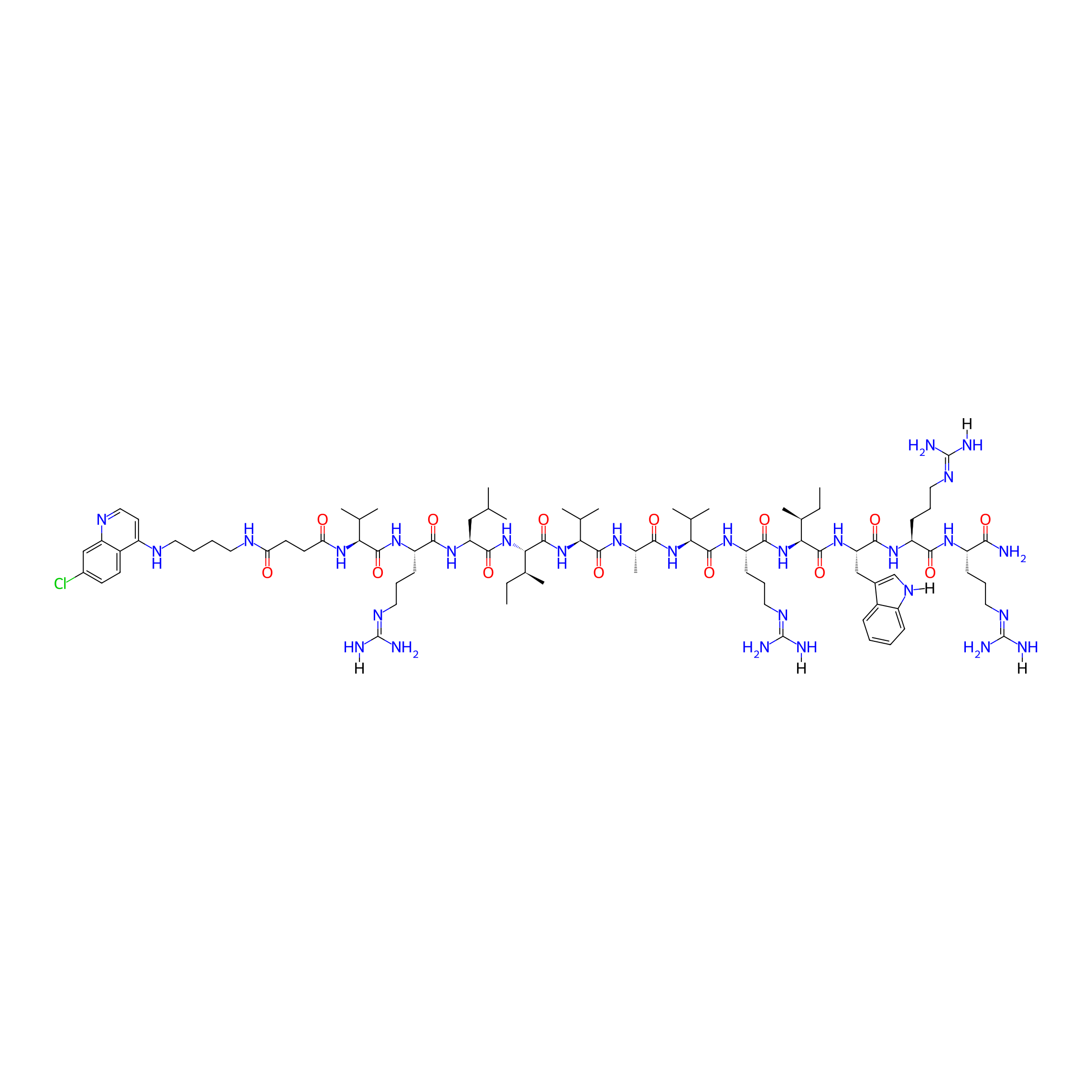
|
|||||
| Peptide Name |
IDR-1018
|
Peptide Info | ||||
| Drug Name |
N1-(7-chloroquinolin-4-yl)butane-1,4-diamine
|
Drug Info | ||||
| Linker Name |
Succinic Acid
|
Linker Info | ||||
| Formula |
C88H144ClN29O14
|
|||||
| #Ro5 Violations (Lipinski): 4 | Molecular Weight | 1867.762 | ||||
| Lipid-water partition coefficient (xlogp) | -0.6558 | |||||
| Hydrogen Bond Donor Count (hbonddonor) | 24 | |||||
| Hydrogen Bond Acceptor Count (hbondacc) | 20 | |||||
| Rotatable Bond Count (rotbonds) | 60 | |||||
Full List of Activity Data of This Peptide-drug Conjugate
Obtained from the Model Organism Data
| Experiment 1 Reporting the Activity Data of This PDC | [1] | ||||
| Indication | Malaria | ||||
| Efficacy Data | Half Maximal Inhibitory Concentration (IC50) | > 10 µM | |||
| MOA of PDC |
The significant increase in the hemolytic activity of TP10 upon conjugation to the 4-aminoquinoline suggests that drug cargo prevents an otherwise active CPP carrier from exerting the desired cell penetrating/antiplasmodial action safely, as it produces conjugates that exert membranolytic activity.
|
||||
| Description |
Only three of the Cq-C4-CPP conjugates, namely, 5a, 5b, and 5g, displayed IC50 values below 10 μM, with TP10- and Transportan-derived conjugates 5a (IC50 = 1.52 μM) and 5b (IC50 = 5.20 μM) being the most active.
|
||||
| In Vivo Model | Plasmodium falciparum W2. | ||||
References