Peptide-drug Conjugate Information
General Information of This Peptide-drug Conjugate (PDC)
| PDC ID |
PDC_00263
|
|||||
|---|---|---|---|---|---|---|
| PDC Name |
P4-Melph-PEG-AuNP
|
|||||
| PDC Status |
Investigative
|
|||||
| Indication |
In total 1 Indication(s)
 Tumor
Tumor
|
|||||
| Structure |
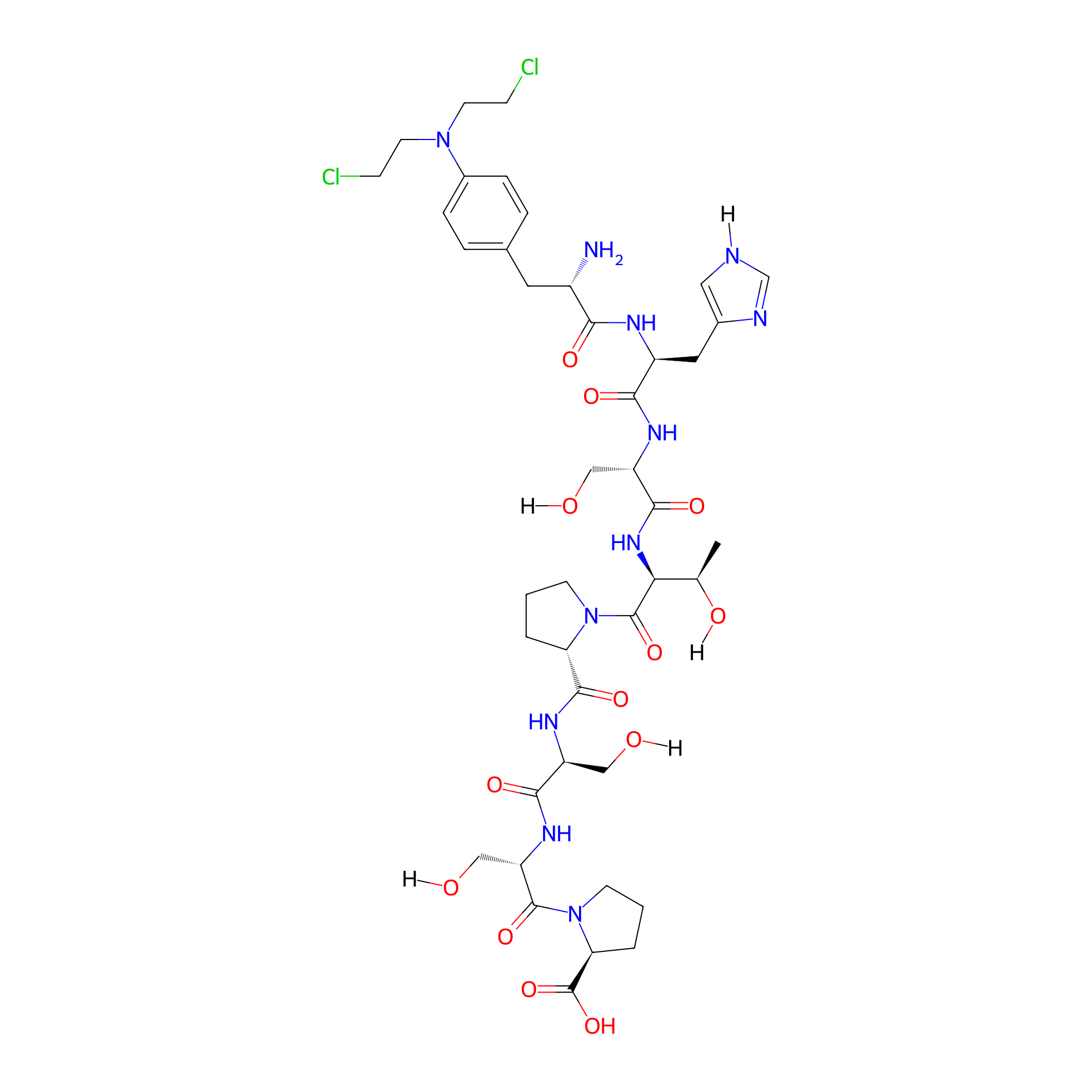
|
|||||
| Peptide Name |
p4
|
Peptide Info | ||||
| Drug Name |
Melphalan
|
Drug Info | ||||
| Therapeutic Target |
Human Deoxyribonucleic acid (hDNA)
|
Target Info | ||||
| Linker Name |
Amide bond
|
Linker Info | ||||
| Peptide Modified Type |
The modification of binding with chemical macromolecules
|
|||||
| Modified Segment |
PEG-AuNP
|
|||||
| Formula |
C42H61Cl2N11O13
|
|||||
| #Ro5 Violations (Lipinski): 5 | Molecular Weight | 998.92 | ||||
| Lipid-water partition coefficient (xlogp) | -4.3455 | |||||
| Hydrogen Bond Donor Count (hbonddonor) | 12 | |||||
| Hydrogen Bond Acceptor Count (hbondacc) | 15 | |||||
| Rotatable Bond Count (rotbonds) | 30 | |||||
Full List of Activity Data of This Peptide-drug Conjugate
Revealed Based on the Cell Line Data
| Experiment 1 Reporting the Activity Data of This PDC | [1] | ||||
| Indication | Tumor | ||||
| Efficacy Data | A20 growth inhibition |
45.00%
|
|||
| Administration Time | 72 h | ||||
| Administration Dosage | 50 µM | ||||
| Evaluation Method | XTT assay | ||||
| Description |
All three P4-PDC-coated gold nanoparticles pre-incubated for 24 or 48 h induced statistically similar cytotoxicity in A20 to that induced by freshly prepared PDC4 and to coated particles without pre-incubation (the latter data not shown).
|
||||
| In Vitro Model | Mouse reticulum cell sarcoma | A20 cell | CVCL_1940 | ||
| Experiment 2 Reporting the Activity Data of This PDC | [1] | ||||
| Indication | Tumor | ||||
| Efficacy Data | A20 growth inhibition |
78.00%
|
|||
| Administration Time | 48 h | ||||
| Administration Dosage | 50 µM | ||||
| Evaluation Method | XTT assay | ||||
| MOA of PDC |
Vitamin C as a water-soluble vitamin is the reduced form of ascorbic acid. No significant adverse effect of taking high doses of vitamin C (over 2000 mg/day) has been reported due to the water-soluble feature of vitamin C. Vitamin C directly reacts with hydroxy, alkoxyl, and lipid peroxyl radicals and converts them to alcohol, water, and hydroperoxide lipid, respectively. It has been shown that taking vitamin C before radioiodine therapy can ameliorate the oxidative stress effect of radioiodine. The radioprotective effects of vitamin C are mainly due to its free radical scavenging activity.
Click to Show/Hide
|
||||
| Description |
All three P4-PDC-coated gold nanoparticles pre-incubated for 24 or 48 h induced statistically similar cytotoxicity in A20 to that induced by freshly prepared PDC4 and to coated particles without pre-incubation (the latter data not shown).
|
||||
| In Vitro Model | Mouse reticulum cell sarcoma | A20 cell | CVCL_1940 | ||
| Experiment 3 Reporting the Activity Data of This PDC | [1] | ||||
| Indication | Tumor | ||||
| Efficacy Data | A20 growth inhibition |
80.00%
|
|||
| Administration Time | 24 h | ||||
| Administration Dosage | 50 µM | ||||
| Evaluation Method | XTT assay | ||||
| Description |
All three P4-PDC-coated gold nanoparticles pre-incubated for 24 or 48 h induced statistically similar cytotoxicity in A20 to that induced by freshly prepared PDC4 and to coated particles without pre-incubation (the latter data not shown).
|
||||
| In Vitro Model | Mouse reticulum cell sarcoma | A20 cell | CVCL_1940 | ||
References