Peptide-drug Conjugate Information
General Information of This Peptide-drug Conjugate (PDC)
| PDC ID |
PDC_00023
|
|||||
|---|---|---|---|---|---|---|
| PDC Name |
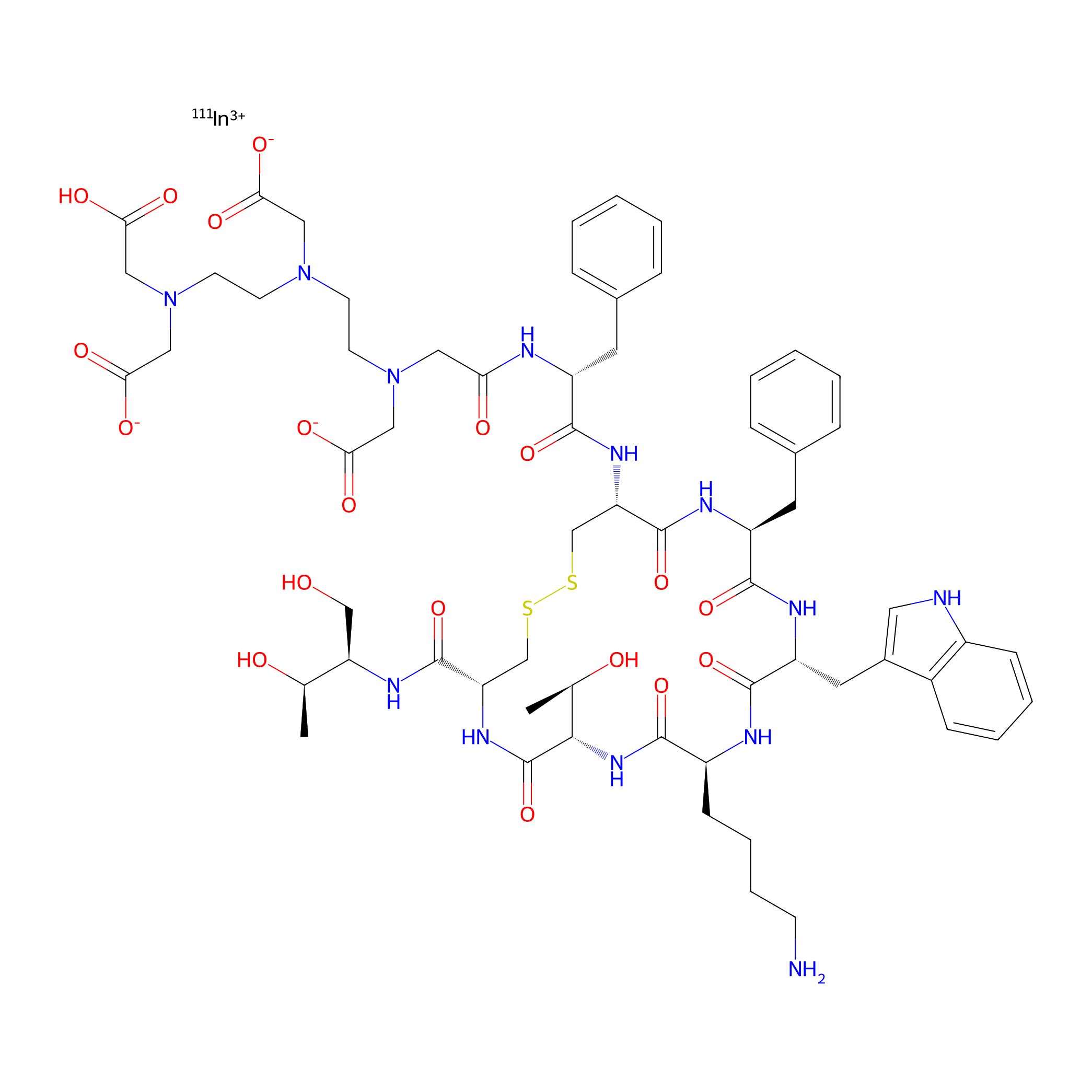
111In-DTPA-octreotide
|
|||||
| Synonyms |
OctreoScan; 111In-DTPA-octreotide; Sdz-215-811; 111In-Pentetreotide; Neuroendomedix; Somatother; SDZ-215811s
Click to Show/Hide
|
|||||
| PDC Status |
Approved
|
|||||
| Indication |
In total 1 Indication(s)
 Digestive system neoplasms
|
|||||
| Structure |
|
|||||
| Peptide Name |
Octreotide
|
Peptide Info | ||||
| Receptor Name |
Somatostatin receptor type 1 (SSTR1)
|
Receptor Info | ||||
| Drug Name |
Indium-111
|
Drug Info | ||||
| Therapeutic Target |
Human Deoxyribonucleic acid (hDNA)
|
Target Info | ||||
| Linker Name |
Amide bond
|
Linker Info | ||||
| Peptide Modified Type |
Amino acid modifications; Cyclization modification
|
|||||
| Modified Segment |
D-amino acids
|
|||||
| Ternimal Modification |
N-terminal modification
|
|||||
| Drugbank ID | ||||||
| ChEBI ID | ||||||
| Formula |
C63H84InN13O19S2
|
|||||
| #Ro5 Violations (Lipinski): 4 | Molecular Weight (mw) | 1502.5 | ||||
| Lipid-water partition coefficient (xlogp) | Not Available | |||||
| Hydrogen Bond Donor Count (hbonddonor) | 14 | |||||
| Hydrogen Bond Acceptor Count (hbondacc) | 25 | |||||
| Rotatable Bond Count (rotbonds) | 31 | |||||
Full List of Activity Data of This Peptide-drug Conjugate
Obtained from the Model Organism Data
| Experiment 1 Reporting the Activity Data of This PDC | [1] | ||||
| Indication | Digestive system neoplasms | ||||
| Efficacy Data | Tumor cell uptake rate |
47%
|
|||
| Administration Time | 4 h | ||||
| Administration Dosage | 10 nM | ||||
| MOA of PDC |
In our previous study, d-Phe at position 1 in 111In-DTPA-d-Phe1-octreotide was replaced with Asp to minimize the change in molecular size. While the Phe3D-Trp4Lys5Thr6 sequence in octreotide is important for binding to the somatostatin receptor, the majority of octreotide derivatives with high somatostatin receptor affinity possess an N-terminal amino acid with an aromatic side chain, such as d-Phe or naphthylalanine. With these findings in mind, we designed, synthesized and evaluated not only the previously reported 111In-DTPA-Asp1-octreotide but also 111In-DTPA-Asp0-d-Phe1-octreotide, in which an Asp was incorporated between DTPA and N-terminal d-Phe in 111In-DTPA-d-Phe1-octreotide.
Click to Show/Hide
|
||||
| Description |
Figure 3 shows the results of cellular uptake experiments. When incubated with111In-DTPA-Asp1-octreotide, the uptake levels of radioactivity by AR42J cells were extremely low compared with those for111In-DTPA-d-Phe1-octreotide. In contrast, the uptake levels of111In-DTPA-Asp0-d-Phe1-octreotide increased in a time-dependent manner. The uptake levels of111In-DTPA-Asp0-d-Phe1-octreotide were not significantly different from those for111In-DTPA-d-Phe1-octreotide at 4h. For 111In-DTPA-Asp0-d-Phe1-octreotide, cell uptake experiments were conducted in the presence of varying concentrations of an unmodified octreotide. In Figure 4, uptake levels are shown as a percentage of the radioactivity level in the absence of the unmodified octreotide. The uptake levels of 111In-DTPA-Asp0-d-Phe1-octreotide were reduced in association with the concentration of the unmodified octreotide. The radioactivity uptake level was reduced by approximately 90% at 1 M concentration of the octreotide.
Click to Show/Hide
|
||||
| In Vivo Model | AR42J tumor-bearing mice model. | ||||
References